
Transformation and Decomposition for Efficiently Implementing and
Improving Dependency-to-String Model In Moses
Liangyou Li†, Jun Xie‡, Andy Way†and Qun Liu†‡
†CNGL Centre for Global Intelligent Content, School of Computing Dublin City University, Dublin 9, Ireland
‡Key Laboratory of Intelligent Information Processing, Institute of Computing Technology Chinese Academy of Sciences, Beijing, China
{liangyouli,away,qliu}@computing.dcu.ie [email protected]
Abstract
Dependency structure provides grammat-ical relations between words, which have shown to be effective in Statistical Ma-chine Translation (SMT). In this paper, we present an open source module in Moses which implements a dependency-to-string model. We propose a method to trans-form the input dependency tree into a cor-responding constituent tree for reusing the tree-based decoder in Moses. In our ex-periments, this method achieves compara-ble results with the standard model. Fur-thermore, we enrich this model via the decomposition of dependency structure, including extracting rules from the sub-structures of the dependency tree during training and creating a pseudo-forest in-stead of the tree per se as the input dur-ing decoddur-ing. Large-scale experiments on Chinese–English and German–English tasks show that the decomposition ap-proach improves the baseline dependency-to-string model significantly. Our sys-tem achieves comparable results with the state-of-the-art hierarchical phrase-based model (HPB). Finally, when resorting to phrasal rules, the dependency-to-string model performs significantly better than Moses HPB.
1 Introduction
Dependency structure models relations between words in a sentence. Such relations indicate the syntactic function of one word to another word. As dependency structure directly encodes
semantic information and has the best inter-lingual phrasal cohesion properties (Fox, 2002), it is be-lieved to be helpful to translation.
In recent years, dependency structure has been widely used in SMT. For example, Shen et al. (2010) present a string-to-dependency model by using the dependency fragments of the neighbour-ing words on the target side, which makes it easier to integrate a dependency language model. How-ever such string-to-tree systems run slowly in cu-bic time (Huang et al., 2006).
Another example is the treelet approach (Menezes and Quirk, 2005; Quirk et al., 2005), which uses dependency structure on the source side. Xiong et al. (2007) extend the treelet ap-proach to allow dependency fragments with gaps. As the treelet is defined as an arbitrary connected sub-graph, typically both substitution and inser-tion operainser-tions are adopted for decoding. How-ever, as translation rules based on the treelets do not encode enough reordering information di-rectly, another heuristic or separate reordering model is usually needed to decide the best target position of the inserted words.
Different from these works, Xie et al. (2011) present a dependency-to-string (Dep2Str) model, which extracts head-dependent (HD) rules from word-aligned source dependency trees and target strings. As this model specifies reordering infor-mation in the HD rules, during translation only the substitution operation is needed, because words are reordered simultaneously with the rule being applied. Meng et al. (2013) and Xie et al. (2014) extend the model by augmenting HD rules with the help of either constituent tree or fixed/float struc-ture (Shen et al., 2010). Augmented rules are cre-ated by the combination of two or more nodes in
the HD fragment, and are capable of capturing translations of non-syntactic phrases. However, the decoder needs to be changed correspondingly to handle these rules.
Attracted by the simplicity of the Dep2Str model, in this paper we describe an easy way to integrate the model into the popular translation framework Moses (Koehn et al., 2007). In or-der to share the same decoor-der with the conven-tional syntax-based model, we present an algo-rithm which transforms a dependency tree into a corresponding constituent tree which encodes de-pendency information in its non-leaf nodes and is compatible with the Dep2Str model. In addition, we present a method to decompose a dependency structure (HD fragment) into smaller parts which enrich translation rules and also allow us to cre-ate a pseudo-forest as the input. “Pseudo” means the forest is not obtained by combining several trees from a parser, but rather that it is created based on the decomposition of an HD fragment. Large-scale experiments on Chinese–English and German–English tasks show that the transforma-tion and decompositransforma-tion are effective for transla-tion.
In the remainder of the paper, we first describe the Dep2Str model (Section 2). Then we describe how to transform a dependency tree into a con-stituent tree which is compatible with the Dep2Str model (Section 3). The idea of decomposition in-cluding extracting sub-structural rules and creat-ing a pseudo-forest is presented in Section 4. Then experiments are conducted to compare translation results of our approach with the state-of-the-art HPB model (Section 5). We conclude in Section 6 and present avenues for future work.
2 Dependency-to-String Model
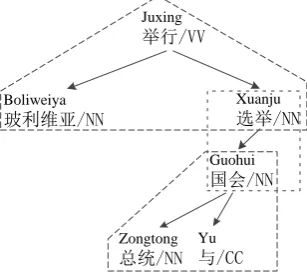
In the Dep2Str model (Xie et al., 2011), the HD fragment is the basic unit. As shown in Figure 1, in a dependency tree, each non-leaf node is the head of some other nodes (dependents), so an HD fragment is composed of a head node and all of its dependents.1
In this model, there are two kinds of rules for translation. One is the head rule which specifies the translation of a source word:
Juxing
举行→holds
1In this paper, HD fragment of a node means the HD frag-ment with this node as the head. Leaf nodes have no HD fragments.
Boliweiya 玻利维亚/NN
Juxing 举行/VV
Zongtong 总统/NN
Yu 与/CC
Guohui 国会/NN
[image:2.595.339.493.66.202.2]Xuanju 选举/NN
Figure 1: Example of a dependency tree, with head-dependent fragments being indicated by dot-ted lines.
The other one is the HD rule which consists of three parts: the HD fragment s of the source side (maybe containing variables), a target string
t (maybe containing variables) and a one-to-one mappingφfrom variables insto variables int, as in:
s=(玻Boliweiya利维亚) 举Juxing行 (x1:
Xuanju
选举 )
t=Bolivia holdsx1
φ={x1 :
Xuanju
选举→x1}
where the underlined element denotes the leaf node. Variables in the Dep2Str model are con-strained either by words (likex1:选举) or
Part-of-Speech (POS) tags (likex1:NN).
Given a source sentence with a dependency tree, a target string and the word alignment between the source and target sentences, this model first an-notates each nodeN with two annotations: head span and dependency span.2 These two spans
specify the corresponding target position of a node (by the head span) or sub-tree (by the depen-dency span). After annotation, acceptable HD fragments3 are utilized to induce lexicalized HD
2Some definitions: Closureclos(S)of setSis the small-est superset ofSin which the elements (integers) are contin-uous. LetHbe the set of indexes of target words aligned to nodeN. Head spanhsp(N)of nodeN isclos(H). Head spanhsp(N)isconsistentif it does not overlap with head span of any other node. Dependency spandsp(N)of node N is the union of allconsistenthead spans in the subtree rooted atN.
Boliweiya Juxing Xuanju
Rule: (玻利维亚) 举行 (x1:选举) Bolivia holds x1
Xuanju
Rule: (x1:NN) 选举 x1 elections
Guohui
Rule: 国会 parliament Zongtong Yu Guohui
Rule: (总统) (与) x1:国会 presidential and x1
Boliweiya
玻利维亚/NN
Juxing
举行/VV
Zongtong
总统/NN
Yu
与/CC
Guohui
国会/NN
Xuanju
选举/NN
Zongtong
总统/NN
Yu
与/CC
Guohui
国会/NN Bolivia holds elections Bolivia holds
Zongtong
总统/NN
Yu
与/CC
Guohui
国会/NN
Xuanju
选举/NN
Bolivia holds presidential and parliament elections Bolivia holds presidential and
Guohui
国会/NN elections (a)
(b)
(c)
(d)
[image:3.595.79.282.59.349.2](e)
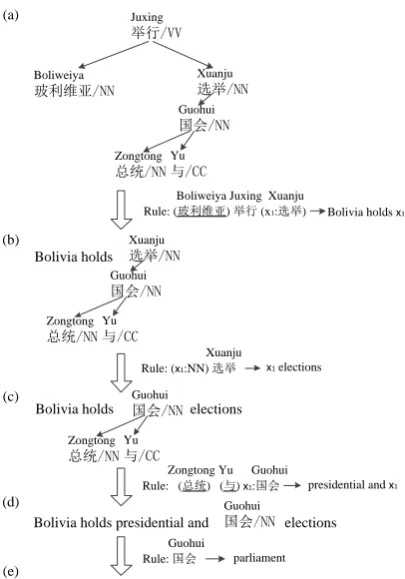
Figure 2: Example of a derivation. Underlined el-ements indicate leaf nodes.
rules (the head node and leaf node are represented by words, while the internal nodes are replaced by variables constrained by word) and unlexicalized HD rules (nodes are replaced by variables con-strained by POS tags).
In HD rules, an internal node denotes the whole sub-tree and is always a substitution site. The head node and leaf nodes can be represented by either words or variables. The target side corresponding to an HD fragment and the mapping between vari-ables are determined by the head span of the head node and the dependency spans of the dependents. A translation can be obtained by applying rules to the input dependency tree. Figure 2 shows a derivation for translating a Chinese sentence into an English string. The derivation proceeds from top to bottom. Variables in the higher-level HD rules are substituted by the translations of lower HD rules recursively.
The final translation is obtained by finding the best derivation d∗ from all possible derivations Dwhich convert the source dependency structure into a target string, as in Equation (1):
d∗= argmax
d∈D p(d)≈argmaxd∈D Y
i
φi(d)λi (1)
whereφi(d)is theith feature defined in the
deriva-tiond, andλi is the weight of the feature.
3 Transformation of Dependency Trees
In this section, we introduce an algorithm to trans-form a dependency tree into a corresponding con-stituent tree, where words of the source sentence are leaf nodes and internal nodes are labelled with head words or POS tags which are constrained by dependency information. Such a transformation makes it possible to use the traditional tree-based decoder to translate a dependency tree, so we can easily integrate the Dep2Str model into the popu-lar framework Moses.
In a tree-based system, the CYK algorithm (Kasami, 1965; Younger, 1967; Cocke and Schwartz, 1970) is usually employed to translate the input sentence with a tree structure. Each time a continuous sequence of words (a phrase) in the source sentence is translated. Larger phrases can be translated by combining translations of smaller phrases.
In a constituent tree, the source words are leaf nodes and all non-leaf nodes covering a phrase are labelled with categories which are usually vari-ables defined in the tree-based model. For trans-lating a phrase covered by a non-leaf node, the de-coder for the constituent tree can easily find ap-plied rules by directly matching variables in these rules to tree nodes. However, in a dependency tree, each internal node represents a word of the source sentence. Variables covering a phrase cannot be recognized directly. Therefore, to share the same decoder with the constituent tree, the dependency tree needs to be transformed into a constituent-style tree.
As we described in Section 2, each variable in the Dep2Str model represents a word (for the head and leaf node) or a sequence of continuous words (for the internal node). Thus it is intuitive to use these variables to label non-leaf nodes of the pro-duced constituent tree. Furthermore, in order to preserve the dependency information of each HD fragment, the created constituent node needs to be constrained by the dependency information in the HD fragment.
Algorithm 1Algorithm for transforming a depen-dency tree to constituent tree. Dnode means node in dependency tree. Cnode means node in con-stituent tree.
functionCNODE(label,span)
create a new CnodeCN CN.label←label CN.span←span end function
functionTRANSFNODE(DnodeH) pos←POS ofH
constrainpos .with H0, like: NN:H0
CNODE(label,H.position) foreach dependentN ofHdo
pos←POS ofN word←word ofN
constrainpos .with Lior Ri, like: NN:R1
constrainword .with Lior Ri ifN is leafthen
CNODE(pos,N.position) else
CNODE(word,H.span)
CNODE(pos,H.span)
TRANSFNODE(N) end if
end for end function
leaf nodes and internal nodes are dependents of the head node. For the leaf node and head node, we create constituent nodes that just cover one word. For an internal node N, we create con-stituent nodes that cover all the words in the sub-tree rooted at N. In Algorithm 1, N.position
means the position of the word represented by the nodeN. N.span denotes indexes of words cov-ered by the sub-tree rooted at nodeN.
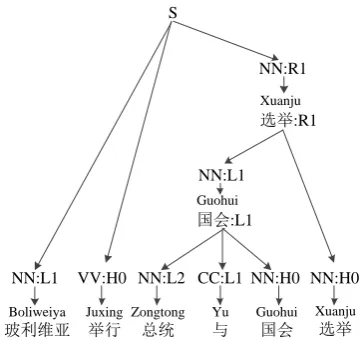
Taking the dependency tree in Figure 1 as an example, its transformation result for integration with Moses is shown in Figure 3. In the Dep2Str model, leaf nodes can be replaced by a vari-able constrained by its POS tag, so for leaf node “Zongtong总统 ” in HD fragment “Zongtong(总统) (与Yu)Guohui国会”,
we create a constituent node “NN:L2”, where “NN” is the POS tag and “L2” denotes that the leaf node is the second left dependent of the head node. For the internal node “Guohui国会” in the HD fragment “(Guohui国会)Xuanju选举”, we create two constituent nodes
Boliweiya
玻利维亚
Juxing
举行
Zongtong
总统
Yu
与
Guohui
国会
Xuanju
选举
NN:L1 VV:H0 NN:L2 CC:L1NN:H0 NN:H0
NN:L1 NN:R1 S
Guohui
国会:L1
Xuanju
[image:4.595.325.507.60.230.2]选举:R1
Figure 3: The corresponding constituent tree af-ter transforming the dependency tree in Figure 1. Note in our implementation, we do not distinguish the leaf node and internal node of a dependency tree in the produced constituent tree and induced rules.
which cover all words in the dependency sub-tree rooted at this node, with one of them labelled by the word itself. Both nodes are constrained by de-pendency information “L1”. After such a transfor-mation is conducted on each HD fragment recur-sively, we obtain a constituent tree.
This transformation makes our implementation of the Dep2Str model easier, because we can use the tree-to-string decoder in Moses. All we need to do is to write a new rule extractor which extracts head rules and HD rules (see Section 2) from the word-aligned source dependency trees and target strings, and represents these rules in the format de-fined in Moses.4
Note that while this conversion is performed on an input dependency tree during decoding, the training part, including extracting rules and cal-culating translation probabilities, does not change, so the model is still a dependency-to-string model.
4Taking the rule in Section 2 as an example, its represen-tation in Moses is:
s=玻利Boliweiya维亚举Juxing行 [Xuanju选举:R1][X] [H1]
t=Bolivia holds[Xuanju选举:R1][X] [X] φ={2→2}
In addition, our transformation is different from other works which transform a dependency tree into a constituent tree (Collins et al., 1999; Xia and Palmer, 2001). In this paper, the produced con-stituent tree still preserves dependency relations between words, and the phrasal structure is di-rectly derived from the dependency structure with-out refinement. Accordingly, the constituent tree may not be a linguistically well-formed syntactic structure. However, it is not a problem for our model, because in this paper what matters is the dependency structure which has already been en-coded into the (ill-formed) constituent tree.
4 Decomposition of Dependency Structure
The Dep2Str model treats a whole HD fragment as the basic unit, which may result in a sparse-data problem. For example, an HD fragment with a verb as head typically consists of more than four nodes (Xie et al., 2011). Thus in this section, in-spired by the treelet approach, we describe a de-composition method to make use of smaller frag-ments.
In an HD fragment of a dependency tree, the head determines the semantic category, while the dependent gives the semantic specification (Zwicky, 1985; Hudson, 1990). Accordingly, it is reasonable to assume that in an HD fragment, dependents could be removed or new dependents could be attached as needed. Thus, in this paper, we assume that a large HD fragment is formed by attaching dependents to a small HD fragment. For simplicity and reuse of the decoder, such an at-tachment is carried out in one step. This means that an HD fragment is decomposed into two smaller parts in a possible decomposition. This decomposition can be formulated as Equation (2):
Li· · ·L1HR1· · ·Rj
=Lm· · ·L1HR1· · ·Rn
+Li· · ·Lm+1HRn+1· · ·Rj
subject to
i≥0, j ≥0
i≥m≥0, j ≥n≥0 i+j > m+n >0
(2)
whereHdenotes the head node,Lidenotes theith
left dependent andRj denotes thejth right
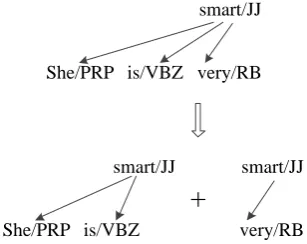
depen-dent. Figure 4 shows an example.
smart/JJ
very/RB She/PRP
smart/JJ
is/VBZ She/PRP
smart/JJ
is/VBZ very/RB
[image:5.595.338.492.63.185.2]+
Figure 4: An example of decomposition on a head-dependent fragment.
Algorithm 2Algorithm for the decomposition of an HD fragment into two sub-fragments. Index of nodes in a fragment starts from 0.
functionDECOMP(HD fragmentfrag) fset← {}
len←number of nodes infrag hidx←the index of head node infrag fors= 0 tohidxdo
fore=hidxtolen−1do if0< e−s < len−1then
create sub-fragmentcore core←nodes fromstoe
addcoretofset
create sub-fragmentshell
initializeshellwith head node
shell←nodes not incore
addshelltofset end if
end for end for end function
Such a decomposition of an HD fragment en-ables us to create translation rules extracted from sub-structures and create a pseudo-forest from the input dependency tree to make better use of smaller rules.
4.1 Sub-structural Rules
In the Dep2Str model, rules are extracted on an entire HD fragment. In this paper, when the decomposition is considered, we also extract structural rules by taking each possible sub-fragment as a new HD sub-fragment. The algorithm for recognizing the sub-fragments is shown in Al-gorithm 2.
decom-positions of an HD fragment. Each decom-position produces two sub-fragments: core and
shell. Bothcoreandshellinclude the head node.
corecontains the dependents surrounding the head node, with the remaining dependents belonging to
shell. Taking Figure 4 as an example, the bottom-right part is core, while the bottom-left part is
shell. Each core and shell could be seen as a new HD fragment. Then HD rules are extracted as defined in the Dep2Str model.
Note that different from the augmented HD rules, where Meng et al. (2013) annotate rules with combined variables and Xie et al. (2014) create special rules from HD rules at runtime by com-bining several nodes, our sub-structural rules are standard HD rules, which are extracted from the connected sub-structures of a larger HD fragment and can be used directly in the model.
4.2 Pseudo-Forest
Although sub-structural rules are effective in our experiments (see Section 5), we still do not use them to their best advantage, because we only en-rich smaller rules in our model. During decod-ing, for a large input HD fragment, the model is still more likely to resort to glue rules. However, the idea of decomposition allows us to create a pseudo-forest directly from the dependency tree to alleviate this problem to some extent.
As described above, an HD fragment can be seen as being created by combining two smaller fragments. This means, for an HD fragment in the input dependency tree, we can translate one of its sub-fragments first, then obtain the whole trans-lation by combining with transtrans-lations of another sub-fragment. From Algorithm 2, we know that the sub-fragmentcorecovers a continuous phrase of the source sentence. Accordingly, we can trans-late this fragment first and then build the whole translation by translating another sub-fragment
shell. Figure 5 gives an example of translating an HD fragment by combining the translations of its sub-fragments.
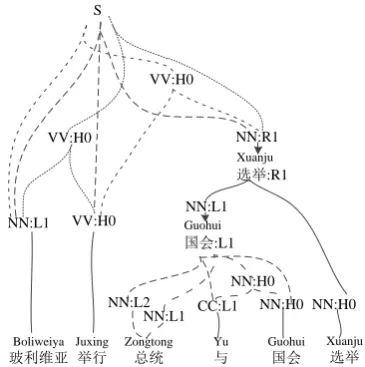
Instead of taking the dependency tree as the in-put and looking for all rules for translating sub-fragments of a whole HD, we directly encode the decomposition into the input dependency tree with the result being a pseudo-forest. Based on the transformation algorithm in Section 3, the pseudo-forest can also be represented in the constituent-tree style, as shown in Figure 6.
Yu Guohui
Rule: (与) 国会 and parliment
Zongtong
总统/NN
Yu
与/CC
Guohui
国会/NN
Zongtong
Rule: (总统) x1:NN presidential x1
presidential and parliament Zongtong
总统 and parliament Guohui
国会/NN
(a)
(b)
[image:6.595.325.506.62.204.2](c)
Figure 5: An example of translating a large HD fragment with the help of translations of its de-composed fragments.
S
NN:L1 VV:H0
NN:L2 CC:L1 NN:H0 NN:H0 NN:R1
Xuanju
选举:R1
NN:L1
Guohui
国会:L1
Boliweiya
玻利维亚
Juxing
举行
Zongtong
总统
Yu
与
Guohui
国会
Xuanju
选举 NN:L1
NN:H0 VV:H0
VV:H0
Figure 6: An example of a pseudo-forest for the dependency tree in Figure 1. It is represented us-ing the constituent-tree style described in Section 3. Edges drawn in the same type of line are owned by the same sub-tree. Solid lines are shared edges.
In the pseudo-forest, we actually only create a forest structure for each HD fragment. For ex-ample, based on Figure 5, we create a constituent node labelled with “NN:H0” that covers the sub-fragment “(与Yu)Guohui国会”. In so doing, a new node la-belled with “NN:L1” is also created, which covers the Node “Zongtong总统 ”, because it is now the first left
dependent in the sub-fragment “Zongtong(总统)Guohui国会”.
[image:6.595.323.506.282.466.2]corpus sentences words(ch) words(en) train 1,501,652 38,388,118 44,901,788
dev 878 22,655 26,905
[image:7.595.71.293.61.136.2]MT04 1,597 43,719 52,705 MT05 1,082 29,880 35,326
Table 1: Chinese–English corpus. For the English dev and test sets, words counts are averaged across 4 references.
corpus sentences words(de) words(en) train 2,037,209 52,671,991 55,023,999 dev 3,003 72,661 74,753 test12 3,003 72,603 72,988 test13 3,000 63,412 64,810
Table 2: German–English corpus. In the dev and test sets, there is only one English reference for each German sentence.
5 Experiments
We conduct large-scale experiments to exam-ine our methods on the Chexam-inese–English and German–English translation tasks.
5.1 Data
The Chinese–English training corpus is from the LDC data, including LDC2002E18, LDC2003E07, LDC2003E14, LDC2004T07, the Hansards portion of LDC2004T08 and LDC2005T06. We take NIST 2002 as the de-velopment set to tune weights, and NIST 2004 (MT04) and NIST 2005 (MT05) as the test data to evaluate the systems. Table 1 provides a summary of the Chinese–English corpus.
The German–English training corpus is from WMT 2014, including Europarl V7 and News Commentary. News-test 2011 is taken as the de-velopment set, while News-test 2012 (test12) and News-test 2013 (test13) are our test sets. Table 2 provides a summary of the German–English cor-pus.
5.2 Baseline
For both language pairs, we filter sentence pairs longer than 80 words and keep the length ratio less than or equal to 3. English sentences are to-kenized with scripts in Moses. Word alignment is performed by GIZA++ (Och and Ney, 2003) with the heuristic functiongrow-diag-final-and(Koehn et al., 2003). We use SRILM (Stolcke, 2002) to
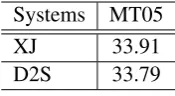
Systems MT05 XJ 33.91 D2S 33.79
Table 3: BLEU score [%] of the Dep2Str model before (XJ) and after (D2S) dependency tree be-ing transformed. Systems are trained on a selected 1.2M Chinese–English corpus.
train a 5-gram language model on the Xinhua por-tion of the English Gigaword corpus 5th edipor-tion with modified Kneser-Ney discounting (Chen and Goodman, 1996). Minimum Error Rate Train-ing (Och, 2003) is used to tune weights. Case-insensitive BLEU (Papineni et al., 2002) is used to evaluate the translation results. Bootstrap resam-pling (Koehn, 2004) is also performed to compute statistical significance with 1000 iterations.
We implement the baseline Dep2Str model in Moses with methods described in this paper, which is denoted asD2S. The first experiment we do is to sanity check our implementation. Thus we take a separate system (denoted as XJ) for comparison which implements the Dep2Str model based on (Xie et al., 2011). As shown in Table 3, using the transformation of dependency trees, the Dep2Str model implemented in Moses (D2S) is comparable with the standard implementation (XJ).
In the rest of this section, we describe exper-iments which compare our system with Moses HPB (default setting), and test whether our de-composition approach improves performance over the baseline D2S.
As described in Section 2, the Dep2Str model only extracts phrase rules for translating a source word (head rule). This model could be enhanced by including phrase rules that cover more than one source word. Thus we also conduct experiments where phrase pairs5are added into our system. We
set the length limit for phrase 7.
5.3 Chinese–English
In the Chinese–English translation task, the Stan-ford Chinese word segmenter (Chang et al., 2008) is used to segment Chinese sentences into words. The Stanford dependency parser (Chang et al., 2009) parses a Chinese sentence into the projec-tive dependency tree.
[image:7.595.372.460.62.110.2]Systems MT04 MT05 Moses HPB 35.56 33.99
D2S 33.93 32.56
[image:8.595.314.519.60.181.2]+pseudo-forest 34.28 34.10 +sub-structural rules 34.78 33.63 +pseudo-forest 35.46 34.13 +phrase 36.76* 34.67*
[image:8.595.81.284.61.165.2]Table 4: BLEU score [%] of our method and Moses HPB on the Chinese–English task. We use bold font to indicate that the result of our method is significantly better than D2S atp ≤0.01level, and * to indicate the result is significantly better than Moses HPB atp≤0.01level.
Table 4 shows the translation results. We find that the decomposition approach proposed in this paper, including sub-structural rules and pseudo-forest, improves the baseline system D2S sig-nificantly (absolute improvement of +1.53/+1.57 (4.5%/4.8%, relative)). As a result, our sys-tem achieves comparable (-0.1/+0.14) results with Moses HPB. After including phrasal rules, our system performs significantly better (absolute im-provement of +1.2/+0.68 (3.4%/2.0%, relative)) than Moses HPB on both test sets.6
5.4 German–English
We tokenize German sentences with scripts in Moses and use mate-tools7 to perform
morpho-logical analysis and parse the sentence (Bohnet, 2010). Then the MaltParser8 converts the parse
result into the projective dependency tree (Nivre and Nilsson, 2005).
Experimental results in Table 5 show that incor-porating sub-structural rules improves the base-line D2S system significantly (absolute improve-ment of +0.47/+0.63, (2.3%/2.8%, relative)), and achieves a slightly better (+0.08) result on test12 than Moses HPB. However, in the German– English task, the pseudo-forest produces a neg-ative effect on the baseline system (-0.07/-0.45), despite the fact that our system combining both methods together is still better (+0.2/+0.11) than the baseline D2S. In the end, by resorting to
6In our preliminary experiments, phrasal rules are also able to significantly improve our system on their own on both Chinese–English and German–English tasks, but the best per-formance is achieved by combining them with sub-structural rules and/or pseudo-forest.
7http://code.google.com/p/mate-tools/ 8http://www.maltparser.org/
Systems test12 test13 Moses HPB 20.44 22.77
D2S 20.05 22.13
+pseudo-forest 19.98 21.68 +sub-structural rules 20.52 22.76 +phrase 20.91* 23.46* +pseudo-forest 20.25 22.24
+phrase 20.75* 23.20*
Table 5: BLEU score [%] of our method and Moses HPB on German–English task. We use bold font to indicate that the result of our method is significantly better than baseline D2S at p ≤
0.01 level, and * to indicate the result is signifi-cantly better than Moses HPB atp≤0.01level.
Systems CE task DE task# Rules
Moses HPB 388M 684M
D2S 27M 41M
+sub-structural rules 116M 121M
+phrase 215M 274M
Table 6: The number of rules in different sys-tems On the Chinese–English (CE) and German– English (DE) corpus. Note that pseudo-forest (not listed) does not influence the number of rules.
phrasal rules, our system achieves the best perfor-mance overall which is significantly better (abso-lute improvement of +0.47/+0.59 (2.3%/2.6%, rel-ative)) than Moses HPB.
5.5 Discussion
Besides long-distance reordering (Xie et al., 2011), another attraction of the Dep2Str model is its simplicity. It can perform fast translation with fewer rules than HPB. Table 6 shows the number of rules in each system. It is easy to see that all of our systems use fewer rules than HPB. However, the number of rules is not proportional to transla-tion quality, as shown in Tables 4 and 5.
Experiments on the Chinese–English corpus show that it is feasible to translate the dependency tree via transformation for the Dep2Str model de-scribed in Section 2. Such a transformation causes the model to be easily integrated into Moses with-out making changes to the decoder, while at the same time producing comparable results with the standard implementation (shown in Table 3).
[image:8.595.310.524.282.372.2]paper also shows a positive effect on the base-line Dep2Str system. Especially, sub-structural rules significantly improve the Dep2Str model on both Chinese–English and German–English tasks. However, experiments show that the pseudo-forest significantly improves the D2S system on the Chinese–English data, while it causes translation quality to decline on the German–English data.
Since using the pseudo-forest in our system is aimed at translating larger HD fragments via split-ting it into pieces, we hypothesize that when trans-lating German sentences, the pseudo-forest ap-proach more likely results in much worse rules be-ing applied. This is probably due to the shorter Mean Dependency Distance (MDD) and freer word order of German sentences(Eppler, 2013).
6 Conclusion
In this paper, we present an open source mod-ule which integrates a dependency-to-string model into Moses.
This module transforms an input depen-dency tree into a corresponding constituent tree during decoding which makes Moses perform dependency-based translation without necessitat-ing any changes to the decoder. Experiments on Chinese–English show that the performance if our system is comparable with that of the standard dependency-based decoder.
Furthermore, we enhance the model by de-composing head-dependent fragments into smaller pieces. This decomposition enriches the Dep2Str model with more rules during training and allows us to create a pseudo-forest as input instead of a dependency tree during decoding. Large-scale experiments on Chinese–English and German– English tasks show that this decomposition can significantly improve the baseline dependency-to-string model on both language pairs. On the German–English task, sub-structural rules are more useful than the pseudo-forest input. In the end, by resorting to phrasal rules, our system performs significantly better than the hierarchical phrase-based model in Moses.
Our implementation of the dependency-to-string model with methods described in this pa-per is available athttp://computing.dcu. ie/˜liangyouli/dep2str.zip. In the fu-ture, we would like to conduct more experiments on other language pairs to examine this model, as well as reducing the restrictions on
decompo-sition.
Acknowledgments
This research has received funding from the Peo-ple Programme (Marie Curie Actions) of the Eu-ropean Union’s Seventh Framework Programme FP7/2007-2013/ under REA grant agreement no. 317471. This research is also supported by the Science Foundation Ireland (Grant 12/CE/I2267) as part of the Centre for Next Generation Local-isation at Dublin City University. The authors of this paper also thank the reviewers for helping to improve this paper.
References
Bernd Bohnet. 2010. Very High Accuracy and Fast Dependency Parsing is Not a Contradiction. In Pro-ceedings of the 23rd International Conference on Computational Linguistics, pages 89–97, Beijing, China.
Pi-Chuan Chang, Michel Galley, and Christopher D. Manning. 2008. Optimizing Chinese Word Seg-mentation for Machine Translation Performance. In Proceedings of the Third Workshop on Statistical Machine Translation, pages 224–232, Columbus, Ohio.
Pi-Chuan Chang, Huihsin Tseng, Dan Jurafsky, and Christopher D. Manning. 2009. Discriminative Re-ordering with Chinese Grammatical Relations Fea-tures. InProceedings of the Third Workshop on Syn-tax and Structure in Statistical Translation, pages 51–59, Boulder, Colorado.
Stanley F. Chen and Joshua Goodman. 1996. An Empirical Study of Smoothing Techniques for Lan-guage Modeling. InProceedings of the 34th Annual Meeting on Association for Computational Linguis-tics, pages 310–318, Santa Cruz, California. John Cocke and Jacob T. Schwartz. 1970.
Program-ming Languages and Their Compilers: Preliminary Notes. Technical report, Courant Institute of Math-ematical Sciences, New York University, New York, NY.
Michael Collins, Lance Ramshaw, Jan Hajiˇc, and Christoph Tillmann. 1999. A Statistical Parser for Czech. InProceedings of the 37th Annual Meeting of the Association for Computational Linguistics on Computational Linguistics, pages 505–512, College Park, Maryland.
Heidi J. Fox. 2002. Phrasal Cohesion and Statis-tical Machine Translation. In Proceedings of the ACL-02 Conference on Empirical Methods in Nat-ural Language Processing - Volume 10, pages 304– 3111, Philadelphia.
Liang Huang, Kevin Knight, and Aravind Joshi. 2006. A Syntax-directed Translator with Extended Do-main of Locality. In Proceedings of the Workshop on Computationally Hard Problems and Joint Infer-ence in Speech and Language Processing, pages 1– 8, New York City, New York.
Richard Hudson. 1990. English Word Grammar. Blackwell, Oxford, UK.
Tadao Kasami. 1965. An Efficient Recognition and Syntax-Analysis Algorithm for Context-Free Lan-guages. Technical report, Air Force Cambridge Re-search Lab, Bedford, MA.
Philipp Koehn. 2004. Statistical Significance Tests for Machine Translation Evaluation. InProceedings of EMNLP 2004, pages 388–395, Barcelona, Spain, July.
Philipp Koehn, Hieu Hoang, Alexandra Birch, Chris Callison-Burch, Marcello Federico, Nicola Bertoldi, Brooke Cowan, Wade Shen, Christine Moran, Richard Zens, Chris Dyer, Ondˇrej Bojar, Alexandra Constantin, and Evan Herbst. 2007. Moses: Open Source Toolkit for Statistical Machine Translation. In Proceedings of the 45th Annual Meeting of the ACL on Interactive Poster and Demonstration Ses-sions, pages 177–180, Prague, Czech Republic. Philipp Koehn, Franz Josef Och, and Daniel Marcu.
2003. Statistical Phrase-Based Translation. In Pro-ceedings of the 2003 Conference of the North Amer-ican Chapter of the Association for Computational Linguistics on Human Language Technology - Vol-ume 1, pages 48–54, Edmonton, Canada.
Arul Menezes and Chris Quirk. 2005. Dependency Treelet Translation: The Convergence of Statistical and Example-Based Machine-translation? In Pro-ceedings of the Workshop on Example-based Ma-chine Translation at MT Summit X, September. Fandong Meng, Jun Xie, Linfeng Song, Yajuan L¨u,
and Qun Liu. 2013. Translation with Source Con-stituency and Dependency Trees. InProceedings of the 2013 Conference on Empirical Methods in Natu-ral Language Processing, pages 1066–1076, Seattle, Washington, USA, October.
Haitao Mi, Liang Huang, and Qun Liu. 2008. Forest-Based Translation. InProceedings of ACL-08: HLT, pages 192–199, June.
Joakim Nivre and Jens Nilsson. 2005. Pseudo-Projective Dependency Parsing. In Proceedings of the 43rd Annual Meeting on Association for Com-putational Linguistics, pages 99–106, Ann Arbor, Michigan.
Franz Josef Och. 2003. Minimum Error Rate Training in Statistical Machine Translation. InProceedings of the 41st Annual Meeting on Association for Com-putational Linguistics - Volume 1, pages 160–167, Sapporo, Japan.
Franz Josef Och and Hermann Ney. 2003. A System-atic Comparison of Various Statistical Alignment Models. Computational Linguistics, 29(1):19–51, March.
Kishore Papineni, Salim Roukos, Todd Ward, and Wei-Jing Zhu. 2002. BLEU: A Method for Automatic Evaluation of Machine Translation. InProceedings of the 40th Annual Meeting on Association for Com-putational Linguistics, pages 311–318, Philadelphia, Pennsylvania.
Chris Quirk, Arul Menezes, and Colin Cherry. 2005. Dependency Treelet Translation: Syntactically In-formed Phrasal SMT. In Proceedings of the 43rd Annual Meeting of the Association for Computa-tional Linguistics (ACL’05), pages 271–279, Ann Arbor, Michigan, June.
Libin Shen, Jinxi Xu, and Ralph Weischedel. 2010. String-to-Dependency Statistical Machine Transla-tion. Computational Linguistics, 36(4):649–671, December.
Andreas Stolcke. 2002. SRILM-an Extensible Lan-guage Modeling Toolkit. In Proceedings Interna-tional Conference on Spoken Language Processing, pages 257–286, November.
Fei Xia and Martha Palmer. 2001. Converting De-pendency Structures to Phrase Structures. In Pro-ceedings of the First International Conference on Human Language Technology Research, pages 1–5, San Diego.
Jun Xie, Haitao Mi, and Qun Liu. 2011. A Novel Dependency-to-string Model for Statistical Machine Translation. In Proceedings of the Conference on Empirical Methods in Natural Language Process-ing, pages 216–226, Edinburgh, United Kingdom. Jun Xie, Jinan Xu, and Qun Liu. 2014. Augment
Dependency-to-String Translation with Fixed and Floating Structures. InProceedings of the 25th In-ternational Conference on Computational Linguis-tics, pages 2217–2226, Dublin, Ireland.
Deyi Xiong, Qun Liu, and Shouxun Lin. 2007. A De-pendency Treelet String Correspondence Model for Statistical Machine Translation. In Proceedings of the Second Workshop on Statistical Machine Trans-lation, pages 40–47, Prague, June.
Daniel H. Younger. 1967. Recognition and Parsing of Context-Free Languages in Time n3. Information
and Control, 10(2):189–208.
![Table 4: BLEU score [%] of our method andMoses HPB on the Chinese–English task. We useand * to indicate the result is significantly betterthan Moses HPB atbold font to indicate that the result of our methodis significantly better than D2S at p≤.0 01 level, p ≤.0 01 level.](https://thumb-us.123doks.com/thumbv2/123dok_us/1507553.692042/8.595.314.519.60.181/chinese-english-indicate-signicantly-betterthan-indicate-methodis-signicantly.webp)
