Content Analysis of Museum Documentation with a Transdisciplinary
Perspective
G ¨unther Goerz, Martin Scholz
University of Erlangen-Nuremberg, Computer Science Department (8)
Erlangen, Germany
[email protected]
Abstract
In many cases, museum documentation consists of semi-structured data records with free text fields, which usually refer to contents of other fields, in the same data record, as well as in others. Most of these references comprise of person and place names, as well as time specifica-tions. It is, therefore, important to rec-ognize those in the first place. We report on techniques and results of partial pars-ing in an ongopars-ing project, uspars-ing a large database on German goldsmith art. The texts are encoded according to the TEI guidelines and expanded by structured de-scriptions of named entities and time spec-ifications. These are building blocks for event descriptions, at which the next step is aiming. The identification of named en-tities allows the data to be linked with var-ious resources within the domain of cul-tural heritage and beyond. For the latter case, we refer to a biological database and present a solution in a transdisciplinary perspective by means of the CIDOC Con-ceptual Reference Model (CRM).
1
Specific Goals of Content Analysis
When we speak of museum documentation, we address a wide variety of document types. First of all, there are acquisition and inventory lists or index cards, which contain more or less detailed records of museum objects. Often these are ac-companied by photographs, restoration records, and further archival records. If curators prepare exhibitions, usually they provide catalogs by com-piling data from sources, such as those just men-tioned, and by contributing short articles on the ex-hibits. Last but not least there are scholarly mono-graphs on museum objects.
With the introduction of information technol-ogy in museums and cultural heritage institu-tions, such records have been stored in (relational) database systems and content management sys-tems. At the beginning — with the exception of bibliographic records — there were no meta-data standards at all in the museum world. Since the 1990s, many metadata schemata have been proposed for the field of cultural heritage, some with very detailed classification features for spe-cific object types1. There is still an active dis-cussion about metadata schemata and their stan-dardisation, as can be seen with recent proposals for CDWA Lite, museumdat and their combination (Stein and Coburn, 2008).
Today, access to museum documentation via the World Wide Web has become a matter of course, in particular, if the documentation has been the result of publicly funded research projects. Nat-urally, printed editions are still a very important medium of publication. However, in many cases the data are too voluminous, which means only abridged versions are published in print, while the full data are available only in digital form. Web access allows many means to retrieve and print the data, with very little cost involved. Us-ing controlled language defined in terminologies and formal ontologies, different forms of “intelli-gent search” come within reach as well as inter-active evaluation and visualisation methods. But it is not only access to the data alone; interactiv-ity opens up possibilites for Wiki-style annotation and scholarly communication, as well as forums for the general public. Furthermore, the technol-ogy provides methods to link the data with other resources, e.g. authority files containing biograph-ical or geographbiograph-ical data.
1
A common situation in museum documenta-tion is characterized by the fact that it is cen-tered around museum objects, i.e. there is a database system or content management system, which contains structured descriptions of museum objects and further information about their cre-ators, provenance, use, and so forth, according to given descriptive and administrative metadata schemata. Besides fields in such data records en-forcing (more or less strictly defined) data types, e.g. for inventory numbers, there are free text fields which contain important background infor-mation about persons, objects, materials, stylistic festures, etc. without any further tagging. Ba-sically, the free text fields are open for any kind of information which cannot be expressed in the strictly defined parts of the schema. Therefore, overall, the given data records at best provide a semi-structured representation.
The free text fields and their relations to other fields, in particular, indicate a clear need for con-tent analysis. Firstly, named entitities must be identified, in particular person and geographic place names. For instance, there may be a data field for the creator of a work of art and another one for the place where this work was created, ad-ditionally one or more free text fields which talk about the artist’s family relations, when he came to the mentioned place and how long he stayed there, etc. As this example indicates, at least a second type of linguistic expressions, time specifications in a variety of forms, ought to be recognized. In the future, we would like to identify event descrip-tions and how they are related among each other, for which the recognition of named entitites and time specifications is a first step.
In the following sections we describe our ap-proach to address these problems. The next sec-tion outlines characteristic features of the data with a reflection on their typicality. Section three is the central technical part presenting the shallow text analysis techniques we use — word class tag-ging, recognition of temporal specifications, place and person names — and the utilization of name authorities for lexical and semantic enrichment. In the fourth section we show how the results achieved so far can be used to construct event-based shallow semantic representations related to the CIDOC CRM. Furthermore, the CRM is also the key to transdisciplinary approaches in museum documentation as outlined in the final section with
an example between biology and cultural history.
2
Characteristics of the Data
We are working2with data which resulted from a project on goldsmith art in Nuremberg, executed at the German National Museum, providing de-scriptions of more than 6700 objects, 2290 artists, many locations, etc. Furthermore, with the mu-seum’s content management system we can access many more data records on sculptures and paint-ings — with a particular emphasis on the work of Albrecht D¨urer — up to 1800. The latter corpora were accessed primarily to verify the general use-fulness of the approach that will be presented in the following sections.
For many projects in the field of cultural her-itage in Germany, a condition for public fund-ing has been to use the MIDAS3 data schema (Heusinger, 1989) in combination with a spe-cific database implementation (HiDA). MIDAS defines a framework of record types with appro-priate properties for terms (thesauri), time, place, artists, other persons and organizations, objects, content and signs, events, sources, and adminis-trative data. The goal of MIDAS was to establish a de facto standard based on the current documen-tation practice in museums. Depending on what is to be documented, the appropriate record types can be selected. HiDA is a data administration sys-tem, which provides a graphical user interface for data input, editing, and search; it stores the records not in a database system, but in a system of files, one for each type, in a proprietary format. For this reason and problems in handling the user in-terface, many HiDA-encoded data are now being converted to an XML representation. For the free texts, we decided to follow the encoding rules of the Text Encoding Initiative (TEI) (Ide and Vero-nis, 1995)4for text bodies.
The actual encoding of the XML-transformed data sets is still very close to HiDA as far as the “classes” and properties are concerned. Cur-rently, the data are in the process of being trans-formed to the emerging museumdat/CDWA Lite
2Research project “WissKI — Wissenschaftliche
Kom-munikationsInfrastruktur”; funding provided by the German Research Council (DFG)
3Acronym for “Marburger Informations-,
Dokumentations- und Administrations-System”, not to be confused with the MIDAS heritage standard in the UK.
4
standard (Stein and Coburn, 2008)5, which in turn is compatible with CIDOC’s Conceptual Refer-ence Model (Doerr, 2003)6. The CRM is the for-mal reference ontology, which defines the con-ceptual background for the semantic representa-tions resulting from content analysis. We refer to the CRM as a formally defined reference ontology because with the “Erlangen CRM”7 we provided is a description logic version of the latest stan-dard (ISO 21127:2009), implemented in OWL-DL (Goerz et al., 2008).
As for the content of the free text fields, the texts contain well-formed sentences in the linguistic sense, although in some cases, one can find elliptic formulations in telegraphic style. In most cases, the texts refer to defined data record fields (per-sons, creatorship, object properties, bibliographic data), providing additional information, for which there is no other place in the schema. A great deal of the texts talk about family and other relations between persons, about creatorship, techniques, actions of the mentioned persons other than the creation of the artwork, and the general cultural context. As in early modern German there is a great orthographic variation even in writing per-son and place names, many of the texts suggest disambiguations of different kinds. Nevertheless, there are still many writing variants of named en-tities. Furthermore, many texts contain quotations from reference works, some of which are too old to obey the actual orthographic standards.
It is important to notice that the actual data we have to deal with are nevertheless a typical ex-ample of the state of the art of documentation in many cultural heritage institutions. Hence, the techniques of content analysis and annotation pre-sented in the following will be of a general utility in many similar projects.
3
Content Analysis: Shallow Parsing and
Semantic Representation
The texts contained in the free text fields are en-coded with the TEI Lite tag set, supplemented by
5cf. slide set by Georg Hohmann: http:
//www8.informatik.uni-erlangen.de/IMMD8/ Services/transdisc/cidoc2008_hohmann.pdf ; visited 03.12.2008
6
The actual version of the ISO standard and a lot of accompanying materials can be retrieved from http:// cidoc.ics.forth.gr/; visited 03.12.2008.
7http://www8.informatik.uni-erlangen.
de/IMMD8/Services/cidoc-crm/ ; visited 05.02. 2009
tags of the modulenamesdatesfor person and place names. For processing, all texts in the free text fields of a MIDAS file — e.g., the “object” file containing all object descriptions in the “database” — are merged in a single multi-text TEI file. Each text from a data field is represented as a<text>
element where the text proper without further an-notations is contained in its subordinate<body>
element. The association between the TEI text el-ements and the orginal MIDAS data fields is as-sured by unique XML identifiers in xml:id at-tributes. The “raw” text data are transformed au-tomatically into the initial TEI representation in a rather straightforward way by a script. No further internal structuring is provided at this stage; anno-tations are added by subsequent processing steps.
Shallow parsing for place names and time spec-ifications is based on sets of chunk rules imple-mented with the Definite Clause Grammar (DCG) formalism8which are executed by Prolog. There are grammars for person and place names and for time specifications; these sets of grammar rules define three partial “parsers”. For the three parsers there is only one pass, and there is in principle no restriction on the order in which they are applied. The parsing results of each of the parsers are rep-resented as feature structures, which are then con-verted to TEI tags and inserted into the file by a separate software component. At this stage, there is no recognition and resolution of anaphoric ref-erences, such as pronouns. In a second and inde-pendent pass, a lookup of person and place names in Name Authority files is executed and the results are collected in local files. There is no filtering ap-plied to the lookup because, at this point, no spe-cial knowledge about these resources is available.
3.1 Tagging
First of all, the texts encoded conforming to the TEI guidelines are annotated with word class tags and lemmata (base forms) by a POS tagger. Lem-matisation is very useful in languages with a rich inflectional system, such as German. For POS tag-ging, we use the Stuttgart TreeTagger9 with the STTS tagset which provides categories for Ger-man words and delimiters.
8
based on previous work by (Tantzen, 2004).
9Institute for Automatic Language Processing of the
The resulting TEI tags express morphosyntac-tic descriptions. Of parmorphosyntac-ticular interest are the tags
<w> for encoding words and <c> for individ-ual punctuation marks which are very well suited for encoding tokens: Both can accept an attribute
typefor the determination of the word or charac-ter class. Lemmata are encoded with the attribute
lemma.
3.2 Time Specifications
The “temporal” grammar/parser recognizes a broad variety of temporal expressions built up from days, weeks, months, seasons of the year, years, decades, and centuries.10 Time specifica-tions may be given as absolute or relative.
Absolute time specifications describe unique time points or intervals on the time line, such as calendar dates (e.g. 28. August 1749) and open or closed time spans (e.g. bis 1832, up to 1832). Fur-thermore, modifying particles are recognized, e.g. Mitte 1749 (midyear 1749) or Ende M¨arz 1832 (end of March 1832).
To determine the missing data in relative time specifications, such as drei Wochen sp¨ater (three weeks later), a kind of anaphoric resolution method is applied. Therefore, we keep track of all occurences of temporal expressions. For reso-lution, we choose the most recently mentioned at the appropriate level (day, month, year).
3.3 Places
The normal case of place specifications in the goldsmith corpus consists of a geographic place name or a preposition followed by a place name. In some cases there are also enumerations of place names. We distinguish between a named entity and the corresponding linguistic phrase. Named entities are looked up in a local dictionary which is built from entries in Name Authorities.
Before lexical lookup, a procedure is executed which prevents the annotation of lower case words as named entities. It implements the simple heuristics that — even composite — named en-tities are designated by words beginning with a capital letter, but not each word beginning with a capital letter is a named entity as in English. In German, a noun must be written with its first letter in upper case.
Each named entity is associated with one out of ten geographical types to avoid aggregations of
10
The actual text corpus does not contain time of day ex-pressions.
incompatible types as in die St¨adte M¨unchen und Berlin und Finnland (the cities Munich, Berlin and Finland). On the other hand, certain words such as city, town, settlement, etc. are associated with such a type (“city”) to be used as a constraint on subsequent proper nouns.
3.4 Persons
Parsing of person names is much more difficult be-cause they are more complex and there is a con-siderably larger variation than with place names. Whereas, usually, composite place names are lex-icalized, this is not a real option for person names. Every person in German speaking countries has at least one first and one surname, optionally amended by further forenames, appellations of no-bility or ancestry or generation. We do not regard titles and forms of address such as K¨onig (king) or Herr (Mister) as parts of names — in spite of the fact that according to German law the title of Doktor (doctor) is a part of the name.
For name parsing, the constituents of names are divided into four categories: forenames, surnames, copula, and generation appellations. The class of copula subsumes many particles which serve as predicates of nobility or ancestry, e.g. von, van der or French/Spanish/Italian de la. The category of generation appellations contains words and num-berings to distinguish persons with the same name, e.g. Karl V., Albrecht D¨urer der ¨Altere.
There are several sources of ambiguities with person names the grammar has to deal with, as well w.r.t. the correct interpretation of their parts as regarding their reference:
• Persons are often referenced not by their full name, but only by their first or surname.
• Many first names may also occur as sur-names.
• Many surnames are also names of profes-sions or places.
• There are several standards of equal range for the ordering of name parts.
• The use of a comma to separate surname and first name can be confused with an enumera-tion and vice versa.
small and have been assembled manually. For first and surnames, several name lists were com-piled into one dictionary file from lists available via Name Authorities and also from the WWW.
To recognize person names containing very rare first and surnames, as well as writing variants which are not contained in the lexicon, we use a system of syntactic and semantic cues — based on statistical analyses of the texts — which indicate the occurence of a name at a specific location (cf. table).
syntax of the trigger Example
profession name Goldschmied Samuel Klemm appellation name Frau Martha
[image:5.595.307.487.62.245.2]preposition relation name mit Meister Silvester possessive pron. rel. name Seine Tochter Katharina relationdes/dername Tochter des Christian Mahler relationvonname Sohn von Peter v. Quickelberg relation:name Lehrling: Lang, Joh. Christoph
Table 1: Rules for person name triggers. Words to be in-serted for profession, appellation and relation are taken from hand-made lexica.
Statistical analysis of the goldsmith corpus has given clear evidence for three groups of words whose occurrence indicates an immediate follow-ing person name: Appellations of professions, ap-pellations plus titles, and relations between per-sons. A relation between persons is regarded as a cue only if certain particles occur immediately be-fore or after it. The word sequence “Tochter von” (daughter of) is a good example of such a cue for a subsequent person name.
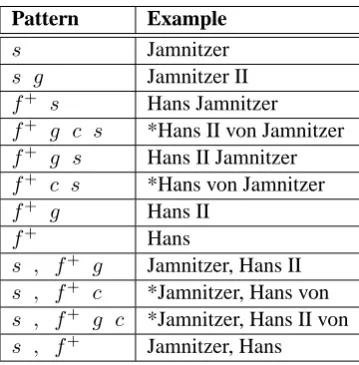
In a first step, the name parts and the cues are labelled separately. In a second pass, whenever a cue or a name part is encountered, an algorithm to assemble the parts into complete person names is run. It tries to match the current word sequence with different patterns of name parts which con-stitute valid person names, i.e. it applies different finite state machines11to the word sequence. The longest sequence recognized by a finite state ma-chine is assumed to be a name (see Table 2).
3.5 Name Authorities
To achieve a normalization of appellations, per-son and place names are looked up in name au-thorities. There are several authorities, none of which can claim completeness, and each has its
11Finite State Machines are formal automata which
recog-nize regular expression patterns; i.e., both notions are equiv-alent.
Pattern Example
s Jamnitzer
s g Jamnitzer II f+ s Hans Jamnitzer f+ g c s *Hans II von Jamnitzer f+ g s Hans II Jamnitzer f+ c s *Hans von Jamnitzer f+ g Hans II
f+ Hans
s , f+ g Jamnitzer, Hans II s , f+ c *Jamnitzer, Hans von s , f+ g c *Jamnitzer, Hans II von s , f+ Jamnitzer, Hans
Table 2:Recognized name patterns with examples showing the name of the goldsmith “Hans II Jamnitzer”.sstands for surname,ffor forename,cfor copula andgfor generation particle. The ‘+’ sign expresses one or more occurences; the asterisk indicates that the name has been modified to fit the pattern with “von”.
strengths and weaknesses. Up to now, we have used the following interfaces — however, fur-ther interfaces are in preparation: BGN: Board on Geographic Names (German places File)12, Diskus “Geographie-Datei” (distributed with MI-DAS)13, Orbis Latinus (Graesse)14, Getty TGN (Thesaurus of Geographic Names)15, PKNAD (Person Names) by prometheus e.V.16, and Getty ULAN (United List of Artist Names)17
There are two modes of use for name authorities in the process of named entity recognition:
1. Decision making: The data are used as dic-tionaries for the person name and place name parsers.
2. Enrichment with metadata in a second phase once the named entities are identified.
As there are not yet unique formats and
inter-12http://earth-info.nga.mil/gns/html/
namefiles.htm; visited 17.12.2008 13http://museum.zib.de/
museumsvokabular/index.php?main=download ; visited 17.12.2008
14http://www.columbia.edu/acis/ets/
Graesse/contents.html; visited 17.12.2008 15http://www.getty.edu/research/
conducting_research/vocabularies/tgn/ ; visited 17.12.2008
16http://www.prometheus-bildarchiv.
de/index.php?id=56\&L=0\&skin=0 ; visited 17.12.2008
17http://www.getty.edu/research/
[image:5.595.77.302.222.310.2]faces for the mentioned name authorities, we im-plemented a querying interface for each name au-thority in both modes with the exception of the Getty vocabularies. These are not used directly as dictionaries, but only for metadata enrichment, because the data must be retrieved place by place from individual web pages due to the lack of an appropriate API.
3.5.1 Name Authorities as Dictionaries
Name authorities can be directly accessed through the dictionary interfaces of the place and person name parsers. To accelerate the search for entries, the retrieved data are stored in local dictionary files, one for each name authority. The dictionary files can be generated either during the recognition process or off-line. To keep the local data up to date, the generation process should to be repeated from time to time, at least for some of the men-tioned resources.
3.5.2 Name Authorities for Metadata Harvesting
Metadata harvesting has been implemented as a separate process; it consists of the search for anno-tations of named entities in the TEI files, of query-ing name authorities and collectquery-ing the metadata through special interfaces, encoding in an appro-priate format and storing in local files. We do not rank name authorities and the content of the meta-data; its structure and degree of detail are taken as retrieved. However, with each data set the list of IDs of the tagged findings in the TEI file is stored.
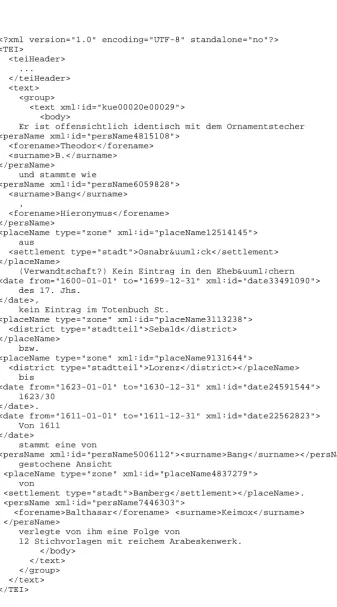
3.6 TEI-Encoding of Named Entities
Temporal expressions are encoded with the
<date>tag. For the attributes, the distinction be-tween time spans and time points is represented by the attributesfromandto, or the attributewhen, resp.
The tag <placeName> is used to anno-tate place expressions as a whole. To label the named entities contained within, the TEI modulenamesdates provides six tags accord-ing to its geographical type: <district>,
<settlement>, <region>, <country>,
<bloc> und <geogName>; for some of them there may be a refinement by means of the ten ge-ographic types mentioned in 3.3 with the attribute
type.
For person names, the TEI tag<persName>
and several subtags are defined, among which
<surname>,<forename>,<nameLink>and
<genName>correspond exactly to the name parts presented above.
3.7 Evaluation Results
The three partial parsers are executed in sequential order. The best results were obtained in the order time – person – place:
On the goldsmith corpus with a test set of about 2000 word types, a precision of 81.8% and a recall of 72.6% was achieved with the described level of granularity, i.e., accounting for the distinction of first and last names and geographic types.
If these distinctions are dropped, as in many other systems, precision increases to 83.0% and recall to 82.6%.
A separate evaluation of the parsers (in paren-theses: with distinctions) showed for
• time: precision 89.0% and recall 92.1%,
• person: precision 74.4% (71.6%) and recall 87.0% (75.5%),
• place: precision 78.9% (69.1%) and recall 76.9% (71.7%),
Depending on the choice of name authorities used for lexicon generation, and due to a high de-gree of ambiguity, too many words may be clas-sified as place names. For this reason, BGN has been left out, because it led to a considerable de-crease of precision and a slight inde-crease of recall.
4
Building Blocks for Event Recognition
particu-<?xml version="1.0" encoding="UTF-8" standalone="no"?> <TEI>
<teiHeader> ...
</teiHeader> <text>
<group>
<text xml:id="kue00020e00029"> <body>
Er ist offensichtlich identisch mit dem Ornamentstecher <persName xml:id="persName4815108">
<forename>Theodor</forename> <surname>B.</surname>
</persName>
und stammte wie
<persName xml:id="persName6059828"> <surname>Bang</surname>
,
<forename>Hieronymus</forename> </persName>
<placeName type="zone" xml:id="placeName12514145"> aus
<settlement type="stadt">Osnabrück</settlement> </placeName>
(Verwandtschaft?) Kein Eintrag in den Ehebüchern <date from="1600-01-01" to="1699-12-31" xml:id="date33491090">
des 17. Jhs. </date>,
kein Eintrag im Totenbuch St.
<placeName type="zone" xml:id="placeName3113238"> <district type="stadtteil">Sebald</district> </placeName>
bzw.
<placeName type="zone" xml:id="placeName9131644">
<district type="stadtteil">Lorenz</district></placeName> bis
<date from="1623-01-01" to="1630-12-31" xml:id="date24591544"> 1623/30
</date>.
<date from="1611-01-01" to="1611-12-31" xml:id="date22562823"> Von 1611
</date>
stammt eine von
<persName xml:id="persName5006112"><surname>Bang</surname></persName> gestochene Ansicht
<placeName type="zone" xml:id="placeName4837279"> von
<settlement type="stadt">Bamberg</settlement></placeName>. <persName xml:id="persName7446303">
<forename>Balthasar</forename> <surname>Keimox</surname> </persName>
verlegte von ihm eine Folge von
12 Stichvorlagen mit reichem Arabeskenwerk. </body>
[image:7.595.133.471.75.683.2]</text> </group> </text> </TEI>
lar in combination with text mining.18In previous work (Fischer et al., 1996; B¨ucher et al., 2002), we augmented a chart-based chunk parser with an in-cremental construction procedure for (partial) Dis-course Representation Structures (DRSs). DRSs are semantic representations which contain a list of discourse referents, introduced by named enti-ties or definite noun phrases, and a body, which consists of a possibly complex logical form repre-senting the meaning of the given part of speech19. For events, we use a neo-Davidsonian represen-tation, i.e., the corresponding verb is a one-place predicate whose argument is a discourse referent representing an event, conjoined with binary re-lations for the thematic roles. For example, the sentence “Albrecht D¨urer painted a self-portrait in 1500 in Nuremberg” would get a semantic rep-resentation in which — extremely simplified — e would be the discourse referent for the event, paint(e) the representation of the event, and ac-tor(e,a), object(e,s), time(e,1500), etc. constitute the body, whereaandsare the discourse referents for the artist and the self-portrait, resp. DRSs are reaching beyond sentence limits and can in prin-ciple be combined into larger and larger discourse structures. Therefore, they are appropriate repre-sentations on which reference resolution mecha-nisms, such as those described in (Fischer et al., 1996) can be built. In our current work, a cen-tral activity is to port this method and its imple-mentation to the museum docuimple-mentation domain and enrich it by collocational analysis as in (Smith, 2002).
The representation of events is not only an ex-tremely important key to content analysis, but also the pivot which connects various objects, persons, places, with each other, making a variety of con-nections explicit, which are implicitly contained in the data fields and free texts of records of dif-ferent types. It, therefore, becomes an obvious goal to enrich such relational structures with fur-ther information elements from ofur-ther cultural her-itage resources — beyond name authorities. In our particular application, access to Getty’s Art and Architecture Thesaurus (AAT), to other museum and collection databases or online auction cata-logs would be obvious. Unfortunately, many of
18To quote just one prominent example, cf. the TERQAS
(Time and Event Recognition for Question Answering) Symposium, 2002,http://www.timeml.org/site/ terqas/index.html; visited 05.02.2009
19cf. (Kamp and Reyle, 1993)
these resources use idiosyncratic data formats just as MIDAS mentioned above. At best, they refer to a formal representation of their respective do-main, in terms of a so-called “formal domain on-tology”, a representative hierarchical structure of concepts, properties and constraints of the domain. However, to satisfy the desideratum of linking di-verse data collections, an intermediate level of in-teroperability is required. A well proven approach for such information integration tasks is to link the different domain ontologies to a generic reference ontology, which contains just the fundamental and most general concepts and properties for a wide variety of applications. In fact, for the field of cultural heritage, CIDOC’s Conceptual Reference Model (CRM) is such a reference ontology. It is worthwhile to notice that, among other things, the CRM emphasizes the event-driven perspective, in fact, events are the glue in CRM which connects all documentation elements. As a first step, we have already implemented a generator for CRM instances from TEI-conformant texts with named entity annotations.
5
Transdisciplinary Aspects
match-ing task will fail. At this point in time, we can only provide a sketch in terms of an example how we would approach this challenge. But it seems ob-vious if we could find a general way to connect to different description systems, we would approach the long-term goal of an “epistemic web”.
Recent efforts showed that there is in fact a way to a solution, indicated by the term “trans-disciplinarity”; first results have been presented at the first meeting of the CIDOC working group on “Transdisciplinary Approaches in Documen-tation”20. Originating from philosophy of sci-ence (Mittelstrass, 2002), transdisciplinarity con-centrates on problems, which cannot be solved within a single disciplinary framework. It takes a new view on the unity of science, focussing on scientific rationality, not systems. Taking into ac-count that for all sciences there are common ele-ments in the practice of argumentation and justifi-cation, transdisciplinarity is a research principle in the first place. Its emphasis on rational language use in science offers a clue to the field of docu-mentation; as a starting point, our methodological focus is first of all on data integration . Taking into account that transdisciplinarity addresses the practice of research, this framework should sup-port an action and event perspective on a generic level, i.e. for the tasks of classification, represen-tation, annorepresen-tation, linking, etc.
In fact, we claim that the CIDOC CRM can play the role of such a transdisciplinary framework; at least for the stag beetle on goblets and still life paintings, some other insects and also birds on drawings and paintings, the modelling task has already been performed successfully. For the birds — hooded crows in Dutch winter scenes in Brueghel paintings — our transdisciplinary mod-elling effort provided a nice result for biodiversity research as a side effect: During the “little ice age” hooded crows lived in Western Europe, whereas today they can only be found east of the Elbe river.
Acknowledgments
The authors are grateful for valuable hints and discussions to Siegfried Krause, Georg Hohmann, Karl-Heinz Lampe, and Bernhard Schiemann and to the anonymous reviewers for valuable sugges-tions.
20
at the CIDOC 2008 conference; online materi-als are available via http://www8.informatik. uni-erlangen.de/IMMD8/Services/
transdisc/; visited 03.12.2008.
References
Kerstin B¨ucher, G¨unther Goerz, and Bernd Ludwig. 2002. Corega Tabs: Incremental semantic compo-sition. In G¨unther Goerz and et al., editors, KI-2002 Workshop on Applications of Description Logics, Proceedings, volume 63 of CEUR Workshop Pro-ceedings, Aachen, September. Gesellschaft f¨ur In-formatik e.V.
Martin Doerr. 2003. The CIDOC Conceptual Refer-ence Model: an ontological approach to semantic in-teroperability of metadata. AI Magazine, 24(3):75– 92, September.
Ingrid Fischer, Bernd Geistert, and G¨unther Goerz. 1996. Incremental semantics construction and anaphora resolution using Lambda-DRT. In S. Bot-ley and J. Glass, editors, Proceedings of DAARC-96 — Discourse Anaphora and Anaphor Resolution Colloquium, pages 235–244, Lancaster, July.
G¨unther Goerz, Martin Oischinger, and Bernhard Schiemann. 2008. An Implementation of the CIDOC Conceptual Reference Model (4.2.4) in OWL-DL. In Proceedings of the 2008 Annual Con-ference of CIDOC — The Digital Curation of Cul-tural Heritage, pages 1–14, Athens, Benaki Mu-seum, September 15–18.
Lutz Heusinger. 1989. Marburger Informations-, Dokumentations- und Administrations-System (MI-DAS) / [1,2]. Saur, M¨unchen.
Nancy Ide and Jean Veronis, editors. 1995. Text En-coding Initiative. Background and Context. Kluwer, Dordrecht. Also in: Computers and the Humanities. Vol. 29, No. 1–3 (1995).
Hans Kamp and Uwe Reyle. 1993. From Discourse to Logic. Kluwer, Dordrecht.
J¨urgen Mittelstrass. 2002. Transdisciplinarity — new structures in science. In Innovative Structures in Basic Research. Ringberg-Symposium, 4–7 October 2000, number 5 in Max Planck Forum, pages 43–54, M¨unchen.
David A. Smith. 2002. Detecting events with date and place information in unstructured text. In Pro-ceedings of the 2nd ACM+IEEE Joint Conference on Digital Libraries, pages 191–196, Portland, OR.
Regine Stein and Erin Coburn. 2008. CDWA Lite and museumdat: New developments in metadata standards for cultural heritage information. In Pro-ceedings of the 2008 Annual Conference of CIDOC, Athens, September 15–18.