One distributional memory, many semantic spaces
Marco Baroni
University of Trento Trento, Italy
Alessandro Lenci
University of Pisa Pisa, Italy
Abstract
We propose an approach to corpus-based semantics, inspired by cognitive science, in which different semantic tasks are tack-led using the same underlying reposi-tory of distributional information, col-lected once and for all from the source corpus. Task-specific semantic spaces are then built on demand from the repository. A straightforward implementation of our proposal achieves state-of-the-art perfor-mance on a number of unrelated tasks.
1 Introduction
Corpus-derived distributional semantic spaces have proved valuable in tackling a variety of tasks, ranging from concept categorization to relation ex-traction to many others (Sahlgren, 2006; Turney, 2006; Pad´o and Lapata, 2007). The typical ap-proach in the field has been a “local” one, in which each semantic task (or set of closely related tasks) is treated as a separate problem, that requires its own corpus-derived model and algorithms. Its successes notwithstanding, the “one task – one model” approach has also some drawbacks.
From a cognitive angle, corpus-based models hold promise as simulations of how humans ac-quire and use conceptual and linguistic informa-tion from their environment (Landauer and Du-mais, 1997). However, the common view in cog-nitive (neuro)science is that humans resort to a multipurpose semantic memory, i.e., a database of interconnected concepts and properties (Rogers and McClelland, 2004), adapting the information stored there to the task at hand. From an engineer-ing perspective, goengineer-ing back to the corpus to train a different model for each application is inefficient and it runs the risk of overfitting the model to a specific task, while losing sight of its adaptivity – a highly desirable feature for any intelligent system.
Think, by contrast, of WordNet, a single network of semantic information that has been adapted to all sorts of tasks, many of them certainly not en-visaged by the resource creators.
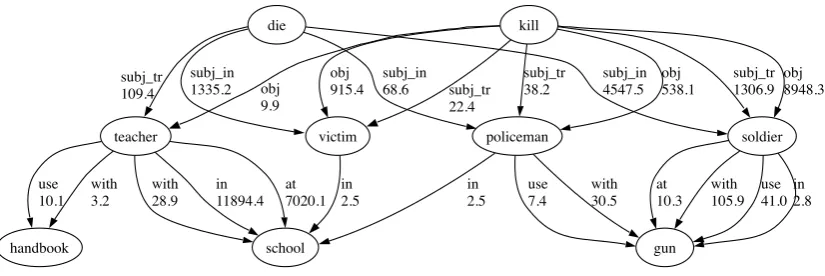
In this paper, we explore a different approach to corpus-based semantics. Our model consists of adistributional semantic memory– a graph of weighted links between concepts - built once and for all from our source corpus. Starting from the tuples that can be extracted from this graph, we derive multiple semantic spaces to solve a wide range of tasks that exemplify various strands of corpus-based semantic research: measuring se-mantic similarity between concepts, concept cate-gorization, selectional preferences, analogy of re-lations between concept pairs, finding pairs that instantiate a target relation and spotting an alterna-tion in verb argument structure. Given a graph like the one in Figure 1 below, adaptation to all these tasks (and many others) can be reduced to two ba-sic operations: 1) building semantic spaces, as co-occurrence matrices defined by choosing different units of the graph as row and column elements; 2) measuring similarity in the resulting matrix ei-ther between specific rows or between a row and an average of rows whose elements share a certain property.
After reviewing some of the most closely re-lated work (Section 2), we introduce our approach (Section 3) and, in Section 4, we proceed to test it in various tasks, showing that its performance is always comparable to that of task-specific meth-ods. Section 5 draws the current conclusions and discusses future directions.
2 Related work
also be used to address the former. Turney tests his system in a variety of tasks, obtaining good results across the board. His approach amounts to pick-ing a task (analogy recognition) and reinterpretpick-ing other tasks as its particular instances. Conversely, we assume that each task may keep its speci-ficity, and unification is achieved by designing a sufficiently general distributional structure, from which semantic spaces can be generated on de-mand. Currently, the only task we share with Tur-ney is finding SAT analogies, where his method outperforms ours by a large margin (cf. Section 4.2.1). However, Turney uses a corpus that is 25 times larger than ours, and introduces nega-tive training examples, whereas we dependency-parse our corpus – thus, performance is not di-rectly comparable. Besides the fact that our ap-proach does not require labeled training data like Turney’s one, it provides, we believe, a more intu-itive measure of taxonomic similarity (taxonomic neighbours are concepts that share similar con-texts, rather than concepts that co-occur with pat-terns indicating a taxonomic relation), and it is better suited to model productive semantic phe-nomena, such as the selectional preferences of verbs with respect to unseen arguments (eating topinamburvs.eating ideas). Such tasks will re-quire an extension of the current framework of Turney (2008) beyond evidence from the direct co-occurrence of target word pairs.
While our unified framework is, as far as we know, novel, the specific ways in which we tackle the different tasks are standard. Concept similar-ity is often measured by vectors of co-occurrence with context words that are typed with dependency information (Lin, 1998; Curran and Moens, 2002). Our approach to selectional preference is nearly identical to the one of Pad´o et al. (2007). We solve SAT analogies with a simplified version of the method of Turney (2006). Detecting whether a pair expresses a target relation by looking at shared connector patterns with model pairs is a common strategy in relation extraction (Pantel and Pennacchiotti, 2008). Finally, our method to de-tect verb slot similarity is analogous to the “slot overlap” of Joanis et al. (2008) and others. Since we aim at a unified approach, the lack of origi-nality of our task-specific methods should be re-garded as a positive fact: our general framework can naturally reproduce, locally, well-tried ad-hoc solutions.
3 Distributional semantic memory
Many different, apparently unrelated, semantic tasks resort to the same underlying information, a “distributional semantic memory” consisting of weighted concept+link+concept tuples extracted from the corpus. The concepts in the tuples are typically content words. Thelinkcontains corpus-derived information about how the two words are connected in context: it could be for example a dependency path or a shallow lexico-syntactic pat-tern. Finally, theweighttypically derives from co-occurrence counts for the elements in a tuple, re-scaled via entropy, mutual information or similar measures. The way in which the tuples are iden-tified and weighted when populating the memory is, of course, of fundamental importance to the quality of the resulting models. However, once the memory has been populated, it can be used to tackle many different tasks, without ever having to go back to the source corpus.
Our approach can be compared with the typical organization of databases, in which multiple alter-native “views” can be obtained from the same un-derlying data structure, to answer different infor-mation needs. The data structure is virtually inde-pendent from the way in which it is accessed. Sim-ilarly, the structure of our repository only obeys to the distributional constraints extracted from the corpus, and it is independent from the ways it will be “queried” to address a specific semantic task. Different tasks can simply be defined by how we split the tuples from the repository into row and column elements of a matrix whose cells are filled by the corresponding weights. Each of these de-rived matrices represents a particularviewof dis-tributional memory: we will discuss some of these views, and the tasks they are appropriate for, in Section 4.
Concretely, we used here the web-derived, 2-billion word ukWaC corpus,1 dependency-parsed with MINIPAR.2 Focusing for now on modeling
noun-to-noun and noun-to-verb connections, we selected the 20,000 most frequent nouns and 5,000 most frequent verbs as target concepts (minus stop lists of very frequent items). We selected as tar-get links the top 30 most frequent direct verb-noun dependency paths (e.g., kill+obj+victim), the top 30 preposition-mediated noun-to-noun or
1
http://wacky.sslmit.unibo.it
2
die
victim subj_in
1335.2
teacher subj_tr 109.4
soldier subj_in
4547.5
policeman subj_in
68.6
school in 2.5
kill
subj_tr 22.4 obj
915.4 obj 9.9
subj_tr 1306.9
obj 8948.3 subj_tr
38.2
obj 538.1
at 7020.1 with
28.9 in 11894.4
handbook with 3.2 use 10.1
gun with 105.9
use 41.0
in 2.8 at
10.3 in
2.5
with 30.5 use
[image:3.595.81.494.63.201.2]7.4
Figure 1: A fragment of distributional memory
verb-to-noun paths (e.g., soldier+with+gun) and the top 50 transitive-verb-mediated noun-to-noun paths (e.g., soldier+use+gun). We extracted all tuples in which a target link connected two target concepts. We computed the weight (strength of association) for all the tuples extracted in this way using the local MI measure (Evert, 2005), that is theoretically justified, easy to compute for triples and robust against overestimation of rare events. Tuples with local MI ≤ 0 were discarded. For each preserved tuplec1 +l+c2, we added a same-weightc1 +l−1 +c2tuple. In graph-theoretical terms (treating concepts as nodes and labeling the weighted edges with links), this means that, for each edge directed fromc1toc2, there is an edge from c2 to c1 with the same weight and inverse label, and that such inverse edges constitute the full set of links directed from c2 toc1. The re-sulting database (DM, forDistributional Memory) contains about 69 million tuples. Figure 1 de-picts a fragment of DM represented as a graph (as-sume, for what we just said, that for each edge from x to y there is a same-weight edge from y
to x with inverse label: e.g., the obj link from killtovictimstands for the tupleskill+obj+victim and victim+obj−1+kill, both with weight 915.4; subj inidentifies the subjects of intransitive con-structions, as in The victim died;subj trrefers to the subjects of transitive sentences, as inThe po-liceman killed the victim).
We also trained 3 closely comparable models that use the same source corpus, the same tar-get concepts (in one case, also the same tartar-get links) and local MI as weighting method, with the same filtering threshold. The myPlain model im-plements a classic “flat” co-occurrence approach (Sahlgren, 2006) in which we keep track of verb-to-noun co-occurrence within a window that can
include, maximally, one intervening noun, and noun-to-noun co-occurrence with no more than 2 intervening nouns. The myHAL model uses the same co-occurrence window, but, like HAL (Lund and Burgess, 1996), treats left and right co-occurrences as distinct features. Finally, myDV uses the same dependency-based target links of DM as filters. Like in the DV model of Pad´o and Lapata (2007), only pairs connected by target links are preserved, but the links themselves are not part of the model. Since none of these alter-native models stores information about the links, they are only appropriate for the concept similar-ity tasks, where links are not necessary.
4 Semantic views and experiments
We now look at three views of the DM graph: concept-by-link+concept (CxLC), concept+concept-by-link (CCxL), and concept+link-by-concept (CLxC). Each view will be tested on one or more semantic tasks and compared with alternative models. There is a fourth possible view, links-by-concept+concept (LxCC), that is not explored here, but would lead to meaningful semantic tasks (finding links that express similar semantic relations).
4.1 The CxLC semantic space
(CxLC) semantic space. From the graph in Fig-ure 1, we can for example construct the matrix in Table 1 (here and below, showing only some rows and columns of interest). By comparing the row vectors of such matrix using standard geo-metrical techniques (e.g., measuring the normal-ized cosine distance), we can find out about con-cepts that tend to share similar properties, i.e., are taxonomically similar (synonyms, antonyms, co-hyponyms), e.g., soldiers and policemen, that both kill, are killed and use guns.
subj in−1subj tr−1 obj−1 with use
die kill kill gun gun
teacher 109.4 0.0 9.9 0.0 0.0
[image:4.595.72.289.221.284.2]victim 1335.2 22.4 915.4 0.0 0.0 soldier 4547.5 1306.9 8948.3 105.9 41.0 policeman 68.6 38.2 538.1 30.5 7.4
Table 1: A fragment of the CxLC space
We use the CxLC space in three taxonomic sim-ilarity tasks: modeling semantic similarity judg-ments, noun categorization and verb selectional restrictions.
4.1.1 Human similarity ratings
We use the dataset of Rubenstein and Goode-nough (1965), consisting of 65 noun pairs rated by 51 subjects on a 0-4 similarity scale (e.g. car-automobile3.9,cord-smile0.0). The average rat-ing for each pair is taken as an estimate of the perceived similarity between the two words. Fol-lowing Pad´o and Lapata (2007), we use Pearson’s
r to evaluate how the distances (cosines) in the CxLC space between the nouns in each pair cor-relate with the ratings. Percentage correlations for DM, our other models and the best absolute re-sult obtained by Pad´o and Lapata (DV+), as well as their best cosine-based performance (cosDV+), are reported in Table 2.
model r model r
myDV 70 DV+ 62
DM 64 myHAL 61
myPlain 63 cosDV+ 47
Table 2: Correlation with similarity ratings
DM is the second-best model, outperformed only by DV when the latter is trained on compara-ble data (myDV in Tacompara-ble 2). Notice that, here and below, we did not try any parameter tuning (e.g., using a similarity measure different than cosine, feature selection, etc.) to improve the performance of DM.
4.1.2 Noun categorization
We use the concrete noun dataset of the ESSLLI 2008 Distributional Semantics shared task,3 in-cluding 44 concrete nouns to be clustered into cog-nitively justified categories of increasing general-ity: 6-way (birds, ground animals, fruits, greens, tools and vehicles), 3-way (animals, plants and artifacts) and 2-way (natural and artificial enti-ties). Following the task guidelines, we clustered the target row vectors in the CxLX matrix with CLUTO,4 using its default settings, and evalu-ated the resulting clusters in terms of cluster-size-weighted averages of purity and entropy (see the CLUTO documentation). An ideal solution would have 100% purity and 0% entropy. Table 3 pro-vides percentage results for our models as well as for the ESSLLI systems that reported all the rel-evant performance measures, indexed by first au-thor. Models are ranked by a global score given by summing the 3 purity values and subtracting the 3 entropies.
model 6-way 3-way 2-way global
P E P E P E
Katrenko 89 13 100 0 80 59 197
Peirsman+ 82 23 84 34 86 55 140
DM 77 24 79 38 59 97 56
myDV 80 28 75 51 61 95 42
myHAL 75 27 68 51 68 89 44
Peirsman− 73 28 71 54 61 96 27
myPlain 70 31 68 60 59 97 9
[image:4.595.305.526.360.469.2]Shaoul 41 77 52 84 55 93 -106
Table 3: Concrete noun categorization
DM outperforms our models trained on com-parable resources. Katrenko’s system queries Google for patterns that cue the category of a con-cept, and thus its performance should rather be seen as an upper bound for distributional models. Peirsman and colleagues report results based on different parameter settings: DM’s performance – not tuned to the task – is worse than their top model, but better than their worse.
4.1.3 Selectional restrictions
In this task we test the ability of the CxLC space to predict verbal selectional restrictions. We use the CxLC matrix to compare a concept to a “proto-type” constructed by averaging a set of other con-cepts, that in this case represent typical fillers of
3
http://wordspace.collocations.de/ doku.php/esslli:start
4http://glaros.dtc.umn.edu/gkhome/
[image:4.595.117.245.591.635.2]a verbal slot – for example, by averaging the vec-tors of the nouns that are, according to the underly-ing graph, objects of killunderly-ing, we can build a vector for the typical “killee”, and model selectional re-strictions by measuring the similarity of other con-cepts (including concon-cepts that have not been seen as objects of killing in the corpus) to this proto-type. Note that the DM graph is used both to find the concepts to enter in the prototype (the set of nouns that are connected to a verb by the relevant edge) and to compute similarity. Thus, the method is fully unsupervised.
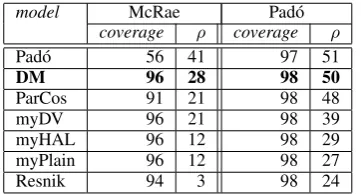
We test on the two datasets of human judgments about the plausibility of nouns as arguments (ei-ther subjects or objects) of verbs used in Pad´o et al. (2007), one (McRae) consisting of 100 noun-verb pairs rated by 36 subjects, the second (Pad´o) with 211 pairs rated by 20 subjects. For each verb in these datasets, we built its prototypical sub-ject/object argument vector by summing the nor-malized vectors of the 50 nouns with the highest weight on the appropriate dependency link to the verb (e.g., the top 50 nouns connected tokillby an objlink). The cosine distance of a noun to a proto-type is taken as the model “plausibility judgment” about the noun occurring as the relevant verb ar-gument. Since we are interested in generalization, if the target noun is in the prototype set we sub-tract its vector from the prototype before calculat-ing the cosine. For our comparison models, there is no way to determine which nouns would form the prototype, and thus we train them using the same top noun lists we employ for DM. Following Pad´o and colleagues, performance is measured by the Spearmanρcorrelation coefficient between the average human ratings and the model predictions. Table 4 reports percentage coverage and correla-tions for our models as well as those in Pad´o et al. (2007) (ParCos is the best among their purely corpus-based systems).
model McRae Pad´o
coverage ρ coverage ρ
Pad´o 56 41 97 51
DM 96 28 98 50
ParCos 91 21 98 48
myDV 96 21 98 39
myHAL 96 12 98 29
myPlain 96 12 98 27
[image:5.595.317.518.374.418.2]Resnik 94 3 98 24
Table 4: Correlation with verb-argument plausibil-ity judgments
DM does very well on this task: its performance on the Pad´o dataset is comparable to that of the Pad´o system, that relies on FrameNet. DM has nearly identical performance to the latter on the Pad´o dataset. On the McRae data, DM has a lower correlation, but much higher coverage. Since we are using a larger corpus than Pad´o et al. (2007), who train on the BNC, a fairer comparison might be the one with our alternative models, that are all outperformed by DM by a large margin.
4.2 The CCxL semantic space
Another view of the DM graph is exemplified in Table 5, where concept pairs are represented in terms of the edge labels (links) connecting them. Importantly, this matrix contains the same infor-mation that was used to build the CxLC space of Table 1, with a different arrangement of what goes in the rows and in the columns, but the same weights in the cells – compare, for example, the soldier+gun-by-withcell in Table 5 to the soldier-by-with+guncell in Table 1.
in at with use
teacher school 11894.47020.1 28.9 0.0 teacher handbook 2.5 0.0 3.2 10.1 soldier gun 2.8 10.3 105.9 41.0 Table 5: A fragment of the CCxL space
We use this space to measure “relational” sim-ilarity (Turney, 2006) of concept pairs, e.g., find-ing that the relation between teachers and hand-books is more similar to the one between soldiers and guns, than to the one between teachers and schools. We also extend relational similarity to prototypes. Given some example pairs instantiat-ing a relation, we can harvest new pairs linked by the same relation by computing the average CCxL vector of the examples, and finding the nearest neighbours to this average. In the case at hand, the link profile of pairs such as soldier+gun and teacher+handbookcould be used to build an “in-strument relation” prototype.
We test the CCxL semantic space on recogniz-ing SAT analogies (relational similarity between pairs) and semantic relation classification (rela-tional similarity to prototypes).
4.2.1 Recognizing SAT analogies
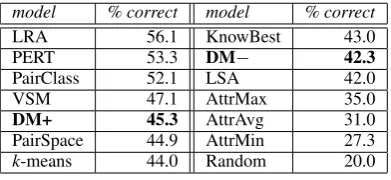
[image:5.595.92.273.627.724.2]the stem (ostrich-bird) , and 5 other pairs (lion-cat, goose-flock, ewe-sheep, cub-bear, primate-monkey). The task is to choose the pair most anal-ogous to the stem. Each SAT pair can be rep-resented by the corresponding row vector in the CCxL matrix, and we select the pair with the high-est cosine to the stem. In Table 6 we report our results, together with the state-of-the-art from the ACL wiki5and the scores of Turney (2008) (Pair-Class) and from Amac¸ Herdaˇgdelen’s PairSpace system, that was trained on ukWaC. The Attr cells summarize the performance of the 6 models on the wiki table that are based on “attributional similar-ity” only (Turney, 2006). For the other systems, see the references on the wiki. Since our coverage is very low (44% of the stems), in order to make a meaningful comparison with the other models, we calculated a corrected score (DM−). Having full access to the results of the ukWaC-trained, simi-larly performing PairSpace system, we calculated the adjusted score by assuming that the DM-to-PairSpace error ratio (estimated on the items we cover) is constant on the whole dataset, and thus the DM hit count on the unseen items is approx-imated by multiplying the PairSpace hit count on the same items by the error ratio (DM+ is DM’s accuracy on the covered test items only).
model % correct model % correct
LRA 56.1 KnowBest 43.0
PERT 53.3 DM− 42.3
PairClass 52.1 LSA 42.0
VSM 47.1 AttrMax 35.0
DM+ 45.3 AttrAvg 31.0
PairSpace 44.9 AttrMin 27.3
[image:6.595.84.280.439.529.2]k-means 44.0 Random 20.0
Table 6: Accuracy with SAT analogies
DM does not excel in this task, but its corrected performance is well above chance and that of all the attributional models, and comparable to that of a WordNet-based system (KnowBest) and a sys-tem that uses manually crafted information about analogy domains (LSA). All systems with perfor-mance above DM+ (andk-means) use corpora that are orders of magnitude larger than ukWaC.
4.2.2 Classifying semantic relations
We also tested the CCxL space on the 7 semantic relations between nominals adopted in Task 4 of SEMEVAL 2007 (Girju et
5http://www.aclweb.org/aclwiki/index.
php?title=SAT_Analogy_Questions
al., 2007): Cause-Effect, Instrument-Agency, Product-Producer, Origin-Entity, Theme-Tool, Part-Whole, Content-Container. For each rela-tion, the dataset includes 140 training examples and about 80 test cases. Each example consists of a small context retrieved from the Web, con-taining word pairs connected by a certain pattern (e..g., “* contains *”). The retrieved contexts were manually classified by the SEMEVAL organizers as positive (e.g., wrist-arm) or negative (e.g., ef-fectiveness-magnesium) instances of a certain re-lation (e.g., Part-Whole). About 50% training and test cases are positive instances. For each rela-tion, we built “hit” and “miss” prototype vectors, by averaging across the vectors of the positive and negative training pairs attested in our CCxL model (we use only the word pairs, not the surround-ing contexts). A test pair is classified as a hit for a certain relation if it is closer to the hit pro-totype vector for that relation than to the corre-sponding miss prototype. We used the SEMEVAL 2007 evaluation method, i.e., precision, recall, F-measure and accuracy, macroaveraged over all re-lations, as reported in Table 7. The DM+ scores ignore the 32% pairs not in our CCxL space; the DM−scores assume random performance on such pairs. These scores give the range within which our performance will lie once we introduce tech-niques to deal with unseen pairs. We also report results of the SEMEVAL systems that did not use the organizer-provided WordNet sense labels nor information about the query used to retrieve the examples, as well as performance of several trivial classifiers, also from the SEMEVAL task descrip-tion.
model precision recall F accuracy
UCD-FC 66.1 66.7 64.8 66.0
UCB 62.7 63.0 62.7 65.4
ILK 60.5 69.5 63.8 63.5
DM+ 60.3 62.6 61.1 63.3
UMELB-B 61.5 55.7 57.8 62.7
SemeEval avg 59.2 58.7 58.0 61.1
DM− 56.7 58.2 57.1 59.0
UTH 56.1 57.1 55.9 58.8
majority 81.3 42.9 30.8 57.0
probmatch 48.5 48.5 48.5 51.7
UC3M 48.2 40.3 43.1 49.9
alltrue 48.5 100.0 64.8 48.5
Table 7: SEMEVAL relation classification
[image:6.595.307.521.549.688.2]the comparable SEMEVAL models. Differently from DM, the models that outperform it use fea-tures extracted from the training contexts and/or specific additional resources: an annotated com-pound database for UCD-FC, machine learning algorithms to train the relation classifiers (ILK, UCD-FC), Web counts (UCB), etc. The less than optimal performance by DM is thus counterbal-anced by its higher “parsimony” and generality.
4.3 The CLxC semantic space
A third view of the information in the DM graph is the concept+link-by-concept(CLxC) semantic space exemplified by the matrix in Table 8.
teacher victim soldier policeman kill subj tr 0.0 22.4 1306.9 38.2 kill obj 9.9 915.4 8948.3 538.1 die subj in 109.4 1335.2 4547.5 68.6 Table 8: A fragment of the CLxC space
This view captures patterns of similarity be-tween (surface approximations to) argument slots of predicative words. We can thus use the CLxC space to extract generalizations about the inner structure of lexico-semantic representations of the sort formal semanticists have traditionally being interested in. In the example, the patterns of co-occurrence suggest that objects of killing are rather similar to subjects of dying, hinting at the classiccause(subj,die(obj)) analysis of killing by Dowty (1977) and many others. Again, no new in-formation has been introduced – the matrix in Ta-ble 8 is yet another re-organization of the data in our graph (compare, for example, thedie+subj in-by-teachercell of this matrix with the teacher-by-subj in+diecell in Table 1).
4.3.1 The causative/inchoative alternation
Syntactic alterations (Levin, 1993) represent a key aspect of the complex constraints that shape the syntax-semantics interface. One of the most important cases of alternation is the causative/inchoative, in which the object argu-ment (e.g., John broke the vase) can also be re-alized as an intransitive subject (e.g., The vase broke). Verbs differ with respect to the possi-ble syntactic alternations they can participate in, and this variation is strongly dependent on their semantic properties (e.g. semantic roles, event type, etc.). For instance, whilebreakcan undergo the causative/inchoative alternation,mincecannot: cf.John minced the meatand*The meat minced.
We test our CLxC semantic space on the discrimination between transitive verbs un-dergoing the causative-inchoative alterna-tions and non-alternating ones. We took 232 causative/inchoative verbs and 170 non-alternating transitive verbs from Levin (1993). For each verb vi, we extracted from the CLxC
matrix the row vectors corresponding to its tran-sitive subject (vi +subj tr), intransitive subject
(vi+subj in), and direct object (vi+obj) slots.
Given the definition of the causative/inchoative alternation, we predict that with alternating verbs
vi + subj in should be similar to vi + obj
(the things that are broken also break), while this should not hold for non-alternating verbs (mincees are very different from mincers).
Our model is completely successful in detect-ing the distinction. The cosine similarity between transitive subject and object slots is fairly low for both classes, as one would expect (medians of0.16
for alternating verbs and0.11 for non-alternating verbs). On the other hand, while for the non-alternating verbs the median cosine similarity be-tween the intransitive subject and object slots is a similarly low0.09, for the alternating verbs the median similarity between these slots jump up to 0.31. Paired t-tests confirm that the per-verb difference between transitive subject vs. object cosines and intransitive subject vs. object cosines is highly statistically significant for the alternating verbs, but not for the non-alternating ones.
5 Conclusion
sim-ilarity tasks. Fortunately, some shortcomings of our current model are obvious and easy to fix. The low coverage is in part due to the fact that our set of target concepts does not contain, by de-sign, some words present in the task sets. More-over, while our framework does not allow ad-hoc optimization of corpus-collection methods for dif-ferent tasks, the way in which the information in the memory graph is adapted to tasks should of course go beyond the nearly baseline approaches we adopted here. In particular, we need to de-velop a backoff strategy for unseen pairs in the relational similarity tasks, that, following Turney (2006), could be based on constructing surrogate pairs of taxonomically similar words found in the CxLC space.
Other tasks should also be explored. Here, we viewed our distributional memory in line with how cognitive scientists look at the semantic memory of healthy adults, i.e., as an essentially stable long term knowledge repository. However, much in-teresting semantic action takes place when under-lying knowledge is adapted to context. We plan to explore how contextual effects can be modeled in our framework, focusing in particular on how composition affects word meaning (Erk and Pad´o, 2008). Similarity could be measured directly on the underlying graph, by relying on graph-based similarity algorithms – an elegant approach that would lead us to an even more unitary view of what distributional semantic memory is and what it does. Alternatively, DM could be represented as a three-mode tensor in the framework of Turney (2007), enabling smoothing operations analogous to singular value decomposition.
Acknowledgments
We thank Ken McRae and Peter Turney for pro-viding data-sets, Amac¸ Herdaˇgdelen for access to his results, Katrin Erk for making us look at DM as a graph, and the reviewers for helpful comments.
References
J. Curran and M. Moens. 2002. Improvements in auto-matic thesaurus extraction. Proceedings of the ACL Workshop on Unsupervised Lexical Acquisition, 59– 66.
D. Dowty. 1977. Word meaning and Montague Gram-mar. Kluwer, Dordrecht.
K. Erk and S. Pad´o. 2008. A structured vector space
model for word meaning in context. Proceedings of EMNLP 2008.
S. Evert. 2005. The statistics of word cooccurrences. Ph.D. dissertation, Stuttgart University, Stuttgart.
R. Girju, P. Nakov, V. Nastase, S. Szpakowicz, P. Tur-ney and Y. Deniz. 2007. SemEval-2007 task 04: Classification of semantic relations between nomi-nals.Proceedings of SemEval-2007, 13–18.
E. Joanis, S. Stevenson and D. James. 2008. A gen-eral feature space for automatic verb classification. Natural Language Engineering, 14(3): 337–367.
T.K. Landauer and S.T. Dumais. 1997. A solution to Plato’s problem: The Latent Semantic Analysis theory of acquisition, induction and representation of knowledge. Psychological Review, 104(2): 211– 240.
B. Levin. 1993. English Verb Classes and Alterna-tions. A Preliminary Investigation. Chicago, Uni-versity of Chicago Press.
D. Lin. 1998. Automatic retrieval and clustering of similar words. Proceedings of ACL 1998, 768–774.
K. Lund and C. Burgess. 1996. Producing high-dimensional semantic spaces from lexical co-occurrence. Behaviour Research Methods, 28: 203– 208.
S. Pad´o and M. Lapata. 2007. Dependency-based con-struction of semantic space models. Computational Linguistics, 33(2): 161–199.
S. Pad´o, S. Pad´o and K. Erk. 2007. Flexible, corpus-based modelling of human plausibility judgements. Proceedings EMNLP 2007, 400–409.
P. Pantel and M. Pennacchiotti. 2008. Automatically harvesting and ontologizing semantic relations. In P. Buitelaar and Ph. Cimiano (eds.),Ontology learn-ing and population. IOS Press, Amsterdam.
T. Rogers and J. McClelland. 2004. Semantic cog-nition: A parallel distributed processing approach. The MIT Press, Cambridge.
H. Rubenstein and J.B. Goodenough. 1965. “Contex-tual correlates of synonymy”. Communications of the ACM, 8(10):627-633.
M. Sahlgren. 2006. The Word-space model. Ph.D. dis-sertation, Stockholm University, Stockholm.
P. Turney. 2006. Similarity of semantic relations. Computational Linguistics, 32(3): 379–416.
P. Turney. 2007. Empirical evaluation of four ten-sor decomposition algorithms.IIT Technical Report ERB-1152, National Research Council of Canada, Ottawa.