Munich Personal RePEc Archive
Expectation-Driven Cycles:
Time-varying Effects
D’Agostino, Antonello and Mendicino, Caterina
European Stability Mechanism, European Central Bank
February 2014
Online at
https://mpra.ub.uni-muenchen.de/53607/
Expectation-Driven Cycles: Time-varying Effects
∗Antonello D’Agostino† Caterina Mendicino‡
February 10, 2014
Abstract
This paper provides new insights into expectation-driven cycles by estimating a structural VAR with time-varying coefficients and stochastic volatility. We use survey-based expectations of the unemployment rate to measure expectations of future developments in economic activ-ity. We find that the effect of expectation shocks on the realized unemployment rate have been particularly large during the most recent recession. Unanticipated changes in expectations con-tributed to the gradual increase in the persistence of the unemployment rate and to the decline in the correlation between the inflation and the unemployment rate over time. Our results are robust to the introduction of financial variables in the model.
JEL classification: C32; E24; E32.
Keywords: Survey Expectations; Economic Fluctuations; Stochastic Volatility; Time Varying Vec-tor AuVec-toregression
∗We are grateful to Agn`es Belaisch, Fabio Canova, Michele Lenza, Giorgio Primiceri and Rolf Strauch for useful
comments and suggestions. The opinions expressed in this article are the sole responsibility of the authors and do not necessarily reflect the position of the Banco de Portugal, the Eurosystem and the European Stability Mechanism.
†European Stability Mechanism, 6a Circuit de la Foire Internationale L-1347 Luxembourg, email:
‡European Central Bank, Directorate General Research, Postfach 160319, D-60066 Frankfurt am Main, Germany;
Introduction
There has historically been a great deal of emphasis on changes in expectations as sources of macroeconomic fluctuations, beginning with Pigou (1927) and Keynes (1936). Yet it is only recently that the business cycle literature revived interest towards the importance of expectation-driven cycles. In an influential paper, Beaudry and Portier (2006) show that changes in expectations that are driven by news about future productivity growth are important sources of macroeconomic fluctuations. Since their contribution, several authors explored the importance of news-driven cycles
in the context of VAR models.1 More recently, changes in expectations of future developments in
economic activity have been measured by directly introducing forward-looking survey data such as consumers’ confidence (Barsky and Sims (2012)) and unemployment expectations (Leduc and Sill (2013)) into otherwise standard VAR models. The advantage of using survey data is that the econometrician does not need to impose any modelling assumptions to back out the expectations of the economic agents.
The aim of this paper is to assess the role of time variation in the macroeconomics effects of changes in expectations. The US economy experienced important changes over the last four decades and most macroeconomic variables exhibited marked time-variation. Several authors have stressed the importance of relaxing the constant parameters assumptions in macroeconomic models
by allowing for time variation.2 With this purpose, we estimate the effects of changes in expectations
on the unemployment rate and other macroeconomic variables using a Time-Varying Coefficients VAR model with Stochastic Volatility (TV-VAR) as in Primiceri (2005). This approach allows for temporal changes in the size and correlation among forecast errors which can be due to changes in the size of exogenous shocks or their impact on macroeconomic variables, i.e. stochastic volatility. Further, it also allows for changes in the transmission of the shocks by means of time-varying coefficients.
The first objective of this paper is to provide new evidence on the quantitative importance of expectation shocks in shaping the dynamics of the unemployment rate and other macroeconomic variables. Following Leduc and Sill (2013) we use unemployment expectations, as compiled by the Survey of Professional Forecasters, to measure expectations of future developments in economic activity. In our baseline model, in addition to expectations, we use the unemployment rate, inflation rate and the short-term interest rate in order to take into account how changes in expectations interact with monetary policy. We aim to quantify the changing role of expectation shocks over time.
1
See Beaudry and Portier (2013) for a complete review of the theoretical and empirical literature on news-shocks-driven cycles.
2
Our results focus on the analysis of the impulse-responses of the endogenous variables to a positive shock to unemployment expectations over time and on the implied variance decomposition, i.e. the percentage of variance explained by such shock. Unanticipated downward revisions to expected unemployment generate a macroeconomic boom coupled with a monetary policy tightening as in Leduc and Sill (2013). Our results improve upon the previous findings in that:
• We detect significant changes in the evolution over time of the dynamic responses of the
en-dogenous variables to shocks to expected future economic activity. In particular, the responses of the unemployment rate increase beginning in the early 2000s and are remarkably larger and more persistent during the most recent recession;
• Expectation shocks account for a sizable fraction of the forecast-error variance of the
endoge-nous variables. The increase in the volatility of the unemployment rate over the second part of the sample can be largely explained by an increase in the variance share of unanticipated changes in expectations.
The second objective of the paper is to explore the impact of expectation shocks on selected key second moments of the unemployment rate and the related implications. Recent empirical evidence highlighted that the last two decades have been characterized by (i) a longer duration of high unemployment rates after the recessions with a consequent slowdown in the labor market
recovery; (ii) a reduced sensitivity of inflation to changes in unemployment.3 We relate our findings
to these two main empirical facts.
We start by investigating how shifts in unemployment expectations affect the persistence of the unemployment rate. Our results highlight differences in the effects of expectation shocks across recessions. In particular, the responses of unemployment are increasingly large and persistent in the post-1990 recessions. Accordingly, unanticipated changes in expectations imply a gradual increase in the persistence of the unemployment rate.
We also explore the role of expectation shocks to study the correlation between the unemploy-ment and the inflation rate. Our results point to a sizable decline in the correlation between inflation and unemployment after a shock to changes in expectations, since early 2000s. This is explained by the different impact that the expectation shock has on the two variables, i.e. larger and more persistent on unemployment, but smaller on inflation.
In addition we present a series of robustness to the inclusion of financial variables in our model. The last two business cycles have also been characterized by coincident booms in economic activity and asset prices, followed by sudden and remarkable falls in asset prices and economic recessions. In particular, during the late 1990s the US economy experienced a dramatic rise in stock prices. Similarly during the mid 2000s house prices displayed a sustained run-up. Both periods of expansion were followed by sudden falls in asset prices and economic downturns. We extend our analysis by
3
including financial variables. We alternatively include in the VAR model stock prices, house prices and credit variables. The key findings of the paper are robust to using a specification which includes financial variables.
The rest of the paper is organized as follows: Section 2 describes the model and Section 3 de-scribes the data used. Section 4 analyzes the time-varying effects of changes in expectations. Section 5 explores the implications of the model for the changing persistence of the unemployment rate and its correlation with the inflation rate. Section 6 shows the results of alternative model specification which include financial variables. Section 7 discusses the results and Section 8 concludes.
The Time-Varying Vector Autoregressive Model
We investigate the effects of innovations to expected changes in the unemployment rate by means of a Time Varying coefficient Vector Autoregression (TV-VAR) with stochastic volatility. The model allows both the autoregressive coefficients and the elements of the innovation covariance matrix to drift over time. This statistical model allows us to investigate weather the link between the expectation shocks and the macroeconomy has been changing over time. The model can be summarized as:
Yt=A0,t+A(L)tYt−1+εt (1)
where Yt is the vector of endogenous variables, A0,t is the vector of time-varying intercepts, A(L)
is a matrix polynomial in the lag operator L of time-varying coefficients, and εt is a vector of
innovations.
LetAt= [A0,t, A1,t, ...Al,t] and θt=vec(A′t), wherevec(·) is the column stacking operator. The
law of motion for θtis assumed to be:
θt=θt−1+ωt,
where ωt is a Gaussian white noise with zero mean and covariance Ω.
The innovations in equation (1) are assumed to Gaussian white noises with zero mean and
time-varying covariance Σt that is factorized as:
Σt=FtDtFt′,
whereFtis lower triangular, with ones on the main diagonal andDta diagonal matrix. Letσtbe the
vector of the diagonal elements ofD1t/2 and the off-diagonal element of the matrixFt−1. We assume
that the standard deviations,σt, evolve as geometric random walks, belonging to the class of models
known as stochastic volatility. The contemporaneous relationshipsφit in each equation of the VAR
are assumed to evolve as an independent random walk, leading to the following specifications:
logσt = logσt−1+ζt
whereζtandϕitare Gaussian white noise with zero mean and covariance Ξ and Ψi, respectively.
We assume that εt, ωt, ζt, and ϕit are mutually uncorrelated at all leads and lags and that ϕit is
independent of ϕjt fori6=j.
Priors Specification
The model is estimated using Bayesian methods. In this section, we briefly discuss the specification of our priors. While the details of the posterior simulation are accurately described in the Appendix. Following Primiceri (2005), we make the following assumptions for the priors densities. First, the coefficients of the covariances of the log volatilities and the hyperparameters are assumed to be
independent of each other. The priors for the initial states, θ0, φ0 and logσ0, are assumed to be
normally distributed. The priors for the hyperparameters, Ω, Ξ and Ψ are assumed to be distributed as independent inverse-Wishart. More precisely, we have the following priors:
• Time varying coefficients: P(θ0) =N(ˆθ,Vˆθ) andP(Ω) =IW(Ω−01, ρ1);
• Diagonal elements: P(logσ0) =N(log ˆσ, In) and P(Ψi) =IW(Ψ−0i1, ρ3i);
• Off-diagonal elements: P(φi0) =N( ˆφi,Vˆφi) andP(Ξ) =IW(Ξ
−1 0 , ρ2);
where the scale matrices are parametrized as follows Ω−01 = λ1ρ1Vˆθ, Ψ0i = λ3iρ3iVˆφi and
Ξ0 = λ2ρ2In. The hyper-parameters are calibrated using a time invariant recursive VAR
esti-mated using a sub-sample consisting of the first T0 = 40 observations. For the initial states θ0
and the contemporaneous relations φi0, we set the means, ˆθ and ˆφi, and the variances, ˆVθ and ˆVφi,
at the maximum likelihood point estimates and four times its variance. For the initial states of
the log volatilities, logσ0, the mean of the distribution is the logarithm of the residuals standard
deviation, estimated in a time invariant VAR. The degrees of freedom for the covariance matrix of
the drifting coefficient’s innovations are set to be equal to T0, the size of the initial-sample. The
degrees of freedom for the priors on the covariance of the stochastic volatilities’ innovations, are set
to be equal to the minimum necessary to insure that the prior is proper. In particular, ρ1 and ρ2
are equal to the number of rows of Ξ−01 and Ψ−0i1 plus one respectively.
The parametersλ1 is important since it controls the degree of time variation in the unobserved
states. The smaller the parameter, the smoother and smaller are the changes in coefficients. The empirical literature has set the prior rather conservatively in terms of the amount of time vari-ations. D’Agostino, Gambetti, and Giannone (2013) show that, in a three variables VAR (with unemployment rate, inflation and interest rate), small parameters deliver accurate forecasts.
In this paper, we fix these parameters differently and based on the in-sample accuracy of the fit. Given that the distribution of the fitted values is available at each point in time, we can compute
percentiles at each date. Very loose values of λ1 would imply large variance of the coefficients’
would tend to overfit the data: confidence bands around the fitted values would include a high percentage of observed data for any given percentile. The opposite would happen if the parameter
λ1 is very tight. Ideally, we would like 1% of the observed data to lie outside 1% confidence bands,
2% to lie outside 2% confidence bands and so on. Therefore the percentage of points included in the bands should lie on the theoretical 45 degree line. Thus, we fix the parameter to the value for
which the distance from the theoretical 45 degree line is minimized. The parameter λ1 is fixed to
0.001 in the baseline model which includes expected changes in unemployment rate, unemployment,
CPI inflation and the interest rate.4
Data and Identification
We follow Leduc and Sill (2013) in choosing macroeconomic and expectation variables. Our baseline VAR model includes a measure of unemployment expectations (EX-UR), the realized unemployment rate (UR), the inflation rate (CPI) and the short-term interest rate (IR). The model is estimated using quarterly data over the sample 1968:Q4 to 2012:Q3. As a measure of the short-term interest rate, we use the three-month Treasury bill. The unemployment rate is measured by the number of unemployed as a percent of the labor force. Inflation is measured by the annualized quarterly change in the consumer price. These variables have the advantage of not being revised over time with the exception of some minor revisions due to seasonal factors.
Unemployment forecasts are from the Survey of Professional Forecasters (SPF) and are used to measure the expectation formation process of the private sector. The survey, started in 1968, collects predictions from professional forecasters of the unemployment rate (and other variables) and it is conducted quarterly on about 40 to 50 participants.
SPF data are generally collected by the third week of the second month of the quarter, at which point survey respondents do not have information about the unemployment rate or the inflation rate of the same month. For example, in the first quarter of the year, the survey is collected within the first two weeks of February, when forecasters only know January’s unemployment and inflation but not February’s. Thus, presumably, concurrent economic conditions are not reflected in changes in unemployment expectations. Taking into account the timing of the survey, we redefine the quarters such that the first quarter starts in February, the second in May, the third in August and the fourth in November. Further, the other variables included in the model are aligned to reflect the fact that the information set of the forecasters includes only past values of the other macroeconomic variables. The timing of the survey is consistent with the choice of ordering of the survey variable first in a recursive (i.e. Cholesky) identification scheme, followed by the unemployment rate, CPI inflation and the interest rate as in Leduc and Sill (2013). Thus, innovations to other variables do not have a contemporaneous impact on the expected unemployment rate.
Figure 1 plots the four series of the baseline model. The 6-month-ahead expected
unemploy-4
ment rate is used as a benchmark measure of expectations (first panel). The same figure reports the unemployment rate, the inflation rate and the interest rate. Both the expected and realized unemployment rate are persistent and tend to pick during the recessions. The inflation rate displays pronounced stabilization between the mid-1980s and mid-2000 and larger volatility at the beginning and at the end of the sample. The interest rate shows a flat path at the end of the sample and it is close to the zero lower-bound. The changes in the dynamics of the unemployment and the inflation series as well as the lack of volatility of the interest rate at the end of the sample are fully accounted in the time varying model, which is suitable to describe such situations.
Baseline Model Results
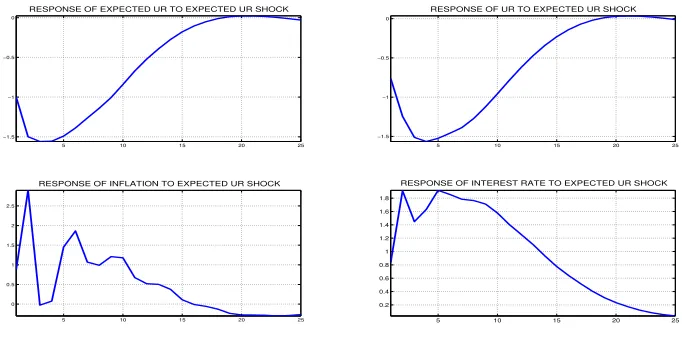
In this section, we report the main results from the TV-VAR model. However, in order to develop intuition about the dynamics of the model, we first present the response to the expectation shocks implied by the constant parameters VAR. Figure 2 shows the impulse-responses to a negative shock to EX-UR. A negative shock to unemployment expectations leads to a decline in the unemployment rate, an increase in inflation and an increase in the interest rate. Unanticipated downward revisions to expected unemployment generate a macroeconomic boom coupled with monetary policy tight-ening, as in Leduc and Sill (2013). In the following, we comment on the IRFs and the variance decomposition implied by the TV-VAR described in Section 2.
Impulse-Responses and Variance Decomposition
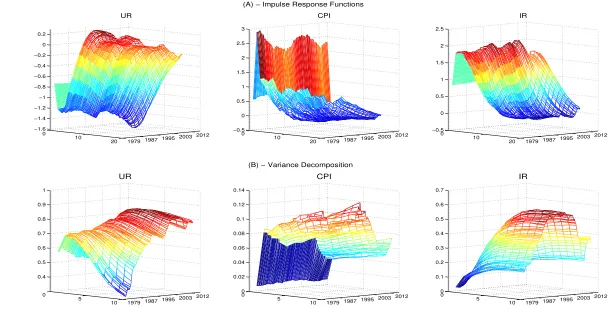
Figure 3 (panel A) shows the posterior median of the evolution over time of the dynamic responses of the realized unemployment rate, the inflation rate and the short-term interest rate to an expectation shock. In each plot of the figure, the x-axis ranges over time and the y-axis ranges over the 1 to 10 quarters horizon. The z-axis reports the responses of each variable to the expectation shock at different periods in time. The IRFs are constructed such that the initial shock has a size of one standard deviation at each point in time.
The responses of realized unemployment to an expectation shock display significant time varia-tion. In the first part of the sample, the unemployment rate falls on impact and, after the second quarter, displays a maximum response below 1 per cent. Afterwards, it slowly reverts back to its pre-shock level. The impact and the persistence of the shock increase starting at the beginning of 2000s. The effect of the expectation shocks on the realized unemployment rate is substantially larger during the recent recession: around 2009, shocks to unemployment expectations generate a maximum response in unemployment of above 1.5 per cent.
the 1980s before increasing again through to the mid 2000s. Afterwards, the effect of the shock on inflation is less sizable. Overall, the maximum response ranges from 3 percentage points at the beginning of the sample to about 2 percentage points both at the end of the 1980s and during the most recent recession. In early 2000s, the maximum response is about 2.5 percentage points. The response of the interest rate has much larger persistence than the response of inflation. The interest rate increases on impact and peaks after about 2 quarters to then revert back to its pre-shock level after about one year. The largest responses of the IR to the shock are displayed around year 2000.
To further explore the time-varying effects of shocks to expectations, we compute the contribu-tion of this shock to the overall variance of the other variables in the system. Figure 3 (Panel B) reports such (posterior median) percentage.
Innovations to EXP-UR account for an increasing fraction of the variance of unemployment over time. Over the first part of the sample period, this shock explains about 40 per cent in the short run and 70 per cent in the long run of movements in realized unemployment. At the end of the sample, the same shock accounts for about 50 per cent of the volatility of UR in the short run and above 80 per cent over the long run.
The fraction of the forecast error variance of inflation due to expectation shocks is negligible in the short run. Over the long run, this shock explains about 10 per cent of the variance of inflation until the early 2000s. Afterwards, shocks to EXP-UR account for a less sizable fraction of variations in inflation. The variance share of the interest rate explained by this shock is similar for all horizons larger than 2-quarters ahead. The contribution of the expectation shock to the volatility of the IR is negligible at the beginning of the sample. However, it increases and stabilizes in a range of 50-60 per cent between the beginning of the 1990s and the mid 2000s. Afterwards, it declines and reaches a contribution of about 20 per cent during the recent recession. The contribution of unanticipated shifts in expectations to the IR increases again after year 2009. These results confirm remarkable time variation in the role of unemployment expectation shocks as sources of economic fluctuations.
Second Moments
We now explore the implications of expectation shocks for selected key second order moments of the unemployment rate. We start by looking at the link between unanticipated shifts in unemployment expectations and the rising persistence of unemployment. Further, we explore the implications of unemployment expectation shocks for changes in the relationship between inflation and unemploy-ment.
Unemployment Persistence
beginning of the recession dated in 2007 Q4 and reached about 9.8 per cent by the end of 2009. After the end of the most recent recession in 2009 Q2, the unemployment rate continued increasing, suggesting a lagging and persistent dynamic. This rising trend continued well after the end of the recession and only rebounded in the beginning of 2010. The recent pattern of US unemployment has been compared by many researchers to the 1980s European experience of high and persistent unemployment as described by Blanchard and Summers (1987) among others.
Turning to the differences in the pattern of unemployment around episodes of economic down-turns, Figure 4 focuses on the dynamics of unemployment starting from 4 quarters before the end of the five most recent recessions. We define the recessionary periods as those determined by the NBER dating committee. The pattern of unemployment across different recessions suggests that the pre-1990s recessions featured a sharp increase in unemployment during the downturns and an immediate decline soon after the end of the recession. Indeed, during the recession of the early 1980s, the unemployment rate increased from slightly below 6 percent to about 7.6 per cent, then began declining following the end of the recession. In the 1981-1982 recession, unemployment in-creased by more than 2 percentage points and reached values above 10 per cent. As in the previous recession, as soon as other indicators of economic activity began to improve, the unemployment rate declined. One year after the end of the recession, the rate returned to levels displayed in the pre-recession period. In contrast, in the most recent recessions, unemployment displays a very slow recovery and a progressive increase in its persistence. The pattern of unemployment during the recession of the early 1990s and early 2000s displays features similar to those experienced during and after the most recent recession. In particular, the unemployment rate stayed high even after the end of the recession and took several quarters to rebound to pre-recession levels.
A variety of factors could have contributed to the rise in the US unemployment persistence over time. In this paper, we also assess to which extent shocks to unemployment expectations have contributed to the increase of unemployment persistence. Figure 5 provides a more structural interpretation of the dynamics of the unemployment rate after a shock to unemployment rate expectations during the five recession periods included in our sample. It reports the average response
of unemployment over each recession period (solid line) and the 16th and 84th percentiles (dotted
line). No differences can be detected in the responses of the unemployment rate during the twin recessions of the early 1980s. In contrast, our findings suggest that expectation shocks generated longer-lived effects in unemployment in the post-1990 recessions. The differences are particularly pronounced in the recent recession. In line with the previous findings, the response of unemployment to an expectation shock is remarkably larger and more persistent during the most recent recession, when compared with previous recessionary periods.
is a measure of time-varying autocorrelation conditional to the shock on expectations. Appendix I provides the details of such computations, which are summarized in Equation 15. Figure 6 (left panel) plots the autocorrelation of the unemployment rate implied by the shock to unemployment expectations. The results are in line with the evidence of higher unemployment persistence in the post-1990s recessions. The figure also confirms that starting from the end of the 1980s, the expectation shock implies a gradually increase in the persistence of the unemployment rate, which peaks during the most recent recession. These results, coupled with the increasing importance of shocks to unemployment expectations over time, confirm that shifts in expectations strongly contributed to the rising persistence of unemployment.
All in all, the results in this section provide further evidence of the time-varying nature of the effects of expectation shocks. In particular, we show that such shocks generate higher post-1990 persistence dynamics in the unemployment rate.
Inflation-Unemployment Correlation
Several authors have highlighted that the most recent recession also featured a decline in inflation that was small in comparison with the large and persistent increase in unemployment. Several explanations have been suggested for these changes in inflation developments over time, such as structural changes in the economy and improved monetary policy (Stock and Watson (2010)), a flattening of the slope of the Phillips curve and downward wage rigidity (Ball and Mazumder (2011)), globalization (Borio and Filardo (2007)) and better ‘anchored’ inflation expectations to central bank targets (IMF (2013), Gambetti and Gali (2009)).
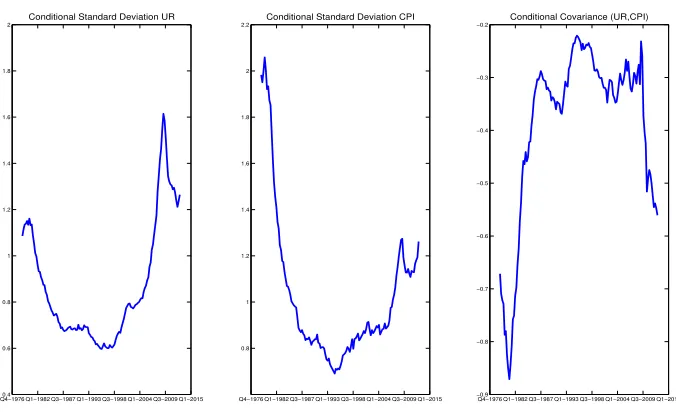
In the following section, we analyze if, in response to expectation shocks, the sensitivity of inflation to unemployment has changed over time and, most importantly, if it declined during the most recent recession. To address this issue, we compute measures of conditional correlation and conditional covariance as described in the Appendix I, equations 16 and 12 respectively. Figures 6 (right panel) and Figure 7 plot these statistics; in particular Figure 6 (right panel) displays the correlation between the two variables conditional on a shock to expectation, whereas Figure 7 displays the conditional standard deviation of unemployment rate (left panel), the conditional standard deviation of CPI inflation (mid panel) and the conditional covariance between the two variables (right panel).
Remarkably, changes in the standard deviations of the unemployment and the inflation rate are reflected in the decline of the correlation between the two variables. Notice that, the conditional covariance between the two series has been relatively low and stable for many years, as many authors have pointed out, and it increases only in the most recent part of the sample. Thus, the reduction in the correlation between inflation and unemployment is largely due to changes in the volatility of the two variables.
Notice that the increase in the standard deviations of the unemployment and the inflation rate mimic the changes over time in the pattern of the responses of the two variables to expectation shocks. In particular, as reported in Section 4, unemployment expectation shocks account for an increasing fraction of the volatility of the unemployment rate over time. Our results suggest that changes in the effects of shocks to unemployment expectations also contributed to the decline in the correlation between inflation and unemployment.
Robustness: Adding Financial Variables
According to the results presented in Section 4, shifts in expectations are relevant sources of macroe-conomic fluctuations. The role of expectation shocks in moving realized unemployment increases in the second part of the sample and is particularly large in the recent recession. The last two business cycles in the U.S. have been characterized by coincident booms in economic activity and asset prices. In particular, during the late 1990s, the US economy experienced a dramatic rise in stock prices, whereas during the mid 2000s, a sustained run-up was displayed in house prices. Both periods of expansions were followed by sudden falls in asset prices and economic downturns.
In order to provide robust evidence regarding the real effects of expectation shocks, we estimates VAR models with measures of asset prices. The first and second rows of Figure 8 report the responses to downward shifts in unemployment expectations for the model that includes stock returns as measured by the S&P 500 and real house prices. In response to unanticipated downward revisions to unemployment expectations, both measures of asset prices rise on impact and then rapidly decline. In particular, the first period response of stock prices sizably increases over time.
Discussion
The evidence reported in this paper suggests that unanticipated changes in unemployment expec-tations significantly contribute to economic fluctuations in the US. Changes in expected future economic activity display substantial variation over time with larger effects beginning in the early 2000s and particularly marked during the most recent recession.
Several authors have highlighted the important changes in the dynamics of unemployment and
inflation over the last decade.5 A variety of explanations have been proposed to rationalize these
changes. In recent papers, Coibion and Gorodnichenko (2013) and Coibion, Gorodnichenko, and Koustas (2013) study the two phenomena separately and conclude that commonly suggested ex-planations do not fully account for changes in the inflation and unemployment rate. In particular, Coibion, Gorodnichenko, and Koustas (2013) test a wide range of economic, demographic and cultural factors that could have influenced the dynamics of unemployment. Contrary to the con-ventional wisdom, they find that financial shocks and wage stickiness do not contribute to the rising persistence of U.S. unemployment. The authors also argue that monetary and fiscal policies ex-plain only part of the developments in unemployment during the most recent recession. Changes in U.S. labor mobility and demographic factors predict a decline in the persistence of unemployment, whereas the decline in ”trust among Americans” has a statistically significant, although limited, impact on the persistence of unemployment. Regarding the missing disinflation during the most re-cent recession, Coibion and Gorodnichenko (2013) consider three explanations in the context of the Phillips curve: changes in the natural rate of unemployment, unusual wage dynamics and marginal costs, and changes in the slope of the Phillips curve. They conclude that none of these channels can fully account for the changes in the relashionship between inflation and unemployment, while changes in consumer expectations are able to rationalize the missing disinflation. The results pre-sented by the authors suggest that more attention should be paid to expectations. Overall, the message of these papers is that traditional channels may have had a limited role in explaining changes in inflation and unemployment over the last decade.
In this paper, we propose an alternative explanation of the changing dynamics of unemployment and inflation in the US. Our results show that changes in the second moments of unemployment and CPI inflation are linked to a shift in the response of the economy to expectation shocks. Indeed, shocks to unemployment expectations display a gradually larger and more persistent effect on the unemployment rate during the most recent recessions. Accordingly, changes in the autocorrelation of the unemployment rate, conditional to expectation shocks, are in line with evidence of higher unemployment persistence over time. Changes in the macroeconomic effects of expectation shocks also have nontrivial implications on the correlation between inflation and unemployment.
5
Our findings capture the effects of shifts in expectations linked to the recent cycles in economic activity. The ”Dot-com” boom of the late 1990s is put forth by many as an example of expectations-driven cycles. Developments in the satellite industry and the booming of the IT economy generated expectations of prosperous future economic prospects. We confirm that changes in expectations about future economic activity might have contributed to the economic boom observed in that period and to its sudden bust. See e.g. Beaudry and Portier (2013).
We find that the effects of unanticipated shifts in expectations on the unemployment rate are particularly large and long-lived during the 2007-2009 economic downturn. The most recent re-cession differs from previous ones mainly due to the fact that it followed the incipit of the global financial crises. The occurrence of a deep financial crises and the resulting increase in uncertainty could have raised the risk of pessimism and, thus, larger changes in unemployment expectations. This could have originated self-reinforcing feedback loop between unemployment expectations and economic activity that contributed to exacerbate the recession and further dampened the following recovery. In general, our results confirm that changes in the macroeconomic performance of the U.S. economy cannot be fully accounted for by factors that abstract from the role of changes in expectations.
Conclusion
This paper provides new evidence on expectation-driven cycles by estimating a structural VAR with time-varying coefficients and stochastic volatility. We use unemployment expectations as compiled by the survey of professional forecasters to measure expectations of future developments in economic activity. Given the changes in the unemployment rate dynamics over the last decades, allowing for time variation in quantifying the role of expectation shocks in shaping the dynamics of the unemployment rate seems a reasonable choice. To the best of our knowledge, no other studies have investigated the time-varying effects of changes in expectations as a source of business cycle fluctuations.
References
Ball, L. M., andS. Mazumder(2011): “Inflation dynamics and the great recession,” Discussion paper, National Bureau of Economic Research.
Barsky, R. B., and E. R. Sims (2012): “Information, Animal Spirits, and the Meaning of
Innovations in Consumer Confidence,”American Economic Review, 102(4), 13431377.
Beaudry, P.,andF. Portier(2006): “Stock prices, news, and economic fluctuations,”American Economic Review, 96, 1293–1307.
(2013): “News driven business cycles: Insights and challenges,” Discussion paper, National Bureau of Economic Research.
Blanchard, O. J., and L. H. Summers (1987): “Expectations and Economic Fluctuations: An
Analysis Using Survey Data,”European Economic Review, 31(1-2), pages 288–295.
Boivin, J., and M. P. Giannoni (2006): “Has monetary policy become more effective?,” The Review of Economics and Statistics, 88(3), 445–462.
Borio, C., and A. Filardo(2007): “Globalisation and inflation: New cross-country evidence on the global determinants of domestic inflation,” .
Canova, F., and L. Gambetti (2009): “Structural changes in the US economy: Is there a role
for monetary policy?,” Journal of Economic Dynamics and Control, 33(2), 477–490.
Carter, C. K., and R.Kohn (1994): “On Gibbs Sampling for State Space Models,”Biometrika, 81, 541–553.
Clarida, R., J. Gali, and M. Gertler (2000): “Monetary policy rules and macroeconomic
stability: evidence and some theory,”The Quarterly Journal of Economics, 115(1), 147–180.
Cogley, T., andT. J. Sargent(2005): “Drifts and volatilities: monetary policies and outcomes
in the post WWII US,”Review of Economic dynamics, 8(2), 262–302.
Coibion, O., and Y. Gorodnichenko (2013): “Is The Phillips Curve Alive and Well After All? Inflation Expectations and the Missing Disinflation,” Discussion paper, National Bureau of Economic Research.
Coibion, O., Y. Gorodnichenko, and D. Koustas (2013): “Amerisclerosis? The Puzzle of Rising US Unemployment Persistence,” Discussion paper, National Bureau of Economic Research.
D’Agostino, A., L. Gambetti, and D. Giannone (2013): “Macroeconomic forecasting and
structural change,”Journal of Applied Econometrics, 28, 82–101.
Gal´ı, J.,andL. Gambetti(2009): “On the sources of the great moderation,”American Economic Journal: Macroeconomics, pp. 26–57.
Gambetti, L., and J. Gali (2009): “On the Sources of the Great Moderation,” American Eco-nomic Journal: MacroecoEco-nomics, 1(1), pages 26–57.
Garin, J., M. Pries, and E. Sims (2013): “Reallocation and the changing nature of economic
IMF (2013): “The Dog That Didn’t Bark: Has Inflation Been Muzzled or Was It Just Sleeping,”
World Economic Outlook, Chapter 3.
Jaimovich, N., and H. E. Siu (2012): “The trend is the cycle: Job polarization and jobless recoveries,” Discussion paper, National Bureau of Economic Research.
Karabarbounis, L.,andB. Neiman(2013): “The Global Decline of the Labor Share,” Discussion paper, National Bureau of Economic Research.
Keynes, J. M. (1936): General theory of employment, interest and money. Macmillan,London.
Leduc, S., andK. Sill(2013): “Expectations and economic fluctuations: an analysis using survey
data,”Review of Economics and Statistics, 95(4), 1352–1367.
Lubik, T. A., and F. Schorfheide (2004): “Testing for indeterminacy: An application to US
monetary policy,”American Economic Review, pp. 190–217.
Pigou, A. C. (1927): Industrial Fluctuations. Macmillan,London.
Primiceri, G. E.(2005): “Time Varying Structural Vector Autoregressions and Monetary Policy,”
Review of Economic Studies, 72, 821–852.
Stock, J. H.,andM. W. Watson(2003): “Has the business cycle changed and why?,” inNBER Macroeconomics Annual 2002, Volume 17, pp. 159–230. MIT press.
Figures
Figure 1: Expected UR, UR, CPI-Inflation 3-months Treasury Bills
Q4−1965 Q2−1971 Q4−1976 Q1−1982 Q3−1987 Q1−1993 Q3−1998 Q1−2004 Q3−2009 Q1−20153 4 5 6 7 8 9 10 11
EXPECTED UNEMPLOYMENT RATE
Q4−1965 Q2−1971 Q4−1976 Q1−1982 Q3−1987 Q1−1993 Q3−1998 Q1−2004 Q3−2009 Q1−20153 4 5 6 7 8 9 10 11 UNEMPLOYMENT RATE
Q4−1965 Q2−1971 Q4−1976 Q1−1982 Q3−1987 Q1−1993 Q3−1998 Q1−2004 Q3−2009 Q1−2015−15 −10 −5 0 5 10 15 20 CPI INFLATION
Q4−1965 Q2−1971 Q4−1976 Q1−1982 Q3−1987 Q1−1993 Q3−1998 Q1−2004 Q3−2009 Q1−20150 2 4 6 8 10 12 14 16 INTEREST RATE
[image:17.612.128.469.375.545.2]Note - The four variables of the baseline VAR.
Figure 2: IRF constant parameters VAR; Negative shock to unemployment
expecta-tions. Baseline four variables VAR model.
5 10 15 20 25 −1.5
−1 −0.5 0
RESPONSE OF EXPECTED UR TO EXPECTED UR SHOCK
5 10 15 20 25 −1.5
−1 −0.5 0
RESPONSE OF UR TO EXPECTED UR SHOCK
5 10 15 20 25 0 0.5 1 1.5 2 2.5
RESPONSE OF INFLATION TO EXPECTED UR SHOCK
5 10 15 20 25 0.2 0.4 0.6 0.8 1 1.2 1.4 1.6 1.8
RESPONSE OF INTEREST RATE TO EXPECTED UR SHOCK
Figure 3: IRF (panel A) and variance decomposition (panel B): shock to unemployment expectations - baseline VAR
0
10
20 1979 19871995 2003 2012 −1.6 −1.4 −1.2 −1 −0.8 −0.6 −0.4 −0.2 0 0.2 UR 0 10
20 1979 1987 1995 2003 2012 −0.5 0 0.5 1 1.5 2 2.5 3 CPI 0 10
20 1979 19871995 2003 2012 −0.5 0 0.5 1 1.5 2 2.5 IR 0 5
10 1979 19871995 2003 2012 0.4 0.5 0.6 0.7 0.8 0.9 1 UR 0 5
10 1979 1987 1995 2003 2012 0 0.02 0.04 0.06 0.08 0.1 0.12 0.14 CPI 0 5
10 1979 19871995 2003 2012 0 0.1 0.2 0.3 0.4 0.5 0.6 0.7 IR
(B) − Variance Decomposition (A) − Impulse Response Functions
Note - Panel A: Negative shock to unemployment expectations. Impulse response functions at different horizons (y-axis) and over time (x-axis). Panel B: percentage of variance explained by the unemployment expectation shock at different horizons (y-axis) and over time (x-axis). Results are from the baseline four variables VAR model (UR expectations, UR, CPI inflation and IR).
Figure 4: The dynamic of unemployment rate during and after recessions
−4 −2 0 2 4 6 8 10 12 14 16
3 4 5 6 7 8 9 10 11
Quartely Unemployment Rate
Years into Recession
1980:I−1980:III 1981:III−1982:IV 1990:III−1991:I 2001:I−2001:IV 2007:IV−2009:II
Note - The figure shows the evolution of unemployment rate from one year before the end of the recession (vertical line crossin zero) to some quarters after the end of the recessions. Unemployment rate dynamics are reported for the five recessions from 1980.
Figure 5: Average IRFs during five recessions
0 2 4 6 8 10 12 14 16 18 −2 −1.5 −1 −0.5 0 0.5 1 RECESSION 2007−2009
0 2 4 6 8 10 12 14 16 18 −2 −1.5 −1 −0.5 0 0.5 1
AVERAGE IRF DURING THE FIVE RECESSION
0 2 4 6 8 10 12 14 16 18 −2 −1.5 −1 −0.5 0 0.5 1 RECESSION 1980−1981
0 2 4 6 8 10 12 14 16 18 −2 −1.5 −1 −0.5 0 0.5 1 RECESSION 1981−1982
0 2 4 6 8 10 12 14 16 18 −2 −1.5 −1 −0.5 0 0.5 1 RECESSION 1990−1991
0 2 4 6 8 10 12 14 16 18 −2 −1.5 −1 −0.5 0 0.5 1 RECESSION 2001 recession: 80−81 recession: 81−82 recession: 90−91 recession: 01 recession: 07−09
[image:19.612.131.470.435.638.2]Figure 6: Conditional moments: autocorrelation and correlation
Q1−1975 Q1−1980 Q1−1985 Q1−1990 Q1−1995 Q1−2000 Q1−2005 Q1−2010 Q1−2015 0.92
0.93 0.94 0.95 0.96 0.97 0.98
Conditional Autocorrelation UR
Q1−1975 Q1−1980 Q1−1985 Q1−1990 Q1−1995 Q1−2000 Q1−2005 Q1−2010 Q1−2015 −0.8
−0.7 −0.6 −0.5 −0.4 −0.3 −0.2 −0.1
Conditional Correlation (UR − CPI)
Note - Left panel: autocorrelation of UR contidional to the expectation shock. Right panel: correlation between UR and CPI inflation conditional to the expectation shock.
Figure 7: Conditional moments: standard deciation and covariance
Q4−1976 Q1−1982 Q3−1987 Q1−1993 Q3−1998 Q1−2004 Q3−2009 Q1−20150.4 0.6
0.8 1 1.2 1.4 1.6 1.8 2
Conditional Standard Deviation UR
Q4−1976 Q1−1982 Q3−1987 Q1−1993 Q3−1998 Q1−2004 Q3−2009 Q1−2015 0.8
1 1.2 1.4 1.6 1.8 2 2.2
Conditional Standard Deviation CPI
Q4−1976 Q1−1982 Q3−1987 Q1−1993 Q3−1998 Q1−2004 Q3−2009 Q1−2015 −0.9
−0.8 −0.7 −0.6 −0.5 −0.4 −0.3 −0.2
Conditional Covariance (UR,CPI)
[image:20.612.130.468.425.631.2]Figure 8: Impulse Response Functions in different VAR models: shock to UR expectations - response of UR
0 10
20 1979 1987 1995 2003 2012 −2 −1.5 −1 −0.5 0 0.5 UR 0 10
20 1979 1987 1995 2003 2012 −30 −20 −10 0 10 20 30 S&P 500 0 10
20 1979 1987 1995 2003 2012 −0.5 0 0.5 1 1.5 2 IR 0 10
20 1979 1987 1995 2003 2012 −2 −1.5 −1 −0.5 0 0.5 UR 0 10
20 1979 1987 1995 2003 2012 −10 −5 0 5 10 15 20
REAL HOUSE PRICES
0 10
20 1979 1987 1995 2003 2012 −0.5 0 0.5 1 1.5 2 IR 0 10
20 1979 1987 1995 2003 2012 −2 −1.5 −1 −0.5 0 0.5 UR 0 10
20 1979 1987 1995 2003 2012 −2 0 2 4 6 MORTGAGE CREDIT 0 10
20 1979 1987 1995 2003 2012 −0.5 0 0.5 1 1.5 2 IR
(A) − VAR with stock prices
(B) − VAR with real house prices
(C) − VAR with mortgage credit
Note - Alternative VAR specificatiosn. Panel (A) Shock to unemployment expectations. Impulse response functions of UR, S&P 500 and IR. Panel (B) Shock to unemployment expectations. Impulse response functions of UR, Real House Prices and IR. Panel (C) Shock to unemployment expectations. Impulse response functions of UR, Mortgage Credit and IR.
Appendix 1: Conditional Statistics
To derive the conditional statistics we rewrite equation(1) in companion form:
xt=µt+Atxt−1+ǫt (2)
where xt ≡ [x′t,x′t−1, ...,x′t−p+1]′ ǫt ≡ [ǫ′t,0, ...,0]′, µt ≡ [A′0,t,0, ...,0]′ and At is the companion
matrix. Equation(2) can be rewritten as:
(I−AtL)xt=µt+ǫt (3)
by inverting the term (I −AtL) on the left-hand side, we can derive the corresponding moving
average representation:
xt=ηt+Ft,0ǫt+Ft,1ǫt−1+Ft,2ǫt−2+... (4)
whereηt= (I−AtL)−1µt, ∞ X
i=0
Ft,iǫt−i = (I−AtL)−1ǫtandFt,0 =I. We assume that the innovations
ǫt are a linear combination of orthogonal structural disturbancesut, i.e.
ǫt=Kut (5)
Equation 4 can be written in terms of orthogonal structural shocks as:
xt=ηt+ ∞ X
i=0
Ct,iut−i (6)
where Ft,iK ≡ Ct,i for i = 0,1,2, .... For a single variable j and in particular for the variables
baseline VAR it is:
xj,t =ηj,t+ ∞ X
i=0
Ct,ij,exuext−i+ 4 X k=2 ∞ X i=0
Ct,ij,kukt−i (7)
Variable xj,t is then written as a time-varying distributed lag model in four orthogonal shocks.
The first one, uext , is the structural expectation shock, while the remaining three, uktk = 2,3,4,
are orthogonal non-identified shocks. Given equation (7) it is straightforward to define second and cross-moments:
Variance
var(xj,t) = ∞ X
i=0
(Ct,ij,ex)2+ 4 X k=2 ∞ X i=0
(Ct,ij,k)2 (8)
Covariance
cov(xj,t, xs,t) = ∞ X
i=0
Ct,ij,exCt,is,ex+ 4 X k=2 ∞ X i=0
Autocovariance
cov(xj,txj,t−1) =
∞ X
i=0
Ct,ij,ex+1Ctj,ex−1,i+ 4
X
k=2
∞ X
i=0
Ct,ij,k+1Ct,ij,k (10)
Similarly, other moments conditional to the expectation shock can be defined as:
Conditional Variance
var(xj,t|uext ) = ∞ X
i=0
(Ct,ij,ex)2 (11)
Conditional Covariance
cov(xj,t, xs,t|uext ) = ∞ X
i=0
Ct,ij,exCt,is,ex (12)
Conditional Autocovariance
cov(xj,txj,t−1|uext ) = ∞ X
i=0
Ct,ij,ex+1Ct,ij,ex (13)
Autocorrelation and conditional autocorrelation are defined respectively as:
corr(xj,t) =
cov(xj,txj,t−1)
var(xj,t)
(14)
and
corr(xj,t|uext ) = cov(xj,txj,t−1|u
ex t )
var(xj,t|uext )
(15)
while correlation and conditional correlation as:
corr(xj,txs,t) =
cov(xj,txs,t)
var(xj,t)( 1
2)var(xs,t)( 1 2)
(16)
and
corr(xj,txs,t|uext ) =
cov(xj,txs,t|uext )
var(xj,t|uext )( 1 2)var(x
s,t|uext )( 1 2)
Appendix 2: the bayesian algorithm
Estimation is done using Bayesian methods. To draw from the joint posterior distribution of model parameters we use a Gibbs sampling algorithm along the lines described in Primiceri (2005). The basic idea of the algorithm is to draw sets of coefficients from known conditional posterior distribu-tions. The algorithm is initialized at some values and, under some regularity conditions, the draws
converge to a draw from the joint posterior after a burn in period. Let z be (q ×1) vector, we
denote zT the sequence [z1′, ..., zT′ ]′. Each repetition is composed of the following steps:
1. p(sT|yT, θT, σT, φT,Ω,Ξ,Ψ)6
2. p(σT|yT, θT, φT,Ω,Ξ,Ψ, sT)
3. p(φT|yT, θT, σT,Ω,Ξ,Ψ, sT)
4. p(θT|yT, σT, φT,Ω,Ξ,Ψ, sT)
5. p(Ω|yT, θT, σT, φT,Ξ,Ψ, sT)
6. p(Ξ|yT, θT, σT, φT,Ω,Ψ, sT)
7. p(Ψ|yT, θT, σT, φT,Ω,Ξ, sT)
Gibbs sampling algorithm
• Step 1: sample from p(sT|yT, θT, σT, φT,Ω,Ξ,Ψ)
Conditional onyi,t∗∗ and rT, we independently sample eachsi,t from the discrete density defined
byP r(si,t=j|y∗∗i,t, ri,t)∝fN(yi,t∗∗|2ri,t+mj−1.2704, vj2), wherefN(y|µ, σ2) denotes a normal density
with mean µ and varianceσ2.
•Step 2: sample from p(σT|yT, θT, φT,Ω,Ξ,Ψ, sT)
To draw σT we use the algorithm of Kim, Shephard and Chibb (KSC) (1998). Consider the
system of equations y∗t ≡ Ft−1(yt−Xt′θt) = Dt1/2ut, where ut ∼ N(0, I), Xt = (In⊗x′t), and
xt = [1n, yt−1...yt−p]. Conditional on yT, θT, and φT, y∗t is observable. Squaring and taking the
logarithm, we obtain
yt∗∗ = 2rt+υt (18)
rt = rt−1+ξt (19)
where yi,t∗∗ = log((yi,t∗ )2+ 0.001) the constant (0.001) is added to make estimation more robust
-υi,t = log(u2i,t) and rt = logσi,t. Since, the innovation in (18) is distributed as logχ2(1), we use,
following KSC, a mixture of 7 normal densities with component probabilitiesqj, meansmj−1.2704,
and variancesvj2(j=1,...,7) to transform the system in a Gaussian one, where{qj, mj, v2j}are chosen
to match the moments of the logχ2(1) distribution. The values are:
6
Table A1: Parameters Specification
j qj mj vj2
1.0000 0.0073 -10.1300 5.7960
2.0000 0.1056 -3.9728 2.6137
3.0000 0.0000 -8.5669 5.1795
4.0000 0.0440 2.7779 0.1674
5.0000 0.3400 0.6194 0.6401
6.0000 0.2457 1.7952 0.3402
7.0000 0.2575 -1.0882 1.2626
Let sT = [s1, ..., sT]′ be a matrix of indicators selecting the member of the mixture to be used
for each element ofυtat each point in time. Conditional onsT, (υi,t|si,t =j)∼N(mj−1.2704, vj2).
Therefore we can use the algorithm of Carter and R.Kohn (1994) to draw rt (t=1,...,T) from
N(rt|t+1, Rt|t+1), wherert|t+1=E(rt|rt+1, yt, θT, φT,Ω,Ξ,Ψ, sT,) andRt|t+1=V ar(rt|rt+1, yt, θT, φT,Ω,Ξ,Ψ, sT).
•Step 3: sample from p(φT|yT, θT, σT,Ω,Ξ,Ψ, sT)
Consider again the system of equationsFt−1(yt−Xt′θt) =Ft−1yˆt=Dt1/2ut. Conditional on θT,
ˆ
yt is observable. SinceFt−1 is lower triangular with ones in the main diagonal, each equation in the
above system can be written as
ˆ
y1,t = σ1,tu1,t (20)
ˆ
yi,t = −yˆ[1,i−1],tφi,t+σi,tui,t i= 2, ..., n (21)
whereσi,tandui,tare theith elements ofσtandutrespectively, ˆy[1,i−1],t= [ˆy1,t, ...,yˆi−1,t]. Under the
block diagonality of Ψ, the algorithm of Carter and R.Kohn (1994) can be applied equation by equa-tion, obtaining draws forφi,tfrom aN(φi,t|t+1,Φi,t|t+1), whereφi,t|t+1 =E(φi,t|φi,t+1, yt, θT, σT,Ω,Ξ,Ψ) and Φi,t|t+1 =V ar(φi,t|φi,t+1, yt, θT, σT,Ω,Ξ,Ψ).
•Step 4: sample from p(θT|yT, σT, φT,Ω,Ξ,Ψ, sT)
Conditional on all other parameters and the observables we have
yt = Xt′θt+εt (22)
θt = θt−1+ωt (23)
Draws for θtcan be obtained from a N(θt|t+1, Pt|t+1), where θt|t+1 =E(θt|θt+1, yT, σT, φT,Ω,Ξ,Ψ)
andPt|t+1 =V ar(θt|θt+1, yT, σT, φT,Ω,Ξ,Ψ) are obtained with the algorithm of Carter and R.Kohn
(1994).
•Step 5: sample from p(Ω|yT, θT, σT, φT,Ξ,Ψ, sT)
Conditional on the other coefficients and the data, Ω has an Inverse-Wishart posterior density
with scale matrix Ω−11 = (Ω0+PTt=1∆θt(∆θt)′)−1 and degrees of freedom dfΩ1 =dfΩ0 +T, where
use for estimation. To draw a realization for Ω makedfΩ1 independent drawszi (i=1,...,dfΩ1) from
N(0,Ω−11) and compute Ω = (Pidf=1Ω1ziz′i)−1 (see Gelman et. al., 1995).
•Step 6: sample from p(Ξi,i|yT, θT, σT, φT,Ω,Ψ, sT)
Conditional the other coefficients and the data, Ξ has an Inverse-Wishart posterior density with
scale matrix Ξ−11= (Ξ0+PTt=1∆ logσt(∆ logσt)′)−1 and degrees of freedomdfΞ1 =dfΞ0+T where
Ξ−01 is the prior scale matrix anddfΞ0 the prior degrees of freedom. Draws are obtained as in step
5.
•Step 7: sample from p(Ψ|yT, θT, σT, φT,Ω,Ξ, sT).
Conditional on the other coefficients and the data, Ψi has an Inverse-Wishart posterior density
with scale matrix Ψ−i,11 = (Ψi,0+PTt=1∆φi,t(∆φi,t)′)−1 and degrees of freedom dfΨi,1 =dfΨi,0 +T
where Ψ−i,01 is the prior scale matrix anddfΨi,0 the prior degrees of freedom. Draws are obtained as
in step 5 for alli.