Aiding Pronoun Translation with Co-Reference Resolution
Ronan Le Nagard and Philipp Koehn University of Edinburgh
Edinburgh, United Kingdom
[email protected], [email protected]
Abstract
We propose a method to improve the trans-lation of pronouns by resolving their co-reference to prior mentions. We report re-sults using two different co-reference res-olution methods and point to remaining challenges.
1 Introduction
While machine translation research has made great progress over the last years, including the in-creasing exploitation of linguistic annotation, the problems are mainly framed as the translation of isolated sentences. This restriction of the task ig-nores several discourse-level problems, such as the translation of pronouns.
Pronouns typically refer to earlier mention of entities, and the nature of these entities may matter for translation. A glaring case is the translation of the Englishitandtheyinto languages with gram-matical gender (as for instance, most European languages). Ifitrefers to an object that has a male grammatical gender in the target language, then its translation is a male pronoun (e.g., ilin French), while referring to a female object requires a fe-male pronoun (e.g.,ellein French).
Figure 1 illustrates the problem. Given a pair of sentence such as
The window is open. It is blue.
the translation of it cannot be determined given only the sentence it occurs in. It is essential that we connect it to the entitythe windowin the pre-vious sentence.
Making such a connection between references to the same entity is called co-reference resolu-tion, or anaphora resolution.1 While this problem
1In the context of pronouns, anaphora resolution and co-reference resolution are identical, but they differ in other con-texts.
has motivated significant research in the field of natural language processing, the integration of co-reference resolution methods into machine transla-tion has been lacking. The recent wave of work on statistical machine translation has essentially not moved beyond sentence-level and has not touched co-reference resolution.
Our approach to aiding pronoun translation with co-reference resolution can be outlined as follows. On both training and test data, we identify the anaphoric noun of each occurrence ofit andthey on the source side (English). We then identify the noun’s translation into the target language (in our experiments, French), and identify the target noun’s grammatical gender. Based on that gender, we replaceit withit-masculine, it-feminine or it-neutral(ditto forthey). We train a statistical ma-chine translation system with a thusly annotated corpus and apply it to the annotated test sentences. Our experiments show some degree of suc-cess of the method, but also highlight that current co-reference resolution methods (we implemented Hobbs and Lappin/Laess) have not yet achieved sufficient performance to significantly reduce the number of errors in pronoun translation.
2 Related Work
2.1 Co-Reference and Machine Translation
The problem of anaphora resolution applied to ma-chine translation has not been treated much in the literature. Although some papers refer to the prob-lem, their content is mostly concerned with the problem of anaphora resolution and speak very lit-tle about the integration of such an algorithm in the bigger theme of machine translation.
Mitkov et al. [1995] deplore the lack of study of the question and try to address it with the im-plementation of an anaphora resolution model and its integration into the CAT2 translation system [Sharp, 1988], a transfer system that uses an
The window is open.Itis blue. La fenˆetre est ouverte.Elleest bleue. CORRECT
The window is open.Itis black. La fenˆetre est ouverte.Ilest noir. WRONG
The oven is open.Itis new. Le four est ouverte.Elleest neuve. WRONG
The door is open.Itis new. La porte est ouverte.Elleest neuve. CORRECT
Figure 1: Translation errors due to lack of co-reference resolution (created with Google Translate).
stract intermediate representation. The anaphora resolution step adds additional features to the in-termediate representation.
Leass and Schwall [1991] present a list of rules to be implemented directly into the machine trans-lation system. These rules seem to work mostly like a dictionary and are checked in a priority or-der. They state what should be the translation of a pronoun in each special case. Being specific to the problem of translating anaphors into Korean, these are of little interest to our current work.
2.2 Co-Reference : Syntactic Method
The first work on the resolution of pronouns was done in the 1970s, largely based on a syntactic ap-proach. This work was based on empirical data and observations about natural languages. For ex-ample, Winograd [1972] uses the notion of co-reference chains when stating that if a single pro-noun is used several times in a sentence or a group of adjunct sentences, all instances of this pronoun should refer to the same entity.
Others have also stated that antecedents of a pronoun should be found in one of the n sen-tences preceding the pronouns, where n should be small [Klapholz and Lockman, 1975]. Hobbs [1978] showed that this number was close to one, although no actual limit could be really imposed.
In work by both Hobbs [1978] and Winograd [1972], the resolution of pronouns also involves a syntactic study of the parse tree of sentences. The order with which candidate antecedents are prior-itized is similar in both studies. They first look for the antecedent to be a subject, then the direct ob-ject of a noun and finally an indirect obob-ject. Only thereafter previous sentences are checked for an antecedent, in no particular order, although the left to right order seems to be preferred in the literature as it implicitly preserves the order just mentioned. Winograd uses focus values of noun phrases in sentences to choose the appropriate antecedent.
Hobbs also refers to the work by Charniak [1972] and Wilks [1975] for the problem of anaphora resolution. However, they do not offer a
complete solution to the problem. For this reason Hobbs [1978] is often considered to be the most comprehensive early syntactic study of the prob-lem, and as such, often used as a baseline to evalu-ate anaphora resolution methods. We use his work and comment on it in a later section.
Another approach to anaphora resolution is based on the centering theory first proposed by Grosz et al. [1995]. Brennan et al. [1987] propose an algorithm for pronoun resolution based on cen-tering theory. Once again, the entities are ranked according to their grammatical role, where subject is more salient than existential constructs, which are more salient than direct and indirect objects. Walker [1998] further improves the theory of cen-tering theory for anaphora resolution, proposing the idea of cache model to replace the stack model described originally.
Another syntactic approach to the problem of co-reference resolution is the use of weighted features by Lappin and Leass [1994] which we present in more details in a further section. This al-gorithm is based on two modules, a syntactic filter followed by a system of salience weighting. The algorithm gathers all potential noun phrase an-tecedents of a pronoun from the current and close previous sentences. The syntactic filter then filters out the ones that are unlikely to be antecedents, ac-cording to different rules, including general agree-ment rules. The remaining candidate noun phrases are weighted according to salience factors. The authors demonstrate a higher success rate with their algorithm (86%) than with their implemen-tation of the Hobbs algorithm (82%).
2.3 Co-Reference : Statistical Approach
Machine Learning has also been applied to the problem of anaphora resolution. Ng [2005] gives a survey of the research carried out in this area.
its antecedent. They include ”lexical (e.g. cate-gory), syntactic (e.g. grammatical role), semantic (e.g. semantic class), and positional (e.g. distance between anaphor and antecedent)” information.
Ge et al. [1998] also present a statistical algo-rithm based on the study of statistical data in a large corpus and the application of a naive Bayes model. The authors report an accuracy rate of 82.9%, or 84.2% with the addition of statistical data on gender categorization of words.
In more recent work, Kehler et al. [2004] show a move towards the use of common-sense knowl-edge to help the resolution of anaphors. They use referring probabilities taken from a large anno-tated corpus as a knowledge base.
2.4 Shared Tasks and Evaluation
Although a fairly large amount of research has been done in the field, it is often reported [Mitkov et al., 1995] that there does not yet exist a method to resolve pronouns which is entirely satisfactory and effective. Different kinds of texts (novel, newspaper,...) pose problems [Hobbs, 1978] and the field is also victim of lack of standardization.
Algorithms are evaluated on different texts and large annotated corpora with co-reference infor-mation is lacking to check results. A response to these problems came with the creation of shared tasks, such as the MUC [Grishman and Sund-heim, 1996] which included a co-reference sub-task [Chinchor and Hirschmann, 1997] and led to the creation of the MUC-6 and MUC-7 corpora.
There are other annotation efforts worth men-tioning, such as the ARRAU corpus [Poesio and Artstein, 2008] which include texts from various sources and deals with previous problems in an-notation such as anaphora ambiguity and anno-tation of information on agreement, grammatical function and reference. The Anaphoric Bank and the Phrase Detectives are both part of the Anawiki project [Poesio et al., 2008] and also promise the creation of a standardized corpus. The first one al-lows for the sharing of annotated corpora. The sec-ond is a collaborative effort to annotate large cor-pora through the Web. In its first year of use, the system saw the resolution of 700,000 pronouns.
3 Method
The method has two main aspects: the application of co-reference to annotate pronouns and the sub-sequent integration into statistical machine
trans-lation. We begin our description with the latter aspect.
3.1 Integration into Machine Translation
English pronouns such as it (and they) do not have a unique French translation, but rather sev-eral words are potential translations. Note that for simplicity we comment here on the pronounit, but the same conclusions can be drawn from the study of the plural pronounthey.
In most cases, the translation ambiguity can-not be resolved in the context of a single sentence because the pronoun refers to an antecedent in a previous sentence. Statistical machine translation focuses on single sentences and therefore cannot deal with antecedents in previous sentences. Our approach does not fundamentally change the sta-tistical machine translation approach, but treats the necessary pronoun classification as a external task. Hence, the pronoun it is annotated, resulting in the three different surface forms presented to the translation system: it-neutral, it-feminine, it-masculine. These therefore encode the gender in-formation of the pronoun and each of them will be match to its corresponding French translation in the translation table.
An interesting point to note is the fact that these pronouns only encode gender information about the pronouns and omit number and person infor-mation. This has two reasons.
Firstly, study of the lexical translation table for the baseline system shows that the probability of having the singular pronounit translated into the plural pronouns ils andelles is 10 times smaller than the one for the singular/singular translation pair. This means that the number of times a sin-gular pronoun in English translates into a plural pronoun in French is negligible.
The other reason to omit the cases when a sin-gular pronoun is translated into a plural pronoun is due to the performance of our algorithm. Indeed, the detection of number information in the algo-rithm is not good enough and returns many false results which would reduce the performance of the final system. Also, adding the number agreement to the pronoun would mean a high segmentation between all the different possibilities, which we assumed would result in worse performance of the translation system.
The window is open.
It is blue.
La fenêtre est ouverte.
It-feminine is blue.
FEMININE
③ lexical resources
④ annotation
② training: word alignment, test: translation mapping
[image:4.595.99.499.62.229.2]① co-reference resolution
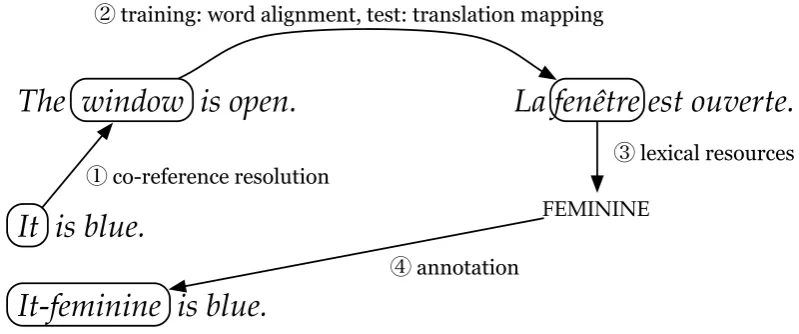
Figure 2: Overview of the process to annotate pronouns: The word itis connected to the antecedent windowwhich was translated asfenˆetre, a feminine noun. Thus, the pronoun is annotated asit-feminine.
the new probabilities that link the source language pronoun to the target language pronouns. That is all instances of it in the training data, which can be found at any position in the corpus sentences, should be replaced by one of its three declension. However, it is important to stress that the gender information that should be encoded in the English corpus is the one which corresponds to the gender of the French translation of the antecedent.
In order to find the correct gender information for the pronoun, we execute the co-reference reso-lution algorithm on the English text which returns the antecedent of the pronoun (more on this in the next section). Note that we are not interested in the English gender of the antecedent, but in gender of its translation.
Thus, we need to detect the French translation of the English antecedent. For the training data, we rely on the word alignment that is produced as a by-product of the training of a statistical machine translation system. For the test data, we rely on the implicit word mapping performed during the translation process.
Note that this requires in practice the translation of all preceding sentences before we can annotate the current sentence. To avoid this practical bur-den in our experiments, we simply use the map-ping in the baseline translation. The performance of the sentence alignment (88
Once the French word is obtained, it is used as the input of a module which returns the gender of the entity in French. This is then used to replace the original pronoun with the new gendered pro-noun.
The entire process is illustrated in Figure 2.
3.2 The Hobbs Algorithm
The Hobbs algorithm is considered to be the base-line algorithm for co-reference resolution. The al-gorithm uses the syntactic parse tree of the sen-tences as input.
The algorithm traverses the parse tree and se-lects appropriate candidate referents to the pro-noun. It goes up sentence nodes and checks all NP nodes encountered for agreement with the pro-noun. The order in which the algorithm traverses the tree ensures that some priorities are respected, to make sure the most probable antecedent is re-turned first. By doing this, the algorithm tends to enforces some of the constraints that apply to co-reference [Jurafsky et al., 2000]. The recency constraint is enforced thanks to the order in which the algorithm traverses the sentences and both the binding and grammatical role constraints are en-forced by the use of the syntactic tree and Part-Of-Speech tags on the words.
Because the algorithm only uses the parse tree of the sentences, the semantic meaning of words is completely omitted in the process of select-ing candidate antecedents and no knowledge is required except for the implicit knowledge con-tained within agreement features.
In case no antecedent was found in the current sentence, the algorithm goes back up in the text, looking at each sentence separately, in a left-to-right breadth first fashion. This ensures that the subject/object/indirect object priorities and hierar-chy are respected. Again, if a candidate NP has matching agreement features, it is returned as the antecedent of the pronoun. Otherwise the algo-rithm goes one sentence higher.
The original algorithm uses limited knowledge because it assumes that:
• Dates do not move.
• Places do not move.
• Large fixed objects don’t move.
This add limited semantic restrictions for the an-tecedent chosen. Indeed, if the pronoun is fol-lowed by a motion verb, the antecedent could not be a date, a place or a large fixed object. However, as Hobbs states himself, those constraints help lit-tle since they do not apply in most cases.
3.3 The Lappin and Leass Algorithm
Lappin and Leass [1994] proposed an anaphora resolution algorithm for third person pronouns and lexical anaphors. It is based on slot grammar and uses syntax combined with a system of weights to select the appropriate antecedent of a pronoun. The implementation of the algorithm we deal with here is fairly different from the one presented in the original paper, and is largely inspired from the JavaRAP implementation [Qiu et al., 2004].
The first important variation was mentioned ear-lier and concerns the application of co-reference resolution to machine translation. We concen-trate in this work on the resolution of third per-son pronouns, and we omit reflexive pronouns ( it-self,themselves) (referred to as lexical anaphora in some works).
Another variation comes from the use of the Collins parser [Collins, 2003]. Although work on the original algorithm uses McCord’s Slot Gram-mar parser [McCord, 1990], work on JavaRAP shows that rules can be created to simulate the cat-egories and predicates used in slot grammar. Also, Preiss [2002] evaluates the use of different parsers for the Lappin and Leass algorithm, showing that performance of the algorithm is not related to the performance of the parser itself. The JavaRAP im-plementation uses a Charniak parser, which per-forms worse than the Collins parser in Preiss’ re-search.
For these reasons and in order to allow for reuse of the code used previously in the implementation of the Hobbs algorithm, the input to the Lappin and Leass algorithm is text parsed with the Collins parser.
It should be noted that the Lappin and Le-ass algorithm (also called RAP for Resolution of Anaphora Procedure) has been used in the original research for the application of machine translation. The algorithm processes sentence by sentence, keeping in memory the information regarding the last four sentences. In the first step of the algo-rithm, all noun phrases (NPs) are extracted and classified. Definite and indefinite NPs are sep-arated, and pleonastic pronouns are segregated from other pronouns.
The notion of salience is very important in RAP, as it allows the algorithm to choose between competing NPs. All candidate NPs are given a ”salience weighting”, which represents the impor-tance and visibility of the phrase in the sentence, and in relation to the pronoun that is being re-solved.
Salience weighting is based on the syntactic form of the sentence and the value for an NP is calculated through the contribution, or not, of dif-ferent salience factors, to which weights are asso-ciated. This calculation ensures that different im-portance will be given to a subject noun phrase in a sentence, and a noun phrase that is embedded in another or that represents the indirect object of a verb.
There are a number of salience factors such as sentence recency, subject emphasis, existential emphasis, accusative emphasis, etc. Each factor is associated with a predefined weight.
Once the weight of each candidate has been cal-culated, the algorithm uses syntactic information to filter out the noun phrases that the pronoun is unlikely to refer to. This includes agreement and other checks.
The list of candidate NPs obtained after this processing is then cleared of all NPs that fall un-der a given threshold. The original algorithm then deals with singular and plural pronouns in differ-ent ways. The JavaRAP implemdiffer-entation however does not use these differences and we refer the reader to Lappin and Leass’ paper for further in-formation.
weights and the highest scoring one is returned as the antecedent of the pronoun. In case several NPs have the same salience weight, the one closest to the pronoun is returned.
3.4 Pleonastic It
English makes an extensive use of the pronounit in a pleonastic fashion. That is, many times,itis considered to be structural and does not refer to any entity previously mentioned. The following are examples of pleonastic uses ofit:
• It is raining.
• It seems important that I see him.
• The session is opened, it was announced.
Being able to discriminate the use of a struc-tural it from the use of a referential use of it is very important for the success of the co-reference algorithm. Indeed, resolving a pleonastic it will be a waste of time for the algorithm, and more im-portantly, it will increase the chance of errors and will result in poorer performances. Moreover, the pleonasticitis most times translated masculine in French, meaning any other resolution by the algo-rithm will yield errors.
In the past, the importance given to the detec-tion of the pleonastic use ofithas varied from au-thor to auau-thor. As an example, Rush et al. [1971], in their work on automatic summarization, only mentioned the problem. Others formed a set of rules to detect them, such as Liddy et al. [1987] with 142 rules, or Lappin and Leass [1994] who propose a very restricted set of rules for the detec-tion of the structuralit.
Paice and Husk [1987] carried out extensive re-search on the topic and their paper defines various categories for the pronounitas well as proposing a set of rules that allow to differentiate when the pronounitis used as a relational pronoun or as a pleonastic pronoun.
Their method categorise words according to the presence of given words around the pronoun it. They distinguish constructs such asit VERB STA-TUS to TASK; construct expressing doubt contain-ing words such aswhether,if,how; parenthetical it such asit seems,it was said. The original arti-cle identifies seven categories for pleonastic pro-nouns.
Since their own results showed a success rate of 92.2% on a test section of the LOBC corpus and the implementation of their technique yields
results similar to the implementation of a machine learning technique, this method seemed appropri-ate for our purpose.
4 Experiments
In this section, we comment on the tools used for the implementation of the algorithms, as well as support tools and corpora.
The implementation of both of the algorithms was done using the Python programming lan-guage, which was chosen for its simplicity in pro-cessing text files and because it is the language in which the Natural Language Toolkit is developed. The Natural Language Toolkit (NLTK) is a suite of Python modules used for research into natural language processing. We mostly used its Tree and ParentedTree modules which enable the represen-tation of parse trees into tree structures. NLTK also includes a naive Bayes classifier, which we used in association with the names corpus in order to classify proper names into gender categories ac-cording to a set of features. We also use NLTK for its named entity capacities, in order to find ani-macity information of entities.
English sentences were annotated with the MX-POST Part of Speech tagger and the Collins syn-tactic parser.
The Lefff lexicon, introduced by Sagot et al. [2006] was used to get agreement features of French words. It contains over 80,000 French words,2 along with gender and number informa-tion.
We used the open source Moses toolkit [Koehn et al., 2007] and trained standard phrase-based translation models.
As training data, we used the Europarl corpus [Koehn, 2005], a commonly used parallel corpus in statistical machine translation research. While there are also commonly used Europarl test sets, these do not contain sentences in sequence for complete documents. Instead, we used as test set the proceedings from October 5, 2000 - a set of 1742 sentences from the held-out portion of the corpus. We translated the test set both with a base-line system and a system trained on the annotated training data and tested on an annotated test set.
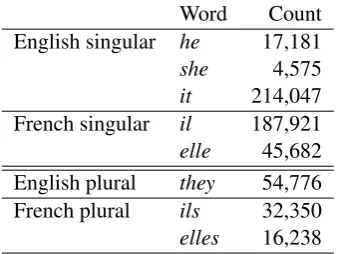
Word Count English singular he 17,181 she 4,575 it 214,047 French singular il 187,921 elle 45,682 English plural they 54,776 French plural ils 32,350 elles 16,238
Table 1: Number of sentences in the training cor-pus containing third person personal pronouns.
Truth Method
[image:7.595.325.508.62.136.2]Pleonastic Referential Pleonastic 42 20 Referential 19 98
Table 2: Detection of pleonastic pronouns
5 Results
5.1 Corpus Statistics for Pronouns
Personal pronouns are among the most frequent words in text. In the training corpus of 1,393,452 sentences, about a 6th contain third person per-sonal pronouns. See Table 1 for detailed statistics. The English pronoun itis much more frequent thanheorshe. For both languages, the masculine forms are more frequent than the feminine forms.
There are then a total of 233,603 sentences con-taining a third person pronoun in French, and 235,803 sentences containing a third person pro-noun in English. This means that over 2,000 of those pronouns in English do not have equiv-alent in French. Similarly for plural: A total of 48,588 sentences contain a plural pronoun in French, against 54,776 in English. That shows that over 6,000 of the English ones are not translated into French.
5.2 Detection of the Pleonasticit
We checked, how well our method for pleonas-tic itdetection works on a section of the test set. We achieved both recall and precision of 83% for the categorization of the referentialit. For details, please see Table 2.
5.3 Translation Probabilities
Let us now examine the translation probabilities for the annotated and un-annotated pronouns. De-tails are given in Table 3.
correct annotation 33/59 56% correct translation:
[image:7.595.92.268.239.297.2]annotated 40/59 68% correctly annotated 27/33 82% baseline 41/59 69%
Table 4: Translation Results:On a manually ex-amined portion of the test set, only 33 of 59 pro-nouns are labeled correctly. The translation results of our method does not differ significantly from the baseline. Most of the correctly annotated pro-nouns are translated correctly.
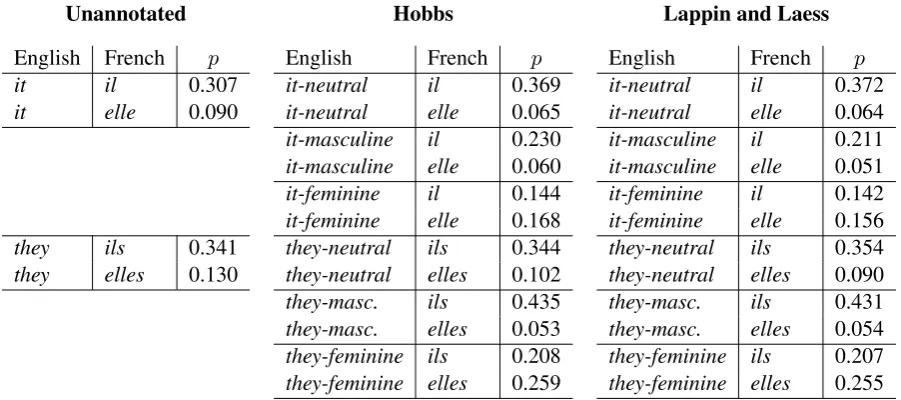
In the baseline system, both it and they have a strong translation preference for the masculine over the feminine form of the French pronoun. Ittranslates with probability 0.307 to iland with probability0.090toelle. The rest of the probabil-ity mass is taken up by theNULL token, punctua-tion, and a long tail of unlikely choices.
For both the Hobbs and the Lappin/Laess algo-rithm, the probability distribution is shifted to the desired French pronoun. The shift is strongest for the masculine markedthey, which prefers the mas-culineilswith 0.431 over the feminineelleswith 0.053 (numbers for Hobbs, Lappin/Laess numbers are 0.435 and 0.054, respectively).
Feminine marked pronouns now slightly prefer feminine French forms, overcoming the original bias. The neutrally marked pronouns shift slightly in favor of masculine translations.
The pronoun they-neutral appears in 12,424 sentences in the corpus, which all represent failed resolution of the co-reference. Indeed, French does not have neutral gender and the plural third person pronoun is never pleonastic. These results therefore show that a lot of noise is added to the system.
5.4 Translation Results
The BLEU scores for our method is almost
iden-tical to the baseline performance. This is not sur-prising, since we only expect to change the transla-tion of a small number of words (however, impor-tant words for understanding the meaning of the text).
A better evaluation metric is the number of cor-rectly translated pronouns. This requires manual inspection of the translation results. Results are given in Table 4.
Unannotated Hobbs Lappin and Laess
English French p English French p English French p
[image:8.595.71.522.62.262.2]it il 0.307 it-neutral il 0.369 it-neutral il 0.372 it elle 0.090 it-neutral elle 0.065 it-neutral elle 0.064 it-masculine il 0.230 it-masculine il 0.211 it-masculine elle 0.060 it-masculine elle 0.051 it-feminine il 0.144 it-feminine il 0.142 it-feminine elle 0.168 it-feminine elle 0.156 they ils 0.341 they-neutral ils 0.344 they-neutral ils 0.354 they elles 0.130 they-neutral elles 0.102 they-neutral elles 0.090 they-masc. ils 0.435 they-masc. ils 0.431 they-masc. elles 0.053 they-masc. elles 0.054 they-feminine ils 0.208 they-feminine ils 0.207 they-feminine elles 0.259 they-feminine elles 0.255
Table 3: Translation probabilities. The probabilities of gender-marked pronouns are shifted to the corresponding gender in the two cases the text was annotated with the co-reference resolution methods mentionned earlier.
suggests that we are moving the translation of pro-nouns in the right direction, this is not reflected by the sample of pronoun translations we inspected. In fact, the performance for our method is almost identical to the baseline (68% and 69%, respec-tively).
One cause for this is the poor performance of the co-reference resolution method, which la-bels only 56% of pronouns correctly. On this sub-sample of correctly annotated pronouns, we achieve 82% correct translations. However, the baseline method also performs well on this subset.
6 Conclusion
We presented a method to aid pronoun transla-tion for statistical machine translatransla-tion by using co-reference resolution. This is to our knowledge the first such work.
While our method works in principle, the re-sults are not yet convincing. The main problem is the low performance of the co-reference resolu-tion algorithm we used. The method works well when the co-reference resolution algorithm pro-vides correct results.
Future work should concentrate on better co-reference algorithms. The context of machine translation also provides an interesting testbed for such algorithms, since it offers standard test sets for many language pairs.
7 Acknowledgements
This work was supported by the EuroMatrixPlus project funded by the European Commission (7th Framework Programme).
References
C. Aone and S.W. Bennett. Evaluating automated and manual acquisition of anaphora resolution strategies. In Proceedings of the 33rd annual meeting on Association for Computational Lin-guistics, pages 122–129. Association for Com-putational Linguistics Morristown, NJ, USA, 1995.
S. E. Brennan, M. W. Friedman, and C. J. Pollard. A centering approach to pronouns. In Proceed-ings of the 25th annual meeting on Association for Computational Linguistics, pages 155–162, 1987.
E. Charniak. Toward a model of children’s story comprehension. MIT, 1972.
N. Chinchor and L. Hirschmann. MUC-7 corefer-ence task definition, version 3.0. InProceedings of MUC, volume 7, 1997.
M. Collins. Head-driven statistical models for nat-ural language parsing. Computational Linguis-tics, 29(4):589–637, 2003.
R. Grishman and B. Sundheim. Message un-derstanding conference-6: A brief history. In Proceedings of the 16th conference on Com-putational Linguistics-Volume 1, pages 466– 471. Association for Computational Linguistics Morristown, NJ, USA, 1996.
B. J. Grosz, S. Weinstein, and A. K. Joshi. Center-ing: A framework for modeling the local coher-ence of discourse. Computational Linguistics, 21(2):203–225, 1995.
J. R. Hobbs. Resolving Pronoun References. Lin-gua, 44:339–352, 1978.
D. Jurafsky, J. H. Martin, A. Kehler, K. Van-der Linden, and N. Ward. Speech and language processing. Prentice Hall New York, 2000. A. Kehler, D. Appelt, L. Taylor, and A. Simma.
The (non) utility of predicate-argument fre-quencies for pronoun interpretation. InProc. of HLT-NAACL, volume 4, pages 289–296, 2004. D. Klapholz and A. Lockman. Contextual
refer-ence resolution. American Journal of Compu-tational Linguistics, microfiche 36, 1975. Philipp Koehn. Europarl: A parallel corpus for
statistical machine translation. InProceedings of the Tenth Machine Translation Summit (MT Summit X), Phuket, Thailand, September 2005. Philipp Koehn, Hieu Hoang, Alexandra Birch,
Chris Callison-Burch, Marcello Federico, Nicola Bertoldi, Brooke Cowan, Wade Shen, Christine Moran, Richard Zens, Christopher J. Dyer, Ondˇrej Bojar, Alexandra Constantin, and Evan Herbst. Moses: Open source toolkit for statistical machine translation. In Pro-ceedings of the 45th Annual Meeting of the Association for Computational Linguistics Companion Volume Proceedings of the Demo and Poster Sessions, pages 177–180, Prague, Czech Republic, June 2007. Association for Computational Linguistics.
S. Lappin and H.J. Leass. An algorithm for pronominal anaphora resolution. Computa-tional Linguistics, 20(4):561, 1994.
Herbert Leass and Ulrike Schwall. An Anaphora Resolution Procedure for Machine Translation. Technical Report Report 172, IBM Germany Science Center, Institute for Knowledge Based Systems, 1991.
E. Liddy, S. Bonzi, J. Katzer, and E. Oddy. A study of discourse anaphora in scientific
ab-stracts. Journal of the American Society for In-formation Science, 38(4):255–261, 1987. Michael C. McCord. Slot grammar: A system
for simpler construction of practical natural lan-guage grammars. In Proceedings of the In-ternational Symposium on Natural Language and Logic, pages 118–145, London, UK, 1990. Springer-Verlag. ISBN 3-540-53082-7.
R. Mitkov, S. K. Choi, and R. Sharp. Anaphora resolution in Machine Translation. In Proceed-ings of the Sixth International Conference on Theoretical and Methodological Issues in Ma-chine Translation, TMI’95, 1995.
V. Ng. Machine learning for coreference resolu-tion: From local classification to global rank-ing. InProceedings of the 43rd Annual Meeting on Association for Computational Linguistics, page 164. Association for Computational Lin-guistics, 2005.
C. D. Paice and G. D. Husk. Towards the auto-matic recognition of anaphoric features in En-glish text: the impersonal pronoun. Computer Speech & Language, 2(2):109–132, 1987. M. Poesio and R. Artstein. Anaphoric annotation
in the ARRAU corpus. InProceedings of the In-ternational Conference on Language Resources and Evaluation (LREC), 2008.
M. Poesio, U. Kruschwitz, and J. Chamberlain. ANAWIKI: Creating anaphorically annotated resources through Web cooperation. In Pro-ceedings of the International Conference on Language Resources and Evaluation (LREC), volume 8. Citeseer, 2008.
Judita Preiss. Choosing a parser for anaphora reso-lution. In4th Discourse Anaphora and Anaphor Resolution Colloquium (DAARC), pages 175– 180. Edi c˜oes Colibri, 2002.
Long Qiu, Min yen Kan, and Tat seng Chua. A public reference implementation of the rap anaphora resolution algorithm. InProceedings of the International Conference on Language Resources and Evaluation (LREC), pages 291– 294, 2004.
B. Sagot, L. Cl´ement, E. V. de La Clergerie, and P. Boullier. The Lefff 2 syntactic lexicon for French: architecture, acquisition, use. In Pro-ceedings of the International Conference on Language Resources and Evaluation (LREC), 2006.
Randall Sharp. CAT2 – implementing a formal-ism for multi-lingual MT. In2nd International Conference on Theoretical and Methodological Issues in Machine Translation of Natural Lan-guage, pages 3–6, 1988.
M. A. Walker. Centering, anaphora resolution, and discourse structure. Centering theory in dis-course, pages 401–435, 1998.
Y. Wilks. A preferential, pattern-seeking, seman-tics for natural language inference. Words and Intelligence I, pages 83–102, 1975.