Micro blogs Oriented Word Segmentation System
Yijia Liu†, Meishan Zhang†, Wanxiang Che†, Ting Liu†, Yihe Deng‡ †Research Center for Social Computing and Information Retrieval
Harbin Institute of Technology, China
{yjliu,mszhang,car,tliu}@ir.hit.edu.cn
‡School attached to Huazhong University of Science and Technology
Wuhan, 430074
Abstract
We present a Chinese word segmentation system submitted to the first task on CLP 2012 back-offs. Our segmenter is built us-ing a conditional random field sequence model. We set the combination of a few annotated micro blogs and People Daily corpus as the training data. We encode special words detected by rules and infor-mation extracted from unlabeled data into features. These features are used to im-prove our model’s performance. We also derive a micro blog specified lexicon from auto-analyzed data and use lexicon related features to assist the model. When test-ing on the sample data of this task, these features result in1.8%improvement over the baseline model. Finally, our model achieves F-score of94.07% on the bake-off’s test set.
1 Introduction
Chinese word segmentation is the initial step of many NLP tasks, includes information re-trieve, dependency parsing and semantic role la-beling. Previous studies focus on word segmen-tation problem on standard data set, of which the training and testing data are drawn from same do-main. However it’s not always true when it comes to micro blogs. As a new source of information, micro blogs produce rich vocabulary ranging over many topics and changing with the times. Word-s like “给力” never appear in traditional data set, but occur frequently in micro blogs. At the same time, owing to the informal nature of micro blog, new type of words, such as URL, smiley and even the misspelled words, also make it very different from traditional task.
According to empirical analysis, one challenge of word segmentation on micro blogs is the sparsi-ty issue resulting from lack of micro blog specified data. Current systems trained on standard data set perform poorly on micro blogs, because of domain mismatch. However, building a micro blogs spe-cific word segmenter in standard supervised man-ner requires a lot of annotated data. Mannual-ly creating them is a tedious and time-consuming work. Semi-supervised approaches, which make use of large scale unlabeled data is a promising so-lution to this issue. It enhances the segmenter with micro blog information and thus reduces sparsi-ty in labeled training data. Recent studies have adopted semi-supervised approaches in word seg-mentation system(Wang et al., 2011; Sun and Xu, 2011), and improvement over the traditional su-pervised approach is observed.
Another challenge is the special word’s detec-tion. Due to the character of micro blogs, there are plentiful special words, such as hash tag, user-name, URL. Here is an example of micro blog entry: “[音 乐] #我 正 在 听# @MCHOTDOG熱 狗 《 差 不 多 先 生 》http://t.cn/h0VJQ ( 分 享
自@微 博 音 乐 盒 )/ [music] #I’m listening# @MCHOTDOC Mr. Ordinary http://t.cn/h0VJQ (share from @weibomusicbox)”. Words surround-ed by “#” are hash tag, usually indicating the top-ics of the micro blog. “@MCHOTDOC熱狗” rep-resent user names, and “http://t.cn/h0VJQ” is a shortened URL link. It’s usually difficult for a word segmentation model to learn these change-able words from the training data. However, some certain type of special word can be detected by some rules easily and unambiguously. In this paper, we introduce some regular expressions to match special words in micro blog. The matching results, along with information extracted from
labeled data, are integrated into a CRF sequence model to learn a robust and high performance segmenter. We also derive a lexicon from auto-analyzed micro blog data and enhance our model with the lexicon information.
The reminder of this paper is organized as fol-lows. Section 2 describes the details of our system. Section 3 presents experimental results and empir-ical analysis. Section 4 concludes this paper.
2 System Architecture
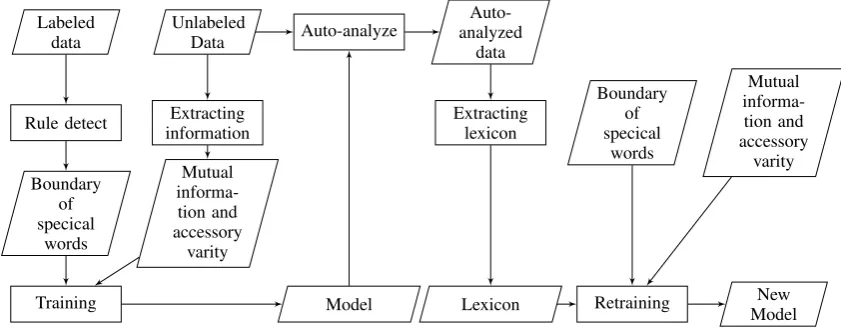
In this section, we describe the details of our sys-tem. We use some regular expressions to detect special words in micro blog. The detected word boundary ofURL,English wordandspecial punc-tuation, along with other information from unla-beled data, are integrated into a CRF sequence model as features. We build our first segmenter with information mentioned above and use this segmenter to parse large scale unlabeled data. Af-ter that, we extract a lexicon from auto-analyzed data and retrained the CRF model with informa-tion provided by the lexicon. The architecture of our system is illustrated in Figure 1.
2.1 Model and Basic Features
We employ a character-based sequence labeling model for word segmentation, which assign labels to the characters indicating whether a character is the beginning(B), inside(M), end of a word(E) or a unit-length word(S). A linear chain CRFs is used to learn model from annotated data. When con-sidering the candidate character tokenci, the basic types of features of our model are listed below.
• character unigram:cs(i−2≤s≤i+ 2)
• character bigram:cscs+1(i−2≤s≤i+ 1),
cscs+2(i−2≤s≤i)
• character trigram:cs−1cscs+1(s=i) • repetition of characters: iscsequalscs+1(i−
1≤s≤i), iscsequalscs+2(i−2≤s≤i)
• character type: iscianalphabet,digit,
punc-tuationorothers
2.2 Rule Detection Features
We introduce regular expressions to detect three kinds of special words in micro blog, URL, En-glish wordandIrregular suspension. These three type of words are demonstrate as below.
• URL: “来 看 华 硕 新 版U36首 发 评 测 吧 !http://t.cn/aBPi3D / Come and see the reviews of newly released ASUS U36! http://t.cn/aBPi3D”
• English word: “分享Colbie Caillat 的歌曲/ Share Colbie Caillat’s song”
• Irregular suspension: “非常的期待... / I’m expecting ...”
We encode word boundary detected by the reg-ular expressions into a new type of preprocessing features. If the candidate character token ci, the following features about URL is extracted.
• beginning of a URL:U RL(ci) =B
• inside of a URL:U RL(ci) =M
• end of a URL:U RL(ci) =E
Features ofEnglish wordandirregular suspension
can be represented in same manner.
We expect that CRF model learns from these matching results and this information assists the CRF model to detect special words and words sur-rounding them.
2.3 Semi-supervised Features
Information of unlabeled data can be easily com-puted and benefit the word segmentation mod-el. When integrated into machine learning frame-work, it will help reduce sparsity issue caused by the out of vocabulary words.
2.3.1 Mutual Information
In probability theory, mutual information mea-sures the mutual dependency of two random vari-ables. Empirical study shows that observation of high mutual information between two characters may indicates real association of these two charac-ters in a word, while low mutual information usu-ally means they belongs to different words.
In this paper, we follow Sun and Xu (2011)’s definition of mutual information. For a character bigram cici+1, their mutual information is
com-puted as follow:
M I(cici+1) = log
p(cici+1)
p(ci)p(ci+1)
For each character ci, M I(cici+1) and
.. Labeled
data.
Rule detect .
Boundary of specical
words
. Unlabeled
Data
.
Extracting information .
Mutual informa-tion and accessory
varity
.
Training
. Auto-analyze
.
Model
. analyzed
Auto-data
.
Extracting lexicon .
Lexicon .
Boundary of specical
words .
Mutual informa-tion and accessory
varity
.
Retraining .
[image:3.595.87.508.63.229.2]New Model
Figure 1: System architecture
2.3.2 Accessory Variety
Another empirical study of word segmentation boundary is that if some n-gram appears in many different environments, it’s more likely that this n-gram be a real word. Sun and Xu (2011) in-troduce a criterion Accessory Variety to evaluate how independently a n-gram is used. In this pa-per, we follow this study and incorporate the fol-lowing features LlAV(c[i:i+l−1]), LlAV(c[i+1:i+l]),
RAVl (c[i−l+1:i]),RlAV(c[i−l:i−1]) (l = 2,3,4)
in-to our model. Here LlAV(c[s:e]) and RlAV(c[s:e])
means accessor variety of strings with length l, c[s:e]means the character sequence starts from cs and ends withce.
2.4 Extracting Lexicon
Study has shown that CRF model can benefit from lexicon features(Zhang et al., 2010). Micro blog specified lexicon provides a clue for detecting words in unfamiliar context. In this paper, we try to extract a micro blog specified lexicon from auto-analyzed data to improve our model’s perfor-mance.
Firstly, we train a CRF model with features de-scribed in 2.2 and 2.3. We use this model to parse large scale unlabeled data, and a list of word is obtained. Intuitively, high frequency word in the auto-analyzed results is more likely to be real word. Therefore, we collect words that never oc-cur in the training data and rank them in order of frequency. A lexicon of words whose frequency is higher than a threshold is extracted. In this pa-per, top 80% most frequent words is extracted. We drop the tokens with more than 5 characters, and then build the lexicon.
After the lexiconDis built, we encode the in-formation of lexicon into a type of features. We follow Zhang et al. (2010)’s work on utilization of lexicon When consideringci, the lexicon feature we extract is shown below:
• match pref ix(ci, D) the length of longest word in lexiconDwhich starts withci
• match mid(ci, D) the length of longest word in lexiconDwhich contains withci
• match suf f ix(ci, D) the length of longest word in lexiconDwhich ends withci
3 Experiments
3.1 Data Preparation and Setting
We crawl some micro blog from September 1st, 2011 to September 5nd, 2011, and drop the entries which not contains simplified Chinese characters. We got 1 million entries and use them as unlabeled data. From these micro blog entries, we random-ly sampled 1,442 entries and manualrandom-ly annotated their segmentation. This set of corpus is use as one part of the labeled data. There are 23.3 words each entry in the annotated micro blogs on average. At the same time, 183,630 lines of sentences from People daily is also used as labeled data. All of the character in training and testing data is convert from single-byte character to double-byte charac-ter.
We conclude our experiments result on the sam-ple data of the bake-off task. There are 503 tries in the test data set, with 38.9 words each en-try. Recall(R), precision(P) and F1 is used as
e-valuation metrics of system performance. We al-so report the recall of out of vocabulary(OOV) words(Roov).
3.2 Effect of Annotated Micro blog
In this set experiments, we test performance of s-tandard supervised learning on different training data. As mentioned above, we have a large set of annotated corpus on newswire and a small set of micro blogs. We expected that a combination of these two corpus will help promote the perfor-mance.
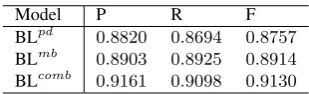
We extract basic features from this two data and trained two CRF model BLpdand BLmb. Then we combine two data and trained another CRF mod-el BLcomb. Performance of these three models is shown is Table 1.
Model P R F
BLpd 0.8820 0.8694 0.8757 BLmb 0.8903 0.8925 0.8914
BLcomb 0.9161 0.9098 0.9130
Table 1: Effect of different annotated corpus
In previous study, the state-of-the-art word seg-mentation system can achieve F-score of about 97%(Che et al., 2010) when tested in-domain data. However, Table 1 shows that when applied to mi-cro blogs, traditional word segmentation system’s performance drops severely.
Experiment result also shows that, a small set of annotated micro blog corpus can achieve bet-ter performance than the traditional newswire cor-pus. And the model trained with combination of two corpus out performance the others. In the fol-lowing section, all of our models are built on the combination of these two corpus.
3.3 Effect of Rule Detection Features
Table 2 compares the baseline model with model that integrates rule detection features.
Model P R F Roov
BL 0.9161 0.9098 0.9130 0.5763 +PRE 0.9216 0.9178 0.9197 0.6715
Table 2: Effect of preprocessing
We can see that rule detection features improve
the model’s performance, especially the recall of OOV. To give a farther analysis of rule detection features’ effect, we categorized words in test set into four sort: URL, English word, Punctuation,
Others and evaluate the recall of certain type of word. Table 3 shows the experiment result.
Model RU RL RP unc REng ROthers
BL 0.8940 0.9857 0.6018 0.8997 +PRE 0.9536 0.9862 0.9227 0.9040
Table 3: Recall of preprocessing on four sort of words
The experiment result shows that rule detection features improves the recall of special word type, especially the English words occur in micro blog. With more accurate detection of sepecial words, accuracy on ordinary words is also improved.
[image:4.595.103.258.354.401.2]3.4 Effect of Semi-supervised Features
Table 4 summarizes the experiment result on dif-ferent combination of semi-supervised features.
Model P R F Roov
BL+PRE 0.9216 0.9178 0.9197 0.6715 +MI 0.9282 0.9220 0.9251 0.7046 +AV 0.9309 0.9231 0.9270 0.7250 +MI+AV 0.9304 0.9231 0.9268 0.7123
Table 4: Effect of semi-supervised features
It can be seen that two types of semi-supervised features both result in improvement on perfor-mance. However, when two types of feature com-bined, the performance drops slightly. Empirical-ly, we consider that the effect of these two type features overlaps due to they share some common property.
3.5 Effect of Lexicon
We also compare our model integrating lexicon features and without lexicon features. The results are shown in Table 5.
Model P R F Roov
BL+PRE+MI+AV 0.9304 0.9231 0.9268 0.7123 +Lexicon 0.9352 0.9275 0.9314 0.7337
Table 5: Effect of lexicon features
As expected, lexicon features result in improve-ment over performance.
3.6 Final System
results show that our final system achieves an F-score of 93.14% and an improvement of 1.8% comparing to our baseline model. On the evalua-tion data of the bake-off, the F-score of our system is 94.07%.
4 Conclusion
In this paper, we describe our system of Chinese Word Segmentation on MicroBlog Corpora. We exploit a single model enhanced by preprocessing, semi-supervised and lexicon features. These fea-tures improve the model’s performance. Our mod-el achieve an F-score of94.07%on the bake-off’s test data.
Acknowledgments
This work was supported by National Natural Science Foundation of China (NSFC) via grant 61133012, the National “863” Major Projects vi-a grvi-ant 2011AA01A207, vi-and the Nvi-ationvi-al “863” Leading Technology Research Project via grant 2012AA011102.
References
W. Che, Z. Li, and T. Liu. 2010. Ltp: A chinese
language technology platform. In Proceedings of
the 23rd International Conference on Computation-al Linguistics: Demonstrations, pages 13–16. Asso-ciation for Computational Linguistics.
Naoaki Okazaki. 2007. Crfsuite: a fast implementa-tion of condiimplementa-tional random fields (crfs).
W. Sun and J. Xu. 2011. Enhancing chinese word
segmentation using unlabeled data. InProceedings
of the Conference on Empirical Methods in Natural Language Processing, pages 970–979. Association for Computational Linguistics.
Y. Wang, Y.T. Jun’ichi Kazama, W. Chen, Y. Zhang,
and K. Torisawa. 2011. Improving chinese word segmentation and pos tagging with semi-supervised
methods using large auto-analyzed data. In
Pro-ceedings of the Fifth International Joint Conference on Natural Language Processing (IJCNLP-2011).
M. Zhang, Z. Deng, W. Che, and T. Liu. 2010. Com-bining statistical model and dicitionary for domain
adaptation of chinese word segmentation. Journal