0
DEVELOPING A MODEL OF THE VARIOUS
TYPES OF RECOGNITION OF PRIOR
LEARNING AND THEIR USE IN YOUTH
WORK IN THE EUROPEAN UNION
K.J. SchutThesis supervisors
First supervisor: Joseph Kessels Second supervisor: Bernard Veldkamp
External supervisor
1
This project was carried out independently and outside the scope of the European institutions.2
Acknowledgement
Projects are never the work of a single person but rather the combined effort of many. This is also true for this project. Although it is part of my graduation of the Master program in Educational Science and Technology, I would never be able to reach such research quality without the help of others. In all the phases of the research people have given me opportunities to make this thesis what it is today. There is a concept called ‘the accumulation of opportunity’ which says that once you are given an opportunity more will follow. I believe this applied to me. As my graduation project progressed the opportunities became more and more plentiful and ever more exciting. I therefore would like to thank Maarten, Elise, Alison, Daniela, Martin, Veron, Sophie, Semih and off course Laura for supporting me during this project and helping me on this incredible journey. This list is not complete but I would like to express my thanks to the people that are not mentioned as well.
Even though there were many who supported, encouraged and otherwise helped me with this project, three people deserve it to be mentioned separately. They played a key role throughout the project making them essential for me. The first person is Marcel. Ever since we met in 2010 he has given me countless opportunities which allowed me to grow both on an academically and personal level. Thanks to him I got involved in the project on Recognition of Learning in Scouting and Guiding project. In this project I developed the first ideas which formed the foundation for this project.
The second person that deserves special mentioning is Pavel. He gave me the opportunity to place the project on the European stage. This allowed me to better develop the project and to conduct some tests at a level I could not imagine a year ago. Furthermore the coffee talks at Place de Luxembourg always provided me with new insights or encouraging words which strengthened my commitment to this project.
3
Summary
In European policy, the recognition of prior learning (RPL) is seen as a step towards lifelong learning. This is especially related towards informal and non-formal learning (European Commission, 2000; 2001b). In the context of this study RPL refers to the provision of some kind of recognition of the learning that has takeng place in these activities as described by Taylor and Clemans (2000).
Due to rapid economical and technological changes individuals are pushed to acquire higher and more generic skills (Pool & Sewell, 2007). In order to keep up with this increasing pace, the full spectrum of learning (ranging from formal to informal learning) has to be used (Malcolm, Hodkinson, & Colley, 2003). To access this whole range, RPL practices need to be integrated into traditional
educational systems. Doing so enables students to obtain partial or full qualifications based on previous experiences (European Commission, 2012a). Within the European Union (EU) two main problems were identified as part of an impact assessment into the state of the validation of non-formal and informal learning: (1) the limited opportunities and underuse of RPL practices and (2) the lack of compatibility and coherence between RPL approaches in the member states of the EU (European Commission, 2012b). In this thesis the first problem will be addressed and a solution will be generated in the form of a model which characterizes the different types of learning outcomes.
The above translates into the following research questions for this study:
1. What causes RPL to be used so infrequently in youth work in the EU?
2. What would the characteristics be of a model describing various types of RPL?
In order to address these questions a literature based Root Conflict Analysis was carried out to identify problems with regard to the underuse of RPL in Europe. This technique is used to identify causes that underlie the given problem. The analysis found four main categories of problems: the lack of a
common language, the limited resources available and limited quality of RPL. Ranking these problems resulted in the language problem being selected to generate a solution for. By applying idea
generating methodologies (inventive principles and –standards) solutions were developed to solve this problem. Ideas were divided in groups which were ranked using a multi-criteria decision matrix to determine the most appropriate one. The solution that was further developed is a model identifying the different aims why people seek RPL. Such a model can lead to a more targeted approach when it comes to helping individuals in getting their previous learning recognised.
The created model follows a user-based approach and is based on the key players in the RPL process regarding portfolio use as described by Johnson (2002): the person seeking RPL, the process advisor and the assessor. To these, a fourth actor was added: the evaluator (as described by Paddison (2012)). From these four actors the assessor and evaluator were identified as having the greatest impact when it comes to the aim of the recognition. Variations in the way these actors can be represented make up the foundation of the model. These variations are self-assessment and
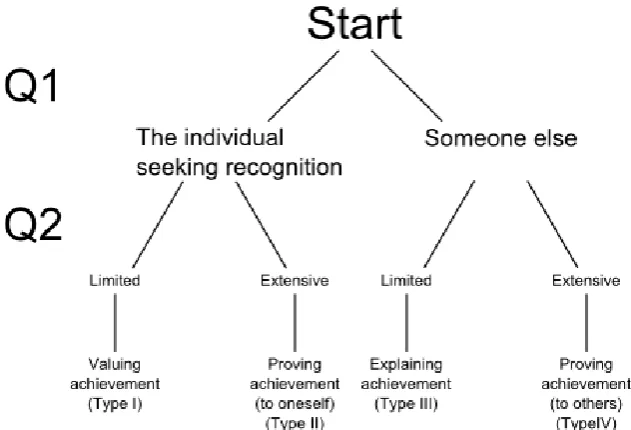
assessment by others in case of the assessor and a limited and broad extent of recognition in case of the evaluator. By placing these in a 2x2 matrix the model was generated. It distinguishes four types of recognition (I to IV): type I recognition is related to the valuing of achievements by the individual (e.g. to foster self-confidence or empowerment of the individual), type II relates to proving one’s
achievements to a limited number of people (e.g. internal certification), type III to explaining the achievement of the individual to others (e.g. CV translation tools) and type IV to proving one’s achievement on a large scale (e.g. credit exemption schemes). These types relate to the aims of recognition as described by Hart, Howieson and Semple (2009).
4
brings to the individual) whereas more extensive reach of the recognition is related to more extrinsic motives (related to factors outside the individual e.g. status).To increase the practical value of the model an instrument was developed which allows organizations to identify the different types of recognition that are taking place. In this instrument a
three-step process is used which organizations can use to identify and classify current strategies and develop new ones related to the development of new tools which enable the recognition of learning outcomes. This process can be aided by a database, which provides examples of recognition of learning outcomes in other organizations. For this purpose a prototype of this database was developed in this project.
The main outcomes of this study include the overview of the problems that limit the adoption of RPL practices in European youth work. A second outcome is the model which gives an overview of the different ways learning outcomes can be recognized. This is valuable as this allows for a targeted development of tools which address one type of recognition.
5
Table of contents
Acknowledgement ... 2
Summary ... 3
Table of contents ... 5
1. Introduction ... 7
1.1. Introduction ... 7
1.2. Thesis structure ... 7
2. Contextual framework and problem definition ... 9
2.1. Introduction ... 9
2.2. RPL policy in the European Union ... 9
2.3. Youth work policy in the European Union ... 10
2.4. RPL in youth work in the European Union ... 11
2.5. Problem definition ... 11
2.6. Relevance of the study ... 12
3. Methodology ... 13
3.1. Introduction ... 13
3.2. Research method ... 13
3.3. Respondents and sampling ... 15
3.4. Data analysis ... 17
3.5. Procedure ... 17
4. The limited use of RPL in the EU ... 19
4.1. Introduction ... 19
4.2. Problems with RPL in Europe... 19
4.3. Conclusion ... 26
5. Ranking the contradictions ... 27
5.1. Introduction ... 27
5.2. Order of comparison ... 27
5.3. Ranking using ideality based criteria ... 28
5.4. Ranking using comparative ranking ... 30
5.5. Conclusion ... 31
6. Generation of solutions ... 32
6.1. Introduction ... 32
6.2. Taking a closer look at the chosen contradiction ... 32
6.3. Using inventive standards to generate solution... 33
6.4. Using inventive principles to generate ideas ... 34
6.5. Conclusion ... 36
7. Ranking the ideas ... 37
7.1. Introduction ... 37
7.2. Grouping the ideas ... 37
6
7.4. Scoring the ideas ... 38
7.5. Conclusion ... 39
8. Design of an RPL model ... 40
8.1. Introduction ... 40
8.2. Existing RPL models ... 40
8.3. Design of a new model ... 42
8.4. Conclusion ... 49
9. Evaluation of the project ... 50
9.1. Introduction ... 50
9.2. Evaluation of the context analysis ... 50
9.3. Evaluation of the problem analysis ... 50
9.4. Evaluation of the model ... 51
9.5. Evaluation of the instrument ... 52
9.6. Evaluation of the prototype ... 54
9.7. Conclusion ... 54
10. Conclusion & discussion ... 55
10.1. Introduction ... 55
10.2. Conclusion ... 55
10.3. Relevance of the outcomes ... 55
10.4. Discussion ... 56
10.5. Areas of further study ... 60
10.6. Further steps for implementation ... 61
7
1.
Introduction
1.1. Introduction
We learn in everything we do. As little children we start to explore the world around us and learn new things. Once a certain age is reached our parents bring us to school. Here we are exposed to a structured form of learning which acts as a framework for discovering ideas. Together with our peers we learn the rules of our language, math and how the world works. Learning here is ordered along the lines of subjects. Learning achievements hold some form of formal value, which is expressed through certificates and diplomas.
During the time we spend in formal education we learn things outside school as well. By participating in society we can generate a lot of new knowledge on our own. This generation of knowledge can be done in various ways. For example, we take courses to become trained in subjects that are not in the formal curricula of our schools but spark our interests. By doing so, we generate a lot of knowledge in fields ranging from photography to computer science. Furthermore, we also take part in all kinds of other leisure-based activities in which we learn all kinds of things.
Although there is much learning that takes place outside school, this learning is often regarded as less valuable in comparison to the knowledge and skills gained in formal education. An example of where this learning of young people is taking place is in youth work. All over Europe youth work activities are taking place that are aimed at the development of young people and (to a lesser extend) adults. These are all taking place outside schools. As youth work gives young people the opportunity to develop their skills (Indecon, 2012), recognizing these is important. Especially people with a disadvantaged
background can benefit from the combination of the recognition of learning outcomes and youth work. For them this can be the first step to some kind of formal qualification (ICF GHK, 2014a). However, the application of RPL is still scarce in Europe (European Commission, 2012a) and it is difficult to obtain (formal) recognition of this type of learning. This so called recognition of prior learning (RPL) is something that can potentially have great benefits.
In this study the definition of RPL by Taylor & Clemans (2000) is used. These authors defined RPL as: “the recognition of non-creditentialled or informal learning (that is to say, observable learned outcomes based on experience rather than mere experience or mere outcomes)” (Taylor & Clemans, 2000). However, the notion of what encompasses RPL differs between writers, researchers and major policy influencing agencies resulting in a lack of consensus and a clear definition (Joosten-Ten Brinke, Sluijsmans, Brand-Gruwel, & Jochems, 2008; Smith L. , 2004). This lack of consensus about the conceptualization of RPL results in the use of a range of definitions (Stenlund, 2010) which range from the RPL as being only related to the rather narrow notion of credit transfer between studies or
universities (Pitman, 2009) to a more broader notion of RPL as a form of acknowledgement of previous learned competencies as a result of unstructured informal learning (Knight, 2006).
This study attempts to come up with answers to improve the application of RPL in the setting of European youth work. This will be done by analyzing the root causes behind this problem and
proposing a model, which incorporates the various types of recognition of prior learning. Such a model can help to structure the dialogue between policymakers, RPL professionals, youth organizations and other stakeholders in the RPL process. Doing so will allow these groups to develop targeted
interventions (through policy, RPL tools or other means) that can help (young) people to advance further in their life.
1.2. Thesis structure
8
situation came to be and to provide the background against which this study is carried out. Thisanalysis will result in the formulation of the two main research questions of this study. The second section will explain the method that will be used (Chapter 3). The next part (Chapter 4) aims to identify the causes that underpin the limited use of RPL practices in the European Union (EU). It will provide a broad overview of the current situation with regard to RPL practice in Europe. This overview portrays multiple problems that need to be solved to increase the use of RPL. Furthermore, creating this overview helps in the design of an intervention by identifying the issues that have to be taken into account during the design and development stages of the project. In Chapter 5 one of these causes will be selected for further examination. For the selected problem multiple solutions will be generated (Chapter 6). One of these is then selected (Chapter 7) and is further developed (Chapter 8). In this last chapter a justification of the importance of this solution is given and will be based on existing solutions and policy in this field. The fourth part (Chapter 9) will feature the evaluation of the
developed solution. This will be done by using various evaluation methods. The last chapter (Chapter 10) summarizes the research project and provides its conclusions. Furthermore, the limitations of this study and areas of future research will be discussed.
9
2.
Contextual framework and problem definition
2.1. Introduction
This chapter highlights the background in which context the project is operating. Doing so provides a clear picture about the current situation in RPL practices in the EU. It will help in the identification of root causes further in this thesis and helps to better understand the problems in RPL practice. First, this chapter will look into the last one and a half decade of policy development in this area. As this project is working on the crossroads of two policy areas (RPL and youth work) the background of those two fields will be presented. This is done separately for each of the policy fields before the current situation of both fields will be presented. However, this chapter is not meant to provide a complete overview of the history of these domains, but rather to give an introduction to the topic. Second, the research questions this report will address are formulated based on the current situation. Finally, the relevance of these questions is examined by looking at the scientific, societal and practical problems this study tries to address.
2.2. RPL policy in the European Union
2.2.1. A short policy background in the field of RPL in Europe
Although the first initiatives related to RPL date back to the 1930s in France, it was not before the 80s that RPL became more mainstream (Valk, 2009). On a European level the first developments in this field started to occur in the mid 90s and marked the start of the first of two periods regarding RPL on the EU policy level (Bjørnåvold, 2013).
The first of these periods ran from 1995 to 2012 and the White paper on teaching and learning (European Commission, 1995) is the first document that addressed this topic on EU level. This paper emphasizes the need for a more flexible educational system in order for the EU to become a learning society and aims to pave the way for a broader debate. It would however take five more years before other kinds than formal learning at all levels were considered important (Valk, 2009). This would come in the form of the Memorandum on lifelong learning (European Commission, 2000) where non-formal learning was listed as one of six key priority areas.
In the next five years after the Memorandum the importance of RPL was expressed several times more as can be seen from the Copenhagen Declaration (European Commission, 2002) (for the Vocational Education and Training (VET) sector), the Berlin Communiqué (European Commission, 2003) (in regard to the higher education sector (as part of the Bologna process)) and the common principles regarding identification and validation of non-formal and informal learning (Council of the European Union, 2004). Furthermore, the first version of the European inventory on the validation of non-formal and informal learning was conducted in 2004 and greatly expanded in 2005 (CEDEFOP, 2013a; 2013b). These studies described the state of recognition on a European (2004 version) as well as national level (2005 version). This study has been updated every three years to monitor the
progress in this field. The latest version of this study is the 2010 update (this version is currently being updated). The next meeting of the EU ministers of education explicitly named recognition of
experiential learning in the context of higher education (also known as the London Communiqué (European Commission, 2007)). This was the first time this was expressed explicitly as earlier documents were rather vague by speaking only about recognition without specifying the nature of the learning (Valk, 2009). However, linking this type of learning to higher education was only possible as a result of the introduction of the European Qualification Framework (EQF) (and the National
Qualifications frameworks (NQF)) in 2006/2007 as this provided a framework in which levels of learning could be characterized. A couple of years later, a set of guidelines was developed to help policymakers in this field (CEDEFOP, 2009).
10
gathered through the various European programs in this field (e.g. the Leonardo Da Vinci, Socrates, YouthInAction, Grundvig and EQUAL programs) (Bjørnåvold, 2013).Although it would seem from the above that recognition became important in the period from 1995 to 2012, the perceived importance was lacking in many institutions (Reichert & Tauch, 2005; Bjørnåvold, 2013). Furthermore, shared goals were lacking as well resulting in different approaches in the various member states (Crosier, Purser, & Smidt, 2007; Bjørnåvold, 2013). However, the implementation of RPL frameworks and practices has been slow but steady (Bjørnåvold, 2013).
2.2.2. The current situation of RPL in Europe
The second period regarding RPL in Europe started in 2012 with the Council recommendation on the validation of non-formal and informal learning (European Commission, 2012c). This document introduces a new coordinating body (the the European Qualification Framework (EQF) Advisory group) which brings together representatives from national authorities and other stakeholders. It aims to align the different approaches of individual member states, create a system for reporting and monitoring and, allows for the continuous development of tools (European Commission, 2013a). This signals a stronger political commitment to this theme than the previous period (1995-2012)
(Bjørnåvold, 2013). Furthermore, it identifies the two main problems that exist in the EU regarding RPL today. These are: (1) the limited opportunities and use of RPL practices and (2) the lack of
compatibility and coherence between RPL approaches in the member states of the EU (European Commission, 2012c).
2.3. Youth work policy in the European Union
2.3.1. A short policy background in the field of youth work in Europe
Although the first youth work activities in Europe were initiated at the end of the 19th and the beginning of the 20th century (ICF GHK, 2014a), the first real international collaboration in the field of youth would not take place before the end of the Second World War (Hansen, 2010). Initiatives like the World Federation of Democratic Youth in 1945 were set up in the spirit of co-operation between the allied countries. Despite this, the division of Europe by the Iron Curtain resulted in a division between Eastern and Western organizations in this field. It would take until 1969 before the EU stimulated co-operation between the two parts of Europe. In this year the European Economic Community (EEC) spoke about youth work and youth policies on one of their summits (See the conference summary of the meeting of the heads of state of government (European Economic Communities, 1969)), which resulted in the financial support of youth activities (Hansen, 2010). Besides these activities, the Council of Europe (CoE) has also been (and still is) very active in this field (cf. Hansen (2010)). As the focus of this thesis is the EU these activities will not be discussed here.
11
2.3.2. The current situation of youth work in EuropeThe continued commitment on youth issues on a European level was shown with the declaration of youth work, which is one of the outcomes of the first European youth work convention (European Youth Work Convention, 2010). The declaration calls for a need for further recognition of youth work as an important provider of non-formal and informal learning and the need for a better recognition of the skills learned by volunteers and young people. With regard to the employability of young people, the Irish presidency of the first half of 2013 further strengthened these ideas naming it as one of the key priorities of its presidency (Government of Ireland, 2013). When combined with the increasing importance of youth work through policy and the development of qualification frameworks for youth workers at a national level (ICF GHK, 2014a), youth work is now seen as an important policy area. Furthermore, the shift in youth work from leisure-based to activities focused on the education and the labour market and the professionalization of youth workers (ICF GHK, 2014a) allows for new
opportunities for RPL as well. This is beneficial for both youth workers (professional and volunteers) as well as young people.
2.4. RPL in youth work in the European Union
In the policy context described in the previous sections the importance of better recognition in informal and non-formal learning settings in youth work is acknowledged. Youth works gives young people the opportunity to develop their skills (Indecon, 2012). Although the current focus on EU level with regard to recognizing these skills is primarily focussed on the combating of youth unemployment, it is believed to be something that has value. Especially people of a disadvantaged background can benefit from the combination of RPL and youth work, as this can be the first step to some kind of formal qualification (ICF GHK, 2014a). In order to do so tools have to be developed that can facilitate the RPL process. It is therefore important to have a common framework of reference. However, a framework that encompasses the various types of RPL does not yet exist.
Although attempts have been made in this direction, models in this field mainly focus on the RPL process rather than providing a classification of the different types and tools used (see for example Duvekot, Schuur & Paulusse (2006), Scholten (2007) or Peeters (2011)). These are mainly based on the model of Whitaker (1989). Another type of model focuses more on various types of RPL. An example of this is the model of Hart et al. (2009). This focuses on different types of RPL but is only limited to the portfolio instrument only. Although this is a popular instrument in RPL (Fejes &
Andersson, 2009) it is not the only tool that can be used (Conrad, 2008). Examples of tools other than the portfolio range from self-reflection tools (e.g. the Competence profile tool of KFUM Spejderne (2012) or the Youtpass tool by the EC (Bergstein et al., 2011) to gamified recognition tools (e.g. the UNIQUE learning badges (UNIQUE network, 2013), the award system used by the Youth
Achievement Foundation (Graaf, Chapman, Bell, & Dunkerley, 2011) and CV translation tools (e.g. the Valorise toi tool of Scout et Guide de France (2011)).
2.5. Problem definition
As described in the previous sections, the underuse and lack of opportunities is considered as one of the main problems regarding RPL in Europe. A model, which classifies the various types of RPL can act as a framework which solves this problem. Such a framework is a step towards a common
language in the field of RPL. A model for describing the various types of RPL may create an overview, which can help policy makers, RPL practitioners and youth organizations to become more aware of the various opportunities there are in this field. This can help them to develop better policies and tools geared towards these various types.
The above translates into the following research questions for this study:
1. What causes RPL to be used so infrequently in youth work in the EU?
12
The first research question is aimed towards a better understanding of RPL in Europe. Thisunderstanding helps to point out key areas to which attention must be paid while designing the model. The second question is focused on the model itself. Given the model is targeted at youth work
organizations, the language used in the model (as well as the model itself) should be as simple as possible as these organizations are not used to RPL jargon. Furthermore, (perceived) complexity can be a major barrier for the use of an RPL model (Fejes & Andersson, 2009) resulting in limited use.
2.6. Relevance of the study
The relevance of this study is looked at from three perspectives: the scientific, the societal and the practical. For each of the perspectives the problems will be identified which this project aims to solve.
When looking at the scientific relevance of the study, it is mainly related to the modelling of the various types of RPL in youth work. As the lack of a common language in this field is perceived as the main threat to the implementation of life-long learning policies in Europe (European Commission, 2012b), this project aims to provide a solution to this problem. Although models in this field exist, none of these incorporate both multiple tools and various types of RPL (see previous section). However, as the lack of a common language is not the only problem regarding the infrequent use of RPL, a good overview of these problems is required. Therefore the first research question has also scientific relevance. Furthermore, answering this question helps to identify new areas of research aimed at solving the other problems in this field.
When looking at the relevance to society of the study it is also mainly related to the modelling of the different types of RPL in youth work. However, where the scientific perspective is focussed on the development of a common language for RPL, the primary aim here is to help young people to see the value of the things they learn through youth work. This is especially important for those who do not have some form of formal certification where youth work can be a first step in this direction (ICF GHK, 2014a). Furthermore, this model will allow policy makers to identify other types of learning outcomes (and therefore other ways of recognition) besides those related to formal diplomas and increased employability. As policy makers on a European level primarily see recognition as an instrument for one of these categories (see the first part of this chapter) the broader view of this study hopes to create a debate about what recognition is about. Finally, as this study also provides an overview of the problems it will help policy makers and other stakeholders to specifically target those issues.
13
3.
Methodology
3.1. Introduction
Before starting with the analysis of the problems an overview is given of the methods used in this thesis. The overview starts by presenting the various types of instruments used in this study. After this the individual instruments used are separately presented discussed in greater detail. This includes the reasons for choosing a particular instrument, the sample strategy used, selection criteria and number of respondents included in this study.
3.2. Research method
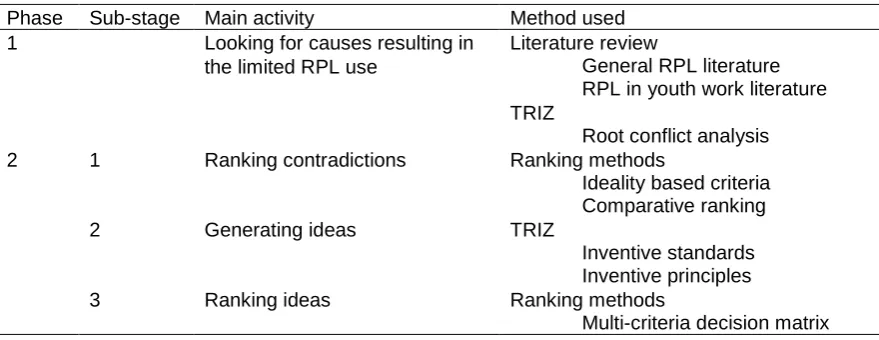
The methodology used in this project follows a four-step process, which is carried out sequentially. These phases correspond to the research questions formulated earlier. Phase 1 and 2 correspond to the first research question and phase 3 to the second question. The fourth phase is about the evaluation of the study. In this project qualitative research methods are used. Given the nature of the research questions (what and how questions) this type of research is appropriate. Furthermore, the lack of quantitative data in both the fields of RPL (Werquin, 2010) and youth work research (Dickson, Vigurs, & Newman, 2013), as well as the limited resources available for this project and the relative ease with which valuable qualitative data can be gathered (as a result of existing contacts with important stakeholders and experts) provide additional reasons to use this type of research methodology.
The first phase of this study consists of an analysis of the root conflicts causing the limited use of RPL in the EU. The aim of this phase is to provide a clear overview of these causes. Doing so results in the identification of problems to be addressed by the model. This is done by carrying out a literature review. This method requires few resources while providing a comprehensive overview (Verschuren & Doorewaard, 2007). To structure this process the literature review is combined with a Root Conflict Analysis (RCA+). This tool is part of xTRIZ. TRIZ (теория решения изобретательских задач, teoriya resheniya izobretatelskikh zadatch) is a problem solving and analysis theory consisting of multiple tools aimed at the development of inventive solutions (Barry, Domb, & Slocum, 2014). xTRIZ is a variation of TRIZ developed by TRIZ Master Valeri Souchkov. It includes several additional tools that are not part of the original set of TRIZ tools and is aimed at structuring thought processes and clarifying problems (Souchkov, 2013) (for an explanation of the tools used in this thesis see annex 8). As the problem of the limited use of RPL is complex, a structured approach helps in the identification of these causes. The literature in this stage will be limited to the recognition of non-formal and informal learning. This means literature on the recognition of specific sectors, professions or activities (e.g. youth work, youth workers and volunteering) was not included. Although these fields have similar problems, they are not part of the same topic as the one discussed in this thesis. As the problem with RPL in the EU is not specifically tied to one sector (e.g. youth work) literature from all sectors was considered relevant. No geographical boundaries were set but literature related to recognition in Europe was preferred over literature discussing problems outside this continent.
The second phase aims at ranking the problems found in the first phase and generate solutions to solve the most important problem. Furthermore, the ideas generated will be ranked to find the best solution for the problem. This will be done using several ranking methods (ideality based criteria, comparative ranking and multi-criteria decision matrixes) and inventive standards and –principles. These are abstract solutions strategies which can be applied to problems. The standards and principles were derived from searching for common patterns in inventions. These tools are part of TRIZ and are aimed at the generation of inventive solutions in a structured way (Souchkov, 2013).
14
The first step is to review existing models in RPL and to provide a provisional classification for them. Doing so identifies types and characteristics of these models that can help in the design andevaluation of the model to be developed for this project. This is done by conducting a literature review of existing models in RPL. This method is chosen for the same reasons as in phase 1. The second step consists of the design of the model and supporting documentation. This will be done based on the literature found in step one of this phase. Furthermore, the model should fit within the framework of EU policy as described in the previous chapter.
The fourth phase is about evaluation of the research project and its results and consists of four sub-steps. These steps are: the evaluation of the problem analysis, the evaluation of the model, the evaluation of the instrument and the evaluation of the database.
The first step is the evaluation of the problem analysis. For this an expert review will be conducted with EU and RPL experts (for respectively the context analysis and the root conflict analysis). The use of this method allows to quickly estimate the validity of the model using limited resources (Verschuren & Doorewaard, 2007). In these reviews experts will be interviewed using semi-structured interviews. These interviews will be conducted by phone and Skype. Doing so limits the resources needed while allowing for a deeper insight than other tools (e.g. survey research). The experts will be interviewed independently of each other as much as possible to avoid the possibility of groupthink. The interviews will serve as a basis for a write-up of the interview. These write-ups will then be used in the evaluation. The evaluation criterion for this step is the completeness of the analysis. Besides this the use of TRIZ will be evaluated by an expert as well. This will be done by submitting the first eight chapters of this thesis for one of the courses offered at the University of Twente on using TRIZ in a real-live setting. The second step is the evaluation of the model. This will be done by the same methods as the previous steps (expert review and evaluation of the TRIZ methodology). The evaluation criteria of this step are the completeness of the model (covers all types of RPL) and ease of comprehension (lack of RPL specific jargon). Furthermore, conferences on RPL and recognition in youth work will be visited to evaluate the model. The evaluation of the instrument will be done by conducting a try-out with staff members active in youth organizations. This will be done to see if they can work with the instrument. In this project the word instrument will be used when referring to the tool that is developed in this project. The word tool will refer to tools that have been created outside this project. A second test will be conducted in which a number of existing case studies. The case studies will be passed through the instrument to see if it can classify real life situations into the categories. The last step of the evaluation will be the evaluation of the database. This will be done using an expert review. In here, the
documentation and the actual database will be submitted as part of a course on database development on the University of Antwerp.
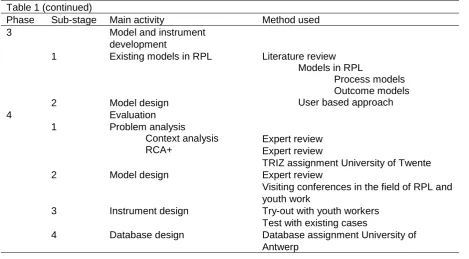
[image:15.595.73.513.581.751.2]An overview of the various instruments used in the various phases is given in table 1.
Table 1. Instruments used in the various phases of the project
Phase Sub-stage Main activity Method used 1 Looking for causes resulting in
the limited RPL use
Literature review
General RPL literature RPL in youth work literature TRIZ
Root conflict analysis
2 1 Ranking contradictions Ranking methods
Ideality based criteria Comparative ranking
2 Generating ideas TRIZ
Inventive standards Inventive principles
3 Ranking ideas Ranking methods
15
Table 1 (continued)Phase Sub-stage Main activity Method used
3 Model and instrument
development
1 Existing models in RPL Literature review Models in RPL
Process models Outcome models
2 Model design User based approach
4 Evaluation
1 Problem analysis Context analysis RCA+
Expert review Expert review
TRIZ assignment University of Twente
2 Model design Expert review
Visiting conferences in the field of RPL and youth work
3 Instrument design Try-out with youth workers Test with existing cases
4 Database design Database assignment University of Antwerp
3.3. Respondents and sampling
3.3.1. Sampling strategy
This study uses different sampling methods for the various steps in the evaluation. For the evaluation of the context analysis and RCA+ analysis criterion sampling (as described by Onwuegbuzie & Leech (2007)) was used to select the experts for this study. As the purpose of this phase is to ensure the quality of this analysis this sampling strategy is appropriate (Miles & Huberman, 1994). The selection criterion used to select the experts is presented in the next sub section. Experts were contacted by e-mail. For a detailed description of approach methods see annex 6.
For the evaluation of the model design opportunistic sampling (as described by Onwuegbuzie & Leech (2007)) was used. This was done as an opportunity arose during the project to have the model
evaluated by the expert group of the youth partnership between the European Commission (EC) and Council of Europe (CoE). This group consists of experts from all of the stakeholders that are relevant for this project making it the ideal group to evaluate the model with. Conferences to take part in were selected using snowball sampling (as described by Onwuegbuzie & Leech (2007)) by asking
individuals that are working in youth work on a European level about upcoming events that were interesting for this project.
For the third step opportunistic sampling was used in the case of try-out with youth workers and snowball sampling in the case of the test with case studies (see Onwuegbuzie & Leech (2007)). In the try-out with youth workers the opportunity arose to test the instrument during a European conference for scout leaders. The opportunity was given to do so as part of one of the workshops of the
conference. With regard to the test with the existing case studies the existence of the database was discovered during a conference in which it was presented.
3.3.2. Selection criteria
Different selection criteria were used for the various steps in which data was gathered.
[image:16.595.70.540.96.355.2]16
the right people for this evaluation. The selection of experts for the evaluation of the RCA+ analysis was based on their knowledge of RPL in Europe. This translated in the criterion of having at least five years of experience in the field of RPL. No connection with youth was necessary as this analysis deals with RPL in a broader scope. However, additional experience in this field was considered a benefit. For the evaluation of the model, experts were selected that currently work in the youth sector or in a sector related to it (e.g. government officials dealing with youth issues). Furthermore, experts needed to represent the different stakeholders that are active in this field. This was done to gain feedback from the various actors thus creating better data saturation and wider acceptance (which makes the model easier to implement). Conferences that were visited were selected based on the agenda of the events. Recognition and youth work were the criteria. A preference was given to events that included both themes on the agenda. However, if recognition was only on the agenda the event wasconsidered as well.
For the evaluation of the instrument youth workers were selected that participated in a conference in October 2013 in Malle, Belgium. This conference was about educational methods in Scouting. The targeted audience consisted of volunteers and professionals in Scouting who work on a national level. The case studies for the other test of this sub step were taken from the Observal-Net database. This database is one the results of the Observal-Net project aimed at identifying good practices regarding the Validation of Non-formal and Informal Learning (VNIL) in Europe. It contains a number of cases, which are considered good practices in this field. Therefore, it should be possible to identify what type of RPL these cases aim at.
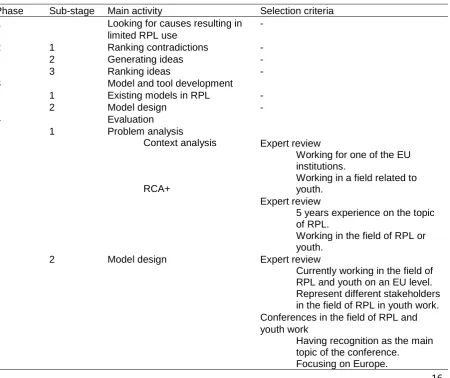
[image:17.595.81.532.384.762.2]An overview of the selection criteria for respondents in the various stages is given in table 2.
Table 2. Selection criteria for the various instruments
Phase Sub-stage Main activity Selection criteria
1 Looking for causes resulting in
limited RPL use
-
2 1 Ranking contradictions -
2 Generating ideas -
3 Ranking ideas -
3 Model and tool development
1 Existing models in RPL -
2 Model design -
4 Evaluation
1 Problem analysis Context analysis
RCA+
Expert review
Working for one of the EU institutions.
Working in a field related to youth.
Expert review
5 years experience on the topic of RPL.
Working in the field of RPL or youth.
2 Model design Expert review
Currently working in the field of RPL and youth on an EU level. Represent different stakeholders in the field of RPL in youth work. Conferences in the field of RPL and youth work
17
Table 2 (continued)Phase Sub-stage Main activity Selection criteria
3 Instrument design Try-out with youth workers Working on (national) management level in a youth organization in the field of education & training in Europe. Test with existing case studies
Part of the Observal-Net database.
4 Database design -
3.3.3. Sample size
Different sample sizes are taken for the different evaluations. For the evaluation of the context analysis one expert will review the work. Although this limits the acceptance of the analysis, its aim is to present the main ideas and to review whether or not major policies were omitted in writing this section. Four experts in this field reviewed the problem analysis. Again this limits acceptance. However, the seniority of the experts (as described in table 2) hopes to compensate this fact. The sample size expert review of the model design will be eight. Although this number is low
according to Creswell (2002) for grounded theory research (at least 15-20 people are suggested), the expert groups consists of the major stakeholders in the debate in RPL in youth work. Furthermore, this size is big enough to let everyone have their say and manageable to moderate (Morgan, 1997).
In the evaluation of instruments design three groups of ten to fifteen participants were consulted. The number of groups is usually enough to reach data saturation (Morgan, 1997). Although the number of participants per group is relatively high when it comes to the moderation of the discussion, this problem was overcome by having two moderators instead of one. The number of case studies evaluated was fifty. Given the aim of this evaluation (see if the questions in the instrument are usable to specify the various types of RPL), this number is sufficient (Morse, 1994).
3.3.4. Instrumentation
Guidance notes for both the expert reviews and the tests as well as templates for the write-ups have been developed. These documents can be found in annex 6. Guidance notes and templates were drafted based on similar documents used by ICF GHK for similar purposes. ICF GHK is a multinational consultancy firm with an office in Brussels (ICF Consulting Limited, 2013) where I did an traineeship from February 2013 till June 2013.
3.4. Data analysis
The analysis of the quantitative data was carried out using specialized software (NVivo, version 10). This resulted in a quicker and more systematic approach compared to when non-specialist software (e.g. document processing software) would have been used. In this software all the data gathered in this project (expert reviews and experiments) was coded using a predetermined set of codes. Codes were based on the characteristics of the various categories of the model, the types of RPL, RPL instruments used and the lack of RPL jargon used in the model. Different sets of codes were used for the expert review and the case studies. Lists of codes are displayed in annex 7.
3.5. Procedure
19
4.
The limited use of RPL in the EU
4.1. Introduction
This chapter aims to identify the reasons that cause RPL to be used infrequently in the EU. These root causes can then be resolved, which in turn solves the main problem. For this a combination of Root Conflict Analysis (RCA) and a literature review will be used (for an explanation of Root Conflict Analysis see annex 8 or chapter 2 of Souchkov (2013)). The first part of the chapter determines the starting point of the analysis after which separate perspectives of looking at the problem are
discussed. These perspectives are then combined to give a clear overview of what causes the limited use of RPL in Europe.
4.2. Problems with RPL in Europe
As a starting point of the analysis the limited use of RPL in the EU is taken. This is considered to be one of two main problems in RPL in Europe (European Commission, 2012b). In RCA this problem is formulated as displayed in figure 1.
Figure 1. The main problem in RPL in Europe
Based on the problem further analysis was carried out looking for causes that contribute to this problem. This was done using a literature review of RPL. This review resulted in a number of causes that were grouped together using three different perspectives. These are the linguistic perspective, the quality perspective and the resource perspective. These groups are first discussed separately before they are combined in the RCA+ diagram.
4.2.1. The linguistic perspective
The first perspective discussed is a linguistic one. Although RPL is considered to be important at the EU policy level, there is no set of definitions of RPL in this field (Werquin, 2010). Although the valuing of things learned in life is common all over the world (Hargreaves, 2006) there seems no consensus between writers, researchers and major policy influencing agencies regarding a clear definition of RPL (Joosten-Ten Brinke et al., 2008). This is further complicated by discussions about what encompasses different kinds of learning (formal, non-formal and informal) in adult education (Conrad, 2008).
Although using different concepts and terminology, all approaches agree that RPL is related to the increasing of awareness by both individuals and society of learning outcomes (Fejes & Andersson, 2009). Another interesting point of similarity between the definitions used is that, they all focus on finding ways to document previous undocumented learning (Taylor & Clemans, 2000). As noted in the introduction of this paper, here the definition of Taylor & Clemans (2000) is used which defines RPL as “the recognition of non-creditentialled or informal learning (that is to say, observable learned outcomes based on experience rather than mere experience or mere outcomes)” (Taylor & Clemans, 2000) since it covers the aspects (of informal learning and awareness) regarding RPL most scholars agree on and does not specify the aim (e.g. the increase of employability of individuals) of the recognition.
20
scale it is directly related to the limited use of RPL. In the RCA+ diagram this results in the element displayed in figure 2 to be added to the RCA+ diagram.Figure 2. Main problem presented by the linguistic perspective
Within the EU this lack of common RPL language seems to be caused by two elements: the differences between member states and the lack in coherence between RPL definitions.
The first element refers to the many differences between member states (Konrad, 2010). As discussed earlier (section 2.2), approaches vary greatly within the EU member states when it comes to RPL. Even though the number of clusters of similar approaches has been reduced in Europe from five (Bjørnåvold, 2000) to two (Hawley et al., 2010), RPL practices still greatly differ between countries. RPL approaches either predominantly focus on design and management of initiatives on national or local level. Furthermore, differences can be found in the degree of implementation of RPL. This differs greatly between countries and even inside various sectors in the same country (Hawley et al., 2010). However, these differences between member states with regard to the approach taken also have their benefits. The major benefit of this diversity is the ability to cater for the specific needs of that country and sector. This is positive as this makes RPL easier to apply in the (educational) frameworks of the countries. Although this is not necessary beneficial from an EU perspective, it is looking from the viewpoint of the individual EU citizens. This results in a contradiction. In the RCA+ diagram as presented in figure 3.
Figure 3. Contradiction of the differences between member states in the field of RPL
The second underlying cause is the lack of coherence between RPL definitions. There seems to be little or no consensus between writers, researchers and major policy influencing agencies regarding a clear definition of RPL (Joosten-Ten Brinke et al., 2008; Smith L. , 2004). This results in the use definitions (Stenlund, 2010) ranging from RPL as only relating to the rather narrow notion of credit transfer between studies or universities (Pitman, 2009) to a broader one where RPL is seen as a form of acknowledgement of previous learned competencies gained through unstructured informal learning (Knight, 2006). Different concepts are used to define the same thing and tend to differ between countries or regions. Terms more associated with recognition of formal learning like “credit transfer” and “qualification recognition” are often confused with RPL (National Qualifications Authority of
21
2008). Besides this, the term Validation of non-formal and informal learning (VNIL) is also often used in discussions on the European level (e.g. see the Council Recommendation on this topic of 2012 (European Commission, 2012c)). Although this concept specifically focuses on non-formal and informal learning, its focus is primarily on the formal recognition by education institutions (and to a lesser extent on the recognition by employers) as a way to increase employability.Even in European policy different things are meant with seemingly similar definitions. For example ‘recognition of non-formal and informal learning’ as used in Europe’s 2020 strategy is not the same as the term ‘recognition of prior learning’ as used in the supporting documentation of the Bologna treaty as this also incorporates formal education (Hawley et al., 2010). In the RCA+ diagram this lack of coherence will be displayed as presented in figure 4.
Figure 4. Second element in the linguistic perspective
Even though the lack of a common definition is not beneficial for RPL practices, it is caused by a more fundamental problem. This is the lack of consensus of what RPL actually is (Hargreaves, 2006). When talking about RPL different things are meant. As with the definitions, this ranges from formal
qualification to less formal approaches aimed at personal development.
This distinction is described by Birenbaum (1996) in the context of portfolio use as ‘grading’ versus ‘inquiry reading’. This lack of consensus is obviously not beneficial for the definition of RPL and therefore it is mentioned separately in the RCA+ diagram. This is presented in figure 5.
Figure 5. Lack of consensus about what RPL is
22
Figure 6. Contradiction related to the existence of various RPL types
These two elements are connected to the main cause of this perspective by a so-called “AND” relationship. This means that either one of the elements has to be solved in order to overcome the main problem presented in this perspective. To solve the problem of lack of a common RPL language approaches have to become more similar or definitions have become clearer. In the first case similar approaches towards RPL will result in a better common understanding of what everyone is doing in this field. This consensus allows for the existence of multiple definitions as it is agreed what the methodology to be used is and what the final outcomes should be. On the other hand, solving the second problem will create a foundation for a common RPL language as well clarifying what is meant by RPL (and its different forms). The use of a common definition allows for multiple approaches towards RPL by clarifying the current situation allowing for a better understanding of the approaches of others. This results in the overview of the linguistic perspective as presented in figure 7.
Figure 7. Overview of the linguistic perspective
4.2.2. The quality perspective
The second perspective discussed is that of quality. Concerns exist about the quality of RPL (Joosten-Ten Brinke et al., 2008; Stenlund, 2010). These concerns regarding the quality can be divided into two groups. These are related to the perceived and actual quality of RPL and RPL procedures. In the RCA+ diagram the main problem of this perspective is presented in figure 8.
23
In society, RPL is mainly perceived negatively (Hawley et al., 2010). For example, in Greece RPL of non-formal and informal learning is looked down upon as something that is less valuable than a similar qualification obtained through formal education (Hawley et al., 2010). Even in Finland, which has a well-developed RPL system, students prefer to go through formal education rather than a validation process (Hawley et al., 2010). Also, other groups than students share the conviction that non-formal and informal learning are less valuable. For example, educational providers in northern Europe expressed being anxious about the implementation of RPL frameworks for non-formal and informal learning as a result of the limited perceived value of these types of learning (Nordiskt Nätverk för Vuxnas Lärande, 2010).Changing these believes is hard and, given the limitations of this study and the extensive nature of this problem, is not considered possible within this study. Therefore, it is considered as being an
unchangeable negative effect. This does not mean the problem cannot be solved. It rather is outsidethe scope of the project. In the RCA+ diagram this is presented in figure 9.
Figure 9. Undervaluing of non-formal and informal learning
Problems relating to the actual quality of RPL are mainly related to the validity aspect. In order to be considered trustworthy by RPL providers, empirical evidence must be present to ensure validity of the methods used. This lack of empirical evidence is caused by a limited number of empirical studies (Joosten-Ten Brinke et al., 2008; Stenlund, 2010). This is in contrast to the theoretical evidence that is available for most procedures regarding construct validity, reliability and perceived trustworthiness (Stenlund, 2010). This lack of quality assurance is something negative and makes educational
institutions limit the amount of RPL they allow in a curriculum (Pitman, 2009). Another downside of this lack of evidence is the preference of educational institutions to only recognize learning of students who can present some form of documentation. Since RPL also intends to give credit to students who learned in an informal environment, this can be considered to be a negative effect and be a potential barrier for these students (Hargreaves, 2006; Pitman, 2009). As this study does not aim to create empirical evidence for specific tools but rather focuses on the mapping of the various types of RPL this is considered to be an unchangeable negative effect. Again, this is the result of it being outside the scope of the project. This is displayed in figure 10.
Figure 10. Causes relating to the lack of quality in RPL
24
reputation of an RPL provider. As a result of the part of the RCA+ diagram relating to this perspective looks as follows (figure 11).Figure 11. Overview of the quality perspective
4.2.3. The resources perspective
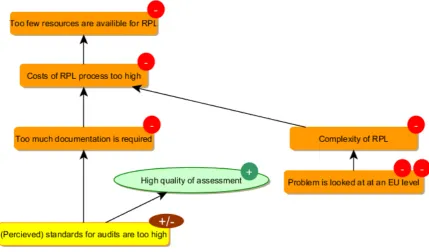
The third perspective that causes RPL use to be limited is the lack of resources available. The high costs related to this method of learning are a significant disadvantage (Fejes & Andersson, 2009; Smith L. , 2004). These costs, both related to time and money, appear to be a major disincentive for both students and RPL providers (Smith L. , 2004) and seems to be caused by the complex nature of RPL (Gallacher & Feutrie, 2003; Knight, 2006; Taylor & Clemans, 2000) and a need for extensive documentation (Gallacher & Feutrie, 2003; Smith L. , 2004). In the RCA+ diagram these two causes ate connected with an “IF” relationship. Even though simplifying RPL would decrease the need for extensive documentation this does not necessarily work the other way around. As a result both negative effects need to be solved. In the RCA+ this is displayed in figure 12.
Figure 12. Causes resulting in the cost of RPL being too high
25
for individuals and institutions that seek recognition with formal educational institutions. In the RCA+ diagram this is displayed in figure 13.Figure 13. Contradiction between required documentations and quality of assessment
The complexity of RPL in this situation seems to be caused by the fact that the problem is looked at EU wide. Looking at RPL from an individual level it often becomes simpler. As the starting point of this analysis is the EU level, it is considered to be an unchangeable negative effect in this context.
This leads to the conclusion of this perspective. A complete overview of this part of the RCA+ diagram is displayed in figure 14.
Figure 14. Overview of the resource perspective
4.2.4. An overview of all of the perspectives
26
Figure 15. Relation between the main problem and the four perspectives
This completes the RCA+ diagram related to the causes underpinning the little use of RPL. A complete image of the whole diagram is presented in annex 2.
4.3. Conclusion
27
5.
Ranking the contradictions
5.1. Introduction
In this chapter the contradictions found in the previous chapter will be ranked according to their importance. This will be done to determine which contradiction can be solved best. For this purpose ideality based criteria (for elements in an “AND” relationship) and comparative ranking (for elements in an “IF” relationship) will be used. These evaluation methods are used in xTRIZ alongside the Root Conflict Analysis (Souchkov, 2013).
5.2. Order of comparison
Before carrying out the actual comparison, the order in which the comparisons have to take place has to be determined. This is necessary as the contradictions appear on various levels in the RCA+ diagram and are connected with each order though different relationships. Determining the ranking order will be done based on a simplified structure of the RCA+ diagram. In this structure the relations between the contradictions is displayed with all the negative effects taken out (except for the main problem). This is shown in figure 16. The main purpose of this figure is to present the structure of the diagram with regard to the contradiction and the relationships between them rather than the actual content of these contradictions. The content of the contradictions is presented in table 3.
Figure 16. Simplified structure of the RCA+ diagram
The three contradictions that were found in the previous chapter are visible in the overview. Two of them (contradiction 1 and 2) are connected through an “AND” relationship. Together they are
28
Table 3. Contradictions and their effects
Type of effect Contradiction
number
Cause Positive Negative
1 Too many types of
RPL exist
Ability to create personal value
Too little consensus of what RPL is
2 Difference between
member states is too great
Interventions/ Approaches are focused on the national situation
No common RPL language
3 Validity requirements are too high
High validity of assessment Too much documentation is required
5.3. Ranking using ideality based criteria
The contradictions that are connected through the “AND” relationship will be ranked first using the ideality based criteria method. This method is used when problems or solutions are dependent of each other, causally or complexly related. This dependence does not allow for a direct comparison as it is difficult to predict which contradiction is the most important. However, heuristic criteria (called the ideality based criteria) can be used to estimate the expected degree of ideality. Solutions that allow for greater ideality are better than those that allow for a lesser degree of ideality. Four of these heuristic criteria are identified in xTRIZ: (1) involving a minimal number of components (solutions involving less components are better), (2) focussing on system elements (solutions that do not require changes to the super system are better), (3) easy to change (solutions that only involve changes that are easily made are better) and (4) alignment with the overall strategy of the problem owner (solutions that are better aligned are better). For each of these heuristics comparative ranking is carried out and the results are added together. The contradiction with the highest score is solved first (cf. annex 8). Problems are solved from the perspective of the problem owner (Souchkov, 2013). The problem owner in this case is twofold. On the one hand this is the European Commission which aims to improve the use of RPL in Europe. More specifically it is Directorate General Education and Culture (DG EAC) (the Directorate General responsible for youth work affairs within the European Commission (European Commission, 2013b)), the Directorate General Employment, social affairs and inclusion (DG EMPL) (the Directorate General responsible for responsible for policy in the field of employment, social affairs and inclusion (European Commission, n.d.)). On the other hand individuals seeking RPL are also considered to be problem owners as they as they are the ones who experience the negative effect as well. Furthermore, they fulfil the role of customer in this problem.
5.3.1. Involvement of a minimal number of elements
The first criterion handles about the number of elements that are involved in the contradiction. The involvement of fewer elements is favourable here as this means fewer components have to be modified to overcome the problem (Souchkov, 2013).
In comparing the contradictions one and two it can be argued the first involves the least components. Whereas the components of contradiction number two consist of the approaches of the various member states and institutions involved in the implementation of RPL systems, the elements involved in contradiction one are more limited. The problem described in contradiction one only affects the various tools used and the academic debate as on the grassroots level interest in defining the different types of RPL is extremely low. Therefore contradiction one receives a score of one and contradiction two a score of minus one. This is displayed in table 4.
Table 4. Ranking scores related to the use of the minimal number of elements
29
Contradiction 1 21 X 1
2 -1 X
5.3.2. Focus on system elements
The second criterion is about the degree of involvement of system components. The involvement of system components, as opposed to components of the super system (the super system consists of everything that is outside the system. For example a road is part of the super system of the system ‘car’), is considered to be favourable as this means it is more likely to find solutions locally (Souchkov, 2013).
In the comparison between contradictions one and two it can be argued the second involves more local components. Whereas the first contradiction is a significant influencer for the super system this is much less the case in the second one. An increase or decrease in the number of RPL types has an impact on the debate about the definitions relating RPL. However, the different approaches of member states only influence the approaches of other countries in a limited way. Therefore, contradiction one receives a score of minus one and contradiction two a score of one. This is displayed in table 5.
Table 5. Ranking scores related to the focus on system elements
Contradiction Contradiction 1 2
1 X -1
2 1 X
5.3.3. Ease of change
The third criterion handles about the ease with which the components of the system can be changed. The ease with which changes can be made is considered to be favourable as this has a positive impact on the implementation of the solutions (Souchkov, 2013).
In the comparison between contradiction one and two it can be argued the first contradiction consist of easier changeable components. Where the second contradiction has strong links with national and European policies (e.g. EVC in the Netherlands (national level) and the ECVET en ECTS credit systems (European level)), the first one is limited to the rules regarding the use of the various tools. In order to change the components of the second contradiction the actors in the policy making process have to be involved. This usually takes quite a bit of time as current approaches are often part of long-term strategies. On the other hand, the tools and the rules governing their use can be changed with relative ease. Therefore, contradiction one receives a score of one and contradiction two a score of minus one. This is displayed in table 6.
Table 6. Ranking scores related to the ease of change
Contradiction Contradiction 1 2
1 X 1
2 -1 X
5.3.4. Alignment with the strategy of the problem owner
The fourth criterion handles about the alignment ofthe solution has with the strategy of the problem owner. Contradictions that align better with the problem owners’ strategy than those which are less aligned are considered to be better solutions (Souchkov, 2013). As discussed in the beginning of the chapter the problem owners are the EC as well as individuals seeking recognition.
30
seeking recognition (as a good single definition makes RPL easier to understand) and contradiction number two favours the EC (as a similarity in RPL approaches eases policy making). Therefore both contradictions receive a score of zero. This is displayed in table 7.Table 7. Ranking scores related to the alignment with the strategy of the problem owner
Contradiction Contradiction 1 2
1 X 0
2 0 X
5.3.5. Calculating the scores
After the individual scores on the four criteria the final scores can be calculated. This is done by adding the four sub-scores. The result of this is presented in table 8.
Table 8. Final scores of the ideality based criteria method
Contradiction number Ideality based criteria 1 2
Minimal elements 1 -1
Focus on system elements -1 1
Ease of change 1 -1
Strategy alignment 0 0
Totals 1 -1
With a score of one, contradiction number one is considered to be the most appropriate to solve. Although contradiction number two focuses more on system elements and contradictions are tied on the point of strategy alignment, this is not enough to choose this contradiction in favour of
contradiction one as the total score of contradiction two is lower (than that of contradiction one).
5.4. Ranking using comparative ranking
The remaining contradictions (one and three) are linked by an “IF” type relationship. To rank these contradictions comparative ranking can be used to determine the contradiction that can be solved best. Here, contradictions are compared in pairs to each other based on the degree to which they contribute to the main problem (Souchkov, 2013). The problem in the comparison that contribute most to the general problem receives a score of one and the problem that contributes less a score of minus one. In case both problems contribute evenly to the problem both problems receive a score of zero.
31
As no other pair wise comparisons have to take place (there are no other contradictions) this is also the final score. This is presented in table 9.Table 9. Results of the comparative ranking method
Contradiction
Contradiction 1 3
1 X -1
3 1 X
Totals 1 -1
With a score of one, contradiction one has the highest score and is selected as the contradiction that can be solved best. Contradiction three comes second with a score of minus one.