publisher policies. Please scroll down to view the document itself. Please refer to the repository record for this item and our policy information available from the repository home page for further information.
To see the final version of this paper please visit the publisher’s website. Access to the published version may require a subscription.
Author(s): David Tall and Michael Thomas
Article Title: Encouraging versatile thinking in algebra using the computer
Year of publication: 1991
Link to published version: http://dx.doi.org/ 10.1007/BF00555720
using the Computer
David Tall & Michael Thomas
Mathematics Education Research Centre Coventry School - Bablake
University of Warwick Coundon Rd
Coventry CV4 7AL Coventry CV1 4AU
U.K. U.K.
Abstract
In this article we formulate and analyse some of the obstacles to understanding the notion of a variable, and the use and meaning of algebraic notation, and report empirical evidence to support the hypothesis that an approach using the computer will be more successful in overcoming these obstacles. The computer approach is formulated within a wider framework of versatile thinking in which global, holistic processing complements local, sequential processing. This is done through a combination of programming in BASIC, physical activities which simulate computer storage and manipulation of variables, and specific software which evaluates expressions in standard mathematical notation. The software is designed to enable the user to explore examples and examples of a concept, in this case equivalent and non-equivalent expressions. We call such a piece of software a generic organizer because it offers examples and non-examples which may be seen not just in specific terms, but as typical, or generic, examples of the algebraic processes, assisting the pupil in the difficult task of abstracting the more general concept which they represent.
Empirical evidence from several related studies shows that such an approach significantly improves the understanding of higher order concepts in algebra, and that any initial loss in manipulative facility through lack of practice is more than made up at a later stage.
Conceptual difficulties in algebra
It is well-known, both in everyday teaching experience and in a wide range of empirical studies, that children find great difficulty in understanding algebra (see, for example, Rosnick & Clement 1980, Matz 1980, Küchemann 1981, Wagner, Rachlin & Jensen 1984). For a child meeting algebra for the first time there are a number of obstacles which must be confronted and resolved.
to this, for instance, numbers in some languages may exhibit a reversal (e.g. 435 is ‘vier hundert fünf und dreisig’ in German, but ‘four hundred and thirty five’ in English). However, this is nothing compared with the subtle rules of precedence which occur in algebra. For instance, the expression 3x+2 is both read and processed from left to right, however, 2+3x is read from left to right as “two plus three x”, but computed from right to left, with the product of 3 and x calculated before the sum. This difficulty of unravelling the sequence in which the algebra must be processed, conflicting with the sequence of natural language, we term the parsing obstacle. It manifests itself in various ways, for example the child may consider that ab means the same as a+b, because they read the symbol ab as a and b, and interpret it as a+b. Or the child may read the expression 2+3a from left to right as 2+3 giving 5, and consider the full expression to be the same as 5a.
Prior to the introduction of algebra, children become accustomed to working in mathematical environments where they solve problems by producing a numerical “answer”, leading to the expectation that the same will be true for an algebraic expression (Kieran 1981). An arithmetic expression such as 3+2 is successfully interpreted as an invitation to calculate the answer 5, whereas the algebraic expression 3+2a cannot be calculated until the value of a is known. This unfulfilled and erroneous expectation we term the expected
answer obstacle. It causes a related difficulty, which we term the lack of closure obstacle, in which the child experiences discomfort attempting to
handle an algebraic expression which represents a process that (s)he cannot carry out.
Faced with such obstacles, it is no wonder that so many children fail. To cope with these difficulties, traditional teaching tends to emphasize the calculation and manipulation of algebraic expressions – teaching children the rules of algebra so that they develop the necessary manipulative ability. “Do multiplication before addition”, “calculate expressions in brackets first”, “collect together like terms”, “of means multiply”, “add the same thing to both sides”, “change sides, change sign”, “to divide, turn upside down and multiply”, etc etc. It is hoped that once the child is able to carry out the rules consistently, then understanding will follow, but it is a forlorn hope. When algebra is taught as an essentially manipulative activity, following a sequence of mechanistic rules, it is only to be expected that a poor understanding of the subject prevails.
We hypothesise that as soon as children are unable to give meaning to concepts, they hide their difficulties by resorting to routine activities to obtain correct answers and gain approval. Once committed to such a course, it easily degenerates into a never ending downward spiral of instrumental activity: learning the “trick of the week” to survive, soon leading to a collection of disconnected activities that become more and more difficult to coordinate, even at a purely mechanistic level. Therefore the beginning phase of the subject – giving meaning to the variable concept and devising ways of overcoming the cognitive obstacles – is fundamental to laying a foundation for meaningful algebraic thinking.
The continuing need for algebra
One way to avoid the difficulties so far acknowledged is to reduce the amount of algebra taught, or not to teach it at all. In the UK, the National Curriculum now makes fewer demands on algebra for 16 year olds than was previously the case, and there are moves elsewhere to reduce formal algebra by using more numerical problem-solving (see, for example, Leitzel & Demana 1988).
We are convinced that the reduction in algebra content – certainly for the average or above average pupil – is a profound error, based on a view of seemingly insurmountable difficulties which have occurred in a pre-computer paradigm. Certainly there is a stage where the introduction of algebra makes matters more difficult (for instance, the question “I am thinking of a number and twice it is six, what is the number?” is more likely to produce a correct response than “solve 2x=6”). But soon there comes a stage in solving slightly more complicated problems where the lack of algebra can bcome a serious handicap. For instance, Gardiner set the following problem in a school mathematics contest:
Students soon find two cubed minus one is prime, but looking for patterns in the numbers that turn up by cubing and subtracting one (2 gives 7, 3 gives 26, 4 gives 63, etc) can give interesting red-herrings. (For instance, when the number is odd the result is even, but when the number is even the result is odd and the question needs further investigation.) But applying the process to the number n gives n3–1 and anyone with a little experience in algebra can see that
this factorizes to (n–1)(n2+n+1), which is prime only when n=2... We thus see
that there is a stage in the curriculum when the introduction of algebra may
make simple things hard, but not teaching algebra will soon render it impossible to make hard things simple.
We believe that, whilst the initial difficulties cannot be totally avoided, they are exaggerated by the teaching of algebra in a context in which the symbolism does not make sense to the vast majority of pupils, and that the success rate can be significantly improved by giving a coherent meaning to the concepts by using a computer. The principles which we will shortly describe apply throughout mathematics and in the next section we formulate a wider theoretical framework before returning to the specific case of algebra.
Versatile Thinking in Mathematics
To be able to be a successful mathematician requires more than the ability to carry out a succession of mechanistic steps, be they steps in carrying out a numerical calculation, solving a linear equation, differentiating a composite function, or writing down a mathematical proof. What is also required is an overall picture of the task at hand, so that the appropriate solution path can be selected and any errors that occur are more likely to be sensed and corrected. Thus the sequential/logical/analytic way of carrying out a succession of mathematical processes needs to be complemented by a global/holistic overall grasp of the context.
The differences between these forms of thinking has been a focus of thought for several centuries. Descartes (1628), for example, contrasted the intuition of an immediate perception of connections between concepts with chains of logical deduction required to give formal relationships. Poincaré (1903) distinguished between those mathematicians who thought in a predominantly sequential/deductive mode, and those whose work developed more through intuition.
Krutetskii (1976, p. 326) divided his mathematically gifted pupils into
analytic, geometric and harmonic types, according to their preferences for
types can be successful in school mathematics, they are liable to experience difficulties which are a consequence of their limitations.
In the last two decades there has been considerable speculation that the sequential/analytic and global/holistic modes of thinking may be due to different methods of processing in different parts of the brain. Several physiological studies (e.g. Sperry, Gazzaniga & Bogen 1969, Seamon 1974, Gazzaniga 1974, Popper & Eccles 1977) promoted a model of thinking as a unified system consisting of two, qualitatively different processors, linked via the corpus callosum (the connection between the two hemispheres), with the rapid flow of data between them and the processing done by them, controlled by a control unit. In this model one processor – usually in the major, left hemisphere of the brain of right-handed individuals – is a sequential processor involved with logical, linguistic and mathematical activities (see e.g. Bogen 1969). The studies suggested that the control unit appears more likely to be seated in this hemisphere, possibly accounting for its dominance. The other processor, in the minor, right hemisphere, is a fast, parallel processor, able to make global decisions, and being the primary centre of visual and mental image reasoning (Bogen 1969).
Following criticism and further research, Gazzaniga (1985) proposed a modified model in which the brain is organized into many relatively independent functioning units working in parallel, with the control unit mentioned above interpreting and coordinating the product of these various units. He gives examples in which individual functions may lie in the left o r right brain of different individuals. According to his theory, what is important is not where the different abilities are located in the brain, but how they operate and interconnect. Some units, related to verbal, aural and linguistic abilities are able, by their very nature, to give conscious verbal output to the individual and constitute a sequential/verbal mode of thought. Others, relating to visual, tactile and other senses can give only gestalt, non-verbal output, relating to what we have characterized as global/holistic thought. This suggests that there may be aspects of visual thinking involved in understanding mathematics which are less easily verbalised and hence less likely to be valued.
The cognitive model proposed by Thomas (1988) stresses the need for
cognitive integration of the two qualitatively different modes of thinking, with
both being actively promoted in teaching and thus made available in the mind of the mathematics student. Following Brumby (1982), we use the term
versatile thinking to refer to the complementary combination of both modes,
in which the individual is able to move freely and easily between them, as and when the mathematical situation renders it appropriate.
apparent, then it qualifies for the term “intuitive”. However, we believe that this intuition can be honed to link in with the sequential/logical thinking processes and therefore be of value in giving an overall view of the mathematical structure. We also believe that visual ideas are not only graphical and geometric. Symbolism is viewed through the eye, and whilst it may be processed sequentially through scanning the expression, it may also be taken in holistically, in chunks, and this side of visualization is very important in algebra.
Versatile thinking in algebra
An illustration of versatile thinking arises from the following type of question:
Factorize : (2x + 1)2 – 3x(2x + 1).
Many secondary-school pupils who view factorization as a process seem locked into a serialist/analytic mode where they work from left to right “multiplying out brackets”, “collecting together like terms” and factorizing the resulting quadratic function. Apparently unable to break free from such a serialist strategy, few seem able to apply the versatility of thought necessary to switch from an analytical approach to a global/holistic one and “see” that 2x+1 is a common factor, hence moving directly to the answer, with a minimum of analytic processing.
One of the reasons for the prominence of a serialist line of thinking in questions like the one above, would seem to be the emphasis in the pupil’s mind on obtaining the product or answer, with the process existing as a means to that end, rather than being a conceptual entity to think about in its own right. This implies that a pupil may be able to obtain a factorization o r “product” by a sequential/analytic process without fully understanding conceptually what a factorization is.
Using the Computer to promote Versatile Thinking
Versatile thinking requires the availability of cognitive interaction between concepts represented by imagery as well as symbolically and verbally. An environment encouraging the formation and manipulation of such cognitive structures should be more likely to produce versatile thinking.
Skemp 1979 proposes three different modes in which the individual can mentally construct concepts: by interaction with the real world (which he terms “actuality”), by interaction with other people, and by reflection on concepts in the mind and the relationships between them. Tall 1990 divides the first of these modes into two:
• interaction with inanimate objects which are passive so that the user must manipulate them him(her)self
and
• interaction with systems, such as computer software, which are
cybernetic, and react to the individual’s actions according to
pre-programmed and predictable rules,
This gives four modes of interaction for concept formation: • with passive objects
• with cybernetic systems • with other persons
• by internal reflection.
Of these four, the cybernetic system offers potentially a more consistent mode of building concepts by providing consistent feedback which may be predicted and tested. For instance, if the statement
A=3
is typed in BASIC, followed by
PRINT A+2
the computer responds with the number 5. One may then conjecture what will happen if one types
PRINT A+3
o r
B=A+2 PRINT B
and so on, in order to begin to formulate theories about the consistency with which the language handles the symbols.
BASIC but may be implicit in algebra. It is therefore helpful to program software in which standard algebraic notation is allowed and is evaluated numerically in the usual way. We therefore designed software called the
algebraic maths machine which allowed several individual letters to stand for
variable numbers, and accepted up to two expressions which could be evaluated to compare the results of calculations (figure 1).
Figure 1
By evaluating expressions such as 2(x+y) and 2x+2y for various numerical values of x, y, it is then possible for pupils to experience the fact that different expressions evaluate to the same values every time, and to predict and test what might happen with other expressions, such as 2+3a and 5a, or, at a more advanced level, (x2-1)/(x-1) and (x+1).
Such software, that allows exploration of examples, and non-examples of concepts (in this case equivalent and non-equivalent expressions), is termed a generic organizer (Tall 1986). It encourages the individual to manipulate examples, to predict and test, to develop experiences on which higher-level abstractions may be built.
We initially proposed quite subtle theories as to why the algebraic maths machine might promote versatile thinking in which equivalent expressions might be viewed holistically as being the same (Thomas & Tall 1988). We subsequently suspected the truth to be rather more prosaic. Although the pupil has to type in each expression (in BASIC programming or the algebraic maths machine), and therefore processes them in the normal left to right scansion, the computer carried out all the intervening evaluations. Thus the pupil is relieved of the burden of the evaluation process and simply, by not having to carry it out, is able to focus on the product of the evaluations and to predict and test why different looking expressions may always give the same value.
Activities to promote versatile thinking in algebra
In addition to the cybernetic organizer, the pupils played with an inanimate organizer, consisting of a cardboard maths machine, which gave them a physical analogy to the process by which BASIC uses letters as variables. This simply consists of two large sheets of card, one representing the computer screen, the other having boxes drawn on it to represent places to store numbers within the computer. In addition there are small pieces of cardboard with letters on them, to place above the stores as labels and numbers to place inside the stores as values
The programming activities in BASIC, such as
A=3 B=A+1 PRINT B
were carried out analogously by a group of pupils on the cardboard machines. Someone placed a message on the screen to say A=3, and a message was passed to someone else in charge of the stores. (S)he looked to see if there was a store labelled A , and if there was not, a new store was labelled. Then the store
labelled A had the number 3 placed insided. Next the message B=A+1 was
passed to the store-keeper, who made sure that a store was labelled B in the
same way, looked into store A to find the value was 3, added 1 to get 4, then
placed a card marked 4 in the store B . Finally when the PRINT B command
was passed over, the store-keeper saw that B contained 4, and found another card with this number written on and passed it back to be displayed on the carboard screen.
The classroom was flexibly organized. Only two or three computers were needed to service a class of twenty or more pupils, because the others could work on cardboard maths machines.
• interaction with the cardboard maths machine (passive organizer)
• interaction with the algebraic maths machine (cybernetic
organizer)
• interaction between the teacher and pupils and between the
pupils themselves
• personal reflection on the meaning of the notation.
Initially the curriculum activities were designed:
• to encourage the mental image of a letter as a store label representing a single number which could be changed and, by extension, could hold any of a variety of numbers,
• to consider the evaluation of expressions and equivalent
expressions in BASIC notation and in standard algebraic notation.
The pupil could think holistically of a variable as a store labelled with a letter, and of an expression either as a process on the cardboard maths machine or as a product in BASIC or in the algebraic maths machine. By giving meaning to the concept of variable and expression in this way it was hypothesized that the pupils would have a better foundation to construct the meaning of algebraic symbolism.
The parsing obstacle was attacked by discussion between teacher and pupils, then encouraging pupils to reflect on the possible meaning of different expressions, using BASIC and the algebraic maths machine to build and test theories as to the meaning of the notation, the order of evaluation of expressions and the nature of equivalent expressions. We hypothesized that the
expected answer obstacle would be less problematic in the computer
environment as letters and algebraic expressions had a physical function in the cardboard maths machine and are typed into the computer and seen by the pupil, thus giving a concrete meaning to the symbolism. Given number values for the variables, the expressions could be evaluated, in the same way as arithmetic expressions. Thus the pupils could think of expressions as being potentially evaluable, yet talk about them as conceptual entities, reducing the problem of the lack of closure obstacle. Finally, the process-product obstacle was faced squarely by seeing that the expression represented both process (in the cardboard maths machine) and product (in the algebraic maths machine and in BASIC). As the computer performed the process in BASIC and the Algebraic Maths Machine, this allowed the pupils to concentrate on the notation as product and to think of it as a conceptual entity.
The Experiments
In the first pilot experiment pupils aged 11/12 in the final year of a Middle School were divided into 21 matched pairs. One half of the pairs were given the Dynamic Algebra Module over a three week period whilst the other half did no algebra. It would therefore be expected that this pilot study showed improvements in the understanding of algebra (Thomas & Tall 1986). What is more significant is that one year later, when all the children had moved schools and studied algebra in a traditional way, a follow-up study indicated that there were still measurable differences in performance on algebra.
All the pupils transferred to Secondary Schools at the end of the school year. Eleven of the matched pairs transferred to the same school and were put into the same mathematics sets, so that during their first year at the school (age 12/13 years) they received an equivalent tuition in algebra. At the end of that year they were again given the algebra test used in the original study to see what the longer term effects might have been. A summary of the results and a comparison with their previous results – using the t-test for non-independent samples – are given in table I. We see that, over one year after their work on the basic concepts of algebra in a computer environment, they were still performing significantly better than those who had not experienced such work. (The relatively low scores – approximately half marks out of a maximum of 71 – occur because conceptually harder questions from the CSMS tests were included on the test. The performance of the control students was typical of a large sample tested by the CSMS project.)
Exper. mean (max=71)
Control mean (max=71)
Mean diff.
S.D. N t df p
Post -test 32.55 19.98 12.57 10.61 21 5.30 20 <0.0005 Delayed post-test 34.70 25.73 8 . 4 7 11.81 20 3.13 19 <0.005 One year + later 44.10 37.40 6 . 7 0 7 . 7 6 10 2.59 9 <0.025
Table I : performance of 11 matched pairs on simple algebraic problems
We may conclude then that there are significant longer term benefits to be had from the introduction of a module such as the Dynamic Algebra package, with its emphasis on conceptualisation and use of mental images rather than on skill acquisition, prior to the more formal learning of algebra.
pre-test based on the CSMS algebra pre-test, and correlated with it, it was found to be possible to organise 57 matched pairs from the classes.
In the first stage of the comparison the experimental group received the Dynamic Algebra Module during their normal mathematics periods over about 4 weeks (about 12 hours). During this time the control group were taught elementary algebra using a traditional skill based module of work used in the school over some years, and covering basic simplification and equation solving in one unknown. Since this point in the experiment gave an ideal opportunity to compare the effects of each treatment thus far after each group had finished its work they were given the same test again and a close comparison of their performance made.
Six months later, all the pupils were given the same traditional module for a two week period, the controls as revision, the others for the first time, followed by a repeat of the test. After the post-test of this experiment a cross-section of 18 pupils, 11 experimental and 7 control, were given a semi-structured interview lasting about twenty minutes. During the interviews, which were recorded, the pupils were required to attempt certain key questions and to explain their thinking and strategies.
The Results
The overall results, as seen in table II, showed that there was no significant difference in performance between the groups on the algebra test in the post test, but that, after the second post test the difference becomes significant.
(N=48)
Exper. mean (max=67)
Control mean (max=67)
Mean
diff. S.D. N t df p
Post -test 36.0 35.9 0.10 10.46 48 0.06 47 n.s Second post-test 42.1 39.3 2.76 8 . 9 1 47 2.08 46 <0.025
Table II : Performance of 48 matched pairs on algebra post-tests
[image:13.595.82.490.478.542.2]effects from the two approaches in respect of algebraic skills on the one hand and deeper conceptual understanding on the other.
Question
(asked of 48 matched pairs)
Experimental proportion
correct
Control proportion
correct
z p
Multiply 3c by 5 0.10 0.44 3.67 <0.0005 Simplify 3a + 4b + 2a 0.52 0.75 2.30 <0.05 Simplify 3b – b + a 0.33 0.63 2.83 <0.005 Simplify 3a + 4 + a 0.42 0.54 1.21 — G jigsaws and H jigsaws =? 0.58 0.81 2.45 <0.01
Table III: Algebraic skills
Question
(asked of 48 matched pairs)
Experimental proportion
correct
Control proportion
correct
z p
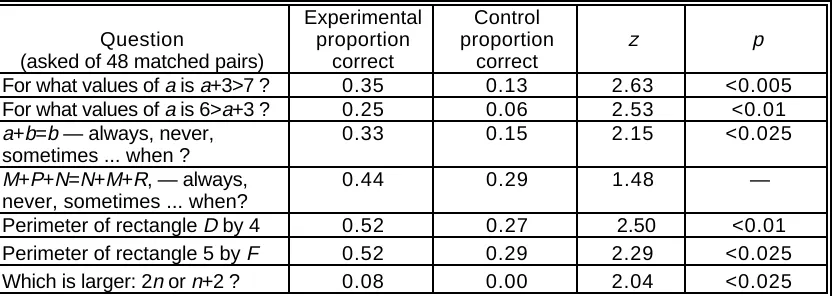
For what values of a is a+3>7 ? 0.35 0.13 2.63 <0.005 For what values of a is 6>a+3 ? 0.25 0.06 2.53 <0.01 a+b=b — always, never,
sometimes ... when ?
0.33 0.15 2.15 <0.025
M+P+N=N+M+R, — always, never, sometimes ... when?
0.44 0.29 1.48 —
Perimeter of rectangle D by 4 0.52 0.27 2.50 <0.01 Perimeter of rectangle 5 by F 0.52 0.29 2.29 <0.025 Which is larger: 2n or n+2 ? 0.08 0.00 2.04 <0.025
Table IV: Conceptual questions
Evidence For Versatility and Conceptual Understanding
The results of our work suggest differential effects between the computer-based approach to algebra, with its emphasis on letters as generalized numbers and the traditional skill-based type of module with its emphasis on acquiring manipulative skills. It seems that the computer work promoted a deeper conceptual understanding, whilst the other work, as expected, initially facilitated better surface skills. However, when the computer module was combined with the skill-based one then it led to a superior overall performance without detrimental effect on skills.
A significant fact here is that the experimental students are initially performing better at skills which are considered to be of a higher level. In other words, the order of difficulty of concepts in the computer paradigm is different from that in the traditional paradigm. This makes the general point that empirical research in a pre-computer paradigm may no longer be appropriate for a computer paradigm. The relative degree of difficulty of concepts is not absolute, it may be paradigm-dependent.
[image:14.595.82.509.128.226.2] [image:14.595.89.506.264.412.2]between experimental and control groups was no longer statistically significant (Thomas & Tall 1989b). During this period the classes had been reorganized in a way which has led to a variety of different experiences for pupils matched in pairs during the experiment. This suggests that, although computer experiences may be able provoke different kinds of understanding in the short and medium term, if these experiences are not continued then their effect may wane in the face of the overwhelming influence of more recent experiences.
However, understanding of algebraic concepts may not be evidenced by test performance alone, since, for example, correct answers may be the result of incorrect understanding. In order to examine the pupils’ understanding of algebra beyond their test performance it is useful to refer back to interviews and a questionnaire administered after the second post-test.
The Interviews
The transcript of the interviews reveals, in the language used by the pupils in each of the groups, the versatility of thought underlying the better performance of the computer group.
The superior relational understanding and versatility of thought of those who had used the Dynamic Algebra module strikingly manifested itself in several different ways, including:
(i) The attempts by the experimental group to explain and offer reasons for their thinking, compared with the control pupils greater concern with surface operations in their comments. (ii) An improvement in encapsulation of processes, shown by the
ability of the computer group to discuss processes without having to carry them out first and to exhibit global knowledge of a question in their comments.
(iii) The ability of the computer group pupils to take a global view of a problem, rather than being pressed into processes implied by the operations present in the notation.
The following examples taken from the transcripts of the interviews show these manifestations of improved versatile thinking:
Question: Solve 2p – 1 = 5.
The confusion in thinking which may result from instrumental understanding is illustrated by one of the control pupil’s explanations for this question :
Pupil C2 : 2p minus 1 equals 5. If you add the 1 to the 5 that’s 6, so because there’s no other minus p I forget the p and do the 2p minus 1 equals. If you add the 1 to the 5 which is 6 and then you take 1 from the 6. No, I don’t get that. I know I’ve done it but...
Here the explanation is solely in terms of the operations with no reasons for their use being cited. This may be compared with the following reasoning from one of the experimental group pupils :
Pupil E2 : Well find out what minus 1 ... so you would add 1 to that so you get rid of the 1, so that would be 6 and then its obvious that 2 times 3 equals 6, so
p would be 3.
The pupils in the interviews were also asked to compare the above equation with 2s – 1 = 5. This was in order to see if they were able to conserve equation (Wagner 1977, 1981) under a change of variable. A distinct difference in the type of comment between the two groups shows the superior understanding in this area of those pupils who had used the computer.
The control group featured those who were unsure of the relationship
Pupil C1 : s could be 3 as well Pupil C4 : They could both equal 4
and those who needed to solve both equations
Pupil C2 : Well what I have put is 2p equals 6 and 2s equals 6,
Pupil C5 : 2s...add the 1 and 5, 6 er 2 and 2, 6, 3 times, so s is 3 as well.
The experimental (computer) group on the other hand were remarkably consistent in seeing the second equation as being equivalent to the first:
Pupil E1 : I can say that p and s have the same value...its the same sum. Pupil E5 : The same. Just using a different letter.
All the experimental group responded in this way. These responses show
evidence of a global/holistic view of the equations which has enabled the students to develop the understanding of conservation of equation by seeing the common structure of the equations. This concept of conservation of equation under a change of variable was further tested with several of the children by using an extension to the first question :
Solve 2(p + 1) – 1 = 5.
The insight of the computer group pupils is shown by :
Pupil E1 : Yes, p equals 2.
Interviewer : How did you work that out then?
Pupil E1 : Well its the same, but its plus 1, so minus 1 add 3. . . .
Pupil E2 : Oh it would be 2. Interviewer : Can you tell me why?
Deep and powerful insights such as these, facilitated by a global/holistic view leading to the structure of the equations, was not matched by the controls. Instead we have :
Pupil C6 : Say p plus 1, there is already 1 plus p plus another one, I’d say that was 2p, and then outside plus another 2 that is 4 minus 1 is 3, I would say. Interviewer : So what is the answer?
Pupil C6 : p equals 1, I would say.
Many would agree that the type of algebraic equation where there are variables on both sides of the equation is conceptually considerably more difficult, since they involve one in algebraic manipulation (i.e. of variables) rather than arithmetic (e.g. Herscovics and Kieran 1980). Although the work done by neither group had involved them in being taught how to solve this type of equation, several of the interviewees were given one to solve. One of the features of relational understanding one might expect to see is that it would be more easily extensible than instrumental understanding, more readily applicable to new areas of mathematics. The ways in which the two groups tackled the question :
Solve 3x – 5 = 2x + 1
again seemed to indicate a superior understanding on the part of those who had used the computer.
For instance, one control pupil began to manipulate the expression instrumentally:
Pupil C6 : I’d say it was minus 2x and here you’ve got 3x, 2x plus 1x, so I’d put that as 1x.
[Writes 3x – 5 = 2x + 1 = 1x] Interviewer : And is that the answer? Pupil C6 : Yes.
Here the pupil clearly realized that progress might be made by subtracting 2x but carried it out in a mechanical way which led to an incorrect result on which he did not wish to elaborate.
Another control pupil lost sight of the objective all together :
Pupil C3 : I’m trying to work out how you could take 5 from that to leave that. Interviewer : Can you see any way of doing it?
Pupil C3 : You would have to find the value of x before you could start.
In contrast, the experimental pupils responded more purposefully:
Pupil E1 : Well the value of x must be the same because it’s in the same sum... I’m thinking that maybe take x times some number away from both sides. That wouldn’t leave anything in there to go on. You’d have nothing there if you take 2x away and 1x minus 5 equals plus 1.
Interviewer : So how might you do it now?
Pupil E1 : I was thinking maybe get rid of this and forget about that 4 by putting, adding 5 to both sides – that should do it – so it would be 3x equals 2x plus 6... try to take x away.
[Writes 3x = 2x + 6]
Shortly after this he solved the equation.
Another experimental pupil started with what seemed like a serialist/analytic approach, but accompanied his actions with clear reasons for the steps he was taking, suddenly making a mental connection that enabled him to solve the problem.
Pupil E2 : You would add 5 to that to get rid of the minus 5 and then that plus 6 so it would be 3x equals 2x plus 6....Well that plus 6 has got a bigger x because 2x plus 6 equals 3x, that means another 6 would be equal to x, so make that 3x as well...Well x equals 6.
In the middle of the question the pupil is versatile enough to change viewpoint (possibly as a result of a cognitive conflict) to a global/holistic one and see the equation in terms of its balancing structure, equating the extra x with 6.
The Questionnaire
A second means of testing the pupils’ understanding which was employed was a questionnaire. This probed their understanding and view of algebraic notation and although it did not allow the opportunity to follow up answers in the way that an interview does, it had the advantage of wider coverage, being given to 147 pupils.
The questionnaire included three types of questions:
• to explain, with reasons, whether two algebraic expressions were equal or not,
• to explain to an imaginary visitor from Mars the meaning of
some algebraic notation,
• harder algebraic questions, beyond the level studied.
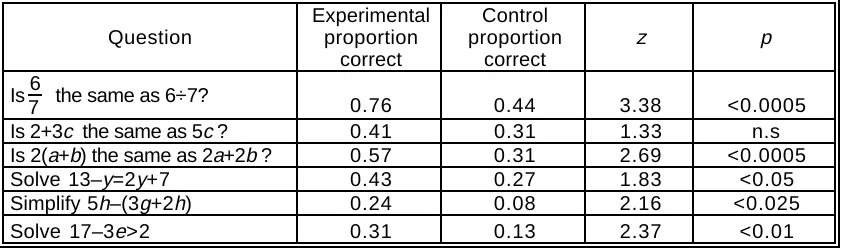
Question
Experimental proportion
correct
Control proportion
correct
z p
Is 6
7 the same as 6÷7? 0.76 0.44 3.38 <0.0005 Is 2+3c the same as 5c ? 0.41 0.31 1.33 n.s Is 2(a+b) the same as 2a+2b ? 0.57 0.31 2.69 <0.0005 Solve 13–y=2y+7 0.43 0.27 1.83 <0.05 Simplify 5h–(3g+2h) 0.24 0.08 2.16 <0.025 Solve 17–3e>2 0.31 0.13 2.37 <0.01
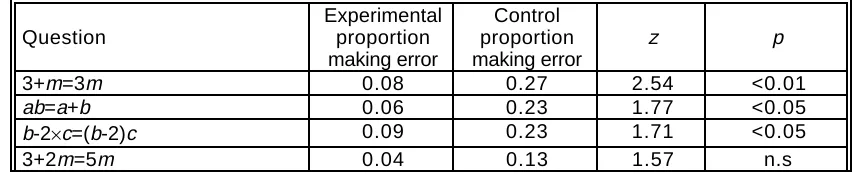
[image:18.595.85.510.597.721.2]Question
Experimental proportion making error
Control proportion making error
z p
3+m=3m 0.08 0.27 2.54 <0.01
ab=a+b 0.06 0.23 1.77 <0.05
b-2×c=(b-2)c 0.09 0.23 1.71 <0.05
3+2m=5m 0.04 0.13 1.57 n.s
Table VI : A Comparison of Some Specific Errors
Table V shows the proportions of the pupils giving correct answers to selected questions and table VI gives the proportion making a specific error. (In both tables there were 78 experimental and 69 control pupils, with no significant difference between pre-test means.) These results, and the fact that the controls did not perform significantly better than the experimental group on
any question, appear to confirm the superior understanding of algebraic
notation of the computer group. Moreover, the experimental students seem to have a better, more global, view of the notation which in turn has reduced the occurence of some of the more common notational errors such as conjoining in addition and the wrong use of brackets.
Of the three questions cited in table V asking if two expressions are equivalent, the experimental students perform worse than than the control students in every case. The least well answered of these is the (non)-equivalence of 2+3c and 5c, illustrating the persistence of the parsing obstacle and the probable reading of the symbolism from left to right. The experimental students perform better, but not at a statistically significant level.
The first of these three questions is a significant instance of the process-product obstacle in which many of the controls did not consider the two notations as the equivalent because
“ 67 is a fraction, 6÷7 is a sum ”.
This reveals the perception of 6÷7 as a process involving value-operation-value rather than as a global entity – the single number – produced by this process. This was not such a problem for the computer group.
The other questions reveal the understanding of the computer group to be superior in its extensibility to the more difficult questions with their requirement of deeper understanding.
Reflections
[image:19.595.79.506.74.161.2]They are better able to cope with the process-product obstacle, evidenced by the fact that they are more likely to consider equivalent expressions such as 2(a+b) and 2a+2b to be the same. They are better at conserving equations and are less likely to feel the need to go through a solution process to solve an equation equivalent to one which they have just solved. They are more likely to be able to chunk information, for instance in seeing that p+1 can be treated as the variable in the equation 2(p+1)–1=5, whilst the control pupils are more likely to feel the need to process the information by multiplying out, collecting terms, and solving for p.
They are more likely to be able to think of expressions as objects, thus overcoming the lack of closure obstacle and seem to have no problem with the
expected answer obstacle.
Those taking the Dynamic Algebra Module show a reversal of the accepted order of difficulty of certain concepts: they are initially better at certain concepts considered more difficult in the CSMS tests (such as solving the inequality a+3>7) and less good at routine algebraic skills (such as simplifying 3b–b+a). However, after a brief revision of routine skills, they improved to match the control students at routine problems whilst retaining their superiority in higher order skills.
This is consistent with Heid’s work in calculus (Heid 1988) where it was shown that students who use the computer for conceptual work and only carry out routine manipulation for a short time at the end of the course were better at higher level conceptual problems than control students following a traditional course and not significantly different in ability with routine manipulation.
There is mixed evidence over the very long term improvements caused by a short three-week period of study using the computer different in nature from the rest of the work of the students. The initial pilot study, in which the experimental students used a versatile computer approach to algebra and the control students did no algebra, showed a maintained difference in performance over a year later even after further study of algebra by both groups. The main study revealed the superior medium term performance of the experimental students following a versatile computer scheme over the control students following a traditional scheme, but failed to reveal a statistically significant difference eighteen months later during which time there was no further computer work.
Finally, although the Dynamic Algebra Module only tackles the initial phases of letter as a label for a number or set of numbers, and equivalence of expressions through evaluation, there is evidence that the treatment has an immediate extension to linear equations.
References
Bogen J.E. 1969: ”The Other Side of the Brain: 2. An Appositional Mind”, Bulletin of the Los-Angeles Neurological Society 34, 1969, pp. 135-162.
Brumby M.N. 1982: “Consistent differences in cognitive styles shown for qualitative biological problem-solving”, British Journal of Educational Psychology, 52, 244-257.
Descartes R. 1628: Regulae ad Directionem Ingenii, (Published posthumously and also translated into English as “Rules for the Direction of the Mind”, in The Philosophical Works of Descartes, E.S. Haldane and G.R.T. Ross, 1934).
Gardiner A. 1988: “WIll computers really count?”, Micromath, 4 1, 31-32.
Gazzaniga M.S. 1974: “Cerebral Dominance Viewed as a Decision System”, in S.J. Dimond and J.G. Beaumont (Eds.), Hemisphere Function in the Human Brain, Elek Science, London, pp. 367-382.
Gazzaniga M.S. 1985: The Social Brain, Basic Books, New York.
Heid M.K . 1988: “Resequencing Skills and Concepts in Applied Calculus using the Computer as a Tool”, Journal for Research in Mathematics Education, 19 1, 3-25.
Herscovics N. and Kieran C. 1980: “Constructing Meaning for the Concept of Equation”, Mathematics Teacher 73, 572-580.
Keiran C. 1981: “Pre-algebraic notions among 12 and 13 year olds”, Proceedings of PME 5, Grenoble, 158-164.
Krutetskii V. A.: 1976, The Psychology of Mathematical Abilities in Schoolchildren, (translated from the Russian by J. Teller), Chicago.
Küchemann D.E. 1981: “Algebra”, in Children’s Understanding of Mathematics : 11-16, K.M. Hart (Ed), John Murray, pp. 102-119.
Leitzel J.R. & Demana F. 1988: “Establishing fundamental concepts in algebra through numerical problem-solving”, NCTM 1988 Year Book.
Matz M. 1980: “Towards a Computational Theory of Algebraic Competence”, Journal of Mathematical Behaviour, 3(1) 93-166.
Poincaré H. : 1903, La Science et l’hypothèse, included in The Foundations of Science (translated by Halsted G.B., 1913) The Science Press.
Popper K.R. and Eccles J.C. 1977: The Self and Its Brain, Berlin, Springer.
Seamon J.G. 1974: “Coding and Retrieval Processes and the Hemispheres of the Brain”, in S.J. Dimond and J.G. Beaumont (Eds.), Hemisphere Function in the Human Brain, Elek Science, London, pp.184-203.
Sperry R.W., Gazzaniga M.S. and Bogen J.E. 1969: “Interhemispheric Relationships: The Neocortical Commissures: Syndromes of Hemispheric Deconnection”, in P.J. Vinken and G.W. Bruyn (Eds.), Handbook of Clinical Neurology, Vol. 4, North Holland Publishing Co., Amsterdam.
Skemp R.R. 1976: “Relational understanding and instrumental understanding” , Mathematics Teaching 77, 20-26.
Skemp R.R., 1979: Intelligence, Learning and Action, Wiley.
Tall D.O. 1986: Building and Testing a Cognitive Approach to the Calculus Using Interactive Computer Graphics, Ph.D. thesis, University of Warwick.
Tall D.O. 1990: “Concept Images, Generic Organizers, Computers and Curriculum Change”, For the Learning of Mathematics, 9, 3, 37-42.
Thomas M.O.J. 1985: The Effects of BASIC Computer Programming on the Understanding of the Use of Letters as Variables in Algebra, unpublished M.Sc. thesis, University of Warwick.
Thomas M.O.J. 1988: A Conceptual Approach to the Early Learning of Algebra Using a Computer, unpublished Ph.D. thesis, University of Warwick
Thomas M.O.J. and Tall D.O. 1986: “The Value of the Computer in Learning Algebra Concepts.”, Proceedings of the 10th Conference of PME, London, 313-318 .
Thomas M.O.J. and Tall D.O. 1988: “Longer-Term Conceptual Benefits From Using A Computer in Algebra Teaching”, Proceedings of the 12th Conference of PME, Veszprem, Hungary, 601-608.
Thomas M.O.J. and Tall D.O. 1989a: “Dynamic Algebra”, in Secondary Mathematics with Micros, Mathematical Association.
Thomas M.O.J. and Tall D.O. 1989b: ““Verbal Evidence for Versatile Understanding of Variables in a Computer Environment”, Proceedings of P.M.E., Paris, volume 3, 213-220.
Wagner S. 1977: Conservation of Equation, Conservation of Function and Their Relationship to Formal Operational Thinking, unpublished doctoral dissertation, New York University.
Wagner S. 1981: “Conservation of equation and function under transformations of variable”, Journal for Research in Mathematics Education, 12, 197-118.