The Influence Factors Analysis to Improve the
Compatibility and the Mechanical Behavior of IPN,
Gradient IPN and BaTiO3 Filled IPN
Yudi Guo, Dongyan Tang*, Ying Wang
Department of Chemistry, Harbin Institute of Technology, Harbin, China.
Email: *[email protected]
Received May 15th, 2012; revised June 20th, 2012; accepted July 21st, 2012
ABSTRACT
Interpenetrating polymer network (IPN), gradient IPN and BaTiO3 filled IPN, composed of poly(ethylene glycol
ure-thane) (PEGPU) and unsaturated polyester resin (UP) curing at room temperatures were prepared. Then the effect of soft/hard segment ratio in polyurethane (PU), component ratio of PU to UP in IPN, adding amount of BaTiO3 in filled
IPN, the component sequences and interval times between each IPN for gradient IPN, on morphology and mechanical behavior of IPN and BaTiO3/IPN nanocomposites with different molecular weight of PU were studied systematically.
Moreover, the investigation on the relationship between the morphologies and the mechanical properties indicated that the IPN with finer morphology exhibited an excellent consistency of the higher strengths and elongations.
Keywords: Poly(ethylene Glycol Urethane) (PEGPU); Gradient Interpenetrating Polymer Networks (Gradient IPN); BaTiO3; Morphology; Mechanical Property
1. Introduction
Owing to the mutual entanglement structural characteris-tics created by the forced compatibility and the synergism of the two networks of IPN, the mechanical properties of IPN are superior to those of ordinary polymers [1,2]. In particular, the maximum tensile strength of IPN can be much higher than that of its constituent polymers [3,4]. Therefore, many valuable systems have been made by taking advantage of the IPN structure [5,6]. Also, much efforts have been put to investigate that how to improve the mechanical properties of IPN and what is the rela-tionship of its mechanical properties with the structures of IPN [7-9]. In our previous papers [10], two series of IPN, BaTiO3 filled IPN, and the gradient IPN have been
prepared, and some properties of such materials have been investigated in details. It is found that the types and its crosslink density of polyurethane influence the mor-phology of IPN greatly, and consequently influence the other properties of the materials [11]. Generally, the struc-tures and the properties of the polymeric materials are related to the molecular weight of the components [12]. However, little attention has been paid to the relation of molecular weight in IPN to the structure and properties of the materials [13,14]. So in the present work, a series
of BaTiO3 filled and unfilled interpenetrating polymer
networks (IPN), gradient IPN composed of poly(ethylene glycol urethane) (PEGPU) and unsaturated polyester resin (UP) with different molecular weight of PU were pre-pared. The aim of the work is to investigate the effect of molecular weight of PU with different soft/hard segment ratio in PU, different component ratio of PU to UP in IPN and different adding amount of BaTiO3 in filled IPN,
and the component sequences and interval times of each IPN in the gradient IPN, on the morphology and the me-chanical properties, and also to reveal the relationship be-tween the morphologies and their mechanical properties.
2. Experimental
Raw materials, their pretreatment and the preparation pro-cedures of IPN are all the same with that described pre-viously [10]. Phase morphology of IPN and BaTiO3 filled
IPN was examined on a Nippon Electron 1200-EX trans-mission electron microscope (TEM). The TEM detection samples were ultramicrotomed into 100 nm thick sections and stained in OsO4 solution (2% by weight) for 18 - 24
hours. Morphology detection of gradient IPN was detected by Energy Dispersive X-ray (EDX) analysis through the using of the Oxford ISIS-300 spectrometer coupled with a JEOL JXA-scanning electron microscope (SEM) on the cross-section of a sample in advance to determine the
transitional ranges in gradient IPN. Then the select gra-dient IPN was observed by TEM through the fracturing it in liquid nitrogen. The tensile strength, shear strength, elo- ngation at break of IPN, gradient IPN and BaTiO3 filled
IPN in small dumb-bell patterns were measured by the Nippon Shimadzu DSS-10T-S tester at room temperature at a crosshead speed of 5 mm/min according to China Standard (GB4456-84). Data were taken as average of at least five measurements.
3. Results and Discussion
3.1. The Effect of the Soft/Hard Segments Ratios with Different Molecular Weight of PEGPU in IPN
Generally, the chemical dissimilar of the soft and hard segments in polyurethane tends to produce the incom-patible structures and thus separate the product into the different phases during its formation. Varying the equi- valent ratio of the isocyanate (-NCO) group to the hydro- xyl (-OH) group in polyurethane is one of the effect mo- difying methods to improve the compatibility [15]. Fig-ure 1 shows the tensile strength (a), the elongation at break (b), and the shear strength (c) of polyurethane with varied molar ratio of -NCO/-OH (represented as the
symbol of R). Seen from the figure, varying the R values and changing the complexity and/or crosslink degree of PU by using the different molecular weight (MW) of PEGPU in IPN can both modulate the product’s com-patibility. The strengths of the IPN with various R values increased with the increase of MW of PU at first, then decreased slowly because of the decreased chain relaxa-tion during the extension by the higher crosslink density. Since the strength of the elastomer of PU is related to the relaxation time of the mobile chain and the hard segment in PU are the main donor to the strength, so the strengths increased with the increase of the R at first and then de-creased slowly.
The PU with lower MW can penetrate into the UP networks more easily and thus exhibit the higher com-patibility. So the approximate crosslink density of PU contributes the approximate penetrating structures, fur-ther contributes the approximate compatibility. That is why the tensile strengths, the elongation and the shear strengths can all reach the relative higher values for the PEGPU1000/UP IPN.
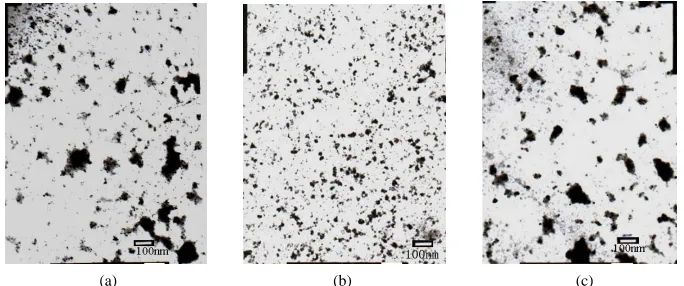
The UP in IPN can be stained selectively by RuO4
so-lution and appears as the dark phase in the TEM photo-graphs (as seen in Figure 2). The domain sizes of PEGPU- 1000/UP IPN are smaller than that of PEGPU600/UP IPN
0 200 400 600 800 1000120014001600180020002200
0.4 0.6 0.8 1.0 1.2 1.4 1.6 1.8 2.0 2.2 2.4 2.6 2.8 3.0
a
T
e
nsi
le st
ren
g
th
(M
Pa
)
Molecular weight of PU R=1.2 R=1.4 R=1.6 R=1.8
0 200 400 600 800 1000120014001600180020002200
0 5 10 15 20 25 30 35 40 45
b
E
lon
ga
ti
on
a
t
br
ea
k(
%)
Molecular weight of PU R=1.2 R=1.4 R=1.6 R=1.8
0 200 400 600 800 1000120014001600180020002200
1.0 1.5 2.0 2.5 3.0 3.5 4.0 c
Sh
e
a
r s
tre
n
g
th
(M
Pa
)
Molecular weight of PU R=1.2 R=1.4 R=1.6 R=1.8
(a) (b) (c)
Figure 1. (a) The tensile strength; (b) The elongation at break (%); and (c) The shear strength of IPN with different -NCO/-OH ratios in PU network.
[image:2.595.65.533.402.527.2]
(a) (b) (c)
[image:2.595.127.469.565.708.2]and PEGPU2000/UP IPN. The better miscibility between the two phases of PEGPU1000 and UP in IPN might due to the higher hydroxyl value of PEGPU1000 and thus lead to the quicker react rate with the isocyanate group to form the PU network, and further lead to a little phase separation with UP phase. After the formation of the first component, the entropy in the system decreases, and the Gibbs free energy increases. Thus the network formed later becomes the filler of the first one. By adjusting the soft/hard segments ratios of different types of PEGPU in IPN, the phase separation could be controlled in some extent. The TEM results are thorough consistency of the mechanical detection results.
3.2. The Effect of the PU/UP Component Ratios in IPN
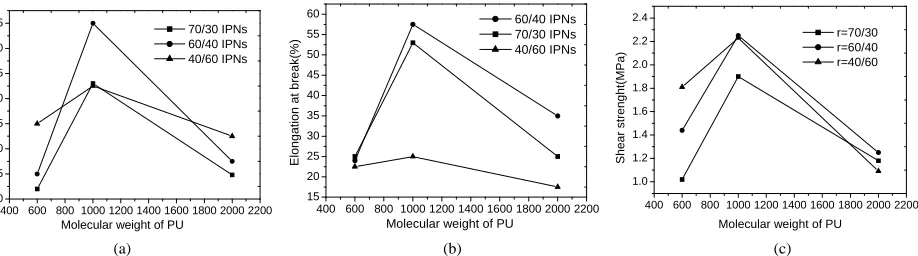
The component ratio of PU to UP is also the main factor that affects the compatibility of IPN. Figure 3 shows the tensile strengths, the elongation at break and the shear strengths of IPN with different PU to UP ratios. All the detection values increased at first and then decreased.
The results indicated that the appropriate crosslink den-sity of PU and the appropriate penetrating degree of PU to UP for 60/40 IPN by using PEGPU1000 gave relative higher mechanical properties. And both the higher values of the strengths and the elongations of 60/40 PEGPU1000/ UP IPN, compared with the ordinary polymers and the each component network (PU and UP), also indicated the existence of such effects as mutual entanglement, forced compatibility, synergism of the networks during IPN’s formation. The existence of the interpenetration and the entanglement molecular structures in IPN contributes the reinforced effect when the materials are elongated and thus improves the mechanical properties greatly than that of the ordinary materials. These effects provide a valid way to improve the materials’ properties from the view-point of the selection of the components in IPN and the adjustment of the blending techniques. Further, these ef-fects have great significance in obtaining the functional
materials with outstanding properties.
Figure 4 shows the TEM photographs of IPN with dif-ferent PU/UP component ratios. The higher PU content in IPN forms the first network and then becomes the con-tinuous phase with UP appears as the dispersed phase. Seen from this figure, both 70/30 and 60/40 PEGPU1000/UP IPN show homogeneous microstructures with small do-main sizes within nanometer scales. The higher UP amount in IPN leads to the more continuous degree of the dis-persed phase with much finer microstructures.
3.3. The Effect of the Amounts of BaTiO3
Nanopowders Added in IPN
The previous studies [10,11] have indicated that, the in-troduction of the inorganic filler into IPN can add the functional properties by the inorganic component, but meanwhile increase the phase separation to the system obtained. And the lower degree of the phase miscibility might further decrease the materials’ mechanical proper-ties. Figure 5 shows the tensile strength and the elongation at break of various -NCO/-OH values of IPN with differ-ent amounts of BaTiO3 nanopowders added. The values of
the tensile strengths decreased with the increase of BaTiO3
nanopowders in IPN, but the values of the elongation at break displayed an opposite trend. The decreased tensile strengths might due to the less miscibility between the two apparent different modulus of BaTiO3 and IPN. And the
increased elongations inferred that the little amount of filler can act as the plasticizer to IPN-based system.
The TEM photographs of the different amount of Ba-TiO3 nanopowders added in IPN are shown in Figure 6.
The nanopowders are dispersed with some aggregations, but mostly with the original structures in the matrix of polymers. Larger BaTiO3 amount added into led to the
appearance of higher aggregation.
3.4. The Effect of the Component Sequences and time Intervals for Gradient IPN
Previous studies also have shown that [11] the large amount
400 600 800 1000 1200 1400 1600 1800 2000 2200 0.0
0.5 1.0 1.5 2.0 2.5 3.0 3.5 a
T
ens
ile s
treng
th(M
P
a
)
Molecular weight of PU 70/30 IPNs 60/40 IPNs 40/60 IPNs
400 600 800 1000 1200 1400 1600 1800 2000 2200 15
20 25 30 35 40 45 50 55 60
b
Elo
n
ga
tion a
t br
eak(
%
)
Molecular weight of PU 60/40 IPNs 70/30 IPNs 40/60 IPNs
400 600 800 1000 1200 1400 1600 1800 2000 2200 1.0
1.2 1.4 1.6 1.8 2.0 2.2 2.4 c
Shear stren
ght(M
Pa)
Molecular weight of PU r=70/30 r=60/40 r=40/60
(a) (b) (c)
[image:3.595.76.535.581.709.2][image:4.595.63.283.96.241.2]
(a) (b)
Figure 4. TEM photographs of IPN with different PU/UP component ratios.(a) 70/30 IPN; (b) 60/40 IPN.
0 5 10 15 20 25
0.0 0.5 1.0 1.5 2.0 2.5 3.0
a
T
e
nsi
le st
re
ng
ht
(MPa
)
Content of BaTiO
3(wt%)
R=1.4 R=1.6
(a)
0 5 10 15 20 25
10 20 30 40 50 60 70 80 90
b
E
longat
ion
at
break(%)
Content of BaTiO3(wt%)
R=1.4 R=1.6
(b)
Figure 5. (a) The tensile strength and (b) Elongation at break (%) of IPN/BaTiO3 composites with different BaTiO3
nanopowders added.
of the dual-entanglement structures formed during the individual IPN’s formation by gradient techniques can improve the compatibility between the two obvious ther-modynamic immiscibility networks. So the gradient tech-nique can thus contribute the improved properties to IPN.
Figure 7 shows the tensile strengths and the elongations at break of gradient IPN with different component ratio sequences at time intervals of 3.5 h during the curing process of the individual IPN. The higher modulus of UP
[image:4.595.308.539.97.251.2]
(a) (b)
Figure 6. TEM photographs of IPN with different amounts of BaTiO3 nanopowders.(a) 3% (wt%); (b) 10% (wt%).
in gradient IPN contributes the better mechanical proper-ties. Furthermore, from the comparison results with that of in Figure 2(a) of IPN, the gradient technique do im-proves the elastic property of IPN greatly. Also seen from the Figure 7, the larger amount of UP in gradient IPN with different components ratio sequences contrib-utes relative higher tensile values and lower elongation values. For the gradient IPN with 40/60 - 60/40 - 70/30 components ratio sequences, the higher tensile values ob-tained without decrease much elongation values indicate that, novel materials with much more better mechanical properties can be designed by forming gradient structures within the different individual IPN.
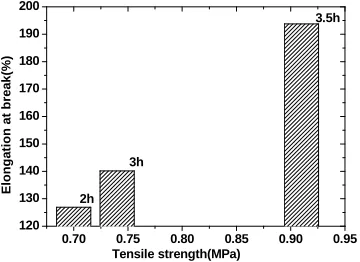
Figure 8 shows the strain and the stress values of the 60/40 - 70/30 - 80/20 gradient IPN with different time intervals. Seen from Figure 8, the gradient IPN with the time intervals of 3.5 h can contributes better mechanical properties. Both the higher tensile strength and the elon-gation at break proved the synergistic action of the more interpenetration in gradient IPN.
The TEM photographs of 40/60 - 60/40 - 70/30 gradi-ent IPN with differgradi-ent time intervals are shown in Figure 9. Seen from this figure, compared with the individual IPN, the gradient IPN show the much finer and the ho-mogeneous structures between the two phases with im-proved dual-continuity degree owing to the large amount of interpenetrating structures between two networks and transitional regions among phases.
4. Conclusion
The soft to hard segment ratio in PU, the component ratio of PU to UP in IPN, the BaTiO3 adding amount and the
[image:4.595.87.261.277.578.2]1 2 3 4 2.2
2.4 2.6 2.8 3.0 3.2 3.4 3.6 3.8
4.0 a Gradient(40/60-60/40-70/30)IPNs
70/30IPNs 60/40IPNs
40/60IPNs
T
e
nsi
le streng
th(MPa)
IPNs and gradient IPNs
(a)
1 2 3 4
20 25 30 35 40 45 50 55 60 65
b Gradient(40/60-60/40-70/30)IPNs
70/30IPNs 60/40IPNs
40/60IPNs
E
lon
gation
a
t
br
eak(%
)
IPNs and gradient IPNs
(b)
Figure 7. (a) The tensile strength and (b) The elongation at break (%) of IPN and gradient IPN.
0.70 0.75 0.80 0.85 0.90 0.95 120
130 140 150 160 170 180 190 200
3.5h
3h
2h
Elong
a
tion at br
ea
k(%
)
[image:5.595.83.264.93.393.2]Tensile strength(MPa)
Figure 8. The tensile strength and the elongation at break (%) of gradient IPN (40/60 - 60/40 - 70/30) with different time intervals.
(UP). The higher hydroxyl value of PEGPU in PU net-work can react faster than that of the other PEGPU. The appropriate crosslink density in IPN and the gradient struc-ture can generate relative smaller domain sizes (within nanometer ranges). The relationship study of the compati-bility and the mechanical properties shows that the better compatibility between the two networks in IPN and in filled IPN contributes both the improved strength and the elongation values. Moreover, the gradient structures can also increase the tensile strength and the elongation at break
[image:5.595.309.538.95.229.2](a) (b)
Figure 9. TEM photographs of 40/60 - 60/40 - 70/30 gradient IPN with different time intervals. (a) 3.5 h; (b) 3.0 h.
of IPN greatly compared with the each individual IPN, owing to the larger transitional ranges created by the gra-dient technique.
5. Acknowledgements
This work was supported by the Program for New Cen-tury Excellent Talents in University of China (NCET- 08-0165).
REFERENCES
[1] K. H. Hsieh, J. S. Tsai and K. W. Chang,
“Interpenetrat-ing Polymer Network of Polyurethane and Unsaturated
Polyester: Mechanical Properties,” Journal of Materials
Science, Vol. 26, No. 21, 1991, pp. 5877-5882. doi:10.1007/BF01130128
[2] T. Trakulsujaritchok and D. J. Hourston, “Damping
Char-acteristics and Mechanical Properties of Silica Filled PUR/PEMA Simultaneous Interpenetrating Polymer
Net-works,” European Polymer Journal, Vol. 42, No. 11,
2006, pp. 2968-2976.
doi:10.1016/j.eurpolymj.2006.07.028
[3] M. A. Syed, Siddaramaiah and B. Suresha, “Mechanical
and Abrasive Wear Behavior of Coleus Spent Filled Un-saturated Polyester/Polymethyl Methacrylate Semi
Inter-penetrating Polymer Network Composites,” Journal of
Composite Materials, Vol. 43, No. 21, 2009, pp. 2387-
2400. doi:10.1177/0021998309341850
[4] S. C. Kim, D. Klempner and K. C. Frisch, “Polyurethane
Interpenetrating Polymer Networks. I. Synthesis and Morphology of Polyrurethane-Poly(methyl Methacrylate)
Interpenetrating Polymer Networks,” Macromolecules,
Vol. 9, No. 2, 1976, pp. 258-263. doi:10.1021/ma60050a016
[5] Y. L. Cai, P. S. Liu and X. B. Hu, “Microstructure-Ten-
sile Properties Relationships of Polyrurethane/
Poly(urethane-Modified Bismaleimide) Interpenetrating
Polymer Networks,” Polymer, Vol. 41, No. 15, 2000, pp.
5653-5660. doi:10.1016/S0032-3861(99)00797-1
[6] C. Vancaeyzeele, O. Fichet, J. Laskar, S. Boileau and D.
[image:5.595.83.263.435.566.2]mer Networks: Effects of Network Formation Order and
Composition on the IPN Architecture,” Polymer, Vol. 47,
No. 6, 2006, pp. 2046-2060. doi:10.1016/j.polymer.2006.01.026
[7] D. Y. Tang, X. L. Wu and L. S. Qiang, “Polymerization
Process and Morphology of PU/VER IPNs,” Journal of
Materials Science & Technology, Vol. 23, 2007, pp. 423- 426.
[8] F. J. Hua and C. P. Hu, “Interpenetrating Polymer
Net-works of Epoxy Resin and Urethane Acrylate Resin: 2.
Morphology and Mechanical Property,” European
Poly-mer Journal, Vol. 36, No. 1, 2000, pp. 27-33. doi:10.1016/S0014-3057(99)00027-0
[9] K. H. Hsieh, J. L. Han and C. T. Yu, “Graft
Inperpene-trating Polymer Networks of Urethane-Modified Bis-maleimide and Epoxy(I): Mechanical Behavior and
Mor-phology,” Polymer, Vol. 42, No. 6, 2001, pp. 2491-2500.
doi:10.1016/S0032-3861(00)00641-8
[10] D. Y. Tang, C. L. Qin and W. M. Cai, “Preparation,
Mor-phology, and Mechanical Properties of Modified-PU/
UPR Graft-IPN Nanocomposites with BaTiO3 Fiber,”
Materials Chemistry and Physics, Vol. 82, No. 1, 2003,
pp. 73-77. doi:10.1016/S0254-0584(03)00162-7
[11] D. Y. Tang, J. S. Zhang, D. R. Zhou and L. C. Zhao,
“In-fluence of BaTiO3 on Damping and Dielectric Properties
of Filled Polyurethane/Unsaturated Polyester Resin
In-terpenetrating Polymer Networks,” Journal of Materials
Science, Vol. 40, No. 13, 2005, pp. 3339-3345. doi:10.1007/s10853-005-0423-3
[12] J. Yang and M. A. Winnik, “Polyurethane-Polyacrylate
Interpenetrating Networks. 1. Preparation and
Morphol-ogy,” Macromolecules, Vol. 29, No. 22, 1996, pp. 7047-
7054. doi:10.1021/ma9601373
[13] L. Zhang and Q. Zhou, “Effects of Molecular Weight of
Nitrocellulose on Structure and Properties of
Polyure-thane/Nitrocellulose IPN,” Journal of Polymer Science:
Part B: Polymer Physics, Vol. 37, No. 14, 1999, pp. 1623-1631.
doi:10.1002/(SICI)1099-0488(19990715)37:14<1623::AI D-POLB7>3.0.CO;2-5
[14] Y. S. Lipatov, V. F. Rosovitsky, T. T. Alekseeva and N.
V. Babkina, “Effect of Physical Ageing on the
Viscoelas-ticity on Interpenetrating Polymer Networks,” Polymer
International, Vol. 49, No. 4, 2000, pp. 334-336. doi:10.1002/(SICI)1097-0126(200004)49:4<334::AID-PI 371>3.0.CO;2-Q
[15] K. H. Yoon, S. T. Yoon and O. O. Park, “Damping
Prop-erties and Transmission Loss of Polyurethane. I. Effect of
Soft and Hard Segment Compositions,” Journal of