ISSN Online: 2153-120X ISSN Print: 2153-1196
DOI: 10.4236/jmp.2017.813132 Dec. 20, 2017 2167 Journal of Modern Physics
Reply to “A Simple Derivation of the Lorentz
Transformation”
Olivier Serret
ESIM Engineer—60 rue de la Marne, Cugnaux, France
Abstract
The theory of Relativity is consistent with the Lorentz transformation. Thus Pr. Lévy proposed a simple derivation of it, based on the Relativity postulates. A reply is provided: Some related results (five ones) are found and developed step by step which would invalid it. So Lorentz transformation would not be simply derived by this way. Finally an alternative demonstration of Lorentz transformation is reminded, consistent with Quantum Mechanics.
Keywords
Lorentz Transformation Derivation, Relativity Theory
1. Introduction
Today, the Relativity Theory does almost the unanimity among the scholarly community. However the problem is that the Relativity Theory and the Quan-tum Mechanics do not describe the same world. “They imagine from a radically different point of view the basic notions of physics that are force, space, time or matter. One considers force as an exchange of quantum, whereas the other con-ceives it as a deformation of space time; one [the Q.M.] sees space-time flat and static, the other [the R.T.], bumpy and dynamic; one confers a preponderant role at random, the other, non-existent ...” [1]. That means that one of these two pre-vious theories should be invalidated. Because the Relativity Theory [2] is consis-tent with the Lorentz transformation, this demonstration is its keystone. Thus ten years ago another derivation [3] of the Lorentz transformation was proposed by Pr. Jean-Michel Lévy based on the two postulates of the Theory of Relativity. It is a simple one, based on a thought experiment. If the mathematical equations look correct, the physical arguments to transit from an equation to another one can be discussed. It is the topic of this paper.
How to cite this paper: Serret, O. (2017) Reply to “A Simple Derivation of the Lor-entz Transformation”. Journal of Modern Physics, 8, 2167-2178.
https://doi.org/10.4236/jmp.2017.813132 Received: November 13, 2017
Accepted: December 16, 2017 Published: December 20, 2017 Copyright © 2017 by author and Scientific Research Publishing Inc. This work is licensed under the Creative Commons Attribution International License (CC BY 4.0).
http://creativecommons.org/licenses/by/4.0/
DOI: 10.4236/jmp.2017.813132 2168 Journal of Modern Physics
2. Vocabulary and Notations
a) A thought experiment
“A thought experiment is a device with which one performs an intentional, structured process of intellectual deliberation in order to speculate, within a specifiable problem domain, about potential consequents (or antecedents) for a designated antecedent (or consequent)” (Yeates, 2004, p. 150). That means it is not a true experiment with real measures coming from instruments. To sum up, a thought experiment is closer to a demonstration that to an experiment; if re-sults are paradoxical it could come either from a mistake in the demonstration or from an erroneous hypothesis.
b) Coordinate and length, moment and duration:
In this paper, we will distinguish the coordinate x from the length L, and the moment t from the duration T. Length and duration will be noted in capital let-ters, coordinate and moment in small letters. Relation between them is:
AB B A
AB B A
L x x
T t t
= −
= −
(1.a-b)
c) Referential frames To distinguish them,
• the frame linked to the object (the mirrors) will be noted without nothing:
(K)
• the first moving frame (from the mirror in reference) and its elements will be
noted with an apostrophe: (K’)
• the second moving frame and its elements will be noted with a double
apos-trophe: (K’’)
d) Galilean referential frames:
According to the Relativity theory and to the Newtonian mechanics too, physical laws are the same in Galilean referential frames, i.e. in rectilinear and uniform translation. We get the same result:
• either the frame (K’) is moving from the mirrors, or the mirrors are moving
within the motionless frame (K’).
• the same, either the frame (K”) is moving from the mirrors, or the mirrors
are moving within the motionless frame (K”).
But an apparent trajectory is not a physical law and so it can be different in two different frames.
e) Regularity and comparison between clocks:
DOI: 10.4236/jmp.2017.813132 2169 Journal of Modern Physics
which suggests that the dribble of the photons is regular and comparable what-ever the situation is.
3. The Arguments
Lorentz transformation is derivate in a decade of equations by Pr. Jean-Michel Lévy, as retraced in Appendix A. If these equations are mathematically under-standable, we will check here how these equations are physically justified, or not.
a) No clear distinction between (K’) and (K”):
ABC
T′ is the duration the photon takes to cover the path length LABC′ in (K’) The author says the clock moving parallel to its mirrors has period
[
TABC′]
inthe lab [K’]; therefore we can be sure that the clock moving perpendicularly to its mirrors also has period
[
TABC′′]
in the lab frame [K’’]1.The lab (K’) is not
necessarily equals to the lab (K’’). Equality of T duration is a reasonable hy-pothesis; but it is not demonstrated at this step.
b) Confusion between T’ and T”:
Let us call for the light path: A the starting point of the first mirror, B the re-flection point of the second mirror and C the arrival point on the first mirror.
By symmetry in (K’):
AB BC
T′ =T′ (2)
Then the author adds for the perpendicular direction (K”) it will reach the front mirror after a time
[ ]
TAB′′ and will need a further time lapse[ ]
TBC′′ 2 forthe return leg, which means:
AB BC
T′′ ≠T′′ (3)
It is paradoxical to get in the same time an equality and an inequality of dura-tion for the same phenomenon!
c) Durations of photon paths would be the same along different inter-mirrors distances:
Now, let us demonstrate what happens in (K’) and (K’’), details in Appendix B.
Using rectilinear uniform translations, mirrors are studied within three dif-ferent redif-ferential frames: in the first one, mirrors are motionless; in the second one, mirrors are moving in parallel to their plan; and in the third one, mirrors are moving perpendicularly to their plan. This mirrors device appears to have different light paths either this device is motionless or in motion (please check Appendix B). The same, this mirrors device appears to have a different light path either this device is moving in parallel to the mirrors or perpendicularly to them. And in (K”), we can add that one way path and its duration are not sym-metric with the return path and its duration.
Then the light path LABC′ in (K’) is a priori different from the light path
ABC
L′′ in (K’’), and their duration too:
DOI: 10.4236/jmp.2017.813132 2170 Journal of Modern Physics
ABC ABC
ABC ABC
L L
T T
′ ≠ ′′
′ ≠ ′′
(4.a-b)
Mirrors device can produce different durations in a referential frame or in another, as it is the case for the pendulum clock. Then (see Appendix B) we get
2 2 0
ABC
L T
c
γ
′′′′ = ⋅
(5)
So
(
)
(
)
(
)
(
)
0 0
0 0
2 0
0 0
2 0
I) if then
1
II) if then
2
III) if and then
ABC
ABC ABC
ABC ABC ABC
L L T T
T T L L
L
L L T T T
c
γ
γ
γ
′′= ′ ′′ =
′′ = ′ ′′= ⋅
′′
′′ ′ ′′ ′ ′′
≠ ≠ =
⋅
⋅
(6.a-b-c)
i) If the inter-mirrors distance remains the same in (K’) and (K’’), L0′′=L0′, so
using Equations ((B3), (B11) and (B17)) of Appendix B, the paths of light and their duration change (TABC′′ ≠TABC′ ).
ii) If we consider period remained the same in (K’) and (K’’), TABC′′ =TABC′ , so using again Equations ((B3), (B11) and (B17)), the inter-mirrors distance (not the path length but the real inter-mirrors distance) would have changed (L0′′≠L0′),
which would be quite surprising! If you are not convinced, please consider that the observer is moving and that the mirrors are motionless.
If not (same clock device, and so same period and same inter-mirrors dis-tance), we would get:
2 1 1
c c
γ
⋅ =γ
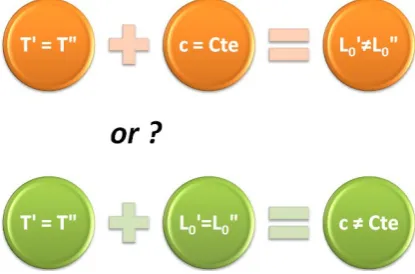
⋅(7) which is impossible! Then we would have to suggest that the main hypothesis in the demonstration is not valid, i.e. that the postulate to get the same celerity 𝑐𝑐 of the photon in (K), (K’) and (K’’) is not valid. (see Figure 1).
[image:4.595.269.477.571.708.2]iii) If inter-mirrors distance were different in (K’) and (K”) and two-ways du-ration too, then dudu-ration in (K”) would be by hypothesis different from dudu-ration in (K’)
DOI: 10.4236/jmp.2017.813132 2171 Journal of Modern Physics
Consequently, his Equation (A4) in (K”) is not justified. d) Round trip with Lorentz transformation
Let us now consider Equation (A4) would be valid for all directions. When we go from the frame (K) to (K’’), length would contract:
0 0
1
L L
γ
′′ = (8)
which is nothing less that:
0 0
L =γ ⋅ ′′L (8.bis)
But according to the author when we go back from (K’’) to (K), length would contract as
0 0
1
L L
γ ′′ =
(9) and so
0 2 0
1
L L
γ
=
(10)
which would be paradoxical!
It is this paradox the author use to demonstrate Equation (A6). Consequently, his Equation (A6) is not demonstrated
e) Length is not coordinate
Let us now consider that when we go from K to K’, length would contract:
1
L L
γ
′ = . And when we go back from (K’) to (K), length would contact too:
1
L L
γ ′
= according to the author hypothesis. The trouble in author’s
demon-stration comes from confusion between the length and the coordinate (check Appendix C). In fact:
( )
( )
in K :
in K :
O M M
OM M
O
O
X x x
X x x
′ = − ′
′ ′ ′ ′
= −
(11.a-b)
But
at 0 : 0
at 0 : 0
O
O
t x
t x
′
≠ ≠
′≠ ′ ≠
(12.a-b)
Then
M O M
OM M
x X
x X
γ
γ
′
′
≠
′ ≠
(13.a-b)
Correct equations are given in Appendix, Equation (C19.a-b). Consequently, his Equations ((A6) & (A7)) are not demonstrated.
op-DOI: 10.4236/jmp.2017.813132 2172 Journal of Modern Physics
posed another thought experiment (see Appendix D); it can also be proposed another demonstration of Lorentz derivation, compatible with the Quantum Mechanics: the Neo-Newtonian Mechanics, developed in a previous article [4].
4. Conclusions
The derivation of Lorentz transformation is the keystone of the Relativity The-ory. This derivation is not as simple as the title of Pr. Lévy’s article suggests it. A thought experiment is not a true experiment with real measures; it is closer to a demonstration. If we found a single logical mistake in the reasoning, it would be enough to invalid this derivation. And we would have found five ones:
• a mixture between the two referential frames in motion,
• a mixture between the duration of the second and the third referential frame, • using a constant light velocity, a same light path duration along a variable
in-ter-mirrors distance,
• an incorrect use of the Lorentz transformation, • and a confusion between length and coordinate.
So, this relativistic derivation does not appear to be a valid one. Then it could open up a field to the Neo-Newtonian Mechanics, consistent with the Quantum Mechanics.
Acknowledegments
I would like to thank the referee for his valuable suggestion to introduce the subject.
References
[1] (2012) La théorie du tout. Science & Vie HS N°260, 121.
[2] Einstein, A. (1920) Relativity: The Special and General Theory. Methuen & Co Ltd., 98-103.
[3] Lévy, J.-M. (2007) A Simple Derivation of the Lorentz Transformation and of the Accompanying Velocity and Acceleration Changes. AAPT.
https://arxiv.org/pdf/physics/0606103.pdf
[4] Serret, O.(2015) Journal of Modern Physics, 6, 252-259.
DOI: 10.4236/jmp.2017.813132 2173 Journal of Modern Physics
Appendix
Appendix A) Equations extracted from “A simple derivation of the Lor-entz transformation (...)” of Professor Jean-Michel LEVY
0 0
2 L
T c ⋅
= (A1)
(
)
2 2(
)
20
2 2
c T⋅ =L + ⋅v T (A2)
( )
0
0 2 1
T
T T
v c
γ
= = ⋅
− (A3)
c t L v t v t L c t
⋅ = + ⋅
⋅ = − ⋅′ ′
(*.a-b)
(
1 2 2)
T=L c⋅ −v c (**)
2 0
0 1
L v L L
c γ
= − =
(A4)
OM =OO′+O M′ (A5)
x
x v t
γ ′
= ⋅ +
(A6)
x
v t x
γ = ⋅ +′ ′ (A7)
Appendix B) Lengths and their durations in three different referential frames
a) First referential frame, linked to the mirrors:
0
L is the distance between the two mirrors (in this referential frame), and
AB
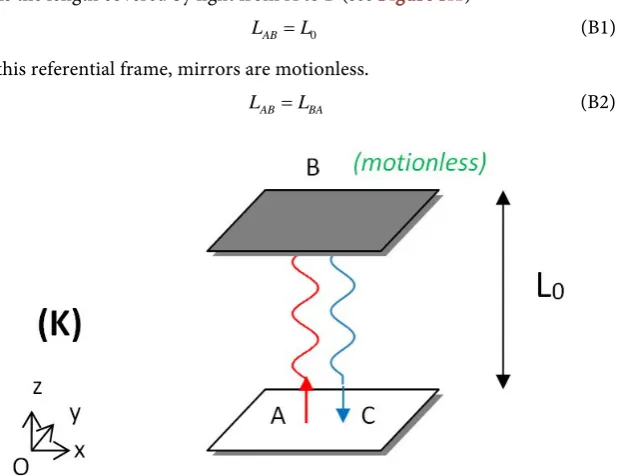
L is the length covered by light from A to B (see Figure A1)
0
AB
L =L (B1)
In this referential frame, mirrors are motionless.
AB BA
[image:7.595.230.540.466.704.2]L =L
(B2)
DOI: 10.4236/jmp.2017.813132 2174 Journal of Modern Physics 0
0
2
T
L = ⋅c
(B3)
2
AB AB
T
L = ⋅c
(B4) Then, the total duration TABC for light for moving from A to C is:
0
ABC
T =T (B5)
b) Second referential frame, motion parallel to the mirrors:
It is equivalent having the observer moving on a parallel way of the mirrors, or seen from the observer having the mirrors moving on a parallel way.
0
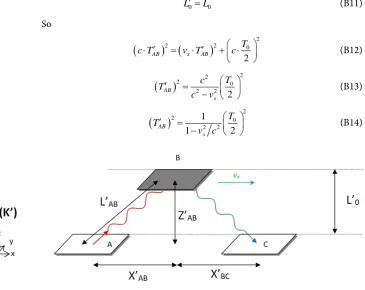
L′ is the distance between the two mirrors (in the frame (K’)), and LAB′ is the length covered by light from A to B (see Figure A2)
x
AB AB
X′ =v T⋅ ′ (B6)
According to the second postulate of the Relativity Theory, light celerity is constant and equal in the two reference frames:
AB AB
L′ =c T⋅ ′
(B7)
AB BC
L′ =L′
(B8)
0
AB
Z′ =L′
(B9)
(
) (
2) (
2)
2AB AB AB
L′ = X′ + Z′ (B10) Because the motion is parallel to the mirrors, it is sure the inter-mirrors dis-tance does not change:
0 0
L′ =L
(B11)
So
(
) (
2)
2 0 22
AB x AB
T c T⋅ ′ = v T⋅ ′ +c⋅
(B12)
( )
2 2 0 22 2
2
AB
x
T c T
c v
′ =
− (B13)
( )
2 0 22 2
1
2 1
AB
x
T T
v c
′ =
[image:8.595.175.541.423.713.2]−
(B14)
DOI: 10.4236/jmp.2017.813132 2175 Journal of Modern Physics 0
2
AB
T T′ = γ
(B15)
Idem for TBC′
0 2
BC
T T′ = γ
(B16)
Then
0
ABC
T′ = ⋅γ T (B17)
In this referential frame we find the same result that this in the simple deriva-tion article.
Remark: vx can be changed to vy or to any velocity parallel to the mirrors.
c) Third referential frame, motion perpendicular to the mirrors:
It is equivalent having the observer moving on perpendicular way of the mir-rors, or seen from the observer having the mirrors moving on a perpendicular way.
0
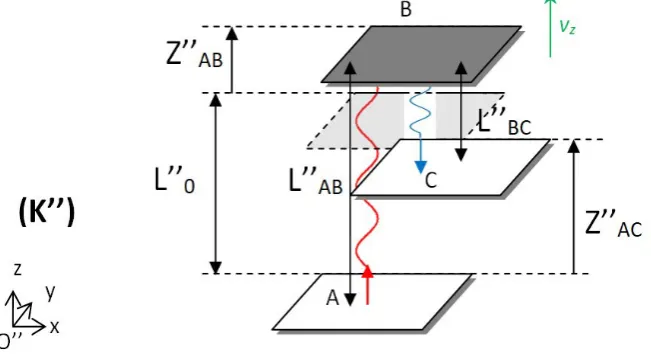
L′′ is the distance between the two mirrors (in the frame (K’’)), and LAB′′ is the length covered by light from A to B (see Figure A3)
z
AB AB
Z′′′ = ⋅v T′′ (B18)
According to the second postulate of the Relativity Theory, light celerity is constant and equal in the two reference frames:
AB AB
L′′ = ⋅c T′′
(B19)
0 AB
AB
L′′ =L′′+Z′′
(B20)
(
)
AC z AB BC
Z′′ = ⋅v T′′ +T′′ (B21)
BC BC
L′′ = ⋅c T′′
(B22)
B C
AB C A
L′′ =L′′ +Z′′ (B23)
ABC AB BC
T′′ =T′′ +T′′ (B24)
[image:9.595.213.539.533.711.2]Then using the Equations (B18)-B(20) for the first one, and Equations (B21)-
DOI: 10.4236/jmp.2017.813132 2176 Journal of Modern Physics
(B23) for the second one:
(
0)
zz AB B
AB AB
AB
C BC
c T L v T
v T T L c T
⋅ ⋅ + ′′ ′′ ′′ ⋅ = + ′′ ′′ = ′′ − ⋅ ′′
(B25.a-b)
And using (B19) again:
(
)
0
AB z AB
z AB B
B C
A BC
c T L v T
c T c T v T T
′′ ′′ ′′
⋅ = +
⋅ ′′ = ⋅ ′′ +⋅ ⋅ ′′ + ′′
(B26.a-b)
0 0 AB z BC z c v L v L T T c ′′ ′′ ′ = − = ′′ + ′ (B27.a-b)
( )
2 0 2 2 ABC z c T L c v ′′ = ′′ −(B28)
2 2 0
ABC
L T
c
γ
′′′′ = ⋅ (B29)
Appendix C) Length and coordinate
The author describes the same relation in (K) and (K’):
′ ′
= +
OM OO O M (C1)
a) In the frame (K):
OM M O
OM =X =x −x
(C2)
OO O O
OO′ =X ′ =x ′−x
(C3)
O M M O
O M′ =X ′ =x −x ′ (C4)
And because (O) is the origin of (K)
0
O
x =
(C5)
And so Equations ((C2) and (C3)) become
OM M
OM =X =x
(C6)
OO O
OO′ =X ′=x ′
(C7)
And then Equation (C1) in (K) is:
M O M O
x =x ′+x −x ′ (C8)
which is coherent. b) In the frame (K’):
OM M O
OM =X′ =x′ −x′ (C9)
OO O O
OO′=X′ ′=x′′−x′ (C10)
O M M O
O M′ =X′′ =x′ −x′′ (C11)
And because (O’) is the origin of (K’)
0
O
x′ =′
(C12)
DOI: 10.4236/jmp.2017.813132 2177 Journal of Modern Physics
OO O
OO′=X′ ′= −x′ (C13)
O M M
O M′ =X′′ =x′ (C14)
And then Equation (C1) in (K’) is:
M O O M
x′ −x′ = − ′ +x x′
(C15)
which is coherent too. c) The property on length:
Let us now use the property that length, not coordinate, would contract when we change of frame (cf Equation (A4)):
?
?
1
1
OM OM
O M O M
L L L L γ γ ′ ′ ′ = = ′ (C16.a-b)
So in (K):
? 1
O M O M
O M X X
γ
′ ′
′ = = ′
(C17) and in (K’):
? 1
OM OM
OM X X
γ ′
= =
(C18)
Consequently:
?
?
1
1
M O M
M O M
O M x x x
OM x x x
γ γ ′ ′ = − = ′ = ′ − ′ =
(C19.a-b)
(
)
? 1M O O M
x x x x
γ
γ
′ ′
− − =
(C20)
(
2 1)
? 2M O O
x x x
γ − = γ ⋅ ′+ ⋅γ ′ (C21)
2 ?
2 1 2 1
M O O
x γ x γ x
γ ′ γ ′
= ⋅ + ⋅
− − (C22)
That would means that whatever M is located, its value would be the same; it is impossible! So by reduction ad absurdum, Eq.(A4) as hypothesis is invalid.
Appendix D) Thought experiment: counter-proposal a) Counter-proposal on duration
Let us imagine a third similar device called (D), but with its inter-mirrors dis-tance half of the previous ones. Then photon will cover a two-ways in (D) when photon will cover a single way, or a return way, in the rest device (K), whatever the direction of the large clock is (parallel or perpendicular):
2 AD ADC AB AB BC L L
T T T
DOI: 10.4236/jmp.2017.813132 2178 Journal of Modern Physics
Then by simultaneity:
AB
AB
ADC BC
ADC BC
ABC ABC
T T T
T T T
T T
′ = ′ = ′
′′ = ′′ = ′′ ′′ = ′
(D2.a-bc)
So there is equality of duration between (K’) and (K”) b) Counter-proposal on length
Let us imagine a bowl. Then:
0
0x y 0z
D =D =D
(D3) D being the diameter of the bowl.
The perfect bowl will not change into a ellipsoid shape because it is running or because the observer is moving whatever his direction is, won’t it? If not, how the bowl would roll?
Then
0
0x z
D′ =D′′ (D4)
So there is a equality of real distance (not of path length) between (K’) and (K”).