Public Distribution System - An Overview in Karnataka
Veena L B1, Mahendra Kumar S2
1
Research scholar, 2Professor, Department of Economics and Cooperation Manasagangothri, University of Mysore, Mysuru, Karnataka state, India.
Abstract: According to FAO estimates in ‘The State of Food Security and Nutrition in the World 2019' report, 194.4 million people are undernourished in India. By this measure 14.5% of the population is undernourished in India. India is home to the largest number of hungry people in the world. India’s government overcome poverty has a developed food subsidy program that is the Public distribution system. TPDS was launched in 1997 public distribution and is managed jointly by the state and central governments in India. The Government of Karnataka launched the Annabhagya scheme on July 10-2013. The study is based on secondary data; planning commission and the ministry of food and civil supplies and consumer affairs department in India and Karnataka. NFSA was enacted; there were three types of ration cards APL (NPHH), BPL (PHH) and AAY cards. This study also suggests methods to improve the PDS in areas, particularly poor families, PDS it should be helpful to reach out to the poor then can the PDS aim to be successful.
New key words: Food security, Nutrition, Beneficiaries, Fair Price Shops, card holders, Food grains, Priority ration card.
I. INTRODUCTION
According to FAO estimates in ‘The State of Food Security and Nutrition in the World 2019' report, 194.4 million people are undernourished in India. By this measure, 14.5% of the population is undernourished in India. India is home to the largest number of hungry people in the world. “In the ranking of the Global Hunger Index 2018, it covers position 102 out of 107 ranked countries and has a “serious“(30.3) food security situation”. To ameliorate the situation the government of India has developed a food subsidy programme that is the Public Distribution System
A. Food Security
Food security has been defined, at the World Food Summit in 1996, as “when all people, at all times, have physical and economic access to sufficient, safe and nutritious food to meet their dietary needs and food preferences for an active and healthy life”.
B. The Public Distribution System (PDS)
PDS is the largest food subsidy programme in India. Targeted Public Distribution System was launched in 1997. the PDS provided food subsidy to all beneficiaries without targeting Government of India under Ministry of Consumer Affairs, Food, and Public Distribution and are managed jointly by state and central governments in India, it distributes subsidized food and non-food items such as wheat, rice, sugar, and kerosene, through a network of fair price shops (also known as ration shops) established in several states across the country State governments are also responsible for operational responsibilities including allocation and identification of families below poverty line, issue of ration cards, supervision and monitoring the functioning of Fair Price Shops. The government of Karnataka launched the Annabhagya scheme on July 10-2013.
C. Objectives of The Study
1) To examine the Process of Procurement, Storage, and Distribution of Commodities in Karnataka.
2) To study the role played PDS to be providing Food Security.
D. The Methodology of the Study
The study is purely based on secondary data; the secondary data collected from the various sources like Books journals, newspaper, Planning Commission and the Ministry of Food, Civil Supplies and Consumer Affairs Department in India and Karnataka, Food and Nutrition Board.
E. Process of Procurement, Storage, and Distribution Under TPDS
FCI (Food Corporation of India) is responsible for making food grains, as the primary objective of procurement, lifting and distributing food grains under the TPDS. The Karnataka Food and Civil Supplies Corporation Limited (KFCSL) agent of the FCI. The central and state government share responsibilities in order to provide food grains to identification beneficiaries.
The center procures food grains from farmers at an MSP (Minimum Support Price), sells it to the state at CIP (Central Issue Price). It is responsible for transporting food grains godowns to each FPS(Fair Price Shops) in each state. Where the beneficiaries buy the food grains at the lower central issue price. Karnataka further subsidies the price of food grains before selling it to beneficiaries.
F. Present Status of PDS in Karnataka
Ration cards are an official document issued by state governments in India to households that are eligible to purchase subsidized food grain from the Public Distribution System NFSA was enacted, there were three types of ration cards APL, BPL and Anthyodaya cards.
Table1: Income level for the card holders.
Cards Income Level
1. APL Those families income is more than Rs.12,000/- per annum in rural area and
Rs.17,000/- per annum in urban areas
2. BPL Those families income is less than Rs.12,000/- per annum in rural area and
Rs.17,000/- per annum in urban areas
3. AAY 1. Below 17.000 and Widows, Widows, persons with disability/weakness/mental
illness and persons aged more than 65 years without any financial and social security, SC/ST.
Source: the Ministry of Food, Civil Supplies and Consumer Affairs Department in India and Karnataka.
Table 1 displays the details of cardholders. the income level of APL cardholder is more than Rs.12,000/- per annum in rural area and Rs.17,000/- per annum in urban areas, Income is less than Rs.12,000/- per annum in rural area and Rs.17,000/- per annum in urban areas for BPL card holder and widows are able to get Anthyodaya ration cards and also widows, persons with disability/weakness/mental illness and persons aged more than 65 years without any financial and social security, SC/ST. those who are below Rs 17,000 annual income.
Table2: District wise Fair Price Shops in Karnataka.
District No of active shops
Bagalakote 692
Bangalore 580
Bangalore Central 76
Bangalore East 115
Bangalore North 171
Bangalore South 246
Bangalore West 327
BangaluruRural 380
Belagavi 1725
Ballari 601
Bidar 740
Vijayapura 827
Chamarajanagara 489
Chikkamagaluru 530
Chitradurga 585
Chikkaballapura 562
DakshinaKannada 484
Dharwar 514
Gadag 366
Kalaburugi 984
Hassan 878
Haveri 465
Kodagu 298
Kolar 609
Koppal 443
Mandya 729
Mysuru 1085
Raichur 709
Ramanagara 561
Shivamogga 579
Tumakuru 1112
Udupi 301
Uttara Kannada 427
Yadgiri 401
Total 20389
Source: the Ministry of Food, Civil Supplies and Consumer Affairs Department in India and Karnataka.
Fair Price Shop (FPS) is a part of India's public system established by the Government of India which distributes rations at a subsidized price to the poor .the table 2 explains Details of the district-wise fair price shops in Karnataka. Karnataka has Total number of 20389 have a PDS active shop, Belgaum district has the highest number of 1,725 have a PDS active shops, Tumkur district has second-highest no of 1112 PDS active shops, Mysore district is 3rd highest number of 1085PDS active shops, Bangalore central district has the lowest number of only 75 PDS active shops, Bengaluru east has second-lowest number of 115 PDS active shops.
Table3: Beneficiaries of Ration Card (district wise) in Karnataka.
District AAY RCs AAY
Beneficiaries PHH RCs PHH Beneficiaries NPHH RCs NPHH Beneficiaries
Bagalakote 37160 4.74 158365 5.11 340057 3.08 1150974 3.17 30980 1.63 108410 1.48
Bangalore 6160 0.79 26407 0.85 479671 4.34 1579264 4.36 69334 3.65 239478 3.27
Bangalore East 2033 0.26 9199 0.30 57517 0.52 199994 0.55 79926 4.21 299416 4.09
Bangalore North 2229 0.28 10766 0.35 81319 0.74 295286 0.81 57138 3.01 213094 2.91
Bangalore South 5298 0.68 23219 0.75 87488 0.79 310846 0.86 64478 3.40 340685 4.65
Bangalore West 4141 0.53 17553 0.57 155343 1.41 534422 1.47 88388 4.66 330937 4.52
Bangaluru Rural 6685 0.85 28064 0.91 220163 1.99 718991 1.98 13585 0.72 53016 0.72
Belagavi 44902 5.73 171601 5.54 984367 8.92 3081577 8.50 273439 14.40 1015975 13.87
Ballari 55423 7.08 227388 7.34 419872 3.80 1467967 4.05 47449 2.50 189127 2.58
Bidar 34839 4.45 139605 4.51 284919 2.58 950102 2.62 34431 1.81 129369 1.77
Vijayapura 36031 4.60 134528 4.34 402441 3.64 1300288 3.59 45569 2.40 164686 2.25
Chamarajanagara 21473 2.74 67447 2.18 255491 2.31 758261 2.09 9752 0.51 27988 0.38
Chikkamagaluru 12803 1.63 45592 1.47 237215 2.15 763141 2.10 54051 2.85 205429 2.80
Chitradurga 26852 3.43 106722 3.45 364360 3.30 1225275 3.38 20138 1.06 74582 1.02
Chikkaballapura 14970 1.91 58957 1.90 283449 2.57 915980 2.53 11730 0.62 42671 0.58
Dakshina Kannada 23715 3.03 123843 4.00 218167 1.98 855899 2.36 186504 9.82 844408 11.53
Davanagere 34495 4.40 136260 4.40 390521 3.54 1317807 3.63 27044 1.42 101635 1.39
Dharwar 21767 2.78 82221 2.66 333382 3.02 1103682 3.04 68051 3.58 259269 3.54
Kalaburugi 54122 6.91 213150 6.88 465596 4.22 1523720 4.20 68291 3.60 281060 3.84
Hassan 11273 1.44 40384 1.30 423895 3.84 1354142 3.73 22828 1.20 73010 1.00
Haveri 31520 4.02 126755 4.09 337940 3.06 1112579 3.07 41828 2.20 167178 2.28
kodagu 6339 0.81 14333 0.46 91944 0.83 286469 0.79 37258 1.96 129138 1.76
Kolar 20191 2.58 77192 2.49 308065 2.79 1045955 2.88 29761 1.57 116035 1.58
Koppal 37000 4.72 152231 4.92 263999 2.39 876181 2.42 8043 0.42 28037 0.38
Mandya 19693 2.51 68301 2.21 465534 4.22 1457476 4.02 40810 2.15 148636 2.03
Mysuru 19286 2.46 69666 2.25 664505 6.02 2033084 5.61 81980 4.32 296216 4.04
Raichur 45514 5.81 162183 5.24 355670 3.22 1127359 3.11 28466 1.50 110388 1.51
Ramanagara 11854 1.51 46716 1.51 272873 2.47 865787 2.39 6846 0.36 19210 0.26
Shivamogga 16605 2.12 64200 2.07 344386 3.12 1126066 3.11 94159 4.96 365841 4.99
Tumakuru 30005 3.83 114669 3.70 611293 5.54 2008009 5.54 45668 2.41 165657 2.26
Udupi 29365 3.75 155057 5.01 146050 1.32 573934 1.58 94300 4.97 451998 6.17
Uttara Kannada 10010 1.28 37837 1.22 272286 2.47 940295 2.59 81543 4.29 300755 4.11
Yadgiri 28045 3.58 107089 3.46 203873 1.85 708996 1.96 6630 0.35 24198 0.33
Total 78324
2 100
309660
1 100
110412
97 100
36259708
100 189870
8 100
7326139 100
Source: the Ministry of Food, Civil Supplies and Consumer Affairs Department in India and Karnataka.
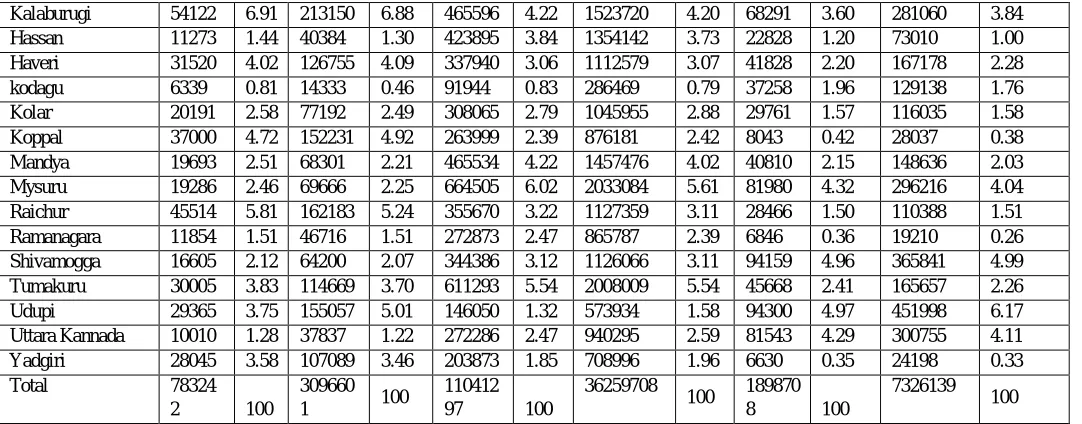
The study explains the details of the district-wise ration cards and beneficiaries in Karnataka. in the following table, (3) Total number of 3096601(7%) beneficiaries are covered with 783242(6%) AAY Ration cards, Total number of 7326139(16%) beneficiaries are covered with 1898708(14%) NPHH (APL) ration cards, are comparatively high in number of 36259708 (77%) beneficiaries are covered with 11041297 (80%) PHH (BPL), Ration cards.
[image:4.612.39.580.76.288.2]Poorest of the poor people live in the Ballari district because they have the highest number of 55423 (7.08) of AAY ration cards, Bangalore East district has the lowest number of 2033 (0.26%) AAY ration cards. The population of ration cardholders has increased as Belagavi has a large population; Belagavi district has the highest number of 273439 (14.4%) APL ration card holders, Yadagiri district has the lowest number of 6630(0.35%) APL rations cardholders. Belagavi district has the highest number of 984367 (8.9%) BPL ration card holders, Bangalore East has a lowest number of 57517(0.52%) BPL ration cardholders.
Table 4: Details of the Priority ration (BPL) card Items and Prices
Items Quantity Price Per Kg/Liter
Rice/Wheat/Ragi Will be distributed 7 Kg per person Rs 0
Tur Dal 1 Kg per Family Rs 38
Source: the Ministry of Food, Civil Supplies and Consumer Affairs Department in India and Karnataka.
Table 4 gives information about the details of the BPL card items and prices. Each person will receive 7 kg of rice/wheat per free, Tur dal1 kg per household (38 rs per kg). Antyodaya (AAY) ration cards are issued to the "poorest of poor" households. Each AAY household is entitled to 35 kilograms of food grain.
Table 5: Allocation and offtake of Food grains (Rice and Wheat) under TPDS (2014-2015 to 2018-2019) in Karnataka. In 100
tonnes
Year Allocation Offtake
2014-15 2542 2315
2015-16 2608 2238
2016-17 2608 2222
2017-18 2608 2825
2018-19 1739 1698
Source: the Ministry of Food, Civil Supplies and Consumer Affairs Department in India and Karnataka.
II. CONCLUSION
Public Distribution System is by far the largest food entitlement program in India. It is accessed by more than one-third of the total population of India. In the analysis, it was found that the PDS scheme in Karnataka is providing food security but low quality and quantity food grains are distributed to the Poor people of Karnataka. This study also suggests the methods to improve the PDS in areas particular as poor families. Those improvements are policy-oriented implications that are needed for the success of the PDS system in Karnataka.
REFERENCE
[1] Anju Singh, Kalanand Singh and AshaDubey (2011) Management of Public Distribution System in India – An Arrangement for Food Security, Public Distribution System in India edited by Anil Kumar Thakur and Kalpana Pal, Regal Publications, New Delhi.
[2] Food And Nutrition Board,http://www.wcd.nic.in
[3] Food Civil Supplies and Consumer Affairs Department ,https://ahara.kar.nic.in [4] Government of India. "National Food Security Act"
[5] Martin, W. (2010). Food Security and Poverty—A Precarious Balance. World Bank Group.
[6] Nigam, A. K. (2018). Global Hunger Index–Revisited. Journal of the Indian Society of Agricultural Statistics, 72, 225-230.