Proceedings of the 56th Annual Meeting of the Association for Computational Linguistics (Long Papers), pages 1437–1447 1437
Sequicity: Simplifying Task-oriented Dialogue Systems with Single
Sequence-to-Sequence Architectures
Wenqiang Lei‡∗, Xisen Jin§∗, Zhaochun Ren†, Xiangnan He‡, Min-Yen Kan‡, Dawei Yin†
‡National University of Singapore, Singapore
§Fudan University, Shanghai, China
†Data Science Lab, JD.com, Beijing, China
{wenqianglei,xisenjin}@gmail.com [email protected]
[email protected] [email protected] [email protected]
Abstract
Existing solutions to task-oriented dia-logue systems follow pipeline designs which introduce architectural complex-ity and fragilcomplex-ity. We propose a novel, holistic, extendable framework based on a single sequence-to-sequence (seq2seq) model which can be optimized with su-pervised or reinforcement learning. A key contribution is that we design text spans named belief spans to track logue believes, allowing task-oriented dia-logue systems to be modeled in a seq2seq way. Based on this, we propose a sim-plistic Two Stage CopyNet instantiation which demonstrates good scalability: sig-nificantly reducing model complexity in terms of number of parameters and train-ing time by an order of magnitude. It significantly outperforms state-of-the-art pipeline-based methods on two datasets and retains a satisfactory entity match rate on out-of-vocabulary (OOV) cases where pipeline-designed competitors totally fail.
1 Introduction
The challenge of achieving both task comple-tion and human-like response generacomple-tion for task-oriented dialogue systems is gaining research in-terest.Wen et al.(2017b,2016a,2017a) pioneered a set of models to address this challenge. Their proposed architectures follow traditional pipeline designs, where the belief tracking component is the key component (Chen et al.,2017).
In the current paradigm, such a belief tracker builds a complex multi-class classifier for each
* Work performed during an internship at Data Science Lab, JD.com.
slot (See§3.2) which can suffer from high com-plexity, especially when the number of slots and their values grow. Since all the possible slot values have to be pre-defined as classification labels, such trackers also cannot handle the requests that have out-of-vocabulary (OOV) slot values. Moreover, the belief tracker requires delexicalization, i.e., re-placing slot values with their slot names in utter-ances (Mrkˇsi´c et al.,2017). It does not scale well, due to the lexical diversity. The belief tracker also needs to be pre-trained, making the models unre-alistic for end-to-end training (Eric and Manning,
2017a). WhileEric and Manning(2017a,b)
inves-tigated building task-oriented dialogue systems by using a seq2seq model, unfortunately, their meth-ods are rather preliminary and do not perform well in either task completion or response generation, due to their omission of a belief tracker.
Questioning the basic pipeline architecture, in this paper, we re-examine the tenets of belief tracking in light of advances in deep learning. We introduce the concept of a belief span (bspan), a text span that tracks the belief states at each turn. This leads to a new framework, namedSequicity, with a single seq2seq model. Sequicity decom-poses the task-oriented dialogue problem into the generation of bspans and machine responses, con-verting this problem into a sequence optimization problem. In practice, Sequicity decodes in two stages: in the first stage, it decodes a bspan to fa-cilitate knowledge base (KB) search; in the sec-ond, it decodes a machine response on the con-dition of knowledge base search result and the bspan.
train-ing time, better performance on larger a dataset and an exceptional ability to handle OOV cases. Furthermore, Sequicity is a theoretically and aes-thetically appealing framework, as it achieves true end-to-end trainability using only one seq2seq model. As such, Sequicity leverages the rapid development of seq2seq models (Gehring et al.,
2017;Vaswani et al.,2017;Yu et al.,2017) in
de-veloping solutions to task-oriented dialogue sce-narios. In our implementation, we improve on CopyNet (Gu et al., 2016) to instantiate Sequic-ity framework in this paper, as key words present in bspans and machine responses recur from previ-ous utterances. Extensive experiments conducted on two benchmark datasets verify the effectiveness of our proposed method.
Our contributions are fourfold: (1) We pro-pose theSequicityframework, which handles both task completion and response generation in a sin-gle seq2seq model; (2) We present an implemen-tation of the Sequicity framework, called Two
Stage CopyNet(TSCP), which has fewer number
of parameters and trains faster than state-of-the-art baselines (Wen et al., 2017b, 2016a, 2017a); (3) We demonstrate that TSCP significantly outper-forms state-of-the-art baselines on two large-scale datasets, inclusive of scenarios involving OOV; (4) We release source code of TSCP to assist the com-munity to explore Sequicity1.
2 Related Work
Historically, task-oriented dialog systems have been built as pipelines of separately trained mod-ules. A typical pipeline design contains four com-ponents: 1) a user intent classifier, 2) a belief tracker, 3) a dialogue policy maker and a 4) re-sponse generator. User intent detectors classify user utterances to into one of the pre-defined in-tents. SVM, CNN and RNN models (Silva et al.,
2011;Hashemi et al.,2016;Shi et al.,2016)
per-form well for intent classification. Belief track-ers, which keep track of user goals and constraints every turn (Henderson et al.,2014a,b;Kim et al.,
2017) are the most important component for task accomplishment. They model the probability dis-tribution of values over each slot (Lee, 2013). Dialogue policy makers then generate the next available system action. Recent experiments sug-gest that reinforcement learning is a promising paradigm to accomplish this task (Young et al.,
1http://github.com/WING-NUS/sequicity
2013a; Cuay´ahuitl et al., 2015; Liu and Lane,
2017), when state and action spaces are carefully designed (Young et al., 2010). Finally, in the response generation stage, pipeline designs usu-ally pre-define fixed templates where placehold-ers are filled with slot values at runtime (
Dhin-gra et al.,2017;Williams et al.,2017;Henderson
et al.,2014b,a). However, this causes rather static
responses that could lower user satisfaction. Gen-erating a fluent, human-like response is considered a separate topic, typified by the topic of conversa-tion systems (Li et al.,2015).
3 Preliminaries
3.1 Encoder-Decoder Seq2seq Models
Current seq2seq models adopt encoder–decoder structures. Given a source sequence of tokens
X =x1x2...xn, an encoder network representX as hidden states: H(x) = h(1x)h(2x)...h(nx). Based
onH(x), a decoder network generates a target se-quence of tokensY =y1y2...ymwhose likelihood
should be maximized given the training corpus. As of late, the recurrent neural network with attention (Att-RNN) is now considered a base-line encoder–decoder architecture. Such networks employ two (sometimes identical) RNNs, one for encoding (i.e., generating H(x)) and another for decoding. Particularly, for decoding yj, the
de-coder RNN takes the embedding yj−1 to gener-ate a hidden vector h(jy). Afterwards, the de-coder attends to X: calculating attention scores between all h(ix) ∈ H(x) and h(y)
j (Eq. (1)), and
then sums allh(ix), weighted by their correspond-ing attention scores (Eqs. (2)). The summed result ˜
h(jx) concatenatesh(jy)as a single vector which is mapped into an output space for asof tmax oper-ation (Eq. (3)) to decode the current token:
uij =vTtanh(W1hi(x)+W2h(jy)) (1)
˜
h(jx)= n
X
i=1
euij
P
ieuij
h(ix) (2)
yj =sof tmax(O
" ˜
h(jx) h(jy)
#
) (3)
where v ∈ R1×l; W1, W2 ∈ Rl×d and O ∈ R|V|×d. dis embedding size andV is vocabulary
3.2 Belief Trackers
In the multi-turn scenarios, a belief tracker is the key component for task completion as it records key information from past turns (Wen et al.,
2017b; Henderson et al., 2013, 2014a,b). Early
belief trackers are designed as Bayesian networks where each node is a dialogue belief state (Paek
and Horvitz, 2000;Young et al.,2013b). Recent
work successfully represents belief trackers as dis-criminative classifiers (Henderson et al., 2013;
Williams,2012;Wen et al.,2017b).
Wen et al. (2017b) apply discrimination
ap-proaches (Henderson et al., 2013) to build one classifier for each slot in their belief tracker. Fol-lowing the terminology of (Wen et al., 2017b), a slot can be either informable or requestable, which have been annotated in CamRes676 and KVRET. Individually, an informable slot, speci-fied by user utterances in previous turns, is set to a constraint for knowledge base search; whereas a requestable slot records the user’s need in the current dialogue. As an example of belief track-ers in CamRes676,food type is an informable slot, and a set of food types is also predefined (e.g., Italian) as corresponding slot values. In (Wen
et al.,2017b), the informable slotfood typeis
recognized by a classifier, which takes user utter-ances as input to predict if and which type of food should be activated, while the requestable slot of addressis a binary variable. addresswill be set to true if the slot is requested by the user.
4 Method
We now describe the Sequicity framework, by first explaining the core concept of bspans. We then instantiate the Sequicity framework with our intro-duction of an improved CopyNet (Gu et al.,2016).
4.1 Belief Spans for Belief Tracking
The core of belief tracking is keeping track of in-formable and requestable slot values when a di-alogue progresses. In the era of pipeline-based methods, supervised classification is a straightfor-ward solution. However, we observe that this tra-ditional architecture can be updated by applying seq2seq models directly to the problem. In con-trast to (Wen et al.,2017b) which treats slot val-ues as classification labels, we record them in a text span, to be decoded by the model. This lever-ages the state-of-the-art neural seq2seq models to learn and dynamically generate them. Specifically,
our bspan has an information field (marked with <Inf></Inf>) to store values of informable slots since only values are important for knowl-edge base search. Bspans can also feature a re-quested field (marked with<Req></Req>), stor-ing requestable slot names if the correspondstor-ing value isTrue.
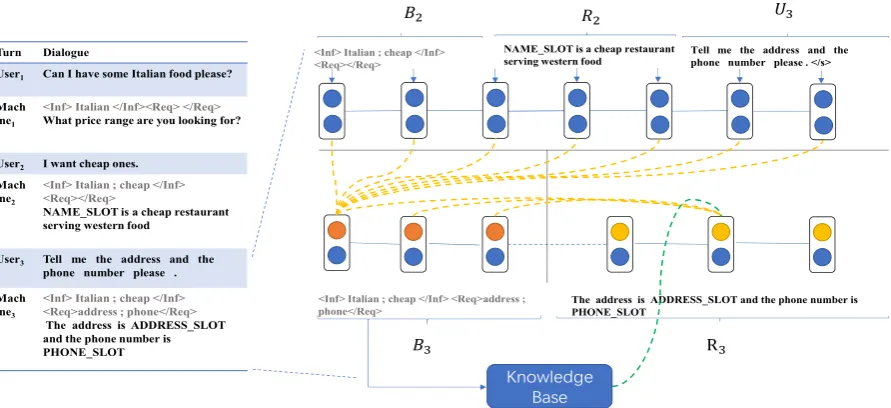
At turnt, given the user utteranceUt, we show
an example of both bspan Bt and machine
re-sponseRtgeneration in Figure1, where annotated slot values at each turn are decoded into bspans.
B1 contains an information slot Italian be-cause the user stated “Italian food” inU1. During the second turn, the user adds an additional con-straintcheapresulting in two slot values inB2’s information field. In the third turn, the user further asks for the restaurant’s phone and address, which are stored in requested slots ofB3.
Our bspan solution is concise: it simplifies multiple sophisticated classifiers with a single se-quence model. Furthermore, it can be viewed as an explicit data structure that expedite knowledge base search as its format is fixed: following (Wen
et al.,2017b), we use the informable slots values
directly for matching fields of entries in databases.
4.2 The Sequicity Framework
We make a key observation that at turn t, a sys-tem only needs to refer toBt−1, Rt−1 and Ut to generate a new belief span Bt and machine
re-sponseRt, without appealing to knowing all past utterances. Such Markov assumption allows Se-quicity to concatenate Bt−1, Rt−1 and Ut
(de-noted as Bt−1Rt−1Ut) as a source sequence for seq2seq modeling, to generateBt andRt as tar-get output sequences at each turn. More for-mally, we represent the dialogue utterances as
{(B0R0U1;B1R1); (B1R1U2;B2R2);...; (Bt−1
Rt−1Ut;BtRt)}whereB0 andR0 are initialized as empty sequences. In this way, Sequicity ful-fills both task accomplishment and response gen-eration in an unified seq2seq model. Note that we process Bt and Rt separately, as the belief state
Bt depends only on Bt−1Rt−1Ut, while the re-sponseRt is additionally conditioned on Bt and
the knowledge base search results (denoted askt);
that is,Btinforms theRt’s contents. For example,
Rtmust include all the request slots fromBtwhen
communicating the entities fulfilling the requests found in the knowledge base. Here,kthelps
𝐵
<Inf> Italian ; cheap </Inf> <Req></Req>
𝑈
Tell me the address and the phone number please . </s>
<Inf> Italian ; cheap </Inf> <Req>address ; phone</Req>
𝐵 R
Turn Dialogue
User1 Can I have some Italian food please?
Mach ine1
<Inf> Italian </Inf><Req> </Req>
What price range are you looking for?
User2 I want cheap ones.
Mach ine2
<Inf> Italian ; cheap </Inf> <Req></Req>
NAME_SLOT is a cheap restaurant serving western food
User3 Tell me the address and the
phone number please .
Mach ine3
<Inf> Italian ; cheap </Inf> <Req>address ; phone</Req>
The address is ADDRESS_SLOT and the phone number is PHONE_SLOT
Knowledge Base
The address is ADDRESS_SLOT and the phone number is PHONE_SLOT
NAME_SLOT is a cheap restaurant serving western food
[image:4.595.79.525.62.266.2]𝑅
Figure 1: Sequicity overview. The left shows a sample dialogue; the right illustrates the Sequicity. Bt
is employed only by the model, and not visible to users. During training, we substitute slot values with placeholders bearing the slot names for machine response. During testing, this is inverted: the placeholders are replaced by actual slot values, according to the item selected from the knowledge base.
Generally,kthas three possibilities: 1) multiple
matches, 2) exact match and 3) no match, while the machine responses differ accordingly. As an example, let’s say a user requests an Italian restau-rant. In the scenario of multiple matches, the sys-tem should prompt for additional constraints for disambiguation (such as restaurant price range). In the second exact match scenario where a sin-gle target (i.e., restaurant) has been found, the sys-tem should inform the user their requested infor-mation (e.g., restaurant address). If no entity is obtained, the system should inform the user and perhaps generate a cooperative response to retry a different constraint.
We thus formalize Sequicity as a seq2seq model which encodes Bt−1Rt−1Ut jointly, but decodes Bt andRtseparately, in two serial stages. In the first stage, the seq2seq model decodesBt uncondi-tionally (Eq.4a). OnceBtobtained, the decoding
pauses to perform the requisite knowledge base search based onBt, resulting inkt. Afterwards,
the seq2seq model continues to the second decod-ing stage, whereRtis generated on the additional
conditions ofBtandkt(Eq.4b).
Bt=seq2seq(Bt−1Rt−1Ut|0,0) (4a) Rt=seq2seq(Bt−1Rt−1Ut|Bt,kt) (4b)
Sequicity is a general framework suitably imple-mented by any of the various seq2seq models. The additional modeling effort beyond a general
seq2seq model is to add the conditioning on Bt
andkt to decode the machine responseRt.
For-tunately, natural language generation with spe-cific conditions has been extensively studied (Wen
et al., 2016b; Karpathy and Fei-Fei, 2015; Mei
et al., 2016) which can be employed within this
framework.
4.3 Sequicity Instantiation: A Two Stage CopyNet
Although there are many possible instantiations, in this work we purposefully choose a simplistic architecture, leaving more sophisticated modeling for future work. We term our instantiated model
aTwo Stage CopyNet(TSCP). We denote the first
m0tokens of target sequenceY areBtand the rests
areRt, i.e.Bt=y1...ym0andRt=ym0+1...ym.
Two-Stage CopyNet. We choose to improve upon CopyNet (Gu et al., 2016) as our seq2seq model. This is a natural choice as we observe that target sequence generation often requires the copying of tokens from the input sequence. Let’s discuss this in more detail. From a probabilis-tic point of view, the traditional encoder–decoder structure learns a language model. To decodeyj,
be exactly copied from the input X (e.g., “Ital-ian”). These copied words need to be explicitly modeled. CopyNet (Gu et al.,2016) is a natural fit here, as it enlarges the decoding output space from
V to V ∪X. For yj, it considers an additional copy probabilityPjc(v), indicating the likelihood ofyj copied fromv ∈ X. Following (Gu et al.,
2016), the simple summation of both probabilities
Pj(v) =Pjg(v) +Pjc(v), v∈V ∪Xis treated as the final probability in the original paper.
In Sequicity, simply applying original CopyNet architecture is insufficient, sinceBt andRt have different distributions. We here employ two sep-arate RNN (GRU in our implementation) in de-coder: one forBtand the other forRt. In the first decoding stage, we have a copy-attention mecha-nism onXto decodeBt; then calculate the
gener-ation probability through attending toX as intro-duced in Sec 3.1, as well as the copy probability for each wordv ∈ X following (Gu et al.,2016) by Eq.5:
Pjc(v) = 1 Z
|X| X
i:xi=v
eψ(xi), j 6m0 (5)
whereZ is a normalization term andψ(xi)is the
score of “copying” wordxi and is calculated by:
ψ(xi) =σ(h(ix)TWc)h(jy), j 6m0 (6)
whereWc∈Rd×d.
In the second decoding stage (i.e., decoding
Rt), we apply the last hidden state ofBtas the
ini-tial hidden state of theRtGRU. However, as we need to explicitly model the dependency onBt, we have copy-attention mechanism onBt instead of
onX: treating all tokens ofBtas the candidate for
copying and attention. Specifically, we use hidden state generated by Bt GRU, i.e.,h(1y), ...,h
(y)
m0, to
calculate copying using Eqs.7and8and attention score as introduced in Sec3.1. It helps to reduce search space because all key information ofXfor task completion has been included inBt.
Pjc(v) = 1 Z
X
i:yi=v
eψ(yi), i6m0 < j6m (7)
ψ(yi) =σ(h(iy) T
Wc)h(jy), i6m
0 < j
6m (8)
In contrast to recent work (Eric and Manning,
2017a) that also employs a copy-attention
mech-anism to generate a knowledge-base search API and machine responses, our proposed method ad-vances in two aspects: on one hand, bspans reduce the search space from U1R1...UtRt to
Bt−1Rt−1Ut by compressing key points for the
task completion given past dialogues; on the other hand, because bspans revisit context by only han-dling the Bt with a fixed length, the time
com-plexity of TSCP is onlyO(T), comparingO(T2)
in (Eric and Manning,2017a).
Involving kt when decoding Rt. As kt has
three possible values: obtaining only one, multi-ple or no entities. We letkt be a vector of three
dimensions, one of which signals a value. We ap-pendktto the embeddingsyj, as shown in Eq. (9)
that is fed into an GRU for generatingh(jy+1) . This approach is also referred to as Language Model Type condition (Wen et al.,2016b)
yj0 =
yj
kt
, j ∈[m0+ 1, m] (9)
4.4 Training
The standard cross entropy is adopted as our ob-jective function to train a language model:
m
X
j=1
yjlogPj(yj) (10)
In response generation, every token is treated equally. However, in our case, tokens for task completion are more important. For example, when a user asks for the address of a restau-rant, it matters more to decode the placeholder <address>than decode words for language flu-ency. We can employ reinforcement learning to fine tune the trained response decoder with an em-phasis to decode those important tokens.
Inspired by (Wen et al.,2017a), in the context of reinforcement learning, the decoding network can be viewed as a policy network, denoted as
πΘ(yj)for decoding yj (m0 + 1 6 j 6m).
Ac-cordingly, the choice of wordyj is an action and
Dataset Cam676
Size Train:408 / Test: 136 / Dev: 136 Domains restaurant reservation
Slot types price, food style etc. Distinct slot values 99
Dataset KVRET
[image:6.595.72.297.61.171.2]Size Train:2425 / Test: 302 / Dev: 302 Domains calendar weather info. POI Slot types date, etc. location, etc. poi, etc. Distinct slot values 79 65 140
Table 1: Dataset demographics. Following the respective literature, Cam676 is split 3:1:1 and KVRET is split 8:1:1, into training, developing and testing sets, respectively.
response model with policy gradient:
1 m−m0
m
X
j=m0+1
r(j)∂logπΘ(yj)
∂Θ (11)
where r(j) = r(j) + λr(j+1) + λ2r(j+2) +
...+λm−j+1r(m). To encourage our generated re-sponse to answer the user requested information but avoid long-winded response, we set the reward at each stepr(j) as follows: once the placeholder of requested slot has been decoded, the reward for current step is 1; otherwise, current step’s reward is -0.1. λis a decay parameter. Sec5.2forλ set-tings.
5 Experiments
We assess the effectiveness of Sequicity in three aspects: the task completion, the language qual-ity, and the efficiency. The evaluation metrics are listed as follows:
·BLEUto evaluate the language quality (Papineni
et al., 2002) of generated responses (hence top-1
candidate in (Wen et al.,2017b)).
· Entity match rate evaluates task completion. According to (Wen et al., 2017b), it determines if a system can generate all correct constraints to search the indicated entities of the user. This met-ric is either 0 or 1 for each dialogue.
· Success F1 evaluates task completion and is modified from the success rate in (Wen et al.,
2017b, 2016a, 2017a). The original success rate
measures if the system answered all the requested information (e.g. address, phone number). How-ever, this metric only evaluates recall. A system can easily achieve a perfect task success by always responding all possible request slots. Instead, we here use success F1to balance both recall and
pre-cision. It is defined as the F1 score of requested slots answered in the current dialogue.
·Training time.The training time is important for iteration cycle of a model in industry settings.
5.1 Datasets
We adopt the CamRest676 (Wen et al., 2017a) and KVRET (Eric and Manning,2017b) datasets. Both datasets are created by a Wizard-of-Oz ( Kel-ley, 1984) method on Amazon Mechanical Turk platform, where a pair of workers are recruited to carry out a fluent conversation to complete an assigned task (e.g. restaurant reservation). Dur-ing conversation, both informable and requestable slots are recorded by workers.
CamRest676’s dialogs are in the single domain of restaurant searching, while KVRET is broader, containing three domains: calendar scheduling, weather information retrieval and point of inter-est (POI) Navigation. Detailed slot information in each domain are shown in Table1. We follow the data splits of the original papers as shown in1.
5.2 Parameter Settings
For all models, the hidden size and the embedding size d is set to 50. |V| is 800 for CamRes676 and 1400 for KVRET. We train our model with an Adam optimizer (Kingma and Ba,2015), with a learning rate of 0.003 for supervised training and 0.0001for reinforcement learning. Early stopping is performed on developing set. In reinforcement learning, the decay parameterλis set to0.8. We also use beam search strategy for decoding, with a beam size of 10.
5.3 Baselines and Comparisons
We first compare our model with the state-of-the-art baselines as follow:
• NDM (Wen et al., 2017b). As described in Sec1, it adopts pipeline designs with a be-lief tracker component depending on delexi-calization.
• NDM+Att+SS. Based on the NDM model, an additional attention mechanism is performed on the belief trackers and a snapshot learning mechanism (Wen et al.,2016a) is adopted.
CamRes676 KVRET
Mat. BLEU Succ. F1 T imef ull T imeN.B. Mat. BLEU Succ. F1 T imef ull T imeN.B.
(1) NDM 0.904 0.212 0.832 91.9 min 8.6 min 0.724 0.186 0.741 285.5 min 29.3 min
(2) NDM + Att + SS 0.904 0.240 0.836 93.7 min 10.4 min 0.724 0.188 0.745 289.7 min 33.5 min
(3) LIDM 0.912 0.246 0.840 97.7 min 14.4 min 0.721 0.173 0.762 312.8 min 56.6 min
(4) KVRN N/A 0.134 N/A 21.4 min – 0.459 0.184 0.540 46.9 min –
(5) TSCP 0.927 0.253 0.854 7.3 min – 0.845 0.219 0.811 25.5 min –
(6) Att-RNN 0.851 0.248 0.774 7.2 min – 0.805 0.208 0.801 23.0 min –
(7) TSCP\kt 0.927 0.232 0.835 7.2 min – 0.845 0.168 0.759 25.3 min –
(8) TSCP\RL 0.927 0.234 0.834 4.1min – 0.845 0.191 0.774 17.5min –
[image:7.595.75.527.61.184.2](9) TSCP\Bt 0.888 0.197 0.809 22.9 min – 0.628 0.182 0.755 42.7 min –
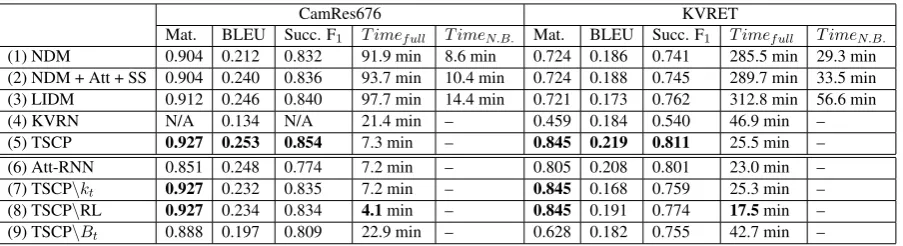
Table 2: Model performance on CamRes676 and KVRET. This table is split into two parts: competitors on the upper side and our ablation study on the bottom side. Mat. andSucc. F1are for match rate and success F1 respectively.Timefullcolumn reports training time till converge. For NDM, NDM+Att+SS
and LIDM, we also calculate the training time for the rest parts except for the belief tracker (TimeN.B.).
• KVRN (Eric and Manning,2017b) uses one seq2seq model to generate response as well as interacting with knowledge base. How-ever, it does not incorporate a belief tracking mechanism.
For NDM, NDM+Att+SS, LIDM, we run the source code released by the original authors2. For KVRN, we replicate it since there is no source code available. We also performed an ablation study to examine the effectiveness of each com-ponent.
• TSCP\kt. We removed the conditioning on
ktwhen decodingRt.
• TSCP\RL. We removed reinforcement learn-ing which fine tunes the models for response generation.
• Att-RNN. The standard seq2seq baseline as described in the preliminary section (See§3.1).
• TSCP\Bt. We removed bspans for dialogue state tracking. Instead, we adopt the method
in (Eric and Manning, 2017a):
concatenat-ing all past utterance in a dialogue into a CopyNet to generate user information slots for knowledge base search as well as machine response.
5.4 Experimental Results
As shown in Table2, TSCP outperforms all base-lines (Row 5 vs. Rows 1–4) in task completion (entity match rate, success F1) and language qual-ity (BLEU). The more significant performance of TSCP in KVRET dataset indicates the scalability
2https://github.com/shawnwun/NNDIAL
of TSCP. It is because KVRET dataset has sig-nificant lexical variety, making it hard to perform delexicalization for Wen et al.’s model (Rows 1– 3)3. However, CamRes676 is relatively small with simple patterns where all systems work well. As predicted, KVRN (Row 4) performs worse than TSCP (Row 5) due to lack of belief tracking.
Compared with Wen et al.’s models (Rows 1–3), TSCP takes a magnitude less time to train. Al-though TSCP is implemented in PyTorch while Wen et al.’s models in Theano, such speed com-parison is still valid, as the rest of the NDM model — apart from its belief tracker — has a compara-ble training speed to TSCP (7.3 mins vs. 8.6 mins on CamRes676 and 25.5 mins vs. 29.3 mins on KVRET), where model complexities are similar. The bottleneck in the time expense is due to belief tracker training. In addition, Wen et al.’s models perform better at the cost of more training time (Rows 1, 2 and 3), suggesting the intrinsic com-plexity of pipeline designs.
Importantly, ablation studies validate the ne-cessity of bspans. With bspans, even a stan-dard seq2seq model (Att-RNN, Row 6) beats so-phisticated models such as attention copyNets (TSCP\Bt, Row 9) in KVRET. Furthermore,
TSCP (Row 5) outperforms TSCP\Bt(Row 9) in
all aspects: task completion, language quality and training speed. This validate our theoretical analy-sis in Sec4.3. Other components of TSCP are also important. If we only use vanilla Attention-based RNN instead of copyNet, all metrics for model effectiveness decrease, validating our hypothesize that the copied words need to be specifically mod-eled. Secondly, BLEU score is sensitive to
knowl-3We use the delexicalization lexicon provided by the
edge base search result kt (Row 7 vs. Row 5).
By examining error cases, we find that the system is likely to generate common sentences like “you are welcome” regardless of context, due to corpus frequency. Finally, reinforcement learning effec-tively helps both BLEU and success F1although it takes acceptable additional time for training.
5.5 OOV Tests
Previous work predefines all slot values in a be-lief tracker. However, a user may request new at-tributes that has not been predefined as a classifi-cation label, which results in anentity mismatch. TSCP employs copy mechanisms, gaining an in-trinsic potential to handle OOV cases. To conduct the OOV test, we synthesize OOV test instances by adding a suffixunkto existing slot fillers. For example, we change “I would like Chinese food” into “I would like Chinese unk food.” We then randomly make a proportion of testing data OOV and measure its entity match rate. For simplicity, we only show the three most representative mod-els pre-trained in the in-vocabulary data: TSCP, TSCP\Btand NDM.
Mat.
0 0.25 0.5 0.75 1
OOV rate
0% 25% 50% 75% 100%
TSCP NDM TSCP\Bt
(a) CamRes676
Mat.
0 0.25 0.5 0.75 1
OOV rate
0% 25% 50% 75% 100%
TSCP NDM TSCP\Bt
[image:8.595.312.519.307.437.2](b) KVRET
Figure 2: OOV tests. 0% OOV rate means no OOV instance while 100% OOV rate means all in-stances are changed to be OOV.
[image:8.595.75.287.426.554.2]Compared with NDM, TSCP still performs well when all slot fillers are unknown. This is because TSCP actually learns sentence patterns. For exam-ple, CamRes676 dataset contains a frequent pat-tern “I would like[food type]food” where the [food type]should be copied inBtregardless
what exact word it is. In addition, the performance of TSCP\Btdecreases more sharply than TSCP as
more instances set to be OOV. This might be be-cause handling OOV cases is much harder when search space is large.
5.6 Empirical Model Complexity
Traditional belief trackers like (Wen et al.,2017b) are built as a multi-class classifier, which mod-els each individual slot and its corresponding val-ues, introducing considerable model complexities. This is especially severe in large datasets with a number of slots and values. In contrast, Sequic-ity reduces such a complex classifier to a language model. To compare the model complexities of two approaches, we empirically measure model size. We split KVRET dataset by their domains, result-ing in three sub-datasets. We then accumulatively add the sub-datasets into training set to examine how the model size grows. We here selectively present TSCP, NDM and its separately trained be-lief tracker, since Wen et al.’s set of models share similar model sizes.
Model Size(million)
0 2 4 5 7
Distinct Slot Values
79 144 284
TSCP NDM Belief Tracker
Figure 3: Model size sensitivity with respect to KVRET. Distinct slot values of 79, 144, 284 cor-respond to the number of slots in KVRET’s
calen-dar,calendar + weather info., and all 3 domains.
As shown in Figure 3, TSCP has a magni-tude less number of parameters than NDM and its model size is much less sensitive to distinct slot values increasing. It is because TSCP is a seq2seq language model which has a approximate linear complexity to vocabulary size. However, NDM employs a belief tracker which dominates its model size. The belief tracker is sensitive to the increase of distinct slot values because it employs complex structures to model each slot and corre-sponding values. Here, we only perform empirical evaluation, leaving theoretically complexity anal-ysis for future works.
5.7 Discussions
In this section we discuss if Sequicity can tackle
inconsistent user requests , which happens when
dif-ficult to tackle in belief tracking (Williams,2012;
Williams et al., 2013). Unlike most of previous
pipeline-based work that explicitly defines model actions for each situation, Sequicity is proposed to directly handle various situations from the training data with less manual intervention. Here, given examples about restaurant reservation, we provide three different scenarios to discuss:
• A user totally changes his mind. For ex-ample, the user request a Japanese restaurant first and says “I dont want Japanese food any-more, I’d like French now.” Then, all the slot activated before should be invalid now. The slot annotated for this turn is onlyFrench. Se-quicity can learn this pattern, as long as it is annotated in the training set.
• User requests cannot be found in the KB (e.g., Japanese food). Then the sys-tem should respond like “Sorry, there is no Japanese food...”. Consequently, the user can choose a different option: “OK, then French food.” The activated slot Japanese will be replaced as French, which our system can learn. Therefore, an important pattern is the machine-response (e.g., “there is no [XXX constraint]”) in the immediate previous utter-ance.
• Other cases. Sequicity is expected to gen-erate both slot values in a belief span if it doesn’t know which slot to replace. To main-tain the belief span, we run a simple post-processing script at each turn, which detects whether two slot values have the same slot name (e.g., food type) in a pre-defined slot name-value table. Then, such script only keeps the slot value in the current turn of user utterance. Given this script, Sequicity can ac-curately discover the slot requested by a user in each utterance. However, this script only works when slot values are pre-defined. For inconsistent OOV requests, we need to build another classifier to recognize slot names for slot values.
To sum up, Sequicity, as a framework, is able to handle various inconsistent user input despite its simple design. However, detailed implementa-tions should be customized depends on different applications.
6 Conclusion
We propose Sequicity, an extendable framework, which tracks dialogue believes through the decod-ing of novel text spans: belief spans. Such belief spans enable a task-oriented dialogue system to be holistically optimized in a single seq2seq model. One simplistic instantiation of Sequicity, called Two Stage CopyNet (TSCP), demonstrates better effectiveness and scalability of Sequicity. Exper-iments show that TSCP outperforms the state-of-the-art baselines in both task accomplishment and language quality. Moreover, our TSCP implemen-tation also betters traditional pipeline architectures by a magnitude in training time and adds the ca-pability of handling OOV. Such properties are im-portant for real-world customer service dialog sys-tems where users’ inputs vary frequently and mod-els need to be updated frequently. For our future work, we will consider advanced instantiations for Sequicity, and extend Sequicity to handle unsuper-vised cases where information and requested slots values are not annotated.
Acknowledgments
We would like to thank the anonymous reviewers for their detailed comments and suggestions for this paper. This work is also supported by the Na-tional Research Foundation, Prime Ministers Of-fice, Singapore under its IRC@SG Funding Initia-tive.
References
Hongshen Chen, Xiaorui Liu, Dawei Yin, and Jiliang Tang. 2017. A survey on dialogue systems: Re-cent advances and new frontiers. arXiv preprint arXiv:1711.01731.
Heriberto Cuay´ahuitl, Simon Keizer, and Oliver Lemon. 2015. Strategic dialogue management via deep reinforcement learning. arXiv preprint arXiv:1511.08099.
Bhuwan Dhingra, Lihong Li, Xiujun Li, Jianfeng Gao, Yun-Nung Chen, Faisal Ahmed, and Li Deng. 2017. Towards end-to-end reinforcement learning of dia-logue agents for information access. In Proceed-ings of the 55th Annual Meeting of the Association for Computational Linguistics (Volume 1: Long Pa-pers). volume 1, pages 484–495.
Mihail Eric and Christopher D Manning. 2017b. Key-value retrieval networks for task-oriented dialogue. SIGDIAL.
Jonas Gehring, Michael Auli, David Grangier, and Yann N Dauphin. 2017. A convolutional encoder model for neural machine translation.ACL.
Jiatao Gu, Zhengdong Lu, Hang Li, and Victor OK Li. 2016. Incorporating copying mechanism in sequence-to-sequence learning.ACL.
Homa B Hashemi, Amir Asiaee, and Reiner Kraft. 2016. Query intent detection using convolutional neural networks. In International Conference on Web Search and Data Mining, Workshop on Query Understanding.
Matthew Henderson, Blaise Thomson, and Jason D Williams. 2014a. The second dialog state tracking challenge. InSIGDIAL Conference. pages 263–272.
Matthew Henderson, Blaise Thomson, and Jason D Williams. 2014b. The third dialog state tracking challenge. InSpoken Language Technology Work-shop (SLT), 2014 IEEE. IEEE, pages 324–329.
Matthew Henderson, Blaise Thomson, and Steve Young. 2013. Deep neural network approach for the dialog state tracking challenge. In Proceedings of the SIGDIAL 2013 Conference. pages 467–471.
Andrej Karpathy and Li Fei-Fei. 2015. Deep visual-semantic alignments for generating image descrip-tions. In Proceedings of the IEEE conference on computer vision and pattern recognition. pages 3128–3137.
John F Kelley. 1984. An iterative design methodol-ogy for user-friendly natural language office infor-mation applications. ACM Transactions on Infor-mation Systems (TOIS)2(1):26–41.
Seokhwan Kim, Luis Fernando DHaro, Rafael E Banchs, Jason D Williams, and Matthew Henderson. 2017. The fourth dialog state tracking challenge. In Dialogues with Social Robots, Springer, pages 435– 449.
Diederik P Kingma and Jimmy Ba. 2015. Adam: A method for stochastic optimization.
Sungjin Lee. 2013. Structured discriminative model for dialog state tracking. In SIGDIAL Conference. pages 442–451.
Jiwei Li, Michel Galley, Chris Brockett, Jianfeng Gao, and Bill Dolan. 2015. A diversity-promoting objec-tive function for neural conversation models. arXiv preprint arXiv:1510.03055.
Bing Liu and Ian Lane. 2017. Iterative policy learning in end-to-end trainable task-oriented neural dialog models. arXiv preprint arXiv:1709.06136.
Hongyuan Mei, Mohit Bansal, and Matthew R Walter. 2016. What to talk about and how? selective gener-ation using lstms with coarse-to-fine alignment. In NAACL.
Nikola Mrkˇsi´c, Diarmuid O S´eaghdha, Tsung-Hsien Wen, Blaise Thomson, and Steve Young. 2017. Neural belief tracker: Data-driven dialogue state tracking.ACL.
Tim Paek and Eric Horvitz. 2000. Conversation as ac-tion under uncertainty. In Proceedings of the Six-teenth conference on Uncertainty in artificial intel-ligence. Morgan Kaufmann Publishers Inc., pages 455–464.
Kishore Papineni, Salim Roukos, Todd Ward, and Wei-Jing Zhu. 2002. Bleu: a method for automatic eval-uation of machine translation. In Proceedings of the 40th annual meeting on association for compu-tational linguistics. Association for Compucompu-tational Linguistics, pages 311–318.
Yangyang Shi, Kaisheng Yao, Le Tian, and Daxin Jiang. 2016. Deep lstm based feature mapping for query classification. In Proceedings of the 2016 Conference of the North American Chapter of the Association for Computational Linguistics: Human Language Technologies. pages 1501–1511.
Joao Silva, Lu´ısa Coheur, Ana Cristina Mendes, and Andreas Wichert. 2011. From symbolic to sub-symbolic information in question classification. Ar-tificial Intelligence Review35(2):137–154.
Ashish Vaswani, Noam Shazeer, Niki Parmar, Jakob Uszkoreit, Llion Jones, Aidan N Gomez, Lukasz Kaiser, and Illia Polosukhin. 2017. Attention is all you need. arXiv preprint arXiv:1706.03762.
Tsung-Hsien Wen, Milica Gasic, Nikola Mrksic, Lina M Rojas-Barahona, Pei-Hao Su, Stefan Ultes, David Vandyke, and Steve Young. 2016a. Contional generation and snapshot learning in neural di-alogue systems.EMNLP.
Tsung-Hsien Wen, Milica Gasic, Nikola Mrkˇsi´c,
Lina M. Rojas Barahona, Pei-Hao Su,
Ste-fan Ultes, David Vandyke, and Steve Young.
2016b. Conditional generation and
snap-shot learning in neural dialogue systems. In EMNLP. ACL, Austin, Texas, pages 2153–2162.
https://aclweb.org/anthology/D16-1233.
Tsung-Hsien Wen, Yishu Miao, Phil Blunsom, and Steve Young. 2017a. Latent intention dialogue mod-els. ICML.
Jason Williams, Antoine Raux, Deepak Ramachan-dran, and Alan Black. 2013. The dialog state track-ing challenge. InProceedings of the SIGDIAL 2013 Conference. pages 404–413.
Jason D Williams. 2012. A belief tracking challenge task for spoken dialog systems. In NAACL-HLT Workshop on future directions and needs in the spo-ken dialog community: tools and data. Association for Computational Linguistics, pages 23–24.
Jason D Williams, Kavosh Asadi, and Geoffrey Zweig. 2017. Hybrid code networks: practical and efficient end-to-end dialog control with supervised and rein-forcement learning. Proceedings of the 55th Annual Meeting of the Association for Computational Lin-guistics (Volume 1: Long Papers).
Steve Young, Milica Gaˇsi´c, Simon Keizer, Franc¸ois Mairesse, Jost Schatzmann, Blaise Thomson, and Kai Yu. 2010. The hidden information state model: A practical framework for pomdp-based spoken dia-logue management. Computer Speech & Language 24(2):150–174.
Steve Young, Milica Gaˇsi´c, Blaise Thomson, and Ja-son D Williams. 2013a. Pomdp-based statistical spoken dialog systems: A review. Proceedings of the IEEE101(5):1160–1179.
Steve Young, Milica Gaˇsi´c, Blaise Thomson, and Ja-son D Williams. 2013b. Pomdp-based statistical spoken dialog systems: A review. Proceedings of the IEEE101(5):1160–1179.