687
Soft Layer-Specific Multi-Task Summarization
with Entailment and Question Generation
Han Guo∗ Ramakanth Pasunuru∗ Mohit Bansal
UNC Chapel Hill
{hanguo, ram, mbansal}@cs.unc.edu
Abstract
An accurate abstractive summary of a doc-ument should contain all its salient infor-mation and should be logically entailed by the input document. We improve these important aspects of abstractive summa-rization via multi-task learning with the auxiliary tasks of question generation and entailment generation, where the former teaches the summarization model how to look for salient questioning-worthy de-tails, and the latter teaches the model how to rewrite a summary which is a directed-logical subset of the input doc-ument. We also propose novel multi-task architectures with high-level (seman-tic) layer-specific sharing across multi-ple encoder and decoder layers of the three tasks, as well as soft-sharing mech-anisms (and show performance ablations and analysis examples of each contribu-tion). Overall, we achieve statistically sig-nificant improvements over the state-of-the-art on both the CNN/DailyMail and Gigaword datasets, as well as on the DUC-2002 transfer setup. We also present sev-eral quantitative and qualitative analysis studies of our model’s learned saliency and entailment skills.
1 Introduction
Abstractive summarization is the challenging NLG task of compressing and rewriting a docu-ment into a short, relevant, salient, and coherent summary. It has numerous applications such as summarizing storylines, event understanding, etc. As compared to extractive or compressive sum-marization (Jing and McKeown,2000;Knight and
∗Equal contribution.
Marcu,2002;Clarke and Lapata,2008;Filippova et al., 2015;Henß et al.,2015), abstractive sum-maries are based on rewriting as opposed to se-lecting. Recent end-to-end, neural sequence-to-sequence models and larger datasets have allowed substantial progress on the abstractive task, with ideas ranging from copy-pointer mechanism and redundancy coverage, to metric reward based re-inforcement learning (Rush et al., 2015; Chopra et al.,2016;Nallapati et al.,2016;See et al.,2017). Despite these strong recent advancements, there is still a lot of scope for improving the summary quality generated by these models. A good rewrit-ten summary is one that contains all the salient information from the document, is logically fol-lowed (entailed) by it, and avoids redundant infor-mation. The redundancy aspect was addressed by coverage models (Suzuki and Nagata,2016;Chen et al.,2016;Nallapati et al.,2016;See et al.,2017), but we still need to teach these models about how to better detect salient information from the in-put document, as well as about better logically-directed natural language inference skills.
by Du et al. (2017). Our entailment generation task is based on the recent SNLI classification dataset and task (Bowman et al.,2015), converted to a generation task (Pasunuru and Bansal,2017).
Further, we also present novel multi-task learn-ing architectures based on multi-layered encoder and decoder models, where we empirically show that it is substantially better to share the higher-level semantic layers between the three afore-mentioned tasks, while keeping the lower-level (lexico-syntactic) layers unshared. We also ex-plore different ways to optimize the shared pa-rameters and show that ‘soft’ parameter sharing achieves higher performance than hard sharing.
Empirically, our soft, layer-specific sharing model with the question and entailment genera-tion auxiliary tasks achieves statistically signif-icant improvements over the state-of-the-art on both the CNN/DailyMail and Gigaword datasets. It also performs significantly better on the DUC-2002 transfer setup, demonstrating its strong gen-eralizability as well as the importance of auxiliary knowledge in low-resource scenarios. We also re-port improvements on our auxiliary question and entailment generation tasks over their respective previous state-of-the-art. Moreover, we signif-icantly decrease the training time of the multi-task models by initializing the individual multi-tasks from their pretrained baseline models. Finally, we present human evaluation studies as well as de-tailed quantitative and qualitative analysis studies of the improved saliency detection and logical in-ference skills learned by our multi-task model.
2 Related Work
Automatic text summarization has been progres-sively improving over the time, initially more fo-cused on extractive and compressive models (Jing and McKeown, 2000; Knight and Marcu, 2002; Clarke and Lapata, 2008; Filippova et al., 2015; Kedzie et al., 2015), and moving more towards compressive and abstractive summarization based on graphs and concept maps (Giannakopoulos, 2009;Ganesan et al., 2010;Falke and Gurevych, 2017) and discourse trees (Gerani et al., 2014), syntactic parse trees (Cheung and Penn, 2014; Wang et al.,2013), and Abstract Meaning Repre-sentations (AMR) (Liu et al., 2015; Dohare and Karnick, 2017). Recent work has also adopted machine translation inspired neural seq2seq mod-els for abstractive summarization with advances
in hierarchical, distractive, saliency, and graph-attention modeling (Rush et al., 2015; Chopra et al., 2016; Nallapati et al., 2016; Chen et al., 2016; Tan et al., 2017). Paulus et al. (2018) and Henß et al. (2015) incorporated recent ad-vances from reinforcement learning. Also, See et al.(2017) further improved results via pointer-copy mechanism and addressed the redundancy with coverage mechanism.
Multi-task learning (MTL) is a useful paradigm to improve the generalization performance of a task with related tasks while sharing some com-mon parameters/representations (Caruana, 1998; Argyriou et al., 2007; Kumar and Daum´e III, 2012). Several recent works have adopted MTL in neural models (Luong et al., 2016; Misra et al.,2016;Hashimoto et al.,2017;Pasunuru and Bansal, 2017; Ruder et al., 2017; Kaiser et al., 2017). Moreover, some of the above works have investigated the use of shared vs unshared sets of parameters. On the other hand, we investigate the importance of soft parameter sharing and high-level versus low-high-level layer-specific sharing.
Our previous workshop paper (Pasunuru et al., 2017) presented some preliminary results for multi-task learning of textual summarization with entailment generation. This current paper has several major differences: (1) We present ques-tion generaques-tion as an addiques-tional effective auxil-iary task to enhance the important complemen-tary aspect of saliency detection; (2) Our new high-level layer-specific sharing approach is sig-nificantly better than alternative layer-sharing ap-proaches (including the decoder-only sharing by Pasunuru et al. (2017)); (3) Our new soft shar-ing parameter approach gives stat. significant improvements over hard sharing; (4) We pro-pose a useful idea of starting multi-task mod-els from their pretrained baselines, which sig-nificantly speeds up our experiment cycle1; (5)
For evaluation, we show diverse improvements of our soft, layer-specific MTL model (over state-of-the-art pointer+coverage baselines) on the CNN/DailyMail, Gigaword, as well as DUC datasets; we also report human evaluation plus analysis examples of learned saliency and entail-ment skills; we also report improveentail-ments on the auxiliary question and entailment generation tasks over their respective previous state-of-the-art.
1About4-5days forPasunuru et al.(2017) approach vs.
In our work, we use a question generation task to improve the saliency of abstractive summariza-tion in a multi-task setting. Using the SQuAD dataset (Rajpurkar et al., 2016), we learn to gen-erate a question given the sentence containing the answer span in the comprehension (similar toDu et al.(2017)). For the second auxiliary task of en-tailment generation, we use the generation version of the RTE classification task (Dagan et al.,2006; Lai and Hockenmaier,2014;Jimenez et al.,2014; Bowman et al., 2015). Some previous work has explored the use of RTE for redundancy detec-tion in summarizadetec-tion by modeling graph-based relationships between sentences to select the most non-redundant sentences (Mehdad et al., 2013; Gupta et al.,2014), whereas our approach is based on multi-task learning.
3 Models
First, we introduce our pointer+coverage baseline model and then our two auxiliary tasks: question generation and entailment generation (and finally the multi-task learning models in Sec.4).
3.1 Baseline Pointer+Coverage Model
We use a sequence-attention-sequence model with a 2-layer bidirectional LSTM-RNN encoder and a 2-layer uni-directional LSTM-RNN decoder, along withBahdanau et al.(2015) style attention. Letx ={x1, x2, ..., xm}be the source document and y = {y1, y2, ..., yn} be the target summary. The output summary generation vocabulary dis-tribution conditioned over the input source doc-ument is Pv(y|x;θ) = Qnt=1pv(yt|y1:t−1, x;θ). Let the decoder hidden state be st at time stept and letctbe the context vector which is defined as a weighted combination of encoder hidden states. We concatenate the decoder’s (last) RNN layer hidden statest and context vectorctand apply a linear transformation, and then project to the vo-cabulary space by another linear transformation. Finally, the conditional vocabulary distribution at each time steptof the decoder is defined as: pv(yt|y1:t−1, x;θ) = sfm(Vp(Wf[st;ct]+bf)+bp)
(1) where, Wf, Vp, bf, bp are trainable parameters, andsfm(·)is the softmax function.
Pointer-Generator Networks Pointer
mecha-nism (Vinyals et al.,2015) helps in directly copy-ing the words from the source sequence durcopy-ing tar-get sequence generation, which is a good fit for a
task like summarization. Our pointer mechanism approach is similar to See et al.(2017), who use a soft switch based on the generation probability
pg =σ(Wgct+Ugst+Vgewt−1+bg), whereσ(·)is a sigmoid function,Wg,Ug,Vgandbg are param-eters learned during training.ewt−1 is the previous time step output word embedding. The final word distribution isPf(y) =pg·Pv(y)+(1−pg)·Pc(y), where Pv vocabulary distribution is as shown in Eq.1, and copy distributionPcis based on the at-tention distribution over source document words.
Coverage Mechanism Following previous
work (See et al., 2017), coverage helps alleviate the issue of word repetition while generating long summaries. We maintain a coverage vector
ˆ
ct = Ptt−1=0αt that sums over all of the previous time steps attention distributions αt, and this is
added as input to the attention mechanism. Cov-erage loss is Lcov(θ) = PtPimin(αt,i,ˆct,i). Finally, the total loss is a weighted combination of cross-entropy loss and coverage loss:
L(θ) =−logPf(y) +λLcov(θ) (2)
whereλis a tunable hyperparameter.
3.2 Two Auxiliary Tasks
Despite the strengths of the strong model de-scribed above with attention, pointer, and cover-age, a good summary should also contain max-imal salient information and be a directed log-ical entailment of the source document. We teach these skills to the abstractive summarization model via multi-task training with two related aux-iliary tasks: question generation task and entail-ment generation.
Question Generation The task of question
learning it with a question generation task, shar-ing some common parameters/representations (see more details in Sec.4). For setting up the ques-tion generaques-tion task, we follow Du et al. (2017) and use the SQuAD dataset to extract sentence-question pairs. Next, we use the same sequence-to-sequence model architecture as our summariza-tion model. Note that even though our quessummariza-tion generation task is generating one question at a time2, our multi-task framework (see Sec.4) is set
up in such a way that the sentence-level knowledge from this auxiliary task can help the document-level primary (summarization) task to generate multiple salient facts – by sharing high-level se-mantic layer representations. See Sec.7 and Ta-ble 10 for a quantitative evaluation showing that the multi-task model can find multiple (and more) salient phrases in the source document. Also see Sec. 7 (and supp) for challenging qualitative ex-amples where baseline and SotA models only re-cover a small subset of salient information but our multi-task model with question generation is able to detect more of the important information.
Entailment Generation The task of entailment
generation is to generate a hypothesis which is entailed by (or logically follows from) the given premise as input. In summarization, the gen-eration decoder also needs to generate a sum-mary that is entailed by the source document, i.e., does not contain any contradictory or unre-lated/extraneous information as compared to the input document. We again incorporate such infer-ence capabilities into the summarization model via multi-task learning, sharing some common repre-sentations/parameters between our summarization and entailment generation model (more details in Sec. 4). For this task, we use the entailment-labeled pairs from the SNLI dataset (Bowman et al., 2015) and set it up as a generation task (using the same strong model architecture as our abstractive summarization model). See Sec. 7 and Table9for a quantitative evaluation showing that the multi-task model is better entailed by the source document and has fewer extraneous facts. Also see Sec.7and supplementary for qualitative examples of how our multi-task model with the entailment auxiliary task is able to generate more logically-entailed summaries than the baseline and
2We also tried to generate all the questions at once from
the full document, but we obtained low accuracy because of this task’s challenging nature and overall less training data.
QG ENCODER SG ENCODER EG ENCODER
QG DECODER SG DECODER EG DECODER
ATTENTION DISTRIBUTION
UNSHA
RED
ENCODE
R LA
YER 1
SHARE
D
ENCODE
R LA
YER 2
SHARE
D
DECODE
R LA
YER 1
UNSHA
RED
DECODER
LA
YER
2
SHARE
D
A
TTEN
[image:4.595.305.524.60.279.2]TION
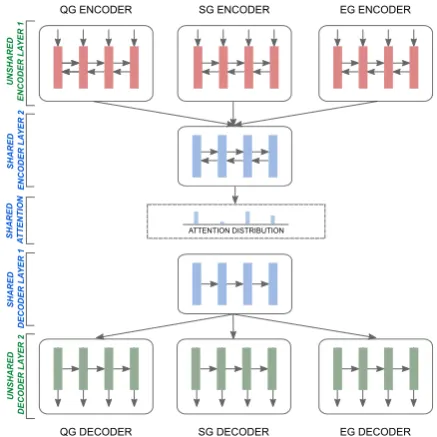
Figure 1: Overview of our multi-task model with parallel training of three tasks: abstractive sum-mary generation (SG), question generation (QG), and entailment generation (EG). We share the ‘blue’ color representations across all the three tasks, i.e., second layer of encoder, attention pa-rameters, and first layer of decoder.
SotA models, which instead produce extraneous, unrelated words not present (in any paraphrased form) in the source document.
4 Multi-Task Learning
We employ multi-task learning for parallel train-ing of our three tasks: abstractive summariza-tion, question generasummariza-tion, and entailment genera-tion. In this section, we describe our novel layer-specific, soft-sharing approaches and other multi-task learning details.
4.1 Layer-Specific Sharing Mechanism
Simply sharing all parameters across the related tasks is not optimal, because models for differ-ent tasks have differdiffer-ent input and output distribu-tions, esp. for low-level vs. high-level parameters. Therefore, related tasks should share some com-mon representations (e.g., high-level information), as well as need their own individual task-specific representations (esp. low-level information). To this end, we allow different components of model parameters of related tasks to be shared vs. un-shared, as described next.
Encoder Layer Sharing: Belinkov et al.(2017)
machine translation model learn to represent word structure, while higher layers (farther from input) are more focused on high-level semantic mean-ings (similar to findmean-ings in the computer vision community for image features (Zeiler and Fergus, 2014)). We believe that while textual summa-rization, question generation, and entailment gen-eration have different training data distributions and low-level representations, they can still benefit from sharing their models’ high-level components (e.g., those that capture the skills of saliency and inference). Thus, we keep the lower-level layer (i.e., first layer closer to input words) of the 2-layer encoder of all three tasks unshared, while we share the higher layer (second layer in our model as shown in Fig.1) across the three tasks.
Decoder Layer Sharing: Similarly for the
de-coder, lower layers (i.e., the layers closer to the output words) learn to represent word structure for generation, while higher layers (farther from output) are more focused on high-level semantic meaning. Hence, we again share the higher level components (first layer in the decoder far from output as show in Fig.1), while keeping the lower layer (i.e., second layer) of decoders of all three tasks unshared.
Attention Sharing: As described in Sec.3.1, the
attention mechanism defines an attention distribu-tion over high-level layer encoder hidden states and since we share the second, high-level (seman-tic) layer of all the encoders, it is intuitive to share the attention parameters as well.
4.2 Soft vs. Hard Parameter Sharing
Hard-sharing: In the most common multi-task
learning hard-sharing approach, the parameters to be shared are forced to be the same. As a result, gradient information from multiple tasks will di-rectly pass through shared parameters, hence forc-ing a common space representation for all the re-lated tasks. Soft-sharing: In our soft-sharing approach, we encourage shared parameters to be close in representation space by penalizing their
l2 distances. Unlike hard sharing, this approach gives more flexibility for the tasks by only loosely coupling the shared space representations. We minimize the following loss function for the pri-mary task in soft-sharing approach:
L(θ) =−logPf(y)+λLcov(θ)+γkθs−ψsk (3)
whereγ is a hyperparameter,θrepresents the
pri-mary summarization task’s full parameters, while
θs and ψs represent the shared parameter subset between the primary and auxiliary tasks.
4.3 Fast Multi-Task Training
During multi-task learning, we alternate the mini-batch optimization of the three tasks, based on a tunable ‘mixing ratio’αs : αq :αe; i.e., optimiz-ing the summarization task for αs mini-batches followed by optimizing the question generation task forαq mini-batches, followed by entailment generation task for αe mini-batches (and for 2-way versions of this, we only add one auxiliary task at a time). We continue this process until all the models converge. Also, importantly, instead of training from scratch, we start the primary task (summarization) from a90%-converged model of
its baseline to make the training process faster. We observe that starting from a fully-converged base-line makes the model stuck in a local minimum. In addition, we also start all auxiliary models from their90%-converged baselines, as we found
that starting the auxiliary models from scratch has a chance to pull the primary model’s shared parameters towards randomly-initialized auxiliary model’s shared parameters.
5 Experimental Setup
Datasets: We use CNN/DailyMail dataset (
Her-mann et al., 2015; Nallapati et al., 2016) and Gigaword (Rush et al., 2015) datasets for sum-marization, and the Stanford Natural Language Inference (SNLI) corpus (Bowman et al., 2015) and the Stanford Question Answering Dataset (SQuAD) (Rajpurkar et al.,2016) datasets for our entailment and question generation tasks, resp. We also show generalizability/transfer results on DUC-2002 with our CNN/DM trained models. Supplementary contains dataset details.
Evaluation Metrics: We use the standard
ROUGE evaluation package (Lin, 2004) for re-porting the results on all of our summarization models. Following previous work (Chopra et al., 2016; Nallapati et al., 2016), we use ROUGE full-length F1 variant for all our results. Fol-lowing See et al. (2017), we also report ME-TEOR (Denkowski and Lavie, 2014) using the MS-COCO evaluation script (Chen et al.,2015).
Human Evaluation Criteria: We used Amazon
ap-Models ROUGE-1 ROUGE-2 ROUGE-L METEOR
PREVIOUSWORK
Seq2Seq(50k vocab) (See et al.,2017) 31.33 11.81 28.83 12.03
Pointer (See et al.,2017) 36.44 15.66 33.42 15.35
Pointer+Coverage (See et al.,2017)? 39.53 17.28 36.38 18.72
Pointer+Coverage (See et al.,2017)† 38.82 16.81 35.71 18.14
OURMODELS
Two-Layer Baseline (Pointer+Coverage)⊗ 39.56 17.52 36.36 18.17
⊗+ Entailment Generation 39.84 17.63 36.54 18.61
⊗+ Question Generation 39.73 17.59 36.48 18.33
[image:6.595.90.504.60.176.2]⊗+ Entailment Gen. + Question Gen. 39.81 17.64 36.54 18.54
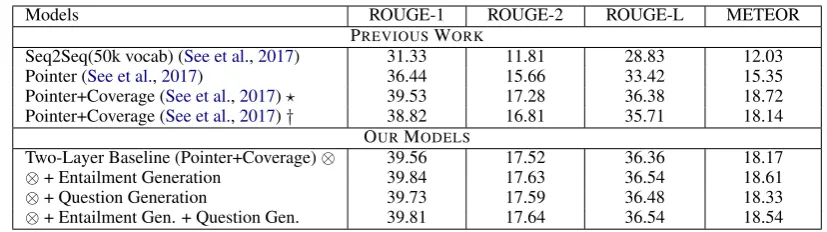
Table 1: CNN/DailyMail summarization results. ROUGE scores are full length F-1 (as previous work). All the multi-task improvements are statistically significant over the state-of-the-art baseline.
Models R-1 R-2 R-L
PREVIOUSWORK
ABS+ (Rush et al.,2015) 29.76 11.88 26.96 RAS-El (Chopra et al.,2016) 33.78 15.97 31.15 lvt2k (Nallapati et al.,2016) 32.67 15.59 30.64
Pasunuru et al.(2017) 32.75 15.35 30.82
OURMODELS
2-Layer Pointer Baseline⊗ 34.26 16.40 32.03 ⊗+ Entailment Generation 35.45 17.16 33.19 ⊗+ Question Generation 35.48 17.31 32.97 ⊗+ Entailment + Question 35.98 17.76 33.63
Table 2: Summarization results on Gigaword. ROUGE scores are full length F-1.
proval rate greater than 95%, and had at least 10,000 approved HITs. For the pairwise model comparisons discussed in Sec.6.2, we showed the annotators the input article, the ground truth sum-mary, and the two model summaries (randomly shuffled to anonymize model identities) – we then asked them to choose the better among the two model summaries or choose ‘Not-Distinguishable’ if both summaries are equally good/bad. In-structions for relevance were defined based on the summary containing salient/important infor-mation from the given article, being correct (i.e., avoiding contradictory/unrelated informa-tion), and avoiding redundancy. Instructions for readability were based on the summary’s fluency, grammaticality, and coherence.
Training Details All our soft/hard and
layer-specific sharing decisions were made on the val-idation/development set. Details of RNN hidden state sizes, Adam optimizer, mixing ratios, etc. are provided in the supplementary for reproducibility.
6 Results
6.1 Summarization (Primary Task) Results
Pointer+Coverage Baseline We start from the
strong model ofSee et al.(2017).3 Table1shows
3We use two layers so as to allow our high- versus
low-level layer sharing intuition. Note that this does not increase
that our baseline model performs better than or comparable to See et al. (2017).4 On Gigaword
dataset, our baseline model (with pointer only, since coverage not needed for this single-sentence summarization task) performs better than all pre-vious works, as shown in Table2.
Multi-Task with Entailment Generation We
first perform multi-task learning between ab-stractive summarization and entailment genera-tion with soft-sharing of parameters as discussed in Sec. 4. Table 1 and Table 2 shows that this multi-task setting is better than our strong base-line models and the improvements are statistically significant on all metrics5on both CNN/DailyMail
(p <0.01in ROUGE-1/ROUGE-L/METEOR and p <0.05in ROUGE-2) and Gigaword (p <0.01
on all metrics) datasets, showing that entailment generation task is inducing useful inference skills to the summarization task (also see analysis exam-ples in Sec.7).
Multi-Task with Question Generation For
multi-task learning with question generation, the improvements are statistically significant in ROUGE-1 (p <0.01), ROUGE-L (p <0.05), and
METEOR (p < 0.01) for CNN/DailyMail and in
all metrics (p < 0.01) for Gigaword, compared
to the respective baseline models. Also, Sec. 7 presents quantitative and qualitative analysis of this model’s improved saliency.6
the parameter size much (23M versus 22M for See et al.
(2017)).
4As mentioned in the github forSee et al.(2017), their
publicly released pretrained model produces the lower scores that we represent by†in Table1.
5Stat. significance is computed via bootstrap test (Noreen,
1989;Efron and Tibshirani,1994) with 100K samples.
6In order to verify that our improvements were from the
[image:6.595.73.290.213.328.2]sig-Models Relevance Readability Total
MTLVS. BASELINE
MTL wins 43 40 83
Baseline wins 22 24 46
Non-distinguish. 35 36 71
MTLVS.SEE ET AL.(2017)
MTL wins 39 33 72
See (2017) wins 29 38 67
[image:7.595.77.289.60.166.2]Non-distinguish. 32 29 61
Table 3: CNN/DM Human Evaluation: pairwise comparison between our 3-way multi-task (MTL) model w.r.t. our baseline andSee et al.(2017).
Models Relevance Readability Total
MTL wins 33 32 65
Baseline wins 22 22 44
[image:7.595.324.513.62.106.2]Non-distinguish. 45 46 91
Table 4: Gigaword Human Evaluation: pairwise comparison between our 3-way multi-task (MTL) model w.r.t. our baseline.
Multi-Task with Entailment and Question
Gen-eration Finally, we perform multi-task learning
with all three tasks together, achieving the best of both worlds (inference skills and saliency). Ta-ble 1 and Table 2 show that our full multi-task model achieves the best scores on CNN/DailyMail and Gigaword datasets, and the improvements are statistically significant on all metrics on both CNN/DailyMail (p < 0.01 in
ROUGE-1/ROUGE-L/METEOR andp <0.02in
ROUGE-2) and Gigaword (p < 0.01 on all metrics).
Fi-nally, our 3-way multi-task model (with both en-tailment and question generation) outperforms the publicly-available pretrained result (†) of the
pre-vious SotA (See et al., 2017) with stat. signifi-cance (p < 0.01), as well the higher-reported
re-sults (?) on ROUGE-1/ROUGE-2 (p <0.01).
6.2 Human Evaluation
We also conducted a blind human evaluation on Amazon MTurk for relevance and readability, based on 100 samples, for both CNN/DailyMail and Gigaword (see instructions in Sec.5). Table.3 shows the CNN/DM results where we do pairwise comparison between our 3-way multi-task model’s output summaries w.r.t. our baseline summaries and w.r.t.See et al.(2017) summaries. As shown, our 3-way multi-task model achieves both higher relevance and higher readability scores w.r.t. the baseline. W.r.t.See et al.(2017), our MTL model is higher in relevance scores but a bit lower in
nificantly better than these models using the auxiliary word-embeddings, suggesting that merely adding more data in not enough.
Models R-1 R-2 R-L
See et al.(2017) 34.30 14.25 30.82
Baseline 35.96 15.91 32.92
[image:7.595.78.285.209.250.2]Multi-Task (EG + QG) 36.73 16.15 33.58
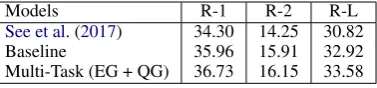
Table 5: ROUGE F1 scores on DUC-2002.
readability scores (and is higher in terms of total aggregate scores). One potential reason for this lower readability score is that our entailment gen-eration auxiliary task encourages our summariza-tion model to rewrite more and to be more abstrac-tive thanSee et al.(2017) – see abstractiveness re-sults in Table11.
We also show human evaluation results on the Gigaword dataset in Table4(again based on pair-wise comparisons for 100 samples), where we see that our MTL model is better than our state-of-the-art baseline on both relevance and readability.7
6.3 Generalizability Results (DUC-2002)
Next, we also tested our model’s generalizabil-ity/transfer skills, where we take the models trained on CNN/DailyMail and directly test them on DUC-2002. We take our baseline and 3-way multi-task models, plus the pointer-coverage model from See et al. (2017).8 We only
re-tune the beam-size for each of these three mod-els separately (based on DUC-2003 as the vali-dation set).9 As shown in Table 5, our
multi-task model achieves statistically significant im-provements over the strong baseline (p < 0.01
in ROUGE-1 and ROUGE-L) and the pointer-coverage model fromSee et al.(2017) (p < 0.01
in all metrics). This demonstrates that our model is able to generalize well and that the auxiliary knowledge helps more in low-resource scenarios.
6.4 Auxiliary Task Results
In this section, we discuss the individual/separated performance of our auxiliary tasks.
Entailment Generation We use the same
archi-tecture as described in Sec.3.1with pointer
mech-7Note that we did not have output files of any previous
work’s model on Gigaword; however, our baseline is already a strong state-of-the-art model as shown in Table2.
8We use the publicly-available pretrained model fromSee
et al.(2017)’s github for these DUC transfer results, which produces the†results in Table1. All other comparisons and analysis in our paper are based on their higher?results.
9We follow previous work which has shown that larger
Models M C R B Pasunuru&Bansal (2017) 29.6 117.8 62.4 40.6 Our 1-layer pointer EG 32.4 139.3 65.1 43.6 Our 2-layer pointer EG 32.3 140.0 64.4 43.7
Table 6: Performance of our pointer-based entail-ment generation (EG) models compared with pre-vious SotA work. M, C, R, B are short for Meteor, CIDEr-D, ROUGE-L, and BLEU-4, resp.
Models M C R B
[image:8.595.320.513.63.147.2]Du et al.(2017) 15.2 - 38.0 10.8 Our 1-layer pointer QG 15.4 75.3 36.2 9.2 Our 2-layer pointer QG 17.5 95.3 40.1 13.8
Table 7: Performance of our pointer-based ques-tion generaques-tion (QG) model w.r.t. previous work.
anism, and Table6compares our model’s perfor-mance toPasunuru and Bansal(2017). Our pointer mechanism gives a performance boost, since the entailment generation task involves copying from the given premise sentence, whereas the 2-layer model seems comparable to the 1-layer model. Also, the supplementary shows some output ex-amples from our entailment generation model.
Question Generation Again, we use same
ar-chitecture as described in Sec. 3.1 along with pointer mechanism for the task of question gen-eration. Table7compares the performance of our model w.r.t. the state-of-the-art Du et al.(2017). Also, the supplementary shows some output ex-amples from our question generation model.
7 Ablation and Analysis Studies
Soft-sharing vs. Hard-sharing As described in
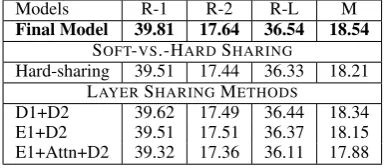
Sec.4.2, we choose soft-sharing over hard-sharing because of the more expressive parameter shar-ing it provides to the model. Empirical results in Table. 8 prove that soft-sharing method is statis-tically significantly better than hard-sharing with
p <0.001in all metrics.10
Comparison of Different Layer-Sharing Meth-ods We also conducted ablation studies among various layer-sharing approaches. Table8 shows results for soft-sharing models with decoder-only sharing (D1+D2; similar toPasunuru et al.(2017)) as well as lower-layer sharing (encoder layer 1 + decoder layer 2, with and without attention shared). As shown, our final model (high-level semantic layer sharing E2+Attn+D1) outperforms
10In the interest of space, most of the analyses are shown
for CNN/DailyMail experiments, but we observed similar trends for the Gigaword experiments as well.
Models R-1 R-2 R-L M
Final Model 39.81 17.64 36.54 18.54
SOFT-VS.-HARDSHARING
Hard-sharing 39.51 17.44 36.33 18.21
LAYERSHARINGMETHODS
D1+D2 39.62 17.49 36.44 18.34
E1+D2 39.51 17.51 36.37 18.15
E1+Attn+D2 39.32 17.36 36.11 17.88
Table 8: Ablation studies comparing our final multi-task model with hard-sharing and different alternative layer-sharing methods. Here E1, E2, D1, D2, Attn refer to parameters of the first/second layer of encoder/decoder, and attention parame-ters. Improvements of final model upon ablation experiments are all stat. signif. withp <0.05.
Models Average Entailment Probability
Baseline 0.907
Multi-Task (EG) 0.912
Table 9: Entailment classification results of our baseline vs. EG-multi-task model (p <0.001).
these alternate sharing methods in all metrics with statistical significance (p <0.05).11
Quantitative Improvements in Entailment
We employ a state-of-the-art entailment clas-sifier (Chen et al., 2017), and calculate the average of the entailment probability of each of the output summary’s sentences being entailed by the input source document. We do this for output summaries of our baseline and 2-way-EG multi-task model (with entailment generation). As can be seen in Table9, our multi-task model improves upon the baseline in the aspect of being entailed by the source document (with statistical significance p < 0.001). Further, we use the
Named Entity Recognition (NER) module from CoreNLP (Manning et al.,2014) to compute the number of times the output summary contains extraneous facts (i.e., named entities as detected by the NER system) that are not present in the source documents, based on the intuition that a well-entailed summary should not contain unrelated information not followed from the input premise. We found that our 2-way MTL model with entailment generation reduces this extraneous count by 17.2% w.r.t. the baseline.
The qualitative examples below further discuss this issue of generating unrelated information.
Quantitative Improvements in Saliency Detec-tion For our saliency evaluation, we used the
11Note that all our soft and layer sharing decisions were
[image:8.595.78.287.172.214.2]Models Average Match Rate
Baseline 27.75 %
Multi-Task (QG) 28.06 %
Table 10: Saliency classification results of our baseline vs. QG-multi-task model (p <0.01).
Models 2-gram 3-gram 4-gram
See et al.(2017) 2.24 6.03 9.72
MTL (3-way) 2.84 6.83 10.66
Table 11: Abstractiveness: novel n-gram percent.
answer-span prediction classifier from Pasunuru and Bansal(2018) trained on SQuAD (Rajpurkar et al., 2016) as the keyword detection classifier. We then annotate the ground-truth and model sum-maries with this keyword classifier and compute the % match, i.e., how many salient words from the ground-truth summary were also generated in the model summary. The results are shown in Ta-ble 10, where the 2-way-QG MTL model (with question generation) versus baseline improvement is stat. significant (p < 0.01). Moreover, we
found 93 more cases where our 2-way-QG MTL
model detects 2 or more additional salient key-words than the pointer baseline model (as opposed to vice versa), showing that sentence-level ques-tion generaques-tion task is helping the document-level summarization task in finding more salient terms.
Qualitative Examples on Entailment and
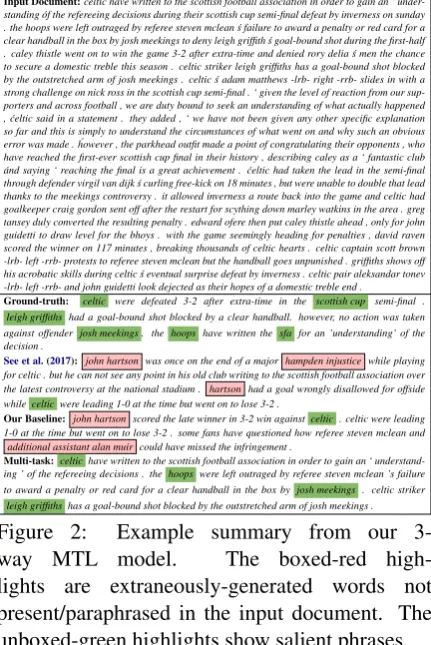
Saliency Improvements Fig. 2 presents an
example of output summaries generated by See et al. (2017), our baseline, and our 3-way multi-task model. See et al. (2017) and our baseline models generate phrases like “john hartson” and “hampden injustice” that don’t appear in the input document, hence they are not entailed by the input.12 Moreover, both models missed
salient information like “josh meekings”, “leigh griffiths”, and “hoops”, that our multi-task model recovers.13 Hence, our 3-way multi-task model
generates summaries that are both better at logical entailment and contain more salient information. We refer to supplementary Fig. 3 for more de-tails and similar examples for separated 2-way multi-task models (supplementary Fig. 1, Fig. 2).
Abstractiveness Analysis As suggested in See
et al.(2017), we also compute the abstractiveness score as the number of noveln-grams between the
12These extra, non-entailed unrelated/contradictory
infor-mation are not present at all in any paraphrase form in the input document.
13We consider the fill-in-the-blank highlights annotated by
human on CNN/DailyMail dataset as salient information.
Input Document:celtic have written to the scottish football association in order to gain an ‘ under-standing ´of the refereeing decisions during their scottish cup semi-final defeat by inverness on sunday . the hoops were left outraged by referee steven mclean ´s failure to award a penalty or red card for a clear handball in the box by josh meekings to deny leigh griffith ´s goal-bound shot during the first-half . caley thistle went on to win the game 3-2 after extra-time and denied rory delia ´s men the chance to secure a domestic treble this season . celtic striker leigh griffiths has a goal-bound shot blocked by the outstretched arm of josh meekings . celtic ´s adam matthews -lrb- right -rrb- slides in with a strong challenge on nick ross in the scottish cup semi-final . ‘ given the level of reaction from our sup-porters and across football , we are duty bound to seek an understanding of what actually happened , ´celtic said in a statement . they added , ‘ we have not been given any other specific explanation so far and this is simply to understand the circumstances of what went on and why such an obvious error was made . ´however , the parkhead outfit made a point of congratulating their opponents , who have reached the first-ever scottish cup final in their history , describing caley as a ‘ fantastic club ´and saying ‘ reaching the final is a great achievement . ´celtic had taken the lead in the semi-final through defender virgil van dijk ´s curling free-kick on 18 minutes , but were unable to double that lead thanks to the meekings controversy . it allowed inverness a route back into the game and celtic had goalkeeper craig gordon sent off after the restart for scything down marley watkins in the area . greg tansey duly converted the resulting penalty . edward ofere then put caley thistle ahead , only for john guidetti to draw level for the bhoys . with the game seemingly heading for penalties , david raven scored the winner on 117 minutes , breaking thousands of celtic hearts . celtic captain scott brown -lrb- left -rrb- protests to referee steven mclean but the handball goes unpunished . griffiths shows off his acrobatic skills during celtic ´s eventual surprise defeat by inverness . celtic pair aleksandar tonev -lrb- left -rrb- and john guidetti look dejected as their hopes of a domestic treble end . Ground-truth: celtic were defeated 3-2 after extra-time in the scottish cup semi-final .
leigh griffiths had a goal-bound shot blocked by a clear handball. however, no action was taken against offender josh meekings . the hoops have written the sfa for an ’understanding’ of the decision .
See et al.(2017): john hartson was once on the end of a major hampden injustice while playing for celtic . but he can not see any point in his old club writing to the scottish football association over the latest controversy at the national stadium . hartson had a goal wrongly disallowed for offside while celtic were leading 1-0 at the time but went on to lose 3-2 .
Our Baseline:john hartson scored the late winner in 3-2 win against celtic . celtic were leading 1-0 at the time but went on to lose 3-2 . some fans have questioned how referee steven mclean and
additional assistant alan muir could have missed the infringement .
Multi-task:celtic have written to the scottish football association in order to gain an ‘ understand-ing ’ of the refereeunderstand-ing decisions . the hoops were left outraged by referee steven mclean ’s failure to award a penalty or red card for a clear handball in the box by josh meekings . celtic striker
leigh griffiths has a goal-bound shot blocked by the outstretched arm of josh meekings .
[image:9.595.309.525.66.389.2]Figure 3: Example of summaries generated bySee et al.(2017), our baseline, and 3-way multi-task model with summarization and both entailment generation and question generation. The boxed-red highlighted words/phrases are not present in the input source document in any paraphrasing form. All the unboxed-green highlighted words/phrases correspond to the salient information. See detailed discussion in Fig. 1 and Fig. 2 above. As shown, the outputs fromSee et al.(2017) and the baseline both include non-entailed words/phrases (e.g. “john hartson”), as well as they missed salient information (“hoops”, “josh meekings”, “leigh griffiths”) in their output summaries. Our multi-task model, however, manages to accomplish both, i.e., cover more salient information and also avoid unrelated information.
Figure 2: Example summary from our 3-way MTL model. The boxed-red high-lights are extraneously-generated words not present/paraphrased in the input document. The unboxed-green highlights show salient phrases.
model output summary and source document. As shown in Table 11, our multi-task model (EG + QG) is more abstractive thanSee et al.(2017).
8 Conclusion
We presented a multi-task learning approach to improve abstractive summarization by incorporat-ing the ability to detect salient information and to be logically entailed by the document, via ques-tion generaques-tion and entailment generaques-tion auxil-iary tasks. We propose effective soft and high-level (semantic) layer-specific parameter sharing and achieve significant improvements over the state-of-the-art on two popular datasets, as well as a generalizability/transfer DUC-2002 setup.
Acknowledgments
References
Andreas Argyriou, Theodoros Evgeniou, and Massim-iliano Pontil. 2007. Multi-task feature learning. In
NIPS.
Dzmitry Bahdanau, Kyunghyun Cho, and Yoshua Ben-gio. 2015. Neural machine translation by jointly learning to align and translate. InICLR.
Yonatan Belinkov, Nadir Durrani, Fahim Dalvi, Hassan Sajjad, and James Glass. 2017. What do neural ma-chine translation models learn about morphology? InACL.
Samuel R Bowman, Gabor Angeli, Christopher Potts, and Christopher D Manning. 2015. A large anno-tated corpus for learning natural language inference. InEMNLP.
Rich Caruana. 1998. Multitask learning. InLearning
to learn, pages 95–133. Springer.
Qian Chen, Xiaodan Zhu, Zhen-Hua Ling, Si Wei, Hui Jiang, and Diana Inkpen. 2017. Enhanced lstm for
natural language inference. In Proceedings of the
55th Annual Meeting of the Association for Compu-tational Linguistics (Volume 1: Long Papers), vol-ume 1, pages 1657–1668.
Qian Chen, Xiaodan Zhu, Zhenhua Ling, Si Wei, and Hui Jiang. 2016. Distraction-based neural networks for modeling documents. InIJCAI.
Xinlei Chen, Hao Fang, Tsung-Yi Lin, Ramakr-ishna Vedantam, Saurabh Gupta, Piotr Doll´ar, and C Lawrence Zitnick. 2015. Microsoft COCO cap-tions: Data collection and evaluation server. arXiv preprint arXiv:1504.00325.
Jackie Chi Kit Cheung and Gerald Penn. 2014. Unsu-pervised sentence enhancement for automatic
sum-marization. InEMNLP, pages 775–786.
Sumit Chopra, Michael Auli, and Alexander M Rush. 2016. Abstractive sentence summarization with at-tentive recurrent neural networks. InHLT-NAACL. James Clarke and Mirella Lapata. 2008. Global
in-ference for sentence compression: An integer linear programming approach. Journal of Artificial Intelli-gence Research, 31:399–429.
Ido Dagan, Oren Glickman, and Bernardo Magnini. 2006. The pascal recognising textual entailment
challenge. In Machine learning challenges.
evalu-ating predictive uncertainty, visual object classifica-tion, and recognising tectual entailment, pages 177– 190. Springer.
Michael Denkowski and Alon Lavie. 2014. Meteor universal: Language specific translation evaluation for any target language. InEACL.
Shibhansh Dohare and Harish Karnick. 2017. Text summarization using abstract meaning representa-tion. arXiv preprint arXiv:1706.01678.
Xinya Du, Junru Shao, and Claire Cardie. 2017. Learn-ing to ask: Neural question generation for readLearn-ing
comprehension. InACL.
Bradley Efron and Robert J Tibshirani. 1994. An intro-duction to the bootstrap. CRC press.
Tobias Falke and Iryna Gurevych. 2017. Bringing structure into summaries: Crowdsourcing a
bench-mark corpus of concept maps. InEMNLP.
Katja Filippova, Enrique Alfonseca, Carlos A Col-menares, Lukasz Kaiser, and Oriol Vinyals. 2015. Sentence compression by deletion with lstms. In
EMNLP, pages 360–368.
Kavita Ganesan, ChengXiang Zhai, and Jiawei Han. 2010. Opinosis: a graph-based approach to abstrac-tive summarization of highly redundant opinions. In
Proceedings of the 23rd international conference on computational linguistics, pages 340–348. ACL.
Shima Gerani, Yashar Mehdad, Giuseppe Carenini, Raymond T Ng, and Bita Nejat. 2014. Abstractive summarization of product reviews using discourse
structure. InEMNLP, volume 14, pages 1602–1613.
George Giannakopoulos. 2009. Automatic summariza-tion from multiple documents.Ph. D. dissertation.
Anand Gupta, Manpreet Kaur, Adarsh Singh, Aseem Goel, and Shachar Mirkin. 2014. Text summa-rization through entailment-based minimum vertex
cover. Lexical and Computational Semantics (*
SEM 2014), page 75.
Kazuma Hashimoto, Caiming Xiong, Yoshimasa Tsu-ruoka, and Richard Socher. 2017. A joint many-task model: Growing a neural network for multiple nlp
tasks. InEMNLP.
Stefan Henß, Margot Mieskes, and Iryna Gurevych. 2015. A reinforcement learning approach for adap-tive single-and multi-document summarization. In
GSCL, pages 3–12.
Karl Moritz Hermann, Tomas Kocisky, Edward Grefenstette, Lasse Espeholt, Will Kay, Mustafa Su-leyman, and Phil Blunsom. 2015. Teaching
ma-chines to read and comprehend. In NIPS, pages
1693–1701.
Sergio Jimenez, George Duenas, Julia Baquero, Alexander Gelbukh, Av Juan Dios B´atiz, and Av Mendiz´abal. 2014. UNAL-NLP: Combining soft cardinality features for semantic textual similarity, relatedness and entailment. InSemEval, pages 732– 742.
Hongyan Jing and Kathleen R. McKeown. 2000. Cut
Lukasz Kaiser, Aidan N. Gomez, Noam Shazeer, Ashish Vaswani, Niki Parmar, Llion Jones, and Jakob Uszkoreit. 2017. One model to learn them all.CoRR, abs/1706.05137.
Chris Kedzie, Kathleen McKeown, and Fernando Diaz. 2015. Predicting salient updates for disaster
summa-rization. In Proceedings of the 53rd Annual
Meet-ing of the Association for Computational LMeet-inguistics and the 7th International Joint Conference on Natu-ral Language Processing (Volume 1: Long Papers), volume 1, pages 1608–1617.
Kevin Knight and Daniel Marcu. 2002. Summariza-tion beyond sentence extracSummariza-tion: A probabilistic ap-proach to sentence compression. Artificial Intelli-gence, 139(1):91–107.
Abhishek Kumar and Hal Daum´e III. 2012. Learning task grouping and overlap in multi-task learning. In
ICML.
Alice Lai and Julia Hockenmaier. 2014. Illinois-lh: A denotational and distributional approach to seman-tics. Proc. SemEval, 2:5.
Chin-Yew Lin. 2004. ROUGE: A package for
auto-matic evaluation of summaries. In Text
Summa-rization Branches Out: Proceedings of the ACL-04 workshop, volume 8.
Fei Liu, Jeffrey Flanigan, Sam Thomson, Norman Sadeh, and Noah A Smith. 2015. Toward abstrac-tive summarization using semantic representations. InNAACL: HLT, pages 1077–1086.
Minh-Thang Luong, Quoc V. Le, Ilya Sutskever, Oriol Vinyals, and Lukasz Kaiser. 2016. Multi-task se-quence to sese-quence learning. InICLR.
Christopher D. Manning, Mihai Surdeanu, John Bauer, Jenny Finkel, Steven J. Bethard, and David
Mc-Closky. 2014. The Stanford CoreNLP natural
lan-guage processing toolkit. InAssociation for Compu-tational Linguistics (ACL) System Demonstrations, pages 55–60.
Yashar Mehdad, Giuseppe Carenini, Frank W Tompa, and Raymond T Ng. 2013. Abstractive meeting
summarization with entailment and fusion. InProc.
of the 14th European Workshop on Natural Lan-guage Generation, pages 136–146.
Ishan Misra, Abhinav Shrivastava, Abhinav Gupta, and Martial Hebert. 2016. Cross-stitch networks for
multi-task learning. InCVPR, pages 3994–4003.
Ramesh Nallapati, Bowen Zhou, Cicero Nogueira dos santos, Caglar Gulcehre, and Bing Xiang. 2016. Abstractive text summarization using
sequence-to-sequence rnns and beyond. InCoNLL.
Eric W Noreen. 1989. Computer-intensive methods for
testing hypotheses. Wiley New York.
Ramakanth Pasunuru and Mohit Bansal. 2017. Multi-task video captioning with video and entailment generation. InACL.
Ramakanth Pasunuru and Mohit Bansal. 2018. Multi-reward reinforced summarization with saliency and
entailment. InNAACL.
Ramakanth Pasunuru, Han Guo, and Mohit Bansal. 2017. Towards improving abstractive
summariza-tion via entailment generasummariza-tion. InNFiS@EMNLP.
Romain Paulus, Caiming Xiong, and Richard Socher. 2018. A deep reinforced model for abstractive sum-marization. InICLR.
Pranav Rajpurkar, Jian Zhang, Konstantin Lopyrev, and Percy Liang. 2016. Squad: 100,000+ questions for
machine comprehension of text. InEMNLP.
Sebastian Ruder, Joachim Bingel, Isabelle Augenstein, and Anders Sogaard. 2017. Sluice networks: Learn-ing what to share between loosely related tasks.
CoRR, abs/1705.08142.
Alexander M Rush, Sumit Chopra, and Jason Weston. 2015. A neural attention model for abstractive
sen-tence summarization. InEMNLP.
Abigail See, Peter J Liu, and Christopher D Manning. 2017. Get to the point: Summarization with pointer-generator networks. InACL.
Jun Suzuki and Masaaki Nagata. 2016. Rnn-based encoder-decoder approach with word frequency es-timation. InEACL.
Jiwei Tan, Xiaojun Wan, and Jianguo Xiao. 2017. Abstractive document summarization with a graph-based attentional neural model. InACL.
Oriol Vinyals, Meire Fortunato, and Navdeep Jaitly.
2015. Pointer networks. InNIPS, pages 2692–2700.
Lu Wang, Hema Raghavan, Vittorio Castelli, Radu Flo-rian, and Claire Cardie. 2013. A sentence com-pression based framework to query-focused
multi-document summarization. InACL.
Matthew D Zeiler and Rob Fergus. 2014. Visualizing
and understanding convolutional networks. In