Munich Personal RePEc Archive
Economic Development, Inequality and
Generalized Trust
Kyriacou, Andreas and Trivin, Pedro
Departament d’Economia, Universitat de Girona, Departament
d’Economia, Universitat de Girona
5 November 2018
Online at
https://mpra.ub.uni-muenchen.de/91651/
Economic Development, Inequality and Generalized
Trust
Andreas Kyriacou, Pedro Trivin
∗Departament d’Economia, Universitat de Girona
November 5, 2018
Abstract
We argue that the positive impact of economic development on generalized trust is likely to be undermined by income inequality. Our empirical evidence, based on a panel of up to 89 countries, provides robust support for this assertion.
JEL Codes: D31, O15, Z13
Keywords: Economic development, income inequality, generalized trust, panel data
1
Introduction
By reducing transaction costs in economic and political exchange, generalized trust can contribute towards economic development and the quality of governance (see Algan and Cahuc, 2014 for a review). Because of this, scholars have attempted to identify the determinants of generalized trust uncovering the role of several variables including the level and distribution of income, ethnic or racial heterogeneity and religion (Nannestad,
2008 reviews related work).
We revisit the role of income. Higher average income should contribute towards gen-eralized trust. Individuals rely on identifiable in-groups to reduce uncertainty in social interaction (Kyriacou, 2005; Efferson et al., 2008). In settings of resource scarcity, un-certainty is greater, thereby increasing in-group bias to the detriment of out-group inter-actions (Banfield, 1958; Inglehart and Welzel, 2005). From this vantage point, resource scarcity is likely to contribute towards the emergence of particularized or within-group trust. Conversely, higher income reduces the rationality of in-group bias thus facilitating the emergence of generalized trust.
Similarly, income inequality may undermine generalized trust because it increases un-certainty in social interaction. Social heterogeneity, of which income inequality is one dimension, makes it more difficult to predict the behavior of others and so increases the rationality of particularized trust. Indeed, in unequal settings, relatively wealth indi-viduals may expect relatively poorer ones to defect from cooperative agreements that perpetuate the status quo, thus reducing generalized trust (Boix and Posner, 1998).
Previous work has reported the positive association between the level of income and generalized trust and/or the negative relationship between inequality and trust (for ex-ample,Knack and Keefer,1997; Alesina and La Ferrara, 2002;Delhey and Newton, 2005;
2
Data and empirical methodology
To measure generalized trust we turn to the World Value Surveys database (WVS) and compute the share of people who think that “most people can be trusted”. Real GDP per capita is obtained from the World Development Indicators, while our inequality mea-sure is the disposable income Gini index from the Standardized World Income Inequality database.
Rather than rely on cross-country estimations like most previous work, we turn to panel data techniques. We use five-years averages to estimate an unbalanced panel over the period 1981 to 2014. More specifically, we estimate the following regression:
T rustit =β1ln(GDPpc)it+β2Giniit+β3ln(GDPpc)it∗Giniit+β4xit+µt+φj+ǫit, (1)
where beyond our variables of interest, xit is a vector of control variables, µt and φj
represent time and region fixed-effects, and ǫit is a random error term.
Given the limited within-country variation in our key variables, our estimation strategy exploits both the within and the between variation. To reduce omitted variable bias we include time and regional fixed-effects along with a set of standard country-specific controls. To account for reverse causality, we also apply 2SLS. We instrument GDP per capita through (five year) lagged values of this variable and income inequality through the size of mature cohorts (You and Khagram, 2005; Leigh, 2006) and the logarithm of the ratio between the land surface suitable for wheat over that suitable for the prodution of sugar (Easterly, 2007). The interaction term is instrumented by the product of the lagged values of GDP per capita and cohort size.1
3
Results
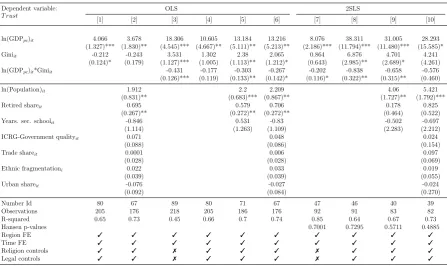
Table 1presents the results from the estimation of equation (1). Columns [1] and [2] show the impact of GDP and inequality on generalized trust when the variables are considered independent of each other. We confirm the opposite impact of economic development and inequality on trust found in the literature. The latter, however, is not estimated with precision when the full set of controls is included.
In columns [3]-[10] we consider how inequality mediates the impact of economic de-velopment on trust: columns [3]-[6] show OLS results while columns [7]-[10] display 2SLS regressions. In both cases, the analysis goes from the most parsimonious estimation where,
1Controlling for the share of the population above 65 years of age as we do below, has the salutary
effect of reinforcing the exclusion restriction of the cohort-based instruments since previous work has
Table 1: Regression Results
Dependent variable:
T rust
OLS 2SLS
[1] [2] [3] [4] [5] [6] [7] [8] [9] [10]
ln(GDPpc)it 4.066 3.678 18.306 10.605 13.184 13.216 8.076 38.311 31.005 28.293
(1.327)*** (1.830)** (4.545)*** (4.667)** (5.111)** (5.213)** (2.186)*** (11.794)*** (11.480)*** (15.585)*
Giniit -0.212 -0.243 3.531 1.302 2.38 2.065 0.864 6.876 4.701 4.241
(0.124)* (0.179) (1.127)*** (1.005) (1.113)** (1.212)* (0.643) (2.985)** (2.689)* (4.261)
ln(GDPpc)it*Giniit -0.431 -0.177 -0.303 -0.267 -0.202 -0.838 -0.658 -0.576
(0.126)*** (0.119) (0.133)** (0.142)* (0.116)* (0.322)** (0.315)** (0.460)
ln(Population)it 1.912 2.2 2.209 4.06 5.421
(0.831)** (0.683)*** (0.867)** (1.727)** (1.792)***
Retired shareit 0.695 0.579 0.706 0.178 0.825
(0.267)** (0.272)** (0.272)** (0.464) (0.522)
Years. sec. schoolit -0.846 0.531 -0.83 -0.502 -0.697
(1.114) (1.263) (1.109) (2.283) (2.212)
ICRG-Government qualityit 0.071 0.048 0.024
(0.088) (0.086) (0.154)
Trade shareit 0.0001 0.006 0.097
(0.028) (0.028) (0.069)
Ethnic fragmentationi 0.022 0.033 0.019
(0.039) (0.039) (0.055)
Urban shareit -0.076 -0.027 -0.024
(0.092) (0.084) (0.270)
Number Id 80 67 89 80 71 67 47 46 40 39
Observations 205 176 218 205 186 176 92 91 83 82
R-squared 0.65 0.73 0.45 0.66 0.7 0.74 0.85 0.64 0.67 0.73
Hansen p-values 0.7001 0.7295 0.5711 0.4885
Region FE ✓ ✓ ✓ ✓ ✓ ✓ ✓ ✓ ✓ ✓
Time FE ✓ ✓ ✓ ✓ ✓ ✓ ✓ ✓ ✓ ✓
Religion controls ✓ ✓ ✗ ✓ ✓ ✓ ✗ ✓ ✓ ✓
Legal controls ✓ ✓ ✗ ✓ ✓ ✓ ✗ ✓ ✓ ✓
Notes: Robust standard errors in parentheses. *, **, *** indicate coefficients are significant at the 10%, 5%, and 1% level, respec-tively. 2SLS: Endogenous variables: ln(GDPpc)it, Giniit, ln(GDPpc)it*Giniit. External instruments: ln(GDPpc)it−1, Cohortit−1, ln(GDPpc)it−1*Cohortit−1, Wheat-Sugari. We employ lagged values of the remaining time variant variables.
beyond our variables of interest, only time and region fixed-effects are included (columns [3] and [7]), to the most saturated regression that further includes a full set of control variables.2
Our sample goes from a maximum of 89 countries (column [3]) to a minimum of 39 (column [10]).3
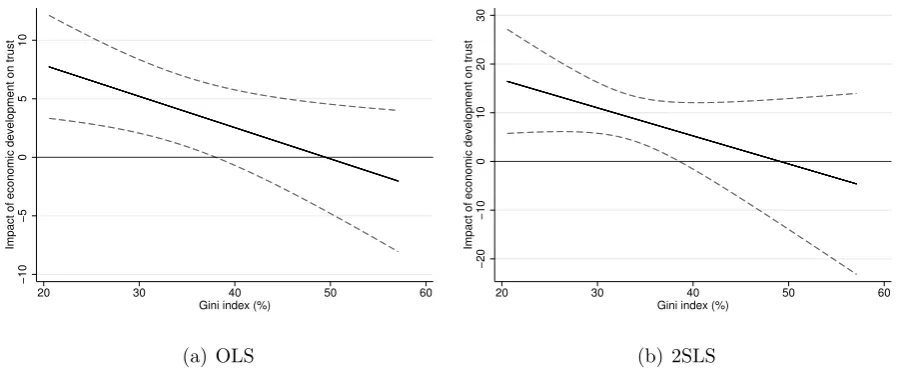
Despite the changes in the number of countries, we observe a robust pattern in our variables of interest. We always find that GDP per capita is positively associated with generalized trust while the interaction term is always negative. To consider the impact of economic development on trust for different values of inequality we compute the marginal effect of the former on trust (along with associated standard errors) for a relevant range of values of the Gini index. Figure 1presents the estimated marginal effects. Figures 1.a and 1.b show the marginal effects computed, respectively, from columns [6] and [10] in Table 1.4
2The Hansen p-values indicate that the instruments are valid, i.e. we do not reject the joint null
hy-pothesis that they are uncorrelated with the error term, and excluded instruments are correctly excluded from the estimated equation.
3All regressions included a balanced number of developed and developing countries, sample
informa-tion is available upon request.
4The marginal effects are robust along the different specifications. We show the results from the
Figure 1: Marginal Effects
−10
−5
0
5
10
Impact of economic development on trust
20 30 40 50 60
Gini index (%)
(a) OLS
−20
−10
0
10
20
30
Impact of economic development on trust
20 30 40 50 60
Gini index (%)
(b) 2SLS
Notes: OLS and 2SLS marginal effects are computed, respectively, from columns [6] and [10] in Table1. 90% Confidence intervals.
Both figures show the same pattern. Economic development has a positive impact on trust, but this depends on the level of inequality. Income inequality mitigates the positive impact of GDP per capita on generalized trust. Our results show that for values of the Gini index larger than 40, a greater GDP per capita does not have a statistically significant impact on generalized trust.
4
Conclusion
Economic development has a positive impact on generalized trust because it relaxes scarcity constraints that otherwise drive individuals into the arms of identified in-groups to the detriment of out-group interactions. We hypothesize that the positive effect of development on generalized trust will be mitigated by income inequality since the latter -by increasing social heterogeneity and thus uncertainty in social interaction - increases the rationality of in-group bias. Our empirical evidence, based on a panel of up to 89 countries over the period 1981-2014 and after accounting for a range of confounding variables and the possibility of reverse causality, supports this hypothesis.
References
Alesina, A. and La Ferrara, E. (2002). Who trusts others? Journal of Public Economics, 85(2):207–234.
Algan, Y. and Cahuc, P. (2014). Trust, growth, and well-being: New evidence and policy implications. In Handbook of Economic Growth, volume 2, chapter 02, pages 49–120. Elsevier, 1 edition.
Banfield, E. (1958). The Moral Basis of a Backward Society. Free Press.
Barone, G. and Mocetti, S. (2016). Inequality and trust: New evidence from panel data.
Economic Inquiry, 54(2):794–809.
Bjørnskov, C. (2007). Determinants of generalized trust: A cross-country comparison.
Public Choice, 130(1):1–21.
Boix, C. and Posner, D. N. (1998). Social capital: Explaining its origins and effects on government performance. British Journal of Political Science, 28(04):686–693.
Brambor, T., Clark, W. R., and Golder, M. (2006). Understanding interaction models: Improving empirical analyses. Political Analysis, 14:63–82.
Delhey, J. and Newton, K. (2005). Predicting cross-national levels of social trust: Global pattern or nordic exceptionalism? European Sociological Review, 21(4):311–327.
Easterly, W. (2007). Inequality does cause underdevelopment: Insights from a new in-strument. Journal of Development Economics, 84(2):755–776.
Efferson, C., Lalive, R., and Fehr, E. (2008). The coevolution of cultural groups and ingroup favoritism. Science, 321(5897):1844–1849.
Inglehart, R. and Welzel, C. (2005). Modernization, Cultural Change, and Democracy: The Human Development Sequence. Cambridge University Press.
Knack, S. and Keefer, P. (1997). Does social capital have an economic payoff? A cross-country investigation. The Quarterly Journal of Economics, 112(4):1251–1288.
Kyriacou, A. P. (2005). Rationality, ethnicity and institutions: A survey of issues and results. Journal of Economic Surveys, 19(1):23–42.
Leigh, A. (2006). Does equality lead to fraternity? Economics Letters, 93(1):121–125.
Nannestad, P. (2008). What have we learned about generalized trust, if anything? Annual Review of Political Science, 11(1):413–436.
Rothstein, B. and Uslaner, E. M. (2005). All for all: Equality, corruption, and social trust. World Politics, 58(1):41–72.
You, J.-S. and Khagram, S. (2005). A comparative study of inequality and corruption.