NEWSLETTER OF THE ASSOCIATION FOR COMPUTATIONAL LINGUISTICS
V
OLUME
14 - N
UMBER
4
S
EPTEMBER
1977
George E. Heidorn has accepted appointment as Associate
Editor of AJCL. He was appointed by Paul Chapin, President
of ACL, on the nomination or a committee chaired by Jerry R.
Hobbs. Heidorn is on the staff of the IBM Thomas J. Watson
Research Center, Yorktown Heights, New York 10598 The
Associate Editor will design a bulletin, to, be issued in
print between mailings of AJCL, and will work to raise the
number of manuscripts submitted for consideration.
Current issues of The Finite String were prepared by William
Benzon.
AMERICAN JOURNAL OF COMPUTATIONAL LINGUISTICS is published
by the Association for Computational Linguistics
EDITOR: David G. Hays, 5048 Lake Shore Road, Hamburg, New
York 14075
EDITORIAL ASSISTANT William Benzon
MANAGING EDITOR: Donald E. Walker Artificial Intelligence
Center, SRI International, Menlo Park, California 94025
TECHNICAL ADVISOR Martin Kay, Xerox Palo Alto Research
Center
Copyright (c) 1977 Association for Computational
Linguistics
American Journal of Computational Linguistics
American Journal of Computational Linguistics
Microfiche 66-.
2
CONTENTS
C 0 L I N G- 7 8: CALL FOR PAPERS ...
3
METAPHOR AND THOUGHT; A CONFERENCE ... . . .
4
C
ONFERENCE ONALGORITHMS FOR IMAGE AND SCENE ANALYSIS ....
5
RECENT CONFERENCES. ICCH 3, IFIP CONGRESS 77 ...
6
4
THLACUS FORUM, NFAIS
INDEXING SEMINAR.
7
NFAIS N
OTES. ...
8
N
ORTHWESTERN MERGESEE
ANDCS
...
9
NHPRC G
RANTI
NFORMATION...
10
ICCP ANNOUNCES CERTIFICATE IN COMPUTER PROGRAMMING
...
11
ACM EMPLOYMENT REGISTER 1978 ...
12
MARSHA, THE DAUGHTER OF E L I Z A — A SIMPLE PROGRAM FOR
INFOR-MATION RETRIEVAL IN NATURAL LANGUAGE.
J
OHNK. C
IPOLARO ANDN
ICHOLASV. F
INDLER...
13
AFIPS P
RESIDENTIALA
DDRESS,
1976 NCC, D
R.
A
NTHONYR
ALSTON. .
42
AFIPS PRESS PUBLICATIONS 1977-1978
...
53
AFIPS W
ASHINGTONR
EPORT... . ...
63
American Journal of Computational Linguistics
Microfiche 66: 3CALL FOR P A P E R'S:
C 0 L I N 6 7 8
W
HEN
:
A
UGUST
14 - 18, 1978
W
HERE
:
B
ERGEN
,
N
ORWAY
WHAT: Theories, methods, and problems of computational linguistics,
interdisciplinary relations
Models for natural language processing
-Applications of natural language processing, MT, MAT,
man-machine communication, QA, database query, speech
under-standing and speech synthesis, information retrieval, etc.
Automated processing of linguistic data collection, lexicology
and lexicography, textual and statistical processing,
archives and banks of texts and lexical information, etc.
HOW: The selection of papers and themes for panel discussion will be
made by a' board of consultants coordinated by A. Zampolli.
Forty minutes will be reserved for each paper. Working
languages: ENGLISH and FRENCH.
ABSTRACTS (1000)WORDS MINIMUM) OR THE COMPLETE TEXT MUST BE
SUBMITTED BY FEBRUARY 1, 1978 TO:
Prof. A. Zampolli
Chairman of the Scientific Program Committee
COLING 7 8
Via S. Maria 36
56100 Pisa, ITALY
Tel. (050) 45245 - Telex: 50371 - CNUCE
Selection will be announced before April 1, 197 8 and completed
versions of accepted papers must be submitted by June 15, 197 8.
Those intending to submit an abstract should RETURN THE ENCLOSED CARD
American Journal of Computational Linguistics
Microfiche 66: 4A C O N F E R E N C E ON:
S
EPTEMBER
26-29, 1977
U
NIVERSITY OF
I
LLINOIS AT
U
RBANA
-C
HAMPAIGN
Center for the Study of Reading
1005 West Nevada Street Urbana.
IL 61801
*********************
MONDAY SEPT. 26
Keynote Address: Max Black
SESSION I - METAPHOR & LINGUISTIC
THEORY
Chairperson:Ladislav Zgusta
Presenter: Charles J. Fillmore
Discussants:L. Jonathan Cohen
David E. Rumelhart
TUESDAY SEPT. 27
SESSION II - METAPHOR AND
PRAGMATICS
Chairperson: William Alston
Presenter: John R. Searle
Discussants: Jerome Bruner
Jerry L. Morgan
WEDNESDAY SEPT. 28
SESSION IV - THE ROLE OF METAPHOR
IN CONCEPTUAL CHANGE
David S. Shwayder
Richard Boyd Zenon
Pylyshyn Thomas S
Kuhn
SESSION III - PSYCHOLOGICAL PRO- SESSION V -
METAPHOR AND THE
EDU-CESSES IN THE COMP-HENSION OF
METAPHOR
Charles Osgood Allan
Paivio Andrew Ortony
Bruce Fraser,
THURSDAY SEPT. 29
SESSION VI - METAPHOR AND THE
SOCIAL CONSCIENCE
Chairperson: Daniel Alpert
Presenter: Donald A. Schon.
Discussants: Donald T. Campbell
Michael J. Reddy
Keynote Address:
George A. Miller
Chairperson:
Presenter:
Discussants:
CATIONAL PROCESS
Harry Broudy
Hugh G. Petrie
Thomas F. Green
Thomas Sticht
Chairperson:
Presenter:
Discussants;
Chairperson:
American Journal of Computational Linguistics
Microfiche 66: 5C
ONFERENCE
:
ALGORITHMS FOR IMAGE AND SCENE ANALYSIS
WHAT: Segmentation
Analysis of multi-images
Properties
Structural Analysis
Software
Application Surveys
WHO: Sponsor — Engineering Foundation
Co-chairmen — K.S. FU, Purdue University
A.S. ROSENFELD, University of Maryland
W
HEN
:
F
EBRUARY
19-24, 1973 W
HERE
:
ASILOMAR CONFERENCE GROUNDS P A C I F I C GROVE
/
CALIFORNIA
HOW: For further information contact:
American Journal of Computational Linguistics
Microfiche 66: 6
R E C E N T AND R E L E V A N T
ICCH 3: THIRD INTERNATIONAL CONFERENCE ON COMPUTING IN THE HUMANITIES
AUGUST 2-5, 1977
University of Waterloo, Waterloo, Ontario, CANADA
CLASSICS GRAPHICS INFORMATION RETRIEVAL
LANGUAGE AND LITERATURE LEXICOGRAPHY SEMANTICS
LITERARY STYLISTICS MUSIC ARCHAEOLOGY
1FIP CONGRESS
77
(August 8 - 12) included the following:
August 8: A Feature Concentration Method for Character
Recognition. K.Komori, T.Kawatani, K.Ishi,
Y.Iida (japan)
Recognition System for Handprinted Characters.
K.Iwata, M.Yoshida, E.Yanamoto, T.Masui,
Y. Kabuyama, S . Shimzu (Japan)
August 9; Using Knowledge of a Data Base World in Interpreting
Natural Language-Queries. P.Dell'orco (Italy), M.
King (Switzerland), V.N.Spadavecchia (Italy)
An Interactive Geometrical Design System with
Hand-writing Input. M.Hosaka, F.Kimura (Japan)
August 10: UNDERSTANDING NATURAL LANGUAGES (Panel)
Chairman: A.P.Ershov (USSR)
Discussants: D. Hays (USA), J.Thorne (UK),
E.Sandewall (Sweden) M.Boitet (France)
August 11: Computational Learning of Semantic Lexical Relations
RECENT AND RELEVANT
4TH LACUS FORUM (August 13-17) included:
A Calculus of Cohesion. Brian Phillips (U. of Illinois at
Chicago Circle)
Some Formal Theorems about Stratificational Grammars and Their
Significance to Linguistic Theory and Practice. Alexander
Borgida (U. of Toronto)
Linguistic Data Processing with an Associative Memory. Sydney
M. Lamb (now of Semionics Associates, The Claremont, Tunnel
Road, Berkeley CA 94705)
NFAIS: I
NDEXING IN
P
ERSPECTIVE
S
EMINAR
June 14-16
Marvell Hall, Auditorium
American Chemical Society
1155 Sixteenth Street, N.W.
Washington, D.C. 20036
Lecturers: Everett H. Brenner (American Petroleum Institute)
Toni Carbo Bearman (NFAIS) Tefko Saracevic (Case
Western Reserve University)
Presenters of Case Histories:
American Journal of Computational Linguistics
Microfiche .66: 83401
FEDERATION OF ABSTRACTING &
INDEXING SERVICES
MARKET STREET • PHILADELPHIA PA 19104 • (215)- 349-8495
S
CIENCE
L
ITERATURE
I
NDICATORS
;
1975 is now available. Author
affiliations of U.S. authors in U.S. primary journals for 1975 are
divided into four categories: Academic, Industry, Government, and
not-for-profit. This report updates the earlier SCIENCE LITERATURE
INDICATORS STUDY (Report No. 9) which covered affiliation patterns
from 1960 to 1974. In addition to author affiliation data the report
includes data on funding sources. The report is available from the
Federation as NFAIS-77/2 for $10.00 prepaid.
O
N
-L
INE
C
OMMANDS
:
A U
SER
'
S
Q
UICK
G
UIDE FOR
B
IBLIOGRAPHIC
R
ETRIEVAL
SYSTEMS: On-line commands are provided in a compact, easy-to-read
chart using the ORBIT, ELHILL, DIALOG, and RECON IV computer
search-ing systems. The chart now includes information on the NEW YORK TIMES
INFORMATION BANK and BIBLIOGRAPHIC RETRIEVAL SYSTEMS. The chart
measures 81/2" by 11", is printed on heavy stock, and is available
from NFAIS for $2.00 prepaid.
NFAIS NEWSLETTER contains summary news articles about: NFAIS members
and affiliates, related activities in other organizations
(abstracting and indexing services, research, serials, thesauri,
net-works, conferences
,
information retrieval, etc.), NFAIS activities. The
NEWSLETTER is published every two months (two) issues are special
issues) and costs $35.00 per calendar year.
American Journal of Computational Linguistics
Microfiche
66: 9
N O R T H W E S T E R N ME R G E S E E AND C S
In order effectively to expand its educational and research programs
in the fields of computer science, computer hardware-software
inter-action, electronics and electrical engineering Northwestern University
has merged faculties and facilities of its electrical engineering and
computer science departments. The merger is effective 1 Sept. 1977
The
new Department of Electrical Engineering and Computer Science will
be headed by Stephen S. Yau, professor of computer science and
of
electrical engineering, and chairman of the computer science
department since 1972. Yau is a director of the Institute of
Electrical and Electronic Engineers and of the American Federation of
Information Processing Societies. He was President of the IEEE
Computer Society (1974-75) and is a Fellow of the IEEE and a Life
Fellow of the Franklin Institute.
American Journal of Computational Linguistics
Microfiche 66: 10N
ATIONAL
H
ISTORICAL
P
UBLICATIONS AND
R
ECORDS
C
OMMISSION
(NHPRC)
RECORDS PROGRAM: Grants are available for a variety of projects,
including: RECORDS USE PROJECTS — comprehensive processing,
arranging, inventorying, preparing finding aids, and indexing.
ARCHIVAL TECHNIQUES PROJECTS - experimental techniques related to
the preservation and use of records and normally resulting in
publications or prototypes which can be distributed to other
institutions and organizations. FEASIBILITY PROJECTS —
feasibility study for more extensive projects in above areas.
GRANT TYPES; Outright Grants, Matching Grants, Combined Grants
ELIGIBILITY: Nonprofit organizations and institutions and State
and local government agencies.
F
OR
M
ORE
I
NFORMATION
C
ONTACT
:
NHPRC
National Archives and Records Service
National Archives Building
American Journal of Computational Linguistics
Microfiche 66: 11
CERTIFICATE IN COMPUTER PROGRAMMING
The INSTITUTE FOR CERTIFICATION OF COMPUTER PROFESSIONALS has
established examinations for the CERTIFICATE IN COMPUTER
PROGRAM-MING, which are being offered for the first time in 1977. The
examinations are intended for senior-level computer programmers
and are being offered in three areas:
BUSINESS PROGRAMMING
SCIENTIFIC PROGRAMMING
SYSTEMS PROGRAMMING
For more information contact:
American Journal of Computational Linguistics
Microfiche 66.12
E M P L O Y M
E N T R E G l S T E R
W
HEN
:
F
EBRUARY
21-23, 1978
W
HERE
: ACM C
OMPUTER
S
CIENCE CONFERENCE
D
ETROIT
P
LAZA
H
OTEL
- D
ETROIT
,
M
ICHIGAN
The purpose of the Register is to provide a mechanism for establishing contact between applicant and employer in a professional manner. The Register
operates as follows, the applicant completes a form giving identifying
informa-tion, educainforma-tion, publications, experience, interests, references, position and salarv desired. Provision is made for submission of anonymous form if desired. The employer completes a similar form giving identifying information ; position
available along with starting date, salary and benefits and education, experience and specialization requirements for the position. This information enables the applicant and employer to determine t h e d esirability for follow up.
Following the pattern of past years, the policies and the procedures listed below, will be in effect:
1 Both applicants and employers must file their registration on official forms. Three different forms will be used (1) applicant (2) academic and (3)
business/industry and government.These forms may be obtained from and completed forms, should be returned, to
Orrin E. Taulbee
ACM Computer Science Employment Register Department of Computer Science.
University of Pittsburgh
Pittsburgh. Pennsylvania l5260
Your request should specify which of the three forms is desired. Employers should request one form for each type of position available (only one form is needed in the case of several identical positions). Employers may use this opportunity to list summer or temporary positions. A typewriter must be used in completing forms since they will be reproduced exactly as submitted Photocopies will not he accepted.
2. Closing date for acceptance of forms is February 1, 1 9 7 8 . The inclusion of a late form cannot he guaranteed.
3. The completed forms will be compiled to form the applicant and employer books of listings. Multiple copies of these books will be available at the confer-ence for review. As in previous years, wide distribution of these books will occur after the conference.
4. Charges: Applicant
(a) Student - No charge(must be certified as student at time of filing by signature of Department Chairman). (b) Non-student -$5,00
(c) Anonymous listing - $5,00 additional charge Employer:-$20,0 0 per form submitted
A check for the appropriate amount (payable to "Computer Science, Employment Register) must be sent with the completed form.
5 The Employment Register Staff will operate a message desk and maintain employer sign-up sheets at the conference to facilitate makinq contacts. Actual
arrangements for interviews will be the responsibility of the employer and the applicant
6 Information on the availability and the cost of copies of employer and applicant books after the conference may be obtained by writing to the above address.
American Journal of Computational Linguistics
Microfiche 66: 13MARSHA, THE DAUGHTER OF ELIZA —
A SIMPLE PROGRAM FOR INFORMATION RETRIEVAL IN NATURAL LANGUAGE
JOHN K, CIPOLARO* & NICHOLAS V. FINDLER
Department Of Computer Science
State University of New York at Buffalo
4 226 Ridge Lea Road
Amherst, New York 14226
ABSTRACT
We present a program which can retrieve information, using natural
language for the questions and answers. The operational basis is a
combination of the keyword-oriented algorithms of ELIZA and
relational database design. Even the novice user can specify in an
easy manner, through the preprocessor HIGGINS, scripts, simple
responses, synonyms, substitutions and relations, all dealing with a
particular topic of conversation. MARSHA has proven to be a
powerful and flexible system, usable in practical applications.
Currently, we attempt to extend it to become a mode of communication
between a human teacher and a machine student on the topic of static
and learning strategies of Poker. The interaction is in the Advice
Taker/Inquirer style.
INTRODUCTION
14
We have wanted to create a conversational information
retrieval system whose database can be extended and charged
inexpensively, i.e. at the user level and without "systems
proqramming" effort. Also, we have decided to use as little
semantic information processing as possible. Our natural
choice for a starting point was Weizenbaun's ELIZA [12],
programs related to which have been used for impressive
man-machine communications in various projects [3,5]• Its
keyword oriented algorithm was then augmented by the
relational model of databases. Different topics of
conversation can be specified in the form of scripts
(normalized and unnormalized relations), through the
preprocessor HIGGINS. The pattern matching by decomposition
templates and the implicit semantics of the relations
between keywords enable MARSHA to "understand" both the
global context and the specific questions in the user's
statement;
We note that the issues being debated concerning
ELIZA's understanding capabilities and the ethics of its use
in certain areas [3,4,5] are of little relevance to the
present project. Our objective was, as will be seen
later,
to provide an on-line consultant for the novice user of a
complex programming system (the "Poker project") , under
continual development over the past several years [6,7,8],
and to serve as a guide about one of the sophisticated
A MINI-BACKGROUND
In order to contrast with MARSHA, we first describe how
ELIZA processes keywords. The scripts contains entry lists
which in turn have a keyword followed by a series of
decomposition and reassembly rules. When a keyword is
recognized, the decomposition rules are tried, one after the
other. Upon finding a match, the reassembly rules are
cycled through and an output sentence is generated. The
script also allows for pronoun substitution, synonyms,
tagging of keywords, and checking of phrases. The
associated memory segment contains a copy of transformed
texts.
Out of the many applications of this program, we single
out the interactive consultant about a programming manual,
written by Shapiro and Kwasny [10], in view of its area of
application being similar to ours. The script in their CAL
SNOBOL version of ELIZA provided information about permanent
file commands for use by novice system users. Keywords were
chosen from a repertory of commands and the reassembly rules
were quotes from an operating system reference manual. This
represents an important difference between this work and
ELIZA, whose prime objective was to carry on an
intelligent-looking conversation. Therefore, ELIZA's
reassembly rules always used part of the input statement in
composing the output. The script of Shapiro and Kwasny,
however, consists mainly of factual information and almost
nothing of the type "Why do you..." or "Tell me more
16
MARSHA, on the other hand, does not need reassembl
y
rules. It actually searches relations between keywords and,
upon finding a tuple which matches, outputs the accompanying
information suitably modified. And if necessary, it can
still keep the conversation going by quoting some neutral
cliches.
ON RELATIONAL DATABASES
We have indicated before that MARSHA's well-structured
script is in the form of relations, both normalized and
unnormalized, where, the name of the relation and the values
of each domain are all keywords. The keywords are recognized
from the user's input text and put in a stack. The order is
according to the user-supplied rank. (See for detail the
description of - the subroutine MAKSTK in the level 2
documentation of MARSHA in the Appendix.) Let us look into
these terms more formally.
Suppose we are given n, not necessarily distinct, sets
of items, D1, D2, ... Dn A relation, R, on these sets
consists of a set of ordered n-tuples, d1, d2, ...
.
dn, such
that d1_ belongs to Dl, d2 to D2, ..., and dn to Dn. Sets D1,
D2,... Dn are called the domains of R, and the value n is
called the degree of R [11 , 12].
A relation is said to be normalized if each domain
value in each tuple is non-decomposable; otherwise it is
unnormalized. We shall view the database as if the columns
of a table representing a relation corresponded to domains
In the following simple example, there are two domains, Last
Name and First Name: The relation of degrees 2. is Persons
Name, in both normalized and unnormalized form;
Last Name
First Name
Smith
Tom
Dick
Jones
Harry
Fred
Normalized and Unnormalized Relations
[image:17.595.60.533.413.772.2]FIGURE 1
ON MARSHA
MARSHA and the preprocessor HIGGINS are described in
detail in the Appendix. The level 1 documentation is user
oriented
(and
system-dependent)
while
the
level
2
documentation is systems programmer oriented. Some important
points are, however, discussed here.
Besides the relational format, MARSHA also accepts
script entries similar to those in ELIZA. Synonyms can he
easily defined for any keyword and, upon encountering a
synonym rather than an established keyword, MARSHA locates
the latter on the basis of the former. Substitutions can
also be specified for a keyword. These are then used in the
input string being scanned in order to change the persons of
pronouns and verbs, and the conjugated form of verbs when a
Last Name
First Name
Smith
Tom
Smith
Dick
Jones
Harry
user's question is to be echoed in a modified form for lack
of a "real" answer.
The majority of information is stored in the form of
relations. However, keywords and its associated responses in
English can also be recorded as a single unit, Once such a
single unit answer has been given in a session, MARSHA marks
it and refuses to respond to the same keyword again.
We also note that MARSHA is able to keep track of the
conversation by storing the immediate past relation and the
immediate past values of the domains ('keys' in the
following). Thus, when the user specifies in a statement a
new keyword relation which involves keys used before, the
answer will make use of such keys as well. Further, if a
relation has been established as the topic of conversation
and it has, for example, three keys, the user can retrieve
information by supplying one, two or three keys.
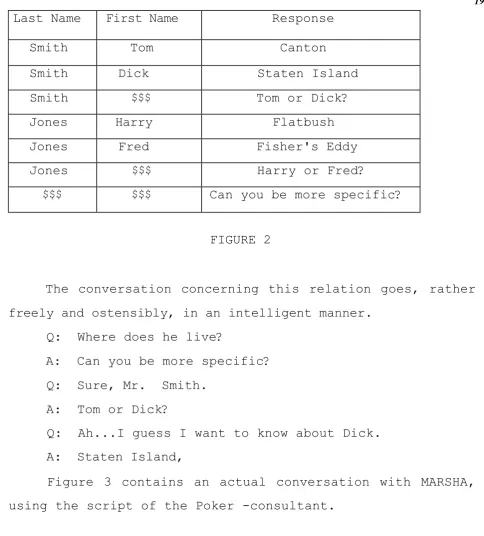
The so-called transparent key, "$$$", will match
anything. It is useful in allowing MARSHA to prompt the user
for more information, whether it is really needed to
determine the answer or just to keep the conversation going.
The following simple example involves the normalized relation
LIVE. (We note that this example could be made a more
"powerful" conversationalist but it suffices in its present
Last Name
First Name
Response
Smith
Tom
Canton
Smith
Dick
Staten Island
Smith
$$$
Tom or Dick?
Jones
Harry
Flatbush
Jones
Fred
Fisher's Eddy
Jones
$$$
Harry or Fred?
[image:19.595.51.536.77.614.2]$$$
$$$
Can you be more specific?
FIGURE 2
The conversation concerning this relation goes, rather
freely and ostensibly, in an intelligent manner.
Q: Where does he live?
A: Can you be more specific?
Q: Sure, Mr. Smith.
A: Tom or Dick?
Q: Ah...I guess I want to know about Dick.
A: Staten Island,
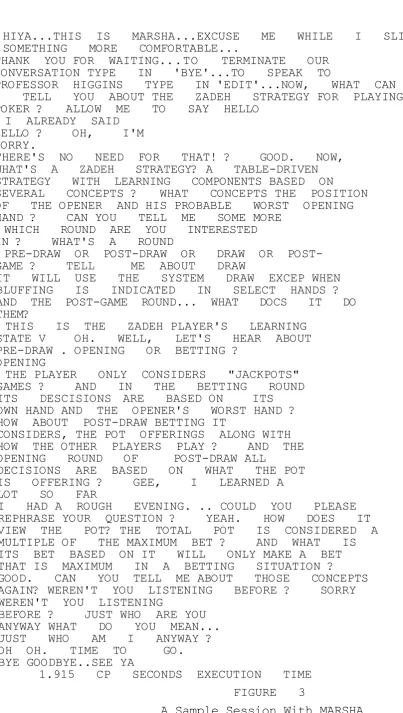
Figure 3 contains an actual conversation with MARSHA,
using the script of the Poker -consultant.
Insert Figure 3 about here
ON HIGGINS
HIGGINS
allows a novice user to generate or to add to a
HIYA...THIS IS MARSHA...EXCUSE ME WHILE I SLIP INTO
SOMETHING MORE COMFORTABLE...
THANK YOU FOR WAITING...TO TERMINATE OUR
CONVERSATION TYPE IN
'BYE'...TO SPEAK TO
PROFESSOR HIGGINS TYPE IN 'EDIT'...NOW, WHAT CAN
I TELL YOU ABOUT THE ZADEH STRATEGY FOR PLAYING
POKER ? ALLOW ME TO SAY HELLO
I ALREADY SAID
HELLO ? OH, I'M
SORRY.
THERE'S NO NEED FOR THAT! ? GOOD. NOW,
WHAT'S A ZADEH STRATEGY? A TABLE-DRIVEN
STRATEGY WITH LEARNING COMPONENTS BASED ON
SEVERAL CONCEPTS ? WHAT CONCEPTS THE POSITION
OF THE OPENER AND HIS PROBABLE WORST OPENING
HAND ? CAN YOU TELL ME SOME MORE
WHICH ROUND ARE YOU INTERESTED
IN ? WHAT'S A ROUND
PRE-DRAW OR DRAW OR DRAW OR
POST-GAME ? TELL ME ABOUT DRAW
IT WILL USE THE SYSTEM DRAW EXCEP WHEN
BLUFFING IS INDICATED IN SELECT HANDS ?
AND THE POST-GAME ROUND... WHAT DOCS IT DO
THEM?
THIS IS THE ZADEH PLAYER'S LEARNING
STATE V OH. WELL, LET'S HEAR ABOUT
PRE-DRAW . OPENING OR BETTING ?
OPENING
THE PLAYER ONLY CONSIDERS "JACKPOTS"
GAMES ? AND IN THE BETTING ROUND
ITS DESCISIONS
ARE BASED ON ITS
OWN HAND AND THE OPENER'S WORST HAND ?
HOW ABOUT POST-DRAW BETTING IT
CONSIDERS, THE POT OFFERINGS ALONG WITH
HOW THE OTHER PLAYERS PLAY ? AND THE
OPENING ROUND OF POST-DRAW ALL
DECISIONS ARE BASED ON WHAT THE POT
IS OFFERING ? GEE, I LEARNED A
LOT SO FAR
I HAD A ROUGH EVENING. .. COULD YOU PLEASE
REPHRASE YOUR QUESTION ? YEAH. HOW DOES IT
VIEW THE POT? THE TOTAL POT IS CONSIDERED A
MULTIPLE OF THE MAXIMUM BET ? AND WHAT IS
ITS BET BASED ON IT WILL ONLY MAKE A BET
THAT IS MAXIMUM IN A BETTING SITUATION ?
GOOD. CAN YOU TELL ME ABOUT THOSE CONCEPTS
AGAIN? WEREN'T YOU LISTENING BEFORE ? SORRY
WEREN'T YOU LISTENING
BEFORE ? JUST WHO ARE YOU
ANYWAY WHAT DO YOU MEAN...
JUST WHO AM I ANYWAY ?
OH OH. TIME TO GO.
BYE GOODBYE..SEE YA
[image:20.595.61.465.33.747.2]1.915 CP SECONDS EXECUTION TIME
FIGURE 3
21
responses, synonyms, substitutions and relations. In
processing an entry, HIGGINS
determines whenever a
keyword has already been defined (a new entry would then
be rejected) , whether a synonym has already been defined,
and whether a key for a relation has been previously
defined as a non-key or in a different domain. (The last
two are not allowed; also, if an entry equates a keyword
with a synonym undefined so far, the entry is rejected.)
The user may create single unit keywords and responses
by entering the keyword followed by the response, a synonym,
a substitution, or various combinations of these. Reserved
characters (= and «-) indicate that a synonym or substitution
follows. A relation may be input by entering the number of
domains, followed by the name of the relation. HIGGINS will
then prompt the use for the keys and their associated
responses. These keys may either be a single keyword, or
may be one of the above mentioned forms for synonyms and
substitutions. The exact syntax of the User Language is
given in HIGGINS,' level 1 documentation.
The user can be completely ignorant of the internal
format of scripts. HIGGINS creates the script entries in
core and then transfers them to the appropriate output file.
This renders MARSHA a readily available, flexible and
powerful tool in any practical application.
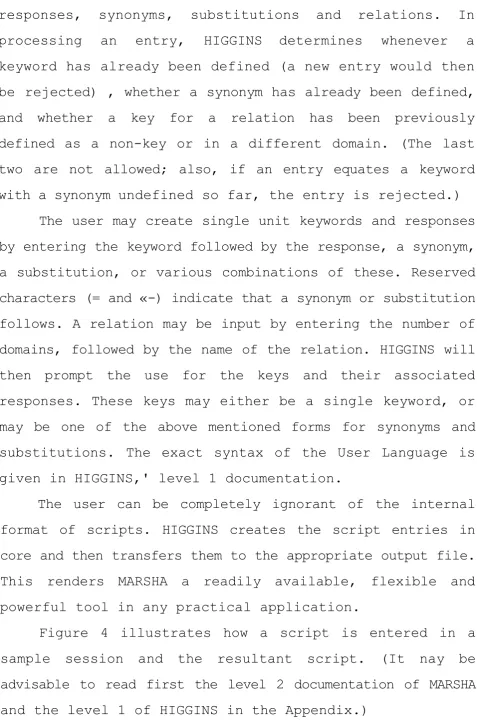
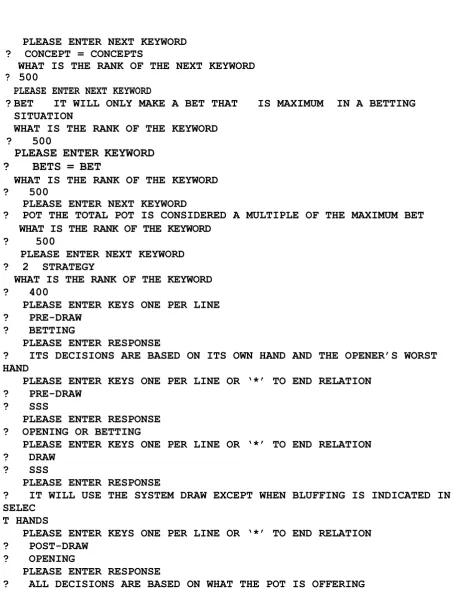
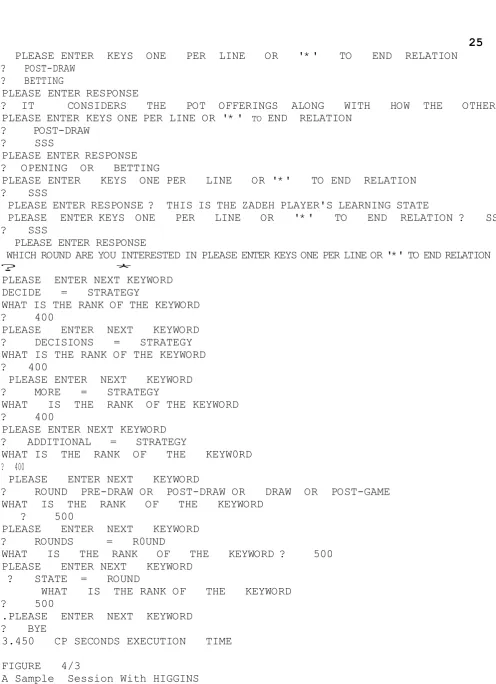
Figure 4 illustrates how a script is entered in a
sample session and the resultant script. (It nay be
advisable to read first the level 2 documentation of MARSHA
[image:21.595.60.538.68.792.2]IMPLEMENTATION DETAILS AND
FUTURE WORK POSSIBLE
MARSHA and HIGGINS were implemented in the
SLIP/AIIPPL-II [13] package embedded in Extended FORTRAN (TTN) on a COC
Cyber 173. It occupies 30k 60-bit words plus whatever is
needed for the scripts. The latter are stored in the form of
SLIP list structures. Although the control structures of the
languaqe chosen do not lend themselves to structured
programming, we have followed the many valuable coding
techniques found in [14].
The following ideas appear worth pursuing in trying to
extend the scope and the power of the system currently
available for use.
At present, only the value of one domain, the response
domain, is retrieved — as consultants are usually asked to
do. This can be generalized so that the value of any domain
should be obtainable.
MARSHA now stores complete English sentences. These
responses could be replaced by pointers to a dictionary of
phrases, saving core storage and making longer and more
versatile responses possible.
MARSHA could also be enabled to manipulate relations in
obeying natural language commands. If could then dynamically
change the database by modifying existing relations and
23
HELLO...THIS IS PROFESSOR HIGGINS . . . ENTER 'ADD' IF YOU WISH TO MAKE ADDITIONS TO A SCRIPT OR 'CREATE' TO START A NEW ONE...TYPE IN 'BYE' TO TERMINATE OUR CONVERSATION ?
? CREATE
WHAT IS THE TOPIC OF CONVERSATION ? THE ZADEH STRATEGY FOR PLAYING POKER PLEASE ENTER NEXT KEYWORD
? HELLO I ALREADY SAID HELLO WHAT IS THE RANK OF THE KEYWORD ? 300
PLEASE ENTER NEXT KEYWORD ? HI = HELLO
WHAT IS THE RANK OF THE KEYWORD ? 300
PLEASE ENTER NEXT KEYWORD
? SORRY THERE'S NO NEED FOR THAT WHAT IS THE RANK OF THE KEYWORD ? 300
PLEASE ENTER NEXT KEYWORD ? APOLOGIZE = SORRY
WHAT IS THE RANK OF THE KEYWORD ? 300
PLEASE ENTER NEXT KEYWORD ? YOU <— I
WHAT IS THE RANK OF THE KEYWORD ? 100
PLEASE ENTER NEXT KEYWORD ? ARE <— AM
WHAT IS THE RANK OF THE KEYWORD ? 100
PLEASE ENTER NEXT KEYWORD ? I <— YOU
WHAT IS THE RANK OF THE KEYWORD ? 100
PLEASE ENTER NEXT KEYWORD ? AM <— ARE
WHAT IS THE RANK OF THE KEYWORD ? 100
PLEASE ENTER NEXT KEYWORD
? ZADEH A TABLE-DRIVEN STRATEGY WITH LEPING COMPONENTS BASED ON SEVERA L CONCEPTS
WHAT IS THE RANK OF THE KEYWORD ? 500
PLEASE ENTER NEXT KEYWORD ? ZADEH'S = ZADEH
WHAT IS THE RANK OF THE KEYWORD ? 500
PLEASE ENTER NEXT KEYWORD
? CONCEPTS THE POSITION OF THE OPENER AND HIS PROBABLE WORST OPENING HAND
WHAT IS THE RANK OF THE KEYWORD ? 500
FIGURE 4/1
[image:23.595.51.542.81.722.2]24
PLEASE ENTER NEXT KEYWORD ? CONCEPT = CONCEPTS
WHAT IS THE RANK OF THE NEXT KEYWORD ? 500
PLEASE ENTER NEXT KEYWORD
? BET IT WILL ONLY MAKE A BET THAT IS MAXIMUM IN A BETTING SITUATION
WHAT IS THE RANK OF THE KEYWORD ? 500
PLEASE
ENTER
KEYWORD
?
BETS
=
BET
WHAT IS THE RANK OF THE KEYWORD ? 500
PLEASE ENTER NEXT KEYWORD
? POT THE TOTAL POT IS CONSIDERED A MULTIPLE OF THE MAXIMUM BET WHAT IS THE RANK OF THE KEYWORD
? 500
PLEASE ENTER NEXT KEYWORD
? 2 STRATEGY
WHAT IS THE RANK OF THE KEYWORD
? 400
PLEASE ENTER KEYS ONE PER LINE ? PRE-DRAW
? BETTING
PLEASE ENTER RESPONSE
? ITS DECISIONS ARE BASED ON ITS OWN HAND AND THE OPENER’S WORST HAND
PLEASE ENTER KEYS ONE PER LINE OR ‘*’ TO END RELATION ? PRE-DRAW
? SSS
PLEASE ENTER RESPONSE ? OPENING OR BETTING
PLEASE ENTER KEYS ONE PER LINE OR ‘*’ TO END RELATION ? DRAW
? SSS
PLEASE ENTER RESPONSE
? IT WILL USE THE SYSTEM DRAW EXCEPT WHEN BLUFFING IS INDICATED IN SELEC
T HANDS
PLEASE ENTER KEYS ONE PER LINE OR ‘*’ TO END RELATION ? POST-DRAW
? OPENING
PLEASE ENTER RESPONSE
? ALL DECISIONS ARE BASED ON WHAT THE POT IS OFFERING
FIGURE 4/2
[image:24.595.47.521.104.713.2]25
PLEASE ENTER KEYS ONE PER LINE OR '*' TO END RELATION ? POST-DRAW
? BETTING
PLEASE ENTER RESPONSE
? IT CONSIDERS THE POT OFFERINGS ALONG WITH HOW THE OTHER PLAYERS PLAY PLEASE ENTER KEYS ONE PER LINE OR '* ' TO END RELATION
? POST-DRAW ? SSS
PLEASE ENTER RESPONSE ? OPENING OR BETTING
PLEASE ENTER KEYS ONE PER LINE OR '*' TO END RELATION ? SSS
PLEASE ENTER RESPONSE ? THIS IS THE ZADEH PLAYER'S LEARNING STATE
PLEASE ENTER KEYS ONE PER LINE OR '*' TO END RELATION ? SSS ? SSS
PLEASE ENTER RESPONSE
? WHICH ROUND ARE YOU INTERESTED IN PLEASE ENTER KEYS ONE PER LINE OR '*' TO END RELATION ? *
PLEASE ENTER NEXT KEYWORD ? DECIDE = STRATEGY
WHAT IS THE RANK OF THE KEYWORD ? 400
PLEASE ENTER NEXT KEYWORD ? DECISIONS = STRATEGY WHAT IS THE RANK OF THE KEYWORD ? 400
PLEASE ENTER NEXT KEYWORD ? MORE = STRATEGY
WHAT IS THE RANK OF THE KEYWORD ? 400
PLEASE ENTER NEXT KEYWORD ? ADDITIONAL = STRATEGY
WHAT IS THE RANK OF THE KEYW0RD ? 400
PLEASE ENTER NEXT KEYWORD
? ROUND PRE-DRAW OR POST-DRAW OR DRAW OR POST-GAME WHAT IS THE RANK OF THE KEYWORD
? 500
PLEASE ENTER NEXT KEYWORD ? ROUNDS = R0UND
WHAT IS THE RANK OF THE KEYWORD ? 500 PLEASE ENTER NEXT KEYWORD
? STATE = ROUND
WHAT IS THE RANK OF THE KEYWORD ? 500
.PLEASE ENTER NEXT KEYWORD ? BYE
3.450 CP SECONDS EXECUTION TIME
FIGURE 4/3
[image:25.595.48.545.36.720.2]27
project selects a subset of domains of a relation and
defines a new relation with them. The
operator join
concatenates two relations over a common domain to form a
third relation. Instead of relying on relational algebra or
relational calculus [11], one would instruct MARSHA in
conversational English to perform such operations.
The most interesting extension of MARSHA, currently
under development, would enable us to use it in an Advice
Taker/Inquirer mode between a human teacher and a machine
student. The domain of discourse is static and learning
strategies of Poker. The teaching is effected via examples
given in natural language of game situations and recommended
actions. The student checks the information conveyed for
consistency and completeness, and asks appropriate
questions.
SUMMARY
We have given some powerful extensions to Weizenbaum's
ELIZA by using the relational database design and by adding
a sophisticate script preprocessor. These modifications
allow MARSHA. to "understand" better, to retrieve useful
information, and to give the novice user the opportunity to
write intelligent scripts.
ACKNOWLEDGEMENTS
28
helped make those long nights at the university's Computer
Center pass a little more quickly, and who understands him
without a script.
Both authors thank several people for "their advice, in
particular Dave Ziffer, Ton Graham, Tom Booth and Trotzl
Lillo.
REFERENCES
1 . Weizenbaum, J ELIZA--a computer program for the study of
natural language communications between man and machine.
CACM, 9
,
pp. 36-45, 1966.
2.
Weizenbaum, J, Contextual understanding by computers.
CACM, 10, pp. 474-480. 1967.
3.
Colby, K.M., J.R. Watt, and J.P. Gilbert A computer
method of psychotherapy: Preliminary communication. J. of
Nervous and Mental Diseases,. 142, 148, 1966.
4.
Weizenbaum, J. Computer Power and Human Reason (W.H.
Freeman: San Francisco, 1976).
5.
Colby, K.M., Artificial Paranoia (Pergamon Press: New
York, 1975).
29
Proc. IFIP Congress 71, pp. 1448-1459, North Holland,
Amsterdam, 1972.
7.
Findler, N.V., H. Klein, and Z. Levine, Experiments
with inductive discovery processes leading to heuristics in
a Poker program. In Beckmann, Goos and Kunzi (Eds.)
Cognitive Processes and Systems (Springer: Berlin, 1973).
8.
Findler, N.V., Studies in machine cognition using the
game of Poker. CACM, 20, pp. 230-245, 1977.
9.
Zadeh, N., Winning Poker Strategies (Prentice-Hall:
Englewood Cliffs, N.J., 1974).
10.
Shapiro, S.C. and S.C. Kwasny, Interactive consulting
via natural language. CACM, 18, pp. 459-462, 1975.
11.
Date, C.J., An Introduction to Database Systems
(Addison-Wesley: Reading, Massachusetts, 1975)•
12.
Chamberlin. D.D., Relational data-base management
systems. Comp. Surveys, 8, pp. 43-66, 1976.
30
APPENDIX
MARSHA - Level 1 Documentation
MARSHA is the natural language Poker System User
Consultant. To talk to her, the user must GET and CALL the
JCL procedure file MARSHA, substituting for the name of the
script file (the topic of conversation). The JCL procedure
file is as follows:
SET(R1=0)
GET,MARBIN,HIGBIN.
ATTACH,SLIPAMP/UN=CSLIBRY.
RFL,50000.
MODE,0.
REDUCE,-.
LDSET,LIB=SLIPAMP.
MARBIN(,,OLDSCB)
REWIND,OLDSCB.
*R1=0 STOP
*R1=1 CALL'HIGGINS
IF(R1=0) GOTO,1.
LDSET", LIB-SLIPAMP.
HIGBIN(,,OLDSCP,NEWSCP,NEWSCB)
1,RETURN,MARBIN,HIGBIN,SLIPAMP.
RFL,20000.
OLDSCB is the script in binary format as produced by
the preprocessor HIGGINS. To talk to MARSHA, simply
GET,MARSHA.
CALL,MARSHA(OLDSCB=script)
Of course, script must be gotten' previously. The program
will respond with 'Hiya...this is Marsha...' and from this
point on the user can talk to and receive answers from
MARSHA in conversational English. To talk to Professor
HIGGINS also, consult his Level 1 Documentation.
There currently exist two prepared script files for
MARSHA, one about the Poker System (SYSSCB) and one about
the Zadeh strategy for playing Poker (ZADSCB) Both of
these are available on the account for users to see how
MARSHA works or for consultation.
32
MARSHA - Level 2 Documentation
This level of documentation is geared towards the more
than casual user. It contains a description of the internal
format of the script and a verbal description of each
subroutine and function used.
The Script
The script is a file of keyword entries which
provides MARSHA'S vocabulary. These entries are in the
form of SLIP lists,
Common to every entry are the
following:
Keyword - the defined keyword
Substitution - an optional substitution word
Rank - the rank (three characters) of the keyword
Indicator - a flag indicating the type of entry:
A,X,=,S,Rn,Kn
The script allows for the following types of entries:
Simple Responses
(Keyword (Substitution,Rank,A(Response)))* Ex.
Define a simple response for the keyword 'tournament'.
(tournament (0 , 100, A (A tournament, is,... ))) *
Synonyms
(Keyword (Substitution,Rank,= (Synonym))) *
Ex. Define the keyword 'Zadeh's' as
equal to 'Zadeh'.
(Zadeh's (0, 200,*= (Zadeh))) *
Keys for Relations
(Keyword (Substitution,Rank,Kn (Actual Key))
)* where n is the domain which contains
the keyword.
Ex. Define 'bluffing' as a key in the second
domain and let 'bluff be the key that is
Relations (Normalized)
(Keyword(Substitution,Rank,Rn (Domain 1
(Domain 2(...Domain n(Response 1)...) Domain
1(Domain.2(...Domain n(Response 2)...)
Domain 1(Domain 2 (..Domain n(Response m) ...))))*
where n = the number of domains m
= the number of rows.
Ex. Define the relation 'strategy' with two domains! 'player'
and 'type of strategy'.
(strategy(0,100,R2 (Zadeh
(bluff(response)) Player
1(sandbag(response))
• • •
• • •
• • •
Player6(bluff (response)))))*
Relations (Unnormalized)
(Keyword(Substitution,Rank,Rn,
(Domain 1 (Domain 2 (...Domain n (Response 1 )...)
Domain 2 (.. .. Domain n (Response 2)...)) Domain
1(Domain 2 (... Domain n(Response 3)...) Domain 2
(.. .Domain n (Response 4)...))
• • • •
Domain 1(Domain 2(...Domain n(Response m-1)...)
Domain 2 (...Domain n(Response m)..))))) *
where n
= number of domains m =
number of rows.
Substitutions Only
(Keyword(Substitution,Rank
,S))
*
Ex. Replace the word 'you' with the word 'I' whenever it
appears in the input string.
(you(I,555,S))*
Subroutines and Functions
34Function HASH
This function is used when initially storing keywords
into the array 'KEYLST' and also when searching for keywords
in the input string. The English word is first folded on
itself, i.e. the leftmost 30 bits are added to the
rightmost 30 bits. This result is then hashed using the MOD
function with a prime divisor of 199, the result yielding
the index, into the array for that particular English word.
Subroutine PACK
This subroutine takes a seven word array of English
words and packs them into a seventy character output line.
If more than one blank exists between the English words,
they are removed. A blank is added after every ten
character word and the hyphenated words produced by GETQST
are rejoined.
The entire purpose of the routine is to create a
legible print line.
Subroutine ANSWER
This subroutine creates a sequence reader for a SLIP
list, reads it and then prints it. It is used to generate
responses and to echo the input question when the keyword
search fails. If necessary it calls PACK to first create
the output line.
Subroutine RANDOM
This subroutine generates responses when the keyword
search fails. One of five possible answers is chosen using
the random number generator RANF.
Subroutine SUBLST (Sublist)
This subroutine creates a list from a sublist without
altering the original list which contained the sublist. It
merely uses a sequence reader to traverse and read the list,
placing each datum on the bottom of a new list.
Subroutine ENG101 (English 101)
This subroutine provides MARSHA'S vocabulary,A
key
list (keyword together with substitution,
rank indicator and
possibly response) is read and the keyword is hashed. If
the element of 'KEYLST' yielded by the hash is not a list
alias
,
then an empty list is created and the entire entry is
placed on it.
35
Subroutine PUNCHR (Punctuation Characters)
This subroutine scans the input text for punctuation
characters and replaces, them with blanks.
Subroutine GETQST (Get Question)
This subroutine processes the user's question. The
text is scanned character by character, using blanks as
delimiters. As blanks are encountered, the characters of
the English word are packed into a computer word. If a word
is longer than ten characters, then each computer word
needed to hold the English word has a hyphen as its first
character.
These English words are placed on the list 'QKYLST'
which is used by the other subroutines. If the English
words 'bye', 'edit' or an EOF is detected, program execution
is halted and an appropriate output messaqe is sent to the
user.
Subroutine MAKSTK (Make Stack)
This subroutine takes the 'QRYLST' generated by GETQST
and searches for keywords in the input string. Each datum on
the 'QRYLST' is read and hashed. If the element of the array
yielded by the hash is not a list alias or a search of the
list fails to find the input word on it, then the next word
is checked.
If the input word is indeed a keyword, the keyword
entry is read to see if there is a substitution word and to
obtain the rank and the indicator. If necessary,
substitutions in the input string are made.
A sequence- reader pointing to the indicator of the
keyword entry is placed on a stack according to its rank
(not the keyword itself) If the rank is greater than or
equal to the rank, of the previous keyword, the new keyword
is placed on the top of 'KEYSTK'; else it is placed on the
bottom. The output of this subroutine is thus a stack of
semi-ordered sequence readers.
Subroutine PROKEY (Process Key)
This subroutine processes the stack of sequence readers
produced by MAKSTK.' If the keyword requires a simple
response (indicator of 'A'), then the response is put on a
list via SUBLST and outputted via ANSWER. (The 'A', is then
replaced by an 'X', an indicator to MARSHA that she has
already answered the question.
If the indicator is an 'X', MARSHA randomly chooses one
of two responses which let the user know that he has
repeated his question.
If the indicator is 'K1'-'K9', this indicates that the
keyword is a key for a relation and the key pertaining to
that domain is set and the stack of sequence readers is
popped.
36
Finally, if the indicator is 'R1'-'R9' the relation is
searched over the appropriate number of domains and a
response is given via SUBLST and ANSWER.
Subroutine ERROR
HIGGINS - Level 1 Documentation.
HIGGINS is the preprocessor for MARSHA. It enables the
user to input a script in a hiqh and relatively easy manner.
HIGGINS may be invoked using the same JCL procedure file
(MARSHA) that MARSHA herself uses. It is repeated here for
convenience:
SET(R1=0)
GET , MARBIN ,HIGBIN .
ATTACH,SLIPAMP/UN=CSLIBRY.
RFL,50000.
MODE,0,
REDUCE,-.
LDSET ,LIB=SLIPAMP.
MARBIN(,,OLDSCB)
REWIND,OLDSCB.
*R1=0 STOP
*R1=1 CALL HIGGINS
IF(R1=0) GOTO,1.
LDSET , LIB=SLIPAMP .
HIGBIN(,,OLDSCP,NEWSCP NEWSCB)
1 ,RETURN,MARBIN,HIGBIN,SLIPAMP.
RFL,20000.
OLDSCP is the old display code script file, NEWSCP is
the new display code script file, and NEWSCB is the new
binary script file. It is up to the user to GET OLDSCP (if
one exists) and to SAVE/REPLACE NEWSCP and NEWSCB. All
files are rewound at program termination.
To talk to HIGGINS, simply
GET,MARSHA.
CALL,MARSHA (OLDSCB=script1,OLDSCP=script2)
It is necessary to GET the old binary script file for. MARSHA
HIGGINS may be operated in two modes: 'add' or 'create'.
To create a completely new script file, the user responds
'create' to HIGGINS' sign-on question. To make additions to
an old script, type in 'add' and HIGGINS will automatically
copy the old display code script file to the new
one. All
new entries will then go to the new file.
Please note that no provision is provided for editing
old display code script files. This unpleasant task has
been left up to the system text editor.
There currently exist two display code script files on
the account, one about the Poker System (SYSSCP) and one
about the Zadeh strategy for playing Poker (ZADSCP). Both
are available for user additions.
The User Language
38
relations) may be input via HIGGINS' user language. Its
error checking is very sophisticated; it can determine
whether a word has already been defined, whether a synonym
has already been defined, and whether a key for a relation
has been previously defined as a non-key or in a different
domain (both of which are not allowed).
Statement ,parsing depends upon blanks for delimiters;
hence where shown in the examples
,
at least one blank is
required.
Simple Responses (with possible substitution)
Keyword Response
Keyword «- Substitution Response
Ex. Define a simple reponse for the keyword 'tournament'
tournament A tournament is defined to be ...
Synonyms (with possible substitution)
Keyword = Synonym
Keyword «- Substitution = Synonym
Ex. Define the keyword 'Zadeh's' as equal to 'Zadeh'.
Zadeh's = Zadeh
Substitutions Only
Keyword <-
Substitution
Ex. Replace the word 'you' with the word 'I' whenever it appears
in the input string.
You «- I
Relations (and their keys)
1-9 (number of domains) Keyword
HIGGINS will then ask for each row, one key at a time,
or for an '*' to end the relation. These keys may simply be a
single keyword, or the forms for synonyms and
substitutions shown above.
They may also be the transparent key '$$$'; this key
Will match any keyword and is useful for allowing MARSHA to
ask for more information. If MARSHA cannot find a
match for
39
Ex.
Define the relation 'type' with one domain: 'player
1 type
Zadeh
He's a learning player
Player6
Player6 is a static player
$$$
Which player did you have in mind???
Ex. Define the relation 'strategy' with two domains; 'player' and
'type of strategy'.
2 strategy
Zadeh
bluffing = bluff
Zadeh bluffs whenever ....
Player5
sandbags = sandbag
Player5 will sandbag when ...
$$$ $$$
Which player and which type of strategy?
*
Please note that in between the lines of the above two
examples HIGGINS will prompt the user for the correct
information, and also note that no more than 200 domains
(including responses) are allowed per relation.
After each entry, HIGGINS will ask the user for the
rank of the keyword (with the exception of keys, which by
default have the highest rank). This rank is a three
character entry; ranks are compared on the basis of their
display code representations. The highest rank in the
current CDC character set collating sequence is the three
semicolons (;;;).
HIGGINS - Level 2 Documentation
40This level of documentation ±s geared towards the more
than casual user. It contain a verbal description of each
subroutine and function used.
Subroutines and Functions
Function HASH
This function is used for storing keywords into the
array 'KEYLST' and when testing to see if a keyword has
already been defined. It is the same hash function as
described in the Level 2 Documentation for MARSHA.
Subroutine COPY
This subroutine is called when the user wishes to add
to a script file. The old display code script file is
copied to the new display code script file; as it is, each
keyword is hashed. If the index into 'KEYLST' yielded by
the hash is not a list alias, then a list is created and the
keyword is placed on the bottom of it. If it is a list
alias, the keyword is placed on the bottom of the existing
list.
If a keyword is a key for a relation, then that keyword
and its indicator are placed on a description list. 'DOMLST'.
This list is used to determine whether a key has been
previously defined as a non-key or in a different domain.
Subroutine SUBLST (Sublist)
This subroutine creates a sublist from a list by
reading the list with a sequence reader and placing each
datum on a separate list.
Subroutine STRLST (Start List)
This subroutine creates the first part of every script
entry, It takes the keyword, substitution, rank and
indicator and places "them in the proper list sublist
orientation.
Subroutine GETINF (Get Information)
This subroutine is exactly the same as. GETQST which is
used by MARSHA and described in her Level 2 Documentation.
Exceptions are that it creates the list 'INFLST' instead of
the list 'QRYLST' and that it associates no special meaning
with the English word 'edit'.
Subroutine FINISH
This subroutine creates a new binary script file
(NEWSCB) from the new display code script file (NEWSCP) and
rewinds all the files used by. HIGGINS. It terminates the
program.
41