Towards more variation in text generation:
Developing and evaluating variation models for choice of referential form
Thiago Castro Ferreira and Emiel Krahmer and Sander Wubben Tilburg center for Cognition and Communication (TiCC)
Tilburg University The Netherlands
{tcastrof,e.j.krahmer,s.wubben}@tilburguniversity.edu
Abstract
In this study, we introduce a non-deterministic method for referring expres-sion generation. We describe two models that account for individual variation in the choice of referential form in automatically generated text: a Naive Bayes model and a Recurrent Neural Network. Both are eval-uated using the VaREG corpus. Then we select the best performing model to gen-erate referential forms in texts from the GREC-2.0 corpus and conduct an evalu-ation experiment in which humans judge the coherence and comprehensibility of the generated texts, comparing them both with the original references and those pro-duced by a random baseline model.
1 Introduction
Automatic text generation is the process of con-verting non-linguistic data into coherent and com-prehensible text (Reiter and Dale, 2000). In recent years, interest in text generation has substantially increased, due to the emergence of new applica-tions such as “robot-journalism” (Clerwall, 2014). Even though computers these days are perfectly capable of automatically producing text, the re-sults are arguably often rather rigid, always pro-ducing the same kind and style of text, which makes them somewhat “boring” to read, especially when reading multiple texts in succession.
Human-written texts, by contrast, do not suf-fer from this problem, presumably because hu-man authors have an innate tendency to produce variation in their use of words and constructions. Indeed, psycholinguistic research has shown that when speakers produce referring expressions in comparable contexts, they non-deterministically vary both the form and the contents of their
refer-ences (Dale and Viethen, 2010; Van Deemter et al., 2012). In this paper, we present and evaluate mod-els of referring expression generation that mimic this human non-determinacy and show that this enables us to generate varied references in texts, which, in terms of coherence and comprehensi-bility, did not yield significant differences from human-produced references according to human judges.
In particular, in this study we focus on the choice of referential form, which is the first de-cision to be made by referring expression gener-ation models (Reiter and Dale, 2000) and which determines whether a reference takes the form of a proper name, a pronoun, a definite description, etc. Several such models have been proposed (Reiter and Dale, 2000; Henschel et al., 2000; Callaway and Lester, 2002; Krahmer and Theune, 2002; Gupta and Bandopadhyay, 2009; Greenbacker and McCoy, 2009). However, all of these are fully de-terministic, always choosing the same referential form in the same context.
The fact that these models are generally based on text corpora which have only one gold standard form per reference (the one produced by the orig-inal author) does not help either. When the corpus contains, say, a description at some point in the text, this does not mean that, for example, a proper name could not occur in that position as well (Yeh and Mellish, 1997; Ferreira et al., 2016). Gener-ally, we just don’t know. To counter this prob-lem, a recent corpus, called VaREG, was devel-oped in which 20 different writers were asked to produce references for a particular topic in a vari-ety of texts, giving rise to a distribution over forms per reference (Ferreira et al., 2016). This gives us the possibility to distinguish situations where there is more or less agreement between writers in their choices of referential form. But it also enables a new paradigm for choosing referential forms,
where instead of predicting the most likely refer-ential form, we can in fact predict the frequency in which a reference assumes a specific form, allow-ing us to turn the choice of referential form into a non-deterministic probabilistic model.
In this study, we introduce two different mod-els that take the individual variation into account for the choice of referential form, one based on Naive Bayes and one on Recurrent Neural Net-works. Both are evaluated using the VaREG cor-pus. Furthermore, we use the best performing model to generate referential forms in texts from the GREC-2.0 corpus, based on the roulette-wheel generation process (Belz, 2008), and conduct an evaluation experiment in which humans judge the coherence and comprehensibility of the generated texts, comparing them both with the original ref-erences and those produced by a random baseline model.
2 Related Studies
Several models for the choice of referential form have been proposed in the literature. They can roughly be distinguished in two groups: rule-based and data-driven models.
Many rule-based models were created for pronominalization, i.e, to choose whether an ob-ject or person should be referred to using a pro-noun or not. Reiter and Dale (2000) proposed one of the first rule-based models, which opts for a pronominal reference only if the referent was pre-viously mentioned in the discourse and no men-tion to an entity of same gender can be found between the reference and its antecedent. Hen-schel et al. (2000) presented a pronominalization model based on recency, discourse status, syntac-tic position, parallelism and ambiguity. To de-cide among a pronoun or a definite description, Callaway and Lester (2002) also proposed a rule-based model which makes the choices rule-based on information about the discourse, rhetorical struc-ture, recency and distance. Krahmer and Theune (2002) extended the Incremental algorithm so that if a referent achieves a level of salience in the dis-course (measured by a salience weight), a pronoun is used. Otherwise, a definite description is pro-duced to distinguish the referent from the distrac-tors.
Aiming to make choices similar to humans, some studies proposed machine learning models trained on human choices of referential form. The
GREC project (Belz et al., 2010) motivated the de-velopment of many of those data-driven models. One of the project’s shared tasks aimed to predict the form of the references to the main topics of texts taken from Wikipedia. Among the partici-pants of the task, Gupta and Bandopadhyay (2009) presented a model that combined rules and a ma-chine learning technique based on semantic and syntactic category, paragraph and sentence posi-tions, and reference number. Similarly, Green-backer and McCoy (2009) proposed a decision tree that, besides the features used in Gupta and Bandopadhyay (2009), was also based on recency and part-of-speech features. For more information on the GREC shared task, see Belz et al. (2010).
One limitation that these models all have in common is that they fail to model individual vari-ation. According to their predictions, a refer-ence will always assume the most likely referential form. For example, a model that takes into account syntactic position will always choose the same ref-erential form for the subject of a sentence, while humans tend to vary in their choices of referential form. One of the reasons for this problem arises from the data these models are trained on. Most corpora only contain one referring expression per reference. Only the newly introduced VaREG cor-pus takes variation into account, containing 20 dif-ferent expressions for each reference, allowing us to model distributions over referential slots.
3 The VaREG corpus
The VaREG corpus was collected for the study of individual variation in the choice of referential form (Ferreira et al., 2016). The corpus is based on a number of texts, which were presented to partic-ipants in such a way that all references to the main topic of the text had been replaced with gaps. Each participant was asked to fill each of those gaps with a referring expression for the topic.
and the referring expressions of the participants were classified into 5 referential forms: proper names, pronouns, definite descriptions, demon-stratives and empty references.
The analysis of the corpus revealed consider-able variation among participants in their choices of referential forms. Various factors influenced the amount of variation that occurred. High amounts of variation, for example, were found in product reviews and also in the object position of sen-tences. Besides allowing us to distinguish between situations with relatively high and relatively low individual variation in choices of referential form, this corpus introduces a new paradigm for the de-velopment and evaluation of models for referen-tial choice. Rather than predicting the most likely form of a reference, as is usually done, the new corpus allows us to develop a model that can pre-dict the frequency with which a particular refer-ence can assume different referential forms. In this study, we explore this possibility.
4 Models
We model the individual variation in the choice of referential form in the following way: each refer-ence consists of a tuple(X, y), whereXis the set of feature values that describes the reference andy is a distribution of referential forms that indicates the frequency (in proportion) in whichXassumes each form. So givenX, we expect to find a distri-butionyˆsimilar toy.
Table 1 depicts the features used to describe X. The influence of those discourse factors in the choice of referential form has been often stud-ied in the literature. Concerning syntactic posi-tion, Brennan (1995) argued that references in the subject position of a sentence are more likely to be shorter than references in the the object posi-tion. In favor of status and recency, Chafe (1994) showed that references to previously mentioned referents in the discourse and ones that are close to their antecedents are more likely to be shorter than references to new referents or ones that are distant from their antecedents.
All features were defined categorically, includ-ing the recency. This latter is treated by describ-ing if a reference’s antecedent is 10 or less words away, between 11 and 20 words, between 21 and 30 words, between 31 and 40 words and more than 40 words away.
To predict a distributionyˆbased onX, we
pro-pose two models: a Naive Bayes and a Recurrent Neural Network.
4.1 Naive Bayes
Given a set of referential formsF, the probability that a reference assumes a particular formf ∈ F according to this model is given by:
P(f |X)∝
P(f) Q
x∈XP(x|f)
P
f0∈FP(f
0) Q
x∈XP(x|f
0) (1)
To avoid zero probabilities, we used additive smoothing withα = 2e−308. So given a reference described byX,yˆis the distribution overF:
ˆ
y=
P(f1...|X)
P(f|F||X)
(2)
4.2 Recurrent Neural Network
Some referential theories support the idea that a referential form is chosen based on previous choices to the same referent. Arnold (1998) ar-gued that subjects of a sentence are more likely to be later pronominalized, as well as references in parallel syntactic position with their antecedents. Chafe (1994) sustained that referents mentioned in recent clauses also tend to be pronominalized. Since Naive Bayes does not take into account the sequential nature of text, we use a Recurrent Neu-ral Network (RNN) to be able to take context into account.
RNN is a powerful structure to handle se-quences of data. It can map a sequence of refer-ences(X1, ..., Xt)to their referential forms distri-butions(y1, ..., yt)based on the previous steps.
Our approach here is similar to the one pre-sented by Mesnil et al. (2013). But instead of word continuous representations, a referential em-bedding is created for each combination of feature values inX. So given a referenceXtand a con-text window sizewin, the embeddings of the ref-erences Xtt−−1win/2, Xt and Xtt+1+win/2 are merged to form a representationet. This representation is used in equations 3 and 4 to find a distribution over the referential forms thatXtcould assume.
ht=sigmoid(Whxet+Whhht−1) (3)
ˆ
Feature Description
Syntactic position Subject, object or a genitive noun phrase in the sentence.
Referential Status First mention to the referent (new) or not (old) at the level of text, paragraph and sentence. Recency Distance between a given reference and the last, previous reference to the same referent.
Table 1: Features used to describe the references.
We assume a sequence of tuples
{(X1, y1)...,(Xt, yt)} as all the references to a referent throughout a text.
We trained our RNN using Backpropagation Through Time. To measure the error amongyand
ˆ
y, we use cross entropy as a cost function. The val-ues for the remaining parameters of the RNN are introduced in Table 2. We chose them based on an ad-hoc analysis, where we searched for an optimal combination to obtain the best predictions.
Batch Size 10
Context Window Size 3
Epochs 15
Embedding Dimension 50
Hidden Layer Size 50
Learning Rate 0.1
Table 2: RNN Settings
5 Individual Variation Experiments
For each reference slot encountered in the VaREG corpus, we evaluated how well a model takes the individual variation into account in the choice of referential form by comparing its predicted distri-bution of referential forms (y) with the real distri-ˆ
bution (y). We performed this comparison through two experiments.
In the first, the models were trained and tested with VaREG corpus. In the second, we aimed to check to what extent the referring expressions from the GREC-2.0 corpus are similar in form to the referring expressions from VaREG corpus by training the models with the first corpus and test-ing with the second.
5.1 Method
4-fold-cross-validation was used to train the mod-els in the first experiment. The number of folds was chosen based on the set-up of the VaREG cor-pus, which consists of 4 groups of texts. Given the structure of the corpus, we decided that training our model with 3 groups of texts and testing it on the held-out group was the most natural solution to
avoid overfitting. Each fold has the same amount of texts per genre.
Unlike VaREG, GREC-2.0 corpus does not have a set of referring expressions for the exact same reference. So, in the second experiment, the referential form distributionsywere defined glob-ally by grouping the references byXand comput-ing the frequency of each referential form.
We also re-annoted the GREC-2.0 corpus to make it compatible with the VaREG corpus. In particular, we added features for status and re-cency to the GREC-2.0 corpus and made the ter-minology consistent beween the two corpora1.
Both the VaREG corpus and the re-annotated GREC-2.0 corpus are publicly available2.
5.2 Metrics
For each reference, Jensen-Shannon divergence (Lin, 1991) was used to measure the similarity be-tweenyandy:ˆ
JSD(y||yˆ) = 1
2D(y||m) + 1
2D(ˆy||m) (5)
wherem= 1
2(y+ ˆy) In this measure, D is the Kullback-Leibler di-vergence (Kullback, 1968). The Jensen-Shannon divergence ranges from 0 to 1, in which 0 indicates full convergence of the two distributions and 1 full divergence. Therefore, a lower number indicates a better individual variation modeling.
To check the behaviour ofyˆbased onyin each reference, the referential forms of both distribu-tions were ranked and their relation were analysed with the Spearman’s rank correlation coefficient. This measure ranges between 1 and 1, where -1 indicates a fully opposed behaviour among the variables and 1 the exact same behaviour among them. 0 indicates a non-linear correlation among the involved variables.
1Texts also used in VaREG had their references removed from the GREC-2.0 version used in here.
5.3 Baselines
We considered two baseline models in the exper-iments. The first, calledRandom, assumesyˆas a random distribution of forms for each reference.
The second model, calledParagraphStatus, al-ways chooses a proper name when the reference is to a new topic in the paragraph (the distribu-tion will assume the value 1 to the proper name form and 0 to the others), and a pronoun otherwise (value 1 to the pronoun form and 0 to the others).
5.4 Results
5.4.1 Cross-validation on VaREG corpus
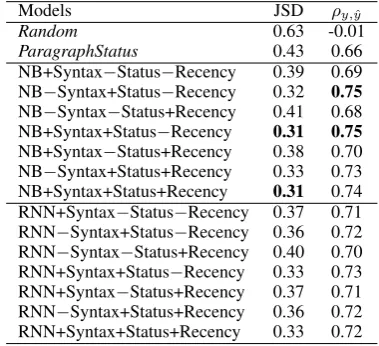
Models JSD ρy,ˆy
Random 0.63 -0.01
ParagraphStatus 0.43 0.66 NB+Syntax−Status−Recency 0.39 0.69 NB−Syntax+Status−Recency 0.32 0.75
NB−Syntax−Status+Recency 0.41 0.68 NB+Syntax+Status−Recency 0.31 0.75
[image:5.595.86.276.253.427.2]NB+Syntax−Status+Recency 0.38 0.70 NB−Syntax+Status+Recency 0.33 0.73 NB+Syntax+Status+Recency 0.31 0.74 RNN+Syntax−Status−Recency 0.37 0.71 RNN−Syntax+Status−Recency 0.36 0.72 RNN−Syntax−Status+Recency 0.40 0.70 RNN+Syntax+Status−Recency 0.33 0.73 RNN+Syntax−Status+Recency 0.37 0.71 RNN−Syntax+Status+Recency 0.36 0.72 RNN+Syntax+Status+Recency 0.33 0.72 Table 3: Average Jensen-Shannon divergence and Spearman’s correlation coefficient of the models in Experiment 1.
Table 3 depicts the Jensen-Shannon divergence and Spearman’s correlation coefficient of the mod-els cross-validated on VaREG corpus. All our models outperformed the baselines.
Considering the models in which the references are described by only one kind of feature, it seems that the status features (+Status) are the ones that best contributed to model the individual variation in the choice of referential form, whereas the re-cency (+Rere-cency) is the worst. Syntactic position is sandwiched among the previous two.
In the comparison within Naive Bayes and RNN models, the ones in which the references are de-scribed by syntactic position and referential sta-tus (+Syntax+Stasta-tus−Recency) obtained the best results for both measures. Figure 1 depicts the average Jensen-Shannon divergences by genre of Naive Bayes and RNN models in which the ref-erences are described by this combination of fea-tures. Both models presented the best results in
News Review Encyclopedic
0.25 0.3 0.35 0.4
NB RNN
Figure 1: Jensen-Shannon divergence of
NB+Syntax+Status−Recency (NB) and
RNN+Syntax+Status−Recency (RNN) by
genre in Experiment 1. Error bars represent 95% confidence intervals.
encyclopedic texts, and the worst in product re-views.
Although RNNs are able to model the indi-vidual variation in a reference based on its an-tecedents, they did not introduce significantly better results than Naive Bayes. In fact, NB+Syntax+Status−Recency is significantly bet-ter than RNN+Syntax+Status−Recency in mod-eling the individual variation in news (Wilcoxon Z = 11574.5, p < 0.01) and encyclopedic texts (WilcoxonZ = 4232.5,p <0.001).
5.4.2 Training on GREC-2.0 and evaluating on VaREG corpus
Models JSD ρy,ˆy
Random 0.63 -0.01
ParagraphStatus 0.43 0.66 NB+Syntax+Status−Recency 0.36 0.67
NB+Syntax+Status+Recency 0.37 0.64 RNN+Syntax+Status−Recency 0.37 0.62 RNN+Syntax+Status+Recency 0.37 0.64 Table 4: Average Jensen-Shannon divergence and Spearman’s correlation coefficient of the models in Experiment 2.
Table 4 shows the results of models trained with GREC-2.0 and tested with VaREG corpus. These models are the two versions of Naive Bayes, and the two versions of RNN which were best evalu-ated in the previous experiment.
[image:5.595.85.275.255.428.2]News Review Encyclopedic
0.3 0.4
0.5 NB RNN
Figure 2: Average Jensen-Shannon divergence of NB+Syntax+Status−Recency (NB) and RNN+Syntax+Status-Recency (RNN) by genre in Experiment 2. Error bars represent 95% confidence intervals.
Figure 2 depicts the Jensen-Shannon diver-gence measures of models NB+Syntax+Status-Recency and RNN+Syntax+Status-NB+Syntax+Status-Recency by text genre. As in the previous experiment, both Naive Bayes and RNN models best mod-eled the individual variation in encyclopedic texts. Moreover, there was not significant dif-ference among NB+Syntax+Status-Recency and RNN+Syntax+Status-Recency in the three text genres.
In general, the models trained with VaREG cor-pus seemed to model the individual variation in the choice of referential form better than the mod-els trained with GREC-2.0 corpus.
6 Coherence and comprehensibility of the texts
In this section, we investigate to what extent texts generated by our method, including variation of referential form, are judged coherent and compre-hensible by readers. We do this by comparing texts from the GREC-2.0 corpus in which all refer-ences were (re)generated using our method, with the original text and with a variant that includes random variation of referential form.
6.1 Our model for choice of referential form
To generate the referring expressions for the topic of a given text of GREC-2.0, we first group all ref-erences by syntactic position and referential sta-tus values. Then for each group, we shuffle the references and choose their forms according to the distribution predicted by our best performing model (the NB+Syntax+Status−Recency trained
on VaREG). The choice of referential forms fol-lows the roulette-wheel generation process (Belz, 2008). This process entails that if a group has 5 references and our model predicts a distribution of 0.75 proper names and 0.25 pronouns, 4 ref-erences of the group will be proper names and 1 a pronoun.
This covers the selection of referential forms (deciding which form to use at which particular point in the text). To deal with their linguistic realisation, we implemented the following heuris-tics. For the cases in which a proper name refer-ence is selected, we choose a realization depend-ing on referential status. If the reference is the first mention to the topic in the text, the reference is realized with the topic’s longest proper name. Otherwise, the reference is realized with its short-est proper name. For the cases in which a defi-nite description is selected, but where the original GREC-2.0 corpus does not provide a description for the topic, we select the shortest predicate ad-jective of the first sentence of the text, immedi-ately following the main verb. For instance, for the sentence “Alan Mathison Turing was an English mathematician, logician, and cryptographer.”, the selected definite description would be “The En-glish mathematician”. In the cases where a refer-ence should assume the form of a demonstrative, the definite article of the definite description is re-placed by the demonstrative “this” (In the previous example, “This English mathematician”).
6.2 Evaluation Method
We evaluated three versions of each text. The
Originalis the original text in the corpus, includ-ing the original referrinclud-ing expressions selected by the author. We compare this with aRandom vari-ant, which does include variation of referential forms, but selects them in a fully random way. Finally, in the third,Generatedversion, all refer-ences are generated according to the method out-lined at Section 6.1. Table 5 depicts an example of text in the three versions.
[image:6.595.105.254.59.184.2]Version Text
Original
Spain, officially the Kingdom of Spain, is a country located in Southern Europe, with two small exclaves in North Africa (both bordering Morocco).Spainis a democracywhichis organized as a parliamentary monarchy.
Itis a developed country with the ninth-largest economy in the world. Itis the largest of the three sovereign nations that make up the Iberian Peninsula–the others are Portugal and the microstate of Andorra.
Random
It, officially the Kingdom of Spain, is a country located in Southern Europe, with two small exclaves in North Africa (both bordering Morocco).The countryis a democracythatis organized as a parliamentary monarchy.
Itis a developed country with the ninth-largest economy in the world.This countryis the largest of the three sovereign nations that make up the Iberian Peninsula–the others are Portugal and the microstate of Andorra. Generated
Spain, officially the Kingdom of Spain, is a country located in Southern Europe, with two small exclaves in North Africa (both bordering Morocco).Spainis a democracythatis organized as a parliamentary monarchy.
The countryis a developed country with the ninth-largest economy in the world. Itis the largest of the three sovereign nations that make up the Iberian Peninsula–the others are Portugal and the microstate of Andorra.
Table 5: Example of text in the Original, Random and Generated version.
references to the topic were highlighted in yellow. The experiment was run on CrowdFlower and is publicly available3.
The experiment was performed by 30 partici-pants (10 per list). Their average age was 36 years, and 22 were female. All were proficient in En-glish (the language of the experiment), 26 partic-ipants were native speakers. They were asked to rate each text in terms of how coherent and com-prehensible they considered it, on a scale from 1 (Very Bad) to 5 (Very Good).
6.3 Results
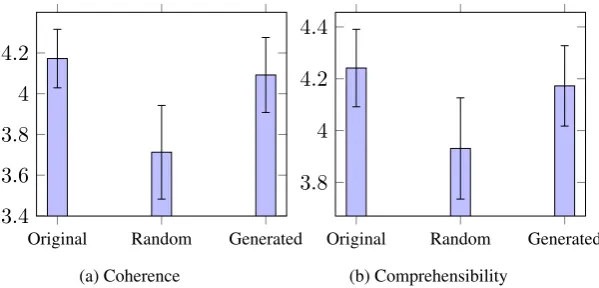
Figure 3 depicts the average coherence and com-prehensibility of the texts where their topics are described by theOriginal,RandomandGenerated
approaches, respectively. Inspection of this Fig-ure clearly shows that theRandomtexts are rated lower than both the Original and the Generated
texts, and that the latter are rated very similarly on both dimensions.
This is confirmed by the statistical analysis. Ac-cording to a Friedman test, there is statistically sig-nificant difference in the coherence (χ2 = 11.79, p < 0.005) and comprehensibility (χ2 = 8.98, p = 0.01) for the three kinds of texts. We then conducted a post hoc analysis with Wilcoxon signed-rank test corrected for multiple compar-isons using the Bonferroni method, resulting in a significance level set at p < 0.017. Texts of theOriginalapproach are statistically more coher-ent (Z = 322, p < 0.017) and comprehensible (Z = 407.5,p <0.017) than texts of theRandom
one. Texts of theGeneratedapproach are also sta-tistically more coherent (Z = 275, p < 0.017), but not more comprehensible (Z = 378,p <0.05) than texts of the Random one. Finally, and
cru-3http://ilk.uvt.nl/˜tcastrof/acl2016
cially, comparing Original and Generated texts revealed no significant differences for coherence (Z = 540, p < 0.5) nor for comprehensibility (Z = 391.5,p <0.5).
7 Discussion
In this paper we explored the possibilities of in-troducing more variation in automatically gener-ated texts, by trying to model individual variation in the selection of referential form. We relied on a new corpus (VaREG (Ferreira et al., 2016)), which does not contain a single expression for each erence in a text, but rather a distribution of ref-erential forms produced by 20 different people. In contrast to earlier models for referential choice which always deterministically choose the most likely form of a reference, we proposed a Naive Bayes and a Recurrent Neural Network model which aimed to predict the frequency distribution with which a reference can assume a specific refer-ential form, based on discourse features including syntactic position, referential status and recency. Given a reference, we evaluated how well each different model could capture the individual vari-ation found in the VaREG corpus by comparing its predicted distribution of referential forms with the real one in the corpus. We trained the models in two different ways: first using the VaREG, and second using the GREC-2.0 corpus. The Naive Bayes model, trained on VaREG corpus, in which the references were described by syntactic posi-tion and referential status features was the one that best modeled the individual variation in the choice of referential form.
fol-Original Random Generated
3.4 3.6 3.8 4 4.2
(a) Coherence
Original Random Generated
3.8 4 4.2 4.4
[image:8.595.159.459.61.205.2](b) Comprehensibility
Figure 3: Average coherence (3a) and comprehensibility (3b) of the texts with the original, randomized and generated referring expressions. Error bars represent 95% confidence intervals.
lowed by the syntactic position feature. Both of these findings are consistent with the observations about human variation in the selection of referen-tial forms, as discussed by Ferreira et al. (2016). This study argued that writers are more likely to vary in their choices when a reference is in the object position, and when it is an old mention in the text, but new in the sentence. Recency was not a helpful feature for our models, and this may be due to the way the feature was represented -i.e., as a categorical rather than a continuous fea-ture. Moreover, the recency feature was measured in terms of words between the current reference and the most recent previous one to the same refer-ent. Perhaps, it would be better to measure recency in terms of different discourse entities mentioned between two references to the same referent.
Genre In agreement with Ferreira et al. (2016), we also found that genre mattered. For model-ing variation, our models performed best when ap-plied to encyclopedic texts, and worst in product reviews, with news sandwiched in between.
Naive Bayes model vs. RNNs Although the RNNs were able to model individual variation in the choice of referential form to some extent, they did not perform significantly better than the Naive Bayes models, which might have to do with the relatively small dataset. However, we think the size of the corpus matches the relatively low complexity of the problem we address. In the most complex case (i.e., when a reference is de-scribed by its syntactic position, status and re-cency), an input can be represented in 120 differ-ent ways to predict a multinomial distribution of size 5 (number of referential forms). This com-plexity is much smaller than other problems
typi-cally modeled by RNNs. In text production, for in-stance, an input may be represented by thousands of words to predict a large multinomial distribu-tion over a vocabulary (Sutskever et al., 2014). Additionally, it is important to stress that we ac-tually have a real multinomial distribution to com-pare with the distribution predicted by the RNN in each situation. We observed that it is possi-ble to compute more fine-grained error costs in our case, which makes the RNN converge faster when it is backpropagated. In sum, we believe that those two factors combined compensate for the size of the dataset. A possible explanation for the non-difference among the Naive Bayes model and RNNs is the use of the referential status fea-tures, which perhaps are already enough to model the relation among a reference and its antecedents.
VaREG corpus vs. GREC-2.0 corpus Inter-estingly, our proposed models yielded better per-formance when trained on the VaREG than on the GREC-2.0 corpus. This shows a difference among the referential choices of both corpora. We conjecture this difference is partly due to differ-ences in text genres, since the VaREG corpus con-tains texts from three different genres, whereas the GREC-2.0 corpus only has encyclopedic texts. Earlier work has also highlighted the influence of text genre on the amount of individual variation in writers’ choices for referential forms (Ferreira et al., 2016).
gen-erated in this way in an experiment in which hu-mans were asked to judge the coherence and com-prehensibility of the generated texts, comparing them both with the original references and those produced by a random baseline model. In terms of coherence and comprehensibility, we found that the texts in which the references were generated by our model were not significantly different than the human generated ones, and significantly bet-ter than the randomly generated ones. This shows that our solution does not only model the individ-ual variation in the choice of referential form, but that this also does not negatively affect the quality of the texts. This is an important step towards de-veloping new models for automatic text generation that are less predictable and more varied.
Acknowledgments
This work has been supported by the National Council of Scientific and Technological Develop-ment from Brazil (CNPq).
References
Jennifer E Arnold. 1998. Reference form and dis-course patterns. Ph.D. thesis, Stanford Univer-sity Stanford, CA.
Anja Belz. 2008. Automatic generation of weather forecast texts using comprehensive probabilis-tic generation-space models. Nat. Lang. Eng.
14(4):431–455.
Anja Belz, Eric Kow, Jette Viethen, and Albert Gatt. 2010. Empirical methods in natural lan-guage generation. Springer-Verlag, Berlin, Hei-delberg, chapter Generating Referring Expres-sions in Context: The GREC Task Evaluation Challenges, pages 294–327.
Susan E. Brennan. 1995. Centering attention in discourse. Language and Cognitive Processes
10(2):137–167.
Charles B. Callaway and James C. Lester. 2002. Pronominalization in generated discourse and dialogue. In Proceedings of the 40th Annual Meeting on Association for Computational Lin-guistics. Association for Computational Lin-guistics, Stroudsburg, PA, USA, ACL ’02, pages 88–95.
Wallace L. Chafe. 1994. Discourse, Conscious-ness, and Time: The Flow and Displacement of Conscious Experience in Speaking and Writing. University of Chicago Press.
Christer Clerwall. 2014. Enter the robot journalist: Users’ perceptions of automated content. Jour-nalism Practice8(5):519–531.
Robert Dale and Jette Viethen. 2010. Attribute-centric referring expression generation. In Em-pirical methods in natural language generation, Springer, pages 163–179.
Thiago Castro Ferreira, Emiel Krahmer, and Sander Wubben. 2016. Individual variation in the choice of referential form. InProceedings of the 2016 Conference of the North Ameri-can Chapter of the Association for Computa-tional Linguistics: Human Language Technolo-gies. Association for Computational Linguis-tics, San Diego, California.
Charles F Greenbacker and Kathleen F McCoy. 2009. Feature selection for reference genera-tion as informed by psycholinguistic research. In Proceedings of the CogSci 2009 Workshop on Production of Referring Expressions (PRE-Cogsci 2009).
Samir Gupta and Sivaji Bandopadhyay. 2009. Junlg-msr: A machine learning approach of main subject reference selection with rule based improvement. InProceedings of the 2009 Work-shop on Language Generation and Summari-sation. Association for Computational Linguis-tics, Stroudsburg, PA, USA, UCNLG+Sum ’09, pages 103–104.
Renate Henschel, Hua Cheng, and Massimo Poe-sio. 2000. Pronominalization revisited. In
Proceedings of the 18th conference on Com-putational linguistics-Volume 1. Association for Computational Linguistics, pages 306–312. Emiel Krahmer and Mari¨et Theune. 2002.
Effi-cient context-sensitive generation of referring expressions. In K. van Deemter and R. Kib-ble, editors, Information sharing: Reference and presupposition in language generation and interpretation, CSLI, Stanford, CA, pages 223– 264.
Solomon Kullback. 1968. Information theory and statistics. Courier Corporation.
Jianhua Lin. 1991. Divergence measures based on the shannon entropy.Information Theory, IEEE Transactions on37(1):145–151.
learning methods for spoken language under-standing. InINTERSPEECH 2013, 14th Annual Conference of the International Speech Com-munication Association, Lyon, France, August 25-29, 2013. pages 3771–3775.
Ehud Reiter and Robert Dale. 2000. Building nat-ural language generation systems. Cambridge University Press, New York, NY, USA.
Ilya Sutskever, Oriol Vinyals, and Quoc V. Le. 2014. Sequence to sequence learning with neu-ral networks. In Advances in Neural Informa-tion Processing Systems 27: Annual Confer-ence on Neural Information Processing Systems 2014, December 8-13 2014, Montreal, Quebec, Canada. pages 3104–3112.
Kees Van Deemter, Albert Gatt, Roger PG van Gompel, and Emiel Krahmer. 2012. To-ward a computational psycholinguistics of ref-erence production. Topics in cognitive science
4(2):166–183.