Statistical Machine Translation Features with Multitask Tensor Networks
Hendra Setiawan, Zhongqiang Huang, Jacob Devlin†∗, Thomas Lamar,Rabih Zbib, Richard Schwartz and John Makhoul
Raytheon BBN Technologies, 10 Moulton St, Cambridge, MA 02138, USA
†Microsoft Research, One Microsoft Way, Redmond, WA 98052, USA
{hsetiawa,zhuang,tlamar,rzbib,schwartz,makhoul}@bbn.com [email protected]
Abstract
We present a three-pronged approach to improving Statistical Machine Translation (SMT), building on recent success in the application of neural networks to SMT. First, we propose newfeatures based on neural networks to model various non-local translation phenomena. Second, we augment thearchitectureof the neural net-work with tensor layers that capture im-portant higher-order interaction among the network units. Third, we apply multitask learning to estimate the neural network parameters jointly. Each of our proposed methods results in significant improve-ments that are complementary. The over-all improvement is +2.7 and +1.8 BLEU points for Arabic-English and Chinese-English translation over a state-of-the-art system that already includes neural net-work features.
1 Introduction
Recent advances in applying Neural Networks to Statistical Machine Translation (SMT) have gen-erally taken one of two approaches. They ei-ther develop neural network-based features that are used to score hypotheses generated from tra-ditional translation grammars (Sundermeyer et al., 2014; Devlin et al., 2014; Auli et al., 2013; Le et al., 2012; Schwenk, 2012), or they implement the whole translation process as a single neu-ral network (Bahdanau et al., 2014; Sutskever et al., 2014). The latter approach, sometimes re-ferred to asNeural Machine Translation, attempts to overhaul SMT, while the former capitalizes on the strength of the current SMT paradigm and leverages the modeling power of neural networks to improve the scoring of hypotheses generated
∗
* Research conducted when the author was at BBN.
by phrase-based or hierarchical translation rules. This paper adopts the former approach, asn-best scores from state-of-the-art SMT systems often suggest that these systems can still be significantly improved with better features.
We build on (Devlin et al., 2014) who proposed a simple yet powerful feedforward neural network model that estimates the translation probability conditioned on the target history and a large win-dow of source word context. We take advantage of neural networks’ ability to handle sparsity, and to infer useful abstract representations automati-cally. At the same time, we address the challenge of learning the large set of neural network param-eters. In particular,
• We develop new Neural Network Features to model non-local translation phenomena related to word reordering. Large fully-lexicalized contexts are used to model these phenomena effectively, making the use of neural networks essential. All of the features are useful individually, and their combination results in significant improvements (Section 2).
• We use aTensor Neural Network Architecture (Yu et al., 2012) to automatically learn com-plex pairwise interactions between the net-work nodes. The introduction of the tensor hidden layer results in more powerful fea-tures with lower model perplexity and signif-icantly improved MT performance for all of neural network features (Section 3).
• We applyMultitask Learning (MTL) (Caru-ana, 1997) to jointly train related neural net-work features by sharing parameters. This allows parameters learned for one feature to benefit the learning of the other features. This results in better trained models and achieves additional MT improvements (Section 4). We apply the resulting Multitask Tensor Net-works to the new features and to existing ones,
obtaining strong experimental results over the strongest previous results of (Devlin et al., 2014). We obtain improvements of +2.5 BLEU points for Arabic-English and +1.8 BLEU points for Chinese-English on the DARPA BOLT Web Fo-rum condition. We also obtain improvements of +2.7 BLEU point for Arabic-English and +1.9 BLEU points for Chinese-English on the NIST Open12 test sets over the best previously pub-lished results in (Devlin et al., 2014). Both the tensor architecture and multitask learning are gen-eral techniques that are likely to benefit other neu-ral network features.
2 New Non-Local SMT Features
Existing SMT features typically focus on local in-formation in the source sentence, in the target hy-pothesis, or both. For example, the n-gram lan-guage model (LM) predicts the next target word by using previously generated target words as con-text (local on target), while the lexical translation model (LTM) predicts the translation of a source word by taking into account surrounding source words as context (local on source).
In this work, we focus on non-local transla-tion phenomena that result from non-monotone re-ordering, where localcontext becomesnon-local on the other side. We propose a new set of power-ful MT features that are motivated by this simple idea. To facilitate the discussion, we categorize the features intohypothesis-enumeratingfeatures that estimates a probability for each generated target word (e.g.,n-gram language model), and source-enumerating features that estimates a probability for each source word (e.g., lexical translation).
More concretely, we introduce a) Joint Model with Offset Source Context (JMO), a hypothesis enumerating feature that predicts the next target word the source context affiliated to the previous target words; and b) Translation Context Model (TCM), a source-enumerating feature that predicts the context of the translation of a source word rather than the translation itself. These two mod-els extend pre-existing features: the Joint (lan-guage and translation) Model (JM) of (Devlin et al., 2014) and the LTM respectively respectively. We use a large lexicalized context for there fea-tures, making the choice of implementing them as neural networks essential. We also present neural-network implementations of pre-existing source-enumerating features: lexical translation,
orien-tation and fertility models. We obtain additional gains from using tensor networks and multitask learning in the modeling and training of all the fea-tures.
2.1 Hypothesis-Enumerating Features
As mentioned, hypothesis-enumerating features score each word in the hypothesis, typically by conditioning it on a context of n-1 previous tar-get words as in then-gram language model. One recent such model, the joint model of Devlin et al. (2014) achieves large improvements to the state-of-the-art SMT by using a large context window of 11 source words and 3 target words. The Joint Model with Offset Source Context (JMO) is an extension of the JM that uses the source words affiliated with the n-gram target history as con-text. The source contexts of JM and JMO over-lap highly when the translation is monotone, but are complementary when the translation requires word reordering.
2.1.1 Joint Model with Offset Source Context
Formally, JMO estimates the probability of the tar-get hypothesis E conditioned on the source sen-tenceFand a target-to-sourceaffiliationA:
P(E|F,A)≈ |E| Y
i=1
P(ei|eii−−1n+1,Cai−k =faaii−−kk−+mm)
whereeiis the word being predicted;eii−−n1+1is the
string ofn−1previously generated words;Cai−k
to the source context of m source words around
fai−k, the source word affiliated with ei−k. We
refer tokas the offset parameter. We use the def-inition ofword affiliationintroduced in Devlin et al. (2014). When no source context is used, the model is equivalent to ann-gram language model, while an offset parameter of k = 0 reduces the model to the JM of Devlin et al. (2014).
Whenk > 0, the JMO captures non-local con-text in the prediction of the next target word. More specifically, ei−k and ei, which are local on the target side, are affiliated to fai−k and fai which
may be distant from each other on the source side due to non-monotone translation, even fork = 1. The offset model captures reordering constraints by encouraging the predicted target wordei to fit well with the previous affiliated source wordfai−k
them jointly via multitask learning. As our ex-periments in Section 5.2.1 confirm, the history-affiliated source context results in stronger SMT improvement than just increasing the number of surrounding words in JM.
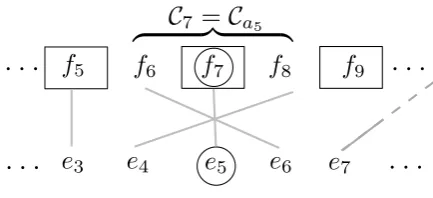
Fig. 1 illustrates the difference between JMO and JM. Assuming n = 3 andm = 1, then JM estimates P(e5|e4, e3,Ca5 = {f6, f7, f8}). On
the other hand, for k = 1 , JMOk=1 estimates
P(e5|e4, e3,Ca4 ={f8, f9, f10}).
f
9f
5. . .
e
5e
6e
4e
7e
3. . .
. . .
C
7=
C
a5. . .
z
}|
{
f
6f
7f
8Figure 1: Example to illustrate features. f9 5 is the
source segment, e7
3 is the corresponding
transla-tion and lines refer to the alignment. We show hypothesis-enumerating features that look at f7
and source-enumerating features that look at e5.
We surround the source words affiliated with e5
and its n-gram history with a bracket, and sur-round the source words affiliated with the history ofe5 with squares.
2.2 Source-Enumerating Features
Source-Enumerating Features iterate over words in the source sentence, including unaligned words, and assign it a score depending on what as-pect of translation they are modeling. A source-enumerating feature can be formulated as follows:
P(E|F,A)≈ |F| Y
j=1
P(Yj|Cj =fjj−+mm)
where Caj is the source context (similar to the
hypothesis-enumerating features above) and Yj is the label being predicted by the feature. We first describe pre-existing source-enumerating fea-tures: the lexical translation model, the orientation model and the fertility model, and then discuss a new feature: Translation Context Model (TCM), which is an extension of the lexical translation model.
2.2.1 Pre-existing Features
Lexical Translation model (LTM) estimates the probability of translating a source wordfjto a
tar-get word l(fj) = ebj given a source context Cj, bj ∈ B is the source-to-target word affiliation as defined in (Devlin et al., 2014). Whenfj is trans-lated to more than one word, we arbitrarily keep the left-most one. The target word vocabularyV
is extended with aNULLtoken to accommodate unaligned source words.
Orientation model (ORI) describes the proba-bility of orientation of the translation of phrases surrounding a source wordfj relative to its own translation. We follow (Setiawan et al., 2013) in modeling the orientation of the left and right phrases offj with maximal orientation span (the longest neighboring phrase consistent with align-ment), which we denote by Lj and Rj respec-tively. Thus, o(fj) = hoLj(fj), oRj(fj)i, where oLj andoRj refer to the orientation ofLj andRj
respectively. For unaligned fj, we set o(fj) =
oLj(Rj), the orientation ofRj with respect toLj. Fertility model(FM) models the probability that a source word fj generates φ(fj) words in the hypothesis. Our implemented model only dis-tinguishes between aligned and unaligned source words (i.e.,φ(fj)∈ {0,1}). The generalization of the model to account for multiple values ofφ(fi) is straightforward.
2.2.2 Translation Context Model
As with JMO in Section 2.1.1, we aim to cap-ture translation phenomena that appear local on the target hypothesis but non-local on the source side. Here, we do so by extending the LTM feature to predict not only the translated word
ebj, but also its surrounding context.
For-mally, we model P(l(fj)|Cj), where l(fj) =
ebj−d,· · · , ebj,· · ·ebj+d is the hypothesis word
window around ebj. In practice, we decompose
TCM further into +Qd
d0=−dP(ebj+d
0|Cj) and
imple-mented each as a separate neural network-based feature. Note that TCM is equivalent to the LTM whend= 0. Because of word reordering, a given hypothesis word in l(fj) might not be affiliated withfjor even to the words inCj. TCM can model non-local information in this way.
2.2.3 Combined Model
not, and thus arrive at the following formulation:
P(l(fj))·P(ori(fj))·P(φ(fj)) =
P(φp(fj) = 0)·P(oLj(Rj))
P(φp(fj)≥1)· +d Q
d0=−dP(ebj+d0)
·P(oLj(fj), oRj(fj))
We dropped the common context (Cj) for readabil-ity.
We reuse Fig. 1 to illustrate the source-enumerating features. Assumingd= 1, the scores associated with f7 are P(φ(f7) ≥ 1|C7) for the
FM;P(e4|C7)·P(e5|C7)·P(e6)|C7)for the TCM;
andP(o(f7) =hoL7(f7) =RA, oR7(f7) =RAi)
for the ORI(RArefers toReverse Adjacent). L7
andR7 (i.e. f6 and f89 respectively), the longest
neighboring phrase off7, are translated in reverse
order and adjacent toe5.
3 Tensor Neural Networks
The second part of this work improves SMT by improving the neural network architecture. Neural Networks derive their strength from their ability to learn a high-level representation of the input auto-matically from data. This high-level representa-tion is typically constructed layer by layer through a weighted sum linear operation and a non-linear activation function. With sufficient training data, neural networks often achieve state-of-the-art per-formance on many tasks. This stands in sharp con-trast to other algorithms that require tedious man-ual feature engineering. For the features presented in this paper, the context words are fed to the net-work netnet-work with minimal engineering.
We further strengthen the network’s ability to learn rich interactions between its units by intro-ducing tensors in the hidden layers. The multi-plicative property of the tensor bares a close re-semblance to collocation of context words which are useful in many natural language processing tasks.
In conventional feedforward neural networks, the output of hidden layer l is produced by mul-tiplying the output vector from the previous layer with a weight matrix (Wl) and then applying the activation functionσto the product. Tensor Neu-ral Networks geneNeu-ralize this formulation by using a tensorUl of order 3 for the weights. The output of nodekin layerlis computed as follows:
hl[k] =σ hl−1·Ul[k]·hTl−1
whereUl[k], thek-th slice ofUl, is a square ma-trix.
In our implementation, we follow (Yu et al., 2012; Hutchinson et al., 2013) and use a low-rank approximation ofUl[k] = Ql[k]·Rl[k]T, where
Ql[k], Rl[k] ∈ Rn×r. The output of node k be-comes:
hl[k] =σ hl−1·Ql[k]·Rl[k]T ·hTl−1
In our experiments, we chooser = 1, and also apply the non-linear activation functionσ distribu-tively. We arrive at the following three equations for computing the hidden layer outputs(0 < l < L):
vl = σ(hl−1·Ql)
v0l = σ(hl−1·Rl)
hl = vl⊗v0l
where hl−1 is double-projected to vl and vl0, and the two projections are merged using the Hadamard element-wise product operator⊗.
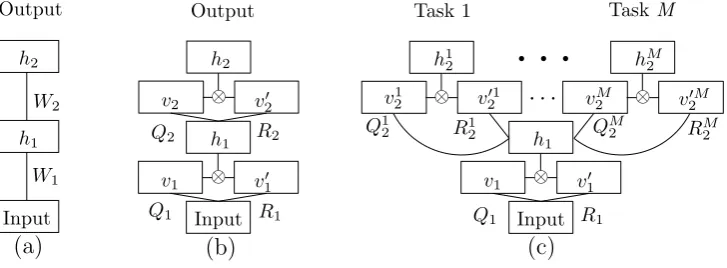
This formulation allows us to use the same in-frastructure of the conventional neural networks by projecting the previous layer to two different spaces of the same dimensions, then multiply-ing them element-wise. The only component that is different from conventional feedforward neural networks is the multiplicative function, which is trivially differentiable with respect to the learnable parameters. Figure 3(b) illustrates the tensor ar-chitecture for two hidden layers.
The tensor network can learn collocation fea-tures more easily. For example, it can learn a col-location feature that is activated only ifhl−1[i]
col-locates withhl−1[j]by settingUl[k][i][j]to some positive number. This results in SMT improve-ments as we describe in Section 5.
4 Multitask Learning
Input
h1
h2
Input
h1
⊗
v1 v01
h2
⊗
v2 v02
Input
h1
⊗
v1 v01
h1 2
⊗
v1
2 v201
hM
2
⊗
vM
2 v20M
· · ·
· · ·
W1
W2
Q1 R1
R2
Q2
R1
Q1
Q1
2 R12 QM2 RM2
(a) (b) (c)
[image:5.595.119.483.62.196.2]Output Output Task 1 TaskM
Figure 2: The network architecture for (a) a conventional feedforward neural network, (b) tensor hidden layers, and (c) multitask learning with M features that share the embedding and first hidden layers (t= 1).
learn the parameters of the other features. Another way of looking at this is that MTL facilitates reg-ularization through learning the other tasks.
MTL is suitable for SMT features as they model different but closely related aspects of the same translation process. MTL has long been used by the wider machine learning community (Caruana, 1997) and more recently for natural language pro-cessing (Collobert and Weston, 2008; Collobert et al., 2011). The application of MTL to ma-chine translation, however, has been much less re-stricted, which is rather surprising since SMT fea-tures arise from the same translation task and are naturally related.
We apply MTL for the features described in Section 2. We design all the features to also share the same neural network architecture (in this case, the tensor architecture described in Section 3) and the same input, thus resulting in two large neural networks: one for the hypothesis-enumerating fea-tures and another for the source-enumerating ones. This simplifies the implementation of MTL. Us-ing this setup, it is possible to vary the number of shared hidden layerstfrom 0 (only sharing the embedding layer) toL−1(sharing all the layers except the output). Note that in principle MTL is applicable to other set of networks that have differ-ent architecture or even differdiffer-ent input set. With MTL, the training procedure is the same as that of standard neural networks.
We use the back propagation algorithm, and use as the loss function the product of likelihood of each feature1:
1In this and in the other parts of the paper, we add the
normalization regularization term described in (Devlin et al., 2014) to the loss function to avoid computing the normaliza-tion constant at model query/decoding time.
Loss=X
i M X
j
log (P(Yj(Xi)))
whereXi is the training sample andYj is one of theMmodels trained. We use the sum of log like-lihoods since we assume that the features are inde-pendent.
Fig. 3(c) illustrates MTL between M models sharing the input embedding layer and the first hidden layer (t = 1) compared to the separately-trained conventional feedforward neural network and tensor neural network.
5 Experiments
We demonstrate the impact of our work with ex-tensive MT experiments on Arabic-English and Chinese-English translation for the DARPA BOLT Web Forum and the NIST OpenMT12 conditions.
5.1 Baseline MT System
We run our experiments using a state-of-the-art string-to-dependency hierarchical decoder (Shen et al., 2010). The baseline we use includes a set of powerful features as follow:
• Forward and backward rule probabilities • Contextual lexical smoothing (Devlin, 2009) • 5-gram Kneser-Ney LM
• Dependency LM (Shen et al., 2010) • Length distribution (Shen et al., 2010) • Trait features (Devlin and Matsoukas, 2012) • Factored source syntax (Huang et al., 2013) • Discriminative sparse feature, totaling 50k
features (Chiang et al., 2009)
(NNLTM) (Devlin et al., 2014)
As shown, our baseline system already includes neural network-based features. NNJM, NNLTM and use two hidden layers with 500 units and use embedding of size 200 for each input.
We use the MADA-ARZ tokenizer (Habash et al., 2013) for Arabic word tokenization. For Chi-nese tokenization, we use a simple longest-match-first lexicon-based approach. We align the training data using GIZA++ (Och and Ney, 2003). For tun-ing the weights of MT features includtun-ing the new features, we use iterativek-best optimization with an ExpectedBLEU objective function (Rosti et al., 2010), and decode the test sets after 5 tuning iter-ation. We report the lower-cased BLEU and TER scores.
5.2 BOLT Discussion Forum
The bulk of our experiments is on the BOLT Web Discussion Forum domain, which uses data col-lected by the LDC. The parallel training data con-sists of all of the high-quality NIST training cor-pora, plus an additional 3 million words of trans-lated forum data. The tuning and test sets consist of roughly 5000 segments each, with 2 indepen-dent references for Arabic and 3 for Chinese.
5.2.1 Effects of New Features
We first look at the effects of the proposed features compared to the baseline system. Table 1 summa-rizes the primary results of the Arabic-English and Chinese-English experiments for the BOLT condi-tion. We show the experimental results related to hypothesis-enumerating features (HypEn) in rows
S2-S5, those related to source-enumerating
fea-tures (SrcEn) in rowsS6-S9, and the combination
of the two in rowS10. For all the features, we set
the source context length tom= 5(11-word win-dow). For JM and JMO, we set the target context length to n = 4. For the offset parameter k of JMO, we use values 1 to 3. For TCM, we model one word around the translation (d = 1). Larger values of d did not result in further gains. The baseline is comparable to the best results of (De-vlin et al., 2014).
In rowsS3toS5, we incrementally add a model
with different offset source context, from k = 1
tok = 3. For AR-EN, adding JMOs with differ-ent offset source context consistdiffer-ently yields pos-itive effects in BLEU score, while in ZH-EN, it yields positive effects in TER score. Utilizing all offset source contexts “+JMOk≤3” (rowS5) yields
around 0.9 BLEU point improvement in AR-EN and around 0.3 BLEU in ZH-EN compared to the baseline. The JMO consistently provides bet-ter improvement compared to a larger JM con-text (rowS2), validating our hypothesis that using
offset source context captures important non-local context.
Rows S6 to S9 present the improvements that
result from implementing pre-existing source-enumerating SMT features as neural networks, and highlight the contribution of our translation context model (TCM). This set of experiments is orthogonal to the HypEn experiments (rows S2
-S5). Each pre-existing model has a modest
pos-itive cumulative effect on both BLEU and TER. We see this result as further confirming the cur-rent trend of casting existing SMT features as neu-ral network since our baseline already contains such features. The next row present the results of adding the translation context model, with one word surrounding the translation (d = 1). As shown, TCM yields a positive effect of around 0.5 BLEU and TER improvements in AR-EN and around 0.2 BLEU and TER improvements in ZH-EN.
Separately, the set of source-enumerating fea-tures and the set of target-enumerating feafea-tures produce around 1.1 to 1.2 points BLEU gain in AR-EN and 0.3 to 0.5 points BLEU gain in ZH-EN. The combination of the two sets produces a complementary gain in addition to the gains of the individual models as Row (S10) shows. The
com-bined gain improves to 1.5 BLEU points in AR-EN and 0.7 BLEU points in ZH-AR-EN.
System BL TERAR-EN BL TERZH-EN
S1: Baseline 43.2 45.0 30.2 58.3
S2:S1+JMLC8 43.5 45.0 30.2 58.5
S3:S1+JMOk=1 43.9 44.7 30.8 57.8
S4:S3+JMOk=2 43.9 44.7 30.7 57.8
S5:S4+JMOk=3 44.4 44.5 30.5 57.5
S6:S1+LTM 43.5 44.7 30.3 58.0
S7:S6+ORI 43.7 44.6 30.4 57.8
S8:S7+FERT 43.8 44.7 30.5 57.8
S9:S8+TCM 44.3 44.2 30.7 57.5
S10:S9+JMOk≤3 44.7 44.1 30.9 57.3
5.2.2 Effects of Tensor Network and Multitask Learning
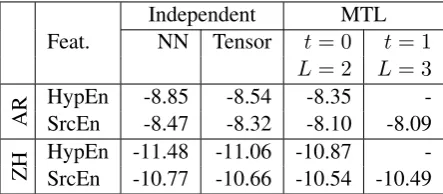
We first analyze the impact of tensor architecture and MTL intrinsically by reporting the models’ average log-likelihood on the validation sets (a subset of the test set) in Table 2. As mentioned, we group the models to HypEn (JM and JMOk≤3) and
SrcEn (LTM, ORI,FERT and TCM) as we perform MTL on these two groups. Likelihood of these two groups in the previous subsection are in col-umn “NN” (for Neural Network), which serves as a baseline. The application of the tensor architec-ture improves their likelihood as shown in column “Tensor” for both languages and models.
Feat. IndependentNN Tensor t= 0MTLt= 1 L= 2 L= 3
AR HypEnSrcEn -8.85-8.47 -8.54-8.32 -8.35-8.10 -8.09
-ZH HypEn -11.48 -11.06 -10.87SrcEn -10.77 -10.66 -10.54 -10.49
-Table 2: Sum of the average log-likelihood of the models in HypEn and SrcEn.t= 0refers to MTL that shares only the embedding layer, whilet= 1
shares the first hidden layer as well.Lrefers to the network’s depth. Higher value is better.
The likelihoods of the MTL-related experi-ments are in columns with “MTL” header. We present two set of results. In the first set (col-umn “MTL,t=0,L=2”), we run MTL for features from column “Tensor” by sharing the embedding layer only (t = 0). This allows us to isolate the impact of MTL in the presence of Tensors. Column “MTL,t=1,l=3” corresponds to the exper-iment that produces the best intrinsic result, where each model uses Tensors with three hidden lay-ers (500x500x500, l = 3) and the models share the embedding and the first hidden layers (t= 1). MTL consistently gives further intrinsic gain com-pared to tensors. More sharing provides an extra gain for SrcEn as shown in the last column. Note that we only experiment with differentlandtfor SrcEn and not for HypEn because the models in HypEn have different input sets. In our experi-ments, further sharing and more hidden layers re-sulted in no further gain. In total, we see a consis-tent positive effect in intrinsic evaluation from the tensor networks and multitask learning.
Moving on to MT evaluation, we summarize the
experiments showing the impact of Tensors and MTL in Table 3. For MTL, we useL = 3, t = 2
since it gives the best intrinsic score. Employing tensors instead of regular neural networks gives a significant and consistent positive impact for all models and language pairs. For the system with the baseline features, we use the tensor architec-ture for both the joint model and the lexical trans-lation model of Devlin et al. resulting in an im-provement of around 0.7 BLEU points, and show-ing the wide applicability of the tensor architec-ture. On top of this improved baseline, we also ob-serve an improvement of the same scale for other models (column “Tensor”), except for HypEn fea-tures in AR-EN experiment. Moving to MTL ex-periments, we see improvements, especially from SrcEn features. MTL gives around 0.5 BLEU point improvement for AR-EN and around 0.4 BLEU point for ZH-EN. When we employ both HypEn and SrcEn together, MTL gives around 0.4 BLEU point in AR-EN and 0.2 BLEU point in ZH-EN. In total, our work results in an improve-ment of 2.5 BLEU point for AR-EN and 1.8 for BLEU point in ZH-EN on top of the best results in (Devlin et al., 2014).
5.3 NIST OpenMT12
Our NIST system is compatible with the OpenMT12 constrained track, which consists of 10M words of high-quality parallel training for Arabic, and 25M words for Chinese. The n-gram LM is trained on 5B words of data from the En-glish GigaWord. For test, we use the “Arabic-To-English Original Progress Test” (1378 segments) and “Chinese-to-English Original Progress Test + OpenMT12 Current Test” (2190 segments), which consists of a mix of newswire and web data. All test segments have 4 references. Our tuning set contains 5000 segments, and is a mix of the MT02-05 eval set as well as additional held-out parallel data from the training corpora.
[image:7.595.72.294.268.365.2]Feature set NN Tensor MTLAR-EN NN Tensor MTLZH-EN
R1: Baseline Features 43.2 43.9 - 30.2 30.8
-R2:R1+ HypEn 44.4 44.4 44.5 30.5 31.5 31.3
R3:R1+ SrcEn 44.3 44.9 45.5 30.7 31.5 31.9
[image:8.595.127.474.62.146.2]R4:R1+ HypEn + SrcEn 44.7 45.3 45.7 30.9 31.8 32.0
Table 3: Experimental results to investigate the effects of the new features, DTN and MTL. The top part shows the BOLT results, while the bottom part shows the NIST results. The best results for each conditions and each language-pair are inbold. The baselines are initalics. .
Base. Feat Tensor MTL
AR-EN 53.7 55.4 55.9 56.4
mixed-case 51.8 53.1 53.7 54.1
ZH-EN 36.6 37.8 38.2 38.5
mixed-case 34.4 35.5 35.9 36.1
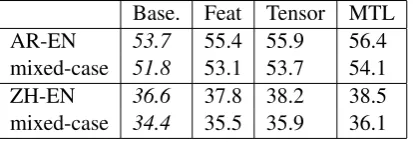
Table 4: Experimental results for the NIST condi-tion. Mixed-case scores are also reported. Base-lines are initalics.
BLEU point and on Chinese-English, we see a 1.9 BLEU point gain. We also report the mixed-cased BLEU scores for comparison with previous best published results, i.e. Devlin et al. (2014) report 52.8 BLEU for Arabic-English and 34.7 BLEU for Chinese-English. Thus, our results are around 1.3-1.4 BLEU point better. Note that they use addi-tional rescoring features but we do not.
6 Related Work
Our work is most closely related to Devlin et al. (2014). They use a simple feedforward neural network to model two important MT features: A joint language and translation model, and a lex-ical translation model. They show very large improvements on Arabic-English and Chinese-English web forum and newswire baselines. We improve on their work in 3 aspects. First, we model more features using neural networks, in-cluding two novel ones: a joint model with off-set source context and a translation context model. Second, we enhance the neural network architec-ture by using tensor layers, which allows us to model richer interactions. Lastly, we improve the performance of the individual features by training them using multitask learning. In the remainder of this section, we describe previous work relat-ing to the three aspect of our work, namely MT modeling, neural network architecture and model learning.
The features we propose in this paper address the major aspects of SMT modeling that have informed much of the research since the origi-nal IBM models (Brown et al., 1993): lexical translation, reordering, word fertility, and lan-guage models. Of particular relevance to our work are approaches that incorporate context-sensitivity into the models (Carpuat and Wu, 2007), formu-late reordering as orientation prediction task (Till-man, 2004) and that use neural network language models (Bengio et al., 2003; Schwenk, 2010; Schwenk, 2012), and incorporate source-side con-text into them (Devlin et al., 2014; Auli et al., 2013; Le et al., 2012; Schwenk, 2012).
Approaches to incorporating source context into a neural network model differ mainly in how they represent the source sentence and in how long is the history they keep. In terms of representa-tion of the source sentence, we follow (Devlin et al., 2014) in using a window around theaffiliated source word. To name some other approaches, Auli et al. (2013) uses latent semantic analysis and source sentence embeddings learned from the re-current neural network; Sundermeyer et al. (2014) take the representation from a bidirectional LSTM recurrent neural network; and Kalchbrenner and Blunsom (2013) employ a convolutional sentence model. For target context, recent work has tried to look beyond the classicaln-gram history. (Auli et al., 2013; Sundermeyer et al., 2014) consider an unbounded history, at the expense of making their model only applicable for N-best rescoring. Another recent line of research (Bahdanau et al., 2014; Sutskever et al., 2014) departs more rad-ically from conventional feature-based SMT and implements the MT system as a single neural net-work. These models use a representation of the whole input sentence.
[image:8.595.73.280.218.289.2]net-works, other network architectures that have been applied to SMT include convolutional networks (Kalchbrenner et al., 2014) and recursive networks (Socher et al., 2011). The simplicity of feedfor-ward networks works to our advantage. More specifically, due to the absence of a feedback loop, the feedforward architecture allows us to treat individual decisions independently, which makes parallelization of the training easy and the query-ing the network at decodquery-ing time straightforward. The use of tensors in the hidden layers strengthens the neural network model, allowing us to model more complex feature interactions like colloca-tion, which has been long recognized as impor-tant information for many NLP tasks (e.g. word sense disambiguation (Lee and Ng, 2002)). The tensor formulation we use is similar to that of (Yu et al., 2012; Hutchinson et al., 2013). Ten-sor Neural Networks have a wide application in other field, but have only been recently applied in NLP (Socher et al., 2013; Pei et al., 2014). To our knowledge, our work is the first to use tensor networks in SMT.
Our approach to multitask learning is related to work that is often labeled joint training or transfer learning. To name a few of these works, Finkel and Manning (2009) successfully train name en-tity recognizers and syntactic parsers jointly, and Singh et al. (2013) train models for coreference resolution, named entity recognition and relation extraction jointly. Both efforts are motivated by the minimization of cascading errors. Our work is most closely related to Collobert and Weston (2008; Collobert et al. (2011), who apply task learning to train neural networks for multi-ple NLP models: part-of-speech tagging, semantic role labeling, named-entity recognition and lan-guage model variations.
7 Conclusion
This paper argues that a relatively simple feedfor-ward neural network can still provides significant improvement to Statistical Machine Translation (SMT). We support this argument by presenting a multi-pronged approach that addresses modeling, architectural and learning aspects of pre-existing neural network-based SMT features. More con-cretely, we paper present a new set of neural network-based SMT features to capture important translation phenomena, extend feedforward neu-ral network with tensor layers, and apply
multi-task learning to integrate the SMT features more tightly. Empirically, all our proposals successfully produce an improvement over state-of-the-art ma-chine translation system for Arabic-to-English and Chinese-to-English and for both BOLT web fo-rum and NIST conditions. Building on the suc-cess of this paper, we plan to develop other neural-network-based features, and to also relax the lim-iteation of current rule extraction heuristics by generating translations word-by-word.
Acknowledgement
This work was supported by DARPA/I2O Contract No. HR0011-12-C-0014 under the BOLT Pro-gram. The views, opinions, and/or findings con-tained in this article are those of the author and should not be interpreted as representing the of-ficial views or policies, either expressed or im-plied, of the Defense Advanced Research Projects Agency or the Department of Defense.
References
Michael Auli, Michel Galley, Chris Quirk, and Geof-frey Zweig. 2013. Joint language and translation modeling with recurrent neural networks. In Pro-ceedings of the 2013 Conference on Empirical Meth-ods in Natural Language Processing, pages 1044– 1054, Seattle, Washington, USA, October. Associa-tion for ComputaAssocia-tional Linguistics.
Dzmitry Bahdanau, Kyunghyun Cho, and Yoshua Ben-gio. 2014. Neural machine translation by jointly learning to align and translate. Technical Report 1409.0473, arXiv.
Yoshua Bengio, R´ejean Ducharme, Pascal Vincent, and Christian Jauvin. 2003. A neural probabilistic lan-guage model. Journal of Machine Learning Re-search, 3:1137–1155.
Peter F. Brown, Vincent J. Della Pietra, Stephen A. Della Pietra, and Robert L. Mercer. 1993. The mathematics of statistical machine translation: Pa-rameter estimation. Comput. Linguist., 19(2):263– 311, June.
Marine Carpuat and Dekai Wu. 2007. Improving sta-tistical machine translation using word sense disam-biguation. In Proceedings of the 2007 Joint Con-ference on Empirical Methods in Natural Language Processing and Computational Natural Language Learning (EMNLP-CoNLL), pages 61–72, Prague, Czech Republic, June. Association for Computa-tional Linguistics.
David Chiang, Kevin Knight, and Wei Wang. 2009. 11,001 new features for statistical machine transla-tion. InHLT-NAACL, pages 218–226.
Ronan Collobert and Jason Weston. 2008. A unified architecture for natural language processing: Deep neural networks with multitask learning. In Pro-ceedings of the 25th International Conference on Machine Learning, ICML ’08, pages 160–167, New York, NY, USA. ACM.
Ronan Collobert, Jason Weston, L´eon Bottou, Michael Karlen, Koray Kavukcuoglu, and Pavel Kuksa. 2011. Natural language processing (almost) from scratch. J. Mach. Learn. Res., 12:2493–2537, November.
Jacob Devlin and Spyros Matsoukas. 2012. Trait-based hypothesis selection for machine translation. InProceedings of the 2012 Conference of the North American Chapter of the Association for Computa-tional Linguistics: Human Language Technologies, NAACL HLT ’12, pages 528–532, Stroudsburg, PA, USA. Association for Computational Linguistics. Jacob Devlin, Rabih Zbib, Zhongqiang Huang, Thomas
Lamar, Richard Schwartz, and John Makhoul. 2014. Fast and robust neural network joint models for sta-tistical machine translation. In Proceedings of the 52nd Annual Meeting of the Association for Compu-tational Linguistics (Volume 1: Long Papers), pages 1370–1380, Baltimore, Maryland, June. Association for Computational Linguistics.
Jacob Devlin. 2009. Lexical features for statistical machine translation. Master’s thesis, University of Maryland.
Jenny Rose Finkel and Christopher D. Manning. 2009. Joint parsing and named entity recognition. In Pro-ceedings of Human Language Technologies: The 2009 Annual Conference of the North American Chapter of the Association for Computational Lin-guistics, pages 326–334, Boulder, Colorado, June. Association for Computational Linguistics.
Nizar Habash, Ryan Roth, Owen Rambow, Ramy Es-kander, and Nadi Tomeh. 2013. Morphological analysis and disambiguation for dialectal arabic. In HLT-NAACL, pages 426–432.
Zhongqiang Huang, Jacob Devlin, and Rabih Zbib. 2013. Factored soft source syntactic constraints for hierarchical machine translation. InEMNLP, pages 556–566.
Brian Hutchinson, Li Deng, and Dong Yu. 2013. Ten-sor deep stacking networks. IEEE Trans. Pattern Anal. Mach. Intell., 35(8):1944–1957, August. Nal Kalchbrenner and Phil Blunsom. 2013. Recurrent
continuous translation models. In Proceedings of the 2013 Conference on Empirical Methods in Natu-ral Language Processing, pages 1700–1709, Seattle, Washington, USA, October. Association for Compu-tational Linguistics.
Nal Kalchbrenner, Edward Grefenstette, and Phil Blun-som. 2014. A convolutional neural network for modelling sentences. In Proceedings of the 52nd Annual Meeting of the Association for Computa-tional Linguistics (Volume 1: Long Papers), pages 655–665, Baltimore, Maryland, June. Association for Computational Linguistics.
Hai-Son Le, Alexandre Allauzen, and Franc¸ois Yvon. 2012. Continuous space translation models with neural networks. In Proceedings of the 2012 Con-ference of the North American Chapter of the Asso-ciation for Computational Linguistics: Human Lan-guage Technologies, NAACL HLT ’12, pages 39– 48, Stroudsburg, PA, USA. Association for Compu-tational Linguistics.
Yoong Keok Lee and Hwee Tou Ng. 2002. An em-pirical evaluation of knowledge sources and learn-ing algorithms for word sense disambiguation. In Proceedings of the ACL-02 Conference on Empiri-cal Methods in Natural Language Processing - Vol-ume 10, EMNLP ’02, pages 41–48, Stroudsburg, PA, USA. Association for Computational Linguis-tics.
Franz Josef Och and Hermann Ney. 2003. A sys-tematic comparison of various statistical alignment models. Computational Linguistics, 29(1):19–51.
Wenzhe Pei, Tao Ge, and Baobao Chang. 2014. Max-margin tensor neural network for chinese word seg-mentation. InProceedings of the 52nd Annual Meet-ing of the Association for Computational LMeet-inguis- Linguis-tics (Volume 1: Long Papers), pages 293–303, Bal-timore, Maryland, June. Association for Computa-tional Linguistics.
Antti Rosti, Bing Zhang, Spyros Matsoukas, and Rich Schwartz. 2010. BBN system descrip-tion for WMT10 system combinadescrip-tion task. In WMT/MetricsMATR, pages 321–326.
Holger Schwenk. 2010. Continuous-space language models for statistical machine translation. Prague Bull. Math. Linguistics, 93:137–146.
Holger Schwenk. 2012. Continuous space translation models for phrase-based statistical machine transla-tion. InCOLING (Posters), pages 1071–1080.
Hendra Setiawan, Bowen Zhou, Bing Xiang, and Li-bin Shen. 2013. Two-neighbor orientation model with cross-boundary global contexts. In Proceed-ings of the 51st Annual Meeting of the Association for Computational Linguistics (Volume 1: Long Pa-pers), pages 1264–1274, Sofia, Bulgaria, August. Association for Computational Linguistics.
Sameer Singh, Sebastian Riedel, Brian Martin, Jiap-ing Zheng, and Andrew McCallum. 2013. Joint inference of entities, relations, and coreference. In Proceedings of the 2013 Workshop on Automated Knowledge Base Construction, AKBC ’13, pages 1– 6, New York, NY, USA. ACM.
Matthew Snover, Bonnie Dorr, and Richard Schwartz. 2008. Language and translation model adaptation using comparable corpora. In Proceedings of the Conference on Empirical Methods in Natural Lan-guage Processing, EMNLP ’08, pages 857–866, Stroudsburg, PA, USA. Association for Computa-tional Linguistics.
Richard Socher, Cliff C. Lin, Andrew Y. Ng, and Christopher D. Manning. 2011. Parsing Natural Scenes and Natural Language with Recursive Neural Networks. InProceedings of the 26th International Conference on Machine Learning (ICML).
Richard Socher, Danqi Chen, Christopher D Manning, and Andrew Ng. 2013. Reasoning with neural ten-sor networks for knowledge base completion. In C.J.C. Burges, L. Bottou, M. Welling, Z. Ghahra-mani, and K.Q. Weinberger, editors, Advances in Neural Information Processing Systems 26, pages 926–934. Curran Associates, Inc.
Martin Sundermeyer, Tamer Alkhouli, Joern Wuebker, and Hermann Ney. 2014. Translation modeling with bidirectional recurrent neural networks. In Pro-ceedings of the 2014 Conference on Empirical Meth-ods in Natural Language Processing (EMNLP), pages 14–25, Doha, Qatar, October. Association for Computational Linguistics.
Ilya Sutskever, Oriol Vinyals, and Quoc V. V Le. 2014. Sequence to sequence learning with neural networks. In Z. Ghahramani, M. Welling, C. Cortes, N.D. Lawrence, and K.Q. Weinberger, editors, Ad-vances in Neural Information Processing Systems 27, pages 3104–3112. Curran Associates, Inc. Christoph Tillman. 2004. A unigram
orienta-tion model for statistical machine translaorienta-tion. In Daniel Marcu Susan Dumais and Salim Roukos, ed-itors,HLT-NAACL 2004: Short Papers, pages 101– 104, Boston, Massachusetts, USA, May 2 - May 7. Association for Computational Linguistics.