Munich Personal RePEc Archive
Getting a Yes. An Experiment on the
Power of Asking
Bruttel, Lisa and Stolley, Florian and Utikal, Verena
University of Potsdam, University of Erlangen-Nuremberg
2 July 2018
Getting a Yes. An Experiment on the Power of Asking
∗
Lisa Bruttel
†Florian Stolley
‡Verena Utikal
§July 2, 2018
Abstract
This paper studies how the request for a favor has to be devised in order to maximize its chance of success. We present results from a mini-dictator game in which giving entails an efficiency gain. In this laboratory experiment, the recipient can send a free-form text message to the dictator before the latter decides. We find that the content of a message does matter for the decision to give. Putting effort into the message and writing in a humorous way pays off. We argue that this can be interpreted in terms of reciprocity. Mentioning reasons why the money is needed increases the generosity of dictators as well. Additionally, we find differences in the behavior of male and female dictators. Only men react positively to efficiency arguments, while only women react to messages that emphasize the power and responsibility of the dictator.
Keywords: dictator game, communication, inequality, text analysis, experiment
JEL-Classification: C91, D63, D64, D83
∗We would like to thank James Andreoni, Bj¨orn Bartling, Eva Berger, Urs Fischbacher, Ulrich Kohler, Wieland M¨uller and Andreas Orland, as well as participants at the PCQR seminar 2016 in Potsdam, the EEA 2016 conference in Geneva, the BBE Workshop 2016 in Berlin, a faculty seminar 2017 in Mainz, the SPI 2017 conference in Chicago, the M-BEES 2018 symposium in Maastricht and the ESA World Meeting 2018 in Berlin for useful comments and suggestions.
†University of Potsdam, Department of Economics and Social Sciences, August-Bebel-Str. 89, 14482 Pots-dam, Germany ([email protected]).
‡Corresponding author. University of Potsdam, Department of Economics and Social Sciences, August-Bebel-Str. 89, 14482 Potsdam, Germany ([email protected]).
1
Introduction
There are numerous situations in which one person asks another one a favor. A person on the
street asking you for money, a roommate asking you to share your food with her, a charity
organization asking you for a donation or a stranger asking you to share your place on a bench
in a beer garden are just some examples of many. There are several aspects in which these
situations differ, such as whether the person asking you is familiar or unfamiliar, whether
she is more to your liking or less and whether she is the beneficiary of the favor or just an
intermediary (e.g. a charity organization). However, there is also an aspect which all of these
situations have in common and which seems to be at the heart of the decision whether to do
the favor: communication between the potential beneficiary and the potential benefactor.
In this paper, we are interested in the effect of communication on the decision to give
some-thing to someone else. While existing studies have shown that communication as such has a
positive effect on the giving decision (Andreoni and Rao, 2011; Mohlin and Johannesson, 2008;
Langenbach, 2016), they provide only very limited insights into the effects of the content of
written communication. This is the main focus of our study. We analyze which arguments of
the recipient convince the person being asked the favor. Additionally, we study other aspects
of written communication that systematically increase or decrease the chance of a successful
request. Finally, we are interested in potential gender differences in these effects since men
and women have been shown to react differently to the social conditions of an experiment in
general (Croson and Gneezy, 2009; Ellingsen et al., 2013; Kahn et al., 1971; Eagly, 1983) as
well as to personal solicitation in particular (Meer and Rosen, 2011).
Closely related to our research question is a study by Althoff et al. (2014), in which the
au-thors use data of requests for a free pizza in the online community Reddit. They analyze
the content of the request by employing topic modeling and automatic detection to extract
polite-ness, provision of evidence for the narrative, intention to reciprocate in the future, sentiment,
length, gratitude, status of the one requesting a favor as well as whether the requests refer
to narratives of money, job (loss), being a student, family or craving. Among other things,
they find that being perceived as needy through the narrative (little money, job loss, family
needs), signaling gratitude and the length of a request affect the success probability positively
whereas politeness, for example, has no effect.
By using a laboratory experiment to study our research question, we can analyze the effects
of differing content on the decision to do somebody a favor in a more controlled way. For
example, participants do not self-select to this specific experiment or to a specific role and
we provide participants with anonymity in order to prevent status effects. Furthermore, we
collect data on the potential beneficiary as well as the potential benefactor which provides us
with the possibility to study gender differences in the response to the content of a request.1
Finally, we use a different technique to analyze messages: several human subjects categorize
the messages independently, which has the advantage that we do not rely on lists of narrow
keywords to extract differences in the content.
Apart from providing advice for communication in interpersonal interactions, our research
may be useful for charitable organizations trying to convince potential donors to give. Our
findings might furthermore contribute to research on negotiations by analyzing which aspects
of communication can convince the other party to agree to a specific arrangement.
In order to study our research question, we conduct a laboratory experiment in which subjects
participate in a modified dictator game. Dictators make a binary decision to either give part
of their endowment to the receiver or to keep their endowment for themselves. Before making
their decision, dictators receive a free-form message written by the receiver. The decision to
give part of their endowment to the receiver results in a decrease in the payoff to the dictator
and an increase in the sum of payoffs to both players. This represents a welfare improvement
1
which is inherent in most real-life situations of doing somebody a favor or giving something
to someone since the party benefitting from the favor usually has a higher marginal utility for
the requested good.
We find clear evidence that the content of a message as well as its spelling and length
in-fluence the dictator’s decision to give. Messages showing that the author exerted effort by
writing a long note without spelling mistakes, exhibit higher chances of success. The same
holds for humorous messages. It seems that if the author of a message is “kind,” the dictator
will reciprocate this kindness by giving money. Additionally, informing potential givers as to
the reasons why the money is specifically needed is an effective way of increasing generosity.
Moreover, our results indicate that there are crucial differences in the responses of male and
female dictators. Arguing that giving increases the sum of the payoffs improves the chances of
a successful request only if the dictator is male. Women, on the other hand, react positively
to statements acknowledging their power and responsibility, which may create subtle social
pressure.
The rest of the paper is structured as follows. Next, the relevant literature is discussed.
Following, we present the design of our experiment and introduce our message categories in
Section 3. Section 4 presents the results of the experiment, which are subsequently discussed
in Section 5. Section 6 concludes.
2
Related Literature
Situations in which one party can act altruistically2
towards another party and in which there
is no strategic interaction between these two parties have been studied extensively using the
dictator game in the experimental economics literature (beginning with Kahneman et al.,
2
1986; Forsythe et al., 1994). In the original game, one party (the dictator) can decide how
to divide her endowment between herself and another party (the receiver). It has been found
that a significant fraction of people behave altruistically to some extent (see Engel, 2011, for a
review). Several explanations for this phenomenon have been mentioned in the literature over
the previous years, including social preferences such as inequity aversion (Fehr and Schmidt,
1999; Bolton and Ockenfels, 2000; Charness and Rabin, 2002), feelings of empathy towards
the other person (Batson et al., 1988; Batson, 2002; Andreoni and Rao, 2011; de Vignemont
and Singer, 2006; Edele et al., 2013), following social norms regarding fairness (Bolton et al.,
1998; Camerer and Thaler, 1995; Zhao et al., 2017) which, in turn, is closely related to guilt
aversion (Charness and Dufwenberg, 2006; Battigalli and Dufwenberg, 2007)3
and self-image
concerns (Dana et al., 2007; Tonin and Vlassopoulos, 2013; Ploner and Regner, 2013).
Even though communication plays an important role in a variety of social interactions,
includ-ing the decision to do someone a favor, surprisinclud-ingly few studies have implemented some sort
of communication into their experimental design. Allowing communication in an experiment
has the disadvantage that it reduces the level of control and that the analysis of the written
data is less straightforward than it would be with numerical data. This is particularly true
when free-form communication is used. Nevertheless, considering the great importance of
communication, it cannot be disregarded when studying social interactions.
Closest to our experiment is the study by Andreoni and Rao (2011), in which either only
the receiver, only the dictator, none of them, or both can write a free-form message. In the
treatment most relevant to our research question, in which only the receiver can communicate,
givings are significantly higher than without communication. The messages were categorized
by independent raters into the categories of Fairness, Friendly Greeting, Flattery,
Acknowl-edge Power and Need. While communication by itself (message + numerical request) has an
effect on generosity, the content of the communication does not seem to have an effect. In their
3
study, Andreoni and Rao hypothesize that the reason for this may be that the content is too
obvious (nearly half of the messages appealed to fairness norms). However, also the number of
observations is relatively small, since only 20 receivers were randomly matched to 20 dictators
for two rounds. Furthermore, the additional numerical request has a significant effect on the
dictator’s decision and, hence, may “crowd out” the content of the messages as is suggested by
Andreoni and Rao (2011). In our study, we focus on one-sided, free-form communication from
the receiver to the dictator without an additional numerical request and modify the design
in such a way that it has more power to find systematic differences in dictator’s behavior
resulting from differences in the content of the particular message. Primarily, this is done by
letting dictators make multiple binary giving decisions in response to a sequence of messages
sent by different receivers.
Mohlin and Johannesson (2008) compare the results of a dictator game in which the receiver
can either write a message to the dictator or not. They find that communication significantly
increases giving. Additionally, they use a treatment in which a third party sends a message
to the dictator to distinguish between a “content effect” and a “relationship effect.” Their
results indicate that both effects are important and increase givings by a similar magnitude.
Moreover, Mohlin and Johannesson try to analyze the content of the messages further by
clas-sifying the messages themselves into different categories. However, they do not find consistent
differences in giving behavior with respect to their categories, which could be due to too few
observations, as is mentioned by Mohlin and Johannesson, since only 55 dictators participated
in their relevant treatment making one decision each. In contrast, in our study 126 dictators
make multiple giving decisions leading to nearly 2,000 observations and messages are
catego-rized by independent raters.
Similar to one of the treatments by Andreoni and Rao (2011), Langenbach (2016) studies the
effect of a combination of a free-form message and a numerical request sent by the receiver
without communication. Differences between the numerical request and the messages as well
as differences in the content of the messages are not analyzed further in the paper.
Some studies have looked at the effect of communication in a dictator game without allowing
free-form communication. Charness and Rabin (2005) let receivers express their preference
about how they would like to be treated by either sending the message “Help me,” “Don’t help
me” or, in some cases, no message at all to dictators before they decide about the allocation
of funds in a series of binary dictator games. They find that more dictators chose the option
that benefitted the receiver when the receiver asked for help. Rankin (2006) allows receivers
to request a certain amount of money to be given to them by the dictator. When the request
is for at most half of the total amount to be divided, the request has a positive effect on the
generosity of the dictator compared to a treatment without a request-possibility. A request
for more than half, however, has a negative effect on the amount transferred by the dictators
to the receivers. This result has also been found by Andreoni and Rao (2011) and Yamamori
et al. (2007).
Letting receivers only choose from a set of pre-written messages or letting them only send a
numerical request, as it is done in these studies, increases the internal validity of the results
because analyzing the data is straightforward. However, at the same time, it decreases the
external validity, since such a reduced form of communication does not capture the richness
of communication in the real world. Because we are interested in exactly these differences
in the content of messages which may have an effect on the decision of dictators, free-form
communication is used in our study.
Andreoni et al. (2017) designed a field experiment resembling the lab experiment in Andreoni
and Rao (2011). In their study, solicitors for a fundraiser were positioned at one or both
entrances of a supermarket. The solicitors either asked passersby verbally (“please give”) or
merely stood there. Actively asking strongly increased the share of people donating as well
avoid the solicitor by using a different entrance or exit. The result that actively asking people
to donate increases givings has also been found by other authors using observational data
on charitable donations (Y¨or¨uk, 2009; Meer and Rosen, 2011). Related to this, Sanders and
Smith (2016) conducted a field experiment in which lawyers asked clients during the process
of drawing up a will if they wanted to leave a bequest for a charitable cause. The authors find
that highlighting a social norm of charitable giving and mentioning emotional factors strongly
increase the proportion of clients who decide to leave a bequest to charity. Furthermore,
several field experiments in the area of charitable giving have shown that suggesting specific
amounts to give has an effect on donation decisions (Edwards and List, 2014; Adena et al.,
2014; Adena and Huck, 2016).
Apart from the effect of communication on altruistic behavior in a dictator game,
commu-nication has been studied in the experimental literature in other experimental settings that
deal with social interactions. For instance, it has been shown that communication increases
cooperation in the public good game (see, for example, Isaac and Walker, 1988, or Bochet
et al., 2006).4
Besides communication, there are several factors that affect the decision to give in a dictator
game which have been studied in the experimental literature so far. Relevant to our study
are the following: decreasing the social distance between the dictator and the receiver leads to
more generous giving decisions (Bohnet and Frey, 1999; Small and Loewenstein, 2003; Goeree
et al., 2010; Hoffman et al., 1996).5
Subjects give more if the recipient is perceived as needy
(Eckel et al., 2007). Increasing the efficiency of a kind act, i.e. multiplying the money
trans-ferred from the dictator to the receiver by a factor larger than one, has a positive effect on
giving decisions (Engel, 2011). Also, the demographics of the dictators have an effect. For
in-4
Dal B´o and Dal B´o (2014) find that messages which appeal to moral norms and to the social benefit of a high contribution significantly increase contributions in a public good game. In their experiment, messages are not sent by other participants but by the experimenters themselves.
5
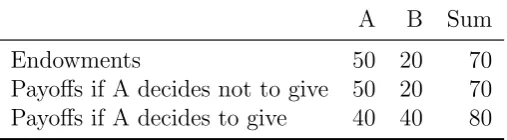
Table 1: Matrix of endowments and payoffs
A B Sum
Endowments 50 20 70
Payoffs if A decides not to give 50 20 70 Payoffs if A decides to give 40 40 80
stance, women tend to give more than men, while students tend to give less than non-students
(Ibid.).
3
Experimental Design and Procedures
In the experiment, we use a modified version of the dictator game. There are two types of
play-ers, player A (the dictator) and player B (the receiver). Prior to the start of the experiment,
subjects are randomly assigned their role, which they keep for the duration of the experiment.
At the beginning of each round, A receives an endowment of 50 points, whereas B receives an
endowment of 20 points. Player A makes the binary decision to either keep the endowments
unchanged or decrease her own points by 10 (to 40 points) while increasing player B’s points
by 20 (to 40 points). Thus, the decision to give points increases the sum of the points from
70 (50 + 20) to 80 (40 + 40). Table 1 illustrates the allocation of points to A and B depending
on A’s decision.
This simple game is played for multiple rounds. The number of rounds in a session is set
in such a way that every A interacts with every B exactly once (absolute stranger matching).
For example, if there are 32 subjects in a session, i.e. 16 A’s and 16 B’s, the game is played
for 16 rounds. In the end, one of the rounds is randomly drawn. This round determines the
payoff of the subjects in the experiment.
first round can be seen as a baseline decision. From round 2 on, A receives a written message
from the matched subject B before making her decision. B writes his message only once at
the beginning of the experiment. B knows that this message will be shown to each subject A,
except for the subject A with whom he is matched in the first round. Hence, subsequent to
the first round, each message is shown to exactly one randomly determined dictator in every
round which ensures that the order of the messages does not affect the results. The reason
for not letting B write a message every round is that we are interested in the performance of
one message encountered by multiple A’s, whereas we are not interested in learning effects of
B. Subjects are told in the instructions that there are no restrictions regarding the content of
the message except that they are not allowed to reveal their identity. The maximum length
of a message is limited to 300 characters.
Eight sessions were conducted at the Laboratory for Experimental Research of the University
of Erlangen-Nuremberg (LERN) in June 2016. In six of these sessions, 32 subjects took part,
and in the remaining two sessions, 30 subjects took part, which led to 252 subjects and 1,986
giving decisions in total. Subjects were students, and nearly 80.0% of these studied
manage-ment and economics. On average, subjects were 23.5 years old and 50.4% of them were male.
In each session, subjects were randomly assigned a seat. At the beginning, they read the
instructions6
and had to complete a short quiz to ensure that everyone understood the
exper-iment.7
While B’s were writing their messages, A’s made their decisions for the first round
without communication and were then asked whether they could remember a situation in the
real world that was similar to their task in the experiment.8
In the following rounds, A’s
decided whether or not to give while viewing the message of the matched B on-screen.9
6
An English translation of the originally German instructions can be found in the Appendix. 7
The control questions can be found in the Appendix. 8
The reason for this was to make the experimental situation less abstract by thinking about a similar situation from the real world. Most of the situational descriptions were about beggars asking for money or, more generally, about solidarity within a society, a family or another group of people (e.g. friends, roommates).
9
Following the experiment, subjects answered a questionnaire10
and received their payoff in
private. Points were converted to Euros at a rate of 5 Points = 1 Euro. Sessions lasted for
approximately 45 minutes and subjects earned on average 11.45 Euros, including a show-up
fee of 4 Euros. The experiment was computerized with z-Tree (Fischbacher, 2007) and the
recruitment process was conducted using ORSEE (Greiner, 2015).
To determine which aspects of the messages are particularly important for the giving decision
of the dictator, the free-form text messages were analyzed and sorted into eight categories
after the main experiment took place. Some of the categories are specific to the particular
design of the experiment, others are more general. We followed the same procedure as
An-dreoni and Rao (2011) and let students from the same subject pool as in the main experiment
decide whether a message belonged to one or multiple predetermined categories.11
An English
translation of the instructions for the rating session can be found in the Appendix.
The eight categories areFriendly Greeting,Sum of Points, Equity,Decency, Power / Respon-sibility,Humor,Need and Random Role. Messages sorted into the categoryFriendly Greeting
are characterized by a particularly friendly or polite greeting. The category Sum of Points
contains messages in which the receiver argues that giving points to him will result in an
increase in the sum of points, an efficiency gain or a welfare improvement. When the receiver
tells the dictator that giving points will lead to an equal allocation of points, the message is
part of the category Equity. When the receiver appeals to the dictator to behave fairly or
10
Part of the questionnaire was the Interpersonal Reactivity Index of Davis (1983), which consists of four subscales. The subscale “Empathic Concern”, which is later used in the regression analysis, consists of 7 items on a 5-point Likert scale.
11
decently, the message is sorted into the category Decency. Messages in which the receiver argues that the dictator has the sole decision power and / or the sole responsibility for both
payments are sorted into the categoryPower / Responsibility. A particularly humorous mes-sage is sorted into the categoryHumor. Messages sorted into the categoryNeed are those in which the receiver explains why he needs the money. Finally, when the receiver emphasizes in
his message that the role allocation was random, and that the dictator could also have been a
receiver or that the dictator should think about how she would like to be treated if she were a
receiver, the message is sorted into the category Random Role.12
Table A.1 in the Appendix
describes the eight categories in detail and gives one example message for each category.
4
Results
The following analysis uses 1,941 allocation decisions by subjects A - 1,815 with communication
and 126 without communication (from round 1) - and 123 messages written by subjects B.13
First, some descriptive statistics about dictators’ decisions are presented, then messages are
analyzed, followed by the main part, in which the effects of the content of the messages on
dictators’ decisions are analyzed using logistic regressions.
12
Regarding the categories used by Andreoni and Rao (2011), we adopted the categoriesFriendly Greeting
andNeed. However, in our study, a friendly greeting is defined as being more formal than it is in the study by Andreoni and Rao, in which it is defined as a “greeting usually used amongst friends.” The category “Fairness” used in their study is divided into two categories,Equity and Decency. What Andreoni and Rao called “Acknowledge Power” is calledPower / Responsibility in our study to emphasize that receivers did not only write about the power of the dictator but also about the dictator’s specific responsibility for both payoffs. There were hardly any messages using “Flattery.” Hence, this category was not used in our study.
13
4.1
Descriptive Statistics about the Giving Decision
Of all the 126 subjects A, 21 subjects (16.7%) always gave points to B, 24 subjects (19.0%)
never gave points to B and 81 subjects (64.3%) varied their decisions to give. In round 1,
which is the baseline decision without communication, subjects A decided to give points to
B in 31.0% of the cases, while in later rounds they gave in 47.7% of the cases.14
Across
all rounds, male A’s gave slightly more often than female A’s (50.6% compared to 42.7%).15
However, this difference between male and female dictators is not statistically significant when
comparing the average giving decision of men and women per session (Wilcoxon Signed Rank
Testp= 0.1953).
4.2
Message Analysis
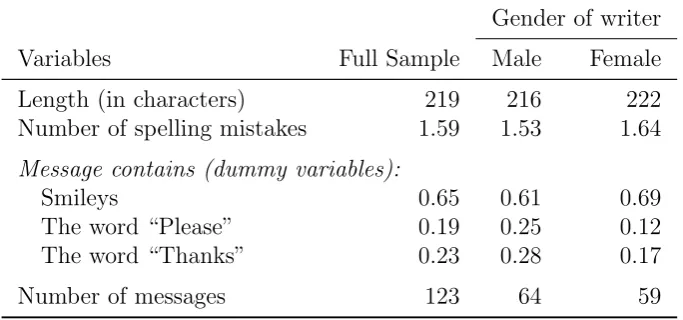
Table 2 shows characteristics of the 123 messages for the whole sample, as well as for male
and female B’s separately.
On average, messages were 219 characterslong and included 1.59spelling mistakes. 65% con-tained at least one smiley, 19% contained the word “please”16
and 23% contained the word
14
Since all subjects A in one session see the same messages, dictators’ decisions after round 2 are not statistically independent observations. Hence, testing for differences between dictators’ decisions without communication in round 1 and with communication after round 1 is merely possible at the session level, which leads to only 8 independent observations. Nevertheless, the difference between the average giving decision without and with communication is statistically significant (Wilcoxon Signed Rank Test p= 0.0078). Even though not the focus of this research, this finding confirms that communication as such has a positive effect on the decision to give. However, as this is only a within-subject treatment comparison, the result could potentially also arise due to an experimenter demand effect (Zizzo, 2010) or due to an order effect (Harrison et al., 2005) since the round without communication is always the first one.
15
In general, results from dictator games suggest that women behave more altruistically than men (Engel, 2011). In our setting, however, an altruistic act is relatively “cheap” or “efficient,” since giving points to the receiver costs only 2 Euros while increasing the receiver’s payoff by 4 Euros, which has been shown to increase the likelihood of altruistic acts more for male dictators than for female dictators (Andreoni and Vesterlund, 2001).
16
Table 2: Objective characteristics of messages
Gender of writer
Variables Full Sample Male Female Length (in characters) 219 216 222 Number of spelling mistakes 1.59 1.53 1.64
Message contains (dummy variables):
Smileys 0.65 0.61 0.69
The word “Please” 0.19 0.25 0.12 The word “Thanks” 0.23 0.28 0.17
Number of messages 123 64 59
Values in the table are averages for the full sample of mes-sages, as well as for messages written by only male or female B’s.
“thanks.”17
There are no significant gender differences in these objective message
characteris-tics except for the use of the word “please,” which is used more frequently by male receivers; this difference is only significant at a 10% significance level (χ2 Test p= 0.062).
As explained in detail in Section 3, the content of the messages was analyzed by letting 9
independent subjects decide for every message whether it belonged to none, one or multiple
predetermined categories.18
We decided to use the average rating and no binary
categoriza-tion in the following analysis since an average rating includes informacategoriza-tion about the level of
agreement between raters.19
17
For “thanks,” different versions of the word were included (“danke,” “dankesch¨on,” “thanks,” “thank you,” “merci”).
18
Each of the 123 messages was rated by 9 subjects leading to 1,107 rating decision. The decision that a message belonged to no category was made 46 times (4.2%), that it belonged to one category was made 208 times (18.8%), that it belonged to two categories was made 284 times (25.7%), that it belonged to three categories was made 253 times (22.9%), that it belonged to four categories was made 169 times (15.3%), that it belonged to five categories was made 107 times (9.7%) and the decision that it belonged to six, seven or eight categories was made 40 times combined (3.6%).
19
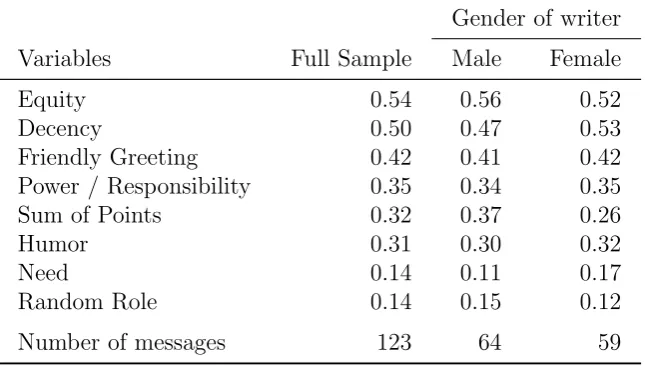
Table 3: Categories of messages resulting from the rating session
Gender of writer
Variables Full Sample Male Female
Equity 0.54 0.56 0.52
Decency 0.50 0.47 0.53
Friendly Greeting 0.42 0.41 0.42 Power / Responsibility 0.35 0.34 0.35
Sum of Points 0.32 0.37 0.26
Humor 0.31 0.30 0.32
Need 0.14 0.11 0.17
Random Role 0.14 0.15 0.12
Number of messages 123 64 59
Values in the table are averages for the full sample of messages, as well as for messages written by only male or female B’s.
Table 3 summarizes the results of the rating session. An average message has a rating of
0.54 in the category Equity, which is the most frequent category. Following this category in order of frequency are Decency, Friendly Greeting, Power and Responsibility, Sum of Points,
Humor,Need andRandom Role, which is mentioned the least often.20
Men appear to mention
the increase in the sum of points more often, while women tend to appeal to decent behavior and address their particularneed more often. However, these differences are not statistically significant.21
To sum up, there does not seem to be a considerable difference between the
content written by male and female receivers.
20
Table A.2 in the Appendix shows the cross-correlation of all the message characteristics and categories. The highest (positive) correlation is between the three categoriesEquity,Decency, andPower and Responsibility. A factor analysis did not yield any additional insights.
21
Wilcoxon Rank Sum Test for Sum of Points : z = −1.433, p = 0.1517; Wilcoxon Rank Sum Test for
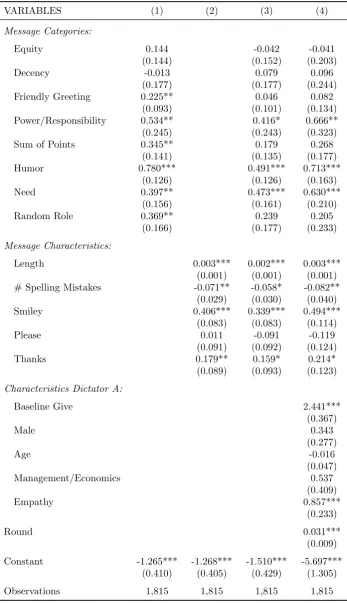
Table 4: Logit regression results for four models for the full sample
VARIABLES (1) (2) (3) (4)
Message Categories:
Equity 0.144 -0.042 -0.041
(0.144) (0.152) (0.203)
Decency -0.013 0.079 0.096
(0.177) (0.177) (0.244) Friendly Greeting 0.225** 0.046 0.082
(0.093) (0.101) (0.134) Power/Responsibility 0.534** 0.416* 0.666** (0.245) (0.243) (0.323) Sum of Points 0.345** 0.179 0.268
(0.141) (0.135) (0.177) Humor 0.780*** 0.491*** 0.713***
(0.126) (0.126) (0.163)
Need 0.397** 0.473*** 0.630***
(0.156) (0.161) (0.210) Random Role 0.369** 0.239 0.205
(0.166) (0.177) (0.233)
Message Characteristics:
Length 0.003*** 0.002*** 0.003*** (0.001) (0.001) (0.001) # Spelling Mistakes -0.071** -0.058* -0.082**
(0.029) (0.030) (0.040) Smiley 0.406*** 0.339*** 0.494***
(0.083) (0.083) (0.114)
Please 0.011 -0.091 -0.119
(0.091) (0.092) (0.124)
Thanks 0.179** 0.159* 0.214*
(0.089) (0.093) (0.123)
Characteristics Dictator A:
Baseline Give 2.441***
(0.367) Male 0.343 (0.277) Age -0.016 (0.047) Management/Economics 0.537 (0.409) Empathy 0.857*** (0.233) Round 0.031*** (0.009)
Constant -1.265*** -1.268*** -1.510*** -5.697*** (0.410) (0.405) (0.429) (1.305)
Observations 1,815 1,815 1,815 1,815
4.3
Regression Results
Table 4 shows the results of a logistic regression22
in which the dependent variable is give, a variable that takes the value of 1 if the dictator decided to give points to B and 0 otherwise.
The first model in column (1) includes only the category ratings of a message as explanatory
variables. The second model in column (2) includes only the objective characteristics of a
mes-sage as explanatory variables. The third model in column (3) includes the category ratings as
well as the objective characteristics of a message as explanatory variables. These models show
that the content as well as spelling and length of a message influence the decision to give.23
Including the objective characteristics of a message as explanatory variables in the third model
changes the coefficients for the category variables compared to the first model. Especially
con-trolling for the length of a message has an impact, since messages scoring high in the categories
Sum of Points, Equity, Random Role, Power / Responsibility and also to a lesser extent
-Decency and Friendly Greeting are on average relatively long messages, as can be seen from the cross-correlation Table A.2 in the Appendix. The length of a message, in turn, has a
positive impact on the probability of a successful request. Controlling for the use of smileys
in a message, which has a positive impact on the likelihood of giving, increases the coefficient
for Need since messages scoring high in this category include on average fewer smileys. On the other hand, messages in the category Humor use a lot of smileys and, hence, controlling for smileys decreases the estimated effect for such a message.
In the fourth model in column (4) of Table 4, characteristics of dictators A are included as
explanatory variables. The predicted effects of the explanatory variables regarding the
con-22
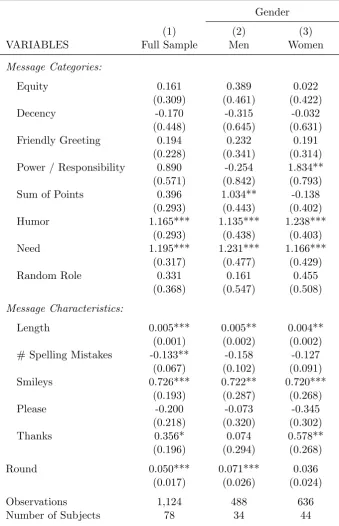
Using a Probit model or an OLS model does not yield essentially different results. Table A.4 in the Appendix shows regression results for a fixed effects model in which subjects A define the panel. The results are mostly robust to the model used here.
23
A Wald Test rejects the joint hypothesis that the category variables for the first model (Wald-statistic with 8 restrictions: χ2
= 56.84,p <0.0001) as well as the subjective category variables and objective characteristics variables for the third model (Wald-statistic with 13 restrictions: χ2
-.1
0
.1
.2
Ef
fect
s
on
Success
Probabilit
y
Equit
y
Decency Friendly Greet
ing
Power
/
Responsibilit
y
Sum
of
Point
s
Humor Need
Random
[image:19.595.122.471.93.351.2]Role
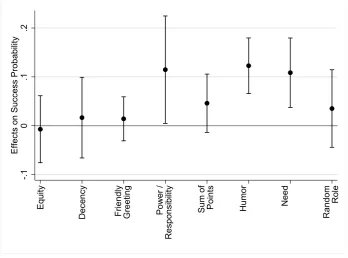
Figure 1: Average marginal effects for the full sample
Note: The figure shows point estimates as well as 95% confidence intervals.
tent as well as spelling and length of the messages change only slightly compared to the third
model. Unless otherwise stated, the fourth model is used in the following discussion of the
results. Additionally, Figure 1 displays the average marginal effects of all eight categories on
the probability of success to provide an idea of the magnitude of the effects.
The regression results show no statistically significant effect of the categoriesEquity,Decency
and Friendly Greeting. Messages that fall in the category Power and Responsibility, though, affect the decision to give positively and statistically significant. The model predicts that,
on average, a message with a rating of 124
in the category Power and Responsibility has a success probability that is around 11.5 percentage points higher than a message with a rating
of 0 in this category as can be seen in Figure 1. We find no statistically significant effect for
the categories Sum of Points and Random Role on the likelihood that the dictator will give points to the receiver. The estimated effects are positive but only statistically significant at
24
a 5% significance level when not controlling for the observable characteristics of a message
-in particular, the length of a message. The category Humor is estimated to have the largest positive impact on the success probability. The model predicts that, on average, a message
with a rating of 1 in this category has a success probability that is roughly 12 percentage
points higher than a message with a rating of 0 in this category. This effect is highly
signif-icant. Regarding the category Need, the regression results show that mentioning the specific need of the receiver results in a higher chance of the dictator giving points to the particular
receiver. The model predicts a statistically significant increase in the success likelihood by
nearly 11 percentage points for a message with a rating of 1 in the category Need, compared to a message with a 0 in this category.
As for the objective message characteristics, Table 4 shows that longer messages affect the
giving decision positively.25
The effect is also highly significant. Additionally,spelling mistakes
in a message are punished by the dictator by reducing her willingness to give (significant at the
5% level). A smiley has a positive and highly significant effect on the probability that a dic-tator gives points to the receiver. This effect is estimated to be around 8.5 percentage points.
Although every child is taught that the word “please” is mandatory or at least expected when asking someone a favor in a polite way, surprisingly, the model predicts that using “please” in a message does not improve the dictator’s willingness to act kindly. Eventually, messages
containing the word “thanks” seem to have a higher success chance. This effect, however, is only statistically significant at the 10% level (p= 0.083).
Considering the characteristics of the dictator, our data confirms that dictators who gave
points to the receiver in the baseline round without communication are clearly more inclined
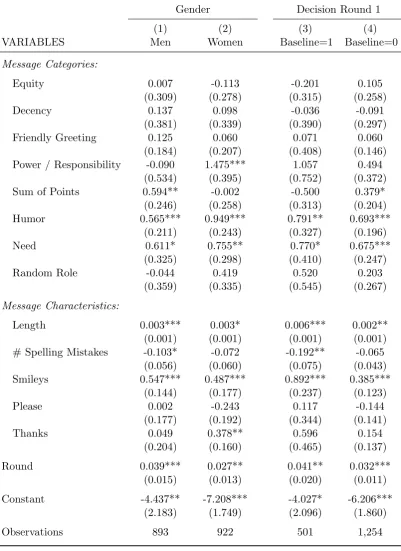
to give points in the later rounds when communication is present. Table A.3 in the Appendix
additionally displays regression results divided according to dictators who did or did not give
points to the receiver in the baseline round (columns (3) and (4)). It could be that dictators
25
who are less inclined to give and, hence, have to be actively convinced to give, and dictators
who are already inclined to give and, hence, have to be actively dissuaded from giving, react
differently to certain aspects of a message. However, the results show no substantial differences
in the behavior of dictators who either gave or did not give points in the baseline round.26
Male dictators and dictators who study management and economics seem to be more generous;
however, this is not statistically significant for the gender of the dictator and only significant
at a 10% level for the dictator’s field of study. Subjects scoring high on the subscale
“Em-pathic Concern” in the post-experimental questionnaire are more willing to give.27
Finally,
the willingness to give increases in later rounds.28
4.4
Different Behavior of Male and Female Dictators
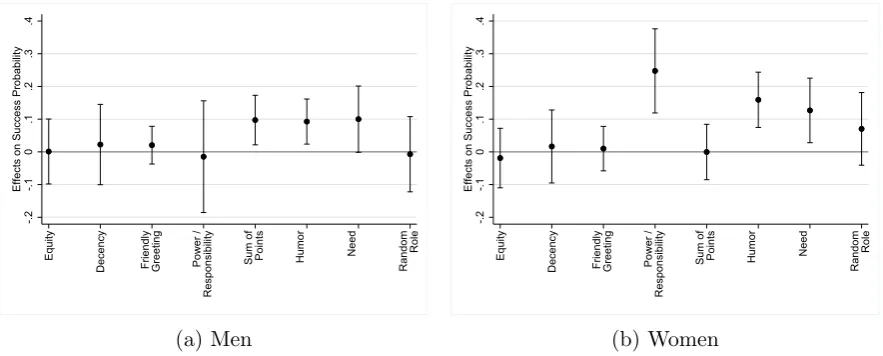
Regarding gender differences in the reaction to particular aspects of the message, Figure
2 displays the average marginal effects for the eight categories for male as well as female
dictators resulting from a logistic regression, which is shown in Table A.3 in the Appendix.
This regression uses the same model as before (fourth model in Table 4) and shows results
once only for male dictators in column (1) and once only for female dictators in column (2).
First of all, men and women seem to react differently to messages which emphasize thepower and responsibility relationship between the dictator and the receiver. The effect of such a message is estimated to be very close to 0 for male dictators (p= 0.865) while being positive,
very large and highly significant for female dictators (p < 0.001); for female dictators an
increase in the success probability of nearly 25 percentage points is predicted by the model if
a message has a rating of 1 in this category, compared to a rating of 0.
26
The results indicate some differences in the reaction to an argument concerning thesum of points, which is only successful when trying to convince a dictator who did not give points without communication.
27
The subscale has a scale reliability coefficient (Cronbach’sα) of 0.8126. 28
-.2 -.1 0 .1 .2 .3 .4 Ef fect s on Success Probabilit y Equit y
Decency Friendly Greet
ing Power / Responsibilit y Sum of Point s Humor Need Random Role (a) Men -.1 0 .1 .2 .3 .4 -.2 Ef fect s on Success Probabilit y Equit y
Decency Friendly Greet
[image:22.595.76.518.93.271.2]ing Power / Responsibilit y Sum of Point s Humor Need Random Role (b) Women
Figure 2: Average marginal effects for male and female dictators
Note: The figures show point estimates as well as 95% confidence intervals.
Furthermore, arguments concerning the efficiency of giving points to the receiver seem to yield
different reactions by men and women. For male dictators, the effect of the category Sum of Points on the success probability is positive, statistically significant (p= 0.016) and relatively
large; an increase of 9.7 percentage points is predicted by the model for a message that has
a rating of 1 in this category, compared to having a rating of 0 in that category. For female
dictators, though, the effect is close to 0.
Finally, men show no reaction to using the word “thanks” in a message (p = 0.811) whereas
it increases the success probability significantly for female dictators (p = 0.018). Hence,
the statistically significant effects of the category Power and Responsibility and of the word “thanks” on the willingness to give in the full sample are solely driven by female dictators.
5
Discussion
In the following we will discuss our results about the effect of message content on giving
de-cisions. We will briefly repeat our main results and link them with previous results from the
First of all, the content of the receiver’s request influences the dictator’s decision to give. This
result is additionally supported by statements from dictators in the post-experimental
ques-tionnaire, in which they were asked how they came to their decision. Ten out of 126 dictators
mentioned that they had planned to either never give points to the receiver or always give
points, but changed their minds after reading particularly “good” or “bad” messages.
Result 1: Messages including Humor affect the dictator’s decision to give positively. The
length of a message and using a smiley affect the success probability positively, while it is negatively affected byspelling mistakes.
It seems that dictators are more willing to give if the receiver puts effort into writing the
message (by writing a longer message without spelling mistakes) and if the message has the
potential to contribute to the dictator’s well-being (e.g. a message that is humorous or
con-tains a smiley). This finding can be interpreted in terms of reciprocity (Rabin, 1993): since the
receiver has done something for the dictator (putting effort into writing the message or
con-tributing to the dictator’s well-being), the dictator reciprocates and gives points to B. When
asked in the questionnaire about what influenced their decision, dictators most commonly
gave answers related to this line of argumentation. They said they were more inclined to give
when a message was nice and friendly so that the writer seemed more likeable (41 mentions),
when the message was creative (23 mentions), funny and humorous (21 mentions), thoughtful
and showed effort (12 mentions) or contained few mistakes (6 mentions).
Result 2: We do not find an effect of afriendly greeting or of using the word “please” on the willingness to give.
In the light of the above argumentation, it may be surprising that a friendly greeting has no
effect on the decision of a dictator. One likely reason is that norms concerning politeness in
electronic chats are different to standard norms in personal settings. Likewise, Althoff et al.
favor in an online community. One dictator wrote in the questionnaire that she does not like
a greeting that is too formal or polite. This could explain why a friendly greeting (and also
the use of the word “please”) has no effect.
Result 3: Messages including Need affect the dictator’s decision to give positively.
A message of “need” may serve as an “empathetic stimulus” (Andreoni et al., 2017) since
it makes a need salient and also heightens the attachment to the other person by letting the
dictator adopt the perspective of the receiver. It has been argued that both the “magnitude of
the perceived need” as well as the “strength of the attachment” to the other person increase
the empathetic concern for this person (Batson, 1991). The empathy-altruism hypothesis
(Batson, 1991; Andreoni and Rao, 2011; Andreoni et al., 2017) states that feelings of empathy
towards the person in need may be the main driving force for altruistic actions. Hence, it
seems that by increasing the empathic concern, such a message raises the probability of an
al-truistic act. Additionally, heightening the attachment to the receiver can also be thought of as
reducing the social distance between the receiver and the dictator (Mohlin and Johannesson,
2008) which would increase the generosity of the dictator (Bohnet and Frey, 1999; Small and
Loewenstein, 2003; Goeree et al., 2010; Hoffman et al., 1996). However, while explaining the
particular need has a positive effect on generosity, the specific wording seems to be important:
a message inducing pity or showing obvious signs of begging was mentioned most often in the
questionnaire as a reason for not giving points to a receiver (14 mentions).
Result 4: We do not find an effect of messages including Equity on the success probability.
Arguing that giving points to the receiver also equalizes payoffs of the two players has no
significant effect on the decision to give, neither for male nor for female dictators. This result
may be surprising since highlighting the aspect that giving points leads to equal payoffs could
make inequity averse (Fehr and Schmidt, 1999; Bolton and Ockenfels, 2000) dictators more
may not be possible to make it more salient by mentioning it in a message.
Result 5: Messages including Power and Responsibility as well as using the word “thanks” affect the willingness to give positively for female dictators.
The positive effect of emphasizing the power and responsibility relationship in a message as
well as using the word “thanks” is driven solely by female dictators. We believe that both
aspects of a message could lead to a subtle increase in the social pressure to behave
altru-istically without being strongly demanding. Highlighting the responsibility of the dictator
for the receiver is a rather clear way to remind the dictator that she is responsible for her
(potentially) selfish action and to think about the consequences for the other party, which has
been shown to increase giving in a dictator game (Bra˜nas-Garza, 2007). The word “thanks”
is mostly used in the end of a message (“thanks in advance”) and, hence, signals gratitude
but also an expectation that the dictator behaves kindly, which could also increase the social
pressure to give in a subtle way.
It has been shown that social pressure has a strong impact on generosity in the area of
charita-ble donations both in field experiments (DellaVigna et al., 2012; Andreoni et al., 2017) as well
as in field data (Bekkers and Wiepking, 2011; de Wit and Bekkers, 2016). Men and women
may initially feel a different level of social pressure to help the receiver. Psychological research
(Eagly, 2009; Babcock and Laschever, 2003) has shown that gender-specific stereotypes exist
and that these stereotypes work not only by describing how men and women usually behave
(descriptive), but also by claiming how men and women should behave (prescriptive). Hence,
such a gender-specific role or stereotype serves as a social norm and men as well as women are
expected to behave accordingly, thereby creating social pressure to do so (Eagly, 2009;
Bab-cock and Laschever, 2003; de Wit and Bekkers, 2016). Since women are assumed to be more
caring, friendly and “other-oriented” (Deaux and Major, 1987; Babcock and Laschever, 2003;
expected to be more generous and help the person in need. In a field experiment, DellaVigna
et al. (2013) show that women increase donations to a charitable cause significantly more than
men when put under pressure.29
Hence, a different reaction to a subtle increase in the social
pressure to act altruistically may be an explanation for why only women react to arguments
concerning the power and responsibility relationship as well as to using the word “thanks” in
a message.
Result 6: We do not find an effect of messages including Decency on the success probability.
Social pressure to give can also be exerted by messages that explicitly make fairness norms
more salient. Such rather demanding messages have no significant effect on dictators’
deci-sion and there are no gender difference in this case. In line with this result, several dictators
mentioned in the questionnaire that they did not like messages which were too demanding or
which told them explicitly how they should behave or what they should do (9 mentions). In
this laboratory setting, it is relatively easy to avoid such an explicit form of social pressure
since clicking twice is enough to let a message disappear. Hence, it is likely that the effect of
explicit and direct social pressure is different in settings in which avoidance is more difficult,
as it is the case in most real-life interactions (DellaVigna et al., 2013; Andreoni et al., 2017;
DellaVigna et al., 2012).
Result 7: Messages including Sum of Points affect the dictator’s decision to give positively for male dictators
Our results indicate a clear gender difference when the dictator is faced with an argument
mentioning the increase in total points when giving. Men react positively to such an
argu-ment, while women show no reaction. This finding corresponds to results by Andreoni and
Vesterlund (2001), in which the authors vary the budget and the relative price of altruism in a
29
dictator game and find that men react more strongly to the efficiency of a donation, i.e. they
behave more altruistically than women when altruism is relatively “cheap” and less
altruisti-cally than women when altruism is relatively “expensive.” This gender difference with respect
to the relative price of a donation has also been found in field data on charitable donations
(Andreoni et al., 2003). A message arguing that giving points to the receiver increases the
total sum of points may make this aspect more salient and, thereby, triggers a positive reaction
by male dictators.
Due to the fact that our subject pool mainly consists of management and economics students,
it could very well be that the effect of the efficiency argument is stronger in this case than
it would be in a sample which is more representative of the general population (Engelmann
and Strobel, 2006; Fehr et al., 2006).30
However, since the proportion of management and
economics students is similarly high for male and female A’s (78 % of the female A’s and 82
% of the male A’s study management and economics), the different reactions to the efficiency
argument cannot be explained by our particular subject pool.
6
Conclusion
In this study, we implemented free-form written communication in a modified dictator game
and analyzed its effect on the dictators’ decision to give. The content of a message has a clear
effect on the dictator’s decision. Humorous and friendly messages, as well as messages showing
that the author exerted effort, lead to reciprocal behavior by the dictator, i.e. if people feel
like they get something in return for their generosity - and it may be just a smile(y) - they
are willing to help. Mentioning the receiver’s specific need also increases generosity, which
emphasizes the importance of empathetic feelings towards the person in need for altruistic
30
behavior. Only men react positively to an efficiency argument, whereas creating subtle social
pressure increases giving only if the dictator is female.
Our research supports the results of Andreoni and Rao (2011), Mohlin and Johannesson (2008)
and Langenbach (2016) that communication has a positive effect on dictators’ willingness to
act kindly. Furthermore and most importantly, we fill the gap in analyzing systematic
reac-tions of dictators in response to certain aspects of written communication, which, to the best
of our knowledge, has not been done before in this level of detail. Additionally, our research
contributes to the current research on gender differences in the area of altruism (Andreoni
and Vesterlund, 2001; DellaVigna et al., 2013; Croson and Gneezy, 2009; de Wit and Bekkers,
2016).
Primarily, our results are relevant for numerous everyday life situations in which one party
asks another one a favor. Additionally, such diverse fields as charity work, negotiations and
marketing might benefit from our findings, even though, especially the latter two differ
con-siderably from our setting. Nevertheless, since negotiating is about convincing the other party
with specific arguments to agree to something and marketing is likewise to a large extent
about convincing somebody (i.e. a customer) to do something (i.e. to buy the product), some
of our findings may be transferable to these fields.
Especially for charity work, it is important to distinguish between content- and
relationship-effects when using our results, since the person who asks a favor is not the person who benefits
from the favor in that case. It is very likely that relationship-specific effects are mitigated if
an intermediary tries to convince a potential benefactor and not the potential beneficiary of
the favor herself. Future research may study the effect of communication in a setting in which
References
Adena, Maja and Steffen Huck (2016) “A field experiment on crowdfunding for a club good,” Discussion Paper (SP II 2016-308), Wissenschaftszentrum Berlin f¨ur Sozialforschung.
Adena, Maja, Steffen Huck, and Imran Rasul (2014) “Charitable Giving and Nonbinding Contribution-Level Suggestions — Evidence from a Field Experiment,”Review of Behavioral Economics, 1 (3), pp. 275–293.
Althoff, Tim, Cristian Danescu-Niculescu-Mizil, and Dan Jurafsky (2014) “How to Ask for a Favor: A Case Study on the Success of Altruistic Requests,” Proceedings of the Eighth International AAAI Conference on Weblogs and Social Media, Association for the Ad-vancement of Artificial Intelligence, URL: http://www.aaai.org/ocs/index.php/ICWSM/
ICWSM14/paper/download/8106/8101, accessed on April 10, 2018.
Andreoni, James, Eleanor Brown, and Isaac Rischall (2003) “Charitable Giving by Married Couples: Who Decides and Why Does it Matter?” Journal of Human Resources, 38 (1), pp. 111–133.
Andreoni, James and Justin M. Rao (2011) “The power of asking: How communication affects selfishness, empathy, and altruism,” Journal of Public Economics, 95 (7–8), pp. 513–520. Andreoni, James, Justin M. Rao, and Hannah Trachtman (2017) “Avoiding The Ask: A Field
Experiment on Altruism, Empathy, and Charitable Giving,” Journal of Political Economy, 125 (3), pp. 625–653.
Andreoni, James and Lise Vesterlund (2001) “Which is the Fair Sex? Gender Differences in Altruism,” Quarterly Journal of Economics, 116 (1), pp. 293–312.
Babcock, Linda and Sara Laschever (2003) Women don’t ask: Negotiation and the gender divide: Princeton University Press, Princeton, NJ.
Batson, C. Daniel (1991) The Altruism Question: Toward a Social-Psychological Answer: Lawrence Erlbaum Associates, Hillsdale, NJ.
(2002) “Addressing the altruism question experimentally,” in Altruism & altruistic love: Science, philosophy, & religion in dialogue eds. by Stephen G. Post, Lynn G. Under-wood, Jeffrey P. Schloss, and William B. Hurlbut: Oxford University Press, New York, NY, pp. 89–105.
Batson, C. Daniel, Janine L. Dyck, J. Randall Brandt, Judy G. Batson, Anne L. Powell, M. Rosalie McMaster, and Cari Griffitt (1988) “Five studies testing two new egoistic alter-natives to the empathy-altruism hypothesis,” Journal of Personality and Social Psychology, 55 (1), pp. 52–77.
Bekkers, Ren´e and Pamala Wiepking (2011) “A Literature Review of Empirical Studies of Philanthropy: Eight Mechanisms That Drive Charitable Giving,” Nonprofit and Voluntary Sector Quarterly, 40 (5), pp. 924–973.
Bochet, Olivier, Talbot Page, and Louis Putterman (2006) “Communication and punishment in voluntary contribution experiments,” Journal of Economic Behavior & Organization, 60 (1), pp. 11–26.
Bohnet, Iris and Bruno S. Frey (1999) “The sound of silence in prisoner’s dilemma and dictator games,” Journal of Economic Behavior & Organization, 38 (1), pp. 43–57.
Bolton, E. Gary, Elena Katok, and Rami Zwick (1998) “Dictator game giving: Rules of fairness versus acts of kindness,” International Journal of Game Theory, 27 (2), pp. 269–299.
Bolton, Gary E. and Axel Ockenfels (2000) “ERC: A Theory of Equity, Reciprocity, and Competition,” The American Economic Review, 90 (1), pp. 166–193.
Bra˜nas-Garza, Pablo (2007) “Promoting helping behavior with framing in dictator games,”
Journal of Economic Psychology, 28 (4), pp. 477–486.
Camerer, Colin and Richard H. Thaler (1995) “Anomalies: Ultimatums, Dictators and Man-ners,” Journal of Economic Perspectives, 9 (2), pp. 209–219.
Charness, Gary and Martin Dufwenberg (2006) “Promises and Partnership,” Econometrica, 74 (6), pp. 1579–1601.
Charness, Gary and Matthew Rabin (2002) “Understanding Social Preferences with Simple Tests,” Quarterly Journal of Economics, 117 (3), pp. 817–869.
(2005) “Expressed preferences and behavior in experimental games,”Games and Eco-nomic Behavior, 53 (2), pp. 151–169.
Croson, Rachel and Uri Gneezy (2009) “Gender Differences in Preferences,” Journal of Eco-nomic Literature, 47 (2), pp. 448–474.
Dal B´o, Ernesto and Pedro Dal B´o (2014) “‘Do the right thing:’ The effects of moral suasion on cooperation,” Journal of Public Economics, 117, pp. 28–38.
Dana, Jason, Roberto A. Weber, and Jason Xi Kuang (2007) “Exploiting moral wiggle room: experiments demonstrating an illusory preference for fairness,” Economic Theory, 33 (1), pp. 67–80.
Davis, Mark H. (1983) “Measuring individual differences in empathy: Evidence for a multidi-mensional approach,” Journal of Personality and Social Psychology, 44 (1), pp. 113–126. Deaux, Kay and Brenda Major (1987) “Putting gender into context: An interactive model of
DellaVigna, Stefano, John A. List, and Ulrike Malmendier (2012) “Testing for Altruism and Social Pressure in Charitable Giving,” Quarterly Journal of Economics, 127 (1), pp. 1–56. DellaVigna, Stefano, John A List, Ulrike Malmendier, and Gautam Rao (2013) “The
impor-tance of being marginal: Gender differences in generosity,”The American Economic Review: Papers and Proceedings, 103 (3), pp. 586–590.
Dufwenberg, Martin and Astri Muren (2006) “Generosity, anonymity, gender,” Journal of Economic Behavior & Organization, 61 (1), pp. 42–49.
Eagly, Alice H. (1983) “Gender and social influence: A social psychological analysis,” Ameri-can Psychologist, 38 (9), pp. 971–981.
(2009) “The His and Hers of Prosocial Behavior: An Examination of the Social Psychology of Gender,” American Psychologist, 64 (8), pp. 644–658.
Eckel, Catherine, Philip J. Grossman, and Angela Milano (2007) “Is More Information Always Better? An Experimental Study of Charitable Giving and Hurricane Katrina,” Southern Economic Journal, 74 (2), pp. 388–411.
Edele, Aileen, Isabel Dziobek, and Monika Keller (2013) “Explaining altruistic sharing in the dictator game: The role of affective empathy, cognitive empathy, and justice sensitivity,”
Learning and Individual Differences, 24, pp. 96–102.
Edwards, James T. and John A. List (2014) “Toward an understanding of why suggestions work in charitable fundraising: Theory and evidence from a natural field experiment,”
Journal of Public Economics, 114, pp. 1–13.
Ellingsen, Tore, Magnus Johannesson, Johanna Mollerstrom, and Sara Munkhammar (2013) “Gender differences in social framing effects,” Economics Letters, 118 (3), pp. 470–472.
Ellingsen, Tore, Magnus Johannesson, Sigve Tjøtta, and Gaute Torsvik (2010) “Testing guilt aversion,” Games and Economic Behavior, 68 (1), pp. 95–107.
Engel, Christoph (2011) “Dictator games: a meta study,” Experimental Economics, 14 (4), pp. 583–610.
Engelmann, Dirk and Martin Strobel (2006) “Inequality Aversion, Efficiency, and Maximin Preferences in Simple Distribution Experiments: Reply,” The American Economic Review, 96 (5), pp. 1918–1923.
Fehr, Ernst and Urs Fischbacher (2003) “The nature of human altruism,” Nature, 425, pp. 785–791.
Fehr, Ernst and Klaus M. Schmidt (1999) “A Theory of Fairness, Competition, and Cooper-ation,” Quarterly Journal of Economics, 114 (3), pp. 817–868.
Fischbacher, Urs (2007) “z-Tree: Zurich toolbox for ready-made economic experiments,” Ex-perimental Economics, 10 (2), pp. 171–178.
Forsythe, Robert, Joel L. Horowitz, N. E. Savin, and Martin Sefton (1994) “Fairness in Simple Bargaining Experiments,” Games and Economic Behavior, 6 (3), pp. 347–369.
Goeree, Jacob K., Margaret A. McConnell, Tiffany Mitchell, Tracey Tromp, and Leeat Yariv (2010) “The 1/d Law of Giving,” American Economic Journal: Microeconomics, 2 (1), pp. 183–203.
Greiner, Ben (2015) “Subject pool recruitment procedures: organizing experiments with ORSEE,” Journal of the Economic Science Association, 1 (1), pp. 114–125.
Harrison, Glenn W., Eric Johnson, Melayne M. McInnes, and E. Elisabet Rutstr¨om (2005) “Risk Aversion and Incentive Effects: Comment,” The American Economic Review, 95 (3), pp. 897–901.
Hoffman, Elizabeth, Kevin McCabe, and Vernon L. Smith (1996) “Social Distance and Other-Regarding Behavior in Dictator Games,” The American Economic Review, 86 (3), pp. 653– 660.
Isaac, R. Mark and James M. Walker (1988) “Communication and Free-Riding Behavior: The Voluntary Contribution Mechanism,” Economic Inquiry, 26 (4), pp. 585–608.
Kahn, Arnold, Joe Hottes, and William L. Davis (1971) “Cooperation and optimal responding in the Prisoner’s Dilemma game: Effects of sex and physical attractiveness.,” Journal of Personality and Social Psychology, 17 (3), pp. 267 – 279.
Kahneman, Daniel, Jack L. Knetsch, and Richard H. Thaler (1986) “Fairness and the As-sumptions of Economics,” The Journal of Business, 59 (4), pp. S285–S300.
Langenbach, Pascal (2016) “The values of ex-ante and ex-post communication in dictator games,” Preprints, Max Planck Institute for Research on Collective Goods, URL: http:
//hdl.handle.net/11858/00-001M-0000-002A-3379-7, accessed on May 09, 2017.
Meer, Jonathan and Harvey S. Rosen (2011) “The ABCs of charitable solicitation,”Charitable Giving and Fundraising Special Issue, 95 (5–6), pp. 363–371.
Mohlin, Erik and Magnus Johannesson (2008) “Communication: Content or relationship?”
Journal of Economic Behavior & Organization, 65 (3–4), pp. 409–419.
Rabin, Matthew (1993) “Incorporating Fairness into Game Theory and Economics,” The American Economic Review, 83 (5), pp. 1281–1302.
Rankin, Frederick W. (2006) “Requests and social distance in dictator games,” Journal of Economic Behavior & Organization, 60 (1), pp. 27–36.
Sanders, Michael and Sarah Smith (2016) “Can simple prompts increase bequest giving? Field evidence from a legal call centre,” Journal of Economic Behavior & Organization, 125, pp. 179–191.
Small, Deborah A. and George Loewenstein (2003) “Helping a Victim or Helping the Victim: Altruism and Identifiability,” Journal of Risk and Uncertainty, 26 (1), pp. 5–16.
Tonin, Mirco and Michael Vlassopoulos (2013) “Experimental evidence of self-image concerns as motivation for giving,” Journal of Economic Behavior & Organization, 90, pp. 19–27.
de Vignemont, Frederique and Tania Singer (2006) “The empathic brain: how, when and why?” Trends in Cognitive Sciences, 10 (10), pp. 435–441.
de Wit, Arjen and Ren´e Bekkers (2016) “Exploring Gender Differences in Charitable Giving: The Dutch Case,” Nonprofit and Voluntary Sector Quarterly, 45 (4), pp. 741–761.
Yamamori, Tetsuo, Kazuhiko Kato, Toshiji Kawagoe, and Akihiko Matsui (2007) “Voice mat-ters in a dictator game,” Experimental Economics, 11 (4), pp. 336–343.
Y¨or¨uk, Barı¸s K. (2009) “How responsive are charitable donors to requests to give?” Journal of Public Economics, 93 (9–10), pp. 1111–1117.
Zhao, Kun, Eamonn Ferguson, and Luke D. Smillie (2017) “Individual Differences in Good Manners Rather Than Compassion Predict Fair Allocations of Wealth in the Dictator Game,” Journal of Personality, 85 (2), pp. 244–256.
Zizzo, Daniel John (2010) “Experimenter demand effects in economic experiments,” Experi-mental Economics, 13 (1), pp. 75–98.
A
Appendix
Table A.1: Message categories
Category Description Example Message (translated from German)
Equity Changing the score of
points leads to an equal distribution of points.
“...and accomplish identical payments for both of us. Please reduce your endowment by 10 points, so that 20 points are added to my endowment and that there is equity in payments. ...”
Decency Appealing to A to behave
fair and decent
“Please be fair and distribute justly,... . Please do not be selfish and inconsiderate, since you would harm me that way and leave with a bad conscience in the end.”
Friendly Greeting
Friendly or polite address “Hello dear participant A, ...”
Power/ Re-sponsibility
A has the sole decision power but also the sole responsibility for both payments.
“I cannot overrule your decision and maybe not even influence it. ... THE CHOICE IS YOURS :)”
Sum of Points
B argues with an efficiency gain, i.e. an increase in the sum of points.
“... Please share your points with me! That way, the overall welfare will increase. You will receive a little less, in return I get a little more. In total, this would put the two of us in a better position. ...”
Humor The message is
particularly humorous
“Two economists are on a quest for personal happiness (i.e. the maximum utility). Let us do it: Let’s increase the overall welfare! In favor of shifting the aggregated budget line, towards higher indifference curves, until we reach the heaven of the best possible Nash equilibrium.”
Need B explains why he needs
the points / money
“Hi. On the weekend, I would like to visit my girlfriend. In order to do this, I need some money to buy a bus ticket. So please be a bit fair and share your points with me. Do it for the sake of Love. :)”
Random Role
B mentions the random allocation of roles and / or how A would feel being a B.
Table A.2: Cross-correlation table of message characteristics
Variables Eq D FG P/R SoP H N RR L SM S Pl T
Equity (Eq) 1.000
Decency (D) 0.604 1.000
Friendly Greeting (FG) -0.006 0.090 1.000
Power / Responsibility (P/R) 0.580 0.572 0.105 1.000
Sum of Points (SoP) 0.366 0.225 -0.076 0.408 1.000
Humor (H) -0.322 -0.318 -0.013 -0.360 -0.235 1.000
Need (N) -0.069 -0.024 0.056 -0.058 -0.151 0.149 1.000 Random Role (RR) 0.244 0.275 0.195 0.316 0.103 -0.048 -0.090 1.000
Length (L) 0.371 0.259 0.186 0.338 0.422 0.090 0.017 0.340 1.000
# Spelling Mistakes (SM) 0.063 -0.043 -0.032 -0.105 -0.029 0.031 0.037 0.179 0.121 1.000
Smileys (S) 0.014 -0.120 0.077 -0.097 -0.117 0.224 -0.083 0.039 -0.068 0.332 1.000 Please (Pl) 0.153 0.282 0.044 0.160 0.045 -0.114 0.189 0.008 -0.057 -0.054 -0.173 1.000 Thanks (T) 0.038 -0.040 0.179 -0.005 0.066 -0.007 0.062 0.034 0.033 0.139 -0.009 0.187 1.000