J. Range Manage.
57:511 -516 September 2004
Soil texture and tree coverage influence on organic matter
D.E. BUSCHIAZZO, H.D. ESTELRICH, S.B. AIMAR, E. VIGLIZZO, AND F.J. BABINEC
Authors are Soil Scientist, Anguil Exp. Station, INTA, cc 11, 6326 Anguil, Argentina; Ecologist, Facultad de Agronomía, UNLPam, cc 300, 6300 Santa Rosa, Argentina; Soil Scientist, Facultad de Agronomía, UNLPam, cc 300, 6300 Santa Rosa, Argentina; Ecologist, Anguil Exp. Station, INTA, cc 11, 6326 Anguil, Argentina, and Statistician, Anguil Exp. Station, INTA, cc 11, 6326 Anguil, Argentina. Corresponding author is D.E. Buschiazzo.
Abstract
Soil organic matter (OM) is an important factor for maintain- ing the productivity and the stability of the so- called Caldenal woodland ecosystem of central Argentina. Little is known about the influence of tree coverage and soil texture on OM accumula- tion in soils of the study region. The relationships between OM content, silt + clay content, and the percent of tree coverage were studied in a 25 x 25 m grid in 2 sites. Results showed that OM
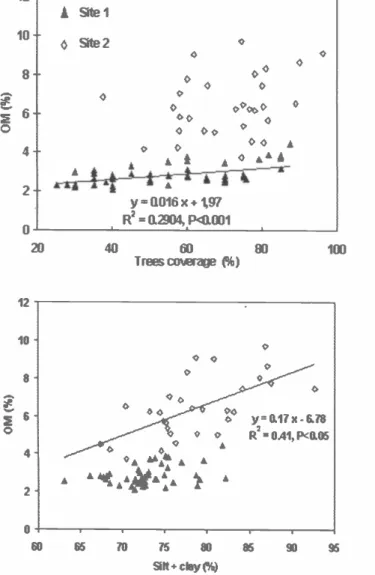
was lower (P < 0.05) at Site I (2.86 %) than at Site II (6.41 %). The OM was positively correlated with the percent of tree coverage in Site I (OM = 0.0156 trees cover + 1.97, R2 = 0.29, P < 0.001), but not in Site II. Conversely, a positive correlation with silt + clay
was observed in Site II (OM = 0.17 silt + clay 6.79, R2 = 0.41, P
< 0.05) but not in Site I. A multiple regression analysis [OM = - 16.64 + 0.71 (silt + clay) + 0.04 (tree coverage), n = 78, R2 = 0.55, P < 0.001] tended to confirm these results. Although they differed in their relative weight both silt + clay and tree coverage affect OM accumulation at both sites. The larger influence of trees on OM variability at Site I was attributed to the lower, but highly variable, tree coverage, and the stronger influence of silt + clay on OM variability at Site II can be attributed to the lower vari- ability of tree coverage, and the higher variability of soil texture.
According to our results, (a) 41% of OM variability is
explained by silt + clay content when tree coverage is dense and uniform, and (b) a 29% of OM variability is explained by tree coverage when such coverage is sparse and heterogeneous. The influence of tree canopy on OM distribution could be explained by its effect on the temperature regime. The influence of soil tex- ture on OM could be attributed to its effect on the water reten- tion capacity of soils. While forest clearing increases the maxi- mum temperature and the temperature amplitude of soils, ero- sion in cleared areas affects soil texture, and consequently, its water retention capacity. The deterioration of both temperature and soil water regimes deteriorates, in turn, the capacity of the soil to accumulate OM.
Key Words: soil organic matter, grasslands
Soil organic matter (OM) is an important factor for improving the stability of semiarid environments, since it improves the soil resistance against wind and water erosion (Lal and Stewart 1990), the soil water holding capacity, and the nutrient availability for
This study was financed by Consejo Nacional de Investigaciones Científicas y Técnicas (CONICET) (PID 1993- 1996), Anguil Exp. Station, INTA, and the Facultad de Agronomía, UNLPam, Argentina. Authors wish to thanks to Monica Mazzola and Edgardo Adema for field work.
Manuscript accepted 9 Feb. 2004.
Resumen
La materia orgánica (OM) es un factor importante para man- tener la productividad y la estabilidad del ecosistema del bosque del Caldenal de la región central de Argentina. Poco se conoce acerca del efecto de la cobertura arbórea y la textura del suelo sobre la acumulación de OM en esta región. Las relaciones entre contenidos de OM, limo más arcilla y el porcentaje de cobertura arbórea se estudió en cuadrículas de 25 x 25 m en dos sitios del Caldenal. Los resultados mostraron que OM fue menor (P <
0.05) en el Sitio I (2.86 %) que en el Sitio II (6.41 %). Los con- tenidos de OM se correlacionaron positivamente con el porcenta- je de cobertura arbórea en el Sitio I (OM = 0.0156 cobertura arbórea + 1.97, R2 = 0.29, P < 0.001), pero no en el Sitio II.
Inversamente, se observó una correlación positiva con limo + arcilla en el Sitio II (OM = 0.17 limo + arcilla 6.79, R2 = 0.41, P
< 0.05) pero no en el Sitio I. Un análisis de regresión múltiple [OM = 16.64 + 0.71 (limo + arcilla) + 0.04 (cobertura arbórea), n = 78, R2 = 0.55, P < estos resultados y demostró que las variables cobertura arbórea y limo + arcilla afectaron la acumulación de OM en ambos sitios pero con difer- ente peso relativo en cada uno. La mayor influencia de la cober- tura arbórea en el Sitio I se atribuyó a la menor y más variable cobertura por parte de los árboles; mientras que la mayor influ- encia de limo + arcilla sobre OM en el Sitio II puede ser atribui- do a la menor variabilidad de la cobertura arbórea y a la mayor variabilidad de la textura del suelo.
De acuerdo a nuestros resultados se puede concluir que (a) 41%
de la variabilidad de OM es explicada por limo + arcilla cuando la cobertura arbórea es densa y uniforme, y (b) un 29% de la vari- abilidad de la OM es explicada por la cobertura arbórea cuando la misma es escasa y heterogénea. La influencia de la canopia arbórea sobre la distribución de OM puede ser explicada por su efecto sobre el régimen de temperatura. La influencia que la textu- ra posee sobre lu distribución de 0M se debería a su efecto sobre la capacidad de retención de agua del suelo.
Mientras que la tala del bosque incrementaría las temperat- uras máximas y la amplitud térmica, la erosión de áreas defor- estadas afectaría la textura del suelo y, consecuentemente, su capacidad de retención de agua. El deterioro de la temperatura y del régimen hídrico disminuiría, consecuentemente, la capacidad del suelo para acumular materia orgánica.
plants (Tisdale and Oades 1982, Rasmussen and Collins 1991, Gregorich et al. 1994). In the semiarid Pampas, Quiroga et al.
(1999) observed an inverse relationship between OM and soil
compaction. Díaz Zorita et al. (1999) found that a decrease in
wheat yield of approximately 40 kg ha' was associated with loss-
es of 1 Mg OM ha'.
The woodland Caldenal ecosystem of Argentina is composed by a spatial suc- cession of woody and herbaceous strata.
This succession of trees and grasses pro- duces differences in soil temperature and soil water contents. López Cadenas (1990) and Powers (1990) demonstrated that in savannas, that the highest and lowest tem- peratures were not so extreme, and that the soil water content was higher below the trees canopy than outside the canopy. In the Chaco forest of Northern Argentina, Mazzarino et al. (1991) found that miner- alization of soil organic matter was lower below larger tree coverage, indicating that a lower OM content can be expected in such areas. Random observations recorded in the Caldenal area, also demonstrated that the air temperature and the soil water content are less variable under the tree canopy than in open areas (Llorens and Frank 1999).
Mordelet and Menaut (1995) found in an humid savanna of Africa that beneath tree clumps, soil water content dynamics was slightly lower during the grasses growing season.
The general effect of climatic conditions on the OM accumulation rate has been established by different authors. Burke et al. (1989) found that OM content increased with increasing precipitation and decreased
with increasing temperature. Similar
results were found by Alvarez and Lavado (1998) for Mollisols in the humid and sub humid Pampas of Argentina. In the semi- arid Pampas of Argentina, Buschiazzo et al. (1991) demonstrated that a positive cor- relation between silt + clay and OM accu-
mulation occurs in Haplustolls and Ustipsamments. This relationship is the consequence of the positive effect of silt and clay on the water holding capacity of the soils, and therefore on the amount of biomass incorporated into the soil.
Management of this ecosystem can lead to changes in the botanical composition of grasses. Higher grazing intensity has prob- ably decreased the deposition rate of plant residues to the soil (Facelli et al. 1988) affecting the amount of OM in the soil (Llorens and Frank 1999).
It is still not known how tree coverage and soil texture affect the soil OM accu- mulation in the Caldenal ecosystem.
Further knowledge on this effect will be of considerable importance for identifying future strategies of forest clearing and pre- venting soil degradation processes.
Considering previous evidence, 4
hypothesis were tested: 1) the OM content of soil increases as the tree coverage of land increases, 2) both tree coverage and
Table 1. Mean percentage values of predominant biophysical attributes of the 2 study sites in the Caldenal woodland.
Site Management Total organic
history matter
Average
Tree - coverage Silt +clay Water - holding capacity
( %)
I Systematic 2.86 a (18.02) 57.08 a (31.20) 72.80 a (3.80) 25.50 a (5.38) Burning
II No burning 6.41 b (24.70) 70.40 b (18.50) 78.50 b (6.00) 27.60 b (7.00) Different letters indicate significant differences between Sites for each variable (P < 0.05)
Number in parenthesis is the standard deviation.
soil texture can explain a significant part of the OM variability, 3) the relative
weight of tree coverage and soil texture on the OM content depends on land coverage density, and 4) another part of the statisti- cal variability can be attributed to other factors (probably antropic) that were not studied.
The objective of this study was to ana- lyze and interpret the OM accumulation in soils of the Caldenal woodland as a func- tion of tree coverage and soil texture.
Materials and Methods
This study was carried out on 2 sites of the Caldenal woodland ecosystem (Fig. 1).
Site I (36° 20' S latitude, and 65° 00' W.
longitude), and Site II (36° 30' S latitude and 64° 30' W. longitude) were selected on the basis of different fire histories, tree canopy coverage, and soil texture. At both
6M sr
sites the woody strata is dominated by Caldén (Prosopis caldenia, Burkhart) trees that in average were older than 200 years.
The herbaceous strata was composed of non - palatable species for cattle grazing like Stipa brachychaeta Godron, Stipa tenuissi-
ma Trinius, Stipa ichu Philippi and
Baccharis ulicina Hook. et Arn, and some palatable ones that included Piptochaetium napostaense (Speg.) Hackel, Stipa tenuis Philippi, Poa ligularis Ness ex Steudel.
The percentage of non - palatable species was 60% in Site I and 20% in Site II.
Both sites were extensively grazed by cattle for more than 50 years. Site I was burnt 3 times as a management strategy during the last 30 years (once every 10 years). Site II was accidentally burnt once in the same period (Table 1). Roberto et al. (1994) show that the mean annual pre- cipitation of the region is 608 mm, with a coefficient of variation of 25.4 %, the annual potential evapotranspiration, calcu- lated with the Thornthwaite method is 815
SITE I
66°
SITE MSouth \- America
35a
36'
37°
L 38°
CALDENAL
-PSA IMO FILE GRASSES
- BUSHES
ÌI AGRICULTURE
01001mí
39°
Fig. 1. Physiographic units of the La Pampa Province (INTA et al. 1980) and location of the
study sites.
SITE I
10 8
Sin I
MBan = 6.41%
Sa= 247
SITE I
'Ann =57.08%
SD =312
SITE II
Min = 70A%
1C3
SD = 18.5
2o
SITE I
0
tiU4,0
,40o
,Vet:O t°o
rn
100
SITE II Mean =78.5%
So =6.0
°
,do rn
m
a)
b)
c)
Fig. 2. a) OM, b) percent of soil cover with trees, and c) silt + clay of soils of 2 sites of the Caldenal ecosystem.
mm, and the annual water deficit reaches 207 mm. Precipitation occurs mostly dur- ing spring and summer (70 %).
The landscape is flat at both sites, the parent material of the soils is composed of late pleistocenic and holocenic eolian sedi- ments (loess), and the soils at both sites were classified as Entic Haplustolls (INTA et al. 1980).
Transects were laid out at both Sites to gain an estimate of statistical variability. A 100 m x 300 m sampling field was select - ed at Site I and a 250 m x 75 m at Site II.
Both sampled areas were divided into a 25m x 25 m grid, delimiting 48 and 30, 625 m2 plots in Site I and Site II, respec-
tively.
Soil samples were taken from the geo- metrical center of each plot up to 20 cm depth. Samples were air dried, sieved through 2 mm, and organic matter content (0M) was determined for each sample by the Walkley and Black method (Schlichting et al. 1995). Clay and silt
contents were determined by the hydrome- ter method (Schlichting et al. 1995) The water holding capacity of the soil was esti- mated by means of the centrifuge method (Schlichting et al. 1995).
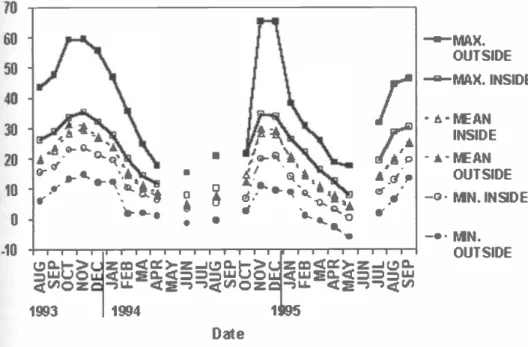
Soil temperatures were measured at Site I between August 1993 and August 1995, from 2 positions: under and outside trees canopy, with an automatic Omnidata meteorological station at 1 cm depth. Soil water contents were monthly determined in all plots of both Sites from the first 20 soil cm using the gravimetric method
(Schlichting et al. 1995).
Results were statistically analyzed by simple and multiple regression analysis, and means were compared by the Student t test (SAS Institute Inc. 1997). Monthly soil water contents were analyzed as a function of time using a mixed model, with site, position and day as fixed effects
and plots within each site as random
effects. This analysis was carried out with the PROC MIXED of SAS (Littell et al.
1996). Likelihood ratio tests (LRT) were
used to select among error structures (compound simmetry, autoregressive, unstructured or heterogeneous variance) compared with the null model. F- values were used for comparisons among sites and positions. Positions within sites were tested using the option SLICE of the
LSMEANS statement (Singer 1998).
Results and Discussion
The effect of soil coverage and silt + clay on organic matter
The spatial variability of organic matter (OM) contents, tree coverage and silt + clay contents of both sites are shown in Figure 2. In Site I OM contents averaged 2.86 %, while in Site II it averaged 6.41 %.
Tree coverage was 57.1% in Site I, and 70.4% in Site II. The silt + clay content was 72.8% in Site I, and 78.5% in Site II.
A Student t -test for comparison of means (P < 0.05) showed that average tree cover- age and silt + clay contents were statisti- cally lower at Site I than at Site II. Tree coverage affects soil temperature and
moisture because low interception of solar radiation by the low density canopies tend to be warmer. Evaporation increases and soil water content decreases with increase solar radiation reaching the ground. Tree coverage can create a microclimatic condi-
tion which can potentially affect OM
pools in semiarid environments.
Regression analysis was conducted to assess the influence of silt + clay and tree coverage on OM contents. The results (Fig. 3a) show that OM was significantly correlated with the percent tree cover at Site I, but not at Site II. Conversely, a sig- nificant positive relationship between OM and silt + clay was observed at Site II but not at Site I (Fig. 3 b).
Correlation between tree coverage and OM may become significant when the amount of organic matter, and its spatial variability, was reduced down by the sys- tematic occurrences from disturbing fac-
tors such as burning and grazing.
Probably, there is a threshold of tree den- sity under which OM and coverage are positively correlated, and over which such correlation disappears. The greater cover-
age by trees in Site II has probably
reached a saturation point beyond which
OM is not anymore sensitive to tree cover
variability. In such case, another driving
factor emerges to explain portions of
residual variability. Thus, the larger OM
content of Site II could be related to its
finer soil texture (silt + clay content). This
V
ó
12
Sitel
10 ,, Site 2
8 6
4-
2
0
but not with previous fire occurrence. Si
a) I, with lower OM contents, was mor intensively grazed and more intensive!
o o o burned than Site II. This agrees with
o ° fact that higher grazing intensity can I
° o * to lower biomass deposition into the so'
°
i3O.ao* o decreasing thereby, OM accumulatio
a o o (Facelli et al. 1988, Llorens and Fran
o o ° o o
A1999), but not with the occurrence of m
i o a L frequent controlled fires in Site I. Iglesi
A
4-1 A- et al. (1990) found that even acciden'
s--xi
fires with higher temperatures than co
y = 0.016 x + 1,97
trolled fires, increased OM in the Calden
R2 = 2íi13, PQ1.001 ecosystem due to the incomplete combus-
20 40 60 SO 100
12
10-
8
2 6- o
4
2
o
tion of plant residues and their incorpora
Trees c eraye (%) tion into the soil.
The relative weight of antropic factors such as burning and grazing on OM varia- tions cannot be clarified from this study
ii