Proceedings of the 55th Annual Meeting of the Association for Computational Linguistics, pages 1789–1798 Proceedings of the 55th Annual Meeting of the Association for Computational Linguistics, pages 1789–1798
Exploiting Argument Information to Improve Event Detection
via Supervised Attention Mechanisms
Shulin Liu1,2, Yubo Chen1,2, Kang Liu1 and Jun Zhao1,2 1 National Laboratory of Pattern Recognition, Institute of Automation,
Chinese Academy of Sciences, Beijing, 100190, China
2 University of Chinese Academy of Sciences, Beijing, 100049, China
{shulin.liu, yubo.chen, kliu, jzhao}@nlpr.ia.ac.cn
Abstract
This paper tackles the task of event detection (ED), which involves identi-fying and categorizing events. We ar-gue that arguments provide significant clues to this task, but they are either completely ignored or exploited in an indirect manner in existing detection approaches. In this work, we propose to exploit argument information explicitly for ED via supervised attention mech-anisms. In specific, we systematically investigate the proposed model under the supervision of different attention strategies. Experimental results show that our approach advances state-of-the-arts and achieves the bestF1 score on ACE 2005 dataset.
1 Introduction
In the ACE (Automatic Context Extraction) event extraction program, an event is repre-sented as a structure comprising an event trigger and a set of arguments. This work tackles event detection (ED) task, which is a crucial part of event extraction (EE) and fo-cuses on identifying event triggers and cate-gorizing them. For instance, in the sentence “He died in the hospital”, an ED system is expected to detect a Die event along with the trigger word “died”. Besides, the task of EE also includes event argument extraction (AE), which involves event argument identi-fication and role classiidenti-fication. In the above sentence, the arguments of the event include “He”(Role =P erson) and “hospital”(Role = P lace). However, this paper does not focus on AE and only tackles the former task.
According to the above definitions, event ar-guments seem to be not essentially necessary to ED. However, we argue that they are capa-ble of providing significant clues for identifying and categorizing events. They are especially useful for ambiguous trigger words. For exam-ple, consider a sentence in ACE 2005 dataset:
Mohamad fired Anwar, his for-mer protege, in1998.
In this sentence, “fired” is the trigger word and the other bold words are event arguments. The correct type of the event triggered by “fired” in this case is End-Position. How-ever, it might be easily misidentified as At-tack because “fired” is a multivocal word. In this case, if we consider the phrase “for-mer protege”, which serves as an argumen-t (Role = P osition) of the target event, we would have more confidence in predicting it as an End-Position event.
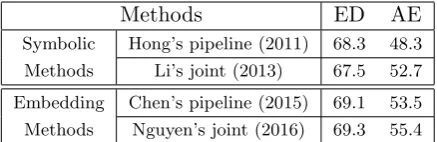
Unfortunately, most existing methods per-formed event detection individually, where the annotated arguments in training set are totally ignored (Ji and Grishman,2008;Gupta and Ji, 2009;Hong et al.,2011;Chen et al., 2015; N-guyen and Grishman,2015;Liu et al.,2016a,b; Nguyen and Grishman,2016). Although some joint learning based methods have been pro-posed, which tackled event detection and argu-ment extraction simultaneously (Riedel et al., 2009; Li et al., 2013; Venugopal et al., 2014; Nguyen et al., 2016), these approaches usu-ally only make remarkable improvements to AE, but insignificant to ED. Table1illustrates our observations.Li et al. (2013) and Nguyen et al. (2016) are state-of-the-art joint mod-els in symbolic and embedding methods for event extraction, respectively. Compared with state-of-the-art pipeline systems, both
Methods ED AE Symbolic Hong’s pipeline (2011) 68.3 48.3 Methods Li’s joint (2013) 67.5 52.7
Embedding Chen’s pipeline (2015) 69.1 53.5 Methods Nguyen’s joint (2016) 69.3 55.4
Table 1: Performances of pipeline and joint approaches on ACE 2005 dataset. The pipeline method in each group was the state-of-the-art system when the corresponding joint method was proposed.
t methods achieved remarkable improvements on AE (over 1.9 points), whereas achieved in-significant improvements on ED (less than 0.2 points). The symbolic joint method even per-formed worse (67.5 vs. 68.3) than pipeline sys-tem on ED.
We believe that this phenomenon may be caused by the following two reasons. On the one hand, since joint methods simultaneous-ly solve ED and AE, methods following this paradigm usually combine the loss functions of these two tasks and are jointly trained un-der the supervision of annotated triggers and arguments. However, training corpus contains much more annotated arguments than trigger-s (about 9800 argumenttrigger-s and 5300 triggertrigger-s in ACE 2005 dataset) because each trigger may be along with multiple event arguments. Thus, the unbalanced data may cause joint models to favor AE task. On the other hand, in im-plementation, joint models usually pre-predict several potential triggers and arguments first and then make global inference to select cor-rect items. When pre-predicting potential trig-gers, almost all existing approaches do not leverage any argument information. In this way, ED does hardly benefit from the anno-tated arguments. By contrast, the component for pre-prediction of arguments always exploit-s the extracted trigger information. Thuexploit-s, we argue that annotated arguments are actually used for AE, not for ED in existing joint meth-ods, which is also the reason we call it an in-direct way to use arguments for ED.
Contrast to joint methods, this paper pro-poses to exploit argument information explic-itly for ED. We have analyzed that arguments are capable of providing significant clues to ED, which gives us an enlightenment that
ar-guments should be focused on when perform-ing this task. Therefore, we propose a neural network based approach to detect events in texts. And in the proposed approach, we adop-t a supervised aadop-tadop-tenadop-tion mechanism adop-to achieve this goal, where argument words are expect-ed to acquire more attention than other word-s. The attention value of each word in a giv-en sgiv-entgiv-ence is calculated by an operation be-tween the current word and the target trigger candidate. Specifically, in training procedure, we first construct gold attentions for each trig-ger candidate based on annotated arguments. Then, treating gold attentions as the super-vision to train the attention mechanism, we learn attention and event detector jointly both in supervised manner. In testing procedure, we use the ED model with learned attention mechanisms to detect events.
In the experiment section, we systemati-cally conduct comparisons on a widely used benchmark dataset ACE20051. In order to fur-ther demonstrate the effectiveness of our ap-proach, we also use events from FrameNet (FN) (F. Baker et al.,1998) as extra training data, as the same as Liu et al. (2016a) to al-leviate the data-sparseness problem for ED to augment the performance of the proposed ap-proach. The experimental results demonstrate that the proposed approach is effective for ED task, and it outperforms state-of-the-art ap-proaches with remarkable gains.
To sum up, our main contributions are: (1) we analyze the problem of joint models on the task of ED, and propose to use the annotated argument information explicitly for this task. (2) to achieve this goal, we introduce a su-pervised attention based ED model. Further-more, we systematically investigate different attention strategies for the proposed model. (3) we improve the performance of ED and achieve the best performance on the widely used benchmark dataset ACE 2005.
2 Task Description
The ED task is a subtask of ACE event eval-uations where an event is defined as a specif-ic occurrence involving one or more partspecif-ici- partici-pants. Event extraction task requires certain specified types of events, which are mentioned
[image:2.595.72.291.62.133.2]in the source language data, be detected. We firstly introduce some ACE terminologies to facilitate the understanding of this task:
Entity: an object or a set of objects in one of the semantic categories of interests.
Entity mention: a reference to an entity (typically, a noun phrase).
Event trigger: the main word that most clearly expresses an event occurrence.
Event arguments: the mentions that are involved in an event (participants).
Event mention: a phrase or sentence with-in which an event is described, with-includwith-ing the trigger and arguments.
The goal of ED is to identify event triggers and categorize their event types. For instance, in the sentence “Hedied in thehospital”, an ED system is expected to detect a Die event along with the trigger word “died”. The detec-tion of event arguments “He”(Role=P erson) and “hospital”(Role=P lace) is not involved in the ED task. The 2005 ACE evaluation in-cluded 8 super types of events, with 33 sub-types. Following previous work, we treat these simply as 33 separate event types and ignore the hierarchical structure among them.
3 The Proposed Approach
Similar to existing work, we model ED as a multi-class classification task. In detail, given a sentence, we treat every token in that sen-tence as a trigger candidate, and our goal is to classify each of these candidates into one of 34 classes (33 event types plus an NA class).
In our approach, every word along with its context, which includes the contextual words and entities, constitute an event trigger candi-date. Figure1describes the architecture of the proposed approach, which involves two com-ponents: (i) Context Representation Learn-ing (CRL), which reveals the representation of both contextual words and entities via at-tention mechanisms; (ii) Event Detector (ED), which assigns an event type (including the NA type) to each candidate based on the learned contextual representations.
3.1 Context Representation Learning
In order to prepare for Context Representa-tion Learning (CRL), we limit the contex-t contex-to a fixed lengcontex-th by contex-trimming longer
sen-Figure 1: The architecture of the proposed approach for event detection. In this figure, w is the candidate word, [w1, ..., wn] is the
contextual words of w, and [e1, ..., en] is the
corresponding entity types of [w1, ... ,wn].
tences and padding shorter sentences with a special token when necessary. Let n be the fixed length and w0 be the current candidate trigger word, then its contextual words Cw is
[w−n 2, w−
n
2+1, ..., w−1, w1, ..., w n 2−1, w
n 2]
2, and
its contextual entities, which is the corre-sponding entity types (including an NA type) ofCw, is [e−n
2, e− n
2+1, ..., e−1, e1, ..., e n 2−1, e
n 2]. For convenience, we use w to denote the cur-rent word, [w1, w2, ..., wn] to denote the
con-textual words Cw and [e1, e2, ..., en] to denote
the contextual entities Ce in figure 1. Note
that, both w, Cw and Ce mentioned above
are originally in symbolic representation. Be-fore entering CRL component, we transform them into real-valued vector by looking up word embedding table and entity type embed-ding table. Then we calculate attention vec-tors for both contextual words and entities by performing operations between the curren-t word w and its contexts. Finally, the con-textual words representation cw and
contex-tual entities representation ce are formed by
the weighted sum of the corresponding embed-dings of each word and entity in Cw and Ce,
respectively. We will give the details in the
fol-2The current candidate trigger word w
[image:3.595.309.526.63.270.2]lowing subsections.
3.1.1 Word Embedding Table
Word embeddings learned from a large amoun-t of unlabeled daamoun-ta have been shown amoun-to be able to capture the meaningful semantic reg-ularities of words (Bengio et al., 2003; Er-han et al.,2010). This paper uses the learned word embeddings as the source of basic fea-tures. Specifically, we use the Skip-gram mod-el (Mikolov et al.,2013) to learn word embed-dings on the NYT corpus3.
3.1.2 Entity Type Embedding Table
The ACE 2005 corpus annotated not only events but also entities for each given sentence. Following existing work (Li et al.,2013;Chen et al.,2015;Nguyen and Grishman,2015), we exploit the annotated entity information in our ED system. We randomly initialize embedding vector for each entity type (including the NA type) and update it in training procedure.
3.1.3 Representation Learning
In this subsection, we illustrate our proposed approach to learn representations of both con-textual words and entities, which serve as in-puts to the following event detector compo-nent. Recall that, we use the matrix Cw and Ceto denote contextual words and contextual
entities, respectively.
As illustrated in figure 1, the CRL compo-nent needs three inputs: the current candidate trigger wordw, the contextual wordsCw and
the contextual entities Ce. Then, two
atten-tion vectors, which reflect different aspects of the context, are calculated in the next step.
The contextual word attention vectorαw
is computed based on the current wordwand its contextual wordsCw. We firstly transform
each word wk (includingw and every word in Cw) into a hidden representation wk by the
following equation:
wk =f(wkWw) (1)
wheref(·) is a non-linear function such as the hyperbolic tangent, andWwis the
transforma-tion matrix. Then, we use the hidden represen-tations to compute the attention value for each
3https://catalog.ldc.upenn.edu/LDC2008T19
word inCw:
αkw= exp(ww T
k)
∑
iexp(wwTi )
(2)
The contextual entity attention vector
αe is calculated with a similar method toαw.
αke = exp(wee T
k)
∑
iexp(weeTi )
(3)
Note that, we do not use the entity informa-tion of the current candidate token to compute the attention vector. The reason is that only a small percentage of true event triggers are entities4. Therefore, the entity type of a can-didate trigger is meaningless for ED. Instead, we use we, which is calculated by
transform-ingwfrom the word space into the entity type space, as the attention source.
We combine αw and αe to obtain the final
attention vector,α=αw+αe. Finally, the
con-textual words representation cw and the
con-textual entities representation ce are formed
by weighted sum ofCwandCe, respectively:
cw =CwαT (4)
ce=CeαT (5)
3.2 Event Detector
As illustrated in figure 1, we employ a three-layer (an input three-layer, a hidden three-layer and a soft-max output layer) Artificial Neural Networks (ANNs) (Hagan et al.,1996) to model the ED task, which has been demonstrated very effec-tive for event detection by Liu et al.(2016a).
3.2.1 Basic ED Model
Given a sentence, as illustrated in figure1, we concatenate the embedding vectors of the con-text (including concon-textual words and entities) and the current candidate trigger to serve as the input to ED model. Then, for a given in-put samplex, ANN with parameterθoutputs a vector O, where the i-th value oi of O is
the confident score for classifyingxto thei-th event type. To obtain the conditional proba-bility p(i|x,θ), we apply a softmax operation over all event types:
p(i|x,θ) = e
oi ∑m
k=1eok
(6)
Given all of our (suppose T) training instances (x(i);y(i)), we can then define the negative log-likelihood loss function:
J(θ) =−
T
∑
i=1
logp(y(i)|x(i),θ) (7)
We train the model by using a simple opti-mization technique called stochastic gradient descent (SGD) over shuffled mini-batches with the Adadelta rule (Zeiler, 2012). Regulariza-tion is implemented by a dropout (Kim,2014; Hinton et al.,2012) andL2 norm.
3.2.2 Supervised Attention
In this subsection, we introduce supervised at-tention to explicitly use annotated argument information to improve ED. Our basic idea is simple: argument words should acquire more attention than other words. To achieve this goal, we first construct vectors using annotat-ed arguments as the gold attentions. Then, we employ them as supervision to train the atten-tion mechanism.
Constructing Gold Attention Vectors
Our goal is to encourage argument words to obtain more attention than other words. To achieve this goal, we propose two strategies to construct gold attention vectors:
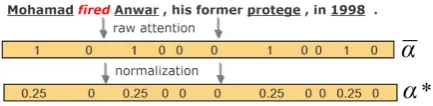
[image:5.595.73.290.590.643.2]S1: only pay attention to argument words.That is, all argument words in the giv-en context obtain the same attgiv-ention, whereas other words get no attention. For candidates without any annotated arguments in context (such as negative samples), we force all entities to average the whole attention. Figure2 illus-trates the details, where α∗ is the final gold attention vector.
Figure 2: An example of S1 to construct gold attention vector. The wordfired is the trigger candidate, and underline words are arguments of fired annotated in the corpus.
S2: pay attention to both arguments and the words around them.The assump-tion is that, not only arguments are important
to ED, the words around them are also help-ful. And the nearer a word is to arguments, the more attention it should obtain. Inspired by Mi et al. (2016), we use a gaussian distri-butiong(·) to model the attention distribution of words around arguments. In detail, given an instance, we first obtain the raw attention vec-torα in the same manner as S1 (see figure2). Then, we create a new vectorα′with all points initialized with zero, and for each αi = 1, we
updateα′ by the following algorithm:
Algorithm 1:Updating α′
for k∈ {−w, ...,0, ..., w} do
α′i+k=αi′+k+g(|k|, µ, σ)
end
wherew is the window size of the attention mechanism and µ, σ are hyper-parameters of the gaussian distribution. Finally, we normal-izeα′ to obtain the target attention vectorα∗. Similar with S1, we treat all entities in the context as arguments if the current candidate does not has any annotated arguments (such as netative samples).
Jointly Training ED and Attention
Given the gold attention α∗ (see subsection 3.2.2) and the machine attentionα produced by our model (see subsection 3.1.3), we em-ploy the square error as the loss function of attentions:
D(θ) =
T
∑
i=1
n
∑
j=1
(α∗ij−αij)2 (8)
Combining equation7 and equation 8, we de-fine the joint loss function of our proposed model as follows:
J′(θ) =J(θ) +λD(θ) (9)
whereλis a hyper-parameter for trade-off be-tweenJ andD. Similar to basic ED model, we minimize the loss functionJ′(θ) by using SGD over shuffled mini-batches with the Adadelta update rule.
4 Experiments
4.1 Dataset and Experimental Setup Dataset
fol-lowed the evaluation of (Li et al.,2013;Chen et al., 2015; Liu et al., 2016b): randomly se-lected 30 articles from different genres as the development set, and subsequently conducted a blind test on a separate set of 40 ACE 2005 newswire documents. We used the remaining 529 articles as our training set.
Hyper-parameter Setting
Hyper-parameters are tuned on the develop-ment dataset. We set the dimension of word embeddings to 200, the dimension of entity type embeddings to 50, the size of hidden lay-er to 300, the output size of word transfor-mation matrix Ww in equation 1 to 200, the
batch size to 100, the hyper-parameter for the L2 norm to 10−6 and the dropout rate to 0.6. In addition, we use the standard normal dis-tribution to model attention disdis-tributions of words around arguments, which means that µ= 0.0, σ= 1.0, and the window size is set to 3 (see Subsection3.2.2). The hyper-parameter λ in equation 9 is various for different atten-tion strategies, we will give its setting in the next section.
4.2 Correctness of Our Assumption
In this section, we conduct experiments on ACE 2005 corpus to demonstrate the correct-ness of our assumption that argument infor-mation is crucial to ED. To achieve this goal, we design a series of systems for comparison.
ANN is the basic event detection model, in which the hyper-parameter λis set to 0. This system does not employ argument information and computes attentions without supervision (see Subsection 3.1.3).
ANN-ENT assignsλwith 0, too. The dif-ference is that it constructs the attention vec-tor α by forcing all entities in the context to average the attention instead of computing it in the manner introduced in Subsection3.1.3. Since all arguments are entities, this system is designed to investigate the effects of entities.
ANN-Gold1 uses the gold attentions con-structed by strategy S1 in bothtraining and
testingprocedure.
ANN-Gold2 is akin to ANN-Gold1, but uses the second strategy to construct its gold attentions.
Note that, in order to avoid the interference of attention mechanisms, the last two systems
are designed to use argument information (via gold attentions) in both training and testing procedure. Thus both ANN-Gold1 and ANN-Gold2 assignλwith 0.
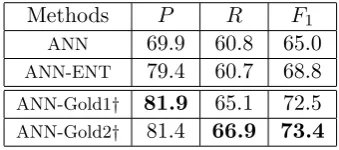
Methods P R F1
ANN 69.9 60.8 65.0
ANN-ENT 79.4 60.7 68.8
ANN-Gold1† 81.9 65.1 72.5 ANN-Gold2† 81.4 66.9 73.4
Table 2: Experimental results on ACE 2005 corpus. † designates the systems that employ argument information.
Table 2 compares these systems on ACE 2005 corpus. From the table, we observe that systems with argument information (the last two systems) significantly outperform system-s without argument information (the firsystem-st t-wo systems), which demonstrates that argu-ment information is very useful for this task. Moreover, since all arguments are entities, for preciseness we also investigate that whether
ANN-Gold1/2 on earth benefits from entities or arguments. Compared withANN-ENT (re-vising that this system only uses entity infor-mation), ANN-Gold1/2 performs much bet-ter, which illustrates that entity information is not enough and further demonstrates that argument information is necessary for ED.
4.3 Results on ACE 2005 Corpus
In this section, we conduct experiments on ACE 2005 corpus to demonstrate the effective-ness of the proposed approach. Firstly, we in-troduce systems implemented in this work.
ANN-S1 uses gold attentions constructed by strategy S1 as supervision to learn atten-tion. In our experiments, λis set to 1.0.
ANN-S2 is akin toANN-S1, but use strat-egy S2 to construct gold attentions and the hyper-parameterλis set to 5.0.
These two systems both employ supervised attention mechanisms. For comparison, we use an unsupervised-attention systemANN as our baseline, which is introduced in Subsection4.2. In addition, we select the following state-of-the-art methods for comparison.
[image:6.595.331.501.128.203.2]Methods P R F1 Li’s joint model (2013) 73.7 62.3 67.5
Liu’s PSL (2016) 75.3 64.4 69.4 Liu’s FN-Based (2016) 77.6 65.2 70.7 Ngyuen’s joint (2016) 66.0 73.0 69.3
Skip-CNN (2016) N/A 71.3
ANN 69.9 60.8 65.0
ANN-S1† 81.4 62.4 70.8
[image:7.595.76.288.61.192.2]ANN-S2† 78.0 66.3 71.7
Table 3: Experimental results on ACE 2005. The first group illustrates the performances of state-of-the-art approaches. The second group illustrates the performances of the proposed approach. † designates the systems that em-ploy arguments information.
2). Liu’s PSL (Liu et al., 2016b) employs both latent local and global information for event detection. It is the best-reported feature-based system.
3). Liu’s FN-Based approach (Liu et al., 2016a) leverages the annotated corpus of FrameNet to alleviate data sparseness problem of ED based on the observation that frames in FN are analogous to events in ACE.
4).Ngyen’s joint model(Nguyen et al.,2016) employs a bi-directional RNN to jointly ex-tract event triggers and arguments. It is the best-reported representation-based joint ap-proach proposed on this task.
5). Skip-CNN (Nguyen and Grishman, 2016) introduces the non-consecutive convo-lution to capture non-consecutive k-grams for event detection. It is the best reported representation-based approach on this task.
Table3presents the experimental results on ACE 2005 corpus. From the table, we make the following observations:
1). ANN performs unexpectedly poorly, which indicates that unsupervised-attention mechanisms do not work well for ED. We be-lieve the reason is that the training data of ACE 2005 corpus is insufficient to train a pre-cise attention in an unsupervised manner, con-sidering that data sparseness is an important issue of ED (Zhu et al.,2014;Liu et al.,2016a). 2). With argument information employed via supervised attention mechanisms, both
ANN-S1 and ANN-S2 outperformANN with remarkable gains, which illustrates the
effec-tiveness of the proposed approach.
3). ANN-S2 outperforms ANN-S1, but the latter achieves higher precision. It is not d-ifficult to understand. On the one hand, s-trategy S1 only focuses on argument words, which provides accurate information to iden-tify event type, thus ANN-S1 could achieve higher precision. On the other hand,S2 focus-es on both arguments and words around them, which provides more general but noised clues. Thus, ANN-S2 achieves higher recall with a little loss of precision.
4). Compared with state-of-the-art ap-proaches, our method ANN-S2 achieves the best performance. We also perform a t-test (p 6 0.05), which indicates that our method significantly outperforms all of the compared methods. Furthermore, another noticeable ad-vantage of our approach is that it achieves much higher precision than state-of-the-arts.
4.4 Augmentation with FrameNet
Recently, Liu et al. (2016a) used events auto-matically detected from FN as extra training data to alleviate the data-sparseness problem for event detection. To further demonstrate the effectiveness of the proposed approach, we also use the events from FN to augment the performance of our approach.
In this work, we use the events published by Liu et al. (2016a)5 as extra training data. However, their data can not be used in the proposed approach without further processing, because it lacks of both argument and entity information. Figure 3 shows several examples of this data.
Figure 3: Examples of events detected from FrameNet (published byLiu et al.(2016a)).
Processing of Events from FN
Liu et al. (2016a) detected events from FrameNet based on the observation that frames in FN are analogous to events in ACE
(lexical unit of a frame ↔ trigger of an even-t, frame elements of a frame ↔ arguments of an event). All events they published are also frames in FN. Thus, we treat frame elements annotated in FN corpus as event arguments. Since frames generally contain more frame el-ements than events, we only use core6elements
in this work. Moreover, to obtain entity infor-mation, we use RPI Joint Information Extrac-tion System7 (Li et al., 2013, 2014;Li and Ji,
2014) to label ACE entity mentions.
Experimental Results
We use the events from FN as extra train-ing data and keep the development and test datasets unchanged.Table 4 presents the ex-perimental results.
Methods P R F1
ANN 69.9 60.8 65.0
ANN-S1 81.4 62.4 70.8
ANN-S2 78.0 66.3 71.7
ANN +FrameNet 72.5 61.7 66.7 ANN-S1 +FrameNet 80.1 63.6 70.9 ANN-S2 +FrameNet 76.8 67.5 71.9
Table 4: Experimental results on ACE 2005 corpus. “+FrameNet” designates the systems that are augmented by events from FrameNet.
From the results, we observe that:
1). With extra training data,ANN achieves significant improvements onF1 measure (66.7 vs. 65.0). This result, to some extent, demon-strates the correctness of our assumption that the data sparseness problem is the reason that causes unsupervised attention mechanisms to be ineffective to ED.
2). Augmented with external data, both
ANN-S1 and ANN-S2 achieve higher recall with a little loss of precision. This is to be ex-pected. On the one hand, more positive train-ing samples consequently make higher recal-l. On the other hand, the extra event sam-ples are automatically extracted from FN, thus false-positive samples are inevitable to be in-volved, which may result in hurting the preci-sion. Anyhow, with events from FN, our ap-proach achieves higher F1 score.
6FrameNet classifies frame elements into three groups: core, peripheral and extra-thematic.
7http://nlp.cs.rpi.edu/software/
5 Related Work
Event detection is an increasingly hot and challenging research topic in NLP. Generally, existing approaches could roughly be divided into two groups.
The first kind of approach tackled this task under the supervision of annotated trig-gers and entities, but totally ignored anno-tated arguments. The majority of existing work followed this paradigm, which includes feature-based methods and representation-based methods. Feature-representation-based methods ex-ploited a diverse set of strategies to convert classification clues (i.e., POS tags, dependen-cy relations) into feature vectors (Ahn, 2006; Ji and Grishman,2008;Patwardhan and Rilof-f, 2009; Gupta and Ji, 2009; Liao and Gr-ishman, 2010; Hong et al., 2011; Liu et al., 2016b). Representation-based methods typi-cally represent candidate event mentions by embeddings and feed them into neural net-works (Chen et al., 2015; Nguyen and Grish-man,2015;Liu et al.,2016a;Nguyen and Gr-ishman,2016).
The second kind of approach, on the con-trast, tackled event detection and argument extraction simultaneously, which is called joint approach (Riedel et al.,2009; Poon and Van-derwende, 2010; Li et al., 2013, 2014; Venu-gopal et al.,2014; Nguyen et al.,2016). Join-t approach is proposed Join-to capJoin-ture inJoin-ternal and external dependencies of events, includ-ing trigger-trigger, argument-argument and trigger-argument dependencies. Theoretically, both ED and AE are expected to benefit from joint methods because triggers and arguments are jointly considered. However, in practice, existing joint methods usually only make re-markable improvements to AE, but insignif-icant to ED. Different from them, this work investigates the exploitation of argument in-formation to improve the performance of ED.
6 Conclusions
conduc-t a series of experimenconduc-ts on conduc-the widely used benchmark dataset ACE 2005. Moreover, we also use events from FN to augment the per-formance of the proposed approach. Experi-mental results show that our approach outper-forms state-of-the-art methods, which demon-strates that the proposed approach is effective for event detection.
Acknowledgments
This work was supported by the Natural Sci-ence Foundation of China (No. 61533018) and the National Basic Research Program of China (No. 2014CB340503). And this research work was also supported by Google through focused research awards program.
References
David Ahn. 2006. Proceedings of the workshop on annotating and reasoning about time and events. Association for Computational Linguistics, pages 1–8. http://aclweb.org/anthology/W06-0901.
Yoshua Bengio, R´ejean Ducharme, Pascal Vincen-t, and Christian Janvin. 2003. A neural proba-bilistic language model. The Journal of Machine Learning Research 3:1137–1155.
Yubo Chen, Liheng Xu, Kang Liu, Daojian Zeng, and Jun Zhao. 2015. Event extraction vi-a dynvi-amic multi-pooling convolutionvi-al neurvi-al networks. In Proceedings of the 53rd An-nual Meeting of the Association for Compu-tational Linguistics and the 7th Internation-al Joint Conference on NaturInternation-al Language Pro-cessing (Volume 1: Long Papers). Association for Computational Linguistics, pages 167–176. https://doi.org/10.3115/v1/P15-1017.
Dumitru Erhan, Yoshua Bengio, Aaron Courville, Pierre-Antoine Manzagol, Pascal Vincent, and Samy Bengio. 2010. Why does unsupervised pre-training help deep learning? The Journal of Machine Learning Research 11:625–660.
Collin F. Baker, Charles J. Fillmore, and John B. Lowe. 1998. The berkeley framenet project. InCOLING 1998 Volume 1: The 17th Interna-tional Conference on ComputaInterna-tional Linguistic-s. http://aclweb.org/anthology/C98-1013.
Prashant Gupta and Heng Ji. 2009. Predict-ing unknown time arguments based on cross-event propagation. InProceedings of the ACL-IJCNLP 2009 Conference Short Papers. Associ-ation for ComputAssoci-ational Linguistics, pages 369– 372. http://aclweb.org/anthology/P09-2093.
Martin T Hagan, Howard B Demuth, Mark H Beale, et al. 1996. Neural network design. P-ws Pub. Boston.
Geoffrey E Hinton, Nitish Srivastava, Alex Krizhevsky, Ilya Sutskever, and Ruslan R Salakhutdinov. 2012. Improving neural net-works by preventing co-adaptation of feature de-tectors. arXiv preprint arXiv:1207.0580 http-s://arxiv.org/abs/1207.0580.
Yu Hong, Jianfeng Zhang, Bin Ma, Jianmin Yao, Guodong Zhou, and Qiaoming Zhu. 2011. Using cross-entity inference to improve event extrac-tion. InProceedings of the 49th Annual Meeting of the Association for Computational Linguistic-s: Human Language Technologies. Association for Computational Linguistics, pages 1127–1136. http://aclweb.org/anthology/P11-1113.
Heng Ji and Ralph Grishman. 2008. Refining even-t exeven-traceven-tion even-through cross-documeneven-t inference. In Proceedings of ACL-08: HLT. Association for Computational Linguistics, pages 254–262. http://aclweb.org/anthology/P08-1030.
Yoon Kim. 2014. Convolutional neural network-s for network-sentence clanetwork-snetwork-sification. In Proceedings of the 2014 Conference on Empirical Methods in Natural Language Processing. pages 1746–1751. http://www.anthology.aclweb.org/D14-1181.
Qi Li and Heng Ji. 2014. Incremental join-t exjoin-tracjoin-tion of enjoin-tijoin-ty menjoin-tions and relajoin-tion- relation-s. In Proceedings of the 52nd Annual Meet-ing of the Association for Computational Lin-guistics (Volume 1: Long Papers). Association for Computational Linguistics, pages 402–412. https://doi.org/10.3115/v1/P14-1038.
Qi Li, Heng Ji, Yu HONG, and Sujian Li. 2014. Constructing information networks using one s-ingle model. In Proceedings of the 2014 Con-ference on Empirical Methods in Natural Lan-guage Processing (EMNLP). Association for Computational Linguistics, pages 1846–1851. https://doi.org/10.3115/v1/D14-1198.
Qi Li, Heng Ji, and Liang Huang. 2013. Joint event extraction via structured prediction with glob-al features. In Proceedings of the 51st Annual Meeting of the Association for Computational Linguistics (Volume 1: Long Papers). Associa-tion for ComputaAssocia-tional Linguistics, pages 73–82. http://aclweb.org/anthology/P13-1008.
Shulin Liu, Yubo Chen, Shizhu He, Kang Liu, and Jun Zhao. 2016a. Leveraging framenet to improve automatic event detection. In
Proceedings of the 54th Annual Meeting of the Association for Computational Linguistic-s (Volume 1: Long PaperLinguistic-s). Association for Computational Linguistics, pages 2134–2143. https://doi.org/10.18653/v1/P16-1201.
Shulin Liu, Kang Liu, Shizhu He, and Jun Zhao. 2016b. A probabilistic soft logic based approach to exploiting latent and global information in event classification. In Pro-ceedings of the thirtieth AAAI Conference on Artificail Intelligence. pages 2993–2999. http://www.aaai.org/ocs/index.php/AAAI /AAAI16/paper/view/11990/12052.
Haitao Mi, Zhiguo Wang, and Abe Ittycheriah. 2016. Supervised attentions for neural machine translation. arXiv preprint arXiv:1608.00112
https://arxiv.org/abs/1608.00112.
Tomas Mikolov, Kai Chen, Greg Corrado, and Jeffrey Dean. 2013. Efficient estima-tion of word representaestima-tions in vector s-pace. arXiv preprint arXiv:1301.3781 http-s://arxiv.org/abs/1301.3781.
Huu Thien Nguyen, Kyunghyun Cho, and Ralph Grishman. 2016. Joint event extraction via re-current neural networks. In Proceedings of the 2016 Conference of the North American Chapter of the Association for Computational Linguistic-s: Human Language Technologies. Association for Computational Linguistics, pages 300–309. https://doi.org/10.18653/v1/N16-1034.
Huu Thien Nguyen and Ralph Grishman. 2015. Event detection and domain adaptation with convolutional neural networks. In Proceedings of the 53rd Annual Meeting of the Association for Computational Linguistics and the 7th Inter-national Joint Conference on Natural Language Processing (Volume 2: Short Papers). Associa-tion for ComputaAssocia-tional Linguistics, pages 365– 371. https://doi.org/10.3115/v1/P15-2060.
Huu Thien Nguyen and Ralph Grishman. 2016. Modeling skip-grams for event detection with convolutional neural networks. In Proceedings of the 2016 Conference on Empirical Method-s in Natural Language ProceMethod-sMethod-sing. Association for Computational Linguistics, pages 886–891. http://aclweb.org/anthology/D16-1085.
Siddharth Patwardhan and Ellen Riloff. 2009. A unified model of phrasal and sentential evi-dence for information extraction. InProceedings of the 2009 Conference on Empirical Method-s in Natural Language ProceMethod-sMethod-sing. Association for Computational Linguistics, pages 151–160. http://aclweb.org/anthology/D09-1016.
Hoifung Poon and Lucy Vanderwende. 2010. Joint inference for knowledge extraction from
biomedical literature. In Human Language Technologies: The 2010 Annual Conference of the North American Chapter of the Associa-tion for ComputaAssocia-tional Linguistics. Association for Computational Linguistics, pages 813–821. http://aclweb.org/anthology/N10-1123.
Sebastian Riedel, Hong-Woo Chun, Toshihisa Tak-agi, and Jun’ichi Tsujii. 2009. Proceed-ings of the bionlp 2009 workshop compan-ion volume for shared task. Association for Computational Linguistics, pages 41–49. http://aclweb.org/anthology/W09-1406.
Deepak Venugopal, Chen Chen, Vibhav Gogate, and Vincent Ng. 2014. Relieving the computational bottleneck: Joint inference for event extraction with high-dimensional fea-tures. In Proceedings of the 2014 Con-ference on Empirical Methods in Natural Language Processing (EMNLP). Association for Computational Linguistics, pages 831–843. https://doi.org/10.3115/v1/D14-1090.
Matthew D Zeiler. 2012. Adadelta: An adap-tive learning rate method. arXiv preprint arX-iv:1212.5701 https://arxiv.org/abs/1212.5701.
![Figure 1:The architecture of the proposedapproach for event detection. In this figure,w is the candidate word, [w1, ..., wn] is thecontextual words of w, and [e1, ..., en] is thecorresponding entity types of [w1, ..](https://thumb-us.123doks.com/thumbv2/123dok_us/185335.517154/3.595.309.526.63.270/figure-architecture-proposedapproach-detection-gure-candidate-thecontextual-thecorresponding.webp)