279
No Army, No Navy: BERT Semi-Supervised Learning of Arabic Dialects
∗Chiyu Zhang Muhammad Abdul-Mageed Natural Language Processing Lab
The University of British Columbia
[email protected],[email protected]
Abstract
We present our deep leaning system submitted to MADAR shared task 2 focused on twitter user dialect identification. We develop tweet-level identification models based on GRUs and BERT in supervised and semi-supervised set-tings. We then introduce a simple, yet effec-tive, method of porting tweet-level labels at the level of users. Our system ranks top 1 in the competition, with 71.70% macroF1score and 77.40% accuracy.
1 Introduction
Language identification (LID) is an important NLP task that usually acts as an enabling tech-nology in a pipeline involving another down-stream task such as machine translation (Salloum et al.,2014) or sentiment analysis (Abdul-Mageed, 2017b,a). Although several works have focused on detecting languages in global settings (see Jauhi-ainen et al. (2018) for a survey), there has not been extensive research on teasing apart similar languages or language varieties (Zampieri et al., 2018). This is the case for Arabic, the term used to collectively refer to a large number of varieties with a vast population of native speakers (∼300 million). For this reason, we focus on detecting fine-grained Arabic dialect as part of our contri-bution to the MADAR shared task 2, twitter user dialect identification (Bouamor et al.,2019).
Previous works on Arabic (e.g., Zaidan and Callison-Burch (2011, 2014); Elfardy and Diab (2013);Cotterell and Callison-Burch(2014)) have primarily targeted cross-country regional varieties such as Egyptian, Gulf, and Levantine, in addi-tion to Modern Standard Arabic (MSA). These
∗
The title is word play on the Yiddish linguist Max Weinreich much quoted metaphor (in Yiddish) “A lan-guage is a dialect with an army and navy”. See: https: //en.wikipedia.org/wiki/A_language_is_a_ dialect_with_an_army_and_navy.
works exploited social data from blogs (Diab et al.,2010;Elfardy and Diab,2012;Al-Sabbagh and Girju, 2012; Sadat et al., 2014), the general Web (Al-Sabbagh and Girju, 2012), online news sites comments sections (Zaidan and Callison-Burch, 2011), and Twitter (Abdul-Mageed and Diab,2012;Abdul-Mageed et al.,2014;Mubarak and Darwish,2014;Qwaider et al.,2018). Other works have used translated data (e.g., Bouamor et al.(2018)), or speech transcripts (e.g.,Malmasi and Zampieri(2016). More recently, other works reporting larger-scale datasets at the country-level were undertaken. These include data spanning 10-to-17 different countries (Zaghouani and Charfi, 2018;Abdul-Mageed et al.,2018).
2 Data
Twitter user dialect identification is the second sub-task of 2019 MADAR shared task (Bouamor et al., 2019). This task is set up as fine-grained multi-class classification where corpus released by organizers are labeled with the tagset {Algeria,
Bahrain, Djibouti, Egypt, Iraq, Jordan, Kuwait,
Lebanon, Libya, Mauritania, Morocco, Oman,
Palestine, Qatar, Saudi Arabia, Somalia, Sudan,
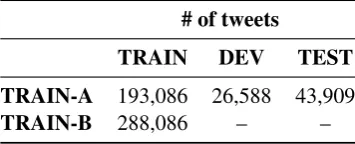
Syria, Tunisia, United Arab Emirates, Yemen}. The corpus is divided into train, dev and test (with the test set shared without labels). For each tweet, organizers released a user id and tweet id and par-ticipants needed to crawl the actual tweets. We were not able to crawl part of the data because of unavailability on the Twitter platform. The distri-bution of the data in our splits after crawling is as follows: 2,036 (TRAIN-A), 281 (DEV) and 466 (TEST). For our experiments, we also make use of the task 1 corpus (95,000 sentences (Bouamor et al., 2018)). More specifically, we concatenate the task 1 data to the training data of task 2, to create TRAIN-B. Note that both DEV and TEST across our experiments are exclusively the data re-leased in task 2, as described above. TEST labels were only released to participants after the official task evaluation. Table 1 shows statistics of the data.
# of tweets
TRAIN DEV TEST
TRAIN-A 193,086 26,588 43,909
[image:2.595.92.270.460.532.2]TRAIN-B 288,086 – –
Table 1: Distribution of classes within the MADAR twitter corpus.
3 Methods
3.1 Pre-processing & Architectures
With tweet ids at hand, we crawl users tweets via the Twitter API. We remove all usernames, URLs, and diacritics in the data. For evaluation, we use accuracy and macroF1−score. For modeling, we
use two main deep learning architectures, Gated Recurrent Unit (GRU) and Bidirectional Encoder Representations from Transformers (BERT). For GRU, we tokenize tweets into word sequences by white-space. For BERT input, we apply Word-Piece tokenization. We set the maximal sequence
length to 50 words/WordPieces. A GRU (Cho et al.,2014;Chung et al.,2014) is a simplification of long-short term memory networks (LSTM), which in turn are a version of recurrent neural net-works.
For BERT (Devlin et al., 2018), it was intro-duced to dispense with recurrence and convolu-tion. Its model architecture is a multi-layer bidi-rectional Transformer encoder (Vaswani et al., 2017). It uses masked language models to enable pre-trained deep bidirectional representations, in addition to a binarynext sentence predictiontask. The pre-trained BERT can be easily fine-tuned on large suite of sentence-level and token-level tasks.We also use semi-supervised learning in our modeling, as we explain next.
3.2 Semi-supervise Learning
Supervised deep learning requires a large num-ber of labeled data points. For this rea-son, we investigate augmenting our training data with automatically-predicted tweets using semi-supervised learning (SSL). More specifically, we use self-training. Self-training is a wrapper method for SSL (Triguero et al., 2015; Pavlinek and Podgorelec, 2017) where a classifier is ini-tially trained on a small set of labeled samplesDl. Then, the learned classifier is used to classify the unlabeled sample setDu. Based on the predication output, the most confident samples with their pre-dicted labels are added to the labeled set. The clas-sifier can then be re-trained on the new ‘labeled’ set. This process can be repeated until all the sam-ples fromDuare added to Dl or a given stopping criteria is reached. We now introduce our experi-ments.
4 Experiments
We illustrate our four main sets of experiment. We present (i) our baseline model, GRU (Section 4.1), (ii) fine-tuning on BERT-Base, Multilingual Cased model for dialect identification (Section 4.2), (iii) semi-supervised learning with unlabeled data 4.3, (iv) user-level dialect identification (DID) 4.4.
4.1 GRU
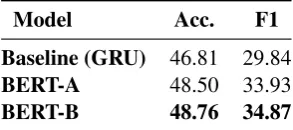
normal distribution, withµ = 0, andσ = 1, i.e., W ∼N(0,1). We apply Adam (Kingma and Ba, 2014) with a fixed learning rate of1e−3for opti-mization. For regularization, we use dropout (Sri-vastava et al., 2014) rate of 0.5 on the hidden layer. We set the maximal length of sequence in our GRU model to 50, and choose an arbitrary vo-cabulary size of 10,000 words. We employ batch training with a batch size of 8 on this model. We run the network for 10 epochs and save the model at the end of each epoch, choosing the model that performs highest on DEV as our best model. We report our best result on dev in Table 2. Our best result is acquired with 3 epochs. As Table 2 shows, the baseline obtainsaccuracy = 46.81%
andF1 = 28.84.
4.2 BERT
As mentioned earlier, we use the BERT-Base Mul-tilingual Cased model released by the authors 1. The model is trained on 104 languages (including Arabic) with 12 layer, 768 hidden units each, 12 attention heads, and has 110M parameters in en-tire model. The model has 119,547 shared Word-Pieces vocabulary, and was pre-trained on the en-tire Wikipedia for each language. For fine-tuning, we use a maximum sequence size of 50 tokens and a batch size of 32. We set the learning rate to2e−5
and train for 10 epochs. We use the same hyper-parameters in all of our BERT models. We fine-tune BERT on TRAIN-A and TRAIN-B sets, and call these BERT-A and BERT-B respectively. As Table 2 shows, both BERT models acquire bet-ter performance than the GRU models. On accu-racy, BERT-A is 1.69% better than the baseline, and B is 1.95% better than baseline. BERT-B obtains 34.87 F1 which is 5.03 better than the
baseline and 0.94 better than BERT-A. Our best model of above two sets of experiment is BERT-B which obtains the best accuracy and F1. Hence,
we use BERT-B in our following semi-supervised learning experiments.
4.3 Semi-supervised Learning
As we mentioned earlier, we apply self-training in order to augment training set. For this pur-pose, we use an in-house unlabeled, Arabic dataset of 9,981,965 tweets. We refer to this unlabeled dataset as unlabeled-10M. We pre-process unlabeled-10M using the same method as the rest of our data. We use the best model from Sec-tion4.2(i.e. BERT-B, which is trained on
TRAIN-Model Acc. F1
Baseline (GRU) 46.81 29.84
BERT-A 48.50 33.93
[image:3.595.343.490.63.128.2]BERT-B 48.76 34.87
Table 2: Model performance. Baseline is a unidirec-tional 500-unit, one-layered GRU. Baseline and BERT-A are trained on TRBERT-AIN-BERT-A. BERT-B is trained on TRAIN-B.
# of tweets
New Total
5% SEMI 499,102 787,188
10% SEMI 998,196 1,286,282
25% SEMI 2,495,491 2,783,577
5% Class SEMI 499,087 787,173
10% Class SEMI 998,186 1,286,272
[image:3.595.318.513.201.332.2]25% Class SEMI 2,495,486 2,783,572
Table 3: Data splits for our emi-supervised learning experiments. New: The new dataset confidently pre-dicted with semi-supervised learning that are added to TRAIN-B.
B) to predict dialect labels for unlabeled-10M. To obtain the best performance, we investigate various settings to select the most reliable sam-ples before adding such samsam-ples to our train-ing data. These settings are based on the per-class value in the softmax/output layer, as fol-lows: (i) Top-N%: We select samples which ob-tain top n% softmax values and add them with their predicted labels to TRAIN-B. We refer to the new training set asN SEMI.(ii) Top-N% Class:
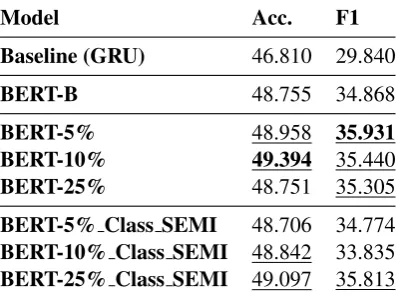
Model Acc. F1
Baseline (GRU) 46.810 29.840
BERT-B 48.755 34.868
BERT-5% 48.958 35.931 BERT-10% 49.394 35.440
BERT-25% 48.751 35.305
BERT-5% Class SEMI 48.706 34.774
BERT-10% Class SEMI 48.842 33.835
BERT-25% Class SEMI 49.097 35.813
Table 4: Semi-supervised learning. All models are evaluated on DEV, with TRAIN-B as training data. Re-sults higher than BERT-B are underlined. Best result is inbold.
BERT 10% (acc = 49.34%) with 4 epochs. It is 0.639% higher than BERT-B. For F1, the best
model is BERT 5% (F1= 35.931) with 3 epochs.
We use these two model in the following user-level DID. Since the official metric of the shared task is macro F1 score, we also consider
BERT-25% Class SEMI as a candidate model for user-level DID since it acquires betterF1 than
BERT-10% as Table4shows.
4.4 User-level DID
Our aforementioned models identify dialect on the tweet-level, rather than directly detect the di-alect of a user. Hence, we use tweet-level pre-dicted labels (and associated softmax values) as a proxy for user-level labels. For each predicted label, we use the softmax value as a thresh-old for including only highest confidently pre-dicted tweets. Since in some cases softmax val-ues can be low, we try all valval-ues between 0.00 and 0.99 to take a softmax-based majority class as the user-level predicted label, fine-tuning on our DEV set. Figure 1 provides performance of the
[image:4.595.311.521.63.189.2]BERT-25% Class SEMImodel on DEV using different softmax threshold values. Note that the shared task requires a maximum of three models submitted. For these, we chose the top 3 mod-els in Table 4 (i.e., BERT-5%, BERT-10%, and BERT-25% Class SEMI). As a precauion, we also use the BERT-B when we fine-tune on the user-level on DEV. We then use only the 3 models that perform best on DEV as our official task sub-mission. As Table 5 shows, the best three sys-tems on DEV are B, 5% and BERT-25% Class SEMI. For the 34 unavailable users,
Figure 1: User-level Performance on DEV using different softmax value thresholds.
we assigned the majority class in TRAIN-A (i.e., ‘Saudi Arabia’). According to 5, our best system on TEST set is BERT-5% with 77.04% accuracy and 71.70F1. It ranktop 1in the shared task.
Model Thresh DEV TEST Acc. F1 Acc. F1
BERT-B 0.91 79.36 75.19 76.40 68.47 BERT-5% 0.89 79.36 76.05 77.40 71.70 BERT-10% 0.92 77.94 74.47 - -B-25%CS 0.91 80.78 79.25 75.80 69.17
Table 5: User-level results. TEST results come from the official leaderboard of the shared task.B-25%CS= BERT-25% Class SEMI.
5 Conclusion
In this paper, we described our submission to the MADAR shared task 2, focused on user-level Ara-bic dialect identification. We show how we ac-quire effective models using various supervised and semi-supervised methods, porting tweet-level labels to the user level. Our semi-supervised model with BERT achieves best results in the of-ficial task evaluation. In the future, we will inves-tigate more extensive semi-supervised methods to improve performance.
6 Acknowledgement
[image:4.595.82.282.64.212.2]References
Muhammad Abdul-Mageed. 2017a. Modeling arabic subjectivity and sentiment in lexical space. Infor-mation Processing & Management.
Muhammad Abdul-Mageed. 2017b. Not all segments are created equal: Syntactically motivated sentiment analysis in lexical space. In Proceedings of the third Arabic natural language processing workshop, pages 147–156.
Muhammad Abdul-Mageed, Hassan Alhuzali, and Mo-hamed Elaraby. 2018. You tweet what you speak: A city-level dataset of arabic dialects. InLREC, pages 3653–3659.
Muhammad Abdul-Mageed, Mona Diab, and Sandra K¨ubler. 2014. Samar: Subjectivity and sentiment analysis for arabic social media. Computer Speech & Language, 28(1):20–37.
Muhammad Abdul-Mageed and Mona T Diab. 2012. Awatif: A multi-genre corpus for modern standard arabic subjectivity and sentiment analysis. InLREC, pages 3907–3914.
Rania Al-Sabbagh and Roxana Girju. 2012. Yadac: Yet another dialectal arabic corpus. InLREC, pages 2882–2889.
Houda Bouamor, Nizar Habash, Mohammad Salameh, Wajdi Zaghouani, Owen Rambow, Dana Abdul-rahim, Ossama Obeid, Salam Khalifa, Fadhl Eryani, Alexander Erdmann, et al. 2018. The madar arabic dialect corpus and lexicon. In Proceedings of the Eleventh International Conference on Language Re-sources and Evaluation (LREC-2018).
Houda Bouamor, Sabit Hassan, and Nizar Habash. 2019. The MADAR Shared Task on Arabic Fine-Grained Dialect Identification. InProceedings of the Fourth Arabic Natural Language Processing Work-shop (WANLP19), Florence, Italy.
Kyunghyun Cho, Bart Van Merri¨enboer, Caglar Gul-cehre, Dzmitry Bahdanau, Fethi Bougares, Holger Schwenk, and Yoshua Bengio. 2014. Learning phrase representations using rnn encoder-decoder for statistical machine translation. arXiv preprint arXiv:1406.1078.
Junyoung Chung, Caglar Gulcehre, KyungHyun Cho, and Yoshua Bengio. 2014. Empirical evaluation of gated recurrent neural networks on sequence model-ing. arXiv preprint arXiv:1412.3555.
Ryan Cotterell and Chris Callison-Burch. 2014. A multi-dialect, multi-genre corpus of informal writ-ten arabic. InLREC, pages 241–245.
Jacob Devlin, Ming-Wei Chang, Kenton Lee, and Kristina Toutanova. 2018. Bert: Pre-training of deep bidirectional transformers for language understand-ing. arXiv preprint arXiv:1810.04805.
Mona Diab, Nizar Habash, Owen Rambow, Mohamed Altantawy, and Yassine Benajiba. 2010. Colaba: Arabic dialect annotation and processing. InLrec workshop on semitic language processing, pages 66–74.
Mohamed Elaraby and Muhammad Abdul-Mageed. 2018. Deep models for Arabic dialect identification on benchmarked data. InProceedings of the Fifth Workshop on NLP for Similar Languages, Varieties and Dialects (VarDial 2018), pages 263–274, Santa Fe, New Mexico, USA. Association for Computa-tional Linguistics.
Heba Elfardy and Mona T Diab. 2012. Simplified guidelines for the creation of large scale dialectal arabic annotations. InLREC, pages 371–378.
Heba Elfardy and Mona T Diab. 2013. Sentence level dialect identification in arabic. In ACL (2), pages 456–461.
Tommi Jauhiainen, Marco Lui, Marcos Zampieri, Tim-othy Baldwin, and Krister Lind´en. 2018. Automatic language identification in texts: A survey. arXiv preprint arXiv:1804.08186.
Diederik Kingma and Jimmy Ba. 2014. Adam: A method for stochastic optimization. arXiv preprint arXiv:1412.6980.
Shervin Malmasi and Marcos Zampieri. 2016. Arabic dialect identification in speech transcripts. VarDial 3, page 106.
Hamdy Mubarak and Kareem Darwish. 2014. Using twitter to collect a multi-dialectal corpus of arabic. In Proceedings of the EMNLP 2014 Workshop on Arabic Natural Language Processing (ANLP), pages 1–7.
Miha Pavlinek and Vili Podgorelec. 2017. Text classi-fication method based on self-training and lda topic models. Expert Systems with Applications, 80:83– 93.
Chatrine Qwaider, Motaz Saad, Stergios Chatzikyri-akidis, and Simon Dobnik. 2018. Shami: A corpus of levantine arabic dialects. In Proceedings of the Eleventh International Conference on Language Re-sources and Evaluation (LREC-2018).
Fatiha Sadat, Farnazeh Kazemi, and Atefeh Farzindar. 2014. Automatic identification of arabic language varieties and dialects in social media. Proceedings of SocialNLP, page 22.
Nitish Srivastava, Geoffrey Hinton, Alex Krizhevsky, Ilya Sutskever, and Ruslan Salakhutdinov. 2014. Dropout: a simple way to prevent neural networks from overfitting. The Journal of Machine Learning Research, 15(1):1929–1958.
Isaac Triguero, Salvador Garc´ıa, and Francisco Her-rera. 2015. Self-labeled techniques for semi-supervised learning: taxonomy, software and em-pirical study. Knowledge and Information Systems, 42(2):245–284.
Ashish Vaswani, Noam Shazeer, Niki Parmar, Jakob Uszkoreit, Llion Jones, Aidan N Gomez, ukasz Kaiser, and Illia Polosukhin. 2017. Attention is all you need. InAdvances in neural information pro-cessing systems, pages 5998–6008.
Wajdi Zaghouani and Anis Charfi. 2018. Arap-tweet: A large multi-dialect twitter corpus for gender, age and language variety identification. InProceedings of the Eleventh International Conference on Lan-guage Resources and Evaluation (LREC-2018).
Omar F Zaidan and Chris Callison-Burch. 2011. The arabic online commentary dataset: an annotated dataset of informal arabic with high dialectal con-tent. InProceedings of the 49th Annual Meeting of the Association for Computational Linguistics: Hu-man Language Technologies: short papers-Volume 2, pages 37–41. Association for Computational Lin-guistics.
Omar F Zaidan and Chris Callison-Burch. 2014. Ara-bic dialect identification. Computational Linguis-tics, 40(1):171–202.