Theta lifts of Bianchi modular forms and applications
to paramodularity
Tobias Berger, Lassina Demb´
el´
e, Ariel Pacetti and Mehmet Haluk S
¸eng¨
un
Abstract
We explain how the work of Johnson-Leung and Roberts on lifting Hilbert modular forms for real quadratic fields to Siegel modular forms can be adapted to imaginary quadratic fields. For this, we use archimedean results from Harris, Soudry and Taylor and replace the global arguments of Roberts by the non-vanishing result of Takeda. As an application of our lifting result, we exhibit an abelian surfaceBdefined overQ, which is not a restriction of scalars of an elliptic curve and satisfies the paramodularity Conjecture of Brumer and Kramer.
1. Introduction
The following is a special case of [5, Conjecture 1.4], known as the Brumer–Kramer paramodularity Conjecture. (For definitions and terminology, we refer the reader to Sections2
and3.)
Conjecture 1.1. Let B be an abelian surface defined overQof conductor N such that EndQ(B) =Z. Then, there exists a Siegel newform g of genus 2, weight 2 and paramodular level N such that L(B, s) =L(g, s). Conversely, if g is a Siegel newform of genus 2, weight 2 and paramodular level N, which is not a Gritsenko lift and whose Hecke eigenvalues are integers, then there exists an abelian surface B defined over Q such that EndQ(B) =Z and
L(g, s) =L(B, s).
In [5], there are examples of abelian surfaces of prime conductor. The first few Euler factors for each of them are shown to match those of a paramodular form in [27]. However, none of those surfaces has been proved to be modular.
Let K be a quadratic field, and E be an elliptic curve defined over K which is not a Q -curve. The surfaceBE= ResK/Q(E) is an abelian surface defined overQwith EndQ(BE) =Z. WhenKis real quadratic, recent work of Freitas, Le Hung and Siksek in [14] shows that there exists a Hilbert newformf of weight 2 such thatL(E, s) =L(f, s). The formf can be lifted to a paramodular Siegel cusp form g of genus 2 and weight 2 thanks to work of Johnson-Leung and Roberts [23]. A direct consequence of the construction of their theta lift is that
L(BE, s) =L(g, s). In other words, the surfaceBEis paramodular. So elliptic curves over real
Received 6 August 2014; revised 13 April 2015; published online 7 July 2015. 2010Mathematics Subject Classification11F41, 11F46 (primary).
The authors’ research is supported by the following grants: EPSRC First Grant EP/K01174X/1 (Berger), EPSRC CAF Fellowship EP/J002658/1 (Demb´el´e), CONICET PIP 2010–2012 and FonCyT BID-PICT 2010-0681 (Pacetti), Marie Curie Intra-European Fellowship (S¸eng¨un).
quadratic fields that are notQ-curves provide a large supply of abelian surfaces which satisfy Conjecture1.1.
In fact, the above strategy to produce evidence for Conjecture1.1was elaborated by Brumer and Kramer themselves. They also speculated that further evidence could be gathered by using abelian surfaces B with trivial endomorphism ring over Q such that EndQ(B) Z (see the paragraph following the statement of [5, Conjecture 1.4]). In [9], Demb´el´e and Kumar provide such numerical evidence. They give explicit examples of paramodular abelian surfacesBdefined overQ, which become of GL2-type over some real quadratic fields. Like with the surfaces BE above, the Johnson-Leung–Roberts’ lift also plays a crucial rˆole in their work.
The goal of this paper is twofold. First, we show that one can generalize the construction in [23] to imaginary quadratic fields. For this, one needs to replace the theta correspondence between GO(2,2) and GSp4by the one between GO(3,1) and GSp4used by Harris, Taylor and Soudry in their work on Galois representations associated to cusp forms for GL2over imaginary quadratic fields (see [21,37]). Our analysis is then an adaptation of the one in [23,29] using archimedean results from [21] and the local–global non-vanishing result of Takeda [35]. Our lift can be seen as a type of Yoshida lift, although, strictly speaking, Yoshida [41] only considered the groups O(4) and O(2,2).
Secondly, we combine our lift with explicit computations of Bianchi modular forms to exhibit an abelian surface B defined over Q, which satisfies Conjecture 1.1 but is not a restriction of scalars of an elliptic curve. Because of the difficulties in constructing such examples (see Subsection5.1) and the paucity of modularity results for GL2over imaginary quadratic fields, we had to limit ourselves to one example. However, it should be clear to the reader that our method, which borrows from [9], can be used in principle to generate more cases of the conjecture when further modularity results become available in this case.
As in the real quadratic case, if E is a modular over an imaginary quadratic field that is not aQ-curve, then the associated surface BE is paramodular by our lifting result. We note that there are several examples of such elliptic curves in the literature (see [10] and references therein).
The paper is organized as follows. In Sections 2and 3, we recall the necessary background on Bianchi and Siegel modular forms. In Section4, we prove the existence of our theta lift for any Bianchi modular form of even weightk that is non-base change. In Section5, we give an example of an abelian surfaceB defined overQwhich satisfies Conjecture 1.1. We prove the modularity of our surface (over an imaginary quadratic field) using the so-called Faltings–Serre method [34].
2. Background on Bianchi modular forms
2.1. Bianchi modular forms
LetKbe an imaginary quadratic field, andOK be its ring of integers. LetZbe the finite ad`eles ofZ. The ad`eles ofKare given byAK =C×AfK, whereOK=OK⊗ZandAfK =K⊗Z are the finite ad`eles ofOK andK, respectively.
Fix an idealN⊆ OK and define the compact open subgroup
U0(N) :=
γ∈GL2(OK) :γ≡
∗ ∗
0 ∗
modN
.
SetK=K∞×U0(N) whereK∞=C×U(2).
Let k2 be an even integer and consider the GL2(C)-representation Vk = Sym2k−2(C2). Letχ:K×\A×K/C×O×K →C× be an unramified Hecke character with trivial infinity type. For
γ=a b c d
∈GL2(AK), put χN(γ) = v|Nχv(dv). We define the space Sk(N, χ) of Bianchi
f : GL2(AK)→Vk such that
(a) f(γg) =f(g) for all γ∈GL2(K); (b) f(zg) =χ(z)f(g) for all z∈A×K;
(c) f(gu) =χN(u)f(g)u∞ for allu= (u∞, uf)∈U(2)×U0(N);
(d) f, viewed as a function on GL2(C), is an eigenfunction of the complexification (in
sl2(C)⊗RC) of the Casimir operator ofsl2(C) with eigenvalue (k2−2k)/8; (e) for allg∈GL2(AK), one has
K\AK f
1 u
0 1
g
du= 0.
We invite the reader to see [16,22] for details. In the notation of [16], we take
n= (k−2)i+ (k−2)c,v=−((k−2)/2)i−((k−2)/2)cin Z[{i, c}],
for i, c:K →C, to ensure that our forms have trivial action by C×. The space Sk(N, χ) is endowed with the so-called Petersson inner product.
2.2. Newforms andL-series
For eachpN, write the double coset decomposition
U0(N)
p 0
0 1
U0(N) = i
xiU0(N),
wherep is a uniformizer at pN. We define the Hecke operator
Tp: Sk(N, χ)−→Sk(N, χ) by
Tpf(g) := i
χN(xi)−1f(gxi), g∈GL2(AK).
Similarly, one can define the operatorUp forp|N.
We refer the reader to [39, Section 1.6] for the theory of newforms for Bianchi modular forms. Whenf ∈Sk(N, χ) is a newform, we have
Tpf =apf for allpN,
Upf =apf for allp|N. TheL-series attached tof is then defined by
L(f, s) := p|N
1− ap
N(p)s
−1
pN
1− ap
N(p)s +
χ(p)
N(p)2s−1
−1 .
The newform f determines a unique cuspidal irreducible automorphic representation π of GL2(AK) of levelN, which admits a restricted tensor product (see [13])
π=π∞⊗
p<∞
πp,
such thatπ∞ hasL-parameter (see Section4)
WC=C× −→GL2(C) :z−→
(z/|z|)k−1 0
0 (z/|z|)1−k
and the central character ofπisχ.
2.3. Connections with cohomology
It is standard to pass to the cohomological framework when working with Bianchi automorphic forms. In fact, this is the only approach that is currently suitable for the algorithmic methods that were used to gather the data in Subsection5.1(see [8,28,40]). So we now give a quick review of this framework.
Let Wn= Symn(C2)⊗CSymn(C2) where the action of GL2(C) on the second factor is twisted with complex conjugation. Consider the adelic locally symmetric space
Y0(N) = GL2(K)\GL2(AK)/K.
The cohomology spaces
Hi(Y0(N),Wn),
where Wn is the local system induced by Wn, carry a natural Hecke action on them. Let
Y0(N)BS denote the Borel–Serre compactification of Y0(N). This is a compact space with boundary∂Y0(N)BS, made of finitely many 2-tori, that is, homotopy equivalent toY0(N). We define thecuspidal cohomologyHi
cusp(Y0(N),Wn) as the kernel of the restriction map
Hi(Y0(N)BS,Wn)−→Hi(∂Y0(N)BS,Wn). The Hecke action stabilizes the cuspidal cohomology.
By the strong approximation theorem, the determinant map induces a canonical bijection
GL2(K)\GL2(AfK)/U0(N) K×\(AfK)×/O×K Cl(K),
where Cl(K) is the class group ofK. Letci, 1ih, be a complete set of representatives for the classes in Cl(K). For eachi, letti be a finite id`ele which generates ci and set Γ0(ci,N) = GL2(K)∩(GL2(C)xiU0(N)x−i1) wherexi=1 00ti. Then, we have
Γ0(ci,N) =
a b
c d
∈
OK c−i1
ciN OK
:ad−bc∈ O×K
and
Y0(N) = h
j=1
Γ0(cj,N)\H3,
whereH3 GL2(C)/K∞is the hyperbolic 3-space. It follows that the cohomology of the adelic space decomposes as
Hi(Y0(N),Wn) = h
j=1
Hi(Γ0(cj,N)\H3,Wn).
The cohomology spaces on the right-hand side lend themselves very well to explicit machine calculations. We refer the reader to [28, 40] for more details on this, and on the Bianchi newforms related to the examples in this paper.
We recall that the diagonal embedding
K×\(AfK)×/OK× →GL2(K)\GL2(AfK)/U0(N),
induces an action of Cl(K) on theHi
cusp(Y0(N),Wn). This action is compatible with the Hecke action as it is via the diamond operators. Therefore, these cohomology spaces decompose accordingly.
Fork2 even, the Generalized Eichler–Shimura Isomorphism (see [20], in our setting [22, Proposition 3.1]) says that
Hcusp1 (Y0(N),Wk−2) χ
as Hecke modules, where χ runs over all Hecke characters of trivial infinity type that are unramified everywhere (that is, characters of Cl(K)).
Remark 2.1. Our Theorem 4.1 only applies to the newforms in Sk(N,1), that is, the newforms whose central character is trivial. We refer the reader to [25, Sections 2.4 and 2.5;
28;40] for details on how the cohomology corresponding to this space can be computed.
3. Background on Siegel modular forms
3.1. Siegel modular forms
Let
J =
0 12
−12 0
∈M4(Z).
We recall that the symplectic group of genus 2 is theQ-algebraic group GSp4defined by setting
GSp4(R) :={γ∈GL4(R) : γtJ γ=ν(γ)J, ν(γ)∈R×},
for anyQ-algebraR. The mapν : GSp4→Gmis called the similitude factor, and its kernel is the symplectic group Sp4.
Let GSp4(R)+ be the subgroup of GSp4(R) which consists of the matrices γ such that
ν(γ)>0; also let
H2:={Z∈M2(C) :Z=Ztand Im(Z)>0}
be the Siegel upper half plane of degree 2. We recall that GSp4(R)+ acts onH2 by
γ·Z= (AZ+B)(CZ+D)−1, γ:=
A B
C D
.
Let k2 be an even integer, and set V(k,2)= Symk−2(C2)⊗det2(C2); this is a GL2(C )-representation which we denote byρ(k,2). The group GSp4(R)+ acts on the space of functions
F :H2→V(k,2) by
(F|(k,2)γ)(Z) =ν(γ)(k+2)/2ρ(k,2)((CZ+D)−1)F(γ·Z).
We fix a positive integerN, and consider the paramodular group
Γp(N) :=
⎛ ⎜ ⎜ ⎜ ⎜ ⎝
Z NZ Z Z
Z Z Z N−1Z
Z NZ Z Z
NZ NZ NZ Z
⎞ ⎟ ⎟ ⎟ ⎟
⎠∩Sp4(Q).
A Siegel modular form of genus 2, weight (k,2) and paramodular level N is a holomorphic functionF : H2→V(k,2) such thatF|(k,2)γ=F for allγ∈Γp(N).
LetF be a Siegel modular form of genus 2, weight (k,2) and paramodular level N. Then, we see that
F(Z+12) =F(Z) for allZ∈H2.
By the Koecher principle [17],F admits a Fourier expansion of the form
F(Z) = Q0
whereQruns over all the 2×2 symmetric matrices in M2(Q) that are positive semi-definite. We say thatF is a cusp formif, for allγ∈GSp4(Q), we have
(F|(k,2)γ)(Z) = Q>0
aγQe2πiTr(QZ).
We denote by S(k,2)(Γp(N)) the space of paramodular Siegel cusp forms of level N and weight (k,2).
3.2. Newforms andL-series
We consider the double coset decompositions
Γp(N)
⎛ ⎜ ⎜ ⎜ ⎜ ⎝
1
1
p
p
⎞ ⎟ ⎟ ⎟ ⎟ ⎠Γ
p(N) = i
Γp(N)hi;
Γp(N)
⎛ ⎜ ⎜ ⎜ ⎜ ⎝
p
1
p
p2
⎞ ⎟ ⎟ ⎟ ⎟ ⎠Γ
p(N) = i
Γp(N)hi;
and following [23, p. 546] define the Hecke operators
T(p)F =p(k−4)/2
i
F|(k,2)hi,
T(1, p, p, p2)F =pk−4
i
F|(k,2)hi.
(As noted in [23],T(1, p, p, p2) agrees with the classicalT(p2) forpN. We also note that our Hecke operators are scaled so as to match the definition in [1, p. 164].) We refer the reader to [23, p. 547] or [31] for the definition of the operatorsUp forp|N.
For the paramodular group Γp(N), the theory of newforms developed in [30,31] for scalar weights carries over to the vector-valued setting. The old subspace is generated by the images of the level-raising maps of [30]. One then defines the new subspace S(newk,2)(Γp(N)) to be its orthogonal complement with respect to the Petersson inner product for vector-valued forms given in [1].
LetF∈S(newk,2)(Γp(N)) be a newform such that for all p
T(p)F =λpF, T(1, p, p, p2)F=μpF and UpF =pF
forλp, μp, p ∈Q. By work of [2], we can associate an automorphic representation Π toFwhich admits a restricted tensor product
Π = Π∞⊗
p<∞ Πp.
TheL-series attached toF is defined by
L(s, F) := p
Lp(s, F),
where the local Euler factorsLp(s, F) are obtained as follows:
(a) for valp(N) = 0, we use the classical Euler factor in [1, p. 173]:
(b) for valp(N) = 1, we let
L(s, F)−1= 1−(λp+pk/2−2p)p−s+ (pμp+pk−1)p−2s+pp3k/2−2p−3s;
(c) for valp(N)2, we let
Lp(s, F)−1= 1−λpp−s+ (pμp+pk−1)p−2s.
For valp(N)1, these definitions are motivated by the results of [31] and the definitions in [23].
4. Theta lifts of Bianchi modular forms
We briefly recall the definition ofL-parameters following [32, Section 4.1]. LetE be a number field, v be a place of E and Ev be the completion of E at v. Let G be the group GL2 or GSp4. Then, the local Langlands correspondence is known forG(see [6,15,24]). It yields a corresponding finite-to-one surjective map
L: Π(G(Ev))−→Φ(G(Ev)),
where
(i) Π(G(Ev)) is the set of isomorphism classes of irreducible admissible representations of
G(Ev);
(ii) Φ(G(Ev)) is the set ofL-parameters forG(Ev), that is, the set of isomorphism classes of admissible homomorphismsφ:WEv →LG0, whereW
Ev is the Weil–Deligne group of Ev and LG0 the dual group ofG(which equalsG(C) in our cases).
For any irreducible admissible representationπvofG(Ev), we callL(πv) theL-parameter ofπv.
Theorem 4.1. Let K/Q be an imaginary quadratic field of discriminant D. Let OK be
the ring of integers of K and N⊆ OK be an ideal. Letπ be a tempered cuspidal irreducible
automorphic representation ofGL2(AK)of levelN and trivial central character such thatπ∞
has L-parameter
WC=C×−→GL2(C) : z−→
(z/|z|)k−1 0 0 (z/|z|)1−k
for some k∈Z, k2 even. Assume that π is not Galois-invariant. Then there exists an irreducible cuspidal representationΠ =vΠvofGSp4(AQ)with trivial central character such
that
(a) Πv is generic for all finitev;
(b) Π∞is a holomorphic limit of discrete series of Harish-Chandra weight (k−1,0); (c) the following equality ofL-parameters holds for all placesv:
L(Πv) = w|v
IndWQv
WKw L(πw). (4.1)
Consequently, there exists a Siegel newform F of weight (k,2) and paramodular level N =D2NK/Q(N) with Hecke eigenvalues, epsilon factor and (spinor) L-function determined explicitly byπ(and described in the proof below).
Remark 4.2. TheL-parameters for GSp
4(Qv) on the right-hand side of (4.1) are defined as follows.
(i) Ifv is split, then as in [23] (5),L(πw)⊕L(πw)(x) =
a1 b1 a2 b2 c1 d1
c2 d2
, where
L(πw)(x) =
a1 b1 c1 d1
andL(πw)(x) =
a2 b2 c2 d2
(ii) Ifv is non-split and finite, then as in [23] (6), letg0∈WKw\WQv be non-trivial. Then
IndW
Qv
WKw L(πw) =ϕ(Kw, πw,1), where
(1) ify∈WKw, thenϕ(Kw, πw,1)(y) =L(πw)(y)⊕L(πw)(g0yg−01);
(2) ϕ(Kw, πw,1)(g0) =
1
a0 b0
1
c0 d0
, forL(πw)(g20) =
a0 b0
c0d0
.
(iii) Ifv=∞,then IndW
Qv
WKw L(πw) =ϕ(Kw, πw,1) as defined in [23] (6) (definition extended to the archimedean case). This L-parameter L(Π∞) :WR =C×∪C×j →GSp4(C) (where
j2=−1 andjzj−1=z forz∈C×) can also be described explicitly as follows:
j−→
⎛ ⎜ ⎜ ⎝
1 1 (−1)k−1 (−1)k−1
⎞ ⎟ ⎟ ⎠,
z−→
⎛ ⎜ ⎜ ⎝
(z/|z|)k−1
(z/|z|)k−1
(z/|z|)1−k
(z/|z|)1−k
⎞ ⎟ ⎟
⎠, z∈C×.
Remark 4.3. For odd weightsk,one still has a lift to a cuspidal automorphic representa-tion Π of GSp4, with central character given by the quadratic character ωK/Q corresponding toKsuch that conditions (a) and (b) in the theorem are satisfied. ([22, Lemma 12] also gives a lift with trivial central character, but Π∞must then be generic of highest weight (k,1).) We also note that one can, in fact, lift any non-Galois-invariantπwith cyclotomic central character to an irreducible cuspidal representation of GSp4(AQ) (as discussed in [21,35]). However, the local calculations of [23] and the paramodular newform theory of [31] apply only for trivial central character, which is the reason why we exclude odd weights in the theorem and impose the condition of a trivial central character.
Proof. The strategy of the proof is very similar to that of [23], but replaces the theta correspondence between GO(2,2) and GSp4 by that between GO(3,1) and GSp4. There are four steps in the construction of the lift, which are outlined as follows.
(a) As in [21, Section 1], πgives rise to an automorphic representation σ= (π,1) for the identity component GSO(3,1) of GO(3,1).
(b) Choosing suitable extensions of the local components of σ promotes this to a repre-sentation ˆσof GO(3,1). (In this step, we follow [29] rather than [21] at the non-archimedean places.)
(c) As in [21] (but using the non-vanishing result of [35]), we then use the theta correspondence between GO(3,1) and GSp4 to lift ˆσ to the automorphic representation Π of GSp4 described in the theorem.
(d) To produce the paramodular Siegel modular form, one takes the automorphic form Φ =Φv, where Φv∈Πv forv∞are the paramodular newform vectors defined by Roberts and Schmidt [31]. By referring to the classical treatment in [1], we transfer the local non-archimedean calculations of Hecke eigenvalues, epsilon andL-factors of Π in [23] to those of the corresponding vector-valued Siegel modular form onH2.
We now give precise details for each of these steps.
cuspidal automorphic representation of
GSO(X,AQ)∼= (GL2(AK)×A∗Q)/{(zId2,NK/Qz−1), z∈A∗K}.
Before we come to Step (b), we review some details of the theta correspondence between GO(X,AQ) and GSp4(AQ): Following [21, 29, 35], we consider the extension of the Weil representation for Sp4×O(X) to the groupR={(g, h)∈GSp4×GO(X) :ν(g)ν(h) = 1}and denote this representation byω. (As explained in [35, Remark 4.3], there is a difference in the definition ofR in [21,29]. But, since we are working with trivial central characters, this does not matter here.)
Let Gbe a reductive group over Q, and v be a place of Q. We denote by Irr(G(Qv)) the collection of equivalence classes of irreducible smooth admissible representations ofG(Qv). Let
v∞, τv∈Irr(GO(X,Qv)) and Πv∈Irr(GSp4(Qv)). We say thatτv and Πv correspond (or that τv corresponds to Πv) if there is a non-zero R-homomorphism from ω to Πv⊗τv. If τv
is tempered and corresponds to Πv, then Πv is unique by [35, Lemma 4.1]. In that case, we denote Πv by θ(τv). For v=∞, we refer the reader to [35, Lemma 4.2] for the appropriate definitions.
(b) For all finite placesv=pofQ, Roberts [29, pp. 277–278] defines extensions ofσv(certain subrepresentations of IndGOGSOσv) to representationsσ+v of GO(X,Qp) such thatθ(σv+)∨ is the unique generic representation of GSp4(Qp) withL-parameter satisfying (4.1).
At v=∞, we define σv− to be the representation denoted by (πn,s, , δ) for n=k−1,
s= 1−k, =1 and δ=−1 in [21, p. 394]. By [21, Lemma 12] (see also [36, Proposition 6.5(2)]) and [21, Corollary 3] (which extends to n= 1), we know that σ−v corresponds to a holomorphic limit of discrete series representation Π∞ of GSp4(R) with Harish-Chandra parameter (k−1,0) whoseL-parameter satisfies (4.1).
By [35, Proposition 5.4], we obtain an irreducible cuspidal automorphic representation of GO(X,AQ) by setting
ˆ
σ:= v<∞
σ+v ⊗σ∞−.
(c) We now consider the global theta lift Θ(Vσˆ), which is the space generated by the GSp4(AQ) automorphic forms θ(f;ϕ) for all f ∈Vσˆ and ϕ∈S(X(AQ)2). (For details of this definition, we refer the reader to [29, Section 5;35, p.11].)
We know by the local non-vanishing and [35, Theorem 1.2] that Θ(Vσˆ)= 0. Since π∼=πc, we also know that Θ(Vˆσ) occurs in the space of cuspforms by Takeda [21, Lemma 5; 35, Theorem 1.3(2)]. Now let Π be an irreducible quotient of Θ(Vˆσ). Then the representations Πv and ˆσv∨ correspond for all placesv, so by [29, Theorem 1.8;35, Lemmas 4.1 and 4.2] we get Πv=θ(ˆσ∨v) =θ(ˆσv)∨(where the last equality holds by [29, Proposition 1.10]).
(d) The existence of the Siegel paramodular form is now proved exactly as in [23], but using the argument from [33, Section 3.1] for defining the vector-valued Siegel modular formF.
The Hecke eigenvalues, epsilon and L-factors for the finite part of the automorphic representation Π are identical to those in the main theorem of [23]. (Note that [23] uses the notationπ0 andπinstead of ourπand Π.)
To match the classical spinorL-factor of [1, p. 173] at unramified places, we see that the shift in the argument of the Euler factors of the local representations Πv given in [23, Proposition 4.2] to those ofF is given by s→s−(k−1)/2. By the calculations in [23], this means that, for all primesp, we have an equality of Euler factors
Lp
s+k−1 2 , F
=Lp(s, π) :=
p|p
Lp
s+1 2, f
,
where the Lp(s, F) were defined in Section 3 and Lp(s+12, f) in Section 2 for the newform
L-function satisfies the functional equation
Λ(k−s, F) =
⎛ ⎝
p|N
p
⎞
⎠Ns−k/2Λ(s, F),
where
Λ(s, F) = (2π)−2sΓ2(s)L(s, F).
Remark 4.4. We end this section with two remarks.
(a) Arthur’s multiplicity formula and [26, Theorem 2.2] imply that the multiplicity of Π in the space of cuspforms is 1. This has been proved in [29, Theorem 8.6] in the real quadratic case using the multiplicity preservation of the theta correspondence [29, Proposition 5.3].
(b) An alternative construction of the lift of automorphic representations has been proved by Chan [7] using trace formulas (under some local conditions onπ). Recently, Mok [26] has also described how to obtain this lift from Arthur’s endoscopic classification, based on work of Chan and Gan which relates Arthur’s local correspondence with that of Gan–Takeda.
5. Application to paramodularity
In this section, we use our lifting result to prove the following theorem.
Theorem 5.1. LetC/Qbe the curve defined by
y2= 31x6+ 952x5−5764x4−3750x3+ 5272x2−7060x+ 4783,
andB the Jacobian ofC. Then, B is a paramodular abelian surface of conductor2232 in the sense that it satisfies Conjecture1.1.
We obtain Theorem5.1as a consequence of the following statement.
Theorem 5.2. LetK=Q(√−223)andw= (1 +√−223)/2,and consider the curve
C: y2+Q(x)y=P(x),
where
P :=−8x6+ (54w−27)x5+ 9103x4+ (−14 200w+ 7100)x3−697 185x2
+ (326 468w−163 234)x+ 3 539 399, Q:=x3+ (2w−1)x2−x.
LetA= Jac(C)be the Jacobian ofC. Then we have the following.
(a) The curve C is a global minimal model for the base change of C to K, and it has everywhere good reduction.
(b) The surface Ahas real multiplication by Z[√2],and there exists a Bianchi newformf of level(1)and weight2, and trivial central character such thatfσ=fτ and
L(A, s) =L(f, s)L(fτ, s),
whereσ= Gal(K/Q)andτ= Gal(Q(√2)/Q).
such example over an imaginary quadratic field. (There is a significant amount of numerical data going back to [8,19] which supports this conjecture in the case of elliptic curves.)
The rest of this section is dedicated to proving Theorem5.2. But first, we show how to derive Theorem5.1from it.
Proof. The equalityfσ=fτ implies that the formf cannot be a base change. Moreover, as the abelian surfaceAis modular byf, the cuspidal irreducible automorphic representation associated tof is tempered. So by Theorem4.1, it admits a liftgof weight 2 to GSp4/Qwith paramodular level 2232. By construction, the identity L(A, s) =L(f, s)L(fτ, s) implies that
L(g, s) =L(B, s). SoB is paramodular.
5.1. The abelian surface
As we mentioned in Remark5.3, the surfaceAsatisfies the Eichler–Shimura Conjecture. It was in fact located via explicit computations of Bianchi modular forms. More specifically, we used the extensive data provided in [28].
To simplify notation, letS2(1) :=S2(OK,1) be the space of Bianchi cusp forms of weight 2, levelN= (1) and central characterχ=1. LetS2bc(1) be the subspace ofS2(1) which consists of twists of those Bianchi cusp forms which arise from classical elliptic newforms via base change, and of those Bianchi cusp forms which are CM (see [12]), andSbc2 (1)⊥ its orthogonal complement with respect to the Petersson inner product. We will call the newforms inS2bc(1)⊥
genuine. Given a newformf, we letOf =Z[ap(f) :p⊂ OK] denote the order generated by the Hecke eigenvalues off andLthe field of fractions of Of.
Of all the 186 imaginary quadratic fields K in [28] (including all those 153 for which
|D|<500), there are only 6 for which S2bc(1)S2(1). (Note that our S2(1) corresponds to
S0(1)+ of [28] by the arguments in [25, Sections 2.4 and 2.5].) In each case, S2bc(1)⊥ is an irreducible Hecke module of dimension 2, except for|D|= 643 when there are two newforms, with rational Hecke eigenvalues, that are Gal(K/Q)-conjugate. Table1provides a summary of these data.
Remark 5.4. The index entries in Table 1 are based on finite sets of Hecke eigenvalues. Since there is no analogue of Sturm’s bound for Bianchi modular forms, the last row entries are not proved to be correct. However, we strongly expect them to reflect the truth.
Let f be any of the genuine Bianchi newforms listed in Table 1. Let σ and τ denote the non-trivial elements of Gal(K/Q) and Gal(L/Q), respectively. Letfτ be Gal(L/Q)-conjugate off, which is determined by the relation
ap(fτ) =τ(ap(f)) for all primesp,
andfσ be the Gal(K/Q)-conjugate of f which is determined by
ap(fσ) =aσ(p)(f) for all primesp.
Except for the discriminant |D|= 643, dimension considerations show that fτ =fσ,so we have
aσ(p)(f) =τ(ap(f)) for all primesp.
A refinement of the Eichler–Shimura Conjecture implies that there exists an abelian surface
A/K withOf ⊂EndK(A) (that is,A has real multiplication byOf) such that
Table 1.Genuine Bianchi newforms of weight2overQ( √
D)found in[28].
|D| 223 415 455 571 643 1003
dimS2bc(1)⊥ 2 2 2 2 1 + 1 2
L Q(√2) Q(√3) Q(√5) Q(√5) Q Q(√7)
[OL:Of] 1 11 2 2 1 1
There are only two pairs (|D|,Disc(L)), where provably the Hecke eigenvalues of the newform f generate the ring of integers of L, namely (223,8) and (1003,28). For the first pair, the (conjectured) abelian surface attached to the form is principally polarizable (see [18, Corollary 2.12 and Proposition 3.11]) in contrast to the second pair, for which this does not seem to be the case. So we will only focus on the first pair, for which we found the associated abelian surface. In that case, we have Of=Z[√2] (see Table2 for the Hecke eigenvalues of the form, which we computed using Yasaki’s algorithm [40] implemented inMagma[4]). Our current approach does not allow us to find the remaining surfaces. (We elaborate on this in Remark5.5.)
For the discriminant|D|= 223, sinceAis principally polarized and has real multiplication by
OL=Z[
√
2], it corresponds to aK-rational point on the Humbert surfaceY−(8) of discriminant 8. In their recent paper [11], Elkies and Kumar give an explicit rational model for Y−(8) as a double-cover of the weighted projective spaceP2r,s. We look forA using this model. In fact, the same heuristic as in [9, Proposition 6 and Remark 5] show that A must be the base change of a surfaceB defined overQ. Indeed, our newform satisfies the identityfτ =fσ. So by Theorem4.1, it admits a lift to a classical Siegel newform gof genus 2, weight 2 and level
D2, with integer coefficients. Moreover,g is not a Gritsenko lift. So, assuming Conjecture1.1,
g corresponds to an abelian surface B over Qsuch that EndQ(B) =Z andL(B, s) =L(g, s). It follows thatA=B⊗QK.
We recall that, as a double-cover ofP2r,s, Y−(8) is given by the equation
z2= 2(16rs2+ 32r2s−40rs−s+ 16r3+ 24r2+ 12r+ 2).
The Igusa–Clebsch invariants as a point inP3(1:2:3:5) are given by
(I2:I4:I6:I10) =
−24B1
A1 : −12A:
96AB1−36A1B
A1 : −4A1B2
,
where
A1= 2rs2,
A=−(9rs+ 4r2+ 4r+ 1)/3, B1= (rs2(3s+ 8r−2))/3,
B =−(54r2s+ 81rs−16r3−24r2−12r−2)/27, B2=r2.
The surface B corresponds to the parameters s=−2 andr= 8. It is the Jacobian of the curve
C : y2= 31x6+ 952x5−5764x4−3750x3+ 5272x2−7060x+ 4783,
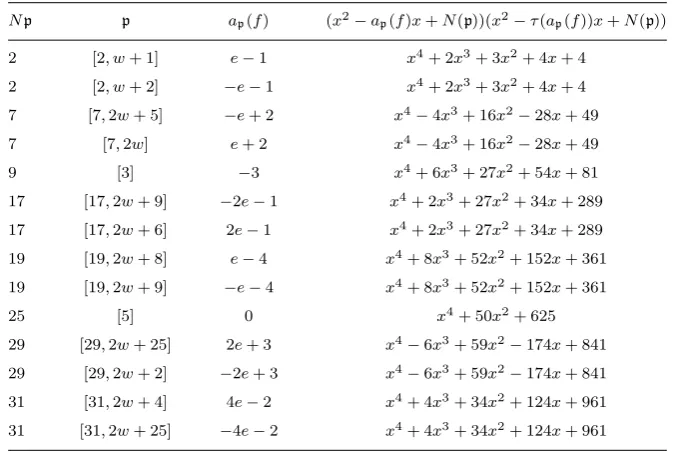
Table 2.Arithmetic data associated to the genuine Bianchi newformfof weight2and level (1)overQ(√−223).
Np p ap(f) (x2−ap(f)x+N(p))(x2−τ(ap(f))x+N(p))
2 [2, w+ 1] e−1 x4+ 2x3+ 3x2+ 4x+ 4 2 [2, w+ 2] −e−1 x4+ 2x3+ 3x2+ 4x+ 4 7 [7,2w+ 5] −e+ 2 x4−4x3+ 16x2−28x+ 49 7 [7,2w] e+ 2 x4−4x3+ 16x2−28x+ 49
9 [3] −3 x4+ 6x3+ 27x2+ 54x+ 81
17 [17,2w+ 9] −2e−1 x4+ 2x3+ 27x2+ 34x+ 289 17 [17,2w+ 6] 2e−1 x4+ 2x3+ 27x2+ 34x+ 289 19 [19,2w+ 8] e−4 x4+ 8x3+ 52x2+ 152x+ 361 19 [19,2w+ 9] −e−4 x4+ 8x3+ 52x2+ 152x+ 361
25 [5] 0 x4+ 50x2+ 625
29 [29,2w+ 25] 2e+ 3 x4−6x3+ 59x2−174x+ 841 29 [29,2w+ 2] −2e+ 3 x4−6x3+ 59x2−174x+ 841 31 [31,2w+ 4] 4e−2 x4+ 4x3+ 34x2+ 124x+ 961 31 [31,2w+ 25] −4e−2 x4+ 4x3+ 34x2+ 124x+ 961 Here,w= (1 +√−223)/2 ande=√2.
invariants
I2=−24, I4=−540, I6= 4968, I10= 4096.
SoA= Jac(C) has everywhere good reduction.
Remark 5.5. For the discriminants|D|= 415,1003, the class number ofLis 2. The same heuristics as in [9, Remark 8] suggest that the surface A is likely not principally polarized. Further, for|D|= 415,455,571,A does not have real multiplication by the maximal order in
L. So finding these surfaces will require working with more general Humbert surfaces for which no explicit models are yet available.
5.2. Proof of modularity
The above discussion already proves Theorem 5.2(a). We will now show that A is modular, hence completing the proof of the theorem. In fact, we already have strong evidence that this is the case. Indeed, letpbe a prime, andLp(A, s) (respectively,Lp(f, s) andLp(fτ, s)) be the Euler factor ofA(respectively,f andfτ) atp. As a built-in of our search method, we already know that for each primep listed in Table2, we have
Lp(A, s) =Lp(f, s)Lp(fτ, s) =Qp(Np−s)−1,
whereQp(x) := (1−ap(f)x+N(p)x2)(1−τ(ap(f))x+N(p)x2).
Letλ⊂ OL be a prime ideal. We recall that theλ-adic Tate module ofAis given by
Tλ(A) := lim←− n
A[λn] OL,λ× OL,λ,
whereOL,λ is the completion ofOL atλ, and
This is naturally endowed with an action of Gal(Q/K) giving rise to theλ-adic representation
ρA,λ: Gal(Q/K)−→GL2(OL,λ).
In the rest of this section, we will drop the reference to the prime in our notation as we are only interested in the primeλ=λ2 (above 2) for whichOL,λ2 =Z2[
√
2]. So our aim is to show that theλ2-adic Tate module
ρA: Gal(Q/K)−→GL2(Z2[√2])
is isomorphic to the representation
ρf : Gal(Q/K)−→GL2(Z2)
associated tof by work of Taylor et al.[3,21, 26, 37]. But, in order to do so, we must first determine the coefficient field ofρf.
Lemma 5.6. The coefficient field ofρf isQ2(√2), so we have
ρf : Gal(Q/K)−→GL2(Z2[√2]).
Proof. By construction, the image ofρf lies in an extension ofQ2of degree at most 4. The
prime 2 is split in K, and the eigenvalues of the Frobenii at the primes above it are distinct and do not add up to zero (see Table2), so by [37, Corollary 1] we can take the coefficient field
Lf to be the one given by the polynomial x4+ 2x3+ 3x2+ 4x+ 4. But, there are two split primes above 2 inLf, and the completion ofLf at either of them is isomorphic toQ2(√2). So
the image ofρf is in fact contained in GL2(Z2[√2]).
From Lemma5.6, we now have
ρA, ρf : Gal(Q/K)−→GL2(Z2[ √
2]).
We denote their reductions modulo 2 by ¯ρA and ¯ρf, respectively. We will show thatρA ρf
by making use of the following version of the so-called Faltings–Serre criterion [10,34].
Theorem 5.7 (Faltings–Serre). Let
ρ1, ρ2: Gal(Q/K)−→GL2(Z2)
be two continuous representations,whose reductions modulo2areρ¯1 andρ¯2. Suppose that
(i) det(ρ1) = det(ρ2);
(ii) ρ1 andρ2are unramified outside a finite set of primesS; (iii) ¯ρ1 andρ¯2are absolutely irreducible and isomorphic.
Then there exists a computablefinite set of primesT such thatρ1 ρ2 if and only if
Tr(ρ1(Frobp)) = Tr(ρ2(Frobp))
for allp∈T.
There is an explicit description of the setT,which we recall here for the sake of completeness (see [10] for more details on this). Assume that the image lies in GL2(F2), which will be the case in our example.
matrices with coefficients in F2. We note that this is a 2-group of order 8, and we consider the set of all extensionsMofM that are unramified outsideS, such thatMis Galois overK
and Gal(M /K ) M20(F2)Im(ρ1). Each suchMis a compositum of quadratic extensions of
M, so there is a canonical isomorphismϕM: Gal(M /K ) M20(F2)Im(ρ1). For algorithmic purpose, this set is determined explicitly using class field theory (see [10, Lemma 5.6]). For each
M, we then find a prime idealpM⊂ OK such that ϕM(FrobpM) = (A, B) with Tr(AB)= 0. The set{pM} thus obtained has the desired properties.
Proof of Theorem5.2(b). We will use Theorem 5.7to show thatρA ρf; hence thatAis modular.
We note that ρA and ρf are unramified away from λ2 (for ρf this uses the local–global compatibility results in [26]) so they satisfy (ii) withS={p|2}. Condition (i) is satisfied by
ρf sincef has trivial Nebentypus. It is satisfied byρA by basic properties of Tate modules. So we only need to check (iii), find the setT and show that
Tr(ρA(Frobp)) = Tr(ρf(Frobp)) for allp∈T.
Since OL/λ2=F2, Im(ρf) and Im(ρA) are both contained in GL2(F2) S3, whereS3 is the symmetric group on three elements.
Claim 5.8. Im(ρ
A) = Im(ρf) = GL2(F2). In particular, ¯ρA and ¯ρf are absolutely irre-ducible.
First, recall that Tr( ¯ρf(Frobp)) =ap(f) modλ2, and that since ρf is unramified away from 2, ¯ρf(Frobp) is either trivial or has order 3 for every odd prime p. In particular, for
p= (3), Tr( ¯ρf(Frobp)) =−3 = 1∈F2 implies that ¯ρf(Frobp) has order 3. Next, forp|2, the representationρf is ordinary atp, so the restriction of ¯ρf to the decomposition groupDpis of the form
¯
ρf|Dp∼
1 ∗ 0 1
modλ2.
If Im( ¯ρf|Dp) was trivial for both primes p|2, then ¯ρf would be unramified at 2 (and hence everywhere). In that case, the fixed field of ker( ¯ρf) would be an unramified cubic extension ofK, which is impossible since the class number ofK is 7. So Im(ρf) contains an element of order 2, hence Im(ρf) = GL2(F2). Similarly, one shows that Im(ρA) = GL2(F2).
Next, let Mf and MA be the Galois extensions of K cut out by ρf and ρA, respectively. ThenMAandMf areS3-extensions ofKramified atλ2 only. To check (iii), we will show that
there is a unique such extension. This will force the isomorphismMf MA.
LetNA andNf be the respective normal closures ofMAandMf overQ. Sincefσ =f mod
λ2, ¯ρf is a base change, so Gal(Nf/Q) Z/2Z×S3. Similarly, we have Gal(NA/Q) Z/2Z×
S3. So each extension comes from an S3-extension ofQwhich is unramified outside {2,223}. Now we will show that there is auniquesuchS3-extensionN/Q.
First, we observe that there are exactly seven possible quadratic subfields, given byQ(√d) with d=−1,2,−2,223,−223,2·223,−2·223. From Table 2, we know that Tr( ¯ρf(Frobp)) is odd for the primes above 3,17,29. The prime 3 is inert ford=−1,2,−223 and 2·223. The prime 29 is also inert ford=−2 and−2·223. So we deduce that the only possible quadratic subfield isQ(√223).
To see this, consider the following diagram:
N K=Mf
J J J J J J J J J J J J
N
l l l l l l l
Q(√223)
Q Q Q Q Q Q
Q K=Q(
√ −223)
jjjjjjjjjj
Q
and note that on the right the ramification index of 223 is 2. So the same holds on the left. Again using class field theory, we see that there is a unique such extensionN/Qgiven by the polynomial
x6−2x5−29x4+ 90x3−58x2−8x+ 8.
So ¯ρA ρ¯f and{ρA, ρf}satisfy all three hypotheses of Theorem5.7.
We conclude thatρf andρA are isomorphic using the same recipe as in [10]. For this, we need to compare the traces of the Frobenii at the primes in OK that lie above the rational primes in{3,5,7,19,29,31}. Since we already know that the traces for these particular primes match, we are done.
Acknowledgements. We would like to thank Xavier Guitart, Abhishek Saha and Neil Dummigan for useful conversations and comments. We are also grateful to Abhinav Kumar for kindly providing us with a preliminary version of his joint work with Elkies [11], and for many helpful email exchanges.
References
1. T. Arakawa, ‘Vector-valued Siegel’s modular forms of degree two and the associated Andrianov
L-functions’,Manuscripta Math.44 (1983) 155–185.
2. M. AsgariandR. Schmidt, ‘Siegel modular forms and representations’,Manuscripta Math.104 (2001) 173–200.
3. T. BergerandG. Harcos, ‘l-adic representations associated to modular forms over imaginary quadratic fields’,Int. Math. Res. Not.(2007) Art. ID rnm113, 16.
4. W. Bosma, J. CannonandC. Playoust, ‘The Magma algebra system. I. the user language’,J. Symbolic
Comput.24 (1997) 235–265.
5. A. BrumerandK. Kramer, ‘Paramodular abelian varieties of odd conductor’,Trans. Amer. Math. Soc. 366 (2014) 2463–2516.
6. C. J. Bushnell and G. Henniart, The local Langlands conjecture for GL(2), Grundlehren der Mathematischen Wissenschaften [Fundamental Principles of Mathematical Sciences] 335 (Springer, Berlin, 2006).
7. P.-S. Chan, ‘Invariant representations of GSp(2) under tensor product with a quadratic character’,Mem.
Amer. Math. Soc.204 (2010) vi+172.
8. J. E. Cremona, ‘Hyperbolic tessellations, modular symbols, and elliptic curves over complex quadratic fields’,Compos. Math.51 (1984) 275–324.
9. L. Demb´el´e andA. Kumar, ‘Examples of abelian surfaces with everywhere good reduction’, Preprint, 2013, arXiv:1309.3821.
10. L. Dieulefait, L. Guerberoffand A. Pacetti, ‘Proving modularity for a given elliptic curve over an imaginary quadratic field’,Math. Comp.79 (2010) 1145–1170.
11. N. ElkiesandA. Kumar, ‘K3 surfaces and equations for Hilbert modular surfaces’,Alg. Num. Theory8 (2014) 2297–2411.
13. D. Flath, ‘Decomposition of representations into tensor products’,Automorphic forms, representations
andL-functions(Proc. Sympos. Pure Math., Oregon State Univ., Corvallis, Ore., 1977), Part 1, Proceedings of Symposia in Pure Mathematics XXXIII (American Mathematical Society, Providence, RI, 1979) 179–183.
14. N. Freitas, B. V. Le HungandS. Siksek, ‘Elliptic curves over real quadratic fields are modular’,Invent.
Math.201 (2015) 159–206.
15. W. T. Gan andS. Takeda, ‘The local Langlands conjecture for GSp(4)’,Ann. of Math.(2) 173 (2011) 1841–1882.
16. E. Ghate, ‘Critical values of the twisted tensorl-function in the imaginary quadratic case’,Duke Math.
J.96 (1999) 595–638.
17. G. van der Geer, ‘Siegel modular forms and their applications’,The 1-2-3 of modular forms, Universitext (Springer, Berlin, 2008) 181–245.
18. J. Gonz´alez, J. Gu`ardiaand V. Rotger, ‘Abelian surfaces of GL2-type as Jacobians of curves’,Acta
Arith.116 (2005) 263–287.
19. F. Grunewald, H. Helling and J. Mennicke, ‘SL2 over complex quadratic number fields. I’, Algebra
Logika17 (1978) 512–580, 622.
20. G. Harder, ‘Eisenstein cohomology of arithmetic groups. The case GL2’, Invent. Math. 89 (1987) 37–118.
21. M. Harris, D. SoudryandR. Taylor, ‘l-adic representations associated to modular forms over imaginary quadratic fields. I. Lifting to GSp4(Q)’,Invent. Math.112 (1993) 377–411.
22. H. Hida, ‘On the critical values ofL-functions of GL(2) and GL(2)×GL(2)’, Duke Math. J.74 (1994) 431–529.
23. J. Johnson-Leung and B. Roberts, ‘Siegel modular forms of degree two attached to Hilbert modular forms’,J. Number Theory132 (2012) 543–564.
24. A. W. Knapp, ‘Local Langlands correspondence: the Archimedean case’,Motives (Seattle, WA, 1991), Proceedings of Symposia in Pure Mathematics 55 (American Mathematical Society, Providence, RI, 1994) 393–410.
25. M. Lingham, ‘Modular forms and elliptic curves over imaginary quadratic fields’, PhD Thesis, University of Nottingham, 2005.
26. C. P. Mok, ‘Galois representations attached to automorphic forms on GL2over CM fields’,Compos. Math. 150 (2014) 523–567.
27. C. PoorandS. D. Yuen, ‘Paramodular cusp forms’,Math. Comp.84 (2015) 1401–1438.
28. A. D. RahmandM. H. S¸ eng¨un, ‘On level one cuspidal Bianchi modular forms’,LMS J. Comput. Math. 16 (2013) 187–199.
29. B. Roberts, ‘GlobalL-packets for GSp(2) and theta lifts’,Doc. Math.6 (2001) 247–314 (electronic).
30. B. Roberts andR. Schmidt, ‘On modular forms for the paramodular groups’,Automorphic forms and
zeta functions(World Scientific Publishing, Hackensack, NJ, 2006) 334–364.
31. B. RobertsandR. Schmidt,Local newforms for GSp(4), Lecture Notes in Mathematics 1918 (Springer, Berlin, 2007).
32. A. Saha, ‘On ratios of Petersson norms for Yoshida lifts’,Forum Math. (2015), to appear, doi: 10.1515/ forum-2013-0093.
33. A. Saha and R. Schmidt, ‘Yoshida lifts and simultaneous non-vanishing of dihedral twists of modular
L-functions’,J. London Math. Soc.(2) 88 (2013) 251–270.
34. J.-P. Serre,R´esum´e des cours de1984–1985 (Annuaire du Coll`ege de France, Paris, 1985) 85–90.
35. S. Takeda, ‘Some local-global non-vanishing results for theta lifts from orthogonal groups’,Trans. Amer.
Math. Soc.361 (2009) 5575–5599.
36. S. Takeda, ‘Some local-global non-vanishing results of theta lifts for symplectic-orthogonal dual pairs’,
J. reine angew. Math.657 (2011) 81–111.
37. R. Taylor, ‘l-adic representations associated to modular forms over imaginary quadratic fields. II’,Invent.
Math.116 (1994) 619–643.
38. R. Taylor, ‘Representations of Galois groups associated to modular forms’, Proceedings of the
International Congress of Mathematicians, Vol. 1, 2 (Z¨urich, 1994) (Birkh¨auser, Basel, 1995) 435–442.
39. E. Urban, ‘Module de congruences pour GL(2) d’un corps imaginaire quadratique et th´eorie d’Iwasawa d’un corps CM biquadratique’,Duke Math. J.92 (1998) 179–220.
40. D. Yasaki, ‘Hyperbolic tessellations associated to Bianchi groups’,Algorithmic number theory, Lecture Notes in Computer Science 6197 (Springer, Berlin, 2011) 385–396.
Tobias Berger
School of Mathematics and Statistics University of Sheffield
Hicks Building Hounsfield Road Sheffield
S3 7RH
United Kingdom
t·t·berger@sheffield·ac·uk
Lassina Demb´el´e Mathematics Institute University of Warwick Zeeman Building Coventry
CV4 7AL United Kingdom
l·dembele@warwick·ac·uk
Ariel Pacetti
Departamento de Matem´atica Universidad de Buenos Aires Ciudad Universitaria and IMAS 1428 Buenos Aires
Argentina
apacetti@dm·uba·ar
Mehmet Haluk S¸eng¨un
School of Mathematics and Statistics University of Sheffield
Hicks Building Sheffield S3 7RH
United Kingdom
M·Sengun@sheffield·ac·uk
![Table 1. Genuine Bianchi newforms of weight√ 2 over Q(D) found in [28].](https://thumb-us.123doks.com/thumbv2/123dok_us/7870120.181825/12.544.99.435.99.161/table-genuine-bianchi-newforms-weight-q-d.webp)