ISSN Online: 2333-9721 ISSN Print: 2333-9705
DOI: 10.4236/oalib.1104847 Sep. 11, 2018 1 Open Access Library Journal
Insight or Originality: A Spray in the River of
Creative Thinking
Yan Wang
1*, Qinlong Hou
21Ming Zheng Judicial Expertise Center, Jilin, China
2The Clinical Immunology Research Center, Beihua University, Jilin, China
Abstract
One synthetic model of creativity was proposed, which tried to unify the dis-pute whether creativity was domain generality or specificity by supporting domain generality-specificity duality. The creative thinking process included convergent thinking, divergent thinking and insight (originality).
Subject Areas
PsychologyKeywords
Creativity, Convergent Thinking, Divergent Thinking, Insight, Originality
1. Introduction
Creativity refers to the ability of individuals to use known information to pro-duce new and unique products with social value. It is the psychological quality necessary for successfully completing some creative activity. In our lives creativ-ity has clear benefits for individuals and society in many aspects, such as: Music, painting, dance, mathematics, architecture and so on. However, is creativity a cognitive process of domain generality or specificity? This debate has been going on for decades and is supported by a number of empirical studies. Nowadays, it has become increasingly clear that creativity is not a single ability, but a combi-nation of abilities and other aspects. Researchers gradually abandoned the “sin-gle dimensional creativity theory”, and gradually constructed a system view of creativity, which led to the development of creativity research to “mul-ti-dimensional orientation” and “polymerization model”. Sternberg and Lubart’s creative investment theory [1] argued that creative activities included intelli-How to cite this paper: Wang, Y. and
Hou, Q.L. (2018) Insight or Originality: A Spray in the River of Creative Thinking. Open Access Library Journal, 5: e4847. https://doi.org/10.4236/oalib.1104847
Received: August 17, 2018 Accepted: September 8, 2018 Published: September 11, 2018
Copyright © 2018 by authors and Open Access Library Inc.
This work is licensed under the Creative Commons Attribution International License (CC BY 4.0).
DOI: 10.4236/oalib.1104847 2 Open Access Library Journal gence, knowledge, thinking style, personality, motivation, and environment. In-telligence consisted of three elements: comprehensive ability, analytical ability and practical ability. The analytical and practical ability was more obvious field-general, and the comprehensive ability was field-special in a sense; know-ledge was strong field-special; thinking style was relatively weak field-special; personality traits showed its particularity in different areas; environment also had different effects on different areas. The theory provides a unique perspective to study the particularity of the creative field. Simonton [2] pointed out that the domain-specific supporters didn’t see creativity phenomenon at the abstract lev-el. He believed that the blind variation and selective retention theory could eliminate the dispute. They also indicate that we can not simply think that crea-tivity is field-special or field-general; on the contrary, this problem is more com-plicated.
2. Divergent Thinking (DT) and Convergent Thinking (CT)
with Chunk Theory
The notion of divergent thinking (DT) was initiated by Guilford within his structure of intellect model, which describes the process that ideas are produced by searching for multiple possibilities as opposed to convergent thinking (CT) which defines the way to solve problem by looking for one correct solution [3] [4]. The DT explores the ability (or potential) to generate multiple solutions to an open-ended problem that does not have a right or wrong answer and to pro-duce many ideas from a starting point. On the contrary, the CT reorganizes all kinds of information, which is characterized by the consistency of thinking in the same direction and the orderliness, conciseness, logic and regularity of thinking.
The DT approach is likely the most frequently used among theory-based ap-proaches of creativity. Webb et al. [5] investigated different influence of conver-gent thinking and diverconver-gent thinking to solving insight and non-insight prob-lems. They found a surprisingly weak relationship between divergent thinking and insight problem solving; however, convergent thinking had a stronger rela-tionship with problem solving. As a conclusion, convergent thinking will also promote problem solving. Usually DT and CT both are used among human’s creative activity.
be-DOI: 10.4236/oalib.1104847 3 Open Access Library Journal tween the overflowing water and object’s volume. In fact, very often new ideas are generated in response to constrains or needs that must be resolved.
Psychologists have long found that “chunking” information is the key to effi-cient cognitive ability, but it can also become a barrier to our thinking. Chunk decomposition refers to decompose familiar patterns into their component ele-ments so that they can be regrouped in a meaningful manner. It is a creative process that can lead into insight [6].
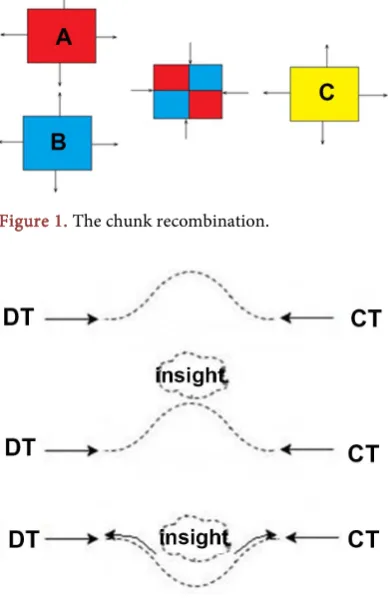
Building on these ideas, we put out one idea about chunk recombination (see
Figure 1) in creative thinking process. In normal state, chunk A (question) and chunk B (knowledge) both are in one balanced state under two strands of power (DT and CT). DT help chunk keep relationship with other chunks, and CT keep chunk in one completed state. When people find new contact between chunk A (question) and chunk B (knowledge) under power of DT, their new relationship will setup, and begin to chunk recombination (CT), and finally reach to one new chunk C (DT and CT), which in one new balanced state. The whole process mostly happened in a moment and suddenly.
3. Originality and Divergent Thinking (DT) with Creative
Insight
By examining several characteristics of the products of the task, the DT ap-proach permits the exploration of creative processes. Typically, DT tasks are scored for fluency (number of relevant productions), flexibility (number of dif-ferent categories of productions), originality (number of unusual productions), and elaboration (the degree of enrichment of productions).
Kleibeuker et al. [7] examined developmental trajectories of creative cognition across adolescence. The two older age groups (18/19 years and 25/30 years) out-performed the two younger age groups (12/13 years and 15/16 years) on insight tasks. The older age group (25/30 years) performed better than the two youngest age groups on verbal divergent thinking originality. No age-group differences were observed for the fluency and flexibility measure of verbal divergent think-ing. Chavez-Eakle et al. [8] found fluency and flexibility strongly correlated with cerebral blood flow (CBF) in left inferior frontal gyrus. Originality correlated with CBF in left superior temporal gyrus (STG) and cerebellar tonsil. Jung-Beeman
et al. [9] found a sudden high frequency γ wave originated from the right
supe-rior temporal gyrus (STG) at 0.3 second before insight production by EEG. They concluded the right STG was associated with establishing a connection between the originally irrelevant information. To sum up, insight has similar develop-mental trajectories and brain activity as originality, which is different from di-vergent thinking (fluency and flexibility). Originality or insight is the third factor except for divergent thinking and convergent thinking, and plays a pivotal role in creative thinking process.
DOI: 10.4236/oalib.1104847 4 Open Access Library Journal
Figure 1. The chunk recombination.
Figure 2. The creative thinking process.
interaction of convergent thinking’s convergence effect and divergent thinking’s diffusion effect, aroused a blossoming spray thinking (insight), which is the es-sence of human creative thinking. The spray either sublimate into a new idea (product), or fall down to stir up the ripples of the thinking river, and inspire new thinking waves. Estabrooks and Couch [10] revealed student’s preference to characterize creative failure as a part of a larger process of inventing rather than to denote failure as an end point.
4. One Synthetic Model of Creativity
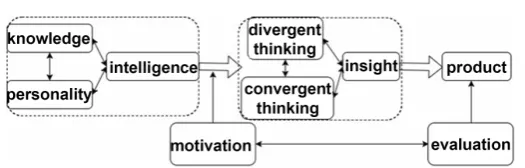
Based on the above, the author proposed one synthetic model of creativity (Figure 3). In this model, there are five main parts: individual reserve, thinking process, motivation, product and evaluation. The individual reserve includes personality (such as interests, hobbies, curiosity, perseverance and the physical conditions and so on), knowledge (such as mathematics, geography, biology, music and so on) and intelligence (such as observation, memory, comprehen-sion, reasoning, expression and so on). The motivation comes from the sur-rounding environment, the educational or social requirements and individual need. The evaluation includes the community evaluation or self-evaluation on individual’s creative products.
[image:4.595.277.473.83.383.2]DOI: 10.4236/oalib.1104847 5 Open Access Library Journal
Figure 3. The synthetic model of creativity.
produce much divergent thinking and find one insight into one thing and keep on it. For another thing, each person has much different intelligence and know-ledge, such as language, logic mathematics, space, nature, interpersonal, body-movement, music and self-awareness. One person may have more musical intelligence and he would create a new piece of music. In the process, his musi-cal intelligence and knowledge plays a more important role, but his other intel-ligence and knowledge may also participate in. In a world, one’s creative process (convergent thinking, divergent thinking, insight) is similar at the level of ab-straction, however, the individual reserve used are different.
There are two questions we need to consider. The first is that the moment in-sight usually means to one new idea relative to individual at the abstract level. However, every insight would not equal to originality every time, that is not every “new” idea is creativity. Therefore, to some extent, originality is an index as insight in the synthetic model of creativity. In the future, we will continue to study the combination of creative thinking test and insight task. The second is that it is believed that insight is a necessary factor in our creative thinking process, except of convergent thinking and divergent thinking. Our creativity thinking process is one connection between freedom and control. Only conflict between them can produce beautiful “spray”—originality. The process also is one dynamitic process to be more deep and perfect during conflict and evalua-tion by oneself or community. Mayseless et al. [11] has proposed one dual mode of creativity based on neural unpinning of originality, which supported the syn-thetic model of creativity from neural mechanism. Therefore, we should put more attention to how the conflict between the convergent and divergent think-ing produce insight, and how evaluation play a role.
5. Conclusions
One synthetic model of creativity was put forward which supported domain ge-nerality-specificity duality. The creative thinking process was discussed in detail from a new perspective. Originality or insight is the third factor except for di-vergent thinking and condi-vergent thinking, and plays a pivotal role in creative thinking process. Just like two strands of power, DT breaks assumptions and rules, while CT keeps the boundaries and constraints. The conflict between them can produce beautiful “spray”—insight (originality).
DOI: 10.4236/oalib.1104847 6 Open Access Library Journal future work will design relevant experiments to verify the theory and further improve the theory.
Conflicts of Interest
The authors declare no conflicts of interest regarding the publication of this pa-per.
References
[1] Sternberg, R.J. and Lubart, T.I. (1996) Investing in Creativity. American Psycholo-gist, 51, 677-688. https://doi.org/10.1037/0003-066X.51.7.677
[2] Simonton, D.K. (2012) Teaching Creativity: Current Findings, Trends, and Con-troversies in the Psychology of Creativity. Teaching of Psychology, 39, 217-222. https://doi.org/10.1177/0098628312450444
[3] Guilford, J.P. (1950) Creativity. American Psychologist, 5, 444-454. https://doi.org/10.1037/h0063487
[4] Guilford, J.P. (1967) The Nature of Human Intelligence. McGraw-Hill.
[5] Webb, M.E., Little, D.R., Cropper, S.J. and Roze, K. (2017) The Contributions of Convergent Thinking, Divergent Thinking, and Schizotypy to Solving Insight and Non-Insight Problems. Thinking & Reasoning, 23, 235-258.
https://doi.org/10.1080/13546783.2017.1295105
[6] Knoblich, G. and Ohlsson, S. (1999) Constraint Relaxation and Chunk Decomposi-tion in Insight Problem Solving. Journal of Experimental Psychology Learning Memory & Cognition, 25, 1534-1555. https://doi.org/10.1037/0278-7393.25.6.1534 [7] Kleibeuker, S.W., De Dreu, C.K.W. and Crone, E.A. (2013) The Development of
Creative Cognition across Adolescence: Distinct Trajectories for Insight and Diver-gent Thinking. Developmental Science, 16, 2-12.
https://doi.org/10.1111/j.1467-7687.2012.01176.x
[8] Chavez-Eakle, R., Graff-Guerrero, A.R.J., Vaugier, V. and Cruz-Fuentes, C. (2007) Cerebral Blood Flow Associated with Creative Performance: A Comparative Study. NeuroImage, 38, 519-528.https://doi.org/10.1016/j.neuroimage.2007.07.059
[9] Jung-Beeman, M., Bowden, E.M., Haberman, J., Frymiare, J.L., Arambel-Liu, S., Greenblatt, R., Reber, P.J. and Kounios, J. (2004) Neural Activity When People Solve Verbal Problems with Insight. Plos Biology, 2, 500-510.
https://doi.org/10.1371/journal.pbio.0020097
[10] Estabrooks, L.B. and Couch, S.R. (2018) Failure as an Active Agent in the Develop-ment of Creative and Inventive Mindsets. Thinking Skills & Creativity. (Article in Press) https://doi.org/10.1016/j.tsc.2018.02.015
[11] Mayseless, N., Eran, A. and Shamay-Tsoory, S.G. (2015) Generating Original Ideas: The Neural Underpinnings of Originality. Neuroimage, 116, 232-239.