A simple piecewise cubic spline method for
approximation of highly nonlinear data
Mehdi Zamani
Civil Engineering Department, Faculty of Technical and Engineering, Yasouj University, Yasouj, Iran; [email protected]
Received 14 September 2011; revised 20 October 2011; accepted 30 October 2011
ABSTRACT
Approximation methods are used in the analysis and prediction of data, especially laboratory data, in engineering projects. These methods are usu-ally linear and are obtained by least-square-error approaches. There are many problems in which linear models cannot be applied. Because of that there are logarithmic, exponential and polynomial curve-fitting models. These nonlinear models have a limited application in engineering prob-lems. The variation of most data is such that the nonlinearity cannot be approximated by the ab- ove approaches. These methods are also not ap-plicable when there is a large amount of data. For these reasons, a method of piecewise cubic sp- line approximation has been developed. The mo- del presented here is capable of following the local nonuniformity of data in order to obtain a good fit of a curve to the data. There is C1 conti-nuity at the limits of the piecewise elements. The model is tested and examined with four problems here. The results show that the model can ap-proximate highly nonlinear data efficiently.
Keywords:Simulation; Data analysis;
Approximation; Cubic Spline; Optimization; Curve Fitting
1. INTRODUCTION
There are many cases in engineering activities in which one is confronted with laboratory or field data. Suppose there are n pairs of data values (xi, yi), where these values are obtained from experimental, field or statistical analysis. The aim is to find a function f(x) that
predicts acceptable values for the dependent variable y
with respect to the independent variable x. There are
al-ways some errors in the experimental analysis, and in the sensitivity and calibration of measuring instruments, and therefore the values of yi are not exact. Also, sometimes there exist multiple values for yi for each value of xi. In
such situations, if the curve of f(x) passes between and
near to the data points, it is more accurate and smoother than when it passes through all the points exactly. Thus, in those cases an approximate analysis is more suitable for predicting and assigning the y values. If the curve
governing f(x) were instead to interpolate such data, it
would have a sinusoidal or unsmoothed zigzag form that would not be acceptable and would not be usable for data analysis. Most of the publications about this subject are related mainly to linear or simple nonlinear models [1-4]. Some more advanced methods in this field are based on B-spline and Bézier curves [5-7]. These methods are used most for computer graphic. Because of the waviness and the sinusoidal forms of their curves, they are not applicable to engineering problems.
2. FORMULATION
Formulation of ProblemIf the variation of the data follows a simple nonlinear curve, a single cubic spline function can be applied in the form of the following equation:
2 d
S a bxcx x3
i
i
i
. (1) The parameters a, b, c and d are obtained by the
method of least-square-error approximation from the solution of the following system of equations:
2 3
1 1 1 1
2 3 4
1 1 1 1 1
2 3 4 5 2
1 1 1 1 1
3 4 5 6 3
1 1 1 1 1
n n n n
i i i i
i i i i
n n n n n
i i i i i
i i i i i
n n n n n
i i i i i
i i i i i
n n n n n
i i i i i
i i i i i
n x x x y
a
x x x x x y
b c
x x x x x y
d
x x x x x y
, (2)
where n is the number of pairs of data values in the
in-terval [a, b]. In the case of the nonuniform variation of
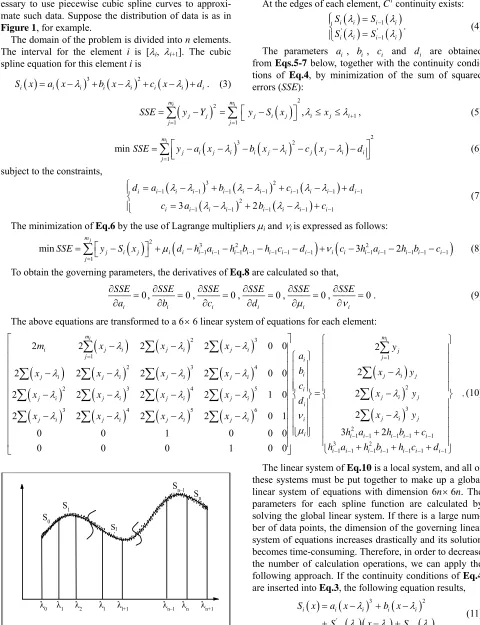
nec-essary to use piecewise cubic spline curves to approxi-mate such data. Suppose the distribution of data is as in
Figure 1, for example.
The domain of the problem is divided into n elements.
The interval for the element i is [i, i+1]. The cubic
spline equation for this element i is
3
2
i i i i i i i
S x a x b x c x d
At the edges of each element, C1 continuity exists:
1
' '
1
i i i i
i i i i
S S S S
. (4)
The parameters i , i, i and i are obtained from Eqs.5-7 below, together with the continuity
condi-tions of Eq.4, by minimization of the sum of squared
errors (SSE):
a b c d
i. (3)
2
21
1 1
,
i i
m m
j j j i j i j
j j
SSE y Y y S x x i
, (5)
3
2
21
min mi j i j i i j i j j i i
j
SSE y a x b x c x d
(6) subject to the constraints,
3 2
1 1 1 1 1 1
2
1 1 1 1 1
3 2
i i i i i i i i i i i
i i i i i i i i
d a b c d
c a b c
1
(7)The minimization of Eq.6 by the use of Lagrange multipliers i and iis expressed as follows:
2
3 2 2
1 1 1 1 1 1 1 1 1 1 1 1
1
min j 3 2
m
j i j i i i i i i i i i i i i i i i i
j
SSE y S x d h a h b h c d c h a h b c
(8)To obtain the governing parameters, the derivatives of Eq.8 are calculated so that,
0, 0 , 0 , 0 , 0 , 0
i i i i i i
SSE SSE SSE SSE SSE SSE
a b c d
. (9)
The above equations are transformed to a 66 linear system of equations for each element:
2 3 12 3 4
2 3 4 5
3 4 5 6
2 2 2 2 0 0
2 2 2 2 0 0
2 2 2 2 1 0
2 2 2 2 0 1
0 0 1 0 0 0
0 0 0 1 0 0
i
m
i j i j i j i
j
i
i
j i j i j i j i
i
j i j i j i j i
i
i
j i j i j i j i
i
m x x x
a b
x x x x
c
x x x x
d
x x x x
1 2 3 21 1 1 1 1
3 2
1 1 1 1 1 1 1
2 2 . 2 2 3 2 i m j j
j i j
j i j
j i j
i i i i i
i i i i i i i
y
x y x y x y h a h b c h a h b h c d
(10) S0 S1 Si Sn–1 Snλ0 λ1 λ2 λl λl+1 λn–1 λn λn+1
Sl
Figure 1. Behavior of a distribution of nonuniform data.
The linear system of Eq.10 is a local system, and all of
these systems must be put together to make up a global linear system of equations with dimension 6n6n. The
parameters for each spline function are calculated by solving the global linear system. If there is a large num-ber of data points, the dimension of the governing linear system of equations increases drastically and its solution becomes time-consuming. Therefore, in order to decrease the number of calculation operations, we can apply the following approach. If the continuity conditions of Eq.4
are inserted into Eq.3, the following equation results,
3 2 ' 1 1i i i i i
i i i i i
S x a x b x
S x S
(11)
The values of Si1
i and Si1
i'
equation can be calculated numerically, taking account of the form of the variation of the data. Thus, the four pa-rameters of Eq.11 are reduced to two. This decreases the
number of related calculation operations by a large amount. Then, by optimizing the sum of squared errors, the parameters ai and bi can be obtained from the fol-lowing equation:
22 12 1
2
12 11 2
11 22 12
1 i
i
b a a f
a a a a a a f
, (12)
in which
4 11
1
5 12
1
6 22
1 j
j
j
m
j i j
m
j i j
m
j i j
a x
a x
a x
(13)
and Eq.14 (see the bottom of the page).
The boundary conditions for Eq.11 are s0
0 and
' 0 0
s . Four problems were selected for verification and
examination of the model presented here.
3. PROBLEMS
3.1. Problem 1About 41 pairs of data values
x yi, i
were generated from the following equation,
lnln
3 7 sin
x
r x
x
f x x
x
, (15)
where r is a uniform random number between 0 and 1. For simplicity and to reduce the number of calculations, two cubic spline elements were used. Figure 2 illustrates
the data distribution for the interval [1,5]. As can be seen, there is a good relationship between the piecewise cubic spline curves and the set of data. Therefore the model that we have developed can satisfactorily approximate this set of data.
3.2. Problem 2
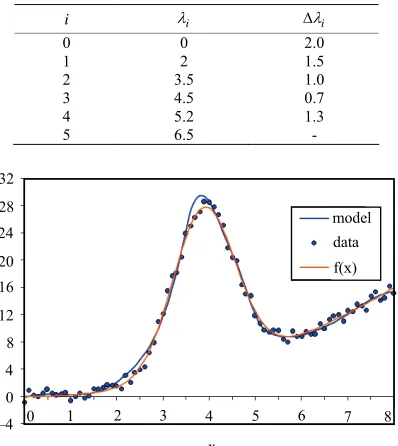
This example consisted of 81 pairs of data values on the interval [0, 8]. These were generated from the fol-lowing equation:
3
2 7 10
0.5 x x 0.25 r
f x x e x
Nonuniform elements were applied here because of the complexity and heterogeneity of the data distribution. The locations of the element boundaries are listed in Ta-ble 1. Figure 3 illustrates the data distribution and the
calculated piecewise spline curve. As can be observed from the graph, there is a satisfactorily close relationship between the data and the curve.
3.3. Problem 3
For this problem, about 76 pairs of data values were generated from the following equation [8] on the interval [1,3] with nonuniform xi
8 7 6
6 5
5 4
4 3
3 2
2 1
1 0
0
x
[image:3.595.57.288.171.318.2]data f(x) model
Figure 2. Comparison between spline curves and real data.
Table 1. Characteristics of the spline curve elements.
i i i
0 1 2 3 4 5
0 2 3.5 4.5 5.2 6.5
2.0 1.5 1.0 0.7 1.3 -
8 7 8
6 24
28 32
5 4
–4 4
20
3 16
2 12
1 0
0
x
data f(x) model
. (16) Figure 3. Comparison between real data and model.
3 2
'
1 1 1
1 1 1
4 3
'
2 1 1
1 1 1
i i i
i i i
m m m
i i j i i i j i j i j
j j j
m m m
i i j i i i j i j i j
j j j
2
3
f S x S x x y
f S x S x x
y [image:3.595.320.526.248.369.2] [image:3.595.325.524.414.637.2]
2100 10
sin r
f x
x
x
. (17)
The above equation is highly nonlinear and its varia-tion is heterogeneous. A cubic spline curve consisting of eight pieces was developed for this example, based on the characteristics of the elements listed in Table 2. Fig-ure 4 shows a comparison between the spline curve and
the data for this test problem. The figure shows that there is a very close superimposition between the model and the governing data.
3.4. Problem 4
This problem is in the field of groundwater engineer-ing. Theis solution for the nonequilibrium partial differ-ential equation for unsteady radial flow from confined aquifer to pumping well is:
0 4π d
u
u
Q e
h h u
T u
(18)Thies approximated the above equation by the follow-ing series:
2 3
0 0.7772
4π 2.2! 3.3!
Q u
h h Ln u u T
u
(19)
The value of brackets equals W(u) well function. The
data for approximation have logarithm value of W(u)
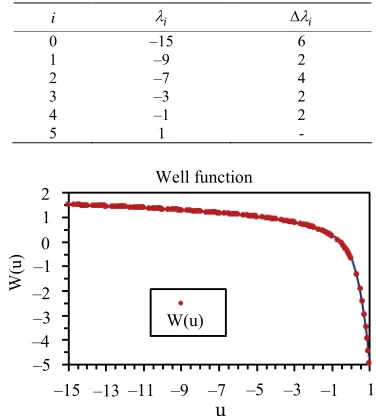
respect to logarithm value of u [9]. A cubic spline curve
[image:4.595.327.515.101.309.2]consisting of five pieces was developed for this problem, based on the characteristics of the elements listed in Ta-ble 3. Figure 5 illustrates the data distribution for the
Table 2. Characteristics of the spline curve elements.
i i i
0 1 2 3 4 5 6 7 8
1.00 1.11 1.36 1.54 1.72 1.84 1.96 2.44 3.00
0.11 0.25 0.18 0.18 0.12 0.12 0.48 0.56 -
0.8 70 60 50 40 30 20 10
–10 –20 –30 –40 –50 –60
3 3.2 2 2.2 2.4 2.6 2.8 1
1.2 1.4 1.6 1.8 0
x data f(x)
model
Figure 4. Comparison between real data and model.
Table 3. Characteristics of the spline curve elements.
i i i
0 1 2 3 4 5
–15 –9 –7 –3 –1 1
6 2 4 2 2 -
–1
–1 –2
–3
–3 –4
–5 –5
–7 –9 –11 –13 –15 2
1 1
0
u
W(u)
W(
u)
Well function
Figure 5. Comparison between real data and model.
interval [−15, 1]. According to the graph, there is an ac-ceptable close relationship between the data and the cu-bic spline curve.
4. RESULTS AND CONCLUSIONS
The model presented above for the approximation of data with highly nonlinear variation can be applied effi-ciently to various engineering problems. Because the model’s formulation is straightforward and explicit, there is no need to establish and solve any linear system of equations. Therefore; the number of calculation opera-tions related to the generation of piecewise cubic curves is noticeably less than that for other classical methods of approximation. I suggest that this formulation and model could be extended to two-dimensional approximation analysis. For this purpose, more attention must be paid to defining the formulation accurately, especially the satis-faction of the continuity conditions at the boundaries between elements or patches.
REFERENCES
[1] De Boor, C. (1978) A practical guide to splines. Springer-
Verlag, Berlin, 472.
doi:10.1007/978-1-4612-6333-3
[2] Conte, S.D. and De Boor, C. (1980) Elementary
numeri-cal analysis: An algorithm approach. 3rd Edition, McGraw- Hill, Auckland, 432.
[3] Lobo, N.A. (1995) Curve fitting using spline sections of
different orders. Proceedings of the 1st International Ma- thematica Symposium, Southampton, 16-20 July, 267-
274.
[image:4.595.77.270.477.714.2]ap-proximation and interpolation of data. Contemporary En-gineering Sciences Journal, 2, 373-381.
[5] Lehmann, T.M., Gonner, C. and Spitzer, K. (2001) B-
spline interpolation in medical image processing. IEEE
Transactions on Medical Imaging, 20, 660-665. doi:10.1109/42.932749
[6] Salomon, D. (2006) Curves and surfaces for computer
graphics. Springer, Northridge, 460.
[7] Zamani, M. (2009) An investigation of Bspline and
Bezier methods for interpolation of data. Contemporary
Engineering Sciences Journal, 2, 361-371.
[8] Burden, R.L. and Fairs, J.D. (1989) Numerical analysis.
4th Edition, PWS-Kent, Boston, 730.
[9] Todd, D.K. (1980) Groundwater hydrology. 2nd Edition,