IN VIVO STUDY TO COMPARATIVELY EVALUATE PAIN THRESHOLD, EFFICACY AND
PROCEDURE TIME TAKEN BY VARIOUS CARIES REMOVAL METHODS IN
CHILDREN BETWEEN 7
*Dr. Rohan Shah, Dr. Shashibhushan
Dr.
Bharti Vidyapeeth Dental College and hospital, Pune
ARTICLE INFO ABSTRACT
Aims: treatment
Design, Methods and Material:
lesions involving occlusal surface of primary or permanent teeth, without pain and pulpal involvement were randomly assigned to 3 treatment groups
instrument like a sharp spoon excavator. Conventional restorative treatment
round diamond bur and straight diamond fissure bur with adequate coolant. Chemo method where cariou
using a sharp spoon excavator. The procedure was repeated until the gel no longer became cloudy and all cavity surfaces were hard on probing. Caries detecting dye was applied f
efficacy was compared clinically by using the scale given by Erickson et.al. At the end of each excavation, children were shown the Wong
their feelings regarding the treatmen
was used for objective evaluation of the children’s reaction during excavation of carious lesion. Procedure time was recorded from the beginning until the restoration was completed. Caries fre lesions were restored using restorative Glass ionomer Cement
Statistical analysis used: hoc and Kruskallwallis Test. Results:
removal was the maximum with Chemo reported to be highest with CRT Conclusions:
response.
Copyright © 2016, Rohan Shah et al. This is an open access article distributed under the Creative Commons Att distribution, and reproduction in any medium, provided the original work is properly cited.
INTRODUCTION
The fear of visiting the dentist usually outweighs the suffering. Pain is frequently associated with dental treatment especially in pediatric dentistry (De Menezes Abreu
Children consider caries removal to be very unpleasant. In spite of developments in dental materials and anesthesia, children are still fearful of the pain during dental treatment more than often; this fear is due to pain/discomfort,
and the use of the drill during caries removal 2003).
*Corresponding author: Dr. Rohan Shah,
Bharti Vidyapeeth Dental College and hospital, Pune, India
ISSN: 0975-833X
Article History:
Received 19th December, 2015
Received in revised form 20th January, 2016
Accepted 15th February, 2016
Published online 31st March,2016
Key words: CRT, ART, Chemo-mechanical method, Carisolv, VAS, MBPS.
Citation: Dr. Rohan Shah, Dr. Shashibhushan, K.K., Dr. Sathyajith Naik, Dr. Subba Reddy, V.V., Dr. Poornima, P. and Dr. Jooie Joshi vivo study to comparatively evaluate pain threshold, efficacy and procedure time taken by various caries removal methods in C
age group”, International Journal of Current Research, 8, (0
RESEARCH ARTICLE
IN VIVO STUDY TO COMPARATIVELY EVALUATE PAIN THRESHOLD, EFFICACY AND
PROCEDURE TIME TAKEN BY VARIOUS CARIES REMOVAL METHODS IN
CHILDREN BETWEEN 7-12 YEARS OF AGE GROUP
Dr. Rohan Shah, Dr. Shashibhushan, K.K., Dr. Sathyajith Naik, Dr. Subba Reddy, V.V.,
. Poornima, P. and Dr. Jooie Joshi
Bharti Vidyapeeth Dental College and hospital, Pune, India
ABSTRACT
To compare the pain threshold, efficacy and procedure time taken using Atraumatic restorative treatment (ART), Chemo-mechanical & Conventional restorative treatment
Design, Methods and Material: 7-12 year old pediatric patients with at least three cavitated dentinal lesions involving occlusal surface of primary or permanent teeth, without pain and pulpal involvement were randomly assigned to 3 treatment groups- Atraumatic restorative treatment
instrument like a sharp spoon excavator. Conventional restorative treatment
round diamond bur and straight diamond fissure bur with adequate coolant. Chemo
method where carious lesions were covered with CarisolvTM gel and gently removed after 30 seconds using a sharp spoon excavator. The procedure was repeated until the gel no longer became cloudy and all cavity surfaces were hard on probing. Caries detecting dye was applied f
efficacy was compared clinically by using the scale given by Erickson et.al. At the end of each excavation, children were shown the Wong-Baker scale, and asked to point the picture best describing their feelings regarding the treatment they just received. The Modified Behavioral Pain Scale (MBPS) was used for objective evaluation of the children’s reaction during excavation of carious lesion. Procedure time was recorded from the beginning until the restoration was completed. Caries fre lesions were restored using restorative Glass ionomer Cement
Statistical analysis used: Statistical data was analyzed by using ANOVA, Chi Square, Tukeys post hoc and Kruskallwallis Test.
Results: The highest efficacy in caries removal was exhibited by
removal was the maximum with Chemo-mechanical method and Pain experienced by the patients was reported to be highest with CRT
Conclusions: Conventional Rotary Method showed highest efficacy in caries removal & pain response. Chemo-mechanical method exhibited least pain but required more procedure time.
is an open access article distributed under the Creative Commons Attribution License, which distribution, and reproduction in any medium, provided the original work is properly cited.
The fear of visiting the dentist usually outweighs the suffering. Pain is frequently associated with dental treatment especially Abreu et al., 2009). Children consider caries removal to be very unpleasant. In spite of developments in dental materials and anesthesia, children are still fearful of the pain during dental treatment more than often; this fear is due to pain/discomfort, injection and the use of the drill during caries removal (Schriks et al.,
Bharti Vidyapeeth Dental College and hospital, Pune, India.
Pain being a highly subjective and individualistic response, the patient plays a major role in how much pain is felt. Stoic, controlled patients may bear even the most unpleasant procedures quietly while highly hysteric patients might jump even if you touch them. The instruments, materials and armamentarium used in dent
caustic chemicals, improperly handled hand instruments and ironically the anesthetic needle itself are associated with pain responses. Heat and pressure play an important role in these mechanisms. The excessive noise of the dr
damage and vibration is unpleasant to the patient. Here is when minimally invasive techniques for caries removal which are more acceptable to patients and clinically sound are required (Schriks et al., 2003).
International Journal of Current Research
Vol. 8, Issue, 03, pp. 28610-28615, March, 2016
Dr. Rohan Shah, Dr. Shashibhushan, K.K., Dr. Sathyajith Naik, Dr. Subba Reddy, V.V., Dr. Poornima, P. and Dr. Jooie Joshi vivo study to comparatively evaluate pain threshold, efficacy and procedure time taken by various caries removal methods in C
”, International Journal of Current Research, 8, (03), 28610-28615.
IN VIVO STUDY TO COMPARATIVELY EVALUATE PAIN THRESHOLD, EFFICACY AND
PROCEDURE TIME TAKEN BY VARIOUS CARIES REMOVAL METHODS IN
12 YEARS OF AGE GROUP
Subba Reddy, V.V.,
, India
To compare the pain threshold, efficacy and procedure time taken using Atraumatic restorative mechanical & Conventional restorative treatment (CRT).
12 year old pediatric patients with at least three cavitated dentinal lesions involving occlusal surface of primary or permanent teeth, without pain and pulpal involvement atic restorative treatment (ART) using a hand instrument like a sharp spoon excavator. Conventional restorative treatment (CRT) using an airotor, round diamond bur and straight diamond fissure bur with adequate coolant. Chemo-mechanical s lesions were covered with CarisolvTM gel and gently removed after 30 seconds using a sharp spoon excavator. The procedure was repeated until the gel no longer became cloudy and all cavity surfaces were hard on probing. Caries detecting dye was applied for one minute and the efficacy was compared clinically by using the scale given by Erickson et.al. At the end of each Baker scale, and asked to point the picture best describing t they just received. The Modified Behavioral Pain Scale (MBPS) was used for objective evaluation of the children’s reaction during excavation of carious lesion. Procedure time was recorded from the beginning until the restoration was completed. Caries free
Statistical data was analyzed by using ANOVA, Chi Square, Tukeys post
The highest efficacy in caries removal was exhibited by CRT. The time taken for caries mechanical method and Pain experienced by the patients was
Conventional Rotary Method showed highest efficacy in caries removal & pain mechanical method exhibited least pain but required more procedure time.
ribution License, which permits unrestricted use,
Pain being a highly subjective and individualistic response, the patient plays a major role in how much pain is felt. Stoic, controlled patients may bear even the most unpleasant procedures quietly while highly hysteric patients might jump even if you touch them. The instruments, materials and armamentarium used in dentistry rotary instrumentation, caustic chemicals, improperly handled hand instruments and ironically the anesthetic needle itself are associated with pain responses. Heat and pressure play an important role in these mechanisms. The excessive noise of the drill, pressure, thermal damage and vibration is unpleasant to the patient. Here is when minimally invasive techniques for caries removal which are more acceptable to patients and clinically sound are required
OF CURRENT RESEARCH
A new approach for the treatment of dental caries, (ART), was introduced in 1985. Atraumatic restorative treatment is a minimal intervention technique based on removing carious tooth structure using hand instruments and restoring the clean cavity with an adhesive material, currently glass ionomer cement. Atraumatic Restorative treatment was intended to make preventive and curative oral care more available for the majority of people in economically deprived countries. The simplicity of ART and the relatively low cost compared to a treatment approach using rotary instruments are attractive advantages of this new method (Nadanovsky et al., 2001). With an advancing era of science, much superior technique of removing dental caries by means of Chemo-mechanical agents was first introduced by Habib et al. (1975). By using 5% sodium hypochlorite, which is a non-specific proteolytic agent. As sodium hypochlorite was found eventually to be corrosive on healthy tissue. Goldman et al. (1976) made an attempt to minimize the problem by introducing GK-101 for removal of dental caries. It was FDA approved for use in USA in 1984 and was marketed in 1985 by the name of Caridex system. Despite its effectiveness, Caridex had certain limitations like long working time, short shelf life and requirement of large volume of solutions along with a special pump. Rolf Bornstein et al in mid1990’s introduced Carisolv as a successor to Caridex. Carisolv was quite a success in the field of dentistry but with its long use certain drawbacks of the system has been
reported which includes requirement of customized
instruments that increased the cost of solution (Sanjeet Singh et al., 2011). The aim and objective of this study was to comparatively evaluate the Pain threshold, Efficacy and Procedure time by Atraumatic restorative treatment, Chemo-mechanical and Conventional restorative treatment using Airotor.
MATERIALS AND METHODS
This study was conducted on thirty 7-12 year old pediatric patients who visited dental clinic, College Of Dental Sciences, Davangere. The inclusion criteria were the need for at least three cavitated dentinal lesions involving occlusal surface of primary or permanent teeth without pain and pulpal involvement. All children were healthy and medical history was normal. Informed consent was obtained from the accompanying parent after explaining and describing the procedure. Each patient was randomly assigned to receive treatment by three caries removal methods. Atraumatic restorative treatment (ART) using a hand instrument like a sharp spoon excavator (Fig. 1). Conventional restorative treatment (CRT) using an airotor where in round diamond bur and straight diamond fissure bur were used along with adequate coolant (Fig. 2). And chemo-mechanical method
where carious dentinal lesions were covered with CarisolvTM
gel and after 30 seconds the carious dentin was gently removed using a sharp spoon excavator (Fig. 3). When gel became heavily contaminated with debris, it was removed with cotton pellets and fresh gel was applied. The procedure was repeated until the gel no longer became cloudy and all surfaces of cavity were hard on probing. After the removal of caries by using the above said methods, the caries detecting dye (Ultra dent-Sable Seek) was applied on carious lesion for one minute. (Fig. 4) Washing was done with water and the efficacy was compared
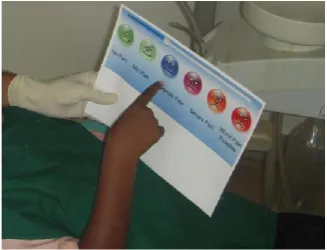
by using the scale given by Erickson et.al, probe should not stick in the dentin and not give a tug back feel (Clinical evaluation). Pain was assessed by using the following Visual Analogue Scale. Each subject was informed of the pain rating and shown the Visual Analog Scale (VAS) for subjective evaluation. A Wong-Baker FACES Pain Rating Scale was used in this study. The scale uses a series of faces ranging from a happy face at 0, "No hurt" to a crying face at 5 "Hurts worst". The patient must choose the face that best describes how they are feeling. At the end of excavation of each carious lesion the scale was shown to the children without mentioning the word pain. The children were asked to point to the picture that best described their feelings regarding the treatment they just received (Fig. 5)
The Modified Behavioral Pain Scale (MBPS), suggested by Taddio et al, was used for objective evaluation of the children’s reaction during excavation of carious lesion. The scale comprised the following parameters: (Fig. 6)
Facial display
Body movements
Crying.
During each treatment this scale was used by a dentist to assess the pain perception in patient. Procedure time was recorded by the dental assistant from the beginning of the procedure when the dentist first picked up the instrument until the restoration was concluded. After the removal of each carious lesion by the above mentioned methods, cavity was restored using restorative Glass ionomer Cement (Fig. 7). Statistical data was analyzed by using ANOVA, Chi Square, Tukeys post hoc and Kruskallwallis Test.
RESULTS
Table 1 and graph 1 shows the mean pain assessment values by the Subject on VAS (Wong-Baker) after various caries excavation procedures in 30 patients. The mean value by CRT using airoter was observed to be 2.3 ± 0.9. Wong Baker score during ART showed a mean value of 1.3 ± 0.5, while the mean value during Chemo-mechanical method was 0.7 ± 0.6.Thus, pain experienced has been observed to be the maximum with CRT using airotor, followed by ART and least by Chemo-mechanical method. Probability P value was highly significant (0.001) when compared among groups. Table 2 and graph 2 shows the mean pain assessment values by the clinician on MBPS during various caries excavation procedures in 30 patients. The mean value of MBPS pain score reported by the subjects in whom CRT using airoter method for caries removal was used, it was observed to be 4.6 with a standard deviation of 1.8 as compared to mean scores of 2.7 and 1.7 in case of ART and chemo-mechanical method respectively. Thus, it is derived that out of the three methods adopted in the present study, Chemo-mechanical method seems to be the least painful with respect to caries removal. Probability P value was highly significant (0.001) when compared among groups. Table 3 and Graph 3 shows the comparison of mean values of the Procedure time taken for caries removal by different methods in 30 patients.
Table 1. Pain assessment values by the subject on VAS (Wong
Groups Mean + S.D
I. Conventional Rotary Method 2.3
II.ART Method 1.3
III. Chemo-mechanical Method 0.7 Probability Value
[image:3.595.83.509.170.232.2]P</=0.001 highly significant
Table 2. Pain assessment values by the clinician on MBPS during various caries excavation procedures
Groups
I. Conventional Rotary Method II.ART Method
III. Chemo-mechanical Method Probability Value
[image:3.595.106.488.265.326.2]P</=0.001 highly significant
Table 3. Procedure time (in mins) taken by various caries excavation procedures
Groups
I.Conventional Rotary Method II.ART Method
III.Chemo-mechanical Method Probability Value
P</=0.001 highly significant
Table 4
Groups
I.Conventional Rotary Method II.ART Method
III.Chemo Probability Value
P</=0.001 highly significant
Graph 1. Pain assessment values by the
(wong-baker) after various caries excavation procedures
Graph 2. Pain assessment values by the clinician on MBPS during various caries excavation procedures
Pain assessment values by the subject on VAS (Wong-Baker) after various caries excavation procedures
Mean + S.D Median Minimum Value Maximum Value
2.3 + 0.9 2 1 4
1.3 + 0.5 1 1 2
0.7 + 0.6 1 0 2
Tests-
Kruskall-Wallis & Mann-Whitney U
Pain assessment values by the clinician on MBPS during various caries excavation procedures
Mean + S.D Median Minimum Value Maximum Value
4.6 + 1.8 5 2 7
2.7 + 1.2 2 2 5
1.7 + 0.6 2 0 2
Tests-
Kruskall-Wallis & Mann-Whitney U
Procedure time (in mins) taken by various caries excavation procedures
Mean + S.D Minimum Value Maximum Value Significant Pairs
13.40 + 2.85 10 20 I&II(N.S)
16.13 + 2.53 12 20 II&III(4.4)
20.53 + 3.78 15 25 I&III(7.1)
Tests-
One way ANOVA & Tukey’s post-hock
Table 4. Efficacy of various caries excavation procedures
Yes No
Conventional Rotary Method 30(100) 0(0)
ART Method 4(13) 26(87)
Chemo-mechanical Method 24(80) 06(20)
Probability Value
P</=0.001 highly significant
Tests- Chi-Square
Pain assessment values by the subject on vas baker) after various caries excavation procedures
Graph 3. Procedure time (in mins) taken by various caries excavation procedures
Graph 2. Pain assessment values by the clinician on MBPS during various caries excavation procedures
Graph 4. Efficacy of various caries excavation procedures excavation procedures
Significant Pairs I&II(1.0) II&III(0.5) I&III(1.5)
Pain assessment values by the clinician on MBPS during various caries excavation procedures
Maximum Value Significant Pairs I&II(1.9) II&III(1) I&III(2.9)
Procedure time (in mins) taken by various caries excavation procedures
Significant Pairs I&II(N.S) II&III(4.4) I&III(7.1)
Graph 3. Procedure time (in mins) taken by various
caries excavation procedures
[image:3.595.55.544.347.579.2] [image:3.595.62.538.618.767.2]Figure 1. Caries removal by ART
Figure 2. Caries removal by CRT
Figure 3. Caries removal by Chemo-Mechanical
[image:4.595.355.515.72.235.2]Figure 4. Caries detecting dye
[image:4.595.353.515.270.397.2]Figure 5. Subjective evaluation of pain using Wong Baker pain rating scale
Figure 6. Objective evaluation of pain using modified Taddio pain rating scale
Figure 7. After GIC restoration
The mean value of time taken for caries removal by Chemo-mechanical method was observed to be maximum of 20.53mins with a standard deviation of 3.78 followed by ART (16.13 ± 2.53 mins respectively) and airotor method (13.40 ± 2.85mins respectively). Thus, it is observed that out of the three methods, CRT using airotor took less procedure time. Probability P value was highly significant (0.001) when compared among groups. Table 4 and Graph 4 show the comparison of efficacy of caries removal by different methods in 30 patients. Efficacy of caries removal by ART was observed to be 13%. Efficacy of caries removal by conventional restorative treatment (CRT) using airotor showed 100%, while efficacy of caries removal by chemo-mechanical method was 80%. The efficacy of caries removal has been observed to be the highest with CRT using airoter, followed by almost comparable effectiveness by Chemo-mechanical
[image:4.595.82.244.332.586.2] [image:4.595.354.516.435.533.2] [image:4.595.81.245.622.747.2]method and least by ART. Probability P value was highly significant (0.001) when compared among groups
DISCUSSION
There are few literature reports that investigate the patient’s feelings related to the ART in comparison to Conventional rotary treatment. Some studies assessed pain through simple questions or more elaborative questionnaires. In a study conducted by Schriks and Van Amerongen discomfort was assessed through the Venham picture test, which was also used by Topaloglu-Ak in his study to evaluate dental anxiety (De Menezes Abreu et al., 2009). While Chambers et al. after comparing different FACES scales, for the measurement of pediatric pain, concluded that the majority of children and parents preferred the scale by Wong Baker (De Menezes Abreu et al., 2009). Also, Newton and Buck affirmed that children do not have a fully developed ability to recognize manifestations of anxiety, younger children are more apprehensive than older ones (De Menezes Abreu et al., 2009). Therefore one of the strategies to eliminate any potential bias should be by measuring the anxiety level from a clinician’s point of view. Hence in a present study The Modified Behavioral Pain Scale (MBPS), suggested by Taddio et al, was used for objective evaluation of the children’s reaction during excavation of carious lesion (Taddio et al., 1995). Study conducted by Danielle et al. to compare pain perception of patient with the use of ART and CRT on children of age group of 4-7 years, using Wong-Baker FACES Pain Rating Scale, they concluded that ART was less painful than CRT (De
Menezes Abreu et al., 2009). Schirks and van Amerongen also
reported children treated with ART approach using hand instruments alone experience less discomfort than those treated using rotary instruments (Schriks et al., 2003). P. Nadanovsky et al. compared the chemo-mechanical and conventional mechanical caries removal method and they reported that the chemo-mechanical method appeared to be more comfortable for most patients (Nadanovsky et al., 2001).
The explanation for least pain perception with chemo-mechanical caries removal method given by Rafique et al. was that the carisolv removes only infected dentin while retaining the sensitive affected dentin intact (Rafique et al., 2003). Similar observations were made by Anusavice and Kinchloe, they demonstrated that cutting or removing carious dentin generally elicits little or no sensation, while cutting sound dentin often results in some level of pain. This has been the basis of the clinical evaluation of the Chemo-mechanical method of caries removal (Anusavice et al., 1987). So Carisolv proves to be a useful substitute when caries removal is intended in highly apprehensive children or during their first visit to a dental office as it is less anxiety provoking when compared to other methods. The ultimate objective of the clinician is to render a quality treatment to the patient and it depends on the effectiveness of the procedure and material. In the management of dental caries thorough caries removal before restoration will determine the long-term success of restoration. So in the present study, the effectiveness of various caries removal method was assessed by caries detecting dye. conducted by Zuhal Kirzioglu et al. where he compared the clinical efficacy of Carisolv and the hand excavation method in
the removal of occlusal dentine caries of primary molar teeth. He concluded that Carisolv system is effective in the removal of caries and causes minimum level pain. Compared to hand excavation, Carisolv system seems to be a promising restorative approach to remove occlusal caries in primary molar teeth (Pandit et al., 2007). While Lozano-Chourio M.A.et.al assessed the chemo-mechanical caries-removal system (Carisolv) with high-speed excavation in cavitated occlusal caries of primary molars. They concluded that Carisolv is an effective clinical alternative treatment for the removal of occlusal dentinal caries in cavitated primary molars and is more conservative on dental tissue (Kirzioglu et al.,
2007). Maragakis et al.reported that efficacy of caries removal
by carisolv was only 62.5%, showing that it did not remove caries efficiently (Lozano-Chourio et al., 2006). Similar observations were made by Banerjee et al where they assessed five alternative methods of carious dentin excavation and they showed that effectiveness of caries removal was highest with airotor, followed by hand excavation and the least by carisolv (Maragakis et al., 2011).
The third and final parameter evaluated in this study was procedure time, taken by each method for caries removal. Studies done by Maragakis GM et.al to determine the clinical efficiency and patient acceptance of the caries removal agent carisolv in contralateral primary molars of sixteen 7-9 year old patients. They concluded that carisolv gel did not remove decay completely in one third of sample and it was much slower than the air-motor (Banerjee et al., 2000). Even Pandit I K et al. observed that out of the three methods, airotor removed caries in the minimum time while chemo-mechanical took more time (Kakaboura et al., 2003). More time required with use of chemo-mechanical method has been explained by Kakaboura et al, according to them, carisolv gel when applied on the carious lesion was clear; but it became opaque/cloudy with debris from the lesion. When the gel was heavily contaminated with debris, it was removed with a cotton pellet and fresh gel was again applied. The procedure was repeated until the gel was no longer contaminated with debris. They concluded that the reason for increased time taken by Carisolv might be the multiple applications of Carisolv gel for complete caries removal (Banerjee et al., 2000).
Though time required with chemo-mechanical method is more than other methods, Katerina et al. 2004 resolved issues with working time for caries removal in primary teeth, the need for local anesthesia and patient cooperation, when the chemo-mechanical Carisolv or the conventional chemo-mechanical methods were used. They concluded that the chemo-mechanical method, although more prolonged, is effective in caries removal in primary teeth, it does not influence children's cooperation and may reduce the need of local anesthesia in Class V restorations (Katerina et al. 2004).
Conclusion
REFERENCES
Anusavice KJ, Kincheloe JE. Comparison of pain associated with mechanical and chemo-mechanical removal of caries. J Dent Res., 1987 Nov;66(11):1680-3
Banerjee A, Kidd EA, Watson TF. In vitro evaluation of five alternative methods of carious dentine excavation. Caries Res., 2000 Mar-Apr;34(2):144-50
De Menezes Abreu DM, Leal SC, Frencken JE. Self-report of pain in children treated according to the atraumatic restorative treatment and the conventional restorative treatment- a pilot study. J Clin Pediatr Dent. 2009 winter; 34(2):151-5.
Kakaboura A, Masouras C, Staikou O, Vougiouklakis G. A comparative clinical study on the Carisolv caries removal method. Quintessence Int., 2003 Apr; 34(4):269-71. Katerina Kavvadia, Drodont Vassiliki Karagianni, Argy
Polychronopoulou, Lisa Papagiannouli- Primary Teeth Caries Removal Using The Carisolv Chemo-mechanical Method: A Clinical Trial. Pediatr Dent, 2004 Jan-Feb;26(1):23-8.
Kirzioglu Z, Gurbuz T, Yilmaz Y. Clinical evaluation of chemo-mechanical and mechanical caries removal: status of the restorations at 3, 6, 9 and 12 months. Clin Oral Investig., 2007 Mar;11(1):69-76
Lozano-Chourio MA, Zambrano O, González H, Quero M. Clinical randomized controlled trial of chemo-mechanical caries removal (Carisolv). Int J Paediatr Dent, 2006 May; 16(3):161-7.
Maragakis GM, Hahn P, Hellwig E. Clinical evaluation of chemo-mechanical caries removal in primary molars and its acceptance by patients. Caries Res., 2001 May-Jun; 35(3):205-10.
Nadanovsky P, Cohen Carneiro F, Souza de Mello F. Removal of caries using only hand instruments: a comparison of mechanical and chemo-mechanical methods. Caries Res., 2001 Sep-Oct; 35(5):384-9.
Pandit IK, Srivastava N, Gugnani N, Gupta M, Verma L. Various methods of caries removal in children: a comparative clinical study. J Indian Soc Pedod Prev Dent, 2007 Apr-Jun;25(2):93-6
Rafique S, Fiske J, Banerjee A. Clinical trial of an air-abrasion/chemo-mechanical operative procedure for the restorative treatment of dental patients. Caries Res. 2003 Sep-Oct; 37(5):360-4
Sanjeet Singh, Deepti Jawa Singh, Shipra Jaidka, Rani Somani- Comparative clinical evaluation of Chemo-mechanical caries removal agent Papacarie® with conventional method among rural population in India -In Vivo Study. Brazilian Journal of Oral Sciences, 2011 July-Sept;10(3):193-8
Schriks MC, van Amerongen WE. Atraumatic perspectives of ART: psychological and physiological aspects of treatment with and without rotary instruments. Community Dent Oral Epidemiol., 2003 Feb; 31(1):15-20.
Taddio A, Nulman I, Koren BS, Stevens B, Koren G. A revised measure of acute pain in infants. J Pain Symptom Manage. 1995 Aug;10(6):456-63