21
Development of an Environmentally Friendly
in-situ Pack-Cyaniding Technique
1,2
*Akinluwade, K. J., 1,2Adetunji, A. R., 2Adeoye, M. O., 2Umoru, L. E.,
3
Kalu, P. N., 1,2Taiwo, A. T. and 1Adewoye, O. O.
1
National Agency for Science and Engineering Infrastructure (NASENI), Abuja, Nigeria
2
Department of Materials Science & Engineering, Obafemi Awolowo University, Ile-Ife, Nigeria
3
Department of Mechanical Engineering, Florida State University, Florida, USA
*Corresponding Author: email: [email protected]; Phone: +2348080280533
ABSTRACT
A safe and environmentally friendly cyaniding method has been developed to mitigate the toxic impacts of cyanide salts on the environment during conventional cyaniding. The method entails in-situ diffusion of nascent cyanide from mature cassava leaves into the surface of mild steel components via pack-cyaniding. Both high-temperature in-situ diffusion into austenite and low-temperature in-situ diffusion into ferrite were explored. Results from light and scanning electron microscopic studies showed that surface hardness of the steel components was substantially increased. The waste product was a harmless biodegradable organic compound that posed no disposal threats. This study is important for increasing the wear resistance of ferrous parts for a longer service life in application without polluting the environment.
Keywords: environmentally friendly, cassava leaves, scanning electron microscope, in-situ
pack-cyaniding, biodegradable, clean technology
1. INTRODUCTION
Virtually all developed and growing economies of the world are involved in production of
consumer goods and services. The turnout of consumer goods is multifarious in nature—
ranging from the simple everyday household utensils to the complex industrial machines.
Case-hardening heat treatment processes are carried out either in gas chambers or in salt baths
[1,2]. In small and medium scale enterprises, salt bath treatment is the commonest method
probably because of its relatively low cost and reduced treatment time. Unfortunately,
substantial amount of highly toxic, corrosive and environmentally unfriendly gases are
liberated from the fused salt mixture into the atmosphere. The disposal of the spent salt
mixture is also hazardous to both the flora and fauna of the environment.
Since the mechanical properties of steels are sensitive to the content of carbon [3],
manufacturers often find it cheaper to augment the level of hardening species (such as carbon
and nitrogen) in mild steel components through diffusion. Liquid salt bath nitriding in
cyanide-cyanate baths tends to release toxic greenhouse gases like CO, CO2, HCN, HCl and
so on into the atmosphere. Both the salt composition and by-products are very toxic [4].
Pack-cyaniding of mild steel using cassava leaves and the characterization of the case formed
have been reported [5,6,7]. The presence of cyanogenic glucoside in cassava plant could be
the accumulation of products of catabolism of amino acids [8] or a mechanism for deterring
predators [9]. Cassava contains some amount of cyanide that is often removed as waste
during processing. This study aims at converting this wanton cyanide waste to engineering
value via a clean technology technique making it of benefit to human use thereby promoting
the nation’s health and economy.
2. MATERIALS AND METHODS
2.1. Preparation of Cassava Powder
Fresh cassava leaves of specie Manihot esculenta (bitter local variety) were collected,
oven-dried, pulverized and subjected to sieve analysis to produce 1.00, 0.85, 0.60, 0.30 and 0.125
mm particle sizes. Each particle size was divided into two: A and B. Group A was mixed
with BaCO3 salt by combining 4 volumes of cassava powder with 1 volume of BaCO3 salt
and then divided into five portions. This was repeated for group B powder but using BaCl2
salt. In all, 50 portions of cassava leaves powder samples comprising 2 groups and 10 batches
were prepared.
Cyaniding boats of 6 cm × 6 cm × 6 cm were constructed using mild steel plates. A
firm 1fireclay luting was provided at the slits between each boat and its cover plate. Mild
steel bolt
and nut were completely embedded in each member of a batch of group A in a cyaniding boat
and loaded into a muffle furnace at room temperature. The furnace was heated to 950 oC and
held for 5 hours. All the samples were cooled in air. The process was repeated for other four
batches but at soaking times of 4, 3, 2 and 1 hour respectively. Group B samples were
pack-cyanided in the same way but at 550 oC.
2.3 Metallography and Microscopy
Each specimen was roughly ground across the cross-section on 60, 120, 180, 240, 320, 400
and 600 SiC grit papers. Rough polishing was carried out on 800 and 1200 grit papers while
final polishing was accomplished with alumina pastes of 6, 1, and 0.6 µm, respectively. Case
depths were measured using the Olympus BH-2 Advanced Optical Microscope with a
Daheng Imavision HV Camera and a calibrated eyepiece. A Cam Scan Series 2 scanning
electron microscope was used to reveal the microstructural details while surface hardness was
measured using LECO ASTM E384 Microhardness tester.
3. RESULTS AND DISCUSSION
3.1 High-Temperature Pack-Cyaniding at 950 oC
The starting material for this experiment was a mild steel bolt with carbon content less than
0.25 wt%. The micrograph of its cross section is as shown in Plate 1. Each paired
micrographs of Plates 2—5 was obtained from the optical microscope, they show distinctly
formed cases for samples treated at 950 oC. The micrograph of the starting material is
displayed at Plate 1 and it shows relatively fine grains. Air-cooling method was used to
obtain abruptness in change from high to low carbon in the microstructure making it
convenient to employ light microscopy in case depth measurement.
(For all plates; a= Case, b= Core) Plate 1: as-received mild steel sample
3.1.1 Variation of case depth with cassava leaves particle size and soaking time
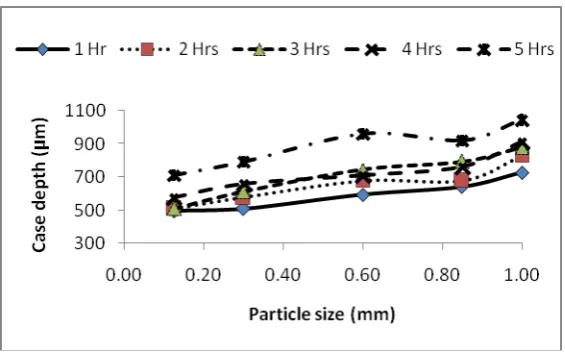
Fig 1 shows the dependence of case depth on cassava leaves particle size for high
temperature pack cyaniding. It was generally observed that case depth increases with particle
size at constant soaking temperature—this is the general trend displayed by the curves. The
variation of case depth with soaking time is provided in Fig 2. The curves exhibit a gentle rise
followed by a slight decline especially in 0.60 and 0.85 mm particle sizes and then a gentle
rise beginning from 4 hrs. In general, case depth increases with soaking time.
Fig 1: Case depth as a function of particle size for high temperature pack cyaniding
3.1.2 Variation of case hardness with cassava leaves particle size and soaking time
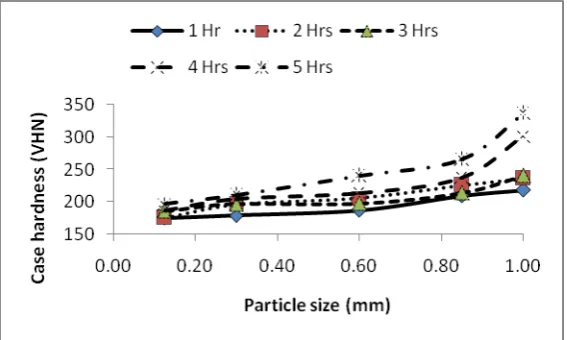
The curves generally increase with particle size. The curves of Fig 3 have a slight gradient
from 0.125 mm to 0.30 mm. Between 0.30 mm and 0.60 mm the curves are almost linear (100X)
Plate 2: 0.60 mm particle size soak 3 hrs (100X)
Plate 3: 1.0 mm particle size soak 3 hrs (100X)
Plate 4: 0.85 mm particle size soak 1 hr (100X)
Plate 5: 0.125 mm particle size soak 5 hrs (100X)
Plate 7: 3 hrs 0.60 mm sample (3000X)
Plate 8: 4 hrs 0.85 mm sample (3000X)
Plate 9: 0.125 mm particle size soak 1 hr (100X)
Plate 10: 0.60 mm particle size soak 4 hrs (100X)
[image:5.595.158.441.447.623.2]with the exception of the 5 hrs series. Beyond 0.60 mm particle size, the curves rise with a
higher gradient. This sort of gradient variation (peaks and troughs) was characteristic of
[image:6.595.159.440.157.333.2]curves obtained from pack cyaniding using cassava leaves powder [6].
Fig 2: Case depth as a function of soaking time for high temperature pack-cyaniding
Fig 3: Case hardness with respect to cassava leaves particle size for high temp pack cyaniding
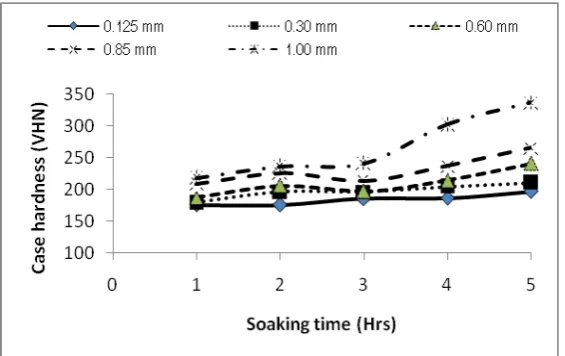
In general, the curves of case hardness as a function of soaking time shown in Fig 4 increase
(with a gentle gradient) with soaking time. It was noted that case depth and hardness are
proportional in that the deeper the case depth, the harder it is to penetrate the material by
indentation. Reasons for the trend observed above are summarized as follows:
1. The larger particle sizes of cassava leaves release their nascent carbon gradually over
time allowing time for more carbon atoms to diffuse thereby producing deeper cases
whereas the smaller particle sizes being very fine burn off more quickly dissipating
[image:6.595.158.442.391.561.2]2. The reason for this gentle wavelike form may be the impure organic nature of the
cassava leaves powder. Conventional salt bath cyaniding produces curves near
straight lines for very long treatment time and smooth parabolic curves for lower
treatment time because the salts are pure substances [10].
3. Cassava plant contains several organic compounds some of which may as well diffuse
to aid or inhibit case formation. There are four identified nutrient compounds in
cassava that contain carbon and/or nitrogen. They are Absorbic acid, Niacinamide,
Riboflavin and Thiamine [11].
4. Longer soaking time allows more time for the reaction to proceed. This results in
more carbon atoms present in the reaction atmosphere diffusing and migrating deeper
[image:7.595.159.442.382.560.2]into the sample surface.
Fig 4: Case hardness with respect to soaking time for high temperature pack cyaniding
3.1.2 Microstructural phases present and distribution
The cases and cores formed were studied using Scanning Electron Microscope (SEM) and the
micrographs obtained are presented in Plates 6-8. The microstructure of the cases consists of
a predominant pearlite and some ferrite phases while the cores are composed of much less
pearlite than ferrite. The structure of all samples under test consisted of ferrite and pearlite
phases. This is indicative of a very good level of toughness and ductility needed for
3.2 Low Temperature Pack Cyaniding
3.2.1 Variation of case hardness with cassava leaves particle size and soaking time
The plot of case hardness as a function of particle size in Fig 5 shows that hardness generally
increases with particle size. It is believed that the same reason that accounts for why this
trend was observed for samples pack cyanided at 950 oC also explains the present trend. At
550 oC, the potential of nitrogen is very high while that of carbon is very low so only nitrogen
diffuses appreciably into the steel resulting in nitriding. Fig 6 is a plot of case hardness
against soaking time for low temperature pack cyaniding. In general, the case hardness rise as
[image:8.595.161.438.320.501.2]soaking time increases.
Fig 5: Case hardness with respect to particle size for low temperature pack cyaniding
[image:8.595.152.448.554.733.2]3.2.2 Microstructural constituents and phases
At 550oC, the potential of nitrogen is very high while that of carbon is very low so only
nitrogen diffuses appreciably into the steel resulting in nitriding. In addition, the atomic
radius of N (0.071 nm) is small relative to that of C (0.077 nm). From the Fe-Fe3C phase
diagram, the iron component of mild steel is in the ferritic phase and only nitrogen can
diffuse into the steel.
During conventional salt bath nitriding, a white layer of Fe4N (γ` nitride), and Fe3N (ε
nitride) forms near the outer layer of steel surface. Nitrogen has partial solubility in iron. It
can form a solid solution with ferrite at nitrogen contents up to about 6% where a compound
called gamma prime (γ`), with a composition Fe4N, is formed. At nitrogen contents greater
than 8%, the equilibrium reaction product is the epsilon compound ε, withcomposition Fe3N.
Nitrided cases are stratified, the outermost surface can be all γ`. If this is so, it is referred to
as the white layer[10]. The white layer is undesirable because it is so hard that it may spall in
service. Results showed that appreciable cases were formed in samples treated at 950 oC
while only a thin hard layer case was formed at the outer surface of samples treated at 550 oC.
The cases varied in both hardness and depth with cassava leaves particle size and soaking
time.
5. CONCLUSION
The following conclusion can be drawn from the study.
1. A locally developed clean technology for the metallurgical industry that reduces the
toxic impact of cyanide on the personnel and environment has been developed.
2. This method is capable of increasing the wear resistance of ferrous parts for a longer
service life in application.
3. The study also showed that pack-cyaniding is capable of converting some agricultural
4. The study has shown that pack-cyaniding is feasible with cassava leaves and has the
potential to boost the economic viability of the plant for a developing economy.
REFERENCES
1. Rajan, T. V., Sharma, C. P. and Sharma, A. (1988) ‘Heat Treatment: Principles and
Techniques’. Prentice Hall of India Private Limited, New Delhi.
2. Hutchings, I. M. (1992) ‘Tribology: Friction and Wear of Engineering Materials’.
Edward Arnold, London
3. Fathi, H. (1997) Handbook of Extractive Metallurgy. Vol.1, The Metal Industry,
Ferrous Metals. Wilhelm Oswald & Co., Wilhelm.
4. Mehrkam, Q. D., Easterday, J. R., Payne, B. R., Foreman, R. W., Vukovich, D. and
Godding, A. D., (1991) “Liquid Nitriding of Steels”. In: Heat Treating—ASM
Handbook (Revised vol. 4). Stephen M. Copley, editor. USA., pp. 923-943
5. Akinluwade, K. J. (2010) Low and High Temperature Pack-cyaniding of Mild Steel in
Pulverized Cassava Leaves. M. Sc. Thesis of Obafemi Awolowo University, Ile-Ife,
Nigeria.
6. Adetunji, A. R., AttahDaniel, B. E., Adeoye, M. O., Umoru, L. E, Adeyinwo, C. E.,
Pelemo, D. A., Olasupo, O. A. and Adewoye, O. O. (2008). “Metallographic Studies
of Pack Cyanided Mild Steel Using Cassava Leaves.” Materials and Manufacturing
Processes. 23(4), pp. 385-390
7. Ibironke, O. J., Falaiye, A., Ojumu, T. V., Odo, E. A. and Adewoye, O. O. (2004)
Case-Depth Studies of Pack Cyaniding of Mild Steel Using Cassava Leaves;
Materials and Manufacturing Processes. 19(5) pp. 899-905
8. Conn, E. E. (1973) “Cyanogenic Glucosides: Their Occurrence, Biosynthesis and
Function”. In: Chronic Cassava Toxicity. (Nestel, B. and MacIntyre, R., Eds).
Conference Proceedings IDRC, Ottawa, Canada., pp.55-63
9. Hosel, W. (1981) The Enzymatic Hydrolysis of Cyanogenic Glucosides. B.
Vennesland, E. E. Conn, C. J. Knowles, J. Westley, & F. Wissing (Eds.). Cyanide in
Biology., pp. 217–232 Academic Press, London.
10. Foreman, R. W. (1991) Pack Carburizing of Steel. In: Heat Treating—ASM