THE SCREENING OF PARAMETERS INFLUENCING THE HYDRODISTILLATION OF MOROCCAN
MYRTUS COMMUNIS
L
1,2
Fadil, M.,
2Farah A.,
3Ihssane, B.,
1
Laboratory of Functional Ecology and Environment, Faculty of Sciences and Techniques Sidi Mohamed Ben
Abdellah University,
2
Laboratory of Medicinal, Aromatic Plants and Natural Substances, National Institute of Medicinal and
Aromatic Plants Sidi Mohamed Ben Abdellah University, Taounate, Morocco
3
Application Organic Chemistry Laboratory, Faculty
Abdellah University, Fez, Morocco
4
Laboratory of Microbial Biotechnology, Faculty o
Abdellah University, P. O. Box 2202
ARTICLE INFO ABSTRACT
Myrtle,
plants in Morocco. For the purpose of examining the factors affecting extraction
by hydrodistillation, a screening study by Hadamard matrix type Placket and Burman was conducted. After an appropriate choice of seven variables, sixteen experiments lead to a mathematical model of first degree linking the res
concluded that five factors have a significant effect on the hydrodistillation process, namely: the extracting time, the individuality effect, the harvest period,
the coefficients: 0.041, 0.025,
cutting present a statistically negligible effect.
Copyright © 2015 Fadil et al. This is an open access article distributed under the Creative Commons Att distribution, and reproduction in any medium, provided the original work is properly cited.
INTRODUCTION
The aromatic and medicinal plants represent a considerable value to the Moroccan economy (Farah et al
these plants, Myrtus communis L. is an evergreen shrub belonging to the family of Myrtaceae. It grows spontaneously in Morocco and is encountered in forest areas belonging to the thermo-Mediterranean series from the Atlantic coast to altitudes of 1100 m. Generally it develops on a siliceous substrate in semi-humid and humid bio-climates (Benabid, 1997). Myrtle oil has many reported benefits for skin especially acne and oily one. Research has also shown it to help the respiratory system with chronic coughs and tuberculosis. It is suitable to use for children’s c
chest complaints and may help support the immune function in
*Corresponding author:Fadil, M. Laboratory of Functional Ecology and Environment, Faculty of Sciences and Techniques Sidi Mohamed Ben Abdellah University, Fez, Morocco.
ISSN: 0975-833X
Article History:
Received 20th May, 2015
Received in revised form 07th June, 2015
Accepted 10th July, 2015
Published online 31st August,2015
Key words:
Myrtus communis L., Hydrodistillation process, Screening, Plackett and Burman design.
Citation:Fadil, M., Farah A., Ihssane, B., Benbrahim, K. F., Haloui, T. and Rachiq, S.
Hydrodistillation of Moroccan Myrtus communis
Research, 7, (8), 19482-19489.
RESEARCH ARTICLE
THE SCREENING OF PARAMETERS INFLUENCING THE HYDRODISTILLATION OF MOROCCAN
L
.
LEAVES BY EXPERIMENTS DESIGN METHODOLOGY
Ihssane, B.,
4Benbrahim, K. F.,
1,2Haloui, T. and
Laboratory of Functional Ecology and Environment, Faculty of Sciences and Techniques Sidi Mohamed Ben
Abdellah University, Fez, Morocco
Laboratory of Medicinal, Aromatic Plants and Natural Substances, National Institute of Medicinal and
Aromatic Plants Sidi Mohamed Ben Abdellah University, Taounate, Morocco
Chemistry Laboratory, Faculty of Sciences and Techniques Sidi Mohamed Ben
Abdellah University, Fez, Morocco
Laboratory of Microbial Biotechnology, Faculty of Science and Technology Saïss.
Abdellah University, P. O. Box 2202
ABSTRACT
Myrtle, Myrtus communis L., is an herb widely used throughout the world. It is one of the most popular plants in Morocco. For the purpose of examining the factors affecting extraction
by hydrodistillation, a screening study by Hadamard matrix type Placket and Burman was conducted. After an appropriate choice of seven variables, sixteen experiments lead to a mathematical model of first degree linking the response function (yield) to factors. After the experiment’s realization and data analysis, we concluded that five factors have a significant effect on the hydrodistillation process, namely: the extracting time, the individuality effect, the harvest period, the material/water ratio and the heating temperature with the coefficients: 0.041, 0.025, - 0.021, 0.018, -0.015 respectively. Moreover, the plant material’s drying and cutting present a statistically negligible effect.
is an open access article distributed under the Creative Commons Attribution License, which distribution, and reproduction in any medium, provided the original work is properly cited.
The aromatic and medicinal plants represent a considerable et al., 2006). Among . is an evergreen shrub belonging to the family of Myrtaceae. It grows spontaneously in Morocco and is encountered in forest areas belonging to the Mediterranean series from the Atlantic coast to altitudes of 1100 m. Generally it develops on a siliceous climates (Benabid, 1997). Myrtle oil has many reported benefits for skin especially acne and oily one. Research has also shown it to help the respiratory system with chronic coughs and tuberculosis. It is suitable to use for children’s coughs and chest complaints and may help support the immune function in
Laboratory of Functional Ecology and Environment, Faculty of Sciences and Techniques Sidi Mohamed
fighting colds, flu and infectious diseases. Myrtle oil is applied topically, diffused or used in a humidifier. In folk medicine, myrtle has been used as anti-inflammatory drug. It is also used as a culinary spice and flavoring agent for alcoholic beverage in the Mediterranean region (Charles, 2013). The essential oil of Myrtus communis reduced leukocyte migration to the damaged tissue and exhibited anti inflammatory activity. The oil also inhibited cotton pellet
TNF-alpha and IL-6 in mice (Maxia strong antioxidant (Gardeli et al
understand the effects of factor acting on the hydrodistillation process, and see their close link with the essential oil yield’s improvement. To achieve this objective, we proceeded by the application of statistical techniques such as the experimental designs to make this improvement increasingly accessible. These methods, which reduce the experimentation to minimum number of experiments (Zeboudj
International Journal of Current Research
Vol. 7, Issue, 08, pp.19482-19489, August, 2015
Ihssane, B., Benbrahim, K. F., Haloui, T. and Rachiq, S. 2015. “The screening of parameters influencing the
Myrtus communis L. leaves by experiments design methodology”, International Journal of Current
THE SCREENING OF PARAMETERS INFLUENCING THE HYDRODISTILLATION OF MOROCCAN
LEAVES BY EXPERIMENTS DESIGN METHODOLOGY
Haloui, T. and
1Rachiq, S.
Laboratory of Functional Ecology and Environment, Faculty of Sciences and Techniques Sidi Mohamed Ben
Laboratory of Medicinal, Aromatic Plants and Natural Substances, National Institute of Medicinal and
Aromatic Plants Sidi Mohamed Ben Abdellah University, Taounate, Morocco
chniques Sidi Mohamed Ben
f Science and Technology Saïss. Sidi Mohamed Ben
L., is an herb widely used throughout the world. It is one of the most popular plants in Morocco. For the purpose of examining the factors affecting extraction of this plant’s essential oil by hydrodistillation, a screening study by Hadamard matrix type Placket and Burman was conducted. After an appropriate choice of seven variables, sixteen experiments lead to a mathematical model of first degree ponse function (yield) to factors. After the experiment’s realization and data analysis, we concluded that five factors have a significant effect on the hydrodistillation process, namely: the extracting the material/water ratio and the heating temperature with 0.015 respectively. Moreover, the plant material’s drying and
ribution License, which permits unrestricted use,
fighting colds, flu and infectious diseases. Myrtle oil is applied topically, diffused or used in a humidifier. In folk medicine, inflammatory drug. It is also used as a culinary spice and flavoring agent for alcoholic beverages in the Mediterranean region (Charles, 2013). The essential oil reduced leukocyte migration to the damaged tissue and exhibited anti inflammatory activity. The oil also inhibited cotton pellet-induced granuloma and serum 6 in mice (Maxia et al., 2011) and it is a et al., 2008). Thus, it is essential to understand the effects of factor acting on the hydrodistillation process, and see their close link with the essential oil yield’s . To achieve this objective, we proceeded by the application of statistical techniques such as the experimental designs to make this improvement increasingly accessible. These methods, which reduce the experimentation to minimum
udj et al., 2005), give the
OF CURRENT RESEARCH
The screening of parameters influencing the
opportunity to screen the factors from the most to the least important, and also optimize the operating conditions to achieve the best possible result.
The use of experiments designs in the analysis and the optimization of the essential oil’s extraction process was reported by several authors. Some have used other types of designs such as complete factorial design (Ammar et al., 2010, Silou et al., 2004, Wognin et al., 2010) and others have performed directly the optimization by using response surface methodology (Tan et al., 2012, Mu’azu et al., 2012). In this paper, we made a screening of factors acting on the hydrodistillation operation of Myrtus communis L. We have used the screening designs which are best known for factors with 2 levels: the Hadamard matrices or Plackett and Burman design (Plackett and Burman., 1946). The experimentation highlights the effects of some factors on the studied response (Silou et al., 2004). The choice of screening design for our study instead of the complete factorial design is based on seven studied factors. This number, which is higher than the factor’s number used in complete factorial design, will cause an increase in the number of experiments (27 = 128 experiments for seven factors). As for the response surface designs, they are generally used for optimization tests. In our case, a screening design of Plackett and Burman type is more advocated. The objective of this screening study is to determine the most important factors acting on hydrodistillation process of studied plant with a view to a more detailed study of parameters optimization. The perspective will be optimization study which will be concerned only with factors considered influential on the hydrodistillation process.
MATERIALS AND METHODS
Vegetable material
Myrtus communis L. plants were collected from the National Institute of Medicinal and Aromatic Plants garden in Taounate (Morocco).
Extraction material
The Clevenger type apparatus was used for hydrodistillation (Clevenger, 1928) according to the method recommended by the French Pharmacopoeia (Pharmacopée Française, 1983). The process operates at the atmospheric pressure and is equipped with a recycling system, permitting the mass plant/water ratio to be maintained at its initial level. During every experiment, plant material and water were placed, in determined proportions, in a one liter capacity glass flask. The mixture was heated to boiling temperature and the liberated steams crossed up the column and passed out of the condenser in a liquid state. At the end of the distillation, two phases were observed, an aqueous phase (aromatic water) and an organic phase (essential oil), less dense than water. The obtained essential oil was dried over anhydrous sodium sulphate and was stored in the refrigerator at 4°C in dark glass bottles until use.
GC and GC–MS analysis
The essential oil was analyzed using Gas chromatography (GC) coupled to mass spectrometry GC / MS (Polaris Q ion
trap MS). A Hewlett-Packard (HP 6890) gas chromatograph (FID), equipped with a 5% phenyl methyl silicone HP-5 capillary column (30m x 0.25 mm x film thickness 0.25 μm) was used. The temperature was programmed from 50°C after 5 min initial hold to 200°C at 4°C/min. Gas chromatography conditions were as follows: N2 as carrier gas (1.8 ml/min), split
mode was used (Flow: 72.1 ml/min, ratio: 1/50), temperature of injector and detector was 250°C, Final hold time was 48 min. The machine was led by a computer system type “HP ChemStation”, managing the functioning of the machine and allowing to follow the evolution of chromatographic analyses. Diluted samples (1/20 in methanol) of 1μl were injected manually.
Placket and Burman Design
Based on a process or phenomenon, the first problems which the experiments design can provide information about, are those of screening parameters. A screening study may be defined as a step for identifying rapidly, in a large number, factors that are actually influential on a process in a fixed experimental field. The most known matrices screening experiments are the matrices of Hadamard (Horadam, 2007) or matrices of Plackett and Burman, for which the number of experiments is close to the numbers of the studied factors (Claeys-Bruno et al., 2009). These designs are matrices with orthogonal columns composed only of values +1 or -1 (Tinsson, 2010). These deigns are generally saturated and the mathematical model is a model without interactions (Goupy, 2006). The Plackett and Burman design is a fractional factorial design and the main effect (the contrast coefficient) of such design may be simply calculated as the difference between the average of measurements made at the high level (+1) of the factor and the average of measurements made at the low level (-1). Contrast coefficients allow the determination of the effect of each factor. A large contrast coefficient either positive or negative indicates that a factor has a large impact on response; while a coefficient close to zero means that a factor has little or no effect (Levin et al., 2005)
Experimental domain of factors and responses
The studied factors
The levels of factors were selected by taking into account the operating experimental limits, the literature data on hydrodistillation conditions (Ganou, 1993), and the previous studies (Wognin et al., 2010, Mu’azu et al., 2012, Galadima et al., 2012). Factors that could affect the essential oil yield can be divided into two categories:
Continuous or quantitative factors:
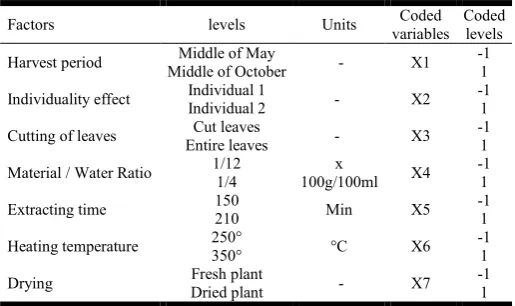
The extracting time varies between 150 and 210 minutes.
The ratio between the vegetable material and water in the distillation flacks: varies between 1/12 and 1/4 (x 100g/100ml).
The flask’s heating temperature which is directly related to the steam flow leaving the heated flask and hence the flow of condensation. To test this
parameter, two heating temperatures are used: 250 °C and 350 °C.
Qualitative factors:
The harvest period of plant material which have two levels: the middle of May and the middle of October.
The studied plant’s drying level with two modalities: fresh plant and dried plant. The plant’s drying is performed in the shade during eight days at a temperature room fixed at 25 °C.
The individuality effect: we have two modalities "individual 1" and "individual 2" because we have studied two separate plants. The cutting of plants in small pieces before the distillation, which have two modalities: entire plant and cut plant.
[image:3.595.34.292.329.482.2]The seven factors which were simultaneously studied to quantify the each one’s effect on the hydrodistillation operation are shown in Table 1.
Table 1. Parameter levels and coded values used in the experimental design
Factors levels Units Coded
variables Coded
levels
Harvest period Middle of May - X1 -1
Middle of October 1
Individuality effect Individual 1 - X2 -1
Individual 2 1
Cutting of leaves Cut leaves - X3 -1
Entire leaves 1
Material / Water Ratio 1/12 1/4 100g/100ml x X4 -1 1
Extracting time 150 Min X5 -1
210 1
Heating temperature 250° °C X6 -1
350° 1
Drying Fresh plant - X7 -1
Dried plant 1
The studied response
The studied response is essential oil yield of Myrtus Communis L. expressed as:
Y = Y (%) =M
M × 100
Where YHE the essential oil yield (%), MHE the essential oil
mass (g) and Ms the dry vegetal matter mass (g)
Experimental matrix
Since we have seven factors, the experimental design was a matrix of eight experiments. For more precision, and in order to determine the pure error, we have duplicated the chosen design, which thus leads to a matrix of sixteen essays.
Mathematical model and statistical analysis
The resulting mathematical model is a polynomial of order one as:
Y = b + b X + b X + b X + b X + b X + b X + b X + ɛ
With:
Y= YHE (%) is the yield of essential oil (response).
b0 represents the theoretical average value of responses.
b1, b2, b3, b4, b5, b6 and b7 are the principal effects of factors
X1, X2, X3, X4, X5, X6 and X7 respectively.
ε is an error term.
An analysis of variance consisting on F test at a 95% significance level was conducted. The mean squares (MS) were obtained as follows:
MS = SS DF
Where SS is the sum of squares of each variation source and DF is the respective degree of freedom.
The ratio between the mean square regression (MSR) and the
mean square residual (MSr), Fratio(R/r), was used in order to
establish whether the model was statistically significant (Ammar et al., 2010). The greater F value from unity adequately explains the variation of the data around its mean, in addition the estimated factor effects are real (Myer and Montgomery, 2002, Box et al., 1978).
The quality of fitting the first-order polynomial was also expressed by the coefficient of determination. The R2 measures the proportion of total variation about the mean response explained by the regression, in fact it is the correlation between observed and predicted response and it is often expressed as a percentage (Draper and Smith, 1998).
The model coefficients were considered significant for values of p-value <0.05. The statistical significance of the model coefficients was determined by using the t-test (only significant coefficients with p-value < 0.05 are included). During this study, we have used the conception and the treatment software of experiments design Nemrodw (Mathieu, 2000).
RESULTS AND DISCUSSION
Chemical composition of the essential oils
Table 2. Chemical composition analysis of the essential oils of two studied Myrtus communis individuals
Compounds KI
Individual 1 Individual 2
(%) (%)
1 α-pinene 941 47,62 34,74
2 3-carene 968 - 0,53
3 Sabinene 970 0,58 -
4 1,8-cineole 1020 48,43 50,69
5 α-Terpinolene 1091 - 6,76
6 α-terpineol 1176 1,48 5,16
7 Myrtenyl acetate 1333 0,15 0,25
8 α-Terpinyl acetate 1340 1,44 0,88
9 Caryophyllene 1399 0,16 0,27
10 Caryophyllene oxide 1565 - 0,19
Total 99,86 99,47
KI: Kovats indices; (-): not detected.
Experimental design
The observed response values with different combinations of seven studied variables are listed in Table 3.
Statistical validation of postulated model
According to the analysis of variance (Table 4), we can conclude that the regression explains the studied process since the significance of the risk p-value is lower than 0,05. Obviously, the calculation of FRatio(R/r) (= 14.47) has shown that
it is 4 times higher than the value of F(0,05;7,8) at 95%
[image:4.595.50.549.247.526.2]confidence level (=3.5). In general, a model has a statistical significance if the calculated F value is at least three to five times greater than the theoretical value (Kalil et al., 2000).
Figure 1. GC chromatograms of individual 1(a) and individual 2 (b) of Myrtus communis essential oil
Table 3. Experimental design of the hydrodistillation process of Myrtus communisL. with the observed answer for each experiment
N° of Experiment Harvest
period Individuality
cutting of leaves
Ratio Material / Water
Extracting time
Heating
temperature Drying Yield (%)
1 1 1 1 -1 1 -1 -1 0,75
2 1 1 1 -1 1 -1 -1 0,79
3 -1 1 1 1 -1 1 -1 0,58
4 -1 1 1 1 -1 1 -1 0,58
5 -1 -1 1 1 1 -1 1 0,65
6 -1 -1 1 1 1 -1 1 0,64
7 1 -1 -1 1 1 1 -1 0,63
8 1 -1 -1 1 1 1 -1 0,68
9 -1 1 -1 -1 1 1 1 0,72
10 -1 1 -1 -1 1 1 1 0,71
11 1 -1 1 -1 -1 1 1 0,59
12 1 -1 1 -1 -1 1 1 0,63
13 1 1 -1 1 -1 -1 1 0,64
14 1 1 -1 1 -1 -1 1 0,67
15 -1 -1 -1 -1 -1 -1 -1 0,63
16 -1 -1 -1 -1 -1 -1 -1 0,59
[image:4.595.49.547.574.746.2]Table 4. Analysis of variance for the fitted model
Source of
variance DF
Sum of squares
Mean
square FRatio(R/r) p-value
R 7 0,0532 0,0076 14,47 0,0008
r 8 0,0042 0,0005
Total 15 0,0574
R² 92,70%
R: regression; r: residual; DF: Degrees of freedom; R² : Coefficient of determination
The coefficient of determination R²=92,7% is sufficient. This value gives a good agreement between the experimental and predicted values of the adapted model.
[image:5.595.58.267.253.424.2]These results are confirmed by those obtained in the graph (Fig. 2), showing a linear curve for the observed values in term of the predicted ones.
Figure 2. Curve of the observed values in terms of the predicted values
Study of the factors effects
[image:5.595.307.562.345.649.2]The main effects of the seven studied variables are shown in Table 5. Each coefficient is associated with the values of t-student and p-value. The values of t-student are employed to determine the significance of the regression coefficients of each parameter and the values of p are defined as the lowest level of importance leading to the rejection of the null hypothesis (Ammar et al., 2010). In general, more the t-student’s magnitude is larger, more the p-value value is smaller, and more the corresponding coefficient term is significant (Ravikumar et al., 2007). The value of the constant b0 is equal to 0.65.
Table 5. Estimated regression coefficients for the Plackett and Burman design
Name of parameter Coefficient Effect Standard
error
t-student p-value
Constant b0 0,655 0,006 114,35 < 0,0001 *
Harvest period b1 0,018 0,006 3,06 0,0154 *
Individuality effect b2 0,025 0,006 4,36 0,00251 *
Cutting of plan b3 -0,004 0,006 -0,65 0,537
Mass plant/water ratio b4 -0,021 0,006 -3,71 0,006 *
Extracting time b5 0,041 0,006 7,20 < 0,0001 *
Heating temperature b6 -0,015 0,006 -2,62 0,0299 *
Drying b7 0,001 0,006 0,22 0,827
*: Statistically significant factor for a confidence level of 95%.
The results show also that only the factors b3 and b7, which are
related to the plant’s cutting and drying respectively, doesn’t have any influence on the hydrodistillation process, since their signification risk is superior than 0,05.
Fitted Model
The statistical mathematical model representing the response in terms of the most influential variables is:
Y = 0,655 + 0,018 X + 0,025 X − 0,021 X + 0,041 X − 0,015 X +ɛ
The calculated experimental error (ε) from the residual mean square was 0.023.
Statistically negligible parameters
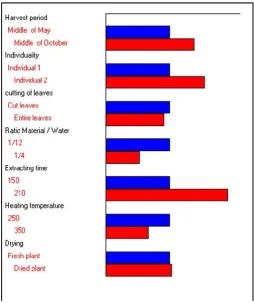
The graph (Fig 3) shows that there is a small yield increase between fresh and dried plants and between the entire and cut leaves, but the test on coefficients b3 and b7 (Table 5) shows
[image:5.595.34.296.645.743.2]that these two factors don’t have any influence on the hydrodistillation operation, since there signification risk is superior to 0.05 (0.537 and 0.827 respectively).
Figure 3. Variation of the response (Yield) in terms of the variation of each parameter
Cutting of leaves
essential oil extraction process. However, the results obtained (Table 5) revealed a low effect of cutting.
This can be explained by the presence of myrtle essential oils in the surface and not in the heart of the plant material (Ammar et al., 2010).
Drying
A small yield increase was observed between fresh and dried plants (Fig 3). This result is similar to those found for other plants such as Rosmarinus officinalis L. (Benjilali, 2005) and Tetraclinis articulata (Bourkhiss et al., 2009) which shows that plant’s drying for one week leads to remarkable increase in yield. However, in our case this increase was not statistically significant.
Statistically significant parameters
Extracting time
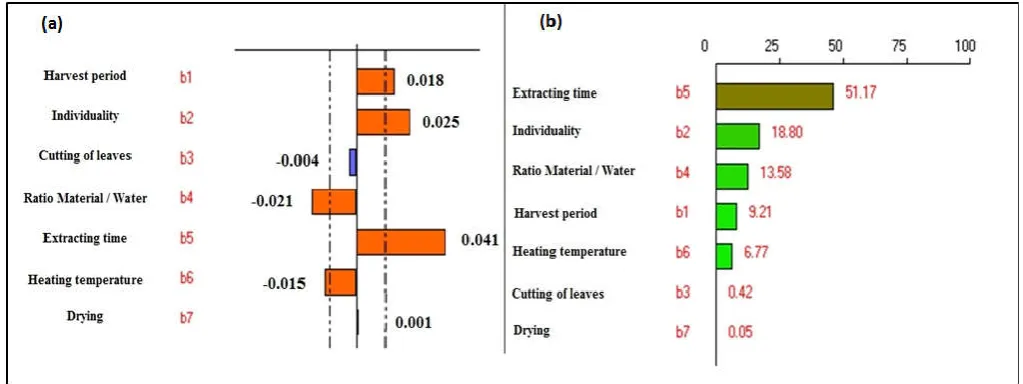
The two graphics (Fig 4) show that time (please precise here which time) (factor b5) is the most influential factor on the
hydrodistillation operation with a coefficient of 0.041. This lone factor contributed by 51.17% to the variability of the studied response. Obviously, the time influences directly the hydrodistillation operation and its impact on such operation has been demonstrated by several authors (Wognin et al., 2010, Tan et al., 2012, Mu’azu et al., 2012, Galadima et al., 2012).
Individuality effect
The individuality effect is the second factor that affects the hydrodistillation process with a coefficient of 0,025 and 18,8% of contribution in the yield variability. The results show that the passage from the individual 1 to individual 2 in the realization of the experiments generates an increase in the essential oil yield. This change from one individual to another can be explained by the development stage of the plant organ (leaf, flower and fruit ontogeny) (Rowshan et al., 2012, Pereira et al., 2009), or by genetic (Figueiredo et al., 2008).
Vegetable material / Water Ratio
The third factor that showed a significant influence on the yield is evidently the ratio between vegetable material and water in the distillation flask. This factor has a coefficient of --0,021 and a contribution of 13,58%. The minus sign indicates that the passage from the minimal level (the ratio 1/ 12) to the maximal level (the ratio 1/4) causes a fall in the essential oil yield. Several studies have shown that the increase in the ratio of vegetable material and water generates a decrease in yield (Ammar et al., 2010, Silou et al., 2004, Tan et al., 2012). This decrease can be explained by the fact that high amount of plant material in water prevents the water vapor formed in the bottom of the flask to rise up in the condensation tube which induce a yield reduction (Rabesiaka et al., 2012).
Harvest period
The harvest period comes in the fourth position with a coefficient of 0,018 and a contribution of 9,21%. This result indicates that yield becomes more important in the middle of October (Ripen fruits Period) compared to the middle of May (Pre-flowering Period). These results are in accordance with Pereira’s and Amin’s ones (Pereira et al., 2009, Amine, 2013) that indicated that October is the best period for better exploiting the Myrtle essences. Furthermore, Bradesi et al. (1997) recommend the period from June to November as the best harvest time for commercial production of the essential oil.
Heating temperature
The last factor having a significant effect on the yield is the heating temperature, with a coefficient of -0,015 and a contribution of 6,77 %. Its increase enhanced the steam condensation’s flow. This increase has a negative effect on yield. Indeed, a big increase of the steam condensation’s flow leads to a decrease of the condensate’s residence time in the decanter, which does not leave time for essential oils to be separated from the liquid (Herzi, 2013). These results are concordant with those found by other authors (Ammar et al., 2010, Silou et al., 2004, Rabesiaka et al., 2012).
Figure 4. (a): The factors effect’s graph, (b): the variation of the contribution percentage of each factor to the studied response
[image:6.595.42.554.406.598.2]Conclusion
In this study, we were able to evaluate the effect of operating conditions on the essential oil yield of Myrtus communis L., by using the strategy of the experiments design to get the maximum results with a minimum of experiments. The results show clearly that this experimental methodology is an appropriate method for screening the factors affecting the hydrodistillation operation of the studied plant. The design of Placket and Burman which was applied led to a first-order model whose statistically significant coefficients are related to the most influential factors on the response. After the statistical validation of the obtained model, we performed the analysis of effects. All the studied factors influenced the hydrodistillation of Myrtus communis leaves. And hence its essential oil yield except the leave’s drying and cutting, even though these two factors showed a negligible statistical effects. To complete this study, an optimization study must be conducted. It will seek the optimal operating conditions to have a better yield through using another type of experiments design developed for this type of study; namely, the response surface methodology by acting only on the continuous operating factors such as time processing, mass plant/water ratio, and heating temperature.
REFERENCES
Amine, M.A., 2013. Effect of Harvesting Date on the Quantity and Quality of Extracted Essential Oil from Myrtus communis L., Aust. J. Basic Appl. Sci., 7: 506-513
Ammar, A.H., Zagrouba, F., Romdhane, M., 2010. Optimization of operating conditions of Tunisian myrtle (Myrtus communis L.) essential oil extraction by a hydrodistillation process using a 24 complete factorial design, Flavour Fragr J., 25: 503-507
Benabid, A., 1997. Projet GEF-RIF : Protection et gestion participatives des écosystèmes forestières du Rif : BDRA, Paris
Benjilali, B., 2005. Le matériel végétal et l’extraction in : Huiles essentielles : de la plante à la commercialisation - Manuel pratique: Corporation Laseve, Québec
Bourkhiss, M., Hnach, M., Bourkhiss, B., Ouhssine, M., Chaouch, A., and Satrani, B., 2009. Effet de séchage sur la teneur et la composition chimique des huiles essentielles de Tetraclinis articulata (Vahl ) Masters, Agrosolutions, 20: 44-48
Box, G.E.P., Hunter, W.G., and Hunter, J.S., 1978. Statistics for Experimenters: An Introduction to Design, Data Analysis and Model Building: Wiley, New York
Bradesi, P., Tomi, F., Casanova, J., Costa, J., Bernardini, A., 1997. Chemical Composition of Myrtle Leaf Essential Oil from Corsica (France), J. Essent. Oil Res., 9: 283-288 Charles J.D., 2013. Antioxidant Properties of Spices, Herbs
and Other Sources, 1st Ed.: Springer-Verlag, New York Claeys-Bruno, M., Dobrijevic, M. and Sergent, M., 2009.
Comparaison entre les plans d'experiences et la methode monte carlo In : 41èmes Journées de Statistique: SFdS, Bordeaux
Clevenger, J., 1928. Apparatus for the determination of volatile oil, J. Am. Pharm. Assoc., 17:345-349
Draper, N.R. and Smith, H., 1998. Applied Regression Analysis, 3rd Ed.: Wiley, New York
Farah, A., Afifi, A., Fechtal, M., Chhen, A., Satrani, B., Talbi, M. and Chaouch, A., 2006. Fractional distillation effect on the chemical composition of Moroccan myrtle (Myrtus communis L.) essential oils, Flavour Fragr J., 21: 351-354 Figueiredo, A.C., Barroso, J.G., Pedro, L. and Scheffer, J.J.C.,
2008. Factors affecting secondary metabolite production in plants: volatile components and essential oils, Flavour Fragr. J., 23: 213-226
Galadima, M.S., Ahmed, A.S., Olawale, A.S. and Bugaje, I.M., 2012. Optimization of Steam Distillation of Essential Oil of Eucalyptus tereticornis by Response Surface Methodology, Niger. J. Basic Appl. Sci., 20: 368-372 Ganou, L., 1993. Contribution à l’étude de mécanismes
fondamentaux de l’hydrodistillation des huiles essentielles : PhD Thesis, Instit. Polytech., Toulouse
Gardeli, C, Vassiliki, P, Athanasios, M. and Komaitis, T.M., 2008. Essential oil composition of Pistacia lentiscus L. and Myrtus communis L.: Evaluation of antioxidant capacity of methanolic extracts, Food Chemistry, 107: 1120-1130 (2008)
Goupy, J. 2006. Les plans d’expériences, Rev. MODULAD, 34 : 74-116
Herzi, N., 2013. Extraction et purification de substances naturelles: comparaison de l’extraction au CO2-supercritique et des techniques conventionnelles : PhD Thesis, Instit. Polytech. Toulouse
Horadam K..J., 2007. Hadamard Matrices and Their Applications: Princeton University Press, New Jersey Kalil, S.J., Maugeri, F. and Rodrigues, M.I., 2000. Response
surface analysis and simulation as a tool for bioprocess design and optimization, Process. Biochem., 35: 539-500 Levin, L. , Forchiassin, F. and Viale, A., 2005. Ligninolytic
enzyme production and dye decolorization by Trametes trogii: application of the Plackett–Burman experimental design to evaluate nutritional requirements, Process Biochem, 40: 1381-1387
Mathieu, D., Phan-Tan-Lu, R., 2000. Logiciel Nemrod : LPRAI, Marseille
Maxia, A., Frau M.A., Falconieri, D., Karchuli, M.S. and Kasture, S., 2011. Essential oil of Myrtus communis inhibits inflammation in rats by reducing serum IL-6 and TNF-alpha, Nat. Prod. Commun., 6: 1545-1548
Mu’azu, K., Mohammed-Dabo, IA. and Waziri, S.M., 2012. Development of Mathematical Model for the Prediction of Essential Oil Extraction from Eucalyptus Citriodora Leave, J. Basic. Appl. Sci. Res., 2: 2298-2306
Myer, R.H. and Montgomery, D.C., 2002. Response Surface Methodology: Process and Product Optimization Using Designed Experiments: Wiley, New York
Pereira, P.C., Cebola, M.J. and Bernardo-Gil, M.G., 2009. Evolution of the Yields and Composition of Essential Oil from Portuguese Myrtle (Myrtus comunis L.) through the Vegetative cycle, Molecules, 14: 3094-3105
Pharmacopée Française., 1983. 10th Ed.: Maison neuve, Paris Plackett R.L. and Burman, J.P., 1946. The design of optimum
multifactorial experiments, Biometrika, 33: 305-325 Rabesiaka, J., Pierre, R. and Razanamparany, B., 2012.
Ravikumar, K., Krishnan, S., Ramalingam, S. and Balu, K., 2007. Optimization of process variables by the application of response surface methodology for dye removal using a novel adsorbent, Dye Pigment, 72: 66-74
Rowshan, V., Najafian, S. and Tarakemeh, A., 2012. Essential oil chemical composition changes affected by leaf ontogeny stages of myrtle (Myrtus communis L.), Int. J. Med. Arom. Plants, 2 : 114-117
Silou , T. , Malanda, M. and Loubaki L., 2004. Optimisation de l’extraction de l'huile essentielle de Cymbopogon citratus grâce à un plan factoriel complet 23, J. Food Eng., 65: 219-223
Tan, Q., Kieu, X., Kim, N. and Hong, X., 2012. Application of response surface methodology (RSM) in condition optimization for essential oil production from Citrus latifolia, Emir. J. Food Agric., 24: 25-30
Tinsson, W., 2010. Plans D’expérience: Constructions et Analyses Statistiques : Springer, Berlin
Wognin, E.L., Tonzibo, Z.F., Augustin, K. and Thomas, Y., 2010. Contribution à l’optimisation de la distillation des huiles essentielles extraites des fleurs de chromolaena odorata l king & robinson grâce à un plan factoriel complet 24, Rev. Ivoir. Sci. Technol., 15: 23-37
Zeboudj, S, Belhanèche-Bensemra, N. and Belabbès, R., 2005. Use of surface response methodology for the optimization of the concentration of the sweet orange essential oil of Algeria by wiped film evaporator, J. Food Eng., 67: 507-512