ISSN Online: 2152-7199 ISSN Print: 2152-7180
DOI: 10.4236/psych.2019.103025 Feb. 22, 2019 358 Psychology
Research Progress on the Influence of
Materialism and Its Interventions
Shuxiang Fu, Yaozhong Liu
Business Administration, Jinan University, Guangzhou, China
Abstract
In recent years, related research on materialism has been widely concerned by scholars at home and abroad, but most of the research is based on its negative influence. Will materialism have a positive impact? How to deal with the negative effects of materialism? It should also cause our concern. This paper introduces the positive and negative effects of materialism from four levels of individual, consumption, organization and society, and summarizes the in-terventions of materialism. Future research should continue to improve the concept of materialism, expand research levels, and develop effective inter-vention strategies.
Keywords
Materialism, Influence, Interventions
1. Introduction
With the development of economic reforms and large-scale urbanization, the privatization of property and the establishment of commercial real estate have initiated “the greatest transfer of wealth in human history”. Chinese people are living in the era of wealth explosion with the success of material desire to keep climbing. The trend of materialism prevails in contemporary work and life, and there are many different definitions of materialism, including personality traits (Belk, 1984), values orientation (Richins & Dawson, 1992) and goal orientation (Kasser & Ryan, 1993, 1996). The empirical research on materialism mostly fol-lows the value/target orientation and reflects the values or goals that emphasize the importance of material wealth, social prestige and external image to personal life. High-level materialists usually focus on low-level needs, have high extrinsic motivation and have lower happiness. In recent years, scholars have expanded How to cite this paper: Fu, S. X., & Liu, Y.
Z. (2019). Research Progress on the Influ-ence of Materialism and Its Interventions. Psychology, 10, 358-370.
https://doi.org/10.4236/psych.2019.103025
Received: January 25, 2019 Accepted: February 19, 2019 Published: February 22, 2019
Copyright © 2019 by author(s) and Scientific Research Publishing Inc. This work is licensed under the Creative Commons Attribution International License (CC BY 4.0).
http://creativecommons.org/licenses/by/4.0/
DOI: 10.4236/psych.2019.103025 359 Psychology
the concept of materialism from different perspectives. Recent theory holds that
materialism is an identity goal pursuit (Shrum et al., 2013). Materialism is not
just equivalent to a specific set of behaviors (such as conspicuous consumption, luxury purchases). Materialism is not a simple dichotomy (materialist and
non-materialist), but as a continuum from low to high (Richins, 2017). The
ex-tension of these concepts provides a new perspective for the study of the positive effects of materialism.
In recent years, related research on materialism has been widely concerned by psychologists, consumer researchers, and sociologists. Most of the current do-mestic research focuses on the negative effects of materialism, such as: compul-sive consumption, life satisfaction and the decline of happiness level, which has the most research on materialism and happiness, but less research on the posi-tive influence of materialism. In view of this, it is of great practical significance to enhance the research on the positive influence of materialism and to effec-tively intervene in its negative influence.
This study will systematically review and summarize the positive and negative effects of materialism from four levels of individual, consumption, organization and society, and summarizes the interventions of materialism. In order to un-derstand the weak links of current materialist research, promote the research and application of materialism and point out the direction for future research.
2. The Influence of Materialism
At present, most research has been done on the relationship between
material-ism and happiness (Kasser & Ahuvia, 2002; Richins, 1987), but the research is
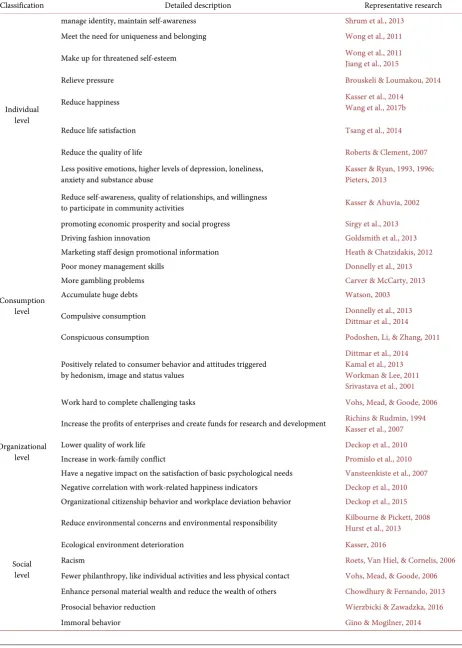
loose, old and not comprehensive. Therefore, it is necessary to establish a com-prehensive and comcom-prehensive theoretical framework. This research will focus on the positive and negative effects of individuality, consumption, organization and society, as presented in Table 1.
2.1. The Influence of Materialism on the Individual Level
Materialism can play an important role in individual life. According to Shrum et
al. (2013), materialism has the role of managing identity and maintaining self-awareness. Material pursuits help to meet the need for uniqueness and be-longing, and can compensate for threatened self-esteem, because people believe that material and wealth make them more socially attractive, or react to the threat of self-esteem, especially when people think when they are excluded by
society (Jiang et al., 2015). In addition, material wealth can help restore and
maintain a sense of stability, identity, control and positive self-image, and is a means of reducing stress (Brouskeli & Loumakou, 2014).
Because of the importance of external goals, high-level materialists have un-met internal needs and have many negative effects on individuals’ psychology,
emotions, and behaviors. For example, materialism and well-being (Kasser et al.,
DOI: 10.4236/psych.2019.103025 360 Psychology
Table 1. The influence of materialism.
Classification Detailed description Representative research
Individual level
manage identity, maintain self-awareness Shrum et al., 2013
Meet the need for uniqueness and belonging Wong et al., 2011
Make up for threatened self-esteem Wong et al., 2011 Jiang et al., 2015
Relieve pressure Brouskeli & Loumakou, 2014
Reduce happiness Kasser et al., 2014 Wang et al., 2017b
Reduce life satisfaction Tsang et al., 2014
Reduce the quality of life Roberts & Clement, 2007
Less positive emotions, higher levels of depression, loneliness,
anxiety and substance abuse Kasser & Ryan, 1993, 1996; Pieters, 2013
Reduce self-awareness, quality of relationships, and willingness
to participate in community activities Kasser & Ahuvia, 2002
Consumption level
promoting economic prosperity and social progress Sirgy et al., 2013
Driving fashion innovation Goldsmith et al., 2013
Marketing staff design promotional information Heath & Chatzidakis, 2012
Poor money management skills Donnelly et al., 2013
More gambling problems Carver & McCarty, 2013
Accumulate huge debts Watson, 2003
Compulsive consumption Donnelly et al., 2013 Dittmar et al., 2014
Conspicuous consumption Podoshen, Li, & Zhang, 2011
Positively related to consumer behavior and attitudes triggered by hedonism, image and status values
Dittmar et al., 2014 Kamal et al., 2013 Workman & Lee, 2011 Srivastava et al., 2001
Organizational level
Work hard to complete challenging tasks Vohs, Mead, & Goode, 2006
Increase the profits of enterprises and create funds for research and development Richins & Rudmin, 1994 Kasser et al., 2007
Lower quality of work life Deckop et al., 2010
Increase in work-family conflict Promislo et al., 2010
Have a negative impact on the satisfaction of basic psychological needs Vansteenkiste et al., 2007
Negative correlation with work-related happiness indicators Deckop et al., 2010
Organizational citizenship behavior and workplace deviation behavior Deckop et al., 2015
Social level
Reduce environmental concerns and environmental responsibility Kilbourne & Pickett, 2008 Hurst et al., 2013
Ecological environment deterioration Kasser, 2016
Racism Roets, Van Hiel, & Cornelis, 2006
Fewer philanthropy, like individual activities and less physical contact Vohs, Mead, & Goode, 2006
Enhance personal material wealth and reduce the wealth of others Chowdhury & Fernando, 2013
Prosocial behavior reduction Wierzbicki & Zawadzka, 2016
DOI: 10.4236/psych.2019.103025 361 Psychology (Tsang et al., 2014), quality of life (Roberts & Clement, 2007) is negatively corre-lated; in addition, a series of studies have found that people with high levels of materialism have less positive emotions, higher levels of depression, loneliness,
anxiety and drug abuse (Kasser & Ryan, 1993, 1996; Pieters, 2013); tend to
re-duce investment in intrinsic value such as self-fulfillment and contributions to families, friends, and communities, thereby reducing self-awareness, quality of interpersonal relationships, and willingness to participate in community activi-ties (Kasser & Ahuvia, 2002), A possible explanation for this is that the focus on material and wealth leads to neglect of social relationships and other areas of life such as the family, thereby reducing mental adjustment and social adaptability.
2.2. The Influence of Materialism on Consumption Level
Materialism has a positive impact on individual consumption behavior. Mate-rialism can stimulate consumer desire to some extent and stimulate achievement motivation. This achievement motivation can not only improve individual in-come and living standards, but also stimulate commodity demand, thereby
promoting economic prosperity and social progress (Sirgy et al., 2013, 2015). For
consumers, Goldberg et al. (2003) found that younger people with higher levels
of materialism tend to shop more often, have more knowledge about products and services, and are most sensitive to advertising and promotions. Therefore, they may be early adopters, trendsetters, and opinion leaders. In addition, the study found that the center, as an important dimension of materialism, domi-nates consumer innovation and is a major driver of fashion innovation (Goldsmith et al., 2013). For marketers, sales information can be designed to identify target customers, promote strategic brand communication, and positive consumer behavior that is beneficial to society (Heath & Chatzidakis, 2012).
High-level materialists place material wealth at the core of their lives, have a strong desire for expensive consumer goods, and hope to obtain social status and social recognition through material products, rather than through self-awareness or carefully planned consumption, usually Lack of control over consumption can lead to irrational consumer attitudes and behaviors. Materialism is positively correlated with high consumption, and high-level materialists tend to save less
money because they have poorer money management skills (Donnelly,
Ksend-zova, & Howell, 2013) and more gambling problems (Carver & McCarty, 2013),
and accumulate huge debts (Watson, 2003), promoting compulsive
consump-tion (CB) (Donnelly et al., 2013; Dittmar et al., 2014) and conspicuous
con-sumption (Podoshen, Li, & Zhang, 2011), but Johnson and Attmann (2009) did
not find a link between materialism and CB in the sample of female college stu-dents, but this is probably because materialism is also affected by other factors (such as neuroticism, fashion interest).
In addition, materialism is also positively related to consumer behavior and
attitudes triggered by hedonism, image and status values. For example, Dittmar
en-DOI: 10.4236/psych.2019.103025 362 Psychology
gaging in health-hazardous behaviors that involve not only consumption (such as cigarettes, alcohol, etc.) but also strong hedonism; materialism also Main-taining image-related attitudes and behaviors positively, including positive
at-tention to fashion and apparel and cosmetic surgery (Kamal, Chu, & Pedram,
2013; Workman & Lee, 2011); materialistic motives should also be of concern, and high-level materialists usually want to have better houses and cars than their neighbors (Srivastava, Locke, & Bartol, 2001).
2.3. The Influence of Materialism on the Organizational Level
Researchers have extended the study of materialism to the organizational do-main and found that the level of materialism of employees may be regarded as an important factor in organizational productivity and can promote the realiza-tion of organizarealiza-tional goals. Materialists tend to spend time on hard work rather than leisure activities, work harder to complete challenging tasks, and want totake on more work (Vohs, Mead, & Goode, 2006); high levels of production and
consumption not only Can increase the profits of enterprises, and can create funds for research and development, better research and development will pro-duce higher productivity, technological breakthroughs, and bring a higher stan-dard of living (Kasser, Cohn, Kanner, & Ryan, 2007; Richins & Rudmin, 1994).
However, because high-level materialists spend too much time and energy on hard work, achieving personal goals, and achieving higher performance, their basic psychological needs are not met, which may result in lower work input. (Schreurs, Van Emmerik, Anja, & Guenter, 2014) and occupational satisfaction (Deckop, Jurkiewicz, & Giacalone, 2010), higher emotional exhaustion and
wil-lingness to leave (Vansteenkiste et al., 2007), affecting the quality of work and
life of individuals and Work-life balance (Deckop et al., 2010) leads to an
in-crease in work-family conflicts (Promislo et al., 2010). In turn, it affects the
work-related personal well-being indicators (such as internal and external re-ward satisfaction, job satisfaction, and professional satisfaction). This negative relationship is determined by the materialistic dimension of happiness and cen-tral dimension rather than the dimension of success. Driven by the study, the investigation further investigated the effects of two behavioral indicators of ma-terialism and work (including organizational citizenship behavior and workplace deviation behavior). The results showed that there was a significant negative correlation between materialism and organizational citizenship behavior, and individual deviation. Positive correlation, but not significantly associated with tissue bias (Deckop et al., 2015).
2.4. The Influence of Materialism on the Social Level
DOI: 10.4236/psych.2019.103025 363 Psychology
According to the theory of value conflict, materialism is a selfish value that conflicts with the altruistic values of environmentalism and prosocial behavior. Therefore, materialism increases the importance of values that are harmful to the environment, and at the same time reduces people’s values of pro-social val-ues. Pay attention to it. For example: reducing environmental concerns and
en-vironmentally responsible behavior (Hurst et al., 2013; Kilbourne & Pickett,
2008), promoting ecological degradation (Kasser, 2016) and racism (Roets, Van Hiel, & Cornelis, 2006); Communicating is more self-directed, less helpful, less
charitable, often prefers individual activities and less physical contact (Vohs et
al., 2006), more competitive and less cooperative (Sheldon, Sheldon, & Osbal-diston, 2000); high-level materialists tend to increase their personal material wealth and reduce material wealth by paying more attention to wealth,
achieve-ment, power, and status (Chowdhury & Fernando, 2013), resulting in reduced
prosocial behavior (Wierzbicki & Zawadzka, 2016) and even unethical behavior
(Gino & Mogilner, 2014).
3. The Interventions of Materialism
In view of materialism has brought about many bad consequences, it is of great practical significance to explore how to effectively intervene and intervene in ma-terialism. The following will propose materialist interventions from the perspective of activating and encouraging internal and self-transcending values/objectives, increasing security and reducing the impact of social factors.
3.1. Activate the Intrinsic Goal
Self-determination theory believes that when the three basic psychological needs of autonomy, competence and belonging are met, the individual will develop in a positive and healthy direction (Deci & Ryan, 2000). When people are guided to focus on internal and self-transcending values/goals, there are less materialist tendencies, quoting Kassel’s words: “The inner goal is often to promote greater happiness, and is an antidote to the values of materialism”.
Experimental studies have found that participants who are immersed in nature (and thus activate self-transcendence value) report higher intrinsic value
expecta-tions than those who are immersed in an unnatural environment (Weinstein,
Przybylski, & Ryan, 2009); And experimental studies have found that those who reported higher levels of mental activity and those who were asked to recall
mental events reduced their desire for materialism (Stillman et al., 2012). In
ad-dition, gratitude and learning mindfulness skills are possible to reduce
material-ist goals and mitigate the negative effects of materialism (Polak & McCullough,
satisfac-DOI: 10.4236/psych.2019.103025 364 Psychology
tion of basic human needs. They will have better experience memories, more re-sistance to unfavorable comparisons, and tend to be more closely related to self, and more likely to meet Social and emotional needs.
3.2. Improve Safety and Security
The lack of hypothesis suggests that individuals lacked a sense of security and urged them to use material as a compensatory strategy to reduce pain and an-xiety. Materialism, as an external motivation, often drives people to pursue hap-piness from external goals such as money, status, and appearance, and may ig-nore the inner satisfaction of basic psychological needs.
For example, the study found that the level of materialism among adolescents
whose self-esteem was temporarily elevated was significantly reduced (Chaplin
& John, 2007); thinking about high-quality interpersonal relationships would
keep people away from the external goals of materialism (Clark et al., 2011).
Nostalgic memories also reduce people’s attachment to money because they
usually involve positive interpersonal activities (Lasaleta, Sedikides, & Vohs,
2014). In addition, although the previous research starts from the theory of fear management, trying to understand the antecedents of materialism from the perspective of insecurity, that when human beings realize that death is inevita-ble, they will pursue the acquisition and consumption of material wealth more and show strong materialist tendencies. A short-term confrontation with death may lead to self-defense and promote materialism, but when people are deeply involved or continue to reflect on death for a long time, they will transcend
de-fense, from external, materialistic values to intrinsic values (Cozzolino et al.,
2004; Lykins et al., 2007).
3.3. Reduce the Impact of Social Factors
The socialization hypothesis believes that individuals in the socialization stage will continue to strengthen their materialist values if they frequently contact various materialist information. Socialized information comes from the mass media, peers and families, so these social factors will reduce materialism to a certain extent.
Intervention studies have found that children’s materialist values are not in-fluenced by advertising when parents use positive methods to criticize commer-cial advertising or involve children in discussing household consumption
deci-sions (Buijzen & Valkenburg, 2005). Experimental evidence also shows that
when adults use the facts (those ads are for sale) or to evaluate (these ads are stupid) sexual speech discussion ads, the children report more negative attitudes
towards the ads, which reduces the desire for advertising products (Buijzen &
Mens, 2007).
4. Summary and Outlook
DOI: 10.4236/psych.2019.103025 365 Psychology
the following characteristics: the research mainly focuses on the individual level and the consumption level, among which there are many researches on mate-rialism and subjective well-being, on the organizational level and society. There are relatively few studies at the level. This paper systematically summarizes the influence of materialism and its interventions, but the internal mechanism of the influence of materialism is insufficient. The future research should explore the mediation and adjustment mechanism of the influence of materialism, and build up a more comprehensive theoretical framework.
Contemporary society is full of various materialist clues. Materialism has an important influence on individuals, consumption, organization, and society. It has a strong practical significance for the prevention of materialism. In order to reduce materialism and get more fun from life, it is best to focus on the inner goal rather than the external goal, improve the sense of security, reduce the influence of social factors, and promote the public through the guiding role of the mass media. Re-cognizing the negative impact of materialism, we encourage everyone to actively participate in charitable activities and charities and reshape good values. Parents should play a good role in modeling and reducing the bad guidance of their child-ren’s materialist values. Educators can set up health-oriented courses and conduct psychosocial services to provide counseling and protection. Future research can conduct in-depth analysis and discussion on the following aspects.
4.1. Improve the Concept of Materialism
Materialism is a complex term which concept has not yet reached a consensus conclusion. Future research should clarify the dimensions of materialism and form a unified concept that will help us build measurement tools that can be evaluated in different cultures in an effective and reliable manner.
4.2. Expanding the Scope of Research
First of all, most of the materialist related research is carried out in the western individualistic culture, but there is less research in the eastern collectivist cul-ture. Materialism as a kind of value should be in the background of the greater value system owned by the individual. Under the circumstance, research in the oriental cultural background and cross-culture should be expanded.
DOI: 10.4236/psych.2019.103025 366 Psychology
and social levels.
Third, at present, some researchers have been done on the relationship be-tween materialism and its related variables, but most of its related research is based on cross-disciplinary research, which fails to accurately reflect the dynam-ic characteristdynam-ics of materialism, while vertdynam-ical research will help reveal Causality and underlying mechanisms explore whether changes in the consequences are caused by changes in materialism. For example, materialism leads to lower hap-piness, or lower happiness leads to materialism, or has a two-way trajectory over time. Therefore, in the field of materialist research, research and design im-provement is necessary, and future research requires more longitudinal, experi-mental and developexperi-mental research.
4.3. Development Interventions
Although research on material interventions is accumulating, further develop-ment and improvedevelop-ment are still needed. First, most research on materialist in-terventions only implements short one-time inin-terventions, and only a few stu-dies (Kasser et al., 2014; Lekes et al., 2012) explore interventions that may lead to sustained changes in materialism, the future. Research needs to do more research on the latter type. Second, most of the interventions are carried out in samples with better economic conditions, so is it effective in individuals with more eco-nomic pressure? Further research is still needed. Third, the exact process of posi-tive effects from certain interventions remains unknown. For example, why does reflective intervention reduce materialism? What is its internal mechanism? Is it because of the reduction in insecurity or the development of values/objectives that contribute to internal and self-transcendence? Understanding the underly-ing mechanisms is conducive to the exploration of more effective interventions.
Conflicts of Interest
The authors declare no conflicts of interest regarding the publication of this pa-per.
References
Belk, R. W. (1984). Three Scales to Measure Constructs Related to Materialism: Reliabili-ty, ValidiReliabili-ty, and Relationships to Measures of Happiness. Advances in Consumer Re-search, 11, 291-297.
Brouskeli, V., & Loumakou, M. (2014). Materialism, Stress and Health Behaviors among Future Educators. Journal of Education and Training Studies, 2, 145-150.
https://doi.org/10.11114/jets.v2i2.252
Buijzen, M., & Mens, C. (2007). Adult Mediation of Television Advertising Effects. Jour-nal of Children & Media, 1, 177-191.https://doi.org/10.1080/17482790701339233
Buijzen, M., & Valkenburg, P. M. (2005). Parental Mediation of Undesired Advertising Effects. Journal of Broadcasting & Electronic Media, 49, 153-165.
https://doi.org/10.1207/s15506878jobem4902_1
DOI: 10.4236/psych.2019.103025 367 Psychology
Gamblers in the United States. International Gambling Studies, 13, 338-355.
https://doi.org/10.1080/14459795.2013.819933
Chaplin, L. N., & John, D. R. (2007). Growing up in a Material World: Age Differences in Materialism in Children and Adolescents. Journal of consumer research, 34, 480-493.
https://doi.org/10.1086/518546
Chowdhury, R. M., & Fernando, M. (2013). The Role of Spiritual Well-Being and Mate-rialism in Determining Consumers’ Ethical Beliefs: An Empirical Study with Australian Consumers. Journal of Business Ethics, 113, 61-79.
https://doi.org/10.1007/s10551-012-1282-x
Clark, M. S., Greenberg, A., Hill, E., Lemay, E. P., Clark-Polner, E., & Roosth, D. (2011). Heightened Interpersonal Security Diminishes the Monetary Value of Possessions.
Journal of Experimental Social Psychology, 47, 359-364.
https://doi.org/10.1016/j.jesp.2010.08.001
Cozzolino, P. J., Staples, A. D., Meyers, L. S., & Samboceti, J. (2004). Greed, Death, and Values: From Terror Management to Transcendence Management Theory. Personality and Social Psychology Bulletin, 30, 278-292. https://doi.org/10.1177/0146167203260716
Deckop, J. R., Giacalone, R. A., & Jurkiewicz, C. L. (2015). Materialism and Workplace Behaviors: Does Wanting More Result in Less? Social Indicators Research, 121,
787-803. https://doi.org/10.1007/s11205-014-0661-3
Deckop, J. R., Jurkiewicz, C. L., & Giacalone, R. A. (2010). Effects of Materialism on Work-Related Personal Well-Being. Human Relations, 63, 1007-1030.
https://doi.org/10.1177/0018726709353953
Dittmar, H., Bond, R., Hurst, M., & Kasser, T. (2014). The Relationship between Mate-rialism and Personal Well-Being: A Meta-Analysis. Journal of Personality and Social Psychology, 107, 879. https://doi.org/10.1037/a0037409
Donnelly, G., Ksendzova, M., & Howell, R. T. (2013). Sadness, Identity, and Plastic in Over-Shopping: The Interplay of Materialism, Poor Credit Management, and Emo-tional Buying Motives in Predicting Compulsive Buying. Journal of Economic Psy-chology, 39, 113-125. https://doi.org/10.1016/j.joep.2013.07.006
Gino, F., & Mogilner, C. (2014). Time, Money, and Morality. Psychological Science, 25,
414-421. https://doi.org/10.1177/0956797613506438
Goldberg, M. E., Gorn, G. J., Peracchio, L. A., & Bamossy, G. (2003). Understanding Ma-terialism among Youth. Journal of Consumer Psychology, 13, 278-288.
Goldsmith, R. E., Flynn, L. R., Goldsmith, E. B., & Kim, W. M. (2013). Fashion Innova-tiveness and Materialism. Journal of Global Fashion Marketing, 4, 266-283.
https://doi.org/10.1080/20932685.2013.817142
Heath, T. P., & Chatzidakis, A. (2012). The Transformative Potential of Marketing from the Consumers’ Point of View. Journal of Consumer Behaviour, 11, 283-291.
https://doi.org/10.1002/cb.1387
Hurst, M., Dittmar, H., Bond, R., & Kasser, T. (2013). The Relationship between Materia-listic Values and Environmental Attitudes and Behaviors: A Meta-Analysis. Journal of Environmental Psychology, 36, 257-269. https://doi.org/10.1016/j.jenvp.2013.09.003
Jiang, J., Zhang, Y., Ke, Y., Hawk, S. T., & Qiu, H. (2015). Can’t Buy Me Friendship? Peer Rejection and Adolescent Materialism: Implicit Self-Esteem as a Mediator. Journal of Experimental Social Psychology, 58, 48-55. https://doi.org/10.1016/j.jesp.2015.01.001
DOI: 10.4236/psych.2019.103025 368 Psychology
Kamal, S., Chu, S. C., & Pedram, M. (2013). Materialism, Attitudes, and Social Media Usage and Their Impact on Purchase Intention of Luxury Fashion Goods among American and Arab Young Generations. Journal of Interactive Advertising, 13, 27-40.
https://doi.org/10.1080/15252019.2013.768052
Kasser, T. (2016). Materialistic Values and Goals. Annual Review of Psychology, 67,
489-514.https://doi.org/10.1146/annurev-psych-122414-033344
Kasser, T., & Ahuvia, A. (2002). Materialistic Values and Well-Being in Business Stu-dents. European Journal of Social Psychology, 32, 137-146.
https://doi.org/10.1002/ejsp.85
Kasser, T., & Ryan, R. M. (1993). A Dark Side of the American Dream: Correlates of Fi-nancial Success as a Central Life Aspiration. Journal of Personality and Social Psychol-ogy, 65, 410.https://doi.org/10.1037/0022-3514.65.2.410
Kasser, T., & Ryan, R. M. (1996). Further Examining the American Dream: Differential Correlates of Intrinsic and Extrinsic Goals. Personality and Social Psychology Bulletin, 22, 280-287.https://doi.org/10.1177/0146167296223006
Kasser, T., Cohn, S., Kanner, A. D., & Ryan, R. M. (2007). Some Costs of American Cor-porate Capitalism: A Psychological Exploration of Value and Goal Conflicts. Psycho-logical Inquiry, 18, 1-22.https://doi.org/10.1080/10478400701386579
Kasser, T., Rosenblum, K. L., Sameroff, A. J., Deci, E. L., Niemiec, C. P., Ryan, R. M. et al. (2014). Changes in Materialism, Changes in Psychological Well-Being: Evidence from Three Longitudinal Studies and an Intervention Experiment. Motivation & Emotion, 38, 1-22.https://doi.org/10.1007/s11031-013-9371-4
Kilbourne, W., & Pickett, G. (2008). How Materialism Affects Environmental Beliefs, Concern, and Environmentally Responsible Behavior. Journal of Business Research, 61,
885-893.https://doi.org/10.1016/j.jbusres.2007.09.016
Kumar, A., & Gilovich, T. (2016). To Do or to Have, Now or Later? The Preferred Con-sumption Profiles of Material and Experiential Purchases. Journal of Consumer Psy-chology, 26, 169-178.https://doi.org/10.1016/j.jcps.2015.06.013
Lasaleta, J. D., Sedikides, C., & Vohs, K. D. (2014). Nostalgia Weakens the Desire for Money. Journal of Consumer Research, 41, 713-729.https://doi.org/10.1086/677227
Lekes, N., Hope, N. H., Gouveia, L., Koestner, R., & Philippe, F. L. (2012). Influencing Value Priorities and Increasing Well-Being: The Effects of Reflecting on Intrinsic Val-ues. The Journal of Positive Psychology, 7, 249-261.
https://doi.org/10.1080/17439760.2012.677468
Lykins, E. L. B., Segerstrom, S. C., Averill, A. J., Evans, D. R., & Kemeny, M. E. (2007). Goal Shifts Following Reminders of Mortality: Reconciling Posttraumatic Growth and Terror Management Theory. Personality and Social Psychology Bulletin, 33,
1088-1099.https://doi.org/10.1177/0146167207303015
Pieters, R. (2013). Bidirectional Dynamics of Materialism and Loneliness: Not Just a Vi-cious Cycle. Journal of Consumer Research, 40, 615-631.
https://doi.org/10.1086/671564
Podoshen, J. S., Li, L., & Zhang, J. (2011). Materialism and Conspicuous Consumption in China: A Cross-Cultural Examination. International Journal of Consumer Studies, 35,
17-25.https://doi.org/10.1111/j.1470-6431.2010.00930.x
Polak, E. L., & McCullough, M. E. (2006). Is Gratitude an Alternative to Materialism?
Journal of Happiness Studies, 7, 343.https://doi.org/10.1007/s10902-005-3649-5
Jour-DOI: 10.4236/psych.2019.103025 369 Psychology
nal of Occupational and Organizational Psychology, 83, 935-953. https://doi.org/10.1348/096317909X480167
Richins, M. L. (1987). Media, Materialism, and Human Happiness. Advances in Con-sumer Research, 14, 352-356.
Richins, M. L. (2017). Materialism Pathways: The Processes That Create and Perpetuate Materialism. Journal of Consumer Psychology, 27, 480-499.
https://doi.org/10.1016/j.jcps.2017.07.006
Richins, M. L., & Dawson, S. (1992). A Consumer Values Orientation for Materialism and Its Measurement: Scale Development and Validation. Journal of Consumer Research, 19, 303-316.https://doi.org/10.1086/209304
Richins, M. L., & Rudmin, F. W. (1994). Materialism and Economic Psychology. Journal of Economic Psychology, 15, 217-231.https://doi.org/10.1016/0167-4870(94)90001-9
Roberts, J. A., & Clement, A. (2007). Materialism and Satisfaction with Over-All Quality of Life and Eight Life Domains. Social Indicators Research, 82, 79-92.
https://doi.org/10.1007/s11205-006-9015-0
Roets, A., Van Hiel, A., & Cornelis, I. (2006). Does Materialism Predict Racism? Mate-rialism as a Distinctive Social Attitude and a Predictor of Prejudice. European Journal of Personality, 20, 155-168.https://doi.org/10.1002/per.573
Ryan, R. M., & Deci, E. L. (2000). Self-Determination Theory and the Facilitation of In-trinsic Motivation, Social Development, and Well-Being. American Psychologist, 55,
68.https://doi.org/10.1037/0003-066X.55.1.68
Schreurs, B., Van Emmerik, I. H., Anja, V. D. B., & Guenter, H. (2014). Work Values and Work Engagement within Teams: The Mediating Role of Need Satisfaction. Group Dynamics Theory Research & Practice, 18, 267-281.
https://doi.org/10.1037/gdn0000009
Sheldon, K. M., Sheldon, M. S., & Osbaldiston, R. (2000). Prosocial Values and Group assortation. Human nature, 11, 387-404. https://doi.org/10.1007/s12110-000-1009-z
Shrum, L. J., Wong, N., Arif, F., Chugani, S. K., Gunz, A., Lowrey, T. M., Scott, K. et al. (2013). Reconceptualizing Materialism as Identity Goal Pursuits: Functions, Processes, and Consequences. Journal of Business Research, 66, 1179-1185.
https://doi.org/10.1016/j.jbusres.2012.08.010
Sirgy, M. J., Gurel-Atay, E., Webb, D., Cicic, M., Husic-Mehmedovic, M., Ekici, A., Johar, J. S. et al. (2013). Is Materialism All That Bad? Effects on Satisfaction with Material Life, Life Satisfaction, and Economic Motivation. Social Indicators Research, 110,
349-366.https://doi.org/10.1007/s11205-011-9934-2
Srivastava, A., Locke, E. A., & Bartol, K. M. (2001). Money and Subjective Well-Being: It’s Not the Money, It’s the Motives. Journal of Personality and Social Psychology, 80, 959. https://doi.org/10.1037/0022-3514.80.6.959
Stillman, T. F., Fincham, F. D., Vohs, K. D., Lambert, N. M., & Phillips, C. A. (2012). The Material and Immaterial in Conflict: Spirituality Reduces Conspicuous Consumption.
Journal of Economic Psychology, 33, 1-7.https://doi.org/10.1016/j.joep.2011.08.012
Tsang, J. A., Carpenter, T. P., Roberts, J. A., Frisch, M. B., & Carlisle, R. D. (2014). Why Are Materialists Less Happy? The Role of Gratitude and Need Satisfaction in the Rela-tionship between Materialism and Life Satisfaction. Personality and Individual Differ-ences, 64, 62-66.https://doi.org/10.1016/j.paid.2014.02.009
DOI: 10.4236/psych.2019.103025 370 Psychology https://doi.org/10.1348/096317906X111024
Vohs, K. D., Mead, N. L., & Goode, M. R. (2006). The Psychological Consequences of Money. Science, 314, 1154-1156.
Wang, G., Liu, L., Tan, X., & Zheng, W. (2017a). The Moderating Effect of Dispositional Mindfulness on the Relationship between Materialism and Mental Health. Personality and Individual Differences, 107, 131-136.https://doi.org/10.1016/j.paid.2016.11.041
Wang, R., Liu, H., Jiang, J., & Song, Y. (2017b). Will Materialism Lead to Happiness? A Longitudinal Analysis of the Mediating Role of Psychological Needs Satisfaction. Per-sonality and Individual Differences, 105, 312-317.
https://doi.org/10.1016/j.paid.2016.10.014
Watson, J. J. (2003). The Relationship of Materialism to Spending Tendencies, Saving, and Debt. Journal of Economic Psychology, 24, 723-739.
https://doi.org/10.1016/j.joep.2003.06.001
Weinstein, N., Przybylski, A. K., & Ryan, R. M. (2009). Can nature Make Us More Car-ing? Effects of Immersion in Nature on Intrinsic Aspirations and Generosity. Personal-ity and Social Psychology Bulletin, 35, 1315-1329.
https://doi.org/10.1177/0146167209341649
Wierzbicki, J., & Zawadzka, A. M. (2016). The Effects of the Activation of Money and Credit Card vs. That of Activation of Spirituality—Which One Prompts Pro-Social Be-haviours? Current Psychology, 35, 344-353.https://doi.org/10.1007/s12144-014-9299-1
Wong, N., Shrum, L. J., Arif, F., Chugani, S., Gunz, A., Lowrey, T. M., Scott, K. et al. (2011). Rethinking Materialism: A Process View and Some Transformative Consumer Research Implications. Journal of Research for Consumers, No. 19, 1.
Workman, J. E., & Lee, S. H. (2011). Materialism, Fashion Consumers and Gender: A Cross-Cultural Study. International Journal of Consumer Studies, 35, 50-57.