Deviations from Beta Radioactivity Exponential Drop
Alexander G. Parkhomov
Institute for Time Nature Explorations, Lomonosov Moscow State University, Moscow, Russia E-mail: [email protected]
Received August 20, 2011; revised September 23, 2011; accepted October 8, 2011
Abstract
At long-term count rate measurements of beta sources 3H, 56Mn, 32Si, 36Cl, 60Co, 137Cs, 90Sr-90Y and decay products of 226Ra the rhythmic changes with amplitude 0.1% 0.3% from average magnitude and period 1 year, and up to 0.01 % with period about one month are detected. Magnitude of diurnal oscillations did not exceed 0.003%. Analysis of measurements data for alpha radioactive sources 238Pu and 239Pu did not reveal any statistically reliable periodic patterns. Sporadic drops in the count rate were detected while registering the activity of 54Mn, 60Co and 90Sr-90Y sources. Bursts in the count rate were registered when scanning the celestial sphere by a reflecting telescope with 60Co or 40K radioactive sources at the focus point. Possible factors underlying these deviations in beta-radioactivity are discussed.
Keywords: Beta Radioactivity, Alpha Radioactivity, Nuclear Decay Rate, Solar Neutrinos, Relic Neutrinos, Variations of Radioactivity, Rhythmic Oscillations, Spectral Analysis
1. Introduction
Until recently was considered, that the nuclear decays are caused by exclusively intranuclear processes, on which course usual external influences (electromagnetic, ther-mal, acoustic, etc.) cannot noticeably influence. There-fore, at measurements of a radioactivity, it should be observed and it was really observed only exponential drop with chaotic fluctuations corresponding to the Poisson distribution. But recently, when it has become possible to spend long-term exact measurements, the experimental results indicating presence of rhythmic and sporadic changes are obtained. Such variations were de-tected while registering beta decays of 3H, 56Mn, 32Si, 36Cl, 60Co, 137Cs, 90Sr-90Y and decay products of 226Ra,
but were not found in data from alpha radioactive sources 238Pu and 239Pu (cf. Table 1).
It should be noted that rhythmic variations in radioac-tivity do not follow from the existing theory of this phe-nomenon, while their detection represents an experimen-tal challenge, which requires fixed conductions of meas-urements with stable equipment running without inter-ruptions for many years. It is no wonder that this effect has been discovered only recently, although the phe-nomenon of radioactivity has been known for more than 100 years. In cases described in [1-4] this effect mani-fested itself as an unidentified error in measurements of half-lives of long-lived radionuclides. Experiments
de-scribed in [5-11] are different in that they were con-ducted with the aim of detecting deviations from the ex-ponential decay law. They were carried out on specially created experimental installations.
2. Rhythms of Beta Radioactivity with a
Period of 1 Year
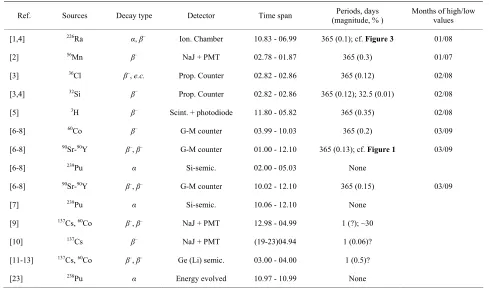
The Table 1 includes 7 different beta radionuclides which exhibited rhythmic variations with a period of 1 year, registered by using detectors of 5 different types. In all cases, the magnitude of the annual rhythm ranges between 0.1 and 0.35% from average count rate, with maximum values taking place between January and March, and minimum values from July to September. As an example, count rate modifications at activity meas-urements of several radionuclides are shown on Figure 1 [7,8]. The presence of 1 year periodic changes for 60Co
and 90Sr-90Y beta sources is obvious, whereas at
meas-urements of 239Pu alpha source the random modifications
called by a noise of a recording equipment are observed only.
Nearly identical effects are received on different beta radionuclides with half-lifes from 2.6 hours (56Mn) till
3·105 years (36Cl) at use of very different detectors
[6-8] 90Sr-90Y β–, β– G-M counter 01.00 - 12.10 365 (0.13); cf. Figure 1 03/09
[6-8] 239Pu α Si-semic. 02.00 - 05.03 None
[6-8] 90Sr-90Y β–, β– G-M counter 10.02 - 12.10 365 (0.15) 03/09
[7] 239Pu α Si-semic. 10.06 - 12.10 None
[9] 137Cs, 60Со β–, β– NaJ + PMT 12.98 - 04.99 1 (?); ~30
[10] 137Cs β– NaJ + PMT (19-23)04.94 1 (0.06)?
[11-13] 137Cs, 60Со β–, β– Ge (Li) semic. 03.00 - 04.00 1 (0.5)?
[23] 238Pu α Energy evolved 10.97 - 10.99 None
of an environment varied uniformly in different laborato-ries and uniformly influenced on very different equip-ment. It indicates existence of the nontrivial reason uni-formly influencing to activity of various beta radionu-clides, connected with driving of the Earth on orbit round the Sun.
3. Rhythms of Beta Radioactivity with a
Period of About a Month
Large amount of data accumulated in a number of ex-periments allows to apply spectral (periodic) analysis which enables not only to pinpoint parameters of the observed annual rhythms but also to uncover other peri-odic patterns that remain unnoticed against the back-ground of fluctuations and noise acting at random in-stants.
Existence of variations modulating radioactive decays with a monthly period (gamma radiation from 137Cs, 60Co)
was reported for the first time in [9]. This publication does not make it clear how large these variations are, and the duration of the measurements (4 months) is not suffi-cient to determine the period rather exactly.
Results of analysis of significantly longer measure-ments are presented in [6-8]. Figure 2 shows amplitude spectrum (a periodogram) of count rate measurement results for beta particles emitted by 90Sr-90Y source and
registered by G-M counter. Analysis was performed by means of Fast Fourier Transform with subsequent con-version of frequency to periods.
Peak with the period of 1 year (with magnitude of 0.13%) and its harmonics (182, 91.5, 61 days) stand out. In the near-month range of periods, peaks with magni-tude of 0.01% corresponding to 29.3 and 33.2 days dominate the landscape. A group of peaks with periods of about 43 days are readily discernible. Persistent nature of variations with the period of the synodical Lunar month (29.53 days) is demonstrated by averaging data of radioactivity measurements of a 90Sr-90Y source over 87
cycles (Figure 3).
In [4], spectral analysis findings based on results of several years of radioactivity measurements of 226Ra [1]
and 32Si [3] are presented. In addition to an annual period,
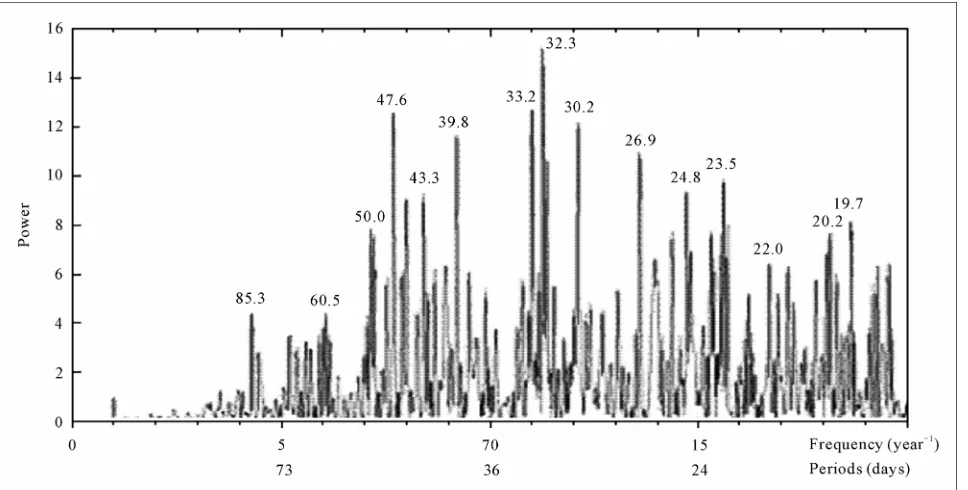
this analysis reveals many other peaks in the frequency range from 4 to 20 year–1 (corresponding to periods from
91 to 18 days) (Figure 4). The most pronounced of the near-month peaks are found to be 33.2, 32.3 and 30.2 days long. A group of peaks with periods about 43 days also stand out.
[image:2.595.54.543.95.383.2]Figure 1. Count rate of the 60Co and 90Sr-90Y beta sources, measured by G-M counters, adjusted for a drop of activity with
half-lifes 5.27 and 28.6 years, and count rate of the 239Pu alpha source, measured by the silicon detector [7,8]. The radioactive
sources with detectors and stabilized power supplies are located in thermostats. That seasonal temperature oscillations is not the reason of beta radionuclides count rate oscillations, is proved by significant difference in time of count rate maximum (February - March) and time of temperature maximum (July).
Figure 2. Periodogram of variations in the count rate of 90Sr-90Y beta source as registered by G-M counter [7,8]. The
experi-ment was run between April 2000 and March 2007. Magnitude is shown as percentage of the average count rate. Numbers correspond to the periods of nearby peaks.
4. Rhythms of Beta Radioactivity with
Diurnal Periods
The first report of rhythmic variations with a diurnal pe-riod and magnitude of about 0.06% in count rates for a beta radionuclide is contained in [10]. These oscillations were detected in measurements of gamma radiation from
137Cs source with total duration of 4 days. Existence of a
diurnal rhythm in results of analogous measurements was pointed out in [9], but the data in this paper cannot be used to estimate magnitude of the effect.
[image:3.595.59.540.432.585.2]behavior of count rates (lowest at night, highest around midday) resembles diurnal oscillations of temperature. A significantly higher value of modulation amplitude with a period of 1 day described in [10-12] is in contra-diction with the results of [6-8]. One can assume that despite the precautions taken, experiments [10-12] were not completely free from being influenced by the oscilla-tions of temperature in the vicinity of the installation which resulted in such large deviations. This conclusion is suggested by coincidence of the days on which no ap-parent effect was found with overcast weather conditions when temperature variations are generally low.
Figure 3. Averaging over cycles of the synodical Lunar month of the count rate data for 90Sr-90Y beta source, as
registered by G-M counter between April 2000 and March 2007. Averaging covers 87 cycles. N—new Moon, F—full Moon [7,8].
detector [11-13].
A diurnal modulation was detected by conducting spec- tral analysis of results of 7-year long count rate meas-urements for beta particles emitted by 90Sr-90Y source
and registered by G-M counter [6-8] (Figure 5).
The issue of the range of diurnal oscillations of radio-activity, if they do indeed exist, remains thus open. Their magnitude probably does not exceed thousandths of per-cent.
In the region of near-day periods, the peak of the Solar day is clearly visible along with a fine structure produced
Figure 4. Power spectrum of variations in the intensity of beta and gamma radiation from the 226Ra source, as registered by
[image:4.595.59.543.438.683.2]Figure 5. Periodogram of variations in count rates for 90Sr-90Y beta source, as registered by G-M counter, for periods in the
region around 1 day [7,8]. Time interval spans April 2000 and March 2007. Magnitude is shown as percentage value of the average count rate. Numbers next to peaks specify their corresponding periods.
5. Sporadic Drops of Beta Radioactivity
In [14,15] results of experiments are described which detected a drop up to 0.2% from the average value in the count rate for 54Mn source in a time period between 12
and 22 December 2006. Because of a series of solar flares registered between 5 and 17 December, the authors associated the observed decrease in the radioactivity with solar phenomena. However, analysis of the data from our installation [6,8] in December 2006 has not revealed any deviations from the usual behaviour of the count rates for
90Sr90Y, 60Co and 239Pu sources [16]. The same can be
said of the data collected during the period of highly powerful solar flares between 19 October and 4 Novem-ber 2003. Apparent drops in the count rate were detected between 10 and 12 May 2002 while registering the activ-ity of 60Co and on 19 and 20 June 2004 for 90Sr-90Y
source. Around the time of these events, no observations of large solar flares were reported. Thus, proposed link between the drop in the rates of radioactive decay and appearance of solar flares could not be confirmed. From obtained outcomes follows, that the radioactivity drop effect, if it really exists, is rather rare, and that the reason calling this effect unequally influences various radioac-tive sources.
6. Count Rate Bursts of Beta Radioactive
Source Placed at Parabolic Mirror Focus
When scanning the celestial sphere by a reflecting tele-scope with 60Co or 40K radioactive sources placed at the
focus point, bursts in the count rate were registered [6,8, 17]. The probability of their registration depended on the orientation of the telescope. The number of bursts in a day as well as its connection with the orientation of the telescope was not reproduced in a unique manner. There
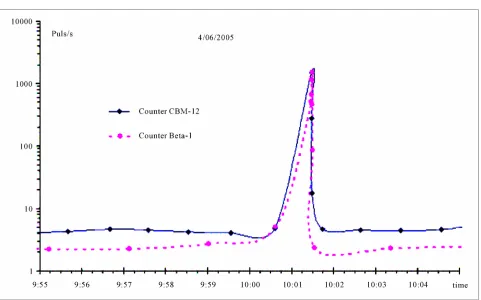
were registered single bursts with duration of about 1 second and an increase in the count rate up to three or-ders of magnitude, and more prolonged (up to several hours) events that consisted of short bursts of various amplitude distributed in time in some complicated man-ner. The change in count rate for one of the bursts is shown in Figure 6.
7. Discussion
Let us consider how the discovered properties of this phenomenon square with hypotheses put forward as an explanation for deviations from the purely exponential character of radioactive decay.
1) It was suggested that rhythmic variations in radio-active decays are associated with the changes in orienta-tion relative to a global anisotropy of physical space [12, 13]. However, if the effect under consideration depends only on orientation relative to some direction, then modulations would occur with a period of the sidereal day and almost constant magnitude during the year. Ex-perimental results show that, on the contrary, the most pronounced deviations take place with a yearly period, while diurnal oscillations are far weaker. Moreover, this hypothesis does not explain the fact that rhythmic varia-tions are observed only for beta, and not alpha radioac-tivity.
Figure 6. The simultaneous registration of count rate of 60Co source by two G-M counters [17]. The cylindrical counter is
positioned adjacent to a source being at the focus of the telescope. The end-window counter is at the distance of 1.5 cm from the source.
motion of our planet, was proposed by Falkenberg [5] and reproduced by Jenkings and Fishbach [14,18].
This assumption looks very unconvincingly due to the extremely weak interactions with matter of solar neutri-nos with energies of about 1 MeV and higher. This elu-sive nature of neutrinos was confirmed by many experi-ments. If one takes that for some reason interaction of solar neutrinos with radionuclides is significantly stronger than suggested by currently accepted estimates, then their flux density would experience noticeable attenua-tion due to passing through the body of the Earth and result in a lower rates of radioactive decays at night when compared to the midday values. Experiments re-veal no such changes. In addition, this hypothesis is not able to explain the existence of readily discernible varia-tions with the period of the synodical Lunar month with maximums around new Moons and minimums around full Moons (cf. Figure 3).
3) Another hypothesis proposes that periodic changes in beta radioactivity are a manifestation of fluxes of relic neutrinos (more precisely, of one of the components of dark matter—slow neutrinos with velocity of 10 1000 km/s) [7,8,19,20]. This assumption is in agreement with the significantly lower magnitude of diurnal oscillations as compared to the oscillations with an annual rhythm.
As shown in [20], the strength of the effect depends strongly on the velocity of motion relative to the flux of slow neutrinos. Throughout the year, due to the orbital motion of the Earth, its speed relative to Galactic neutri-nos changes by 40 km/s, whereas the speed changes caused by the spinning of the Earth around its axis do not exceed 1 km/s.
The appearance of the rhythm of the syndic Lunar month (about 29.5 days) could be explained by the fact that the gravitational field in the system Earth-Moon-Sun changes with this period. Gravitational field is the main factor affecting motion of the fluxes of slow neutrinos. Moreover, the assumption of the influence exerted by cosmic fluxes of slow neutrinos on beta radioactivity ex- plains bursts of the radioactivity of beta sources mounted in the focal point of a parabolic mirror [8,17,20].
The origin of the rhythm with period of 33 days is unknown. This timescale is not only distinctly visible on spectral curves of variations in radioactivity of 90Sr-90Y
and 226Ra sources but also manifests itself in spectral
of the Sun’s core [4] does not seem convincing.
8. Conclusions
In this paper the review of experimental results indicat-ing presence of rhythmic and sporadic changes at meas-urements of beta radioactivity is given. Nearly identical effects on eight different beta radionuclides with half- lifes from 2.6 hours till 3·105 years at use of very differ-
ent detectors (scintillators, proportional counters, G-M counters, ionization chambers) are obtained in Germa-nium, Russia and USA. The fact that the effect observed only for beta, and not alpha radioactivity allows to as-sume that it is caused by an incoming flux of cosmic neutrinos, maybe, relic neutrinos flux.
Importance of this effect that it indicates a possibility of influence on a radioactivity. And if we shall learn to operate radioactive decays rate over a wide range, it will be possible to create essence new nuclear power engi-neering.
9. Acknowledgements
The author is deeply indebted to V. V. Kapelko for ac-tual support of my researches and translation of my pa-pers into English. The author is grateful to E.A. Kramer- Ageev, E. F. Makliaev, N. F. Perevozchikov, B. M. Vladimirsky, A. P. Levich, S. E. Shnoll, V. I. Muromtsev, A. V. Karavaikin, N. V. Samsonenko, D. S. Baranov, Yu. A. Baurov, L. B. Boldyreva for support, invariable atten-tion to these researches and helpful conversaatten-tions.
10. References
[1] Н. Siegert, H. Shrader and U. Schotzis, “Half-Life Meas-urements of Europium Radionuclides and the Long-Term Stability of Detectors,” Applied Radiation and Isotopes, Vol. 49, No. 9-11, 1998, pp. 1397-1401.
doi:10.1016/S0969-8043(97)10082-3
[2] K. J. Ellis, “The Effective Half-Life of a Broad Beam
238PuBe Total Body Neutron Irradiator,” Phys. Med. Biol.,
Vol. 35, No. 8, 1990, pp. 1079-1088. doi:10.1088/0031-9155/35/8/004
[3] D. E. Alburder, G. Harbottle and E. F. Norton, “Half-Life of 32Si,” Earth and Planetary Science Letters, Vol. 78,
No. 2-3, 1986, pp. 168-176.
doi:10.1016/0012-821X(86)90058-0
[4] P. A. Sturrock, J. B. Buncher, E. Fischbach, et al., “Power Spectrum Analysis of Physikalisch-Technische Bundesanstalt Decay-Rate Data: Evidence for Solar Ro-tational Modulation,” 2010.
arXiv:1010.2225v1 [astro-ph.SR]
[5] E. D. Falkenberg, “Radioactive Decay Caused by Neu-trinos?” Apeiron, Vol. 8,No. 2, 2001, pp. 32-45. [6] A. G. Parkhomov and E. F. Maklyaev, “Investigation of
Rhythms and Fluctuations during Long-Term Measure-ments of Radioactivity, Frequency of Quartz Resonators, Noise in Semiconductors, Temperature, and Atmospheric Pressure,” Fizicheskaya Mysl Rossii, Vol. 1, 2004, pp. 1-12 (in Russian).
http://www.chronos.msu.ru/RREPORTS/parkhomov_rit my/parkhomov_ritmy.htm
[7] A. G. Parkhomov, “Researches of Alpha and Beta Radioactivity at Long-Term Observations,” 2010.
arXiv:1004.1761v1 [physics.gen-ph]
[8] A. G. Parkhomov, “Cosmos. Earth. New Sides of Sci-ence,” Science, Мoscow, 2009 (in Russian).
[9] Yu. A. Baurov, Yu. G. Sobolev, V. F. Kushniruk, et al., “Experimental Investigation of Changes in Beta Decay Count Rate of Radioactive Elements,” Fizicheskaya Mysl Rossii, Vol. 1, 2000, pp. 1-7 (in Russian).
[10] Yu. A. Baurov, “Does Neutrino Really Exist?”
Fizicheskaya Mysl Rossii, Vol. 2-3, 1997, pp. 126-134 (in Russian).
[11] Yu. B. Riabov, A. I. Berlev, A. P. Senkevich, et al., “About Stability of a Gamma-Quantum Registrations for Ge(Li) Detectors,” Preprint of Institute for Nuclear Re-search, Vol. 1079, Moscow, 2002 (in Russian).
[12] Yu. A. Baurov and I. F. Malov, “Variations of Decay Rates of Radio-Active Elements and Their Connections with Global Anisotropy of Physical Space,”2010. arXiv:1001.5383v1 [physics.gen-ph]
[13] Yu. A. Baurov, “The Neutrino: What Is It?” Apeiron, Vol. 9, No. 4, 2002, pp. 1-24.
[14] E. Fischbach, J. B. Buncher, J. T. Gruenwald, et al., “Time-Dependent Nuclear Decay Parameters: New Evi-dence for New Forces?” Space Science Reviews, Vol. 145, No. 3, 2009, pp. 285-335.
doi:10.1007/s11214-009-9518-5
[15] J. H. Jenkins and E. Fischbach, “Perturbation of Nuclear Decay Rates during the Solar Flare of 2006 December 13,” Astroparticle Physics, Vol. 31, No. 6, 2009, pp. 407-411. doi:10.1016/j.astropartphys.2009.04.005 [16] A. G. Parkhomov, “Effect of Radioactivity Decrease. Is
There a Link with Solar Flares?” 2010.
arXiv:1006.2295v1 [physics.gen-ph]
[17] A. G. Parkhomov, “Bursts of Count Rate of Beta-Radio- active Sources during Long-Term Measurements,” Inter- national Journal of Pure and Applied Physics,Vol. 1, No. 2, 2005, pp. 119-128.
[18] J. H. Jenkins, E. Fischbach, J. B. Buncher, et al., “Evi-dence for Correlations between Nuclear Decay Rates and Earth-Sun Distance,” 2008.arXiv:0808.3283v1 [astro-ph] [19] A. G. Parkhomov, “Distribution and Motion of Dark Matter,” Preprint of MNTTS VENT, No. 37, Moscow, 1993 (in Russian).
http://www.chronos.msu.ru/RREPORTS/parkhomov_ras predelenie.pdf.
[20] A. G. Parkhomov, “Influence of Relic Neutrinos on Beta Radioactivity,” 2010.
arXiv:1010.1591v1 [physics.gen-ph]
![Figure 2. Periodogram of variations in the count rate of 90Sr-90Y beta source as registered by G-M counter [7,8]](https://thumb-us.123doks.com/thumbv2/123dok_us/9231631.410410/3.595.59.538.74.366/figure-periodogram-variations-count-rate-source-registered-counter.webp)
![Figure 5. Periodogram of variations in count rates for 90region around 1 day [7,8]. Time interval spans April 2000 and March 2007](https://thumb-us.123doks.com/thumbv2/123dok_us/9231631.410410/5.595.60.541.75.238/figure-periodogram-variations-count-region-interval-april-march.webp)