Master of Science thesis Industrial Design Engineering
Management of Product Development University of Twente
Faculty of Engineering Technology PO Box 217
7500AE Enschede The Netherlands
Author
R. R. H. Dommerholt S1298348
University of Twente supervisor and professor Prof. Dr. Ir. J. Henseler (Jörg)
Company supervisor Ing. P. Spackler (Pim)
Commission
Ir. M. E. Toxopeus (Marten) Dr. Ir. G. D. S. Ludden (Geke)
Publication Date 11-07-2019
Number of pages 167
Appendix pages 21
First and foremost, I would like to thank the following people for their support and contribution to this thesis.
Marten, thank you for starting this process with me and thank you for ending it as well. Jörg, I would like to thank you for guiding and advicing me through the better of six months that we worked together. I am especially grateful for the fact that you, without questioning, took over the tutorship and that you are able to ask the rights questions to ease my mind. Pim, thank you for the opportunity and the support during the entire operation. You and I have been working on, thinking about, and developing this concept for over a year now and I hope you are happy with this manifestation that lies before you.
Daan, Mats, and Mick, thank you for listening to my ramblings and thanks for teasing me. I think I figured out the business case for our company.
Eeke, Rianne, Vera, and Matthijs, thank you for taking the time to listen to my test-drive of the colloquium. I think that my colloquium will be significantly better and that is all thanks to you.
Luuk, Fenna, Thijs, Leendert, Mauricy, Sjoerd, Remco, Gijs, Martijn, Marian, Patrick, Mike, Semme, and Iris, thank you for providing me with the information and knowledge that I needed to progress.
Esther, thank you for providing me with so much information and thank you for opening your network to me. That brought me in incredibly useful conversations with the vast majority of experts I talked to (and thanks for replying to my emails when I sometimes forgot to). Evelien, thank you for teaching me everything about CRC.
Frans, thank you for taking the time to talk with about almost anything, from tuberculose, GP’s, the ‘maffia’, the health council, to the train to Berlin.
Tara, thank you for providing more support than I think you realise.
Mijke, thank you for your loving support, advice, and a hearing ear. I am grateful we found each other again.
More than 7 years ago,
Henk lost his life to colon cancer. The difficulty of certain types of colon cancer is not necessarily the treatment, but rather the diagnostics and the treatment time. This type of colon cancer has a relative short period of time, between being able to diagnose the cancer and being able to treat this disease.
Once Henk got to the hospital, as something wrong had been discovered, he got to hear that there was not much that could be done. The time in which a treatment would have been possible had passed, making any efforts futile.
Ten eerste, voor dit onderzoek is er een ontwerp en implementatie plan voor een systeem ontwikkeld dat in staat is om ontlasting te analyseren en op basis daarvan een indicatie te kunnen geven van de gezondheid van zijn gebruikers. Voor het ontwikkelen van dit systeem zijn meerdere academische papers en theorieën gebruikt in combinatie met bronnen buiten de academica en interviews met experts uit het veld. Het onderzoek van Kroneman et al. (2016) beschrijft de Nederlandse gezondheidszorg vanuit meerdere facetten, welke zijn toegevoegd door bronnen van de NZa, het ministerie en de Europese wetgeving IVDR. De stakeholder theorie van Mitchell et al. (1997) bood een kader waarin alle belanghebbende, met betrekking tot de ontwikkeling en implementatie van de oplossing, geanalyseerd konden worden. Ten tweede, er gerealiseerd dat dit onderzoek valt onder Design Research (Simon, 1996; Van Aken et al., 2017) dat op zoek is naar een generiek ontwerp als antwoord op een vraagstuk dat ook toegepast kan worden in andere (onderzoeks-)velden. Om zo’n generiek ontwerp te ontwikkelen was een methodiek nodig die deze ontwikkeling kon sturen. De User-Centred Design methodology (Norman, 1986; Rahimi & Ibarra, 2014), de Design Thinking methodology (Gordon, 1961; Osborn 1963; Brown, 2008), en de Stage-Gate Approach (Cooper, 1986) zijn meegenomen in de overweging, alleen geen van de drie voldeden aan de gestelde eisen. Daarom is er een nieuwe, cyclische en iteratieve methodiek ontwikkeld die de beste elementen van de drie andere methodieken combineert. Hoe het resultaat van deze methodiek, het generieke ontwerp, uiteindelijk waardevol voor de gespecificeerde doelgroepen kon zijn is toegelicht via de Hybrid Offerings theorie (Ulaga and Reinartz, 2011).Deze theorie beschrijft hoe een ontwerp waardevol kan zijn in een complex netwerk bestaande uit meerdere belanghebbenden (Mitchell et al., 1997) die samen moeten werken om het systeem te laten functioneren als behoren. Ten derde, zijn er drie cluster van groepen gevonden die mogelijkerwijs de doelgroep kunnen worden van een systeem zoals ontworpen is in dit onderzoek. Deze drie groepen bestaan uit mensen die van nature angstig zijn aangelegd wat betreft hun gezondheid, mensen die boven mate geïnteresseerd zijn in hun gezondheid, en mensen die op basis van demografische gegevens het meest zouden kunnen profiteren van zo’n systeem. Ten vierde, zijn er vier toegangen tot de Nederlandse markt gedefinieerd op basis van onderzoek (Janssen et al., 2014) en interviews met experts. De eerste route is de consumenten route die het meest haalbaar lijkt voor de start-up, doordat er minder investeringen nodig zijn en er minder regel- en wetgeving mee gemoeid is. De tweede route is de zorg professional route die probeert de markt te betreden door zorg professionals ambassadeur te laten spelen voor het product. De derde route probeert toegang te verschaffen door de verzekeraar te overtuigen van het nut en de kostenbesparende kwaliteiten van de oplossing. De laatste route probeert via de overheid toegang te krijgen tot de markt en mogelijkerwijs een alternatief te bieden voor het huidige darmkanker bevolkingsonderzoek. Ten vijfde, door de methodiek is er een conceptuele oplossing ontworpen die in staat is om de gezondheid conditie van zijn gebruikers te bepalen door het analyseren van de stoelgang. Meerdere diagrammen in dit verslag tonen hoe dit systeem moet functioneren in coöperatie met de relevante stakeholders. Op basis van de eerder gespecificeerde routes is er een implementatie plan ontwikkeld om deze oplossing daadwerkelijk te implementeren in het Nederlands gezondheidszorg. Het Capital Model werd ontwikkeld om het ontwerp van het implementatie plan te structuren. Door zes perspectieven (sociaal, HR, intellectueel eigendom, organisatorisch, middelen en activa, en financieel) werd er een plan ontwikkeld, bestaande uit vier fases, dat het best inspeelde op de gelimiteerde kwaliteiten van het bedrijf. De eerste fase beschreef de ontwikkeling van het prototype om bewijslast te creëren van het concept. De tweede fase beschreef de ontwikkeling van een configuratie van het systeem dat verkocht mag worden aan consumenten. De derde fase beschrijft hoe het concept klinisch gevalideerd kan worden om zo ook medisch gebruikt te mogen. De laatste fase beschrijft hoe de oplossing een eventueel alternatief zou kunnen zijn voor het huidig bevolkingsonderzoek. Ten slot, is het gehele proces gevalideerd door ofwel literatuur ofwel interviews and discussies met experts uit de relevante (onderzoeks-)velden: van hoogleraren gastroentologie, tot business developers in de zorg, een lid van de Gezondheidsraad, twee huisartsen, en onderzoekers betrokken bij klinische validatie projecten en kosteneffectiviteit calculaties.
First, what has been developed during this assignment is a design and an implementation plan of a system capable of measuring and analysing stool to provide users with an indication of their health condition. To develop such a solution, multiple academic papers, non-academic sources, and expert interviews were used. Kroneman et al. (2016) described the Dutch healthcare system, which was added upon with knowledge and detailed information from the IVDR and sources from the NZa and the MVWS. The stakeholder theory from Mitchell et al. (1997; with additional knowledge from Hillebrand et al., 2015) was used to define stakeholders and their relationships based on research from Kroneman et al. (2016). Second, it was identified that this assignment should be considered as Design Research (Simon, 1996; Van Aken et al., 2017) aiming for a generic design and a new body of knowledge applicable in multiple contexts. For the development of such a generic design, a methodology was needed. Three methodologies were considered, from the User-Centred Design methodology (Norman, 1986; Rahimi & Ibarra, 2014), the Design Thinking methodology (Gordon, 1961; Osborn 1963; Brown, 2008), and the Stage-Gate Approach (Cooper, 1986). However, due to their limitations, neither was used. Therefore, a new methodology was developed combining the best elements of the three methodologies: iterative, cyclical, and consisting of two stages. How this solution can provide value was described through the Hybrid Offerings theory (Ulaga and Reinartz, 2011) providing insight into how value is delivered to multiple stakeholders in a complex network. Identifying the stakeholders (Mitchell et al., 1997) was crucial for the development of such a network. Third, when designing the target group, information from the CBS as well as non-academic sources showed that three clusters of people exist: those who are worried about developing CRC, those who are interested in knowing more about their health and body, and those who based on statistics should be profiting most from such a solution. Fourth, Janssen et al. (2014) described the four entry points how this market can be approached, which has been validated with insiders and experts. The first route being the consumer approach which is more feasible from a start-up perspective, as less is demanded of the company in terms of legislative requirements and resources. The second approach is through care professionals, which can become ambassadors of the new solution in negotiations with insurers. The third route directly targets the insurers, which requires a solid business case and clear cost-effective or cost-saving capabilities of the solution. The last approach targets the government through the Ministry and the NZa, which is thought to be bureaucratic and demanding. Fifth, through the methodology, the solution had been developed: a conceptual system architecture with functions capable of measuring, analysing, and reporting the results to its users. Multiple diagrams showed how the system as a whole is structured and how it functions with relevant stakeholders in the context. After the design and validation of the design by experts, the implementation of that solution into the Dutch market had to be developed. From a broad collection of over 20 literature papers, the Capital Model was developed able to structure the multiple phases of implementation. The Capital Model consists of 6 perspectives: the social, human, intellectual, organization, resource, and financial capital perspective. This model was also used to scope the assignment and in doing so, provided cohesion between research and practice. The entry points to the market, as specified before, were analysed in cooperation with an assessment of the capabilities of the company. In doing so, a four phased implementation trajectory had been developed moving from the less resource-demanding prototype phase, to a phase in which a consumer product configuration will be developed, to the use of this product as a medical device and therefore needing a clinical validation, and the possible application of the device as an alternative to the current national CRC screening in the Netherlands. Last, the result of this entire project has been validated throughout the project as at the end of the development process. Representatives of a large collection of relevant stakeholders were requested to provide advice and guidance in the development of both solution and implementation. From a professor gastroentology, to business developers in the medical industry, a former member of the Health Council as well as general practitioners, to researchers involved in the establishment of clinical trials and the cost-effectiveness calculations of screening methods.
Acknowledgements 2
Preface 3
Summary & samenvatting 4
PART 0 INTRODUCTION
101. Introduction 12
1.1 Colorectal cancer – an individual’s perspective 12
1.2 Colorectal cancer – a national perspective 12
1.3 The national screening – the good 13
1.4 The national screening – the bad 13
1.5 Dutch consumer medical device market and development 14
1.6 The proposed solution – for at home 16
1.7 Glossary 18
1.8 Reading guide 19
Summary 20
PART I ANALYSIS AND CONTEXT
242. Value proposition 26
2.1 Value 26
2.2 Predictive value of the human stool 27
2.3 Value for the Company 29
2.4 Cost-saving capabilities of smart tech 29
2.5 Extending the body of knowledge 30
3. Identifying Stakeholders 32
3.1 Complex networks and capabilities 32
3.2 The Dutch healthcare system 34
3.3 Actors and stakeholders 35
4. Market & regulations 42
4.1 Managed competition 42
4.2 Financial management and payment structures 43
5.1 The development power grid 53
5.2 The implementation power grid 54
6. Approaching the market 56
6.1 Preparations and entry points 56
6.2 Consumer route 56
6.3 Care professional route 58
6.4 Insurer route 59
6.5 Governmental route 60
7. Company characteristics 62
7.1 Social Capital 62
7.2 Human Capital 64
7.3 Intellectual Capital 64
7.4 Organizational Capital 65
7.5 Resource Capital 66
7.6 Financial Capital 66
8. Company assessment 68
8.1 The Capital perspective 68
8.2 Conclusion 69
Summary 70
PART II PROCESS & METHODOLOGY
769. Process & approach 78
9.1 Process goals 78
9.2 Why think in Solutions? 78
9.3 Research questions 79
9.4 Design research as scientific backbone 79
9.5 Scope & assumptions 82
10. Methodology 84
10.1 Methodology-based design 84
10.2 Methodologies 84
10.3 The developed methodology 86
11. Target group design 92
11.1 Establishing characteristics 92
11.2 Clusters 93
11.3 Conclusion and ethics 95
12. Solution design 96
12.1 Principles for design 96
12.2 Requirements 97
12.3 Functional development 97
12.4 Functional specification 97
12.5 Functional allocation 102
12.6 Design impression 108
Summary 110
PART IV IMPLEMENTATION DESIGN
11213. Developing the implementation 114
13.1 Goal of phased implementation 114
13.2 Obstacles 114
13.3 Legend 117
14. Phase 0 - prototyping 118
14.1 Solution design 118
14.2 Key activities 118
14.3 Social Capital 120
14.4 Human Capital 120
14.5 Intellectual Capital 121
14.6 Organizational Capital 123
14.7 Resource Capital 123
14.8 Financial Capital 123
14.9 Successful completion 123
15. Phase 1 - consumer product 124
15.1 Solution design 124
15.2 Key activities 126
15.3 Social Capital 127
15.8 Financial Capital 131
15.9 Successful completion 132
16. Phase 2 - Medical application 134
16.1 Solution & test design 134
16.2 Key activities 137
16.3 Social Capital 138
16.4 Human Capital 139
16.5 Intellectual Capital 140
16.6 Organizational Capital 140
16.7 Resource Capital 142
16.8 Financial Capital 142
16.9 Successful completion 145
17. Phase 3 - the national screening 146
17.1 The capital perspectives 146
17.2 Desire and the perceived barrier of entry 146
Summary 150
PART V CONCLUSION & REFLECTION
15418. Discussion and Conclusion 156
18.1 The problem 156
18.2 The context and analysis 157
18.3 Methods 158
18.4 results 159
18.5 Implementation 160
18.6 Conclusion 160
19. Evaluation & Reflection 162
19.1 Evaluation 162
19.2 Conclusion 163
20. Recommendations & future research 166
20.1 Recommendations 166
INTRODUCTION
This part will provide insight into the reasoning and demand for this design research project. A look is given into colorectal cancer, from both an individual as from a societal perspective. Additionally, it is discussed why the
current solution is insufficient in solving the problem and
1.1 COLORECTAL CANCER – AN INDIVIDUAL’S PERSPECTIVE
Being diagnosed with colorectal cancer is too often a death penalty. In most cases, the possibility for successful treatment has passed before the patient is even aware of having the disease. Colorectal cancer (a collection of cancers in the small intestines, colon and rectum, CRC) is a malignant (=kwaadaardig) neoplasm (=nieuwvorming) growing on the epithelium (=protective tissue) of the inside of the colon. The disruption of normal behaviour of cells causes the process of neoplasia: disrupted cells get the ability of autonomous growth, invasion and destruction of surrounding tissue, and the spreading to other parts of the body (=metastasis, uitzaaïngen) (Maag Lever Darm Stichting, 2019a). CRC is commonly found in older people (90% of the patients are 50 years or older (Maag Lever Darm Stichting, 2019b)) as the process of developing CRC takes several years (between 10 and 15 (Maag Lever Darm Stichting, 2019c). Due to this long development time, health complaints often occur in later stages of the development. These health complaints include blood in the stool, abdominal pain and cramps, decreased appetite, altered stool pattern, and weight loss (Maag Lever Darm Stichting, 2019a). The survival chance1 of CRC is
heavily dependent on the stage in which the cancer is found. In 2017, the average 5-year-survival-rate, for men and women, is 66% (RIVM, 2018). Since the 80’s, the 5-year-survival-rates have been increasing (RIVM, 2018), which is accredited to better therapy, pre-operative radiation and improved surgery procedures. Compared to other Western countries, the Dutch 5-year-survival-rate is good . Therefore, the absolute number of CRC deaths is lower than the incidence numbers would presume [45].
In most cases, a patient2 experiences symptoms related to CRC and decides to visit the General
Practitioner (GP). Or, the patient gets picked out because of the national screening. The patient describes his/her medical history (=anamnese (Radboud UMC, n.d.)) and a preliminary (physical) analysis by the GP or an outpatient clinic is performed. If enough evidence is present to suspect the presence of CRC or advanced adenomas, the patient is referred to the hospital for a colonoscopy (or sigmoscopy). The results of the diagnostic test are discussed in a multidisciplinary council (MDC = Multidisciplinair overleg
(iNKL, n.d.)) consisting of a surgeon, gastroentologist, internist, radiologist, radiotherapist, pathologist, case manager and nurses. When it is decided to treat the patient, the council will establish a treatment plan. After the diagnosis, the colon cancer or rectum cancer is treated (within 6 weeks after the first visit to the outpatient clinic) by removing the adenomas through surgery and a chemotherapeutic is pumped into the abdomen to treat any left-over metastasis (HIPEC (Antoni van Leeuwenhoek, n.d.)). After the surgery, another MDC is being held that will discuss the results of the surgery and based on that, determine what after-care is necessary for the patient. After the treatment, the patient will have to check in every half year for the first 2 to 3 years, and every year up until 5 years after surgery, for examinations. Either the GP or the case manager can become responsible for the check-ups, this will be decided in the after-care plan. If the case that it becomes clear that the disease cannot be treated anymore, the patient becomes a responsibility for the GP which develops an appropriate plan to assist the patient and his/her beloved ones in the final moments.
1.2 COLORECTAL CANCER – A NATIONAL PERSPECTIVE
In 2017, 13.739 people got diagnosed with colorectal cancer (14.076 if cancer in the small intestine is included) in the Netherlands (iKNL, 2019). 1 in 20 people will acquire CRC in their lifetime and in 2017, 5.103 persons died from colorectal cancer (iKNL, 2019). Every year, a general practice has at least one new patient with CRC and, in total, 9 living patients with CRC, on average. In 2015, 575.5 million Euros was spent on CRC (RIVM, 2018b), which is €34 per Dutch citizen. 86,6% of that amount was spent on hospital care, the rest on prevention, medication, elderly care and other related activities. In other words, the majority of money spent on CRC is in treating and trying to cure the patient. And in 35% of the cases, the patient doesn’t survive for more than 5 years (iKNL, 2018).
1 The survival chance is almost always depicted as the 5-year-survival-rate. In other words, how many patients live 5 years after the diagnosis (National Cancer Institute, 2019).
1.3 THE NATIONAL SCREENING – THE GOOD
The incidence3 of CRC has been growing steadily over the years due to increased medical expertise,
increased general health as people become older increasing the chance of getting cancer. Additionally, the costs for treating late-stage CRC have been increasing significantly (due to costly pharmaceuticals, Lansdorp-Vogelaar et al., 2009). Therefore, the Health Council, in 2009, advised a national screening program based on the iFOBT (27% sensitivity and 65% specificity (Gezondheidsraad, 2009; RIVM, 2014)), which tests a population of 2 million people every two years: men and women of the age of 55 to 75 (Gezondheidsraad, 2009). This screening should be able to save at least 1.400 lives a year. And so, the population screening was introduced by the Dutch government in 2013 (RIVM, 2018)4.The participant
receives an announcement through the mail (this is only true for participating the first time). Two weeks later, the participation package is delivered containing an invitational letter, a folder explaining CRC and the procedure, the actual test, a manual, a bag in which the samples can be placed, and a self-addressed envelope. Contracted laboratories analyse the sample, three outcomes are defined: positive, negative, and insusceptible (at which a new invite is sent to the participant). Two weeks after sending the sample to the laboratories, the results will be communicated to the participant through another letter. A letter indicating a positive test result will be combined with an invite for an intake at a colonoscopy centre. Additionally, the letter also advises the positively-tested participant to seek out the GP and discuss what is necessary to figure out before the intake. The intake occurs within 10 work days after sending the letter bearing the result, the colonoscopy within 15 work days. The results of the intake and colonoscopy are sent to the GP, which in their turn contacts the participant (RIVM, 2013). After this procedure, the established care path is followed. This screening program was able to prevent an estimated 2.400 lives from ending needlessly early due to CRC.
1.4 THE NATIONAL SCREENING – THE BAD
The screening process has been developed to outweigh the cons. However, the Dutch screening process is not without shortcomings (Van Dam, F., & Stalpers, L., 2012).In 2014, 14,5% of CRC was not found with the population screening. This is due the relatively low sensitivity of the test for cancers (NOS, 2017). As can be imagined, this is one of the most prominent risks of the screening: people will be told that everything is fine, yet this is most definitely not the case. In this case, the situation can only worsen as the health complaints that are present can be wrongfully ignored as the false promise tells those that they’re okay. Additionally, because of the high number of false negatives (people tested negative for the test but did have CRC or advanced adenomas), a new thing occurred called ‘interval carcinomas. Which are people that got a negative test result (and thus were told that they did not show signs Table 1. Stages, incidence and survival rates (iKNL, 2018).
Stage Description Incidencea
(%) Incidence b
(%) 5ysr
b
(%) Treatment steps People deceasedb I Carcinoma found in
colon 26 17 95 Surgery 207
II Carcinoma
penetrated gut 28 23 88 Surgery, radiotherapy, and possible chemotherapy 534 III Carcinoma spread
to lymph 25 35 69 Surgery, radiotherapy, and chemotherapy 1231 IV Carcinoma spread
to organs 21 26 11 Surgery, radiotherapy, and chemotherapy 2967
a 2015 b 2017
3 The incidence of cancer concerns the number of new cases that are diagnosed in a certain period (usually 1 year).
of CRC) which did actually had CRC. These people, unjustly, got their chances on curing the disease decreased. Because now, if these people got health complaints related to CRC, they will think that they do not have CRC as they were tested negative. Additionally, most of the criticism is directed towards the effectiveness and the burdening on the Dutch population. Six out of 1.000 participants were tested positive for CRC (and 30 for advanced adenomas) and referred to a colonoscopy. Of 1.000 colonoscopies, 67 carcinomas and 335 advanced adenomas were found. Which results in 15 colonoscopies necessary to find one person with CRC (Rozendaal, 2016). And thus, 14 people have to undergo a colonoscopy with all complications considered completely pointless. Even though the quality of colonoscopies is high in the Netherlands, in 2017, 1 person passed away because complications of a colonoscopy and 39 had serious complications but stayed alive (RIVM, 2018). Or in the other case, something could be found which did not have to be found. An example, such as a dilation of the large body artery has not proven to be essential for early diagnostics. In other words, because of intensive screening the number of diagnostics is dubbled [247,262] which increases the pressure on the entire healthcare system. Another issue with screening has not necessarily to do with the treatment possibilities, but more with the unjust estimated performance of the test. The lead-time bias explains the phenomenon where a person has a supposedly longer 5-year-survival-rate as the cancer is found earlier. However, the actual situation is that the person only knows earlier that he/she is going to die. This is often the case for lung cancer, as for the moment that a lung tumour is visible on a lung scan, that tumour has already spread to other organs(Van Dam, F., & Stalpers, L., 2012).
Recently, physicians have been sued because of alleged diagnostic mistakes in population screening targeted at cancer (something that has been happening with other screenings in the past (Wilson, 2000; The Lancet, 1999)). Dutch Pathology and Radiology associations have also indicated an increase in civil procedures; however, no data is available yet (Giard, 2001). Liability is a complex issue in population screening, as every test will deliver false positives and negatives, regardless of quality. Especially in the case of population screening, the difficulty is in understanding who is liable for wrongful diagnoses as the test is only an indication. The actual diagnosis has to be determined through a follow-up test
(Schouten et al., 1998). A false positive is not a diagnosis of a disease, and a false negative can cause an unnecessary death as the participator is under the wrongful impression that he/she is free from the targeted disease. Essentially, a national screening will increase wrongful diagnostics.
The population screening in 2017, cost €14,22 per participating citizen (RIVM, 2018) (excluding the intake and the colonoscopy, the most expensive procedures in diagnosing CRC) which accumulates to just a bit more than €20 million growing to €27 million when the screening is fully implemented, paid for by the government. Over-treatment, unnecessarily treating someone which does not improve the well-being of that individual, will also add up to the costs of the screening. This could be by treating something that could grow out to cancer, but is not cancer at the moment, or by unnecessarily let people undergo a diagnostic test (like a colonoscopy, Bonneux, 2011) to determine CRC which is 14 times out of 15. All these over-treatment procedures only add to the cost and do not result in a better well-being or better health. The test is covered through subsidies and insurance. However, the following colonoscopy and intake are not covered. Therefore, in cases where no indication of CRC is found people are spending unnecessary money (between €300 and €425 for a colonoscopy) on these procedures (De Visser, 2014).
1.5 DUTCH CONSUMER MEDICAL DEVICE MARKET AND
DEVELOPMENT
Developing new medical systems and solutions is becoming increasingly expensive every year. Research and development of new solutions are becoming more complex and take longer to deliver results, and thus become more expensive, yet the payback of such development trajectories cannot be guaranteed (think of drug development with lead times of 12 years, after which clinical trials have to prove its effectiveness, effectively flipping a coin on the fate of the return on investment). Most efforts to improve the system, like specialized medicine or treatments, only add to the expenditure. However, the incumbents of the industry are most likely not the organizations willing and capable of providing the necessary change5. It is often stated that change in healthcare must come from entrepreneurs and
intrapreneurs, doctors, patients, and start-ups as disruption and change should not be expected form incumbents (Christensen, Waldeck, & Fogg, 2017). Even more so, for many incumbents in the healthcare
industry it is currently more cost-effective to purchase and takeover a start-up with a proven concept or new innovation, that has done a lot of necessary R&D and market research, than to develop products themselves (Morgan Stanley, 2015). Buying another firm is currently the most cost-effective way to broaden the product portfolio of an incumbent and decrease the risks of investing in new tech. Reducing risk is an essential part of these incumbents as many solutions perish before reaching the market due to the many barriers involved in medical device development. From a limited access to funds and other resources due to a lack of proof, to heavy and demanding regulations (Deloitte Center for the Edge & Deloitte Center for Health Solutions, 2014), and conservative and sceptical stakeholders often unwilling to adopt new tech (“not invented here”) .
The Netherlands is increasingly becoming older, greyer and more urban. The growth of children is decreasing steadily since the 1980s, whereas the growth of seniors is increasing (Kroneman et al., 2016), meaning that more and more pressure is put on systems that provide care to older people. Even more so, because of the growing life expectancy (CBS, 2018, which is essentially a favourable trend) and the improvements in diagnostics, chronic diseases are becoming more and more prevalent in the population. Thus, people will increasingly have “multi-morbidity”, which is two or more chronic conditions. Socio-economic differences in life expectancy are large in the Netherlands and are expected to grow. Currently, the life expectancy for people with lower education is six years shorter than those with higher education (Kroneman et al., 2016). Malignant neoplasms and diseases of the circulatory system are most predominantly the cause of death for many Dutch men and women (Kroneman et al., 2016). The five-year survival ratios for people diagnosed with breast, cervical or colorectal cancer have increased mildly between 2000 and 2011. Dutch survival ratios are middle range compared to other countries (Van den Berg et al., 2014a; OECD, 2013; Kroneman et al., 2016), which is surprising in light of healthcare expenditure, as the Dutch healthcare systems is one of the most expensive. However, because of improvement in treatment options cancer is becoming “more and more a chronic disease instead of a lethal illness” (Kroneman et al., 2016). The growing prevalence of cancer (iKNL, 2019), and especially colorectal cancer, sparked the initiative to launch additional screening programmes in the Netherlands. And even though the standardized rates for groups with malignant neoplasms as the main cause of death have been decreasing, the absolute numbers have been growing due to the aging population (Kroneman et al., 2016). Despite the flattening growth of healthcare expenditure since 2013, the Dutch healthcare system remains one of the most expensive one in the world. Quality indicators, like the prescription of generics and length of stay indicate improvements in the efficiency in the system. Additionally, healthcare investments and related profits have been growing to almost pre-crisis levels. Nevertheless, as healthcare expenditure keeps increasing (from 8% of GDP in 1995 to almost 13% in 2013 (van den Berg et al., 2014a)), the “pressure to contain healthcare costs” become only stronger (Kroneman et al., 2016). The most conventional claim is the lack of efficiency (Ahli, 2019) in healthcare provision because of the lack of proper cost-reduction tools, lack of meaningful data and the complex relations between insurers and providers. Causing frequent overspending of forecast budgets by almost all healthcare professionals (Kroneman et al., 2016).
The consumer medical device market is blooming and more solutions become available for consumers to use at home. From systems capable of monitoring the prevalence of a progressive eye disease (ForseeHome, n.d.), and a device that can placed over the chest of a women to measure the presence of breast cancer (Braster S.A., n.d.), to the first FDA approved home test for CRC (Philippidis, 2019). As has been mentioned, treating a patient is currently more expensive than maintaining a patients’ good health. This train of thought is slowly becoming more established among leaders and professionals in the healthcare industry, allowing the introduction of new treatments, business models, and methods of improving the system while making revenue. Therefore, it is not strange to see that most innovative solutions are centred around preventive and primary care6 issues and service delivery7 (Govindarajan
& Ramamurti, 2018). As consumer spend more money ‘out-of-pocket’ (not covered by insurance) for medical treatments, solutions, and devices, they begin to expect the same quality of experience as with regular consumer products. A new paradigm shift is occurring in which ‘patients’ are becoming ‘consumers’. Companies capable for adapting to this change and treating these consumers properly will most likely profit most (Citrin, 2018).
6 Iora Health developed a new business model that ‘doubled down’ on primary care expenditure by maintaining good health in patients with the help of coaches. Since the start, seven years ago, Iora Health reduced hospitalizations by 35-40%, lowered costs by 15-20%, all while improving patients’ health.
1.6 THE PROPOSED SOLUTION – FOR AT HOME
To gather information for this design research project, multiple sources were employed. The main source of information are academic papers (see all Bibliographies and Appendix 1), and discussions with experts (Appendix 2). I had discussions with founders and management of other medical device companies, with an expert in brand management, experts in business models and customer value, a professor gastroentology, multiple business developers, a data sharing and communication expert of the national association for GPs, a former GP and now member of the Health Council, the head of the patient association for CRC patients, and a healthcare reimbursement calculations researcher. Additionally, I participated in 11 events. From an event focussed on philosophizing where healthcare will be in the future, the biggest European medical device trade fair, a panel discussion about the future of cancer data management, a panel discussion on business models and market acceptance in the Dutch healthcare market, a panel discussion on start-up funding and venture capital, and an event discussing the health tech innovations in the East of the Netherlands. I also participated in 7 workshops. From multiple workshops on different ISO standards (e.g. risk management (ISO 14971:2007), quality management system (ISO 13485:2016), etc.), on intellectual property rights and protection methods, on business models and business model innovation, production of medical devices and specifically on the production of low quantities, and on how to involve users in the development of a medical device. I had 6 meetings with the total company during the progress of this project. Last, I read 118 pieces of grey literature (e.g. blog posts, news articles, opinion pieces, etc.) and saw 5 lengthy YouTube (panel) discussions that further aided my understanding of the subject matter while also provide insight in how the related subjects are seen by healthcare professionals and other interested/involved people. Generally speaking, the papers8 formed the scientific backbone of this
research. Discussions with experts were used to validate my understanding of the papers, as well as discuss my ideas and answer any remaining questions. The events and workshops were chances to further my understanding of the subject and at the same time, offer the chance to meet new people and make useful connections. Specifically, because of participating in 1 workshop was I able to contact a gastroentology professor who’s network was so grand that I could make contact with others more easily as well. As said before, the grey literature explained subjects in a simplified way, making it easier to understand, as well as offer insight into the perspective of the interested and involved healthcare professionals and researchers. The tutor meetings, of which there were 47, were most predominantly used to show progress and discuss new findings. Brainstorming and thinking about the concept was mostly done with my company supervisor, whilst solving problems and safeguarding the process was mostly done with my university supervisor.In the opinion of the company, the solution provided by the government does not solve the issue adequately. The idea exists that this screening can be more efficient when it’s performed at home and on a daily basis. Doing so, there is no more room for error as false positives or negatives get filtered out by other measurements. Currently, there are over 200,000 medical devices on the European market (Fraser et al., 2011), yet not one solved this issue in a home setting. Therefore, the following solution is proposed: a scanning device is introduced that will be mounted at the back of the individual’s toilet that will be able to analyses the faeces in a similar manner to the national screening. However, the scanning device will analyses every time the individual visits the toilet. Therefore, being a better tool to use than the one-time screening as performed in the Dutch screening. This device will analyse the faeces and the results will be presented in such a way that the individual can be monitored. At first, this monitoring will be done by the user self and the device will only alert the user, based on statistical deviations, of any possible dangers. In the future, the solution might be an alternative to the national screening program. However, implementing the solution in such a way is far from easy. As because of the influence and involvement of the medical industry might pose significant risks for successful implementation. From regulatory and liability issues, to difficulty in financing the development process as well as the actual solution itself. This report will provide an overview of how these issues can be solved. I think that the development of such a product that can solve issues with diagnosing colon cancer can be a very interesting case for a management of product development student. As this situation is quite complex: the medical world is a demanding place to develop a product for, and as a start-up there is a clear limitation in terms of resources, capital, and employment. The designed solution will be presented as well as the implementation of this solution in the Dutch consumer medical device market, which is structured with the Capital Model, a framework consisting of 6 perspectives regarding business and development. Afterwards, this process will be evaluated to show the academic merits and prove its academic value.
“IT’S INCREDIBLE TO THINK EACH TEASPOON OF YOUR
STOOL CONTAINS MORE DATA IN THE DNA OF THOSE
MICROBES THAN IT WOULD TAKE LITERALLY A TONNE OF
DVDS TO STORE. AT THE MOMENT EVERY TIME YOU’RE
TAKING ONE OF THOSE DATA DUMPS AS IT WERE, YOU’RE
JUST FLUSHING THAT INFORMATION AWAY. PART OF OUR
VISION IS, IN THE NOT TOO DISTANT FUTURE, WHERE AS
SOON AS YOU FLUSH IT’LL DO SOME KIND OF INSTANT
READ-OUT AND TELLS YOU ARE YOU GOING IN A GOOD
DIRECTION OR A BAD DIRECTION. THAT I THINK IS GOING
TO BE REALLY TRANSFORMATIVE”
1.7 GLOSSARY
Colorectal cancer (CRC) Cancer development in the colon or rectum (darmkanker).
Gastroentology A branch of medicine focussed on the digestive system and medical conditions regarding the digestive system.
Biomarker A measurable indicator of a biological state or condition.
5-year-survival-rate The percentage of people that survived a disease 5 years after its diagnosis.
Incidence The occurrence of a medical condition among the population over a given time period. GP General Practitioner (Huisarts)
Curative care Care focused on curing the patient [0021]
Colonoscopy An endoscopic (= looking inside) examination of the large and small intestine with a camera. A sigmoscopy only examines the first part of the large intestine.
iFOBT/FIT Immunochemische fecaaloccultbloedtest, the stool test used by the Dutch government in the national screening. The iFOBT tests for remnants of faecal (old) blood in the excrement of the participant. Also called fecaal immunochemische test (FIT).
FOB Faecal Occult Blood, old blood remains present in human stool.
IVDR In Vitro Diagnostica Regulation, European legislation on in vitro diagnostica regarding validation, market entry, surveillance, production methods, and more.
MDR Medical Device Regulation, European legislation on medical devices regarding validation, market entry, surveillance, production methods, and more.
RCT Randomized Controlled Trials, a type of scientific research to determine the effectiveness of a treatment.
Reimbursement The act wherein an insurer pays for the services of a healthcare provider to a patient (Vergoeding). If a product/service is reimbursable, that indicates that the insurer is willing to pay for this product/ service if the patient desires/needs it.
GDPR General Data Protection Regulation (Algemene Verordening Gegevensbescherming , AVG), European legislation on privacy and data protection.
Notified Body An entity that has been accredited to assess whether a product meets predefined standards.
Methodology A research-based framework with analysis tools and proposed actions that try to improve and/or guide a process. In this case, the process of product development.
Solution design Conceptual design of a product, a service, or a combination of both that answers a specific users need. Implementation design Conceptual roadmap/framework describing the processes necessary to implement the solution design
into the real world. Concept A first iteration of a design.
MVP Minimal viable product, a product with minimal features and functions that still satisfies the needs of early users and which can be used to gather feedback for the development of future products. DSR Design Science Research. DSR is the academic conceptualization of the rather natural design process: Generic design A conceptual design that is able to solve the problem it was developed for, which is also translatable
to other contexts.
Black-box A theory in which the inner mechanisms of a product/process are unclear. In other words, it assumes that a process delivers output B with input A, unknowing how that happens.
UCD User-Centred Design, a design methodology to develop products with a strong user focus. A collection of methods.
SGA Stage-Gate Approach, a development methodology that divides a development process in separate phases that need to be executed and completed consecutively. Each phase is completed with a phase describing certain criteria, which must be upheld, before a new phase is started.
Financial Capital A collection of practices, processes, competencies, and goals related to the financial management of a firm. Think of accounting, business model, investments, etc.
Social Capital A collection of practices, processes, competencies, and goals related to the alliance and stakeholder management of a firm. Think of, stakeholders, alliances, cooperation, marketing, etc.
Intellectual Capital A collection of practices, processes, competencies, and goals related to the intellectual property management of a firm. Think of patents, trademarks, protection methods, etc.
Organizational Capital A collection of practices, processes, competencies, and goals related to the organizational management of a firm. Think of legal entities, business architecture, shares, etc.
Resource Capital A collection of practices, processes, competencies, and goals related to the resource capital management of a firm. Think of machinery, procurement, maintenance, sustainability, etc. Super-system The context in which a system operates.
Subsystem A subdivision of a system.
System A description of a product, service, or both detailing components, functions, and processes.
1.8 READING GUIDE
Antoni van Leeuwenhoek. (n.d.). Hypertherme Intraperitoneale Chemotherapie (HIPEC). Retrieved May 15, 2019, from https://www.avl. nl/behandelingen/hypertherme-intraperitoneale-chemotherapie-hipec/
Bonneux, L. (2011). ‘En ze leefden nog lang en gezond. Hoe gezondheid een industrie werd.’ Tielt, Belgium: Lannoo.
De Visser, E. (2014, January 13). Poeptest is helaas niet waterdicht. Retrieved May 15, 2019, from https://www.volkskrant.nl/nieuws-achtergrond/poeptest-is-helaas-niet-waterdicht~b0cfc680/
Gezondheidsraad. (2009). Dossier Bevolkingsonderzoek naar darmkanker. Retrieved from https://www.gezondheidsraad.nl/ documenten/adviezen/2009/11/17/bevolkingsonderzoek-naar-darmkanker
Giard, R. W. M. (2001, June 3). Artsen steeds vaker aansprakelijk gesteld voor het missen van kanker bij bevolkingsonderzoek | Nederlands Tijdschrift voor Geneeskunde. Retrieved May 15, 2019, from
https://www.ntvg.nl/artikelen/artsen-steeds-vaker-aansprakelijk-gesteld-voor-het-missen-van-kanker-bij/volledig
Harvard Business Review. (2018, September 18). Transforming Health Care from the Ground Up. Retrieved May 15, 2019, from https:// hbr.org/2018/07/transforming-health-care-from-the-ground-up
iKNL. (2018). Overlevingscijfers dikkedarmkanker. Retrieved from https://www.kanker.nl/kankersoorten/dikkedarmkanker/wat-is/ overlevingscijfers-dikkedarmkanker
iKNL. (2019). belangrijke cijfers over darmkanker. Retrieved from https://www.iknl.nl/docs/default-source/PDF_Docs/iknl-folder-darmkankermaand_nkr_2019.pdf?sfvrsn=0
iKNL. (n.d.). Multidisciplinair overleg (mdo). Retrieved May 15, 2019, from https://www.iknl.nl/oncologische-zorg/diensten/ multidisciplinair-overleg
Lansdorp-Vogelaar, I., van Ballegooijen, M., Zauber, A. G., Habbema, J. D. F., & Kuipers, E. J. (2009). Effect of Rising Chemotherapy Costs on the Cost Savings of Colorectal Cancer Screening. JNCI: Journal of the National Cancer Institute, 101(20), 1412–1422. https://doi.org/10.1093/jnci/djp319
Maag Lever Darm Stichting. (2019a, April 11). Darmkanker in het kort. Retrieved May 15, 2019, from https://www.mlds.nl/kanker/ darmkanker/darmkanker-in-het-kort/
Maag Lever Darm Stichting. (2019b, March 21). Feiten en cijfers darmkanker - Maag Lever Darm Stichting. Retrieved May 15, 2019, from https://www.mlds.nl/kanker/darmkanker/feiten-en-cijfers-darmkanker/
Maag Lever Darm Stichting. (2019c, February 28). Prof. dr. Evelien Dekker, specialist in vroege opsporing darmkanker - Maag Lever Darm Stichting. Retrieved May 15, 2019, from https://www.mlds.nl/zorgprofessionals/prof-dr-evelien-dekker-specialist-vroege-opsporing-darmkanker/
National Cancer Institute. (n.d.). NCI Dictionary of Cancer Terms. Retrieved May 15, 2019, from https://www.cancer.gov/publications/ dictionaries/cancer-terms/def/five-year-survival-rate
Nederlandse Kankerregistratie (NKR), iKNL. (2018, February 2). Incidence Digestive organs / Small intestine / Large intestine and rectum [Dataset]. Retrieved May 15, 2019, from https://www.cijfersoverkanker.nl/selecties/Dataset_1/img5c51963b25fad
NOS. (2017, January 10). “Veel minder darmkanker en sterfte door bevolkingsonderzoek.” Retrieved May 15, 2019, from https://nos.nl/ artikel/2152257-veel-minder-darmkanker-en-sterfte-door-bevolkingsonderzoek.html
Radboud UMC. (n.d.). Anamnese reumatische ziekten. Retrieved May 15, 2019, from https://www.radboudumc.nl/patientenzorg/ onderzoeken/anamnese-reumatische-ziekten
RIVM. (2013, October 20). Huisartsenpraktijken. Retrieved May 16, 2019, from https://www.rivm.nl/bevolkingsonderzoek-darmkanker-voor-professionals/wie-doet-wat/huisartsenpraktijken
RIVM. (2014, January 8). De ontlastingstest (iFOBT). Retrieved May 15, 2019, from https://www.rivm.nl/bevolkingsonderzoek-darmkanker/wel-of-niet-meedoen/ontlastingstest-ifobt
RIVM. (2018). Factsheet Bevolkingsonderzoek Darmkanker. Retrieved from https://www.rivm.nl/sites/default/files/2018-12/ Factsheet%20bvo%20darmkanker%202018.pdf
RIVM. (2018b, July 20). Dikkedarmkanker | Kosten | Volksgezondheidenzorg.info. Retrieved May 15, 2019, from https://www. volksgezondheidenzorg.info/onderwerp/dikkedarmkanker/kosten/kosten
Rozendaal, S. (2016, February 19). Screenen op darmkanker: een hoop gehannes met preventieve test. Retrieved May 15, 2019, from https://www.elsevierweekblad.nl/kennis/article/2015/04/screenen-op-darmkanker-een-hoop-gehannes-met-preventieve-test-1741597W/
Schouten, L. J., de Rijke, J. M., Schlangen, J. T., Verbeek, A. L. (1998). Evaluation of the effect of breast cancer screening by record linkage with the cancer registry, the Netherlands. Journal of Medical Screening, 5, 37-41.
The Lancet. Double jeopardy for women in cervical screening. Lancet 1999, 354,1833.
Van Dam, F., & Stalpers, L. (2012, July 31). Geef commerciële bodyscans geen kans. Retrieved May 15, 2019, from https://www. medischcontact.nl/nieuws/laatste-nieuws/artikel/geef-commerciele-bodyscans-geen-kans.htm
Wilson, R. M. (2000). Screening for breast and cervical cancer as a common cause for litigation. A false negative result may be one of an irreducible minimum of errors. BMJ, 320(7246), 1352-1353.
CBS. (2018, September 7). Levensverwachting stijgt minder hard in Nederland en EU. Retrieved May 30, 2019, from https://www. cbs.nl/nl-nl/nieuws/2018/36/levensverwachting-stijgt-minder-hard-in-nederland-en-eu
iKNL. (2019, February 3). Aantal gevallen van kanker in dertig jaar verdubbeld. Retrieved May 30, 2019, from https://www.iknl.nl/ over-iknl/nieuws/nieuws-detail/2019/02/03/aantal-gevallen-van-kanker-in-dertig-jaar-verdubbeld
Ahli, S. (2019, April 29). Efficiëntie in de zorg nog moeilijk te meten. Retrieved May 30, 2019, from https://www.skipr.nl/actueel/ id38278-efficientie-in-de-zorg-nog-moeilijk-te-meten.html
ForseeHome. (n.d.). Diagnose Wet AMD Early | ForseeHome. Retrieved May 30, 2019, from https://www.foreseehome.com/ Braster S.A. (n.d.). Discover our products for breast examination. Retrieved May 30, 2019, from https://www.braster.eu/en Philippidis, A. (2019, February 6). FDA Approves First Noninvasive Colorectal Cancer Test. Retrieved May 30, 2019, from https://
www.clinicalomics.com/topics/precision-medicine-topic/cancer/fda-approves-first-noninvasive-colorectal-cancer-test/ Citrin, T. (2018b, October 3). Direct-to-Consumer Healthcare. Retrieved May 30, 2019, from
https://medium.com/@tcitrin/direct-to-consumer-healthcare-b855b4c31850
Morgan Stanley. (2015, July 10). Does M&A Boom Have Staying Power? Retrieved May 27, 2019, from https://www.morganstanley. com/ideas/adam-parker-on-m-and-a-boom.html
ANALYSIS AND
CONTEXT
As treating a patient is currently more expensive than maintaining a patients’ good health due to increased costs of treatment (Hart & NU.nl, 2019; Emery, 2017; DutchNews.nl & Pascoe, 2019). Even more so, diseases that used to have a high mortality are now turning into chronic diseases (NU.nl & den Elt, 2015). As a countermeasure, more emphasis is being place on preventive methods and treatment options. Technology can aid this process and so, smart technologies are becoming increasingly more prevalent in the modern medical industry. The introduction of these new technologies also allow for the development and implementation of new treatments, business models, and methods of improving the system, while making revenue. Therefore, it is not strange to see that most innovative solutions are centred around preventive and primary care issues and service delivery (Govindarajan & Ramamurti, 2018).The best context for preventive care is where the patient is not a patient: at home. Therefore, more and more preventive care solutions find their way into the homes of healthy individuals that want to remain healthy. From well-known example heart rate monitors that are increasingly more often built in smart watches (Tweakers, 2015), to the fitness trackers (21,6 million units sold in Q2 of 2017 (Bright. nl, 2017)), and even Amazon’s Alexa that is becoming used for medical applications (Chen, 2019). Even more so, patients are the fastest-growing user group for electronic medical records (Gawande, 2018). This solution will also be used in a home context and can therefore be seen as a consumer medical device. Due to this consumer approach to medical innovations, it is important to define the value proposition of the solution first to be able to design the architecture, functions, business model, and implementation roadmap. Therefore, a look is taken at the value that this solution can provide to its users, the company, as well as any relevant stakeholders (for an in depth analysis of stakeholders, see
Chapter 3 and 5).
2.1 VALUE
In stakeholder theory, value is the entity that is conjoined and created thought the complex relationships and co-operations between stakeholders. To view the value creation process as something that only the company has under control, depicts an “imperfect understanding” of how value is created (Hillebrand et al. 2015). Value in from this solution is created through relationships and cooperation with the relevant stakeholders from the medical industry. First, value for the user can be found in the capability of the system to enable the user to maintain good health. As has been mentioned in the introduction (Chapter 1), this solution enables users to monitor their health more closely by measuring and analysing the user’s stool. A part of the value is created when the user is able to monitor his/her health through the interpretation of the test results. The rest of the value is created when healthcare professionals recognize and acknowledge the test results of the solution. Only then can the user use the output of the system to actively restore their health. In doing so, the solution does not pose as an alternative to other health management systems and PSS’s but as an entirely new category of products. If the system is capable of predicting CRC, then the issues regarding the national screening can be solved. Second, value for the system can be found in the capability of the solution to lower the expenditure by reducing the amount of (unnecessary) treatments due to better maintained health and subsequently further the understanding of CRC, stool, and good health through data and pattern recognition. The system is able to monitor users and all the output combined can be used to establish a database. The database can be analysed to identify new insights in CRC development and health condition.
Table 2. Value proposition for the user and the system.
User System
Goal Monitor and maintain good health Reduce costs Further the understanding of CRC and good health By Measuring valuable information
2.2 PREDICTIVE VALUE OF THE HUMAN STOOL
2.2.1 Measuring for?To be able to provide value for the users of this system, the system must be able to measure biomarkers that can indicate the healthiness of an individual. However, there lies the first major problem. The medical industry and medical research fields are currently undivided or unaware of biomarkers in faecal matter capable of indicating or assisting in the indication someone’s health condition9. For the
same reason, the Health Council advised the Dutch government to use a testing method capable of detecting old blood in faecal matter, as FOB is capable of predicting CRC. Other biomarkers, are either unable to predict CRC or too expensive to be used successfully (Appendix 3).
What can be measured is blood in faeces and the relief pattern as these are able to provide an assessment of health of the user. Faecal occult blood in faeces is the best non-invasive method to detect possible CRC and measuring relief pattern is the only technically feasible and cost-effective option available. DNA tests are effective predictors, but too expensive to be used in a consumer product. The microbiome (i.e. the bacterial biomass responsible for the digestion and establishment of the immune system (Rose et al., 2015)) also has its clinical application10, yet no proven measuring method exists yet.
Other biomarkers have not been found or are hampered by to other problems (e.g., massive differences in genomics between individuals (Health Council, 2009).
2.2.2 Measuring blood
Faecal (=in the faeces, fecaal) occult blood (=old blood) can be a resultant of bleeding carcinomas in the colon. Faecal occult blood (FOB) is often dark-brown of colour, and difficult to spot in human excrements (you can probably guess why). The downside of using occult blood, is the possibility that blood exists in the faeces because of other reasons. For instance, haemorrhoids can also cause bleeding which can in turn, create a false positive for an FOB test. Faecal (=in the faeces, fecaal) occult blood (=old blood) can be a resultant of bleeding carcinomas in the colon. Faecal occult blood (FOB) is often dark-brown of colour, and difficult to spot in human excrements (you can probably guess why). Faecal occult blood is still the only biomarker known that is able to identify people that possibly have CRC. A biomarker is “A defined characteristic that is measured as an indicator of normal biological processes, pathogenic processes or responses to an exposure or intervention” (FDA-NIH Biomarker Working Group, 2016; Califf, 2018). In this case, the biomarker is used as a predictor of CRC. A “predictive biomarker” is able to find changes in the health condition of an individual that might indicate a favourable or unfavourable effect occurring in the user (FDA-NIH Biomarker Working Group, 2016). The biomarker on its own does not indicate much, it is the interpretation of healthcare professionals that can apply medical knowledge, context and understanding to a biomarker. To be able to prove that a biomarker can predict diseases in persons, requires considerable effort, time, and money. This assessment is always done through randomised controlled trials (RCT), a rigorous clinical study that compares two or more populations to evaluate the capabilities of a biomarker (Califf, 2018). Biomarker development for CRC is to this day a subject of healthcare that is heavily researched. Researchers are always looking for new clues that can help in diagnosing CRC and especially in finding these people earlier than current methods are able to do. Several other biomarkers have been identified over the years, but none has been able to demonstrate an improved sensitivity or specificity to CRC compared to FOB (Appendix 3). Even more so, advanced adenomas (i.e., the ‘things’ that grow into CRC have shown to be bad predictors as well (Majumdar et al., 2014)). Other methods have tried to combine methods with FOB, yet the main issue in those cases is the cost-effectiveness of the measurement. Additionally, the research field is also prone to too many failures, where improvements can include the introduction of “stringent” research methodologies, researching in large collaborative efforts, and more rigorous systematic reviews of biomarkers (Ioannidis & Bossuyt, 2017). The downside of using occult blood, is the possibility that blood exists in the faeces because of other reasons. For instance, haemorrhoids can also cause bleeding which can in turn, create a false positive for an FOB test.
9 In conversation with a professor gastroentology, as well as Rose et al. (2015).
All things considered, to this day, FOB is the most reliable and proven biomarker being able to identify people with CRC. So, this solution will focus on identifying FOB. Several methods exist, yet in most cases it comes to down to adding a reagent (a substance that reacts to blood) and measuring the reaction to determine the amount of FOB in the faeces.
2.2.3 Measuring relief pattern
Changes or complaints in the relief pattern can be a reason for a healthcare professional to examine a patient and perform diagnostic tests11. Therefore, due to a lack of knowledge of biomarkers and other
possible indicators of CRC, relief pattern will be the second focus point to analyse faeces. Relief pattern constitutes to the characteristics of one’s pooping behaviour. This pattern has some characteristics focussed on how the faeces is (consistency, colour, pH, weight, and type on the Bristol stool chart (Lewis and Heaton, 1997)) and how often it is ‘laid’ (frequency).
2.2.4 Longitudinal measuring
As would seem logical, increasing the number of tests will increase the sensitivity (.e.g., the sensitivity of the iFOBT improved from 65% to as much as 80 to 90% sensitivity (Nakama et al., 1999). For the national screening, however, the Health Council (2009) pointed out that screening every year, instead of every two, will only roughly double the screening costs as the iFOBT used is a disposable. So, it was decided that screening once every two years is the most cost-effective method. For this solution, the value can be found in measuring over longer periods of time, instead of just once. Doing so, it becomes possible to notice subtle differences in the faecal output of the user. This is a radically different approach than what is available now.
2.2.5 What must be measured to provide value Table 3. Measuring methods.
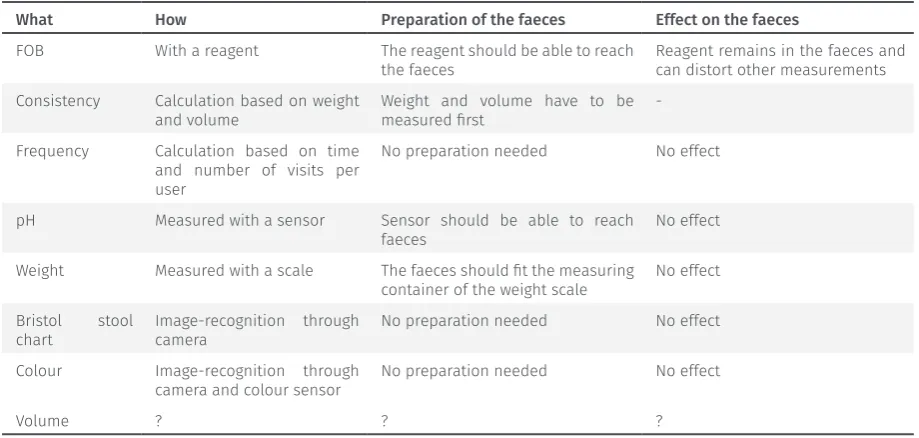
What How Preparation of the faeces Effect on the faeces FOB With a reagent The reagent should be able to reach
the faeces Reagent remains in the faeces and can distort other measurements Consistency Calculation based on weight
and volume Weight and volume have to be measured first -Frequency Calculation based on time
and number of visits per user
No preparation needed No effect
pH Measured with a sensor Sensor should be able to reach
faeces No effect
Weight Measured with a scale The faeces should fit the measuring
container of the weight scale No effect Bristol stool
chart Image-recognition through camera No preparation needed No effect Colour Image-recognition through
camera and colour sensor No preparation needed No effect
Volume ? ? ?
Table 3. summarizes all possible options. Behind every biomarker it is indicated how it can be measured. Providing this information will clarify that it should be taken into account how the faeces is treated, manipulated, and modified and how this can (negatively) affect the test. To ensure that the tests are performed correctly, the sensors used for measuring the biomarkers must be validated before every testing. It is important to test with a known variable if the sensor is able to perform the test accurately. For instance, the colour sensor could first measure a colour of which the variables are known to see if the sensor outputs the same variable. Measuring faeces can also leave some dirtiness obstructing the sensors efficiency and therefore, the sensors should be cleaned after every visit. Additionally, as some biomarkers can only be measured by manipulating the faeces or adding substances to the faeces, it is
[image:26.659.99.559.477.696.2]important to test on multiple samples as to avoid impurities. What must be guaranteed to provide the value is the validity of the measuring methods and the guarantee of valid results. Otherwise, the user cannot trust the device and will not use the results provided by the solution, deeming it obsolete.
2.3 VALUE FOR THE COMPANY
Selling the solution obviously provides value for the company, however, in this chapter other types of value will be discussed. The company can find value in the usage data of the system and the subsequent database. As new products are increasingly more equipped with communication and information technologies, usage data or strategic customer data (Rijsdijk, Hultink, and Diamantopoulos, 2007) becomes a new asset manufacturers have access to. New networks are formed from these products where manufacturers have remote control over these technologies (i.e., the installed base (Wise and Baumgartner, 1999)), capturing data on its usage, the use process, and its user (Allmendinger and Lombreglia, 2005; Shugan, 2004). This information is a powerful resource for a multitude of applications: from predictive maintenance process, to monitoring user experiences, improving design parameters, and developing new knowledge. Closely monitoring the users of the system also allow for the establishment of a database containing health data of the installed base. Assuming that the privacy and safety of its users can be guaranteed and the users have allowed for data-sharing, such information could provide tremendous amounts of value for the healthcare system. That database can provide health information of a large set of individuals over longer time periods than ever has been recorded before. This is inherit value for care professionals and researchers, as they can use this information to improve their understanding of CRC and CRC development, as well as stool in relation to health. Data analytics and statistical analyses can provide inside in the behaviour of the digestive system from a perspective that has not been researched in such detail before. Possessing such a database is therefore incredibly valuable, for the company12 as well as the academia13.
2.4 COST-SAVING CAPABILITIES OF SMART TECH
Table 4. Costs of cancer treatment for the stages of CRC (Lansdorp-Vogelaar et al., 2018).CRC treatment costs (€), per patient per year Stage I Stage II Stage III Stage IV
Initial treatment 17,219 22,177 26,585 30,992
Continuous care 685 685 685 685
Terminal care, death CRC 23,786 23,786 24,888 32,050
Terminal care, death other causes 9,352 8,912 10,234 19,930
CRC treatments were divided into 3 clinically relevant phases: initial, continuous, and terminal care. Initial phase was defined as first 12 months after diagnosis, terminal phase was defined as final 12 months of life, and continuous phase was defined as all months between the initial and terminal phases. For patients surviving less than 24 months, the final 12 months were allocated to the terminal phase. The remaining months of observation were allocated to the initial phase.
Last, the new product could also be capable of saving costs for the healthcare industry through two means: keeping people healthier longer and reducing the amount of processes necessary. Maintaining health is more affordable than treating a disease. Even more so for CRC, as cancer medication is expensive, as has been mentioned before. Table 4. has been used to calculate the cost-effectiveness14 of new biomarkers vs.
the current iFOBT for non-invasive cancer screening, and shows us the costs of treating cancer for each of the four stages. As this table shows, is that finding an individual that has CRC earlier saves tremendous costs for the healthcare system. For example, an individual was found with stage I CRC, after the initial treatment that individual lived for another 4 years (i.e. , 5 years from the diagnosis) before dying due to other causes. Another individual was found with stage III CRC and after the initial treatment lived for another 4 years (i.e. 5 in total) before dying of CRC. The treatment of the first individual costs €51,231, whereas the treatment of the second individual costs €76,133. A significant difference due to treatment options, medicine types and use, the need for specialists, and more.
12 Founder and CFO of a medical device company possessing such a database, see Appendix 2. 13 Professor gastroentology, see Appendix 2.