University of Warwick institutional repository: http://go.warwick.ac.uk/wrap
A Thesis Submitted for the Degree of PhD at the University of Warwick
http://go.warwick.ac.uk/wrap/59108
This thesis is made available online and is protected by original copyright. Please scroll down to view the document itself.
The University of Warwick School of Engineering
Engineering Doctorate Programme
Innovation Report:
Changing the Model of Workplace E-learning:
A Platform to Facilitate Autonomous Social
E-learning for Adult Learners.
Date: 22/09/2013
Name: Benjamin W. Betts, MBA.
Company: HT2 Ltd
EXECUTIVE SUMMARY ... 6
ACKNOWLEDGEMENTS ... 7
1. INTRODUCTION ... 10
1.1.RESEARCH AIM &OBJECTIVES ... 13
1.2.MOTIVATION ... 13
1.3.RESEARCH METHOD ... 14
1.4.THE RESEARCH SCOPE ... 15
1.5.THE RESEARCH ENGINEER’S CONTRIBUTION ... 16
1.6.ABOUT THE INNOVATION REPORT ... 18
1.7.READING ORDER OF SUBMISSIONS ... 18
2. BACKGROUND ... 20
2.1.BACK TO BASICS ... 22
2.2.PEER-TO-PEER LEARNING IN CONTEXT ... 23
2.3.TEACHING EXPERIENCED LEARNERS ... 26
2.4.SOCIAL CONTEXT IN LEARNING ... 27
2.5.THE SOCIAL WEB. ... 28
2.6.ONLINE PEER-TO-PEER LEARNING IN PRACTICE ... 31
2.7.COMPUTER SUPPORTED COLLABORATIVE LEARNING AND THE PARTICIPATION PROBLEM. ... 34
2.8.INTRINSIC MOTIVATION FOR A LEARNING ACTIVITY ... 36
2.9.DIGITAL GAMES,MOTIVATION AND LEARNING ... 40
2.10.GAMIFICATION AS A METHOD OF INCREASING ONLINE ENGAGEMENT ... 41
2.10.1. A NOTE ON THE RISE OF GAMIFICATION AS A TREND ... 45
2.11.DEFINING THE PROBLEM ... 47
3. TOWARDS A NEW METHODOLOGY ... 51
3.1.CONNECTING,CREATING AND CURATING ... 52
4. ENGINEERING CURATR ... 58
4.1.EXISTING SOFTWARE ... 60
4.2.ENGINEERING CURATR ... 62
4.2.1.PLATFORM BEHAVIOUR ... 63
4.2.2.INITIAL TESTING ... 64
4.3.OVERVIEW OF CURATR ... 65
4.4.CASE STUDY EXAMPLE:SERVICE OPERATIONS MANAGEMENT AT WARWICK BUSINESS SCHOOL ... 68
4.4.1.THE LEARNER EXPERIENCE ... 70
4.4.2.COURSE CONTENT AND FLOW ... 75
4.4.3.BUILDING THE COURSE ... 81
4.4.4.ADDING OBJECTS ... 87
5. EVALUATING THE INNOVATION ... 96
5.1.DEFINING INNOVATION ... 96
5.1.1.CLASSIFYING CURATR ... 97
5.2.SOFTWARE EVALUATION ... 100
5.2.1.USER REACTIONS ... 100
5.2.2.USER PARTICIPATION ... 104
5.2.3.ATTAINMENT OF LEARNING OUTCOMES ... 106
5.2.4.CONTENT ANALYSIS:EVALUATING THE QUALITY OF CONTRIBUTIONS ... 108
6. IMPACT OF THE INNOVATION ... 112
6.1.COMMERCIAL IMPACT ... 112
6.2.COMMERCIAL IMPLEMENTATIONS ... 113
6.2.1.CERTIFICATE IN SERVICE OPERATIONS MANAGEMENT AT WARWICK BUSINESS SCHOOL ... 114
6.2.2.SUPPLY CHAIN MANAGEMENT INSTITUTE: UNIVERSITY OF SAN DIEGO ... 115
6.2.3.THE EUROPEAN SAFETY BUREAU (ESB) ... 115
6.2.4.ONBOARDING AT BARCLAYS ... 116
6.2.5.CUSTOMER SERVICE TRAINING FOR DESJARDINS ... 117
6.2.6.EMPLOYABILITY SKILLS AT UNIVERSITY OF WARWICK ... 117
6.2.7.SCHOOLS AND COLLEGES ... 118
6.3.COMPANY IMPACT ... 119
6.3.1.INDUSTRY RECOGNITION ... 120
6.4.ACADEMIC IMPACT ... 121
6.4.1.GAMIFICATION AS A MEANS OF FACILITATING ONLINE COLLABORATIVE LEARNING ... 121
6.4.2.THE EFFECT OF GAMIFICATION ON THE QUALITY OF LEARNING ... 122
7. CONCLUSION ... 125
7.1THE CURATR LEARNING CYCLE ... 125
7.2.THE CURATR PLATFORM ... 126
7.3.THE RIGHT WAY TO ‘GAMIFY’ A SOCIAL LEARNING ENVIRONMENT ... 129
7.4.FURTHER WORK ... 130
7.4.1.ADOPTION OF THE CURATR LEARNING CYCLE ... 130
7.4.2.IMPROVING THE CLASSIFICATION OF CONTRIBUTIONS TO A SOCIAL LEARNING ENVIRONMENT. ... 130
7.4.3.APPLICATIONS TO EDUCATION ... 131
7.4.4.IMPROVEMENTS TO CURATR ... 132
7.5.CONCLUDING REMARKS ... 134
REFERENCES ... 135
APPENDIX A: DESCRIPTION OF CURATR SOFTWARE ... 152
THE TAXONOMY OF CURATR ... 152
PLAYING THE GAME ... 155
VIEWING OTHERS WORK IN CURATR ... 170
USING CURATR ON A TABLET DEVICE ... 177
FIGURES: FIGURE 1: KOLB'S EXPERIENTIAL LEARNING CYCLE (1984; P33). ... 25
FIGURE 2: TAM FOR E-LEARNING, AS ADAPTED FROM ROCA & GAGNE, 2008, P.1598. ... 39
FIGURE 3: THE RISE OF GAMIFCIATION AS A TREND (CREATED USING GOOGLE INSIGHTS). ... 45
FIGURE 4: THE CURATR LEARNING CYCLE ... 54
FIGURE 5: CURATR LAYER DIAGRAM ... 62
FIGURE 6: LEVEL 1 DATA FLOW DIAGRAM ... 64
FIGURE 7: NODES REPRESENTING LEARNING OBJECTS……….69
FIGURE 8: PROGRESSION WITHIN CURATR; THOSE OBJECTS ON THE OUTER RING ARE THE SAME OBJECTS SEEN IN FIGURE 5, ONLY NOW THEY HAVE MOVED ‘OUT’ AS THE USER HAS MADE PROGRESS TO LEVEL 2. ... 72
FIGURE 9: CURATR INTERFACE AT SCALE IN SOM, SHOWING THE WHOLE OF ‘DIRECT’. ... 72
FIGURE 10: THE COMPLETE CURATR INTERFACE. ... 73
FIGURE 11: THE PEER VIEW. ... 74
FIGURE 12: A USER’S 'GALLERY' OF OBJECTS. ... 74
FIGURE 13: COURSE INTRODUCTION VIDEO WITH USER COMMENT UNDERNEATH. ... 75
FIGURE 14: STUDENT REACTING TO THE LESSON. ... 76
FIGURE 15: A USER’S RESPONSE TO THE END-OF-LEVEL QUESTION. ... 77
FIGURE 16: LINKING TO A THIRD-PARTY WEBSITE AS A LEARNING OBJECT. ... 78
FIGURE 17: STUDENT ‘SARAH'S’ GALLERY OF OBJECTS. ... 79
FIGURE 18: SARAH'S GUIDE TO HAYES AND WHEELWRIGHT. ... 79
FIGURE 19: BUILDING THE STRUCTURE OF THE SOM COURSE. ... 81
FIGURE 20: LEARNING OBJECTS ADDED TO LEVEL 2 OF THE SOM COURSE. ... 88
FIGURE 21: THE OVERVIEW GRAPH FOR ‘DIRECT’, SOM. ... 91
FIGURE 22: LEVEL COMPLETION REPORT, LEVEL 7 SOM. ... 92
FIGURE 23: A USER'S 'PLAYERCARD'. ... 94
FIGURE 24: A GRAPH TO SHOW THE AVERAGE OF EXPERIENCE POINTS EARNED VS THE AVERAGE FINAL ASSIGNMENT MARK (BETTS ET AL, 2013A, P.10). ... 106
FIGURE 25: A GRAPH TO SHOW THE TOTAL NUMBER OF CHARACTERS IN COMMENTS VS THE AVERAGE FINAL ASSIGNMENT MARK (BETTS ET AL, 2013A, P12). ... 107
FIGURE 26: CLASSIFICATION OF STRUCTURED DISCUSSION AS FACILITATED BY CURATR (BETTS ET AL., 2013B). ... 109
FIGURE 27: CLASSIFICATION OF STRUCTURED DISCUSSION AS FACILITATED BY AN E-MODERATOR (KANUKA ET AL., 2007). ... 109
FIGURE 28: REVENUE AND PROFIT INCREASES AT HT2 SINCE 2011. ... 119
FIGURE 29 THE TAXONOMY OF A CURATR LEARNING EXPERIENCE ... 152
FIGURE 30: MUSEUM OVERVIEW ... 153
FIGURE 31: CURATR’S GALLERY ... 155
FIGURE 32: OBJECT DIALOG BOX. ... 156
FIGURE 33: VIEWING AN OBJECT ... 158
FIGURE 34: CURATR INTERFACE ... 160
FIGURE 35: FILTER BAR ... 161
FIGURE 36: VIEWING A GUIDE ... 162
FIGURE 37: SEEING THE LATEST ACTIVITY. ... 163
FIGURE 38: ANSWERING A QUESTION. ... 164
FIGURE 39: PEER MARKING. ... 165
FIGURE 41: VISUALISING LEVELS. ... 167
FIGURE 42: THE PLAYERCARD. ... 168
FIGURE 43: THE PEER VIEW. ... 170
FIGURE 44: PEER DIALOG BOX. ... 171
FIGURE 45: VIEWING A PEER’S GALLERY. ... 172
FIGURE 46: PEER-ADDED FILTERS. ... 173
FIGURE 47: MANAGING USER CONTRIBUTION. ... 174
FIGURE 48: ADDING A CONTRIBUTION ... 175
FIGURE 49: SHOWING USER CONTRIBUTIONS ON THE CURATR’S GALLERY. ... 176
FIGURE 50: THE IPAD VIEW OF THE CURATR’S GALLERY. ... 177
FIGURE 51: VIEWING AN OBJECT ON AN IPAD. ... 178
TABLES: TABLE 1: SUMMARY OF CURRENTLY AVAILABLE SOFTWARE (AS COMPLETED IN 2011). ... 60
TABLE 2: OUTLINE OF THE 'DIRECT' MUSEUM ... 69
TABLE 3: LEADERBOARD AT THE END OF SOM MODULE 1 (NAMES REDACTED). ... 92
TABLE 4: PARTICIPATION VERSUS MODERATION. ... 104
TABLE 5: PARTICIPATION STATISTICS FOR BETTS ET AL. STUDY (2013B, P.12). ... 108
Executive Summary
E-learning has a significant blind spot (Dalziel, 2003). The predominant existing model of delivering instructional ‘Courseware’ via a Learning Management System (LMS) is expensive to produce and often isolating; eschewing many seminal lessons concerning the importance of social context in a learning scenario (Dewey, 1938).
Following a review of literature, a new method of facilitating workplace E-learning was devised, focused on user-generated content and the notion of a more social E-learning experience. This new method has subsequently been dubbed the Curatr Learning Cycle (CLC). To encourage user participation, a technique known as gamification was harnessed; the use of digital game-like progress measures in a non-game context.
A software platform was devised to enable the new approach to be tested in the real world. Following positive testing results, the software platform received a wide commercial launch and became known as ‘Curatr’.
Using the CLC as a template of the actions that need to be facilitated for an effective social E-learning experience, organisations can create workplace E-learning that is quick to deploy, low cost and highly effective. The CLC and Curatr represent a potentially disruptive innovation to the workplace E-learning marketplace, with the possibility to displace earlier technology and existing methods.
Acknowledgements
This innovation report is the product not just of the Research Engineer’s efforts over the last four years, but also the combined efforts of a wide range of people.
First and foremost I would like to thank my academic supervisor, Dr Jay Bal, for his input, direction and motivation during this long period of research. Without this advice and without the challenges Jay laid down before me, I would not have achieved this work.
Second I would like to thank my industrial mentor, Alan Betts. Alan’s input, thoughtfulness and efforts throughout this period have made for an immeasurably better project. I have him to thank for consistently pushing me to believe in both myself and my work. I would not be here without him.
Third I need to thank my team at HT2, especially James Mullaney. My architectures, specifications and wireframes often call for the impossible to be produced by my collaborators at HT2. Time and again they have delivered. Starting with the work of John Gardiner to make Flash do things it didn’t know it could do in 2010, moving forward to James in 2011 and onwards, and Andy Drizen, who worked tirelessly to build the mobile version of Curatr.
I must thank all of the organisations and individuals who have been brave enough to try and implement this innovation: doing something new is inherently risky and your decisiveness in choosing a different path has been a defining moment in both this project and my career.
“E-learning has a significant
blind-spot…”
1. Introduction
The classroom as a medium for workplace training and development may well have had its day. That isn’t to suggest that workplace training is on the wane. On the contrary, a 12 per cent growth in US spending on corporate learning and development was seen in 2012 (O’Leonard, 2013). But it is to online alternatives that companies are turning; the E-learning market is growing at 23 per cent year on year, the fastest growth sector in education (IBIS Capital, 2012). Companies are today spending over $2 billion a year on E-learning initiatives (O’Leonard, 2013).
Workplace E-learning has thus far concentrated mostly on delivering instructional content to users in an asynchronous, on-demand, slideshow-esque medium; a method commonly known as E-learning ‘Courseware’ (Clark & Mayer, 2011). This approach scales well and can be cost efficient when large numbers of learners are enrolled onto these courses – the ‘per head’ cost of E-learning at scale is significantly lower than the classroom alternative (CIPD, 2011). Adopting E-learning brings down the cost of organisational training further when incidental aspects of classroom training, such as a travel and the opportunity cost of time out of the office are taken into account.
E-learning’s growth is to be sustained, improvements in the time to develop, and to the cost and quality of the learning experience need to be made.
Since its inception, innovation within workplace E-learning has often been sustaining in nature (Christensen, 1997); for example, the popular E-learning authoring tool Adobe Captivate is now on its sixth edition (Adobe, 2013); the market leading Learning Management System (LMS), Blackboard, version 10 (Blackboard, 2013). Tools such as these seek to reinforce the existing ‘Courseware’ model of instruction; a tool to create E-learning content (Captivate) and a tool to deliver the content to learners (Blackboard).
But this paradigm runs counter to what is known about the creation of truly effective adult learning experiences, which are said to be personalised, experience-based and, perhaps most importantly, social (Dewey, 1938; Bruner, 1966; Knowles, 1970; Argyris, 1977; Bandura, 1977; Bloom, 1984, Levy et al., 2009). In fact, the vast majority of what we learn in the workplace comes as a result of what we learn on the job and what we learn from others (EDC, 1998). Workplace learning, it could be said, is an inherently social process. Typically, E-learning in the form of Courseware is an isolated, solitary activity (Dalziel, 2003). Whilst attempts have been made to bring more of this ‘social’ activity into the E-learning world (for example, Blackboard 10 promotes ‘social E-learning’ with discussion boards and blogs), workplace E-learning remains stubbornly focused on the instructivist, ‘telling’ approach facilitated by interaction with content alone.
crowd-sourced encyclopedia, has amassed hundreds of millions of articles that document the world’s history and knowledge, but with only a handful of paid staff (Wikipedia, 2013). A key difference between these initiatives and the ‘socialisation’ of E-learning is the underpinning methodology; Facebook, like workplace learning, is inherently social. Without people it wouldn’t work. On the other hand, E-learning in its Courseware incarnation is inherently isolated. Attempts to add ‘social’ to the mix fail to address the methodological differences.
1.1. Research Aim & Objectives
This research focuses on the creation and evaluation of a social learning platform for use in online workplace training initiatives. By leveraging peer-to-peer social interaction as a core component of the learning process, the intention is to create a methodology that leverages employees experience in addition to learning content to create novel improvements in behavior and performance that might positively affect an organisations performance. This approach relies less on the creation of E-Learning content, which is costly and time consuming to develop, and as such could save organisations time and money. In order to achieve this aim it was necessary to meet the following objectives:
1. To understand the social factors that may influence the learning process;
2. To develop a new theoretical model for E-learning, encouraging learners to adopt a more ‘social’ approach;
3. To develop an innovation in E-learning software to meet the requirements of the new model;
4. To evaluate the effectiveness of the innovation.
1.2. Motivation
1.3. Research Method
This innovation report is the result of a mixed methods study spanning four years. To understand current thinking and benefit from previous experience a systematic literature review was undertaken. A systematic review was required given the discipline of software engineering, the fast pace of change within software engineering and the vast amounts of literature on learning (Kitchenham, 2004; Okoli & Schabram, 2010).
The systematic approach demands that a rigorous review of literature is undertaken in a scientific and auditable manner. This often begins with the definition of a research question, or research questions (Kitchenham, 2004). A method is then derived by which searches can be carried out in order to answer the research question(s) set. This method must be documented, such that future researchers might arrive at the same results (Kitchenham, 2004; Okoli & Schabram, 2010).
In our circumstances, suitable questions were derived from a combination of formulating the problem to be understood and a search of previous literature reviews in the field (Kitchenham, 2004; Minocha, 2009). In these circumstances the question: “What is known about the role of social interaction in a learning experience?” provided the initial goal for the review.
relevant and oft-cited research within the field. This afforded a view of which literature was likely to be considered ‘seminal’ and of good quality. The results of this systematic process can be found in Submission 2, the literature review. Whilst it is thought that Submission 2 represents a fair and comprehensive overview of the literature relevant to the field of study, it should be acknowledged that learning, education and technology is a vast and fast-moving field and omissions are likely to have occurred. The scope of this EngD is not the exhaustive cataloguing of past literature, but the rigorous development of a new innovation. As such, the review completed is believed to be of an appropriate level of rigour to have fulfilled its obligations to the quality of this research.
In addition to the systematic literature review, a series of one-to-one interviews were conducted with industry specialists to further investigate the role of game-based learning. This primary research is covered in detail in Submission 4.
Evaluation of the innovation was undertaken through a series of mixed method primary research case studies. The research methods implemented in these case studies included quantitative regression analysis, participant surveys (both quantitative and qualitative), and extensive content analysis. Submission 5 details the use of these methods in the evaluation and refinement of the innovation in the light of user feedback. In addition, two research papers (Betts et al. 2013a; Betts et al. 2013b) and a book chapter (Betts, 2013) cover in detail the methodology employed in the evaluation of the innovation.
1.4. The Research Scope
development process targeted towards the employees, or customers, of an organization and facilitated primarily ‘online’. This includes learning and development processes facilitated by third-party organisations on behalf of a company, such as is the case with university-led executive education. This research is also applicable to university-level education initiatives. Primary and secondary educational experiences are beyond the remit of this submission. Research was carried out primarily in the UK and USA, but there are no known barriers to limit the findings from being applicable on a worldwide basis.
1.5. The Research Engineer’s Contribution
HT2, the sponsoring organisation, is a small UK-based business specialising in the engineering of online learning software for use by both university and workplace learners. In 2009, HT2 sponsored the Research Engineer (RE) with hopes of producing a new software product through research and development. The software product would compliment HT2’s approach to the marketplace, playing to HT2’s strength in the creation of collaborative E-learning experiences and helping to differentiate the company in an increasingly saturated marketplace.
At the commencement of the project the RE was Operations Director at the company. Having worked for HT2 since 2005, the RE was responsible for the day-to-day running of the business. His experience centered on the design and production of Internet-based software for use in online learning experiences. Having previously completed a Master of Business Administration (MBA) qualification, the Engineer Doctorate (EngD) qualification was attractive because of its demands to create real-world impact.
1.6. About the Innovation Report
This innovation report describes the story of a new innovation in workplace E-learning. It is ordered to reflect the Research Aims and Objectives stated earlier.
Starting from the evidence that workplace E-learning is failing to deliver on its promises, the report summarises relevant literature to arrive at a suggestion for an innovation that might change existing models of E-learning design and deployment. Having conceived of a new method, an Internet-based software application was engineered to meet the requirements of the new approach. This software was subsequently launched commercially and tested in different deployments around the world. Findings from the implementation of the new approach serve to further inform future E-learning developments in the workplace.
1.7. Reading Order of Submissions
This innovation report should be read in conjunction with the personal profile. If required, further detail can be found as to the research and development methodology in submissions 1, 2, 3, 4 and 5. Submissions should be read in the order 1, 2, 4; then 3 and 5. In addition, readers may find it beneficial to read the following associated papers:
• “Social Learning: Answers to eight crucial questions” (Betts, 2012);
• “Gamification as a tool for increasing the depth of student
understanding using a collaborative e-learning environment” (Betts et al., 2013a);
• “The effect of Gamification on the quality of contribution in a
“The principle that development
of experience comes about
through interaction means that
education is essentially a social
process.”
2. Background
Whilst pedagogy is most often concerned with maximising the effectiveness of the student-teacher relationship, the commercial realities of teaching a formal curriculum to every student has naturally meant a shift towards teaching in groups. This trend has been continued from the classroom into the virtual world, where learners are directed to take part in online learning, or E-learning. Most often E-learning is completed either in large groups or as ‘on-demand’ services in a bid to increase training efficiency (Wang et al., 2005; Lin, 2011). Such programmes are standardised and content focused, most often directing users to courses made up of modules and topics of content resources to be worked through at the users own pace, in isolation from other learners (Anderson, 2001; Dalziel, 2003; Vaughan & MacVicar, 2004; Clark & Mayer, 2011). Increasingly, E-learning authoring tools have sought to inject greater engagement into static content by way of animation or human-computer interaction. These methods create ever more inventive content, but are often time consuming to produce. This runs somewhat counter to the core reason as to why organisations turn to E-learning; to improve efficiency in terms of the time it takes to deliver training, the cost of delivering training and the time to competency for their employees (Towards Maturity, 2013).
attitudes they foster in their users (Sun et al., 2008; Lee, 2009; Lin, 2011). There remains a stubborn view amongst learning and development professionals that E-learning is not as engaging or motivating as face-to-face courses (Kim et al., 2005; CIPD, 2011). This is not surprising; where negative attitudes are created, widespread adoption of such systems is limited and their commercial value constrained (Davies, 1989; Sun et al., 2008). Quality of learning content isn’t necessarily the issue; the beliefs and attitudes of users undertaking E-learning experiences are perhaps more decisive in gaining learners’ continued acceptance of E-learning as the preferred method of workplace learning delivery (Davies, 1989; Sun et al., 2008; Lin, 2009). Where users fail to adopt a new technology, the pre-supposed benefits will inevitably fail to materialise. In many ways, E-learning is a victim of its past failures. Where E-E-learning has gone before, and failed, so widespread adoption is that much harder to achieve. It is not good enough for the next generation of E-learning innovations to provide bottom-line business benefits of time and cost reductions; they must also undo some of the damage that has been done with regard to user perception. The old model of self-paced, content driven, isolated learner E-learning should be re-visited (Dalziel, 2003). There exists a need for innovations in learning technology to appeal on all three fronts of time, cost and quality of experience.
2.1. Back to Basics
Bloom’s (1984) Two-Sigma Problem suggested that teaching in groups is substantially less effective than one-to-one tutoring. This is perhaps not surprising, as the classroom environment is compelled to proceed at the mean pace of understanding; it will be too slow for some and too fast for others. Bloom’s research suggested that 98 per cent of students taught in a one-to-one or small (three or four students) environment would achieve better results than the average student in a class situation (1984). Bloom called this finding a ‘problem’ because of the shortage of resources that is experienced when attempting to find a teacher for every student (1984).
Bloom’s (1984) study highlighted teaching techniques that proved to increase the efficacy of the experience for those in a classroom situation. Mastery learning, where a teacher gives feedback to their student and asks them what they would do differently were they to do the task again (thus mastering the subject) showed a substantial improvement of 1 standard deviation alone. However, mastery learning also leans heavily on the capabilities of the teacher to provide structure and feedback. Cooperative learning, where students work together to solve problems, assist one-another and provide moral support, was cited by Bloom as also potentially increasing efficacy by 1-Sigma.
work was perhaps too holistic in view to fully appreciate the mechanics of what caused cooperative learning to be successful in the first place.
2.2. Peer-to-Peer Learning in Context
Early epistemic theorists such as Skinner (1953) suggested a simplistic operant conditioning process as the core means of learning; that learning was the result of reinforcement given for performing a particular behaviour. Skinner’s (1953) work, termed radical behaviourism, was demonstrated readily by rats, whom Skinner trained to press a button when a light came on in return for a reinforcement of food. However, Skinner’s approach left little room for the social environment to be factored in to decision making and learning, beyond the roles of stimuli and reinforcement (Skinner, 1977). Chomsky (1971) highlighted this shortcoming by examining the way in which children learned language; children are able to utter sentences never before heard and without suitable reinforcement from modeling what had gone before. If they hadn’t heard the sentences before, how could they have learned them? Radical behaviourism has fallen out of favour as a theory of learning and cognitivists, who appreciate the process of thought and not just the resulting behaviour, have come to the fore.
connect experiences together for themselves and achieve higher levels of competency within the domain (Wood et al., 1976). However, it is perhaps misleading to think of the master as someone with authority or some measure of superiority over the apprentice; dialogue between any two people brings the opportunity for knowledge to be built. It is perhaps in this manner that cooperative learning is best thought; in sharing thoughts, ideas and theories we each get to build our knowledge with viewpoints from each other. Placing this approach in a practical context is thought to further improve retention and application skills (Kolb, 1984).
Another theoretical group, the social constructivists, formed primarily out of the work of Piaget, argue that we each build our own form of knowledge based on our experiences, dialogue and meaning-making (Marn et al., 2000). We each literally ‘construct’ knowledge for ourselves, based on our experiences (Papert, 1993). Whilst teaching in a classroom setting with abstract examples is perhaps now the normal mode for student-teacher interaction, learning experiences that take place within an appropriate context are said to be more effective learning experiences as they offer greater opportunity for this construction process to take place in a realistic setting (Dewey, 1938; Bruner, 1966). When we elect to believe that learning is an experiential process, that is that we learn through experience, then we must also acknowledge that learning is an inherently social process (Dewey, 1938; Kolb, 1984). Even Skinner (1977) recognised this, suggesting that environmental factors accounted for variation in behaviour. However, he failed to appreciate that the social environment itself could be the product of the cognition. Our individual perception of the world is unique, not some permanent and fixed map that we equally share. Social context is irremovable from the learning process. The cues, signals and behaviours we witness all impact on our learning.
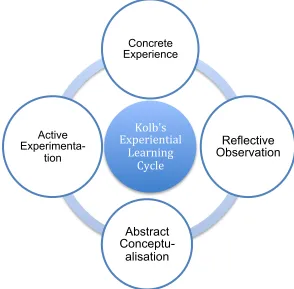
process. In the cycle, which can begin at any point, concrete experience is followed by reflective observation, which leads to abstract conceptualisation and finally to active experimentation. Kolb extended his model to include ‘learning styles’ which exist at the four stages. However this extension of the core model has been rightly critiqued for lacking any rigorous empirical evidence (Smith, 2001). Kolb’s model is also somewhat isolating in nature; it makes no reference to the potential influence or impact of social learning. Additionally, Jarvis (1987) suggested that Kolb’s work was incomplete in the context of adult learners. Jarvis reasoned that not all experiences lead to learning, a concept that is particularly relevant when dealing with self-motivated adult learners. Some learners may disregard information or experiences as irrelevant or incorrect. This in itself is not a problem, but should be a decision that is arrived at through critical thought, not simple dismissiveness. In addition, adult learners working at their own pace may work through the model in different cycles or order; repeating stages or skipping them entirely due.
Figure 1: Kolb's Experiential Learning Cycle (1984; p33).
Kolb's Experiential
Learning Cycle Concrete Experience
Reflective Observation
Abstract
Conceptu-alisation
Active
2.3. Teaching Experienced Learners
Andragogy (Knowles, 1970) has found favour as a theory of adult learning, especially in the workplace, despite a lack of empirical evidence (Blondy, 2007). Andragogy remains compelling because it recognises the motivations, thinking and desire for application that experienced learners bring to any event. Knowles (1970) suggested four key assumptions differentiated between a pedagogic and an andragogic approach:
1. The concept of the learner. In pedagogy, learners are thought to be dependent on the direction and instruction of the teacher. Andragogy suggests self-directedness is important to the learner, who will ultimately decide the direction and instruction to accept. 2. The learner experience. Andragogy suggest learning from
experiences, where pedagogy promotes a more passive “transmittal” technique (Knowles, 1970, p.44).
3. A readiness to learn. Pedagogy assumes that learners are ready to learn when they are told to; andragogy suggests that learning occurs as and when it is needed.
4. Orientation to learning. Pedagogy suggests that learning is a process of knowledge transfer, for application at some later point. Andragogy sees education as a path to competence in the short term, to be applied today.
attempting to reach it despite failure, but fundamentally questioning the goal and modifying attempts to reach it based on experience. E-learning remains firmly pedagogic in its approach; set lessons that are often to be learned by rote. When E-learning is instructivist in nature, it falls short as a vehicle to promote organisational learning; the double loop theory requires learners to examine not only content, but context, relevance and experience.
2.4. Social Context in Learning
factors have what Bandura termed ‘reciprocal determinism’; they reinforce each other. In this way Bandura suggests we model and evolve behaviours from one another in a community.
Dewey (1938) suggested the nature of a learning community impacts heavily on the quality of the educational experiences it produces. Lave & Wenger (1991) coined the term ‘situated learning in communities of practice’ to further illustrate the importance of the community when learning from one-another in an applied context. Communities tend to exhibit not only a similar level of understanding between the participants, but also a shared language and culture. Such shared activities and dialogue are said to represent a powerful method for professional development (Zenios, 2011, p.261). Thomas and Seely Brown (2011) suggest that the term ‘collective’ might be more relevant to an Internet-based group of learners working together.
2.5. The Social Web.
It has been suggested that new forms of communication are transforming the way in which we learn from each other (Siemens, 2005). This is made possible by the architecture of participation that has emerged in Internet technology – much of the technology we use today values creation over consumption and so the number of connections we make between people and ideas grows exponentially (Kamel Boulos & Wheeler, 2007). The opportunity to learn from and with one another has never been as vast as it is today. That is not to say that we haven’t always learnt in groups; just that today those groups are more geographical dispersed and diverse than ever before.
communication has meant that the barriers to create a community of practice have fallen dramatically. Physical spaces are no longer required to interact; collaboration between companies or indeed between countries can now be facilitated from any location.
Throughout the Internet’s short existence, communities of practice have been created and used for online learning. Many of these communities make use of asynchronous discussion board technology to allow learners to communicate with each other. Often this communication is triggered, shaped and encouraged by an online moderator, or e-moderator (Salmon, 2001). The role of the e-moderator is akin to that of the teacher in a classroom setting. Direction, insight and encouragement all fall within the role requirements of a good e-moderator (Salmon, 2001). However, this can create a shortfall in supply. Suitable personnel need technical skill, subject matter knowledge and online teaching abilities to fulfill the role. This could have prevented the growth of the Internet as a medium for social learning, however, it has become increasingly obvious that an e-moderator isn’t always required for insight and learning to be generated.
users the freedom and control to publish words, pictures, videos and other digital content for sharing and exchange. Technologies such as Blogs, video sharing and Wiki’s encourage users to co-operate virtually in the creation of community websites and can be defined as follows:
• Blogs, short for ‘web logs’, are a form of published diary writing,
where an author automatically shares his or her blog entries with readers. Typically, blogs allow for visitors to comment and respond to entries. Increasingly, microblogs such as Twitter have emerged as a form of short-hand blogging, limiting the author to posting just 140 character messages as a time.
• Video sharing has increased rapidly in popularity due in part to the
prevalence of video cameras (now a familiar function in smartphones) and partly due to the falling costs of digital storage and bandwidth availability.
• Wiki’s require a group of collaborators to contribute and refine a
single page of content, such that any member of the group may edit or delete the work of any other member. These individual pages are then hyperlinked together to form a networked document of content. Wikipedia, the largest such example of a Wiki, is widely regarded as one of the foremost repositories of human knowledge.
2.6. Online Peer-to-Peer Learning in Practice
Many examples of using the Web to facilitate social learning interactions exist today. Perhaps most commonly cited is the use of online discussion boards, which allow students to write messages to each other asynchronously (Garrison & Cleveland-Innes, 2005). Universities swiftly adopted this technology in order to better facilitate distance-learning courses (Prinsen et al., 2007). Both individual and group work can be directed by teachers commenting and replying to student’s contributions. The success of these initiatives tends to rest with the level of participation that students give to such activities. Not only is participation required to facilitate a successful social learning experience, it has also been shown to be independently beneficial for student outcomes. Several studies have commented on the relationship between the level of student participation and subsequent learning outcomes; increased participation resulting in better achievement of grades (Cho et al., 2005; Palmer et al., 2008; Darabi et al., 2008; Cheng et al., 2011; Michinov et al., 2011; Xie, 2012).
Increasingly, discussion boards are giving way to Web 2.0 technologies (discussion boards, or bulletin boards as they were known, pre-date the Web 2.0 movement by some years) that enable rich media to be used and more collaborative practices to be employed. For example, Wiki’s have been used in educational activities (Glassman & King, 2011), where students have been asked to create new content and ‘remix’ others contributions. Learning Management Systems such as Moodle or Blackboard have embraced not only discussion boards, but blogs, Wiki’s and other ‘Web 2.0’ features as a core part of their software. There are drawbacks to these implementations. Glassman & King (2011) remarked that many students failed to grasp the correct method for creating a Wiki page – they simply chose to add to the content, instead of critically refining each others contributions.
Web 2.0 platforms for education are today being created or leveraged from existing platforms. For example, Kahn Academy, a poster-child example for online education, was founded by one man recording and sharing math lessons on YouTube for his nieces and nephews. Edmodo, a social network for education, seeks to replicate much of the functionality of Facebook but in a secure, online classroom environment. LORE, a US software company, is attempting to make a more ‘social’ learning management system that also somewhat replicates the Facebook approach.
2.7. Computer Supported Collaborative Learning and the Participation Problem.
Computer Supported Collaborative Learning (hereafter CSCL) has emerged as a method to facilitate advanced learning through online discussion and Web 2.0 activities (Prinsen et al., 2007). Where other models of E-learning concentrate solely on learner-content interaction (Moore, 1989), CSCL seeks to leverage teacher-learner and learner-learner interaction, allowing students to contribute, create and critique each others work (Darabi et al., 2011).
CSCL is thought to require the presence of a teacher, or e-moderator, within a small class of students in order to motivate participation and facilitate meaningful discourse (Salmon, 2000; Dillenbourg, 2002; Garrison & Cleveland-Innes, 2005). The same could be said of approaches like Learning Design (Dalziel, 2003). Without this direction, the value of CSCL becomes somewhat questionable (Dillenbourg, 2002; Garrison & Cleveland-Innes, 2005; Xie, 2012). This need inevitably leads to a lack of scalability in the approach; the need for a ‘hands-on’ e-moderator is restrictive in terms of both capacity and commercial reality. Because of this, CSCL could be thought to lack the cost effectiveness and scalability of other E-learning approaches. However, the approach could be rapid to deploy; relying on group discussion as opposed to pre-prepared learning materials would suggest a rapid rollout should be possible.
where Bloom’s taxonomy is somewhat more generalised (and older, having been conceived before CSCL was possible).
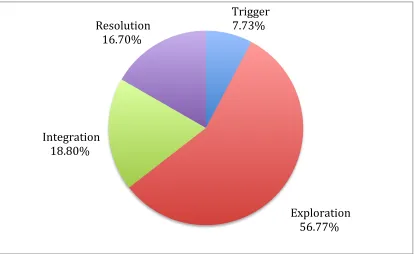
Cognitive Presence is said to have four phases through which participants in a discussion progress on their way to critical enquiry: The Triggering Event; Exploration; Integration and Resolution. Park (2009) further classified these four phases into sub-phases. Park (2009) suggested that the Triggering Event is often associated with Clarification and restating the problem. Exploration then encompasses aspects such as information sharing, divergences, personal narration and opinions. Integration occurs when a participant builds upon an earlier point, creates a novel solution or suggests a justified hypothesis. Finally, resolution sees the application of the new thought generated in the discussion and a wrap-up. Participants should look to progress through these steps in order to successfully assimilate experiences.
Of course, in order to attain the higher levels of cognitive presence, everyone in a learning experience must participate (Garrison & Cleveland-Innes, 2005). However, Nielson (2006) suggests that in any given online collaborative environment, 90 per cent of participants will ‘lurk’ and fail to actively engage in conversation or contribution (but they may read heavily). 9 per cent of participants will offer a facile level of contribution; the occasional comment or suchlike. Just 1 per cent of participants will consistently create original content. Making participation optional would appear foolhardy in the light of such collective tendencies.
a participant’s level of intrinsic motivation. The theory suggests that a committed individual offered no rewards for participation would participate more effectively than an individual who participated for an external reward, like money or course credit.
2.8. Intrinsic Motivation for a Learning Activity
To understand this finding it is necessary to understand the wider context in which intrinsic motivational research exists. Deci and Ryan (1985) suggested that a feeling of self-determination underpinned the basis of whether or not an individual will experience intrinsic motivation to perform a particular activity. Self-Determination Theory (SDT) proposes that a person’s level of intrinsic motivation for an interesting task is moderated by the degree of autonomy, competence and psychological relatedness they experience whilst completing the task (Deci & Ryan, 1985). Autonomy refers to the level of free-choice that a participant is allowed to express in undertaking the task. Competence is the notion that participants need to feel they are increasing in mastery of a task in order to pursue it. And finally, relatedness refers to the notion that an individual is impacted by, and impacts on, others undertaking the task.
better than their counterparts in the control group. This finding reinforces earlier research by Malone (1981) that suggested the fantasy elements of a computer game were central to the intrinsic motivation experienced by players of a game.
Cordova & Lepper’s findings are made more interesting because of the nature of the choices given. Cordova & Lepper (1996) cite a previous study (Parker & Lepper, 1992) in which giving students just a single choice to personalise an experience had no bearing on the outcome. This suggests that a ‘tipping point’ of choice and control is required for an activity to be intrinsically motivational; on balance it must appear that the student is in control, even if the choices are facile and fundamentally unrelated to instructionally relevant choices. However, as Cordova & Lepper’s (1996) findings were conducted with a group of young students for whom a sense of autonomy might have been granted by relatively facile choices, the authors are unable to suggest if such a strategy would be successful for adult learners. Deci & Ryan’s (1985) SDT would tend to suggest that it would, although the choices given may need to move beyond fantasy. This need for further work is reinforced by the nature of other studies – for example, Malone (1981) also studied children and learning.
Tension exists in the SDT approach where notions of competence conflict with those of reward. Extrinsic rewards are often said to detract from intrinsic motivation (Deci & Ryan, 1985). There is said to be a fine line between “controllers of behaviour versus affirmations of competence” (Deci et al., 1999, p628). In order for a participant to feel like they are progressing, some measure of competence is required. As long as the individual accepts this measure autonomously, intrinsic motivation is reinforced (Deci & Ryan, 1985).
for finishing the task at a certain quality threshold) all undermine the overall level of intrinsic motivation experienced for an activity (after taking in to account any positive effect of the reward). However, extrinsic rewards can also work as motivators. For example boosts to motivation are experienced consistently when unexpected rewards are given (Deci et al., 1999). Endogenous rewards (those inherent to the task) are also said to buck the trend (Cordova & Lepper, 1996). Positive effects are shown in the application of external rewards for activities that are determined by the participant to be dull and uninteresting (Deci et al., 1999). This latter point is perhaps most relevant in the context of workplace E-learning, a task which is said to be “uninteresting but relevant” for many participants (Roca & Gagne, 2008, p.1589). In such circumstances so called ‘autonomous extrinsic motivation’ has been found to be a better predictor of engagement (Roca & Gagne, 2008). This situation occurs when a participant in an activity internalises extrinsically specified goals as one’s own (Deci & Ryan, 1985; Roca & Gagne, 2008).
Studies in motivation and learning have revealed close links between increased motivation and better educational outcomes (Malone, 1981; Cordova & Lepper, 1996; Roca & Gagne, 2008). Even Bloom (1984) suggested that ‘time on task’ improved the attainment of learning outcomes, but many of those who have studied the area in more detail suggest that the effect is more profound than simply spending more time working towards a goal.
Figure 2: TAM for E-learning, as adapted from Roca & Gagne, 2008, p.1598.
TAM introduces the simple notions of perceived usefulness and perceived ease of use as core drivers to a users willing adoption of an IT systems (Davis, 1989, as cited in Roca & Gagne, 2008). Roca & Gagne (2008) built upon this to include the notion of ‘playfulness’. By examining the attitudes of workplace learners using an E-learning system, the factors listed in the model were found to be significant determinants of users willingness to accept the E-learning and do more work (Roca & Gagne, 2008). However, TAM has been critiqued because of its simplicity (Bagozzi, 2008); it fails to account for factors in adoption such as social pressure, design aesthetics or personal goals. Actual adoption of a new technology is almost certainly more complex than TAM infers.
player’s current level of ability to the challenge of task at hand, or stretching that ability just beyond. And, increasingly, games are played in multi-player environments that allow players to relate not only to those in the room with them, but also with players dispersed all over the world. So-called ‘Massively Multiplayer Online Games’ (MMOGs) are played by millions of participants at a time.
2.9. Digital Games, Motivation and Learning
An extensive overview of the game-based learning landscape can be found in Submission 4. What follows here is a brief summary of these findings.
Przybylski et al (2010) weren’t the first to highlight the potential of games to increase motivation for a learning experience. Malone (1981) investigated the intrinsic motivational properties of computer games for educational purposes. He suggested that games could be used and learned from in the design of educational experiences. Cordova & Lepper’s (1996) theories on choice and fantasy were put to the test using computer games as the mediating technology.
learning (de Freitas & Jarvis, 2006). But perhaps the most often cited benefit of employing a digital game for learning is an increase in learner motivation (Malone, 1981; Cordova & Lepper, 1996; Ricci et al., 1996; Garris et al., 2002; Egenfeldt-Nielson; 2006; de Freitas, 2006; Kapp, 2012).
It would be easy to assume that supplanting E-learning with game-based learning would alleviate the issues organisations face when deploying online learning. However, the cost and skillset required to design, build and deliver a digital game for learning tends to be prohibitively high. This is perhaps not surprising given that the skillset required to produce a game can be diverse; instructional designers, programmers, graphic artists and game designers come together in the production of a digital game for learning. Sitzmann (2011) suggests that the games for workplace learning cost on average $3m-$5m (USD) to produce. Prensky (2001) suggested $1m as an average figure. The American Society for Training and Development (ASTD) reports an average build effort of 1346 development hours to create a simulated environment (Kapp & Defelice, 2009). Smaller scale games or even commercial games used for serious purposes can all undercut these costs, but it seems somewhat unlikely that the bespoke development of a serious game for learning can compete in terms of cost and time to deploy when compared to more standard E-learning activities.
2.10. Gamification as a Method of Increasing Online Engagement
characteristic of games in non-game contexts. Gamification differs from a full game because its design incorporates only some of the elements that might otherwise be included in a game. These designs and feedback patterns are placed into real-world or otherwise ‘non-game’ contexts to facilitate users’ progress towards a purposeful goal (other than completion of the game, which tends to be the purposeful goal in a whole game experience). The aim of gamification is to increase the frequency of behaviours that designers see as necessary to fulfill the purpose of an experience. For example, the geo-location app ‘Foursquare’ requires users to press a ‘check-in’ button when they reach a location that they wish to share with their followers. In an attempt to encourage this behaviour, Foursquare’s designers chose to reward participants with points which translate into badges for frequent check-ins. Users aren’t playing a game; they are telling their friends where they are, but the ‘experience points’ brings a playful and competitive element to an otherwise mundane task.
times and against various offers. These techniques are long-established marketing tools proven to increase engagement with a brand over the long-term.
However, gamification differs from loyalty programmes in that, traditionally, loyalty programmes materially benefit the participant with some item of monetary value. Gamification systems tend not to do this, instead relying on social comparison and the urge to progress within ‘the game’ in an endogenic reward pattern – you earn points simply because it is a part of a game and we all enjoy some feeling of mastery, however that feeling is manifested. Critics suggest that gamification in this mold promotes facile engagement that borders on exploitation (Bogost, 2011). The term ‘pointsification’ was coined as a more accurate, but somewhat derogatory language to define gamification (Robertson, 2010). Detractors such as Bogost and Robertson suggest that gamification has little in common with a game, save for taking some of the more obvious feedback mechanisms and making them core to the experience, as opposed to a side-effect of progress. Gamification isn’t the first movement to attempt to tap into the motivational properties of games; ‘funology’ sought to take a more playful approach to work and life as a response in part to the success of the experiments in fantasy and motivation by Malone (1981) (Deterding et al., 2011). There perhaps emerges a further distinction, that of ‘gamefulness’, which more accurately describes the inspiration behind play and how this might be used to make activities more intrinsically appealing (McGonigal, 2011, Deterding et al., 2011). Gamefulness can be seen to encompass more of the ludic features said to make games compelling exploratory and reflective exercises (Deterding et al., 2011).
elements. Instead, gamification shares more of its heritage with fields such as choice architecture, where experiences are specifically designed to manipulate behaviour (Thaler & Sunstein, 2009). For example, supermarkets place their in-store bakery towards the rear of the store in order to tempt customers deeper in to the shop. To the layman, gamification appears to be capturing the essence of what makes a computer game compelling without necessarily needing to build a full computer game. But the reality is that gamification builds upon the popularity of games as a basis in shared language that increasing numbers of consumers understand. As the average age of a game player increases, so does the awareness that a ‘experience point’ or a ‘level up’ is a desirable outcome. In doing so it builds upon many years of experience perfecting Human-Computer Interaction (Deterding et al., 2011) and research into the efficacy of short-term rewards as a part of long-term process (McClure et al., 2004). The evidence for something akin to gamification to be used as a method to facilitate increased user participation is compelling. However, questions must be raised as to the suitability of gamification across all settings and all genres. For example, gamification makes significant use of phrases and terminology that might not appeal to all audiences. Where ‘experience points’, ‘badges’ and ‘virtual gifts’ mean nothing to an end-user, there is a disconnect between the intended impact and the probable outcome of offering these sorts of incentives. Even where the basis in shared language exists, gamification practitioners such as Kris Duggan (2012) warn against seeing gamification as a one-off development, suggesting that in order to keep the rewards interesting they must constantly be tweaked, changed and modified. Without this campaign driven approach gamification may loose its allure over the long-term.
desire to participate in (Deci & Ryan, 1985; Roca & Gagne, 2008). It is perhaps questionable as to whether or not all workplace learning activities are desired by their participants; they tend more to be a function of organisational demand for compliance or change. The net effect of such contingent rewards becomes somewhat uncertain in these circumstances. It might be that gamification provides users with an extrinsic measure that they can internalise as desirable. Outperforming competitors and achieving high levels of self-efficacy, as demonstrated by reaching the top of a leaderboard for example, might be considered an autonomous extrinsic motivator (Roca & Gagne, 2008).
2.10.1. A Note on the Rise of Gamification as a Trend
Gamification was not a term in regular parlance when this research was initiated. Whilst game-based learning had been popular for decades, the use of game-like progress measures in non-game situations remained largely without documentation. Using Google’s Insight Tracker tool to analyse the popularity of the term ‘gamification’ over time, we can suggest that the term only entered popular usage about half-way through 2010 (one-and-a-half years after this research commenced).
Since that time its rise has been somewhat exponential, to its current peak now (end of 2012). Gartner, a research organisation, suggests that gamification will be utilised within 50 per cent of all innovation processes within companies by 2014 (Gartner, 2012).
2.11. Defining the Problem
The central criticism leveled at workplace E-learning could be said to boil down to its fascination with content as the sole means of instructing learners (Levy et al., 2009). This basis overlooks many underpinning epistemological and andragogic findings; that learners, especially adults, base their learning in experience not in didactic teaching. And whilst workplace e-learning delivery expands in ever more inventive ways of reshaping content, costs and time to develop will remain high and frequent failures will not be fully addressed (Lee, 2009; Lin, 2011). There exists a distinct lack of social interaction facilitated in workplace E-learning (Dalziel, 2003). If education is seen as an inherently social process then we must first and foremost imagine ways in which a more ‘social’ approach can be facilitated (Dewey, 1938).
This, it must be said, is already happening in every organisation. Informal learning theory suggests that most of the learning which individuals experience in the workplace is the result of informal circumstances – learning on the job or talking with colleagues – instead of formal learning (EDC, 1998). Despite this ubiquity, a study into the role of informal learning in a workplace (EDC, 1998) noted three distinct limitations:
1. The context of the company is a mediating factor in the effectiveness of informal learning – not all companies see themselves as ‘learning organisations’ and where the ability to facilitate learning is not central, so the availability of good informal learning practice is limited;
2. The variability that occurs with informal learning does not lend itself equally to all disciplines. For instance, areas that require a high degree of regulation or are high risk may benefit from formal training;
This study suggests that informal learning is by its nature ‘constructivist’ and therefore the greatest synergy between the formal and informal world is seen where a more active involvement in the construction of knowledge is undertaken (EDC, 1998). This approach is more useful for building skills such as problem solving than traditional ‘absorption through instruction’ techniques. Such skills are top of the priority list for companies today (Mourshed et al., 2012). Increasingly it would seem that the ability to build widgets faster, to achieve higher levels of quality or to maximise durability are not factors that businesses can rely on to differentiate themselves in a global marketplace. Instead it is in their human capital, the ability of their employees to problem solve and create novel solutions, that companies are turning to differentiate themselves in the marketplace. Here companies have a shortfall not just with existing employees, but also with newcomers to the workplace. Less than 50 per cent of employers rate young people as being competent when it comes to problem-solving or written communications (Mourshed et al., 2012).
Adopting a more social approach to workplace E-learning at the expense of content development is therefore a worthwhile notion. However, it has been recognised that fostering meaningful social interaction online is difficult (Salmon, 2000; Dillenbourg, 2002; Garrison & Cleveland-Innes, 2005). For educational settings it has often only been possible with the intervention of a teacher or moderator. This is not a scalable solution for the workplace. But simply leaving learners to their own devices would not systematically produce learning (Dillenbourg, 2002; Garrison & Cleveland-Innes, 2005). A method of scripting collaboration could be advocated, but the time and effort this would take to design would prohibit widespread workplace adoption (Dillenbourg, 2002).
confidence grows. By structuring collaboration around content, we automatically provide a context for conversation to take place. As this content becomes more advanced and involved, so we might expect conversation to progress and build in depth and quality. Latterly, the need for scripted conversations falls away, as learners reach higher levels of understanding within a subject area.
To encourage participation without the need for a hands-on e-moderator, our research has led us to consider a gamification system that might be employed to shape learners’ behaviours in favour of participation (Deterding et al., 2011). Capturing lessons from andragogy and self-determination theory, this same system should allow for participants to be more autonomous in their behaviour; choosing their own path within the confines of the scaffolding. In an effort to mimimise cost and time to build, the innovation should be able to reuse content previously created, as well as utilise other content from outside the confines of the organisation and its learning platforms. As the focus of learning moves towards the application of ideas, the need to create content somewhat declines in importance; constructivists value learners building over teachers teaching (Papert, 1993).
This approach may not be suitable for all organisations, all applications or all cultures. For example, where learning is orientated towards a ‘tick-box’ exercise for compliance requirements, there may be little need to implement a substantial ‘social’ system around what is essentially a requirement for rote retention. Where organisations are suspicious of the role of social media, social networks or ‘games’ there will almost certainly be hostility towards the Curatr approach. This attitude may well be warranted by the nature of the environment; if a company does not have an inherent culture of sharing and openness, it is perhaps naïve to think a software platform will change that.
“Free collaboration does not
3. Towards a New Methodology
We can capture our understanding of a new, more social approach to workplace E-learning with the creation of a theoretical model. Building on the evaluation work of Garrison et al (2001), which broadly aligns with the work of Kolb (1984), it is possible to construct a model of how a learner’s interactions must advance in an online social learning experience in order to reach higher levels of critical thought. This advances Kolb’s (1984) model by introducing the social context in which learners exist. Garrison et al (2001) suggests that first there is a trigger; an insight or idea that, for want of a better phrase, causes some form of cognitive dissonance in the learner’s mind. This occurs when a pre-existing connection is challenged by a new insight. Either the new insight is rejected or the pre-existing connection is modified. Garrison et al (2001) suggest that this completed by socially mediated exploration; an investigation that is undertaken through the articulation of thoughts. In the case of an online asynchronous discussion type area, this creation is most often seen as a comment or reply. As this yields results for an individual, so an attempt to reconcile a new connection with previous experience is made; it is integrated.
3.1. Connecting, Creating and Curating
We can summarise the Cognitive Presence stages as being the result of three key behaviours; the learner connecting with an idea; the learner creating a response to that idea and the learner curating both their responses and others in order to arrive at a conclusion. We can call these three behaviours Connecting, Creating and Curating.
1. Connecting. A learner must firstly connect to an idea as exhibited by either a learning object, the teacher or another user (Moore, 1989; Garrison & Cleveland-Innes, 2005). By ‘connect’ we refer to the cognitive process of deriving a personal opinion in response to something that is experienced – making a connection or having an experience (Kolb, 1984; Jarvis 1994). This is akin to ‘triggering’
and ‘exploring’ (Garrison et al., 2001);
3. Curating. Finally, the learner begins to assimilate new experiences into existing experiences in a more systematic manner, perhaps as a prelude to actively experimenting with a new idea in the real world (Kolb, 1984). This need not always be a positive process; it is equally valid for a learner to reject a new idea in this knowledge construction phase (Jarvis, 1987). Garrison et al (2001) label this stage integrating or, for more advanced cases, resolution. Kolb (1984) would refer to it as abstract conceptualisation. Here we refer to it as ‘Curating’.
Due to the proliferation of user-generated content on the Internet, there is an increasing need to sort, maintain and dispose of digital content in a systematic manner (Beagrie, 2006). The field of ‘digital curation’ has emerged as a new term to encompass this process (Beagrie, 2006; Rosenbaum, 2011). Curation is a well-established practice of creating value from collection building, where the sum of the experiences and the context provided is greater than the parts alone (Beagrie, 2006). Indeed, remixing concepts in an educational context is an established pedagogical practice by its own right (Papert, 1993).