Original citation:
Murawski, Andrzej S. and Tzevelekos, Nikos (2014) Game semantics for nominal
exceptions. In: Muscholl, Anca, (ed.) Foundations of Software Science and Computation
Structures : 17th International Conference, FOSSACS 2014, Held as Part of the
European Joint Conferences on Theory and Practice of Software, ETAPS 2014,
Grenoble, France, April 5-13, 2014, Proceedings. Lecture Notes in Computer Science,
Volume 8412 . Springer Berlin Heidelberg, pp. 164-179. ISBN 9783642548291
Permanent WRAP url:
http://wrap.warwick.ac.uk/65245
Copyright and reuse:
The Warwick Research Archive Portal (WRAP) makes this work by researchers of the
University of Warwick available open access under the following conditions. Copyright ©
and all moral rights to the version of the paper presented here belong to the individual
author(s) and/or other copyright owners. To the extent reasonable and practicable the
material made available in WRAP has been checked for eligibility before being made
available.
Copies of full items can be used for personal research or study, educational, or not-for
profit purposes without prior permission or charge. Provided that the authors, title and
full bibliographic details are credited, a hyperlink and/or URL is given for the original
metadata page and the content is not changed in any way.
Publisher’s statement:
"The final publication is available at Springer via
http://dx.doi.org/10.1007/978-3-642-54830-7_11 "
A note on versions:
The version presented here may differ from the published version or, version of record, if
you wish to cite this item you are advised to consult the publisher’s version. Please see
the ‘permanent WRAP url’ above for details on accessing the published version and note
that access may require a subscription.
Game Semantics for Nominal Exceptions
⋆Andrzej S. Murawski1and Nikos Tzevelekos2
1
DIMAP and Department of Computer Science, University of Warwick
2
School of Electronic Engineering and Computer Science, Queen Mary University of London
Abstract. We present a fully abstract denotational model for a higher-order pro-gramming language combining call-by-value evaluation and local exceptions. The model is built using nominal game semantics and is the first one to achieve both effective presentability and freedom from “bad exception” constructs.
1
Introduction
Exceptions are a standard programming effect for raising and handling eccentric pro-gram behaviour, and more generally for manipulating the flow of control. They are a key feature, for example, of ML, Java and C++. The raising of an exception forces a program to escape out of its context and to the nearest applicable exception-handler. Thus, exceptions provide a means of overriding nested behaviour of pure functional programs. The mechanism that allows handlers to recognise the exceptions to be han-dled usually relies on the use of names. In the paper we shall focus on modelling such
nominalexceptions.
The difficulties in modelling (even soundly) nominal exceptions stem from the com-bination of name-locality and name-mobility with non-local control flow. In particular, traditional approaches do not cope with locality and examine global exceptions only via the exception monad [9]. On the other hand, existing game models [5] rely on Reynolds’ principle of modelling references as objects with read/write methods [13], extended to the modelling of exceptions as objects with raise/handle methods. The main defect of this principle is that, in order to achieve full abstraction, “bad” constructors have to be included in the syntax, which means that the language examined will include “bad exceptions”, which are terms of exception type that do not correspond to genuine ex-ceptions, but rather to couplings of arbitrary raise/handle methods. These constructs, while solving the full-abstraction problem, distance the languages from the program-ming features they were set out to capture; in particular, term-equivalence is not conser-vative with respect to bad constructors. For example, “handle x in (raise x) with skip” is not equivalent to “skip”.
Nominal game semantics advocates a departure from Reynolds’ modelling rule and stipulates that “nameful” types be modelled by names rather than objects. Nominal games were introduced in [1] and [6] in order to provide the first fully abstract models of theν-calculus and its extension with pointers (i.e. storable names) respectively. They constitute a ‘nominalised’ version of game semantics, in which names may appear in
⋆
class MyExn extends Exception {}
public class Trap {
public static void main(String [] argv) throws Exception {
Exception e1 = new MyExn(); Exception e2 = new MyExn(); try { foo(e1); }
catch ( Exception x ) { System.out.printf("%b, %b",
x==e1, x==e2); }
}
static void foo(Exception e) throws Exception {
throw(e); }
}
exception MyExn let e1 = MyExn let e2 = MyExn let foo(x) = raise x;;
try foo(e1) with x -> (x==e1, x==e2)
fun new_exn() = let exception MyExn
[image:3.612.133.479.115.268.2]fun eq(x) = case x of MyExn => true | _ => false in (MyExn, eq) end val e1 = new_exn() val e2 = new_exn() fun foo(x) = raise x;
foo(#1 e1) handle x => (#2 e1 x, #2 e2 x)
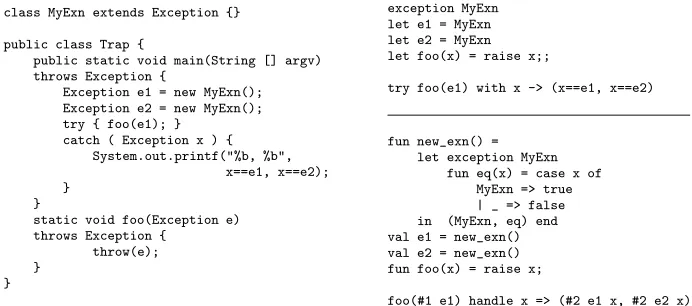
Fig. 1.Code samples. Clockwise, from upper-left corner: Java, OCaML and SML. In the Java example, thecatchclause in methodmainis able to trap the exceptione1raised byfoo, extract its name and pass it tox. As a result, the program printstrue,false. In OCaML, the same effect is achieved by pattern matching the handled expression. We instigate analogous behaviour in SML, using the generativity of theexceptionconstructor to produce local exceptions.
plays as atomic moves. Put differently, they are ordinary games constructed within the universe ofnominal sets[2]. A first attempt to model exceptions using nominal games was made in [15]. However, the close reliance on the monadic approach led to a model which was too intensional to yield an explicit characterisation of contextual equiva-lence and the full abstraction result had to be obtained through the intrinsic quotient construction ([15, Proposition 5.23]). The development of a direct model was left as a major challenge for future work in [15]. In the present paper, we meet that challenge by producing two fully abstract and effectively presentable models for higher-order languages with references and exceptions. The fact that our models are not quotiented yields a direct approach to proving program equivalences, with scope for future automa-tion (cf. [11]). In particular, we prove new non-trivial equivalences (cf. Example 28).
We consider two kinds of exception-handling mechanisms, in Sections 2-4 and 5-6 respectively. In the first one, illustrated by the code samples in Figure 1, the handler is given explicit access to the exception names that it encounters. Another, less invasive approach, is to require the handler to specify which exception is to be intercepted, under the assumption that all the others will be propagated by default. This approach respects privacy of exceptions in that no handler may react to a freshly generated exception. The latter kind of exceptions turns out to lead to a slightly more complicated game model.3
At the technical level our full abstraction results are obtained by modelling the ex-ception type by an arena whose moves belong to a countable set ofnames. Additionally, players are allowed use moves of the forme!(whereeis an exception name) as answers toarbitraryquestions. Uses ofe!can be taken to correspond to raising an exception. These two relatively simple enrichments, along with standard game semantic conditions such as alternation and well-bracketing, already give rise to a fully abstract model of the
3This is a common pattern in game semantics: fewer conditions are needed to describe models
u, Γ⊢(), Ω:unit u, Γi⊢∈iZ:int
l∈u∩ Lβ
u, Γ ⊢l:refβ e∈
u∩ E
u, Γ ⊢e:exn
u, Γ⊢M:int u, Γ⊢N0, N1:θ
u, Γ⊢if0MthenN0elseN1:θ
u, Γ⊢M, N :int
u, Γ⊢M⊕N :int
u, Γ ⊢M, N :exn,refβ
u, Γ⊢M=N:int
(x:θ)∈Γ
u, Γ⊢x:θ
u, Γ, x:θ⊢M :θ′
u, Γ ⊢λxθ.M:θ→θ′
u, Γ⊢M:θ→θ′
u, Γ⊢N:θ
u, Γ⊢M N:θ′
u, Γ⊢M:β
u, Γ⊢refβ(M) :refβ
u, Γ⊢M :refβ
u, Γ⊢!M :β
u, Γ ⊢M:refβ u, Γ ⊢N:β
u, Γ⊢M:=N:unit
u, Γ⊢exn() :exn
u, Γ ⊢M:exn
u, Γ ⊢raiseM :θ
u, Γ ⊢M :θ u, Γ, x:exn⊢N:θ
[image:4.612.138.479.129.275.2]u, Γ⊢Mhandlex=>N:θ
Fig. 2.Syntax ofExnML.
first kind of exceptions, i.e. handlers have direct access to exception names. To model the other type of handlers, we identify a compositional subclass of strategies that must propagate any exceptions unless they were revealed to the program by the environment. In both cases, we obtain an explicit characterisation of contextual equivalence through the induced sets ofcomplete plays, ones in which all questions are answered. In the setting where handling of private exceptions is not available, the latter set needs to be appropriately trimmed, so as to reflect the handling restrictions on environments.
2
A language with local exceptions and ground references
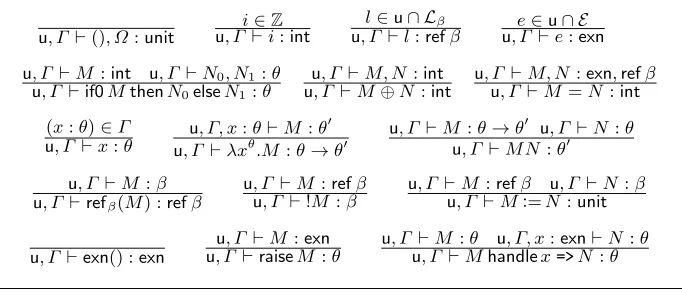
We introduce the languageExnML, which is a fragment of ML with full ground refer-ences4 augmented with nominal exceptions. Its typesθare generated according to the
following grammar.
θ ::= β|θ→θ β ::= unit|int|exn|refβ
Note that reference types are available for each type of the shapeβ, including the ex-ception type (full ground storage). We assume disjoint denumerable setsLandE of
locationsandexceptionsrespectively, such thatL = U
βLβ. We range over location
names byl, l′ and over exception names bye, e′. Terms are typed in contexts(u, Γ), whereua finite subset ofL ∪ E andΓ is a variable context. Moreover, we assume a fixed set of binary integer operators ranged over by⊕. The terms of the language are given by the following grammar (alli∈Z), while its typing rules are in Figure 2.
M ::= ()|Ω|i|l|e|x|λxθ.M |M M|if0MthenMelseM |M ⊕M
|M =M |refβ(M)|!M |M:=M |exn()|raiseM |Mhandlex=>M
We shall writeΓ ⊢M :θiff∅, Γ ⊢M :θcan be derived using the rules of Figure 2. Similarly, ⊢ M :θ is shorthand for∅,∅ ⊢ M :θ. In what follows, we write M;N
4
Σ,(λx.M)v−→Σ, M[v/x] Σ,if00thenN0elseN1−→Σ, N0
Σ, i1⊕i2−→Σ,(i1⊕i2) Σ,if0ithenN0elseN1 −→Σ, N1 (i6= 0)
Σ,!l−→Σ, s(l) Σ,refγ(v)−→Σ[l7→v], l (l /∈dom(Σ1))
Σ, l:=v−→Σ[l7→v],() Σ,exn()−→Σ∪ {e}, e (e /∈Σ2)
Σ, e=e−→Σ,1 Σ, e=e′
−→Σ,0 (e6=e′ )
Σ, l=l−→Σ,1 Σ, l=l′−→Σ,0 (l6=l′)
Σ, vhandlex=>N−→Σ, v Σ,(raisee)handlex=>N−→Σ, N[e/x]
Σ, E¬H[raisee]−→Σ,raisee Σ, M−→Σ
′
, M′
Σ, E[M]−→Σ′
[image:5.612.160.454.120.255.2], E[M′ ]
Fig. 3.Small-step operational semantics ofExnML.
for the term(λzθ.N)M, wherezdoes not occur inN andθmatches the type ofM. letx=MinNwill stand for(λxθ.N)M in general.Value termsv, are given by:
v ::= ()|i|e|l|λxθ.M
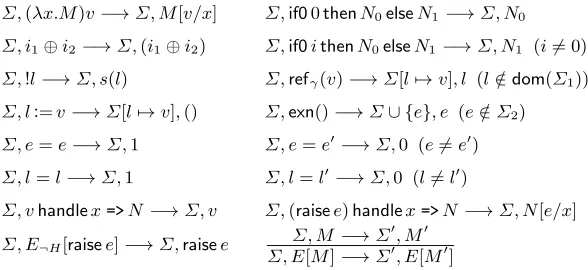
The operational semantics of the language utilises finitestores, which record generated exceptions and assign to locations atomic values of compatible type:
Sto={s:L⇀finVal | l∈dom(s)∩ Lβ =⇒ s(l)∈Valβ} × Pfin(E),
whereVal =Valunit∪Valint∪Valexn∪U
βValrefβ,Valunit={∗},Valint=Z,Valexn= E,Valrefβ =Lβ. We range overStobyΣ, T (and variants). GivenΣ∈Stowe write
Σ1, Σ2 to refer to its respective components. Stores must beclosed in the following
sense: for allΣ∈Stoandl∈dom(Σ1),
(Σ1(l)∈ L =⇒ Σ1(l)∈dom(Σ1))∧(Σ1(l)∈ E =⇒ Σ1(l)∈Σ2).
Finally, we letevaluation contextsbe given by the syntax:
E::= [ ]|E N|(λx.M)E|if0EthenN0elseN1|E⊕N|i⊕E|refγ(E)|E:=N
|l:=E|!E|E=N|e=E|l=E|Ehandlex=>N |raiseE.
We writeE¬H for contextsE derived from the above grammar applying any of the
rules apart fromEhandlex=>N. In Figure 3 we give a small-step reduction relation for terms in contexts fromSto. Given ⊢M :unitwe writeM ⇓iff(∅,∅), M−→−→Σ,() for someΣ.
Definition 1. We say that the term-in-contextu, Γ ⊢ M1:θ approximates u, Γ ⊢
M2:θ(writtenu, Γ ⊢M1<∼M2) ifC[M1]⇓impliesC[M2]⇓for any contextC[−]
such thatu,∅ ⊢C[M1], C[M2] :unit. Two terms-in-context areequivalentif one
Example 2. Take the terms ⊢M1, M2:unit→unitto be respectively
M1≡lety=exn()inλxunit.raisey and M2≡λxunit.raise(exn()).
Their game semantics will contain the following plays respectively
qΣ0
0 ⋆Σ00qΣ0e1!Σ1qΣ1e1!Σ1· · ·qΣ1e1!Σ1 qΣ00⋆Σ00qΣ0e1!Σ1· · ·qΣk−1ek!Σk
whereΣi = (∅,{e1,· · ·, ei}). Handlers ofExnMLcan extract the name of an
excep-tion and remember it for future comparisons. Accordingly, we have ⊢M16∼=M2(cf.
Example 19).
3
Game semantics
We construct a game model forExnMLby extending the fully abstract model ofGround ML[11] so as to incorporate nominal exceptional effects. LetAbe a countably infinite collection ofnames, corresponding to reference and exception names:
A=]
βAβ⊎Ae where Aβ =Lβ, Ae =E.
We range over names witha, b, etc,and alsol, ewhen we want to be specific about their kind. The model is constructed using mathematical objects (moves, plays, strategies) that will feature names drawn fromA. Although names underpin various elements of our model, their precise nature is irrelevant. Hence, all of our definitions preserve name-invariance, i.e. our objects are (strong)nominal sets[2, 16]. Note that we do not need the full power of the theory but mainly the basic notion of name-permutation. Here permutations are bijectionsπ:A→Awith finite support which respects the indexing of name-sets. For an elementxbelonging to a (nominal) setX, we writeν(x)for its name-support, i.e. the set of names occurring inx. Moreover, for anyx, y ∈X, we write
x∼yifxandyare the same up to a permutation ofA. We let[x] ={y∈X |x∼y}. Our model is couched in the Honda-Yoshida style of modelling call-by-value com-putation [3]. Before we define what it means to play our games, let us introduce the auxiliary concept of an arena.
Definition 3. AnarenaA=hMA, IA, λA,⊢A, Meiis given by:
– a setMAof ordinary moves, a setIA⊆MAof initial moves,
– a labelling functionλA:MA∪Me→ {O, P} × {Q, A},
– a justification relation⊢A⊆MA×(MA\IA)∪Me,
– and a fixed setMe={e!O|e∈Ae} ∪ {e!P|e∈Ae}of exceptional moves;
such thatMA∩Me=∅and, for allm, m′∈MAande∈Ae:
– m∈IA =⇒ λA(m) = (P, A),
– m⊢Am′∧λQAA (m) =A =⇒ λ QA
A (m′) =Q,
– m⊢Am′ =⇒ λOPA (m)6=λOPA (m′),
– λA(e!O) = (O, A)∧(λA(m) = (P, Q) =⇒ m⊢Ae!O),
– λA(e!P) = (P, A)∧(λA(m) = (O, Q) =⇒ m⊢Ae!P).
We writeλOP
A (resp.λ QA
MA⊗B= (IA×IB)⊎I¯A⊎I¯B
IA⊗B=IA×IB
λA⊗B= [(iA,iB)7→P A, λA↾I¯A, λB↾I¯B]
⊢A⊗B={((iA,iB), m)|iA⊢Am∨iB⊢B m} ∪⊢¯A∪⊢¯B
MA+B=MA⊎MB
IA+B=IA∪IB
λA+B= [λA, λB]
⊢A+B=⊢A∪ ⊢B
MA⇒B ={⋆} ⊎MA⊎MB
IA⇒B ={⋆}
λA⇒B = [⋆7→P A, λA[iA7→OQ], λB]
⊢A⇒B ={(⋆,iA),(iA,iB)} ∪ ⊢A∪ ⊢B
MA→B =MA⊎MB
IA→B=IA
λA→B= [λA[iA7→OQ], λB]
[image:7.612.138.485.124.248.2]⊢A→B={(iA,iB)} ∪ ⊢A ∪ ⊢B
Fig. 4.Basic arena and prearena constructions
Note that, asMeis fixed for all arenasAand so are the parts ofλA,⊢Aconcerning
moves from it, we will not be specifying them explicitly in definitions, We shall refer to moves fromMA∪Mecollectively asmoves ofA, we shall useito range over initial
moves (which are necessarily ordinary moves), and we shall range over exceptional moves viae!. LetλAbe theOP-complement ofλA. We define the basic (flat) arenas:
1 =h{⋆},{⋆},{(⋆, P A)},∅i Aβ =hAβ,Aβ,{(a, P A)|a∈Aβ},∅i
Z=hZ,Z,{(i, P A)|i∈Z},∅i Ae =hAe,Ae,{(a, P A)|a∈Ae},∅i
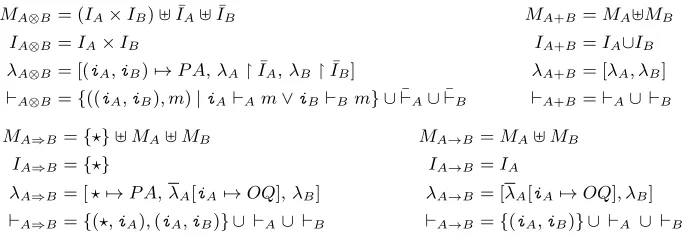
Given arenasA, B, the arenasA⊗BandA⇒Bare constructed as in Figure 4, where ¯
IA=MA\IA,⊢¯A = (⊢A↾I¯A×I¯A)(and similarly forB). For each typeθwe can
now define the corresponding arenaJθKby setting:
JunitK= 1 JrefβK=Aβ JintK=Z JexnK=Ae Jθ→θ′K=JθK⇒Jθ′K
Although types are interpreted by arenas, the actual games will be played inprearenas, which are defined in the same way as arenas with the exception that initial moves are O-questions. Given arenasA, B we define the prearenaA → B as in Figure 4. The moves will be accompanied by an explicit store componentΣ. Amove-with-storeon a prearenaAis thus a pairmΣwithm∈M
A∪MeandΣ∈Sto.
Definition 4. Ajustified sequenceon a prearenaAis a sequence of moves-with-store
sonAsuch that, apart from the first move, which must be of the formiΣwithi∈IA, every movenΣ′
insis equipped with a pointer to an earlier movemΣsuch thatm⊢ A
n. We then callmthejustifierofnand, ifλAQA(n) =A, we also say thatnanswersm.
Remark 5. Note that, by definition, any exceptional movee!can answer any question move in a play, as long as the latter has not already be answered. Thus, exceptional moves will model situations when evaluation of some term leads to raising an exception.
We shall writes⊑s′to mean thatsis a prefix ofs′. For eachS ⊆AandΣwe
defineΣ0(S) =SandΣi+1(S) =Σ
1(Σi(S))∩A(i≥0). LetΣ∗(S) =SiΣi(S).
The set ofavailable namesof a justified sequence is defined inductively byAv(ǫ) =∅ andAv(smΣ) =Σ∗(Av(s)∪ν(m)). Theviewof a justified sequencesis defined as
follows:view(ǫ) =ǫ,view(mΣ) =mΣandview(s mΣt nΣ′
) =view(s)mΣnΣ′
Definition 6. LetAbe a prearena. A justified sequences onA is called aplay, if it satisfies the conditions below.
– No adjacent moves belong to the same player (Alternation).
– The justifier of each answer is the most recent unanswered question (Bracketing).
– For anys′mΣ ⊑swith non-emptys′, the justifier ofmoccurs inview(s′)( Visi-bility).
– For anys′mΣ ⊑s,ν(Σ) =Av(s′mΣ)(Frugality).
We writePAfor the set of plays onA.
We say that a namea is a P-name of a plays if there iss′mΣ ⊑ s such that
a ∈ ν(mΣ)\ν(s′)andmis a P-move. We writeP(s)for the set of all P-names of
s. The setO(s)is defined dually. We moreover define a partial function on alternating justified sequences which imposes the frugality condition by restricting the stores in moves to available names. More precisely, we defineγ(s)inductively byγ(ǫ) =ǫand:
γ(s mΣ) =γ(s)mΣ↾Av(smΣ)
ifman O-move
γ(s mΣ) =γ(s)mΣ↾Av(smΣ) ifma P-move,Av(s mΣ)∩ν(s)⊆Av(s) and∀a∈dom(Σ)\Av(s mΣ). Σ(a) =Σ′(a)
where, in the last clause above, the last move ofshas storeΣ′ and, for each storeΣ
and setS ⊆A,Σ ↾S = ({(a, v)∈Σ1|a∈S}, Σ2∩S). Note that partiality arises
from sequences breaking the conditions of the last clause.
Definition 7. Astrategyσon a prearenaAis a set of even-length plays ofAsatisfying:
– IfsoΣpΣ′
∈σthens∈σ(Even-prefix closure).
– Ifs∈σands∼tthent∈σ(Equivariance).
– Ifs1pΣ11, s2pΣ22∈σands1∼s2thens1pΣ11∼s2pΣ22(Nominal determinacy).
We writeσ:Aforσbeing a strategy onA.
Example 8. For each arenaA, the strategyidA:A→A, is defined by
idA={s∈PAeven→A| ∀s′⊑
even
s. s′↾Al=s′ ↾Ar},
where the indicesl, rdistinguish the two copies ofA, ands′↾A
xis the subsequence of
s′ containing only moves from thex-copy, along with any exceptional moves justified
from them. For each arena A, let us write T Afor the arena 1 ⇒ A, i.e.MT A =
{⋆1, ⋆2} ⊎MA. Next we define the following exception-related strategies:
– raizA:Ae→A={e{e}e!{e}|e∈Ae}
– trapA:T A→(A+Ae) ={⋆1⋆2s|s∈idA} ∪ {⋆1⋆2e!{e}e{e}|e∈Ae}
– newe : 1→Ae={⋆ e(∅,{e})|e∈Ae}
Note that, in definitions like the above, we implicitly assume that we close the con-structed set of plays under even-prefix closure. Thus, inraizA the play starts with O
providing an exception namee, to which P answers by raising the exceptione!(thus,
e{e} justifiese!{e}); note that the play never opens in arenaA. On the other hand, in
with a question⋆2. At this point, O is given two choices: (a) to answer with an initial
move ofA, so the play will transform into a copycat between theAcomponents ofT A
andA+Ae; (b) to answer with an exceptional movee!, in which case P will ‘trap’
the nameeand return it in theAe component ofA+Ae. Finally, innewe P answers
the initial move by playing a fresh exception name and adding it to the store. We will see below that the above mechanisms give us all the structure we need for modelling exceptional behaviours.
We proceed to strategy composition. Given arenasA, B, C, we define the prearena
A→B→Cby settingMA→B→C=MA→B⊎MC,IA→B→C=IAand:
λA→B→C = [λA→B[iB7→P Q], λC] ⊢A→B→C=⊢A→B∪ {(iB,iC)}∪ ⊢C
Letube a justified sequence onA → B → C. We defineu ↾ BC to beuin which allA-moves and all exceptional moves justified byA-moves are suppressed.u ↾ AB
is defined analogously, only that we also remove any exceptional move justified by an initial move ofB.u↾ACis defined similarly with the caveat that, if there was a pointer from an initialC-move (resp. an exceptional move) to an initialB-move, which in turn had a pointer to anA-move, we add a pointer from theC-move (the exceptional move) to theA-move. Let us writeu↾γ X forγ(u↾ X)withX ∈ {AB, BC, AC}. Below
we shall often say that a move is an O- or a P-move inX meaning ownership in the associated prearena (A→B,B →CorA→C).
Definition 9. A justified sequenceuonA →B → Cis aninteraction sequenceon
A, B, C if it satisfies bracketing and frugality and, for allX ∈ {AB, BC, AC}, we have(u↾γ X)∈PXand the following conditions hold.
– P(u↾γ AB)∩P(u↾γ BC) =∅;
– O(u↾γ AC)∩(P(u↾γAB)∪P(u↾γBC)) =∅;
– For eachu′⊑uending inmΣm′Σ′
anda∈dom(Σ′)if • m′is a P-move inABanda /∈Av(u′↾AB),
• orm′is a P-move inBCanda /∈Av(u′↾BC), • orm′is an O-move inACanda /∈Av(u′↾AC), thenΣ(a) =Σ′(a).
We writeInt(A, B, C)for the set of interaction sequences onA, B, C, andσkτfor the
set of interactions between strategiesσ:A→Bandτ:B →C:
σkτ={u∈Int(A, B, C)|(u↾γ AB)∈σ∧(u↾γBC)∈τ}.
and letσ;τ:A→C={u↾γ AC|u∈σkτ}.
The following result is deduced by translating our strategies into [7, 10].
Lemma 10. Strategy composition is associative and identity strategies are neutral ele-ments. Thus, arenas and strategies yield a category of gamesG.
Remark 11. G can be shown to host a lluf subcategoryG′, consisting of a variant of single-threadedstrategies [7], where(1,⊗)yield finite products. Moreover, the oper-ation T on arenas extends to a strong monad in G′ withT-exponentials, i.e. for all
A, B, C there is a bijectionΛT : G′(A⊗B, T C)∼= G′(A, B⇒C)natural inA, C.
Then one can show that there exists a bijectionΦ: G(A, B)∼=G′(A, T B), which
es-tablishes equivalence ofG and the Kleisli category onG′ determined byT (G′
T). We
writeh, ifor the left-pairing obtained inGfrom pairing inG′
T, andΛ( )for the weak
exponential structure.
The above provides a canonical interpretation of application andλ-abstraction in G. To interpret the remaining constructs of ExnMLin G, we need to define special morphisms for reference manipulation (cf. [14]) while for exceptions we shall use the morphisms from Example 8.
getβ : Aβ →JβK={lΣΣ(l)Σ∈PAβ→JβK}
setβ : Aβ⊗JβK→1 ={(l, v)Σ⋆Σ[l7→v]∈PAβ⊗JβK→1}
newβ : JβK→Aβ={vΣlΣ[l7→v]∈PJβK→Aβ |l /∈dom(Σ)}
We interpret any term-in-contextu, Γ⊢M :θwith a strategyJu, Γ ⊢M :θK:Ju, Γ ⊢
θK, denoted also as JMK : Ju, Γ ⊢ θK. The interpretation is given explicitly below. Suppose thatu = {a1,· · · , an} andΓ = {x1 : θ1,· · · , xk : θk}. We writeJu, ΓK
for the arenaJuK⊗Jθ1K⊗ · · · ⊗JθkK, whereJuKis the flat arenahMu, Iu, λu,⊢uiwith
Mu=Iu = [(a1,· · ·, an)].
– Ju, Γ ⊢() :unitK=Ju, ΓK→−! 1, where! ={(¯a,iΓ)Σ⋆Σ}.
– Ju, Γ ⊢Ω:unitK=Ju, ΓK−⊥→1, where⊥={ǫ}.
– Ju, Γ ⊢i:intK=Ju, ΓK→−! 1−→ˆi Z, whereˆi={⋆ i}.
– Ju, Γ ⊢xj :θjK=Ju, ΓK πn+j
−−−→JθjK.
– Ju, Γ ⊢ M1⊕M2 : intK = Ju, ΓK
hJM1K,JM2Ki
−−−−−−−−→ Z⊗Z −−→σ⊕ Z, whereσ⊕ =
{(i1, i2) (i1⊕i2)}.
– Ju, Γ ⊢if0MthenN0elseN1:θK=Ju, ΓK
hJMK,idi
−−−−−→Z⊗Ju, ΓK−−−→if0⊗id (1 + 1)⊗
Ju, ΓK−∼=→Ju, ΓK+Ju, ΓK−−−−−−−→[JN0K,JN1K] JθK, whereif0={0⋆l, i ⋆r |i6= 0}.
– Ju, Γ ⊢refβ(M) :refβK=Ju, ΓK
JMK
−−−→JβK newβ
−−−→Aβ.
– Ju, Γ ⊢!M :βK=Ju, ΓK−−−→JMK Aβ
get −−→JβK.
– Ju, Γ ⊢M :=N :unitK=Ju, ΓK−−−−−−−→hJMK,JNKi Aβ⊗JβK
setβ
−−→1.
– Ju, Γ ⊢M N :θ′K=Ju, ΓK−−−−−−−→hJMK,JNKi (JθK⇒Jθ′K)⊗JθK−→ev Jθ′K.
– Ju, Γ ⊢λx.M:θ→θ′K=Λ(JMK:Ju, ΓK⊗JθK→Jθ′K).
– Ju, Γ ⊢exn() :exnK=Ju, ΓK−→t 1 newe
−−−→Ae.
– Ju, Γ ⊢raiseM :θK=Ju, ΓK−−−→JMK Ae
raizJθK
−−−−→JθK.
– Ju, Γ ⊢ Mhandlex =>N : θK = Ju, ΓK −−−−−−−→hid,Φ(JMK)i Ju, ΓK⊗TJθK −−−−−−→id⊗trapJθK
Ju, ΓK⊗(JθK+Ae) ∼ =
−→(Ju, ΓK⊗JθK) + (Ju, ΓK⊗Ae))
[π2,JNK]
We can demonstrate that the game model is sound for contextual approximation (Propo-sition 12) by following the traditional route through Computational Soundness and Ad-equacy. For the former we show that we work in a modified version of aνǫρ-model[15, Def. 5.13]. Recall that a play is completeif each question occurring in it justifies an answer. Given a set of playsX, let us writecomp(X)for the set of complete plays inX.
Proposition 12. LetΓ ⊢ M1, M2:θ be terms ofExnML.comp(JΓ ⊢ M1:θK) ⊆
comp(JΓ ⊢M2:θK)impliesΓ ⊢M1<∼M2.
4
Full abstraction
We prove full abstraction by showing that all finitary behaviours in the model are de-finable in ExnML. For the latter we use a factorisation argument which decomposes, in three steps, a strategy from G into an exception-freestrategy and strategies man-aging handling, raising and creation of exceptions respectively. Then, for the class of exception-free strategies we show that finitary members can be expressed in the frag-ment ofExnMLcorresponding to Ground ML.
We call a strategyσfinitaryif the set[σ] ={[s]|s∈σ}is finite (i.e.σisorbit-finite
in the nominal sense). For the first factorisation, we restrict strategies in the following manner. First, for each even-length plays, we letφ(s)be the justified sequence obtained fromsby deleting all its O-moves of the forme!Σ (anye, Σ), as well as the moves
following these. That is,φ(ǫ) =ǫand
φ(s mΣnT) =
(
φ(s) ifmΣ=e!T
φ(s)mΣnT otherwise
We say that a plays ∈PAisexception-propagatingifγ(φ(s))is defined and, for all
s′e!ΣmT ⊑
even s,mT = e!Σ. We writePAprop for the set of exception-propagating
plays onA. We say that a strategyσ:Ais exception-propagating ifσ⊆PApropand, for alls∈σ,
– for alls e!Σ ∈P
A, we haves e!Σe!Σ∈σ;
– for alls′ ∈PApropwithγ(φ(s)) =γ(φ(s′)), we haves′∈σ.
The former condition says that P always copycats raised exceptions, and the latter en-sures that P cannot register moves that raise exceptions. We say that an exception-propagating strategyσisφ-finitaryif the set{[γ(φ(s))]|s∈σ}is finite.
Lemma 13. Letσ : A → B be a strategy in G. There is an exception-propagating
strategyσˆ:Ae⊗A⊗((1⇒1)⇒Ae)→Bsuch that5
σ=hh!;Jexn()K,idi,!;Jλf. f()handlex=>xKi; ˆσ.
Moreover, ifσis finitary thenσˆisφ-finitary. 5The role of the leftmost
Aeinˆσis purely technical and fulfils two functions: (a) it supplies the
Proof. Letτ =hh!;Jexn()K,idi,!;Jλf. f()handlex=>xKiandC=Ae⊗A⊗((1⇒
1)⇒Ae)→B. We constructσˆ :Cas follows. For eachs∈σ, buildˆsin two stages.
In the first stage, perform the following move replacements ins, from left to right.
– Replace the initial moveiΣwith(h,i, ⋆)Σ, for some freshh∈Ae.
– Replace each P-questionqΣwith a sequenceqΣ
1q2ΣqΣ, whereq1a question justified
by the (newly added) initial⋆, andq2justified byq1.
– Replace each exceptional movee!Tof O, answering some previousqΣ, withe!Te!TeT,
where the first (resp. second)e!is justified byq(q2), andeis justified byq1.
Dia-grammatically:
i· · ·qΣ· · ·e!T· · · 7−→ (h,i, ⋆)· · ·qΣ
1qΣ2qΣ· · ·e!Te!TeT· · ·
– Replace each P-answermT(to some previousq′Σ) withhThT· · ·hThTmT, where
mis justified byq, and the thehT’s answer all openq
1 andq2 moves that were
added in the second step above and appear afterq′. Note that theseq
i’s are visible
at the correspondinghbecause they are, in each such case, the pending question.
In the second stage, replace each storeΣin the resulting play with(Σ1, Σ2⊎ {h})(his
chosen fresh fors). We takeσˆ ={t∈PCprop| ∃s∈σ. γ(φ(t)) =γ(φ(ˆs))}. Note first thatσˆincludes the strategyσ′={ˆs|s∈σ}, assˆ∈Pprop
C for alls∈σ, andτ;σ′=σ.
Hence,σ=τ; ˆσ. By construction,σˆis exception-propagating, and[γ(φ(ˆσ))]is finite if [σ]is finite. Finally, note that the passage fromσ′toσˆdoes not break determinacy, as
the moves deleted byφare pairs of identical O/P moves. ⊓⊔
The next factorisation eliminates from strategies the capability of raising excep-tions. We say that an exception-propagating strategyσ ishandle/raise-freeif, for all
smTe!Σ ∈σ, we havem=e!.
Lemma 14. Letσ : Ae⊗A → B be an exception-propagating strategy. There is a
handle/raise-freeσˆ:Ae⊗A⊗(Ae⇒1)→Bsuch thatσ=hid,!;J⊢λx.raisexKi; ˆσ.
Moreover, ifσisφ-finitary then so isσˆ.
Proof. Letτ =hid,!;J⊢ λx.raisexKiandC =Ae⊗A⊗(Ae ⇒1) →B. For each
s∈σwe constructsˆby replacing each initial move(h,i)Σwith(h,i, ⋆)Σ, and each P-movee!Tbraking handle/raise-freeness with a sequenceeTe!Te!T. Diagrammatically
(m6=e!and we omit some stores for brevity):
(h,i)· · ·q· · ·mΣe!T· · · 7−→ (h,i, ⋆)· · ·q· · ·mΣeTe!Te!T· · ·
We letσˆ ={t∈PCprop| ∃s∈σ. γ(φ(t)) =γ(φ(ˆs))}. As above, we have thatτ; ˆσ=
σ. Sinceσis exception-propagating, the movemabove cannot be of the forme′!(any
e′ ∈ Ae), and thereforeσˆ preserves the exception-propagating conditions. Moreover,
by construction,σˆis handle/raise-free, and[γ(φ(ˆσ))]is finite if[γ(φ(σ))]is. ⊓⊔
Our final factorisation concerns removing any exception-name generation capability from our strategies. The technique is similar to the one used in the factorisations above and amounts to delegating all fresh exception-name creation to an external generator. Formally, a handle/raise-free strategy is calledexception-freeif, for alls ∈σ,P(s)∩
Lemma 15. Letσ:Ae⊗A→Bbe a handle/raise-free strategy. There is an
exception-freeσˆ :Ae⊗A⊗(1⇒Ae)→Bsuch thatσ=hid,!;Jλz.exn()Ki; ˆσ. Moreover, ifσ
isφ-finitary then so isσˆ.
Let us callExnML¬e the fragment of ExnMLobtained by suppressing the
con-structorshandle,raiseandexn(). We can show that exception-freeness is captured by
ExnML¬ein the following sense.
Lemma 16. Letσ:Ae⊗A→Baφ-finitary exception-free strategy over a denotable prearena. There is anExnML¬etermu, Γ ⊢M :θsuch thatJMK=σ.
Combining the four previous lemmas we obtain the following.
Proposition 17. LetAe⊗A→Bbe a denotable prearena andσ:A→Ba finitary
strategy. There is anExnMLtermu, Γ ⊢M :θsuch thatJMK=σ.
Theorem 18. For allExnML-termsΓ ⊢M1, M2:θ, we havecomp(JΓ ⊢M1:θK)⊆
comp(JΓ ⊢M2:θK)if, and only if,Γ ⊢M1<∼M2.
5
Idealised exceptions
The design of exception handling inExnMLwas guided by common practice. In an idealised world, private exceptions should not be amenable to handling. This can be achieved by the alternative handling construct:
u, Γ ⊢M, N′:θ u, Γ ⊢N :exn u, Γ ⊢MhandleN ->N′:θ
We callExnML$the language which differs fromExnMLin featuring the above
con-struct instead of “Mhandlex=>N”. The new language has additional reduction rules:
Σ,(raisee)handlee->N−→Σ, N
Σ, E¬e[raisee]−→Σ,raisee
Evaluation contexts are now given by:
E::= [ ]|E N|(λx.M)E|if0EthenN0elseN1|E⊕N|i⊕E|refγ(E)|E:=N
|l:=E|!E|E=N|e=E|MhandleE->N|Ehandlee->N |raiseE
and, for each e ∈ E, we writeE¬e for contexts E derived by the above grammar
applying any of the rules apart from Ehandlee ->N. Note that the new handler is easily definable inExnMLby:
MhandleN ->N′ ≡ letz=Nin(Mhandlex=>(if0x=zthen raisexelseN′))
Thus,ExnML$is a sublanguage ofExnMLin terms of expressivity.
Example 19. Recall the termsM1andM2from Example 2. They will turn out
equiv-alent inExnML$, because in either case the private exceptions raised by the terms can
6
Games propagating private exceptions
We derive the game model ofExnML$by restricting the categoryGwith an additional
condition on strategies. We need to depict semantically that terms inExnML$are only
able to handle exception names that are ‘known’ to them. In particular, fresh excep-tions cannot be handled and will break through any evaluation context. Moreover, such exceptions cannot be remembered and neither can their accompanying stores. We there-fore define the following notion of available subplay. For any even-length playsover some prearenaA, we define the justified sequence$(s)inductively by$(ǫ) =ǫand:
$(s mΣnT) =
(
$(s) ifm=e!ande /∈Av($(s)) $(s)mΣnT otherwise
We letAv$(s) =Av($(s)). The above definition disregards not only fresh exceptions
raised by O, but also the P-moves succeeding them. This is due to the fact that the terms (and strategies) we consider simply propagate such exceptions.
Definition 20. We say that a plays ∈PAis$-propagatingifγ($(s))is defined and,
for alls′e!ΣmT ⊑
evenswithe /∈Av$(s),mT =e!Σ.
We say that a strategyσ:Ais$-propagatingifσ⊆PA$propand, for alls∈σ,
– for alls e!Σ ∈P
Aande /∈Av$(s), we haves e!Σe!Σ ∈σ;
– for alls′ ∈PA$propwithγ($(s)) =γ($(s′)), we haves′∈σ. We writePA$propfor the set of$-propagating plays ofA.
Thus, the former condition stipulates that strategies propagate raised exceptions if these feature fresh exception names. The latter ensures that strategies do not depend on these raised exceptions or their stores. We can show that these conditions are composi-tional. Suppose we compose$-propagating strategiesσ:A→Bandτ :B →C. Ex-ceptional moves suppressed by$are O-moves, carrying O-names. Thus, by the name-ownership conditions of strategy-composition, if a move is suppressed in a composite play inAC, then it is also suppressed in its constituent plays inABandBC. As a re-sult, suppressed exceptions are propagated inσandτ, resulting in propagation byσ;τ. Similarly, saturation underγ($( ))ofσ;τ is ensured by componentwise saturation of
σandτrespectively.
Lemma 21. Ifσ:A→B, τ :B →Care$-propagating then so isσ;τ.
Identity strategies are$-propagating by construction. We therefore obtain a lluf cat-egoryG$of$-propagating strategies. Terms fromExnML$are given denotations inG$
as before, only that now we use the strategies hdl$A:T A⊗Ae→A+ 1 =
{(⋆1, e){e}⋆2{e}s|s∈idA, e∈Ae} ∪ {(⋆1, e){e}⋆{2e}e!{e}⋆{e} |e∈Ae}
instead oftrapA, which break$-propagation. With these constructs we obtain aνǫρ -model [15] with references restricted to ground types. We thus have soundness.
Remark 23. In previous game models of control, the control-manipulating effect of privately-propagating exceptions was captured by relaxing the bracketing condition [4, 8]. The latter was achieved in the expense of adding an additional pointer structure, calledcontrol (or contingency) pointers, to mark violations of bracketing. Here we took a different approach by exposing the private-exception mechanism that caters for such violations (cf. [15, 8]). As a result, our model consists of plays that still satisfy brack-eting, albeit in this extended setting. As in the case of control pointers, to avoid being overly intentional, we need to hide access to private exceptions via the propagation conditions.
While previously term approximation was characterised by inclusion of complete plays, now we have to restrict the set of plays to take into account$-propagation on the part of the environment. Given a complete playson a prearena1 →Awith final store
Σ, we letˆs ≡⋆ s ⋆Σ ∈P
(1⇒A)→1. For each$-propagating strategyσ : 1 → A, we
then definecomp$(σ) ={γ($(ˆs))|s∈comp(σ), sˆ∈P $prop (1⇒A)→1}.
Proposition 24. For allExnML$-terms ⊢M1, M2:θ, ifcomp$(JM1K)⊆comp$(JM2K) then ⊢M1<∼M2.
Proof. Suppose the inclusion holds and let C[M1]⇓ for some context C. Then, by
Lemma 22,JC[M1]K = {⋆⋆}, that is,Jλz.M1K;Jf ⊢ C[f()]K = {⋆⋆}. Let us write
Mi′ forλz.Mi (i = 1,2),N forJf ⊢ C[f()]K, γ$( )forγ($( ))and let A = JθK.
Then,JM1′K;JNK = {⋆⋆}, the latter due to composing some complete play⋆ ⋆ s ∈ JM′
1K with some ⋆s⋆Σ ∈ JNK. SinceM1′ ≡ λ~x.M1,s must be an interleaving of
complete plays s1,· · · , sk ∈ JM1K. For each i, we have sˆi ∈ P(1$prop⇒A)→1, because
⋆s⋆Σ ∈ JNK ⊆ P$prop
(1⇒A)→1, and thereforeγ$(ˆsi) ∈ comp$(JM1K). By hypothesis,
γ$(ˆsi)∈comp$(JM2K), and so there iss′i ∈comp(JM2K)such thatγ$(ˆsi) =γ$(ˆs′i).
Lets′ ∈P
1→(1⇒A)be the interleaving ofs′1,· · ·, s′kobtained by simulating the
inter-leaving pattern ofs. Note that, for eachi, sinceγ$(ˆsi) = γ$(ˆs′i),si ands′ishare the
same structure apart from P/O pairs of exceptional moves deleted by$, which do not af-fect simulating the interleaving ofs(change of thread can only occur in O-moves). We thus obtain some⋆s′⋆Σ′
∈P(1prop⇒A)→1and, by lifting equality underγ$from threads to
thread-interleavings, we haveγ$(⋆s⋆Σ) =γ$(⋆s′⋆Σ). But, sinceJNKis$-propagating,
⋆s⋆Σ ∈JNKimplies⋆s′⋆Σ′
∈JNKand thereforeJM′
2K;JNK={⋆⋆}=JC[M2]K. By
Lemma 22, then,C[M2]⇓. ⊓⊔
For completeness, we again work our way through a finitary definability result, established via factorisations. The first factorisation brings us to handle-free strategies, from which the factorisations of the previous section can be applied. We say that an $-propagating strategyσis$-finitaryif the set{[γ($(s))]|s∈σ}is finite.
Lemma 25. Let σ : A → B be a$-finitary strategy. There is some n ∈ ω and a
φ-finitary handle-free strategyσˆ:Ae⊗A⊗Aexnn ⊗((1⇒1)⇒Ae)→Bsuch that
σ=h!;Jexn()K,idi;hid, π1;h
−−−−−−−−−−−−→
Jx:exn⊢ref(x)K,idii;hπ1,J
−−−−−−→
z:ref exn, h:exn⊢MKi; ˆσ
The above factorisation is identical to the corresponding one in the previous sec-tion, only that instead of simply delegating exception handling to the environment, the strategyˆσalso stores all exception names encountered, apart from those in$-removable moves, in the variableszi.
Proposition 26. LetA → B be a denotable arena. For each$-finitary strategyσ :
A→Bthere is anExnML$termu, Γ ⊢M :θsuch thatJMK=σ.
We can now prove completeness, and thus full abstraction.
Theorem 27. For allExnML$-terms ⊢M1, M2:θ, we havecomp$(M1)⊆comp$(M2) if, and only if, ⊢M1<∼M2.
Proof. We show completeness (right-to-left). Let us write M′
i forλz.Mi (i = 1,2).
Suppose s ∈ comp$(JM1K)\ comp$(JM2K). LetA = JθK and define the strategy
ρ : (1 ⇒ A) → 1 by:ρ= {t ∈ P(1$prop⇒A)→1 |γ($(t)) ⊑even s}. By construction,ρ
is$-propagating and$-finitary. Hence, there is a termf : unit →θ ⊢N : unitsuch thatJNK = ρ. Moreover,s ∈ JNKand thus, by Lemma 22,(λf.N)M′
1⇓. We claim
that⋆⋆ /∈ JM′
2K;ρ and therefore(λf.N)M2′6⇓. For suppose⋆⋆ ∈ JM2′K;ρ, because
of composingJM′
2K with some playt = ⋆s′⋆Σ ∈ ρ. Then, s′ ∈ comp(JM2K)and
γ($(⋆s′⋆Σ)) ⊑ s. Since ⋆Σ is not deleted by $, we have in factγ($(⋆s′⋆Σ)) = s,
hences∈comp$(JM2K), contradicting the hypothesis. ⊓⊔
Example 28. Let us revisit the terms from Examples 2 and 19. We havecomp$(JMiK) =
{⋆Σ0qΣ0
0 ⋆Σ0⋆Σ0}fori= 1,2, because other plays fromJMiKwould give rise to
non-propagating interactionsˆs. Thus, inExnML$we do have ⊢M1∼=M2.
References
1. S. Abramsky, D. R. Ghica, A. S. Murawski, C.-H. L. Ong, and I. D. B. Stark. Nominal games and full abstraction for the nu-calculus. InLICS’04.
2. M. J. Gabbay and A. M. Pitts. A new approach to abstract syntax with variable binding.
Formal Aspects of Computing, 13:341–363, 2002.
3. K. Honda and N. Yoshida. Game-theoretic analysis of call-by-value computation.Theoretical Computer Science, 221(1–2):393–456, 1999.
4. J. Laird.A semantic analysis of control. PhD thesis, University of Edinburgh, 1998. 5. J. Laird. A fully abstract games semantics of local exceptions. InLICS’01. 6. J. Laird. A game semantics of local names and good variables. InFOSSACS’04.
7. J. Laird. A game semantics of names and pointers.Ann. Pure Appl. Logic, 151:151-169, 2008. 8. J. Laird. Combining and relating control effects and their semantics. InCOS, 2013.
9. E. Moggi. Notions of computation and monads.Inf. and Comput., 93:55–92, 1991.
10. A. S. Murawski and N. Tzevelekos. Game semantics for good general references. InLICS’11. 11. A. S. Murawski and N. Tzevelekos. Algorithmic games for full ground references.ICALP’12. 12. A. S. Murawski and N. Tzevelekos. Full abstraction for Reduced ML.Ann. Pure Appl. Logic,
164(11):1118–1143, 2013.
13. J. C. Reynolds. The essence of Algol. In J. W. de Bakker and J.C. van Vliet, editors,
Algorithmic Languages, pages 345–372. North Holland, 1981.
14. I. D. B. Stark. Names and Higher-Order Functions. PhD thesis, University of Cambridge, 1995. Technical Report No. 363.