warwick.ac.uk/lib-publications
A Thesis Submitted for the Degree of PhD at the University of Warwick
Permanent WRAP URL:
http://wrap.warwick.ac.uk/78802
Copyright and reuse:
This thesis is made available online and is protected by original copyright.
Please scroll down to view the document itself.
Please refer to the repository record for this item for information to help you to cite it.
Our policy information is available from the repository home page.
M A
E
G
NS I
T A T MOLEM
U N
IV
ER
SITAS WARWICEN
SIS
Developing Energy-Aware Workload Offloading
Frameworks in Mobile Cloud Computing
by
Bo Gao
A thesis submitted to The University of Warwick
in partial fulfilment of the requirements
for admission to the degree of
Doctor of Philosophy
Department of Computer Science
The University of Warwick
Mobile cloud computing is an emerging field of research that aims to provide a platform on which
intelligent and feature-rich applications are delivered to the user at any time and at anywhere.
Computation offload between mobile and cloud plays a key role in this vision and ensures that
the integration between mobile and cloud is both seamless and energy-efficient. In this thesis,
we develop a suite of energy-aware workload offloading frameworks to accommodate the efficient
execution of mobile workflows on a mobile cloud platform. We start by looking at two energy
objectives of a mobile cloud platform. While the first objective aims at minimising the overall
energy cost of the platform, the second objective aims at the longevity of the platform taking into
account the residual battery power of each device. We construct optimisation models for both objectives and develop two efficient algorithms to approximate the optimal solution. According to
simulation results, our greedy autonomous offload (GAO) algorithm is able to efficiently produce
allocation schemes that are close to optimal. Next, we look at the task allocation problem from
a workflow’s perspective and develop energy-aware offloading strategies for time-constrained
mobile workflows. We demonstrate the effect of software and hardware characteristics have over
the offload-efficiency of mobile workflows with a workflow-oriented greedy autonomous offload
(WGAO) algorithm, an extension to the GAO algorithm. Thirdly, we propose a novel network
I-O model to describe the bandwidth dependencies and allocation problem in mobile networks.
This model lays the foundation for further objective developments such as the cost-based and adaptive bandwidth allocation schemes which we also present in this thesis. Lastly, we apply a
game theoretical approach to model the non-cooperative behaviour of mobile cloud applications
that reside on the same device. Mixed-strategy Nash equilibrium is derived for the offload game
First, I would like to express my sincere gratitude to my supervisor Dr. Ligang He, whose
guid-ance, encouragement and support have been invaluable to me during my time at the Department
of Computer Science at the University of Warwick. I benefited greatly from his insightful
ad-vices and comments in finding and solving research problems. I look forward to maintaining our
collaboration in the future.
I would like to thank my wife Wenting whose patience, encouragement and unwavering love
has been the magical special ingredient in my life for the past four years. I also need to thank
her for bringing the little bundle of joy and many other things that is our new born daughter
Alex to the world. May I wish here that she is as lucky as her daddy is in finding that special person of her life.
I thank my parents, auntie and uncle for their continuous and unreserved support in my
pursuit of an academic career.
I thank Dr. Roger Packwood for his support in solving technical issues and his positive
attitude which influenced me greatly.
Last but not the least, I want to thank my fellow lab-mates, particularly Xin Lu, Chao Chen,
Huanzhou Zhu, Zhuoer Gu, Peng Jiang, Shenyuan Ren, Xufeng Lin, Phil Taylor and Wilson
Tan, for their stimulating discussions in current trends in technology and for creating all the
Declarations
This thesis is submitted to the University of Warwick in support of the author’s application
for the degree of Doctor of Philosophy. It has been composed by the author and has not been
submitted in any previous application for any degree. The work presented was carried out by
the author except where acknowledged.
Parts of this thesis have been previously published by the author in the following publications:
[1] B. Gao, L. He, and S. A. Jarvis, “Offload Decision Models and the Price of Anarchy in
Mobile Cloud Application Ecosystems,” IEEE Access, Special Section on Emerging
Cloud-Based Wireless Communications and Networks, vol. 3, pp. 3125–3137, 2016
[2] B. Gao, L. He, and C. Chen, “Modelling the Bandwidth Allocation Problem in Mobile
Service-Oriented Networks,” inProceedings of the 18th ACM International Conference on Modeling,
Analysis and Simulation of Wireless and Mobile Systems (MSWiM’15), pp. 307–311, 2015
[3] B. Gao, L. He, X. Lu, C. Chang, K. Li, and K. Li, “Developing Energy-Aware Task
Allo-cation Schemes in Cloud-Assisted Mobile Workflows,” in Proceedings of IEEE International
Conference on Ubiquitous Computing and Communications (IUCC’15), pp. 1266–1273, 2015
[4] B. Gao and L. He, “Modelling Energy-Aware Task Allocation in Mobile Workflows,” in
Pro-ceedings of the 10th International Conference on Mobile and Ubiquitous Systems: Computing,
Networking and Services (MobiQuitous’13), vol. 131, pp. 89–101, 2013
[5] B. Gao, L. He, L. Liu, K. Li, and S. Jarvis, “From Mobiles to Clouds: Developing
Interna-[6] H. Zhu, L. He, B. Gao, K. Li, and K. Li, “Modelling and Developing Co-Scheduling Strategies
on Multicore Processors,” in Proceedings of the 44th International Conference on Parallel
Processing (ICPP’15), 2015
[7] C. Chen, L. He, and B. Gao, “Modelling and Optimizing Bandwidth Provision for Interacting
Cloud Services,” in Proceedings of the 13th International Conference on Service Oriented
Computing (ICSOC’15), 2015
[8] S. Fu, L. He, X. Liao, C. Huang, K. Li, C. Chang, and B. Gao, “Cadros: The Cloud-Assisted
Data Replication in Decentralized Online Social Networks,” inProceedings of the 11th IEEE
International Conference on Services Computing (SCC’14), pp. 43–50, 2014
[9] S. Fu, L. He, X. Liao, C. Huang, K. Li, C. Chang, and B. Gao, “Modelling and Predicting
the Data Availability in Decentralized Online Social Networks,” in Proceedings of the 21st
IEEE International Conference on Web Services (ICWS’14), pp. 161–168, 2014
[10] C. Chen, L. He, H. Chen, J. Sun, B. Gao, and S. A. Jarvis, “Developing Communication-aware
Service Placement Frameworks in the Cloud Economy,” inProceedings of IEEE International
Conference on Cluster Computing (CLUSTER’13), pp. 1–8, 2013
[11] K. Li, Z. Zhang, Y. Xu, B. Gao, and L. He, “Chemical Reaction Optimization for
Heteroge-neous Computing Environments,” inProceedings of the 10th IEEE International Symposium
on Parallel and Distributed Processing with Applications (ISPA’12), pp. 17–23, IEEE, 2012
[12] L. He, C. Huang, K. Li, H. Chen, J. Sun, B. Gao, K. Duan, and S. A. Jarvis, “Modelling and
Analyzing the Authorization and Execution of Video Workflows,” inProceedings of the 18th
Sponsorship and Grants
The research presented in this thesis was made possible by the support of the following
benefac-tors and sources:
• Leverhulme Trust:
Research Project Grant (RPG-101)
• Department of Computer Science, The University of Warwick, United Kingdom:
2G Second Generation (Mobile Telecommunications Technology)
3G Third Generation (Mobile Telecommunications Technology)
4G Fourth Generation (Mobile Telecommunications Technology)
App Applications (Mobile)
CPU Central Processing Unit
GAO Greedy Autonomous Offload (Algorithm)
WGAO Workflow-oriented Greedy Autonomous Offload (Algorithm)
IP Integer Program
I/O Input/Output (Module)
I-O Input-Output (Analysis Model)
LAN Local Area Network
LP Linear Program
MCC Mobile Cloud Computing
MCP Mobile Cloud Platform
MGECP Minimum Group Energy Cost Problem
MIQP Mixed Integer Quadratic Program
MMUP Minimum Maximum Utilisation Problem
MSON Mobile Service-Oriented Network
OS Operating System
P2P Peer to Peer
QP Quadratic Program
QAP Quadratic Assignment Problem
QoS Quality of Service
SA Simulated Annealing (Algorithm)
SOA Service-Oriented Architecture
VANET Vehicular Ad Hoc Network
VM Virtual Machine
Abstract ii
Dedication iii
Acknowledgements iv
Declarations v
Sponsorship and Grants vii
Abbreviations viii
List of Figures xvi
List of Tables xvii
1 Introduction 1
1.1 Mobile, Cloud, Cloud via Mobile and Mobile Cloud Computing . . . 2
1.2 Mobile Cloud Workflow . . . 4
1.3 Outline of Research Contributions . . . 5
1.4 Thesis Organisation . . . 6
2 Mobile Cloud Computing 8 2.1 Architectures and Components of Mobile Cloud Computing . . . 8
2.1.1 Enabling Mobile Computation Offload . . . 9
2.2 Impact of Mobile Cloud Computing . . . 11
2.2.1 Motivational Applications of Mobile Cloud Computing . . . 11
2.2.2 Illustrative Use Cases of Mobile Workflows . . . 12
2.2.3 Advantages and Issues of Mobile Cloud Computing . . . 15
3 Energy-Aware Task Allocation in Mobile Cloud Platforms 17 3.1 Mobile Cloud Platform Model . . . 18
3.1.1 Mobile, Cloud and Network Metrics . . . 18
3.1.2 Application Workflow Metrics . . . 19
3.1.3 Fixed and Constrained Tasks . . . 20
3.1.4 Allocation Scheme and Energy Costs . . . 20
3.2 Minimum Group Energy Cost Problem . . . 21
3.2.1 Assignment Matrix . . . 21
3.2.2 Quadratic Program Formulation . . . 22
3.2.3 Convexification . . . 23
3.3 Minimum Max-Utilisation Problem . . . 24
3.3.1 Device Cost Matrix . . . 25
3.3.2 Device Utilisation . . . 25
3.3.3 Quadratically Constrained Program Formulation . . . 26
3.4 Heuristics . . . 27
3.4.1 Simulated Annealing . . . 27
3.4.2 Greedy Autonomous Offload . . . 30
3.4.3 Joint Search . . . 33
3.5 Simulations, Comparisons and Discussion . . . 33
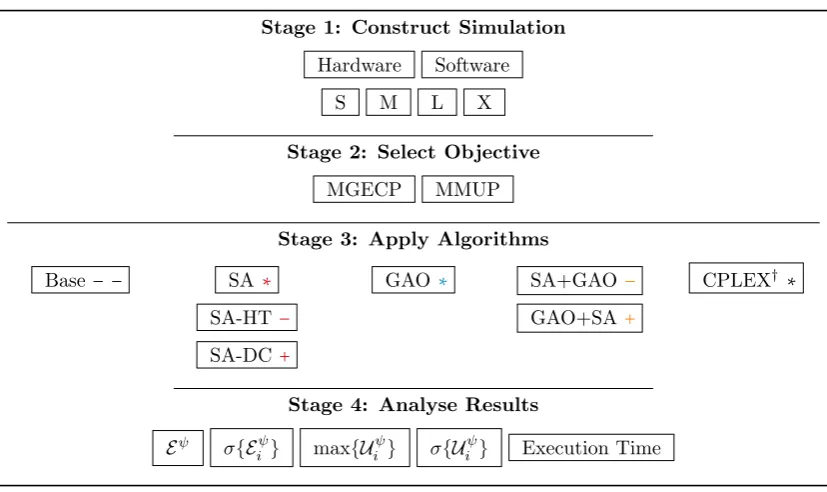
3.5.1 Simulation Structure . . . 33
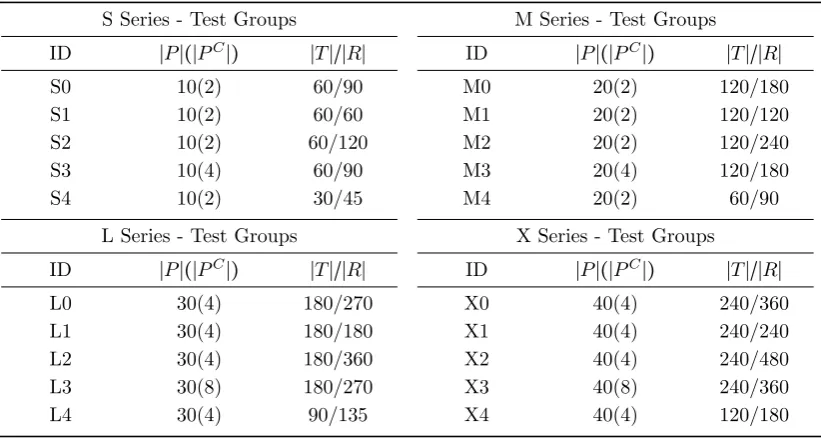
3.5.2 MCP Construction . . . 36
3.5.3 Results from Solving MGECP . . . 37
3.5.4 Results from Solving MMUP . . . 41
3.5.5 Comparing MGECP and MMUP . . . 42
4.1 Computation Offload with Cloudlets . . . 51
4.2 Offload Strategies for Mobile Workflows . . . 53
4.2.1 Preliminaries and Problem Definition . . . 53
4.2.2 Workflow-Oriented Greedy Autonomous Offload Algorithm . . . 58
4.2.3 Discussion of Variations and Optimisation of WGAO . . . 61
4.3 Simulations . . . 63
4.3.1 Communication Size and Network Connectivity . . . 64
4.3.2 Computation Size and Cloudlet Speed . . . 69
4.3.3 Energy Profile . . . 70
4.4 Summary . . . 71
5 Bandwidth Dependency and Allocation in Mobile Service-Oriented Networks 73 5.1 Mobile Service-Oriented Networks . . . 74
5.1.1 Example and Definition . . . 74
5.1.2 Service-Oriented Architecture . . . 76
5.1.3 Applications of MSON . . . 77
5.1.4 Mobile Device as Service Hosts . . . 77
5.2 Input-Output Analysis in Economics . . . 78
5.3 The Economy of Mobile Service-Oriented Networks . . . 79
5.3.1 Network I-O Model . . . 84
5.3.2 Network I-O Model with Latency . . . 86
5.4 Parametric Evaluation . . . 87
5.4.1 Effect of Service Arrival Rate . . . 88
5.4.2 Effect of Per Service Data Size . . . 89
5.4.3 Effect of Latency . . . 89
5.4.4 Alternative Allocation Scheme . . . 89
5.5 Cost-Based Bandwidth Allocation . . . 91
5.5.1 Problem Formulation . . . 91
5.6 Adaptive Bandwidth Allocation . . . 94
5.6.1 Problem Formulation . . . 94
5.6.2 Simulation . . . 96
5.7 Summary . . . 99
6 Rethinking the Offload Decision Models in Mobile Cloud Application Ecosys-tems 100 6.1 Mobile Cloud Application Ecosystems . . . 101
6.1.1 Problem Statement . . . 102
6.1.2 Objective and Contribution . . . 105
6.1.3 System Notations . . . 105
6.2 Offload with Symmetrically Incomplete Information . . . 107
6.3 Offload with Complete Information . . . 108
6.3.1 The Offload Game . . . 109
6.3.2 Mixed Strategies and Expected Costs . . . 109
6.3.3 Nash Equilibrium . . . 110
6.3.4 Social Cost and Price of Anarchy . . . 111
6.4 Cooperative Decision Model . . . 112
6.5 Simulations, Comparisons and Discussion . . . 114
6.5.1 Simulation Setup . . . 114
6.5.2 Strategy Behaviour of Non-Cooperative Applications . . . 116
6.5.3 Social Costs . . . 120
6.5.4 Price of Anarchy . . . 120
6.6 Summary . . . 129
7 Conclusions and Further Work 130 7.1 Energy-Aware Task Allocation . . . 131
7.2 Offloading Strategies for Time-Constrained Workflows . . . 132
7.3 Efficient Resource Allocation in Mobile Networks . . . 132
7.4 Application Ecosystem and Offload Competition . . . 133
A MGECP Simulation Results 148
B MMUP Simulation Results 154
List of Figures
1.1 Research structure. . . 7
2.1 Example use case of an MCC workflow: Business task interaction. . . 14
2.2 Example use case of an MCC workflow: 3D scan workflow. . . 15
2.3 Example use case of an MCC workflow: Darts game. . . 15
3.1 Illustration of a Mobile Cloud Platform. . . 19
3.2 Results from solving MGECP: Solution optimality from S0 and M0. . . 38
3.3 Results from solving MGECP: Solution optimality from L0 and X0. . . 39
3.4 Results from solving MGECP: Solution time from S0, M0, L0 and X0. . . 40
3.5 Results from solving MMUP: Solution optimality from S0 and M0. . . 44
3.6 Results from solving MMUP: Solution optimality from L0 and X0. . . 45
3.7 Results from solving MMUP: Solution time from S0, M0, L0 and X0. . . 46
3.8 Prime and by objective values from S0, M0, L0 and X0. . . 47
4.1 Example showing cloudlet and faster network connections improve battery life on mobile devices. . . 52
4.2 Offload expands the mapping into the Cloudlet space. . . 55
4.3 Effect of change in executable size and WiFi availability. . . 65
4.4 Offload savings when no WiFi is available. . . 67
4.5 Effect of change in communication data size and WiFi availability. . . 68
4.6 Effect of density of workload. . . 69
5.1 A simple example of a personal MSON. . . 75
5.2 The economy of an MSON. . . 80
5.3 Four types of service communication patterns. . . 82
5.4 Parametric evaluation of the Network I-O model. . . 90
5.5 Effect of reductions in utilisation threshold (ui). . . 93
5.6 Comparison of adaptive strategies. . . 98
6.1 A mobile cloud application ecosystem . . . 102
6.2 Application composition of a mobile cloud application ecosystem. . . 106
6.3 Results from S1, S1F and S2: Offload strategy behaviours of application with increasing weight, and the impact on social costs. . . 117
6.4 Results from S3 and S4: Offload strategy behaviours of application within increas-ing weight, and the impact on social costs. . . 119
6.5 Results from Y1, Y2 and Y3: ΘP−ΘOpt. . . 122
6.6 Results from Y1, Y2 and Y3: PoAP =ΘP ∶ΘOpt. . . 123
6.7 Results from Y1, Y2 and Y3: ΘB−ΘOpt. . . 124
6.8 Results from Y1, Y2 and Y3: PoAB=ΘB∶ΘOpt. . . 125
6.9 Results from Y1, Y2 and Y3: Social costs. . . 126
List of Tables
1.1 Development of mainstream mobile devices . . . 2
3.1 Simulation structure . . . 34
3.2 Simulation series specific parameters . . . 35
6.1 An example showning the effect of different offload decisions . . . 104
6.2 Simulation parameters . . . 115
A.1 Comparison of algorithms for MGECP - S series - Solution optimality . . . 149
A.2 Comparison of algorithms for MGECP - M series - Solution optimality . . . 150
A.3 Comparison of algorithms for MGECP - L series - Solution optimality . . . 151
A.4 Comparison of algorithms for MGECP - X series - Solution optimality . . . 152
A.5 Comparison of algorithms for MGECP - Solution time . . . 153
B.1 Comparison of algorithms for MMUP - S series - Solution optimality . . . 155
B.2 Comparison of algorithms for MMUP - M series - Solution optimality . . . 156
B.3 Comparison of algorithms for MMUP - L series - Solution optimality . . . 157
B.4 Comparison of algorithms for MMUP - L series - Solution optimality . . . 158
Introduction
Technologies that were once thought to be futuristic like self-driving vehicles and wearable digital assistants are fast becoming a reality with the proliferation of mobile smart devices. Indeed,
mobile computing is radically changing the way applications are delivered. From traditional
office productivity applications like word processors and spreadsheet, to emerging smart mobile
applications like personal AI assistants embedded in smart vehicles [13] and large-scale urban
sensing projects [14], mobile smart devices and services are at the centre of interest for application
developments.
Despite the rapid development of mobile computing technologies, mobile applications are
constrained by many limiting factors including battery power, storage space and CPU speed. To
overcome these issues, researches turn to cloud computing which has an abundance of computing
and storage resources accessible in forms of services that are scalable and easy to integrate. Facilitating the intelligent, seamless and adaptive integration of the two platforms in this joint
1.1 Mobile, Cloud, Cloud via Mobile and Mobile Cloud Computing
1.1
Mobile, Cloud, Cloud via Mobile and Mobile Cloud
Computing
Mobilesmart devices are becoming the platform of choice for both enterprise and personal
com-puting needs. It was predicted that mobile application development projects would outnumber
desktop projects by a ratio of 4:1 by the end of 2015 [15]. Indeed, in recent years the mobile platform’s ability to enable ubiquitous access to services on the move has broadened the usability
of many social and entertainment media and created great successes.
With the convenience provided by the compactness of mobile devices come many limitations
to its hardware, especially its battery size. In comparison to other components, the pace of
devel-opment in improving the energy density of smartphone batteries has been slow. In Table 1.1, we
list the component specifications of several mainstream smartphones from their first generation
to the latest. We see that battery size has not improved in the same order of magnitude as the
other components. Furthermore, improvements made at a hardware level have often been taken
up by extended software functionalities [16, 17]. Therefore, energy-awareness is crucial for all
mobile-related developments.
This energy-awareness also limits the processor’s performance on mobile devices. To prevent
over-heating and reduce energy consumption, mobile CPUs are considerably less powerful than
their desktop counter parts of the same frequency.
In contrast,Cloudcomputing has a resource rich infrastructure. Implemented over networks
of servers and data centres, computing power and storage space on a cloud seem “limitless” when
compared with their counter parts on mobile devices. What lacks in cloud computing is its
ac-cessibility to the end user. These characteristics make cloud computing a perfect complementary
Table 1.1: Development of mainstream mobile devices
OS Name Year CPU Memory Display Network App Store Battery
iOS iPhone 1 2007 412MHz 128MB 320×480 2G 500 1400mAh
iOS iPhone 6 2014 Dual 1.4GHz 1GB 750×1334 4G 1.2million 1810mAh
Android nexus 1 2010 1GHz 512MB 480×800 3G 30k 1400mAh
technology to overcome the disadvantages of mobile computing.
Mobile application developer has long adopted cloud services as the back end of mobile
applications. In this development paradigm, mobile devices act as an interface to the cloud
services which implements the actual logic of the mobile application and holds its database.
ThisCloud via Mobile approach simply defines a client-server structure between mobile and
cloud. We further distinguish a mobile application with a cloud back end and a mobile cloud
application as we discuss in this thesis in Section 6.1.
As opposed to native mobile applications, applications with a cloud back end are able to take advantage of the richness of cloud services, and are often more feature-rich. For example, user
data can be synchronised and shared across all devices registered to a user; more sophisticated
algorithms can be applied without concern over energy consumption; sensor data recorded on
mobile devices can be used to customise user experience of cloud services.
However, with this client-server structure and its dependency of a wireless connection come
new challenges:
1. In a client-server structure, mobile devices rely on wireless data links to communicate
with cloud services. Due to the high mobility of mobile devices, wireless data links have
fluctuating capacities which greatly affects service QoS.
2. Compared to local computation, wireless communication is associated with higher energy
costs. Constant communication with the server quickly drains the battery of mobile devices.
3. Applications of a client-server structure are only available when data link to the server is
established. The application does not function locally on device. The user can not use the
application unless a wireless data connection is established to the server.
4. The local computation capability of mobile devices has dramatically improved in recent
years (Table 1.1). The energy efficiency of these components has also improved. These
local computation resources are not fully utilised in a client-server structure.
5. When a group of mobile devices are to cooperate on a workflow, their communication has
1.2 Mobile Cloud Workflow
these devices are of close geographical proximity to each other, this centralised network
topology also dictates a higher energy cost than that of a local ad hoc network.
Researches in Mobile Cloud Computing aim to address these issues in addition to the
limited energy, storage and processing capacities of mobile computing. As we discuss in this
the-sis, mobile cloud computing extends the integration of cloud and mobile computing further from
the client-server architecture and covers a broad spectrum of networking architectures. Mobile
cloud computing is more than making cloud services accessible through mobile devices. With techniques like computation and storage offloading (Section 2.1.1), an intelligent and seamless
integration of mobile and cloud computing is envisioned in the research of mobile cloud
comput-ing.
We give a more detailed overview of mobile cloud computing, its key techniques like
compu-tation offloading and its research challenges in Chapter 2.
1.2
Mobile Cloud Workflow
Mobile computing and cloud computing are two of the most influential technologies that look set
to change the face of computing in the coming years. Combination of the two provides us with
an unprecedented opportunity to provide highly portable and yet content-rich and
computation-intensive applications to the end user.
With the rapid development of the smartphone and tablet market comes a new generation of
handheld devices equipped with faster processors, bigger memories and higher quality displays that have not been seen before in the mobile world. With this improved hardware capability,
sophisticated, intelligent and mission-critical processes are being adapted from desktop computers
to mobile devices. We also expect to see novel applications utilising the unique features of the
devices developed for the mobile world. A workflow is the abstraction of the processes involved
in the execution of an application.
A mobile workflow, as discussed in this thesis, consists of a sequence of interactive
compo-nents1 that are deployed over a network of distributed mobile devices and cloud servers. In [18],
1In this thesis, the workload of one such component is referred to as a “task” in the context of a workflow.
two scenarios are used to demonstrate how a mass of mobile devices, each used as a rich sensor,
organised in a cooperative mobile workflow, can be used to solve real-life problems that could
not have been solved by traditional methods. In the first scenario, photos taken on smartphones
within a two miles perimeter at a crowded location are gathered to locate a missing child. In the
second scenario, photos taken on smartphones in a disaster-stricken area are used to construct
detailed maps in aid of rescuing efforts.
Indeed, with the ability to collect rich sensor data and process data at anywhere and at
anytime, applications deployed over a network of mobile devices provide the user with much more flexibility than the traditional desktop-based work environments.
To oversee and schedule the execution of mobile cloud workflows, a mobile workflow engine
plays an essential part in the development of mobile cloud workflows. The development of a
mobile workflow engines as shown in [19, 20, 21] suggests that an organisation is able to rely
on the computing and connectivity capabilities within the mobile devices as a substitute to a
technology back end server infrastructure.
The main logics and algorithms we discuss in this thesis reside on a workflow engine. We give
further description and use cases of mobile cloud workflows and workflow engines in Section 2.2.1.
1.3
Outline of Research Contributions
Workload offload [22, 23, 24, 25] is a key technique applied in mobile cloud computing. Aimed at
reducing the energy costs of mobile devices, its principle approach is to reduce the computation
workload on mobile devices by offloading it to the cloud. Most existing researches are constrained within a one-to-one model in which offloading is carried out between a single device and a single
cloud.
In this thesis, we extend the existing research framework of mobile cloud computing and
investigate the issues embedded in the many-to-many model of mobile cloud computing which
underlies the future developments of the platform.
First, from the platform’s perspective, a quadratic program is constructed first to model the
energy-aware task allocation problem of a mobile cloud platform. Two energy objectives are
1.4 Thesis Organisation
platform respectively. Two heuristic algorithms are proposed to approximate the solution to
both objectives.
Second, from a workflow’s perspective, time constraints are considered as well as energy
constraints in developing offload strategies. A heuristic algorithm are proposed to produce offload
strategies that satisfies both constraints. Effect of hardware and software characteristics over
the offload-ability of the workflow are demonstrated.
Third, in order to address the need for efficient resource allocation in mobile networks, a
novel network I-O model is proposed to model the bandwidth dependencies between interactive services of a mobile network. The network I-O model lays the foundation for further objective
developments. Based on the network I-O model, a cost-based bandwidth allocation scheme is
proposed, and models for adaptive bandwidth allocation strategies are also constructed.
Lastly, to address the competition between applications that share the same device, an
exten-sion to the classic load balancing game is developed. Three offload deciexten-sion models of cooperative
and non-cooperative nature were constructed. Mixed-strategy Nash equilibrium is derived for
the non-cooperative offload game with complete information which further quantifies the price
of anarchy in such ecosystems.
More detailed summaries of our contributions are given at the end of Chapter 3, Chapter 4, Chapter 5 and Chapter 6.
1.4
Thesis Organisation
This chapter provided a brief overview of the motivations of the research of mobile cloud comput-ing and mobile workflows. It is important to distcomput-inguish and understand the relations between
mobile cloud computing and the cloud-based mobile application development paradigm as we
discussed at the beginning of this chapter.
In the next chapter, we give description of the mobile cloud computing architecture, and
mo-tivating applications of the mobile cloud platform. Computation workload offloading techniques
which is the key feature of mobile cloud computing and the basis for the development of our
efficient frameworks are discussed further in Section 2.1.1.
Multiple Workflows
Multiple
Devices
Single
Device
Single Workflow
Chapter 3
Chapter 6
Chapter 4
Existing Work Chapter 5
Figure 1.1: Research structure.
computing platform from a different perspective. One way to understand the relations between
these chapters is by the number of workflows and the number of devices considered in the scenario
which is concerned with in that chapter as illustrated in Fig. 1.1.
From Fig. 1.1, we see that we start this thesis in Chapter 3 which extends existing work
from energy-aware offloading between single workflow on a single device to that of multiple
workflows on multiple devices. Then in Chapter 4, we take into account the time constraint that is
associated with individual workflows and develop offload strategies accordingly. In Chapter 5, we
develop a network I-O model to describe the bandwidth dependencies of general mobile networks
as a foundation for further efficient bandwidth allocation schemes. Lastly in Chapter 6, we focus
on the competition between mobile cloud applications on a single device which give further
Chapter 2
Mobile Cloud Computing
This chapter gives description of the research topic of mobile cloud computing. We define the scope of the platform as we discuss in this thesis and its architecture. We focus on existing
imple-mentations which enable the computation workload offloading ability of mobile cloud computing
platforms. Motivating scenarios and applications of mobile cloud computing are illustrated
fol-lowed by a discussion of the advantages and disadvantages of the platform.
2.1
Architectures and Components of Mobile Cloud
Com-puting
Mobile cloud computing is an emerging field of research that aims to provide a platform on
which intelligent and feature-rich applications are delivered to the user’s fingertips efficiently.
This efficiency comes from the adaptive offload ability of mobile cloud applications which is key
to the seamless integration of mobile devices and cloud servers. Pioneered by the likes of MAUI
[22], CloneCloud [23] and ThinkAir [26], adaptive computation offload as a core technology in
mobile cloud computing has gathered momentum in recent years and has grown from a futuristic concept to a practical means to improve and augment the user’s experience of mobile applications.
In this thesis we give two illustrations of the architecture of mobile cloud computing, in Fig. 3.1
a mobile cloud platform and a change in task allocation, Fig. 4.1 adds an extra layer of cloud
computing resources referred to as cloudlets (Section 4.1) into the mobile cloud computing
picture and illustrate the benefit of computation offloading with cloudlets in the field.
Commonly applied to enable access to cloud resources a service-oriented architecture (SOA)
is also observed in a mobile cloud platform. We give further description of SOA in Section 5.1.2
and related researches that use mobile devices as service hosts in Section 5.1.4. In the rest of this
section, we focus on the techniques that enables computation offloading and researches related
to the development of mobile workflow engines which are most relevant to all technical chapters of this thesis.
2.1.1
Enabling Mobile Computation Offload
The integration of mobile and cloud computing promises the user with convenient access to
powerful applications at any time and at any where. The research of computation offload plays
an essential part in this vision and ensures that this integration process is both seamless and energy-efficient.
The idea of transferring computation to a nearby processing unit in order to improve mobile
application’s performance and reduce local energy cost has been researched along with the
ma-turity of mobile technologies. Many ideas and techniques we use in this paper are inspired by
this work.
Early research focuses on the partition schemes of an application. Aimed at energy
manage-ment, a compile-time framework supporting remote task execution was first introduced in [27].
Based on the same approach, a more detailed cost graph was used in [28] with a parametric
analysis on its effect at runtime presented in [29]. Another compiler-assisted approach was intro-duced in [30], which turns the focus to reducing the application’s overall execution time. Spectra
[31] adds application fidelity (a run-time QoS measurement) into the decision making process
and uses it to leverage execution time and energy usage in its utility function. Spectra monitors
the hardware environment at run-time and choose between programmer pre-defined execution
plans. Chroma [32] builds on Spectra but constructs the utility function externally in a more
2.1 Architectures and Components of Mobile Cloud Computing
of the partitioning process models. The offload decision engine applies an integer programming
techniques to produce allocation schemes.
Before Cloud, opportunistic use of surrogates (untrusted machines) was adopted in [33] and
[34]. Slingshot [34] also identifies wireless hotspots as a platform to accommodate the virtual
machine capsule. As Cloud Computing and Virtual Machine technologies become mainstream,
more researches turned to the Cloud in search of a more secure, accessible and powerful offload
platform. OS supported VM migration was introduced in CloneCloud [35]. Calling-the-cloud
[36] add a middleware platform that manages an application’s execution between the phone and the cloud. A consumption graph is used to model the application. Wishbone [37] looks at the
partitioning of sensor network applications in particular and models the decision making process
as a integer program. Aimed at reducing the communication costs [38] proposes the concept of
cloudlets, which brings the distant Cloud to the more commonly accessible WiFi hotspots. A
dynamic VM synthesis approach is also suggested in [38].
Our research is distinguishable to existing work since the applications that we investigate have
computation tasks scattered over a group of distributed mobile devices (i.e. a mobile workflow),
whereas existing researches look at applications that are implemented on one device only.
Besides existing research level implementations of mobile cloud applications (we recommend three excellent surveys, [39], [40] and [41], to the interested readers for a comprehensive list
of existing researches in mobile cloud computing), we argue that the increasing popularity of
HTML5 as a mobile application development framework also greatly shortens the time required
to develop applications that are deployable both natively on the mobile device and remotely as
cloud services. The use of HTML5 and platforms like Apache Cordova help significantly lower the
level of technical challenges involved in the development of mobile cloud applications. We expect
to see an increasing number of mobile applications to adopt the adaptive execution approach
proposed by the research of mobile cloud computing in the near future.
2.1.2
Mobile Workflow Engine
A workflow engine is often required to oversee the execution of mobile workflows. In [19] a
workflow coordination architecture designed for mobile devices is presented in [42] for use in
biological studies and the supply-chain industry. Authors of [20] propose a rapid application
development framework based on a dynamic workflow engine for creating mobile web services.
A Field Service application is presented in [20] as an example use case.
Several researches has been carried out in workflow management issues in mobile social
con-tent sharing applications [43, 44, 45, 46]. A mobile P2P social concon-tent sharing framework was
proposed in [44]. In [45], a Java API based mobile workflow system was proposed. A content
distribution protocol was proposed in [47] for vehicular ad hoc networks (VANET). Clusters of mobile devices has been proposed in [48] to support the execution of parallel applications. A
workflow engine is present in all these researches to oversee the scheduling of tasks.
The common approach towards an allocation problem often model the problem as a linear
programs (LP) [22, 49, 50] in the workflow engine. LPs are suitable for modelling situations
where communication time is not considered or when there are only two devices involved in
the process. However, in the cases of mobile workflows, communication tasks are an essential
part of the workload and occur significant amount of energy cost[51]. Thus we construct our
model’s objective function as a quadratic program in Chapter 3 in order to accurately capture
the communication costs.
2.2
Impact of Mobile Cloud Computing
2.2.1
Motivational Applications of Mobile Cloud Computing
Mobile cloud applications combine the accessibility, agility and the rich sensing ability of the
mobile computing platform with the abundance of services provided by the cloud computing
platform and is applicable in many fields of researches. [41]
Healthcare
Mobile medical treatment and health monitoring devices are constrained by its physical size just
like smartphones. mHealthMon [52] is a mobile health monitoring platform which adopts the
2.2 Impact of Mobile Cloud Computing
the process of continuously gather, process and update sensor readings for patients. In
mHealth-Mon, users publish and access sensor data via a cloud-based P2P overlay network. @HealthCloud
[53] proposes the implementation of a mobile system that enables electronic healthcare data
stor-age, update and retrieval utilising cloud services provided by Amazon S3 and an Android app.
Although computation offload is not applied in @HealthCloud, the system benefit greatly from
the cooperation of mobile and cloud computing.
Image and Video Processing
Cuckoo [24] implements a face detection over its offloading platform and is able to reduce the
energy cost as well as augment the features provided by the application. MAUI [22] is also
tested with a face detection application and significant energy savings has been make by
apply-ing computation offload. The two scenarios given in [18] as discussed in Section 1.2 are both
based on crowd-sourced imaging informations. GigaSight [54] is a scalable video crowd-sourcing
application which gathers video information from devices such as Google Glass. Privacy sensi-tive information is automatically removed from the video based on time, location and content
informations. Cloudlets are used to support the computation and storage offloading of GigaSight
and also achieve scalability.
Gaming
A video game and a chess game is tested by MAUI [22]. Although significant energy savings were made under good network conditions, significant savings in execution time has been made in the
video game application. In [55] an adaptive rendering technique is applied to maximise user
experience of cloud-based mobile gaming given constraints in communication and computation
in the wireless network.
2.2.2
Illustrative Use Cases of Mobile Workflows
A cloud-assisted mobile workflow as we discuss in this thesis is an application workflow that is implemented over a group of mobile devices with access to cloud resources. The cloud resources
role to handle computation offload requests sent from the mobile devices. Mobile application
workflows can be found when a group of mobile users are to share or communicate with each
other in order to accomplish a certain task. We give two example use cases of such workflows in
Fig. 2.1, Fig. 2.2 and Fig. 2.3 to further clarify our objective.
Enterprise use case: With increasing adaptation of mobile devices into enterprise business
models[15], modern enterprise applications often include or are entirely based on mobile devices.
Fig. 2.1 illustrates an application workflow involving three mobile devices and two cloud services
of a supply-chain business. Two employees are concerned with the receipt and sale of goods respectively. Both activities require an up to date pricing information at runtime. A manager is
concerned with the trends that are developing in the company’s inventory in real-time which is
produced via a series of tasks like forecast and analysis.
There are two types of tasks in this workflow: tasks like login, record sale and database
queries that are fixed either on a mobile device or a cloud node; and tasks like data analysis and
forecast that can be offloaded between devices and clouds. Depending on the computation size
and communication size of these offload-able tasks, an energy-aware allocation scheme can help
optimise the execution of the workflow in term of its overall energy cost imposed onto the mobile
cloud platform.
Consumer use case 1: Because of it portability, mobile devices encourages the development
of collaborative application. In Fig. 2.2, we illustrate the collaboration of three mobile devices
in scanning the 3D structure of an object. Pictures of the object is taken on all three devices at
the same time and once pre-processed, these pictures are gathered to construct the 3D model of
the object. Two cloud services are available to the users, one for storage and one for application
hosting and computation offloading.
Similar to the enterprise use case, the tasks involved in this mobile application workflow can
either be fixed or offload-able over the mobile cloud platform. Allocation of tasks is critical
in deciding the energy-footprint of the workflow. For instance, once the picture has been
pre-processed, the subsequent communication size may be reduced. Comparing this reduction to the computation cost of the pre-processing task on the mobile device, it may or may not be beneficial
for the device to offload this task to the cloud.
2.2 Impact of Mobile Cloud Computing
receipt
forecast
sale
display
trend login
analysis
Database Service
inventory database
Application Service
user database
pricing
Figure 2.1: Example use case of an MCC workflow: Business task interaction.
Solid circles represent tasks that are fixed on a device or a cloud service, whereas dashed circles represent tasks that are free to offload / migrate between devices and clouds. Allocation of
tasks significantly affects the energy-efficiency of the mobile cloud platforms.
running atop a platform of mobile and cloud devices. Our goal is to develop ways to produce
energy-aware task allocation schemes and provide an energy efficient execution platform for
cloud-assisted mobile workflows.
Consumer use case 2: Fig. 2.3 illustrates three smartphones and a tablet, and expands on
the idea of a popular consumer game application [56] that allows the user to use a smartphone
and a tablet to emulate the equipments used in a darts game. The tablet is used to display a
dart board, the smartphones are used by each participating player as their darts. The workflow
starts when a player throws a dart (by waving the phone towards the tablet). Sensor readings
(accelerometer and gyroscope) are then taken from the phone and fed into a calculation module
to work out where the dart should land on the board. Once the calculation is finished, the result
is then passed on to the display module of the tablet.
Like all multi-player competitions, the game can only function until its weakest player
with-draws, which in this case, is the device that runs out of battery first. The module for calculating the landing point might not cause too much energy to run each time, however, repeat execution
construct 3D model
take photo
take photo
take photo
pre-process photo
pre-process
photo
pre-process
photo view
model save
model
Application Service Storage Service
Figure 2.2: Example use case of an MCC workflow: 3D scan workflow.
sense
action
display
calculate
landing
point
sense
action
sense
action
Figure 2.3: Example use case of an MCC workflow: Darts game.
of energy more than the others over time. A fair task allocation, which we study in Section 3.3,
is needed in such scenarios to balance the contribution made by participating members of the workflow.
2.2.3
Advantages and Issues of Mobile Cloud Computing
As a combination of mobile and cloud computing, mobile cloud computing combines the
ad-vantages of both platforms including convenient access to services at anywhere and at any time
2.2 Impact of Mobile Cloud Computing
• Access to applications at anywhere and any time
• Greater computation power to implement sophisticated applications
• Bigger, more reliable and synchronised storage space
• On demand scalability of cloud services
• Reduced battery consumption
However, because of use of a wireless connection that is both energy-consuming, unstable
and limited in capacity, there are open issues that need to be addressed in order to maximise
the benefit of the mobile cloud platform.
Energy-Awareness Wireless communication is expensive in energy costs. The wireless
radio unit is the most energy-consuming component in smart devices[51, 57]. Therefore task
allocation and offloading actions which changes the communication costs of the workflow
need to be managed in an energy-efficient manner. We address these issues by developing
energy-aware task allocation and offload strategies in Chapter 3 and Chapter 4.
Network Capacity, Reliability and Cost Bandwidth is a valuable asset on all types of
mobile networks and limits the offload-ability and efficiency of mobile workflows. Therefore
knowing the bandwidth dependency between interacting mobile services is key to the resource
management aspect of mobile cloud computing. Furthermore, the reliability issue related to
the wireless network requires adaptive strategies to accommodate changes in network
con-ditions. Wireless connections can be expensive and therefore the provisioning of bandwidth need to be cost effective. We address these issues by constructing a network I-O model in
Chapter 5.
Competition On Device Mobile devices are crowded with applications and services of
dif-ferent purposes. Many require the access to cloud resources. The unawareness of information
of other applications and the selfish behaviour exhibited by application put the system as a
whole in a sub-optimal position, We address this issue by constructing a game theoretical
framework to model the offload decision models in a mobile cloud platform and also propose
Energy-Aware Task Allocation in
Mobile Cloud Platforms
Improvement in mobile applications’ energy efficiency is one of the principle motivations behind
the development of mobile cloud computing technologies. This improvement is facilitated by the
computation offloading capability provided by mobile cloud platforms. Relocating offload-able
tasks in an application’s workflow from one host to another modifies the energy profile of the
platform. Therefore, solving the task allocation problem becomes a critical first step in ensuring
the energy efficiency of the mobile cloud platform. The optimality of task allocation schemes is
a fundamental issue which greatly affects the energy efficiency of application workflows running
atop a mobile cloud computing platform.
In this chapter, we investigate the energy-aware task allocation problem in a mobile cloud
platform with two distinctive objectives. For our first objective, which we refer to as the Minimum
Group Energy Cost Problem (MGECP), we aim to minimise the overall energy cost of the
platform. We construct a quadratic program to model the MGECP. Using the quadratic objective
function as constraints, we further developed a quadratically constrained program to model our
second objective which we refer to as the Minimum Maximum Utilisation Problem (MMUP). In
the MMUP, we aim to distribute the tasks fairly while taking into account the size of the residual
3.1 Mobile Cloud Platform Model
In a cloud-assisted mobile application workflow, energy is spent on both executing the
com-putation of tasks and the communications between tasks. Therefore, quadratic objectives and
constraints are inevitable in modelling the allocation problem in such scenarios. This increases
the complexity of finding the exact solution to our problems. To approximate the optimal
solu-tion, we developed two heuristics including an implementation of the simulated annealing (SA)
algorithm and a greedy autonomous offload (GAO) algorithm.
The solution optimality and execution time cost of our heuristics are compared to that of
the QP and QCP solver libraries of CPLEX [58] version 12.6.1, an industry-leading optimisation software package, herein through the analysis of a series of simulation results. We also investigate
and report on the relations between MGECP and MMUP based on simulation results.
3.1
Mobile Cloud Platform Model
3.1.1
Mobile, Cloud and Network Metrics
We consider a mobile cloud platform MCP consisting of a set of p processing nodes, denoted
P= {P1,⋯, Pp}. Each processing node may either be amobile devicenode from setPM ⊆P or a
cloud resourcenode from setPC⊆P, withPM∩PC= ∅andPM∪PC=P. We denote a mobile device node profile asPiM(si, ecmpi , esndi , ercvi , emnti ), i∈ {1, . . . ,∣PM∣} and a cloud resource node
profile asPC
i (si)1,i∈ {1, . . . ,∣PC∣}with parameters defined as follows:
si, denotes the peak processing speed of Pi ∈ P, measured in the number of clock cycles
available in a millisecond;
ecmpi , denotes the current draw from the battery ofPM
i ∈PM when the device is executing
computation tasks at peak speed;
esndi /rcv, denotes the current draw from the battery of PiM ∈PM when the device is
send-ing/receiving data to/from the data network.
1Although we don’t associate any particular energy metrics for a cloud processor, the notation ofesnd/rcv/mnt i
is applied in the rest of this chapter even wheni∈PC in order to keep the notations easy to follow. The reader
P
C
P
M
Public Cloud Enterprise Cloud
- constrained tasks - re-locatable tasks
- change in allocation
Authentication Service Database Service
- workflow engine
Figure 3.1: Illustration of a Mobile Cloud Platform.
emnt
i , denotes the current draw from the battery ofP
M
i ∈PM when the device is maintaining
the wireless connection alive to anticipate transmission of data.
All nodes (Pi ∈P) are interconnected via a network (as illustrated in Fig. 3.1 with solid lines
being wired connections and dotted being wireless connections), and we use bij to denote the
bandwidth between devicesPi andPj,i, j∈ {1,2, . . . , p}. Thus, we have p-matricesB= (bij)p×p
and L = (lij)p×p which hold all of the bandwidth and latency information of the underlying
network of the MCP. When two adjacent tasks are assigned to the same device, we assume that
they share the same memory address space on the device. Therefore, we assign positive infinite
values to the principal diagonal elements ofB, that isbii= +∞, i∈ {1,2, . . . , p}, and zeros to the
principal diagonal elements ofL, that islii=0, i∈ {1,2, . . . , p}.
Our choice of energy profile parameters is in line with researches that investigate the energy
characteristics of mobile devices and wireless networks [51, 59, 60, 61, 62, 63, 64] especially for
the wireless module. We especially emphasis the difference in energy consumption between the
sender and the receiver of the data, and that it cost energy to maintain a live connection in
anticipation of data transmission. We refer the interested reader to [57] for a comprehensive
survey in energy consumption models and techniques of modern mobile devices.
3.1.2
Application Workflow Metrics
The tasks of application workflows hosted on MCP and their interactions are represented by
3.1 Mobile Cloud Platform Model
workflows. The ordering of the tasks are defined as the topological order given by W. We
assume that all tasks are defined via a service-oriented architecture (SOA) and that services
may be available on more than one device. An n-matrix D = (dab)n×n denotes the weighted
adjacency matrix ofW, wheredabis the size of the data package that is to be sent fromta totb
for(ta, tb) ∈R. All principle diagonal elements ofD are zeros.
Each task has profileta(d(.a), d(a.), ca),a∈ {1, . . . n}whered(.a)andd(a.)are thea-th column
and thea-th row ofD which represent the incoming and outgoing data respectively. ca denotes
the workload size of the task.
3.1.3
Fixed and Constrained Tasks
Not all tasks of a mobile workflow are suitable for offload from its host. For instance, a task
that authenticates the user’s identity using the fingerprint reader on the smartphone has to
be executed on the smartphone; a task that manages database files saved on a cloud-storage
service has to run locally on that cloud; a task which senses the user’s heartbeat resides on the smart-watch, etc. These tasks aref ixedon their hosts.
Furthermore, there may be tasks that are only allowed to be executed on a subset of the
devices from P. For instance, when a task is associated with sensitive data shared between a
group of users, or when the OS of each device varies in versions such that the execution of certain
tasks are not supported by all ofP. The allocations of these tasks areconstrainedwithin a group
of devices.
We denote the set of devices that a taskta may execute on withPta. For a fixed task, Pta
has a cardinality of one and contains only its host. For a constrained task, Pta includes only
devices on whichta is installed. For a task which is not at all constrained, Pta=P.
3.1.4
Allocation Scheme and Energy Costs
Given an allocation schemeψ∶T →P, we first derive the energy cost of computingta, a∈ {1, . . . n}
to be
Ecmp aψ(a)=e
cmp ψ(a)×
ca
sψ(a)
whereψ(a)is the device to whichtais assigned. Secondly, we have the energy cost of transferring
dab,(ta, tb) ∈Ras given by
Etran
abψ(a)ψ(b)=esndψ(a)×
dab
bψ(a)ψ(b) +
emntψ(a)lab
´¹¹¹¹¹¹¹¹¹¹¹¹¹¹¹¹¹¹¹¹¹¹¹¹¹¹¹¹¹¹¹¹¹¹¹¹¹¹¹¹¹¹¹¹¹¹¹¹¹¹¹¹¹¹¹¹¹¹¹¹¹¹¹¹¹¹¹¹¹¹¹¹¹¹¹¹¹¹¹¹¹¹¹¹¹¸¹¹¹¹¹¹¹¹¹¹¹¹¹¹¹¹¹¹¹¹¹¹¹¹¹¹¹¹¹¹¹¹¹¹¹¹¹¹¹¹¹¹¹¹¹¹¹¹¹¹¹¹¹¹¹¹¹¹¹¹¹¹¹¹¹¹¹¹¹¹¹¹¹¹¹¹¹¹¹¹¹¹¹¹¹
sender’s cost
+ercvψ(b)×
dab
bψ(a)ψ(b) +
emntψ(b)lab
´¹¹¹¹¹¹¹¹¹¹¹¹¹¹¹¹¹¹¹¹¹¹¹¹¹¹¹¹¹¹¹¹¹¹¹¹¹¹¹¹¹¹¹¹¹¹¹¹¹¹¹¹¹¹¹¹¹¹¹¹¹¹¹¹¹¹¹¹¹¹¹¹¹¹¹¹¹¹¹¹¹¹¹¹¸¹¹¹¹¹¹¹¹¹¹¹¹¹¹¹¹¹¹¹¹¹¹¹¹¹¹¹¹¹¹¹¹¹¹¹¹¹¹¹¹¹¹¹¹¹¹¹¹¹¹¹¹¹¹¹¹¹¹¹¹¹¹¹¹¹¹¹¹¹¹¹¹¹¹¹¹¹¹¹¹¹¹¹
receiver’s cost
(3.2)
(3.2) accounts the data transmission cost from both the sender device and the receiver device of the data. Modern wirelss transmission components on a mobile device such as WiFi and cellular
3G and 4G modules apply a third power state to intermediate the off and transmit power states.
This power state is often referred to as the “idle” power state in related researches such as
[63, 64, 65, 66]. We refer to this power state as the “maintenance” cost of the data link, denoted
byemnt
i with i∈ {1, . . . ,∣PM∣}. In this power state, a device is ready to transmit or receive but
because of the latency between the devices, the actual transmition or receiving action has yet to
happen, therefore the higher power states (esndi andercvi ) do not yet apply.
3.2
Minimum Group Energy Cost Problem
In this section, our objective is to minimise the energy cost of the MCP as a whole. We first
show that the Minimum Group Energy Cost Problem (MGECP) can be modelled as a generalised
Quadratic Assignment Problem (QAP) [67] and then we convexify the objective function in order
to obtain the optimal solution using a QP solver.
3.2.1
Assignment Matrix
To represent an allocation scheme ψ, we first construct ann×pbinary matrixXψ= (xψ ai)n×p,
such that
xψai=⎧⎪⎪⎪⎪⎪⎨
⎪⎪⎪⎪⎪ ⎩
1 ifψ(a) =i, ta∈T, Pi∈P
0 otherwise.
3.2 Minimum Group Energy Cost Problem
We call matrix Xψ an assignment matrix and a valid assignment must satisfy the following
constraints
∑ Pi∈Pta
xψai=1, a=1,2, . . . , n, (3.4)
xψai∈ {0,1}, a=1,2, . . . , n, i=1,2, . . . , p. (3.5)
(3.4) ensures that every task must be assigned to one and only one device within the group of
devices which it is able to execute. (3.5) states that all tasks are indivisible.
3.2.2
Quadratic Program Formulation
With (3.1) (3.2) and (3.3), we can derive the group energy cost function as
Eψ=∑n b=1
p ∑ j=1
n ∑ a=1
p ∑ i=1
((esndi +ercvj )
dab
bij + (
emnti +emntj )lab)xψaixψbj
+∑n a=1
p ∑ i=1
ecmpi ca
si
xψai (3.6)
The quadratic terms in (3.6) gives the total energy cost for data transmission, whereas the
linear term gives the total energy cost for executing computing tasks. Next we introduce (pn)2
coefficientsqaibj as given by
qaibj∶=
⎧⎪⎪⎪⎪ ⎪⎪⎪⎪⎪ ⎪⎪⎪⎪⎪ ⎪⎨ ⎪⎪⎪⎪⎪ ⎪⎪⎪⎪⎪ ⎪⎪⎪⎪⎪ ⎩
ecmpi ca
si + (
esndi +ercvj )
dab
bij + (
emnti +emntj )lab
´¹¹¹¹¹¹¹¹¹¹¹¹¹¹¹¹¹¹¹¹¹¹¹¹¹¹¹¹¹¹¹¹¹¹¹¹¹¹¹¹¹¹¹¹¹¹¹¹¹¹¹¹¹¹¹¹¹¹¹¹¹¹¹¹¹¹¹¹¹¹¹¹¹¹¹¹¹¹¹¹¹¹¹¹¹¹¹¹¹¹¹¹¹¹¹¹¹¹¹¹¹¹¹¹¹¹¹¹¹¹¹¹¹¹¹¹¹¸¹¹¹¹¹¹¹¹¹¹¹¹¹¹¹¹¹¹¹¹¹¹¹¹¹¹¹¹¹¹¹¹¹¹¹¹¹¹¹¹¹¹¹¹¹¹¹¹¹¹¹¹¹¹¹¹¹¹¹¹¹¹¹¹¹¹¹¹¹¹¹¹¹¹¹¹¹¹¹¹¹¹¹¹¹¹¹¹¹¹¹¹¹¹¹¹¹¹¹¹¹¹¹¹¹¹¹¹¹¹¹¹¹¹¹¹
=0
if(a, i) = (b, j),
esndi
dab
bij +
emnti lab a < b,
ercv
j
dba
bij +
emnt
j lab a > b.
(3.7)
With (3.7) we can transform (3.6) to
minimise: Eψ=
n ∑ b=1
p ∑ j=1
n ∑ a=1
p ∑ i=1
qaibjxψaix
ψ
bj (3.8)
Theorem 3.2.1. Let coefficientsqaibj be the entries of an pn×pn matrix Q, such thatqaibj is
on row (i−1)n+aand column(j−1)n+b, andvec(Xψ) = (xψ
11, x
ψ
12, . . . , x
ψ
1n, x ψ
21, . . . , xψpn)
T
be
the vector formed from the columns ofXψ.
Equivalent formulations for the MGECP objective function are given by (3.8)and
minimise: Eψ=vec(Xψ)T ⋅Q⋅vec(Xψ) (3.9)
Proof. From the construction of vec(X), we observe that its u-th element vec(Xψ)u = xψai ⇔
u= (i−1)n+a. Furthermore, givenu= (i−1)n+aandv= (j−1)n+b,u, v∈ {1,2, . . . , pn}, we
also getQuv=qaibj. Hence,
(3.9)=
pn ∑ v=1
pn ∑ u=1
vec(Xψ)TuQuvvec(Xψ)v=
n ∑ b=1
p ∑ j=1
n ∑ a=1
p ∑ i=1
xψaiqaibjxψbj=(3.8)
Therefore (3.9) constrained by (3.4) and (3.5) completes our quadratic program formulation
for the MGECP. The assignment matrix for the MGECP is given by
arg min
Xψ (E
ψ)
(3.10)
3.2.3
Convexification
With the quadratic program formulated, we can find its exact optimal solution using QP solvers.
In order to exploit the power of modern QP solvers, we first need to pre-process the problem
and convexify the objective function [68]. There are a number of ways of convexification. Our
process is similar to that use in [69].
Theorem 3.2.2. Let Q∗ ∶=1/2(Q+QT) +αI, where I is the pn×pn identity matrix, then Q∗
is positive definite if scalarα=1+ ∥Q∥∞
Proof. We observe thatQ∗ preserve the properties of being a square, non-negative matrix from
3.3 Minimum Max-Utilisation Problem
Therefore we have
xTQ∗x=
mn ∑ u=1
quu∗ x2u+2
mn−1
∑ u=1
mn ∑ v=u+1
q∗uvxuxv (3.11)
=mn∑ u=1
⎛ ⎜ ⎝q ∗ uu− mn ∑ v=1
v≠u
q∗uv
⎞ ⎟ ⎠x
2
u+ mn−1
∑ u=1
mn ∑ v=u+1
q∗uv(xu+xv)2
=mn∑ u=1
⎛ ⎜
⎝quu+α− mn ∑ v=1
v≠u
quv∗
⎞ ⎟ ⎠x
2
u+ mn−1
∑ u=1
mn ∑ v=u+1
quv∗ (xu+xv)2
=mn∑ u=1(
2quu+α− mn ∑ v=1
quv)x2u+
mn−1
∑ u=1
mn ∑ v=u+1
quv(xu+xv)2
≥mn∑ u=1
⎛ ⎜⎜ ⎜⎜ ⎜⎜ ⎝
2quu+α− mn ∑ v=1
quv ´¹¹¹¹¹¹¹¹¹¹¹¹¹¹¹¹¹¹¹¹¹¸¹¹¹¹¹¹¹¹¹¹¹¹¹¹¹¹¹¹¹¹¹¶ ≥1 ⎞ ⎟⎟ ⎟⎟ ⎟⎟ ⎠
x2u
Hence xTQ∗x > 0 for any x ≠ 0 and the proof is complete. Similar formulation was first
introduced in [69] to construct a negative definite matrix.
Addition of a constant on the main diagonal of Qonly adds a constant to the value of (3.9)
and does not change its optimal solution to (3.10). Hence we can rewrite our objective function
as
minimise: vec(X)TQ∗vec(X) (3.12)
This together with (3.4) and (3.5) completes the formulation of the QP solvable optimisation
problem of the MGECP. The positive definite property ofQ∗ensures that (3.12) is strictly convex
and a global minimum can be found by existing QP solvers.
3.3
Minimum Max-Utilisation Problem
While solutions generated by the MGECP ensures that the application workflows running atop
the MCP consumes minimum amount of energy from the mobile devices as a collection, it does not
consider the stress it has on individual devices. This could result in unfair energy cost distribution
time without adjustment to its task allocation scheme could lead to early retirements of
over-utilised devices from the MCP. In a business environment, it is common to have authorisation
constrained services or tasks taking critical roles within workflows. In such cases, the MCP’s
inclusion of these authorised devices is critical to the fulfilment of the application workflow’s
functionalities. Retirement or withdrawal of devices which support this set of critical tasks could
lead to the retirement of the entire workflow. This leads to the shift in the workflow engine’s
priority from reducing the total energy cost of the group to ensuring the availability of individual
devices.
Hence in this section, we look at ways to adjust the task allocation provided by the MGECP
so that the availability period (or the number of run counts) of a workflow can be lengthened.
We refer to this class of problem as the Minimum Max-Utilisation Problem (MMUP).
3.3.1
Device Cost Matrix
Unlike the MGECP, we need to add additional constraint to individual devices’ energy cost in order to control the outcome of the adjustment action. In order to formulate these constraints,
we first introduce the device specific cost matrixQi:
Theorem 3.3.1. Let
Qiuv=
⎧⎪⎪⎪⎪ ⎪⎨ ⎪⎪⎪⎪⎪ ⎩
Quv if n× (i−1) <u≤n×i,
0 otherwise.
(3.13)
fori∈ {1, . . . ,∣PM∣}. Then given an allocation scheme ψand its allocation matrix Xψ, we have
the energy cost of Mi to be
Eψ
i =vec(X ψ)T
Qivec(Xψ) (3.14)
Proof. Proof is similar to the proof of Theorem 3.2.1 and can be worked out easily.
3.3.2
Device Utilisation
3.3 Minimum Max-Utilisation Problem
Definition 1. Given an allocation schemeψ, theutilisation ofMi, denotedUiψ, equalsE
ψ i /EiR,
forPi∈PM, whereEiψ is the energy cost ofPi underψandEiR is the size of the residual energy
ofPi.
It is easy to see that the reciprocal of a device’s utilisation, (1/Uiψ), is the number of times
PiM can support the workflow before it runs out of battery. The wholeness of the workflow is
limited to the device which can afford the least number of runs. This implies that the availability
period of a workflow is hence constrained by the member with the highest value of utilisation. Redistribution of workload from over-utilised devices to under-utilised devices can help reduce
Ei and thus lengthen the workflow’s availability prospect.
By definition, another aspect that determines a device’s utilisation value is its residual battery
valueER
i . Because the resources on most mobile devices are often not exclusively managed in
coordination with the services that serve the cause of the workflows, the workflow engine cannot
accurately predict the residual battery value over time. For instance, a user’s decision to watch
an online video over 3G network can quickly drain the battery, and that in turn will affect the
prospect of the workflows in which it plays a critical role. Furthermore, unlike devices with fixed
locations, mobile devices are constantly exposed to the changing conditions of the open world.
This is especially true with the changing signal strengths of the data links which can put extra stress on the device’s battery.
3.3.3
Quadratically Constrained Program Formulation
The MMUP is a min-max problem over each device’s utilisation ratio:
minimise: max{ Uiψ }, i∈1, . . . ,∣P M∣
(3.15)
subject to: (3.4) and (3.5)
With the introduction of an auxiliary variable
y≥ Uiψ, i∈1, . . . ,∣P
M∣