Jhinkoe Rai, D.A.
BSc. Industrial Engineering & Management
University of Twente
AIR FRANCE KLM |
Optimizing an IT
internal control
process
A RESEARCH ABOUT THE COLLABORATION BETWEEN THE IT
INTERNAL CONTROL TEAM AND CONTROL
OWNERS/EXECUTORS
2
Optimizing an IT internal control process
A research about the collaboration between the IT internal control team and control owners/executors
Author:
Darshana Alisa Jhinkoe-Rai
S1453157
BSc. Industrial Engineering and Management
University of Twente
Drienerlolaan 5
7522NB, Enschede
Nederland
Supervisors University of Twente:
Dr. J.M.G. Heerkens
D. Ir. S.J.A. Löwik
Dr. Ir. L.L.M. van der Wegen
Behavioural, Management and Social sciences
Supervisor Air France – KLM:
3
Preface
In front of you, you find my bachelor thesis ‘Optimizing the IT internal control process at KLM’. I wrote this thesis as a graduation assignment for the bachelor Industrial Engineering and Management at the University of Twente. This thesis discusses a research about the collaboration of the IT internal control team and the control owners and executors at KLM. I enjoyed my research period at Air France - KLM to maximum. I learned
about the company, it’s business and ofcourse the blue heart spirit.
Specials thanks, for the ability to enjoy this experience as I did, goes out to Aart van der Giessen. With his help I was able to experience KLM in this short period of time. But ofcourse, he also helped making this research possible. Together with the rest van the IT internal control team, I always had someone to ask for consult. So, another special thanks to the IT internal control team.
This research would not be possible without the input of all the control
owners and executors. I like to thank them as well for their open and honest input.
Last but not least, I want to thank Hans Heerkens, Sandor Löwik and Leo van der Wegen of the University of Twente for their supervision.
4
Management summary
IT internal control is a way for the IT department or Air France – KLM to protect, above all, their finances. This duty is taken upon the IT internal control team. One of their tasks is to perform ITGC self-tests. While these tests are due at the end of the financial year, the IT internal control team
didn’t make this deadline for several years in a row. In this research is we optimize the IT internal control process.
This research is conducted as a graduation assignment for the bachelor Industrial Engineering and Management at the University of Twente commissioned by the IT internal control team of Air France – KLM.
In order to optimize the IT internal control process, the following research question was set up: How can the process of IT internal control be optimized by improving the collaboration between the IT internal control team and the control owners and control executors/IT specialists?
To answer this question, firstly, an analyzes of the current situation was done. With this information as background information, all the control owners and control executors were asked about what aspects of the IT internal control process they think need improvements and which should remain the way they are. This information was gathered by interviews. All the statements, problems and non-problems, were recorded. Per statement is also recorded who the statement made and on behalf on which department and platform. Thereafter, every problem statement was presented to the IT internal control, for them to decide whether the problem was influenceable and to what extend the problem an impact on the IT internal control process has.
This information, together with how many times a statement was mentioned, resulted in a ranking of the problems, depicting the order in which the IT internal control has to solve the problems to have the highest impact in improving the collaboration with the control owners and executors, and so, improve the IT internal control process.
Besides the ranking, this research also consists of a result tool, in which all the results are generatable. This tool can show the overall results but more interestingly, it can also show the results depending on the role, department platform and/or control, or any combination of these entities.
Finally, by conducting a literature review, there are solutions given for the top three problem statements with the highest priority.
The top three problem statements are:
5
• There should be access to general information and documents concerning internal control. E.g. a platform or dashboard
• The IT internal control framework should be clear and unambiguous. It should not be possible to interpret things differently
The conclusion and recommendations for the IT internal control team that follow from the results are:
- Perform the ITGC self-tests with a platform specific approach, using the result tool
- Improve the Microsoft SharePoint page
- Elaborate the role of consults by actually using the automated controls in the IT internal control processes
- Plan regular meetings with the control executors and quantify the IT internal control framework
6 Inhoud
1. Introduction ... 8
1.1 The company and the IT internal control department ... 8
1.2 This research ... 9
2. Current situation ... 14
2.1 Departments ... 14
2.2 IT internal control team ... 15
2.3 Control owners and control executors/IT specialists ... 15
2.4 IT Platforms / IT Processes ... 16
2.5 Controls ... 17
2.6 Testing process... 17
3. Research approach ... 19
3.1 Research method ... 19
3.2 Problem and non-problem statements ... 22
3.3 Prioritization of the statements ... 24
3.4 Solving the problem statements ... 25
4. Results ... 27
4.1 Overall results ... 27
4.2 Statements per category ... 28
4.3 Problem statements versus non-problem statements ... 28
4.4 Prioritization of the problem statements ... 30
4.5 Statements per department, platform and role ... 31
4.6 Result tool ... 34
4.7 Solutions to the top problem statements ... 36
5. Conclusion and discussion ... 49
5.1 Answering the research questions ... 49
5.2 Recommendations ... 50
5.3 Discussion ... 51
References ... 53
8
1. Introduction
This chapter is an introduction to the Air France – KLM company and the research conducted. It commences with facts and figures of the company, followed by information about the aim and tasks of IT internal control , where this research was performed. The chapter continues with the research, discussing the motivation and objective, the selection of the core problem, the research qu estions, and the chapter concludes with restrictions.
1.1 The company and the IT internal control department Air France – KLM
Air France – KLM is the mother company of the two airlines Air France and KLM (KLM Royal Dutch Airlines). The two airlines merged in 2004, creating one group with two airlines (KLM, 2015). With this merger the two airlines combined their strengths to retain customers and gain potential customers. The group has 552 airplanes, transporting 93.4 million people in 2016 with a network of 328 destinations in 118 different countries (Air France - KLM, 2017). The group achieved in 2016 a net profit of 792 million Euros. Apart from the regular businesses Air France – KLM makes extraordinary things happen like transporting pandas from China to the Netherlands, and having the king of The Netherlands as a pilot when flying with KLM Cityhopper (KLM, 2017).
IT internal control
The Air France – KLM (AFKL) Group has many business divisions which all contribute to the mission of the group. One of these divisions is Information Services which is managed by the AFKL Group IT and both IT Airlines. Information Services operates for the AFKL Group, focusing on the development, production, deployment and maintenance of IT systems and services that keep all the business divisions running. IT systems like these are for instance the application for booking plane tickets or the application for checking in passengers on a flight. An example of IT services is facilitating and maintaining workstations in the form of laptops, tablets and/or smartphones that enable the employees of Air France – KLM to perform their daily tasks. The AFKL IT Group manages among others the availability, security, maintenance and applications of these workstations (Air France - KLM Information Technology Group, n.d.)
9 constantly attacked by cyberattacks, soft protection techniques (e.g. Firewalls) prevent these attacks from causing damage. However, more aggressive cyberattacks cannot be prevented by these soft protection techniques, which makes it significant for the company to protect the data on these servers. Besides data, also applications that involve major cash flows are at risk.
One of the many things Air France – KLM does to protect their financials is internal control. Air France – KLM defines internal control (IC) as:
“Internal Control is defined as a process, effectuated by an entity’s board of
directors, management and other appropriate personnel, designed to provide reasonable assurance regarding the achievement of objectives relating to
operations, reporting and compliance.”
Throughout the year, the IT IC team has several tasks that provides them with insight information about the operations, reporting and compliancy of different IT platforms and IT processes (further explained in section 2.4 IT Platforms / IT Processes). Among these tasks is auditing. This auditing process consists of performing different IT general control tests (ITGC self-tests) for IT platforms and IT processes in scope of financial reporting. If an issue occurs, the IT IC team reports to the IT line management who are responsible for a specific control and they will have to remedy this issue. The status of the open issues and the progress of the ITGC self-testing process are communicated to the board of directors of Air France – KLM at the end of every financial year.
1.2 This research Motivation
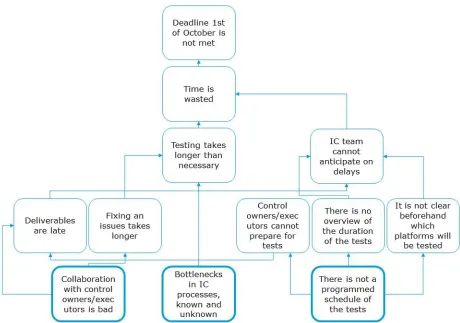
Due to various issues and problems within the IT IC team (see Figure 1 Problem cluster), the workload of the team is high. This was particular noticeable when at the end of the financial year 2016 a lot of testing was still to be done. Also, there are a lot of aspects of the process that can, and should be, optimized according to the IT IC team. For this reason, this research was initiated with the following motive:
Motive
To lower the workload of the IT internal control team by optimizing the IT internal control process.
Problem identification
10 Figure 1 Problem cluster
Concluding from this problem cluster, there are three main problems that cause the other occurring problems. These three problems are the collaboration with control owners and control executors, the bottlenecks in the IT IC process and the lack of a programmed schedule of the tests. According to the ABP guidelines (Algemene Bedrijfskundige Probleemaanpak) all three main problems are a potential core problem (Heerkens & van Winden, 2012). The decision of selecting a core problem was made in close consultation with the IT IC team.
Collaboration with control owners/executors is bad
11
Bottlenecks in internal control processes, known and unknown
Many of the bottlenecks within the IT IC team and their way of working are logical consequences of some of the team members being new to the job. Also, every IT IC team member has their own working approach, which causes small differences in the ITGC self-testing process depending on which team member is performing the tests.
There is not a programmed schedule of the tests
At the moment, there are many facts unknown, for instance the time it takes to perform an IT IC test. Also, due to the different actions taken by the IT IC team to improve the IT IC process sudden changes, currently unknown, could occur within the process. This will make a programmed schedule for the IT IC tests unreliable. When the process is optimized, and the other two problems are addressed, it would be more effective to have a programmed schedule. Because nobody has ever investigated the collaboration between the IT IC team and the control owners and control executors, this core problem was therefore the most valuable one to investigate. The other two problems are less valuable to investigate because the IT IC team is currently trying to investigate the bottlenecks in the process. They have team meetings discussing the (potential) bottlenecks and share best practices. Also, a programmed schedule would be most effective when the collaboration and the bottlenecks are investigated and improved/solved.
The following research question is formulated based on this core problem:
Research question
How can the process of IT internal control be optimized by improving the collaboration between the IT internal control team and the control owners and control executors/IT specialists?
Research questions
During own observations it was clear that improvements can be made in the contact between the IT IC team and the control owners and control executors/IT specialists as well as in the IT IC process.
To answer the main research question, the following follow up research questions are formulated. The questions are based on improvements in contact and process and on filling in the gap in knowledge about the control owners and control executors/IT specialist’s experiences with the IT IC process.
12 i. How do the control owners and control executors/IT
specialists experience the contact?
ii. How do the control owners and control executors/IT specialists experience the IT IC process?
3. How can the contact between the IT IC team and the control owners and control executors/IT specialists be improved?
i. What should be improved on the contact according to the control owners and control executors/IT specialists?
ii. What aspects of the contact should not be changed according to the control owners and control executors/IT specialists?
4. How can the IT IC process be optimized?
i. What should be improved on the IT IC process according to the control owners and control executors/IT specialists? ii. What aspects of the IT IC process should not be changed
according to the control owners and control executors/IT specialists?
5. How should the IT IC team improve the aspects of the contact and the process that should be improved according to the control owners and executors/IT specialists?
[image:13.612.79.542.481.723.2]
The different research questions are discussed in the following chapters. Table 1 gives an overview of which question is answered in which section.
Table 1 Research questions
Question SECTION Paragraph
Research question 5.1 Answering the research questions
1 2. Current situation
2 4.3 Problem statements versus
non-problem statements
3 4.4 Prioritization of the problem
statements
4.5 Statements per department, platform and role
4 4.4 Prioritization of the problem
statements
4.5 Statements per department, platform and role
5 4.7 Solutions to the top problem
13
Restrictions
The focus will be on the collaboration between the IT IC team and the control owners and control executors concerning testing on controls. All other aspects of the IT internal control process and tasks of the IT internal control team are not part of this research.
14
2. Current situation
This chapter gives answer to research question 1; what is the current situation of the IT IC process? By site visits of the IT IC team the different aspects of the IT IC process had been determined. These aspects are: departments, IT IC team, IT platforms/processes, control owners and control executors/IT specialists, controls, and the testing process. The current situation is based on an analysis of these aspects. We focus on the facts, rules and regulations that concern the workload of the IT IC team and/or the collaboration with the control owners and executors/IT specialists.
2.1 Departments
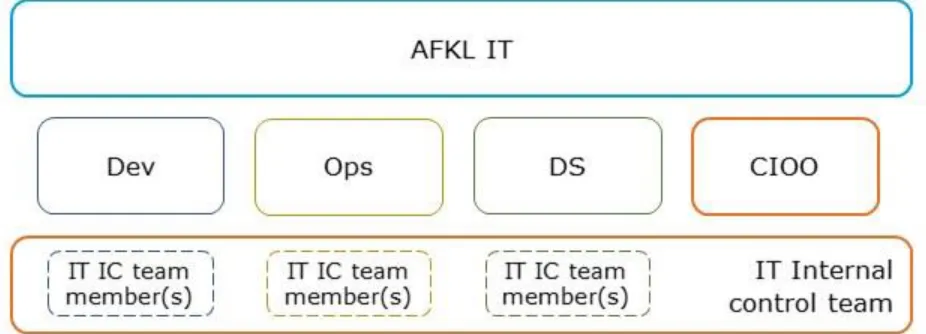
[image:15.612.76.539.356.523.2]The IT department of Air France – KLM is divided into four departments: Development (Dev), Operations (Ops), Distributed Services (DS) and the CIO Office (chief information officer office = CIOO). The IT IC team is functionally part of the CIOO, but the individual IT IC team members are hierarchically positioned in the respective departments Dev, Ops and DS.
Figure 2 Departmental organization structure
• Dev is the application development division that aims to implement tomorrow's IT applications. It consists of departments dedicated to business domains and projects that create these applications, soft- and hardware.
• Ops consists of IT platforms and activities that concern the IT continuity of the applications, soft- and hardware that is used to make the business of Air France – KLM possible, for example the booking system.
• The DS department facilitates all IT necessary for all the Air France –
15 The IT department increasingly uses Agile practices to speed up delivery of their new/adapted IT services, e.g. by blending Dev and Ops staff in one team. KLM defines agile teams as:
“An Agile Team is a cross-functional, multi-disciplinary and fulltime dedicated group of 5 to 11 people including a Product Owner and a Facilitator (e.g. Scrum Master) who have shared responsibility to define, build, test, deploy and maintain a Product or Service, or part of it, in a short Iteration time box
(Scrum) and/or on a continuous basis (Kanban).” (Air France - KLM Information Technology Group, sd)
The vision for the future is to work with such multidisciplinary teams, in order to have all the relevant knowledge of a specific application or system within such a team. However, this research is solely based on the situation in which Dev and Ops teams operate separately.
2.2 IT internal control team
Currently, the IT IC team consists of five employees. These employees are responsible for testing the ITGCs of different IT platforms and processes. Last year the leaving of two employees resulted in a renewed composition of the team. According to KLM Human Resource policy vacancies were opened for internal applicants firstly. For the new employees in the IT IC team, training on the job is used as the main training method. Doeringer and Piore said recruiting from an internal labor market obtains efficiency in recruiting and screening because the skills and behavioral characteristics of the employee are already known. However potential new hires from an external labor market maybe more qualified for the position such that less training would be necessary. This would reduce the efficiency obtained from recruitment and screening as more training is necessary. How much the efficiency reduces when training on the job is used as main training method is heavily dependent on the natural curiosity, the desire to show off and the reinforcement value of imitation. (Doeringer & Piore, 1970). This would imply for the IT IC team that the efficiency of the IT IC process could be reduced by recruiting internal applicants and training them on the job.
2.3 Control owners and control executors/IT specialists
16 with the control owner when it comes to the status of a platform and its issues. The collaboration with the control executor is more extensive. This collaboration also includes the IT IC testing process. However, in practice, it appears that this collaboration is delegated by the control executors to one or more IT specialists working on a specific platform. For the rest of this reports, control executor means both the control executor and IT specialists fulfilling the role of control executor.
2.4 IT Platforms / IT Processes
There are currently 12 different IT technical platforms involved in the IT IC testing process. These platforms are either an individual platform or a group of platforms. These 12 platforms are:
• DB2/IMS
• Exchange
• Firewalls
• Linux
• Oracle non-SAP
• Oracle SAP
• SAP TAM
• SAP / JIRA / SM9
• SQL server
• Workstations
• Windows
• z/OS
Apart from these twelve platforms there are also four processes and/or projects that require IT IC self-testing. These processes and/or projects are generically applicable to IT staff e.g. the Change Management and the Incident
P
la
tf
orm
Control owner
Control executor
P
la
tf
orm
IT Control executor specialist
IT specialist
[image:17.612.134.355.196.374.2]Control executor
17 management process. In this research ‘platforms’ refer to both the twelve platforms and the four processes.
2.5 Controls
The ‘rules’ that apply to an IT platform to ensure that the data and financials of this platform are protected are called controls. Such a control for instance is: A password to an employee’s account to make any changes to an
application must be at least 9 characters. Every control is defined and specified in the IT IC framework, a document within the Air France – KLM IT department. There are 20 different controls, named: C1, C2, C3, …, C20. Besides a description of the control, this framework holds also other significant information. Among others, the platforms to which the control applies, the control owner and control executor, the risk factor and the evidence that a platform or process should bring to prove that they are indeed in control. This IT IC framework and all the other relevant information about IT IC is available on the internal Microsoft SharePoint page for the IT IC team, but also for the control owners and control executors.
Separate IC frameworks for Air France and KLM were developed in compliance with the Sarbanes-Oxley legislation (SOx) as obligated for being listed on the New York Stock Exchange. February 2008 Air France – KLM delisted from the New York Stock Exchange, however the Group Executive committee decided to keep the controls in force. In 2011 the separated frameworks got combined to a common Air France – KLM IT general control framework, as used today. This document is annually updated as a means to risk, compliance and quality management and IC. Relevant changes within ICT processes will also cause corresponding changes to the IT IC framework during this annual update. These changes can however not affect the compliance with the SOx legislation. The SOx legislation may cause that a desired improvement of the control owners and control executors/IT specialists will not be possible to implement in reality.
2.6 Testing process
In the current situation the IT general control self-testing process depends on the IT IC team-member that is performing the self-tests. Every IC team member has their own approach. This results in small differences in IT IC process depending on which IT IC member performs the tests. In general, the process consists of consulting with the platform about changes made in the
18 they want to receive. The control executor/IT specialist deliver the evidence and based on this evidence the IT IC team member performs the test and provides the results. The differences in the process, depending on the IC member, are for instance how they approach the control executor/IT specialist, by mail or by phone, but also the deadline for delivering evidence can differ depending on the schedule of the IC team member. The risks and benefits of the differences in approach are shared with the IT IC team in staff meetings.
Currently, the IT IC team tries to improve the ITGC self-testing process in different ways. One of these ways is this research about the collaboration with the control owner and control executors/IT specialists. Other ways are sharing their different approaches of the ITGC self-testing process with the other IT IC team members. Another way in which they try to improve the process is by working on an awareness module to highlight the topic of IC within the IT department of Air France – KLM. This module is an online click-program that is supposed to be easy to understand and simple to use. It consists of every important aspect of the IT IC process that the users (mainly the control owners and control executors/IT specialists, but also other parties of interest) should be aware of.
Knowing the current situation by facts rules and regulations of the IT departments, IT IC team, IT platforms, control owners and control executors, controls and the testing process will help to put the results of the remaining of this research in perspective. It serves as background information when talking to the control owners and executors about the collaboration and the IT IC process.
19
3. Research approach
This chapter describes the approach used to answer the research questions, beginning with why interviewing was selected as research method, what type of interviewing method was selected and how the interviews were set up. In addition to this, this chapter explains the statements derived from the data, categorizes these statements and motivates recording the statements. The second part describes the method of prioritizing the statements. In the final part, the method of finding a solution to the problem statements with highest priority is described.
3.1 Research method
To answer the research question How can the process of IT internal control be optimized by improving the collaboration between the IT internal control team and the control owners and control executors/IT specialists? The first thing to find out is what aspects of the collaboration needs improvements. Through a survey research control owners and control executors and IT specialists get the chance to express the aspects of the IT IC process that need improvement according to their experiences and opinions. With this survey they also get the chance to complement aspects of the IT IC process that are going well and/or are experienced as pleasant.
By interviewing all the control owners and control executors/IT specialists a data collection is generated of all the aspects of the IT IC process that need improvements and/or should remain the same according to the interviewees. Every problem or non-problem mentioned is considered a statement. The statements are a perspective of the control owners and control executors/IT specialists on the IT IC process, this gives the IT IC team the opportunity to change the process with the aim to improve the collaboration.
Semi-structured face-to-face interviews
20
Set-up of the interviews
All the control owners and control executors are invited for an interview by a meeting invitation. In this invitation the aim of the research is briefly explained, and a proposal of the meeting time and date is introduced.
According to the IT IC framework IT specialists do not have a role in the IT IC process. However, as mentioned before, in practice, IT specialists working on large processes that need to be tested, will be in contact with the IT IC team about the IT IC process. This happens both in addition to and instead of the control executor on the process. Because of the time it takes to interview all the control executors and IT specialists individually, both are invited for the same meeting.
In 2011 Ivana Acocella did research to analyze the advantages and disadvantages of groups in research. From this research there had been concluded that during a focus group discussion various cognitive and communicative mechanisms can emerge. These mechanisms have advantageous as well as disadvantageous. The disadvantageous mechanisms that can emerge are
• Speed of interaction and several coordination problems can cause slowing down the free production of idea
• The presence of other people can cause a participant to give more socially desirable and stereotypical answers
These risks should be taken into consideration to understand the reliability and quality of the results from the research. (Acocella, 2011)
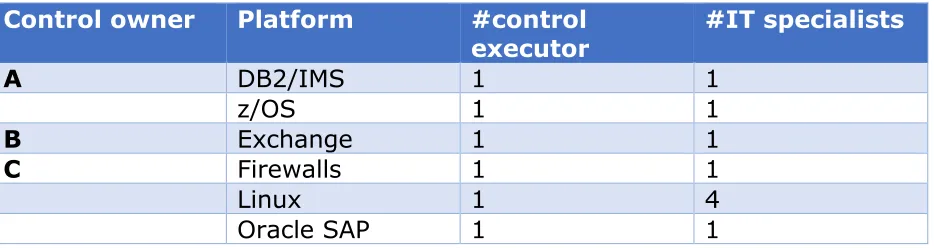
[image:21.612.76.543.584.708.2]Because the control executor and IT specialists are invited for the same interview, 22 interviews are taken. Eight interviews are with control owners (A till H) and sixteen interviews with control executors and the corresponding IT specialists. An overview of this, and the number of IT specialist per platform can be seen in Table 2.
Table 2 interviewed control owners and control executors/IT specialists
Control owner Platform #control
executor #IT specialists
A DB2/IMS 1 1
z/OS 1 1
B Exchange 1 1
C Firewalls 1 1
Linux 1 4
21
SAP TAM 1 1
Windows 1 2
Process 1 0
Process 1 1
D Oracle non-SAP 1 3
SQL 1 1
E SAP/JIRA/SM9 1 1
F Workstations 1 1
G Process 1 0
H Process 1 0
Interview structure
The interviews were set up by an introduction followed up by five open questions and the closing part. The introduction consisted of explaining the background of the researcher and the goal of the research. According to Lavrakas (2008) the introduction of the interview needs proper preparation. The introduction is meant to give the control owners and control executors/IT specialists a comfortable feeling. This way they are willing to give personal, honest and open answers to the questions asked.
The five open questions of the survey are based on the follow up research questions and are as followed:
• How often do you get in contact with the IT IC team?
• What types of getting in contact are used when getting in contact with the IT IC team (i.e. mail, phone, virtual meetings etc.)?
• How do you experience this contact?
• What is going well?
• What can be improved?
All these questions are about the IT IC process and the IT general controls the control owners and control executors/IT specialists are responsible for as also mentioned in the introduction of the interview.
The first two questions will give measurable responses that are comparable. The third question will answer research question 2, the fourth will answer research question 3i and 4i, and the last question will answer question 3ii and 4ii.
22 for the time taken for this interview and the openness of the answers during the interview.
The last two questions are purposely very broad. It is up to the control owners and control executors/IT specialists to think as broad as possible about aspects that should or shouldn’t be improved. This can be about every aspect they consider part of the IT IC process. As the interviewer knows which aspects are discussed in earlier interviews, these aspects are mentioned when the control owners and control executors/IT specialists didn’t refer to them by themselves by the end of the interview.
After the interview the data received during the interview will be stored as minutes.
Change in interview structure
After a few interviews it turned out that the kind of contact the control owners and control executors have with the IT IC team, and the frequency of these contacts differ in every single situation. Depending on the personnel preferences of the control owners and control executors/IT specialists this is considered more or less and/or pleasant or unpleasant. Also, the platform and control has influence on the frequency and kind of contact and how it is experienced. During the interviews the approach changed to a more unstructured face-to-face interview method. Instead of the first two questions the introduction of the interview was a little extended by explaining that there is a lack of knowledge from the perspective of the control owners and control executors/IT specialists on the aspects of the IT IC process that need improvements, contact being one of these aspects. This way the third question was incorporated into the last two questions.
A consequence of this change is that there is no clear bifurcation in contact and process in the questions and thus in the results. Which means there cannot be a clear bifurcation in contact and process when answering the research questions in 5.1 Answering the research questions.
3.2 Problem and non-problem statements
23 preferred to not undergo any changes. The control owners and control executors/IT specialists had the opportunity, after the interviews, to give feedback on the statements that were derived. According to the feedback the statements were finalized. An overview of all the final 61 problem and non-problem statements that are derived from the data received through the interviews can be found in Appendix A.
Categories
For every statement made, the subject of the statement is established in order to clarify the aspects of the IT IC process that should or should not be improved. These subjects are translated to seven different categories, among which all the problem and non-problem statements are divided. An overview of the categorized statements can be found in Appendix A. The categories are: Role
Statements with the subject role name, role description or the person assigned to the role.
Awareness
Statements with the subject awareness of the content of the IT IC process and the purpose of this process.
Priority
Statements with the subject priority which is given to the tasks that come with the IT IC process.
Work Efficiency
Statements with the subject efficiency of the IT IC process. Collaboration
Statements with the subject collaboration with the control owner, control executor/IT specialists, IT IC team and involved third parties (e.g. external control auditors).
Reasonable Assurance
Statements with the subject credibility of the reasonable assurance of being in control. (See Chapter 1 for the definition of IC by Air France – KLM.) Planning
Statements with the subject planning of the IT IC process.
Recording problem- and non-problem statements
24 is paid to whom (control owner or control executor) made the statement, which platform was discussed, and which controls apply to this platform. While recording how often a statement was made, two assumptions were taken into consideration. The first assumption being the statement a person makes counts per platform he or she is representing. For example, when a person is control owner of platform 1 as well as of platform 2, the statement he or she makes counts two times, one time for platform 1 and one time for platform 2. This assumption is made because this way every platform has statements from its control owner as well as from its control executors. Because of this assumption, the statements made by a person that is control owner of more than one platform have been recorded more than once while it might be emanated from one person.
The second assumption that was taken into account is when a role for one platform is fulfilled by more than one person every statement made by either one or both of these persons only counts once. I.e. when the role of control executor/IT specialist for platform 1 is fulfilled by person A and person B, and person A and B both make the same statement, the statement counts as one. The reason for this assumption is that this way a platform with more than one person as control owner or control executor/IT specialist, who both mention the same problem and/or non-problem, don’t necessarily have more problems and/or non-problems.
With these two assumptions the results of this research represent the perspective on the IT IC process, according to every role (either control owner or control executor/IT specialist) on every platform. Regardless of how many actual persons fulfill this role and/or how many platforms one specific person is representing.
3.3 Prioritization of the statements
Because the statements are opinions based on personal experiences of the control owners and control executors/IT specialists, the statements need to be prioritized for their relative importance. A statement that is mentioned
25 be given to the statement, because this will improve the IT IC process the most.
Influenceability of the statement and impact on the IT internal control process
To gather the information needed for the prioritization of the statements, a group interview was set-up with the IT IC team. This interview was structured with only multiple-choice questions. A list of all the statements made by the control owners and control executors was presented to the IT IC team. Per statement the following questions were asked:
• Is this problem or non-problem influenceable by the IT IC team? (Yes/No)
• How big of an impact does this problem or non-problem has on the IT IC process? (Small/Medium/Large)
The answers to these questions are given by the IT IC team in a group meeting, where there was consensus of the total group per answer.
3.4 Solving the problem statements
To provide the IT IC team a recommendation on how to improve the collaboration the final research method that was used was a literature study on the three problems with the highest priority. With this literature study a solution for these problems was found.
The search for relevant literature was conducted by the following steps: 1. Defining the search terms
The three main subjects of the search terms became respectively the three problems with the highest priority. Per subject the search term may differ using synonyms or extra terms to specify the search for a more relevant result.
2. Defining searching criteria
For the search of relevant literature FINDUT, the search engine of the University of Twente was used. Within this search engine searching criteria were defined with the aim to find relevant and useable literature. The searching criteria that were used are:
Content: Full text
Material type: Downloadable article
26 The search as described by the previous steps resulted in many potentially relevant articles. To decide whether an article was useable
and relevant first the ‘overview’ section was read. When the section was
found relevant the article was downloaded and read.
27
4. Results
This chapter discusses the results taken out of the data received from the interviews. The results consist of 54 problem- and non-problem statements. In this chapter we firstly discuss the overall results, after that a distribution of the statements per category is depicted. Next, we discuss some contradictions between the statements, after which the prioritization of the statements is given. Followed by graphs that show the statements per department, platform and role. The result tool is discussed afterwards and as last part of this chapter a solution to the top 3 problem statements is discussed.
4.1 Overall results
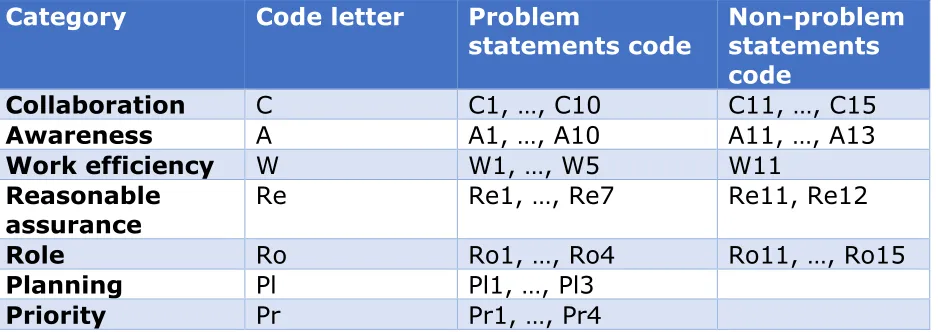
[image:28.612.75.544.428.594.2]When considering all the statements made during the interviews, the statements depict the overall problems and non-problems of the IT IC process and collaboration with the IT IC team according to the control owners and control executors. As mentioned in part 3.2 the subject of every statement is determined, resulting in the statements being divided among seven categories. All the problem and non-problem statements and their category can be found in appendix A Statements. Also, in this appendix every statement has a code, from now on every statement is referred to by its code. This code tells the category of the statement and if the statement is a problem or non-problem statement. This is shown in Table 1.
Table 1 Statement codes
Category Code letter Problem
statements code Non-problem statements code
Collaboration C C1, …, C10 C11, …, C15
Awareness A A1, …, A10 A11, …, A13
Work efficiency W W1, …, W5 W11
Reasonable
assurance Re Re1, …, Re7 Re11, Re12
Role Ro Ro1, …, Ro4 Ro11, …, Ro15
Planning Pl Pl1, …, Pl3
Priority Pr Pr1, …, Pr4
28
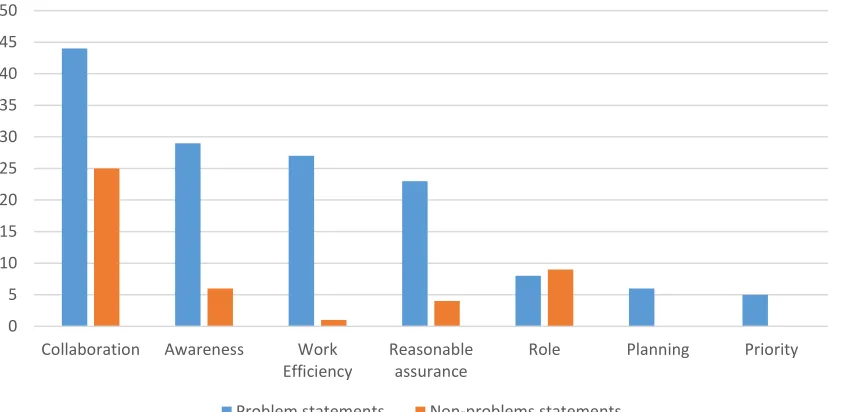
4.2 Statements per category
[image:29.612.97.519.159.365.2]A distribution of the number of times a statement of a certain category is mentioned is depicted in Figure 4 Distribution of the statements per category.
Figure 4 Distribution of the statements per category
Looking at how often a statement is made per category most of the problems as well as non-problems have to do with collaboration. Least problems are mentioned about priority. The biggest difference between problem and non-problem statements can be seen within the category work efficiency.
4.3 Problem statements versus non-problem statements
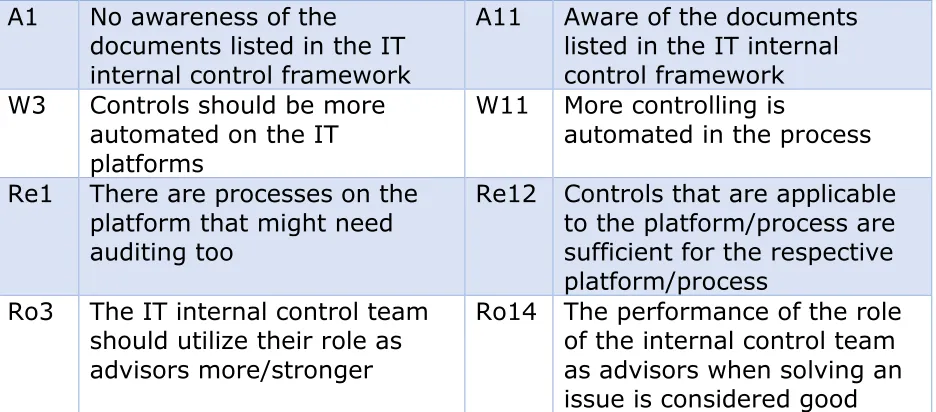
The problem and non-problem statements show in some cases contradictions. What some control owners and control executors consider as a problem, are named as a non-problem by others. A list of these contradictions can be seen in Table 2.
Table 2 Contradictions problem and non-problem statements
Code Problem statement Code Non-problem statement C6 One auditor from the IT
internal control team should be in contact with the IT platform concerning IT internal control
C11 Contact with the auditors of the internal control team is pleasant
C8 Status report is not as
frequent as it used to be C13 ITGC self-testing results are reported properly
0 5 10 15 20 25 30 35 40 45 50
Collaboration Awareness Work Efficiency
Reasonable assurance
Role Planning Priority
Distribution of the statements per category
[image:29.612.75.540.593.717.2]29 A1 No awareness of the
documents listed in the IT internal control framework
A11 Aware of the documents listed in the IT internal control framework W3 Controls should be more
automated on the IT platforms
W11 More controlling is
automated in the process
Re1 There are processes on the platform that might need auditing too
Re12 Controls that are applicable to the platform/process are sufficient for the respective platform/process
Ro3 The IT internal control team should utilize their role as advisors more/stronger
Ro14 The performance of the role of the internal control team as advisors when solving an issue is considered good
[image:30.612.74.542.72.278.2]While some control owners and control executors are aware of the documents listed in the IT internal control framework, others are not. Apart from these contractions there are also contradictions within either the problem statements or non-problem statements. These are shown in Table 3Table 3 Contradiction within problem or non-problem statements. As mentioned in Table 4 the code of the statement says whether the statements are problem or non-problem statements.
Table 3 Contradiction within problem or non-problem statements
Code Statement Code Statement
C5 Status updates should be more efficient by only providing updates when there are issues
C10 There is no notification when 'in control' and/or when self-tests are not performed
Re3 ITGC self-testing could be improved by applying the rules stricter
Re4 ITGC self-testing is (too) much in depth and/or strict
Ro13 ITGC self-testing is not a required task to be
performed by the control executor
Ro15 ITGC self-testing is a task to be performed by the control executor
Pr1 Risk estimation is lower than named in the internal control framework
[image:30.612.79.536.442.669.2]30 For these contradictions applies that while some find the ITGC self-testing too strict (Re4), others find that it could be stricter (Re3), both being a problem statement.
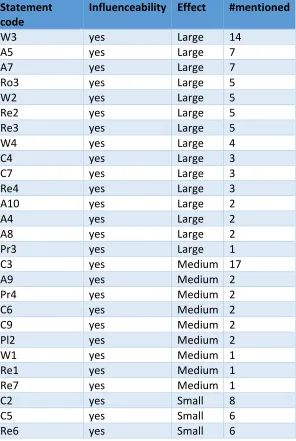
4.4 Prioritization of the problem statements
[image:31.612.161.457.279.720.2]The statements need to be prioritized for their relative importance. When prioritizing the problem statements, the statements are sorted by influenceability from yes to no, effect on IT IC process from large to small (large, medium, small) and number of times that the statements is mentioned from high to low. This resulted in a list depicted in
Table 4
Table 4 Prioritization of the problem statements
Statement code
Influenceability Effect #mentioned
W3 yes Large 14
A5 yes Large 7
A7 yes Large 7
Ro3 yes Large 5
W2 yes Large 5
Re2 yes Large 5
Re3 yes Large 5
W4 yes Large 4
C4 yes Large 3
C7 yes Large 3
Re4 yes Large 3
A10 yes Large 2
A4 yes Large 2
A8 yes Large 2
Pr3 yes Large 1
C3 yes Medium 17
A9 yes Medium 2
Pr4 yes Medium 2
C6 yes Medium 2
C9 yes Medium 2
Pl2 yes Medium 2
W1 yes Medium 1
Re1 yes Medium 1
Re7 yes Medium 1
C2 yes Small 8
C5 yes Small 6
31
A3 yes Small 4
W5 yes Small 3
Pl3 yes Small 3
Re5 yes Small 2
Ro1 yes Small 1
Ro2 yes Small 1
Ro4 yes Small 1
A1 yes Small 1
A2 yes Small 1
A6 yes Small 1
Pr1 yes Small 1
Pr2 yes Small 1
C10 yes Small 1
C8 yes Small 1
C1 no - 1
Pl1 no - 1
The statements C1 ‘Collaboration with IMO is not running smoothly’ and Pl1 ‘It is not clear in advance which ITGC self-tests will be performed by the
external auditor and to which requirements they have to comply’ are the only
two statements that are not influenceable by the IT IC team, both also mentioned once. 15 of the other 41 statements are labeled as large, for having a large effect on the IT IC process. Among these 15, the most mentioned statement is W3 ‘Controls should be more automated on the IT platforms’, which is mentioned 14 times. The two most mentioned statement after this one, both mentioned seven times are A5 ‘There should be access to general
information and documents concerning internal control. E.g. a platform or
dashboard’ and A7 ‘The IT internal control framework should be clear and
unambiguous. It should not be possible to interpret things differently’.
4.5 Statements per department, platform and role
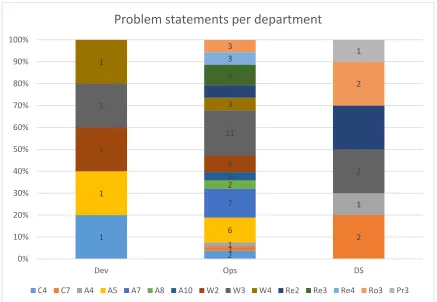
32
[image:33.612.88.525.87.389.2]Problem statements per department
Figure 5 Problem statements per department
Problem statement C4 ‘The knowledge transfer to new staff who will be
involved in the internal control process should be improved’ is mentioned once for the development department and twice for the operations department. However, this statement takes a much smaller part for operations than for development considering all problem statements made for the department. A statement that takes the most and about the same part in all the departments
is statement W3 ‘Controls should be more automated on the IT platforms’. For de operations department it is notable that there are more different problem statements mentioned than for the development and distributed services department.
1
2 1
2 1
1 1
6 7 2 2 1
4 1
11
2 1
3 3
2 5
3 3
2 1
0% 10% 20% 30% 40% 50% 60% 70% 80% 90% 100%
Dev Ops DS
Problem statements per department
33
[image:34.612.86.526.82.326.2]Problem statements per platform
Figure 6 Problem statements per platform
When looking at the problem statements with a large effect on the IT IC process the Exchange platform does not have any. SAP/JIRA/SM9 has one,
W4 ‘Controls should be arranged more efficiently’. The not platforms, but different processes that need ITGC self-testing have most, among which W3
‘Controls should be more automated on the IT platforms’ is mentioned most. This same statement applies to most of the platforms, with the exception of DB2/IMS, Exchange, SAP/JIRA/SM9 and z/OS.
1 1
1
1 1 1 1
1 1 1 1 1 1 2 1 1 1 1 1 1 1 1 1 1 1 1 1 1 1 1 1 2 1
2 2 1 1
1 3 1 1 1 1 1 2 1 1 1 1 1 1 1 1 1 1 1 1 1 1 1 0% 10% 20% 30% 40% 50% 60% 70% 80% 90% 100%
DB2/IMS Exch
an ge Fi re w all s Li n u x O rac le n o n -S A P O rac le S A P SA P / J IR A / S M9 SA P TA M SQ L W in d o w s W o rk stati o n s z/O S Pro ce ss e s
Problem statements per platform
34
Problem statements per role
Among the control owners, the statements that are mentioned most, are W3
‘Controls should be more automated on the IT platforms’ which is mentioned 9 times and A7 ‘The IT internal control framework should be clear and unambiguous. It should not be possible to interpret things differently’ which is mentioned 6 times. W3 also takes a large part for the control executors
however statement A5 ‘There should be access to general information and
documents concerning internal control. E.g. a platform or dashboard’ is mentioned most. There is a lot of overlap between the statements that are mentioned by the control owners and control executors. Only mentioned by control owners is statement A8 ‘Everyone (including third parties) should be aware of the content and number of controls named in the internal control
framework’. The statements that are only mentioned by control executors are A1 ‘No awareness of the documents listed in the IT internal control framework‘, W2 ‘The IT internal control team does not have self-serving
access to evidence’, Re3 ‘ITGC self-testing could be improved by applying the rules more strict’ and Re4 ‘ITGC self-testing is (too) much in depth and/or
strict’.
4.6 Result tool
When taking a look at the total results one can come up with the question,
‘does a particular statement apply to all platforms or only one or maybe two?’.
Apart from the total results, the problem and non-problem statements can also be approached from a certain role, department, platform, control or even
1 2 2 1 1 1 1 6 6 1 2 2 5 9 5 1 3 2 3 5 3
2 31
0% 10% 20% 30% 40% 50% 60% 70% 80% 90% 100%
Control owner Control executor/IT specialist
Problem statements per role
[image:35.612.70.506.85.327.2]C4 C7 A4 A5 A7 A8 A1 W2 W3 W4 Re2 Re3 Re4 Ro3 Pr3
35 a combination of one or more of these entities. For instance, it could be very interesting what problems statements of the category collaboration were mentioned by the control owners of the operations department.
To easily answer any sort of these questions with a list of problems and/or non-problems a result tool was set up. This tool is made in Microsoft Excel and consists of a dashboard sheet, a result sheet and a graph sheet. The tool works with the help of VBA codes, buttons, forms, and hidden sheets, some to help the codes others filled with data.
On the dashboard sheet there is the option to generate the results, being a list of problem and/or non-problem. When selecting the results button, a form comes up. On this form you can select what results you want to generate. You can select the sort of statements being problem statements and/or non-problem statements, but also the category of the statements. Further you can specify which statements you want to show depending on the role, the departments, the platforms and/or the controls.
[image:36.612.71.541.417.656.2]As an example a form on which problem statements from the category Collaboration by Control owners from the Dev department is selected, as in Figure 8, will generate all the problems in the category collaboration mentioned by the control owners of the development department.
Figure 8 Generate results form
36 Figure 9 Generated results
The statements that can be seen on this sheet are the statements as selected on the form. The numbers, however, depict the number of statements mentioned on the corresponding department, platform, role or control in total. This means that figure 9 shows that the problem statement ‘Between the
control owner and control executor there is not enough communication about
IT internal control’ is mentioned twice by control owners over all the
interviews. Over all the interviews, this same statement is mentioned only once on the development department.
This tool provides insight in the problems and non-problems on any department or platform or any role. The IT IC team can use this tool to adjust their process according to the preferences of any entity.
4.7 Solutions to the top problem statements
While it depends on which entities you base the prioritization of the problem statements, the three problem statements with the highest priority in general are
• W3 ‘Controls should be more automated on the IT platforms’
• A5 ‘There should be access to general information and documents
concerning internal control. E.g. a platform or dashboard’
• A7 ‘The IT internal control framework should be clear and unambiguous.
It should not be possible to interpret things differently’
37 Automating controls on the IT platforms
Current situation
Currently some platforms automated the controls for their processes, meaning that they deliver evidence for the control with a high frequency, if not continuous, by using IT. This provides advantages for both the control executors as for the IT internal control team. Evidence is almost immediately ready and deliverable, which saves a lot of time for both parties.
If a platform automizes their controls is for them to decide, it is not an obligation given by the IT internal control team or any other, higher, party. In this research control owners and control executors indicate that automating the control would benefit their experience with IT internal control. Automating the controls is not easily done, it takes a lot of knowledge about the processes and the controls. Besides the required knowledge, it also takes a lot of time to design the controls and implement them. These disadvantages are the reason that most platform didn’t automate their controls yet.
The design and implementing part of automizing the controls is considered as a responsibility of the platform and the control executors of the platforms. However, the IT internal control team has a part in this process as well. In the process of automizing the controls the IT internal control team functions as a consultative party.
The IT internal control team should know how to elaborate their role as consultants in this process in order to improve the efficiency and effectiveness of automating the controls, making it more likeable for the other platforms to also automize their controls.
Literature
In 2006 the monitoring and control layer for continuous monitoring of business process controls (CMBPC) was implemented in the IT audit department of Siemens Corporation. A report was written on the approach that was developed for the implementation and the lessons that were learned during the implementation. This report states several inferences and findings about (internal control) auditors during this implementation process (Alles, Brennan, Kogan, & Vasarhelyi, 2006):
- CMBPC require both managers and auditors to verify controls over the firm’s financial reporting processes.
- While formalizing the AAS’s, the participation of the senior internal auditors was essential. Ambiguities and uncertainties were resolved and the
formalized versions of the AAS’s were validated.
38 - The process of re-engineering controls by experienced auditor for purposes of
formalization of controls leverages automation to produce more efficient methods of addressing key controls.
- Throughout an audit, auditors are instructed to perform review procedures varying from simple checks of standard system parameters to securing more subjective data requiring input from interviews.
- The degree of compliancy of an audit action sheet (AAS) (the scope of the audit) given by the internal control auditor depends on the score given on this AAS by the continuous auditing analyzer code.
- The continuous auditing analyzer also provides flexibility for the auditor to further formalize the evaluation and scoring process without making hard-coded programming changes.
- The AAS’s provide general guidelines for the auditor to reconcile the
weighting of scores, which were problematic when programming intelligent software. A challenge of the continuous audit analyzer and the scores that it assigned to the AAS’s was that often the scoring criteria were ambiguous or vague, causing the auditor to have to score the findings
- The tab ‘components used for scoring’ allows the auditor or operator to define the control elements to be included in the evaluation and scoring.
- A continuous auditing system will always send an alarm to the auditors when there is an exception, a deviation in the value of the control. Optionally this alarm can also be sent to responsible enterprise personnel and/or enterprise managers, as well as other relevant parties.
- While alarming is critically important in CMBPC since it makes it possible to correct the identified problems in close real time, if the number of alarms generated by the CMBPC system explodes then it will hamper the ability of auditors and other enterprise personnel to react and correct the identified problems
- The ongoing maintenance of the configuration of individual alarm conditions is a laborious process, which may require an inordinate amount of auditor’s time if the CMBPC system is not designed to alleviate this problem.
- The monitoring and control layer is implemented in a separate computer system, which is usually owned and operated by the auditor.
Automating controls on the IT platforms
Through the CMBPC implementation at Siemens we learn that the IT internal control is involved in more than just consulting. When implementing the
atomization of the control on the IT platform the IT internal control is involved in:
39 team has to consult the programmers. These programmers are the control executors of the IT process. In order for the programmers to program an efficient and effective control the control can’t be ambiguous or vague. This is where the consult of the IT internal control team is needed. Based on experiences of Alles, Brennan, Kogan & Vasarhelyi, to solve the
ambiguousness and vagueness at least two IT internal auditors should be consulted, preferable senior auditors.
- Providing input; When the controls are formalized, in some cases it will still not be possible for the CMBPC to score every aspect of the control. As in the current situation, some input is given by interviews with the control
executors. For these cases it is not possible to fully automize the controls, some manual work is necessary to score the compliancy of the control. - Using continuous auditing analyzer; To score the controls on level of
compliancy an analyzer should be used. The analyzer scores the controls based on the CMBPC. The final decision on the level of compliancy, given by the IT internal control team, is based on the score given by the analyzer. Such an analyzer can provide flexibility by even further formalize the controls and changing the conditions on which the score is based. This is however, according to Alles, Brennan, Kogan & Vasarhelvi, not error resistant. In practice, the controls might not be formalized enough, resulting in controls that are still ambiguous and vague, causing the IT internal control to determine the level of compliancy.
- Alarms; When the CMBPC is in use, it will send alarms to the IT internal control team every time the process is divergent from the controls. The IT internal control will have to react to such an alarm. When there is an
overflow of alarms, to be expected when the CMBPC is newly in use, this will obstruct the ability of the IT internal control team to react. This can be prevented to some extend by the design of the CMBPC.
To stimulate all the platforms to automize the controls, the IT internal control team should elaborate their involvement with more than just consulting. When the IT internal control will use this automized controls for their auditing
processes by providing input, using the analyzer and the alarms they can improve the productivity of their auditing process. This will give the control executors more motivation to invest time and money in automizing their
40 Access to general information and documents concerning internal control
Current situation
Currently Air France – KLM uses Microsoft SharePoint as a platform to store and share information within the company, also the IT internal control team uses this platform to share all the relevant information concerning IT internal control with their stakeholders within the company. Nevertheless, the access to general information and documents concerning IT internal control (problem statement A5) is mentioned as a problem by both control owners and especially control executors. While every stakeholder within Air France – KLM should be able to access this information, especially the control executors should be able to know where to easily find the information because for them IT internal control is a more day-to-day subject.
According to Microsoft Corporation, SharePoint is an intranet platform to easy share and effortless collaborate, to provide involvement in the organization, to use common knowledge and to transform business processes. (Microsoft Corporation, sd). However, there might be more alternatives on the market, SharePoint should be a suited platform for accessing general information and documents concerning internal control. Also, changing to another platform for one of the many business processes is largely inconvenient when not absolutely necessary. The application of SharePoint should rather be improved.
literature
Brown and Duguid suggests that to benefit a company, the company should dynamically coordinate different types of knowledge among different communities, within a community of practice environment. Coordinating this knowledge within the community, while ignoring the differences in practice raises difficulties. These difficulties include stickiness due to the differences in labor but also leakiness due to routines in common practices. A community of practice being a continuous source of knowledge, makes it necessary as well as challenging for a company to dynamically coordinate innovative and routine knowledge. Brown and Duguid argue that coordination of knowledge in a community of practice doesn’t solely depend on motivation and trust but addressing knowledges differences due to differences in labor as well. Such differences can cause one party to change an object, unintentionally damaging communication, coordination and trust within the community of practice. The use of shared documents, tools, business processes, objectives, schedules etc. not only coordinates but also record and signals changes in a community. This will stimulate different practices to reconsider their changes, and so, stimulate negation between the different practices. (Brown & Duguid, 2001)
Access to general information and documents concerning internal control
41 negotiations. In the current situation the sharing objects shared on SharePoint are only managed by the IT IC team and used as routine knowledge by control owners and control executors. To improve the coordination of these information and documents, these documents should be adjustable in regard to the knowledge of the control owners and control executors. In practice this means that for instance, the schedule on SharePoint could be dynamic in a way that every control owner and/or control executor/IT specialist can change or suggest changes according to their schedules. This way motivation, trust as well as negotiations for/in and about these shared objects are stimulated.
Apart from the sort documents that are shared on SharePoint, it might be useful to research how they are shared. Because at this point in this research it is not possible to gather detailed information on how SharePoint is used by the IT internal control team and its stakeholders, it is also not possible to research how they can improve the use. Building the SharePoint User Experience (Furuknap, 2009), describes in detail the SharePoint architecture and how to develop SharePoint pages, attributes, lists, columns etc. that have an impact on the user experience. Furuknap his instructions, tips and tricks can be very useful when known what parts of the SharePoint should improve.
42 A clear and unambiguous IT internal control framework
Current situation
The IT internal control framework as describes in section 2.5 is currently not clear enough for the IT internal control owners and executors. The controls as stated in the framework can be ambiguous in a way that it’s not clear what has to be done about the process to be compliant with the controls.
Every financial year the internal control team will decide whether to make changes to the framework or not. This decision depends on changes in the organization structure and/or processes within IT or changes in the risk matrix. Another reason for adjustments to the framework are changes in the CobiT. However, changes to the framework do happen, these adjustments only consist of changing the platforms or processes to which the controls apply, changing the risk matrix or adding new controls. Changing the control itself is not possible for the IT internal control team because the controls as stated in the IT internal control framework are directly based on CobiT. Unfortunately for the IT internal control owners and control executors this means that there is no easy and effective solution to this problem by changing the formulation of the controls. It must be looked at how to adjust the framework in order for the control owners to know how to effectively be compliant with the controls.
The IT internal control team makes agreements with the control executors on what has to be done in the process to be complaint with the controls in a meeting in the early phase of an ITGC self-test. However not every process or platform has an ITGC self-test every year, which means that not every control owner or control executor/IT specialist makes these agreements on a regular basis. Another thing to look at is how to keep track of these agreements. This way the control owners and executors know that has to be done in the process to be complaint with the controls, independently from the IT internal control framework at all times.
Literature
43
Figure 10 Control objective summary table
44
Figure 11 The extended framework model
The first two columns are for the IT internal control team to fill in. The first column is the compliance level in percentage for the IT internal control team to decide based on the audit guidelines provided by CobiT. The second column is to make comments on the motivation for the compliance level. The values of the third to sixth columns are based on calculations.
Weightage: 𝑊 = ∑ 𝐼𝑛𝑓𝑜𝑟𝑚𝑎𝑡𝑖𝑜𝑛 𝐶𝑟𝑖𝑡𝑒𝑟𝑖𝑎 + ∑ 𝐼𝑇 𝑅𝑒𝑠𝑜𝑢𝑟𝑐𝑒𝑠; for the information
criteria P=1 S=0.5 and blank=0 applies, for IT resources ✓=1 and black=0 applies.
%Weightage: %𝑊 =𝑊∗100
𝑊ₘₐₓ; Wmax=12.
Relative Weightage: %𝑊∗100
∑ %𝑊 ; ∑ %𝑊 is calculated for the entire domain.
Effective Compliance: 𝑅𝑒𝑙𝑎𝑡𝑖𝑣𝑒 𝑊𝑒𝑖𝑔ℎ𝑡𝑎𝑔𝑒∗𝐶𝑜𝑚𝑝𝑙𝑖𝑎𝑛𝑐𝑒 𝐿𝑒𝑣𝑒𝑙 100
Apart from the columns, S.J. Hussain and M.S. Siddiqui also add 4 rows to the framework, for every domain one. In this row they calculate the sum of the weightage, %weightage, relative weightage and effective compliance of all the process within the domain.