Original citation:
Akerlof, Robert J.. (2016) Anger and enforcement. Journal of Economic Behavior & Organization, 126 . pp. 110-124.
Permanent WRAP URL:
http://wrap.warwick.ac.uk/80967
Copyright and reuse:
The Warwick Research Archive Portal (WRAP) makes this work by researchers of the University of Warwick available open access under the following conditions. Copyright © and all moral rights to the version of the paper presented here belong to the individual author(s) and/or other copyright owners. To the extent reasonable and practicable the material made available in WRAP has been checked for eligibility before being made available.
Copies of full items can be used for personal research or study, educational, or not-for-profit purposes without prior permission or charge. Provided that the authors, title and full bibliographic details are credited, a hyperlink and/or URL is given for the original metadata page and the content is not changed in any way.
Publisher’s statement:
© 2016, Elsevier. Licensed under the Creative Commons Attribution-NonCommercial-NoDerivatives 4.0 International http://creativecommons.org/licenses/by-nc-nd/4.0/
A note on versions:
The version presented here may differ from the published version or, version of record, if you wish to cite this item you are advised to consult the publisher’s version. Please see the ‘permanent WRAP url’ above for details on accessing the published version and note that access may require a subscription.
Anger and Enforcement
Robert J. Akerlof
¤February 1, 2015
Abstract
Observers who are angered by rule violations and punish violators often play a crit-ical role in enforcement. Hence a key question is: when will noncompliance provoke anger, and when will it be excused? This paper develops a theory of rule compliance as the outcome of a two-person Bayesian game. The core of the model is its description of what constitutes an excuse. Noncompliance is excused when a “reasonable person” in similar circumstances would also have failed to comply. Phenomena explained include the role of “legitimacy” in enforcement; corruption traps; graduated sanctions for repeat o¤enders; and tolerance of self-interestedness in markets.
Keywords: enforcement, rules, norms, legitimacy, anger.
JEL classi…cation: D02, D03, K42, Z13.
¤University of Warwick, [email protected]. I would especially like to thank Robert Gibbons and Laurence
1 Introduction
The enforcement of rules is central to the operation of all societies and organizations.
Observers who are angered by rule violations and punish the violators often play a critical
role in enforcement. That punishment may be as simple as reporting o¤enses to authorities.
Enforcement may be di¢cult, however, if observers excuse noncompliance. The question
arises: when will noncompliance be viewed as negligent, provoking anger and punishment,
and when will it be excused?
In the law, the standard test of negligence is “the reasonable person test,” which is
de…ned as follows: “Negligence arises from doing an act that a reasonable person would not
do under the circumstances, or from failing to do an act that a reasonable person would
do.”12 This paper suggests that the reasonable person test is not only a principle of the
law but, in fact, a basic feature of how people assess negligence. The paper builds a simple
model in which agents use such a test to assign blame. It considers the implications for
the enforcement of rules. In particular, we show that the model captures two important
enforcement problems that are previously unaccounted for theoretically.
The model is a two-person, sequential-move game. The …rst player decides whether
to comply with a rule, at a cost; the second player decides how much to punish him for
any noncompliance, at a cost. We assume: (1) the …rst player could be of two types, one
of which has a “sense of duty” to comply with the rule; and (2) the second player could
be of two types, one of which holds that the …rst player has a duty to comply with the
rule (or, put di¤erently, de…nes a “reasonable” …rst player as one possessing a sense of
duty). We critically assume that the second player is only angered by noncompliance if she
thinks a “reasonable” …rst player would have complied in similar circumstances. Otherwise,
noncompliance is excused.
In the model, anger over rule violations depends upon whether reasonable people are 1Miller and Perry (2012), p. 2.
2According to Unikel (1992): “From its modest beginnings, ‘reasonableness’ has gained a prominent
expected to comply; whether reasonable people comply depends, in turn, upon the anger
over – and punishment of – violations. We consider the equilibria of this system. First,
consider what equilibria look like when the second player feels there is a duty to comply,
and de…nes a reasonable person accordingly. We …nd that, when the …rst player’s cost of
compliance is high, there is a unique equilibrium in which the …rst player fails to comply
and the second player excuses noncompliance. When the …rst player’s cost of compliance is
low, there is a unique equilibrium in which the …rst player complies and the second player
is angered by noncompliance.
When the cost of compliance takes an intermediate value, there are multiple equilibria.
To illustrate, consider an example. Suppose there is a rule against corruption. There is the
possibility of being in a good, low-corruption equilibrium. In this equilibrium, reasonable
people are not corrupt; in consequence, corruption provokes anger and punishment; this
threat of punishment sustains the low rate of corruption. But, there is also the possibility of
being trapped in a high-corruption equilibrium. In this equilibrium, corruption is rampant,
with even reasonable people (with a sense of duty) engaging in it; in consequence, it is
excused; the lack of punishment sustains the high rate of corruption.
The possibility of a corruption trap, in which the endemic nature of corruption leads
people to excuse it, is the …rst important enforcement problem identi…ed by the paper. This
result is consistent with a large empirical literature on corruption (see especially Collier
(2000) and Rose-Ackerman (2001)). There are, in fact, a number of other “noncompliance
traps” that have been documented.
The paper identi…es a second enforcement problem that is, perhaps, even more
funda-mental. If the second player feels there is no duty to comply – and de…nes a reasonable
person accordingly – there is a unique equilibrium with the property that noncompliance
is always excused. It follows that absence of sense of duty to follow rules presents a serious
challenge to enforcement. If the …rst player lacks a sense of duty to comply, he complies
only to avoid punishment; if the second player feels there is no duty to comply, she excuses
This …nding relates to a large body of work outside of economics, on “legitimacy.” By
common de…nition, a rule is “legitimate” if there is a widespread feeling that there is a
duty to comply. Complete lack of legitimacy thus corresponds to the case in the model
where neither player feels there is a duty to comply. Blau (1964) argues that rules will
be disobeyed in the absence of legitimacy because “coercive use of power engenders
resis-tance.”3That resistance, according to Ostrom (1990), is commonly manifested in reluctance
to report violations to authorities. Violations are not reported because they are excused.
In consequence, “the legitimacy of rules. . . will reduce the costs of monitoring, and [its]
ab-sence will increase [the] costs.”4 Later in the paper, we will consider a number of examples
where enforcement problems arise from lack of legitimacy. They suggest that the need to
legitimate rules serves as a constraint; this constraint often has large e¤ects on the way in
which organizations are structured.
The model yields a theory of anger as well as a theory of rule enforceability. It makes
several predictions regarding anger and punishment. First, as we have already indicated in
passing, anger depends upon the cost of compliance. A high cost of compliance serves as an
excuse for breaking a rule. This result is intuitive. It is also consistent with survey evidence
from Kahneman, Knetsch, and Thaler (1986). They found, for example, that 68 percent
of survey respondents excused a company for reducing wages when it was losing money;
and 75 percent excused a landlord for raising the rent on a property when the landlord’s
costs increased, even though increasing the rent meant the current tenant would be forced
to move.5
Provided the second player does not know the …rst player’s cost of compliance, we …nd
that anger-over-noncompliance depends upon beliefs about the …rst player’s type. The
logic is as follows. Upon observing noncompliance, player 2 is uncertain whether there is 3Blau (1964), pp. 199-200.
4Ostrom (1990), p. 204.
5A high cost of compliance is similarly seen as a valid excuse in courts of law, for which there are many
a good excuse (the cost of compliance is high) or player 1 is just unreasonable. Player
2’s prior on player 1’s type a¤ects the weight she puts on there being a good excuse. This
result explains the empirical …nding that anger escalates with repeated noncompliance (since
repeated noncompliance is likely to signal that a person lacks a sense of duty).6
Finally, it has been observed that anger is contextual. For instance, there is typically a
high degree of tolerance of self-interested behavior in markets. Sen (1977) has seen this as
a puzzle, given people’s strong concerns for fairness in other settings. The model accounts
for the high tolerance of self-interested behavior in markets. This is explained as being due
to context-speci…c de…nitions of what is reasonable.
Relation to Existing Literature. First and foremost, the paper contributes to the
eco-nomic literature on norms (for a survey of approaches to norms, see Young (2008)). Norms
are often conceptualized as internalized views regarding duty and obligation (see, for
ex-ample, Elster (1989), Besley and Ghatak (2005), Akerlof and Kranton (2005), Prendergast
(2007, 2008), and Benabou and Tirole (2003)).7 In stark contrast, norms are not
internal-ized at all in other work. Agents simply obey norms in order to avoid punishment (see, for
instance, Kandori (1992)).8 A question is whether there is, in fact, a relationship between
punishment and internalized conceptions of duty. A number of scholars have posited that
there is (see, for instance, Sugden (1986) and Coleman (1990)). There is also considerable
experimental work demonstrating people’s willingness to in‡ict costly punishment when
internalized norms are violated.9
This paper explains how views regarding duty can give rise to sanctions: a player’s
feeling that there is a duty to comply not only motivates compliance, it potentially
moti-vates punishment of others’ noncompliance. Norm violations sometimes provoke anger and
punishment in the model, but, on the other hand, they may be excused. The paper further
explains when noncompliance will and will not be punished. Moreover, it describes when 6See the discussion of Kliemann, Young, Scholz, and Saxe (2008) in Section 5.
7Some of these papers use di¤erent terminology, such as “intrinsic motivation” or “values.”
8Young (2008) lists two additional reasons why people may comply with norms. They may do so in order
to coordinate with others (see Young (1993,1996)). They may also obey in order to avoid social stigma (see Bernheim (1994), Lindbeck, Nyberg, and Weibull (1999), and Benabou and Tirole (2011)).
those who lack a sense of duty (have failed to internalize the norm) may nonetheless comply
in order to avoid such sanctions.
The paper also contributes to the literature on rule enforcement. The model, in
particu-lar, is unique in identifying legitimacy of rules as a determinant of enforceability. Standard
approaches to rule enforcement are repeated-game models and third-party enforcement
models (see especially Becker (1968)), neither of which describe the role of legitimacy.
Le-gitimacy is highly stressed outside of economics – in particular, in the legal literature (see,
for instance, our later discussion of Tyler (1990) and Fagan and Meares (2008)). A point
that is particularly stressed is that when punishments are too harsh – and fail to …t the
crimes – it makes enforcement more di¢cult. Such punishments may undermine the
le-gitimacy of rules/laws. A recent economics paper, Chen (2013), provides some empirical
con…rmation. Chen (2013) looks at a dataset of British and Irish soldiers sentenced to death
by the British military during World War I. He …nds that executions of British deserters
deterred absences; in contrast, executions of non-deserters and Irish soldiers spurred
ab-sences. Another related paper is Benabou and Tirole (2011). They consider how the law
a¤ects agents’ internalized values – as well as the social stigma associated with crime.
There is also a literature related to the other enforcement problem discussed in the
paper – corruption traps (see Bardhan (1997) for a review). Our paper provides a novel
and important account of corruption traps. In particular, it is the only model in which
a high rate of corruption leads agents to excuse it. However, there are other stories –
complementary to our own –such as: the di¢culty of auditing corrupt o¢cials in corrupt
societies (Lui (1986), Cadot (1987), and Andvig and Moene (1990)); the higher returns to
corruption relative to entrepreneurship when corruption is more prevalent (Murphy, Shleifer,
and Vishny (1991, 1993), and Acemoglu (1995)); and the greater willingness of individuals
to engage in corruption when others are believed to be doing so (Sah (1988)).
As mentioned earlier, in addition to yielding a theory of rule enforceability, the model
also yields a theory of anger. It makes predictions regarding when one player will blame – or
fairness models, in which there is a …xed notion of what constitutes fair treatment, what is
considered fair here varies with the de…nition of what is reasonable. This allows the model
to account for contextual di¤erences in fairness attitudes, such as the particularly high
tolerance of self-interested behavior in markets. There is, however, overlap with existing
models. In their survey article, Fehr and Schmidt (2006) distinguish two types of reciprocity
models of fairness: “intention-based models” (such as Rabin (1993)) and
"interdependent-preference models" (such as Levine (1998)).10 Our model is a hybrid, and it addresses
respective concerns: for example, in intention-based models, a high cost of providing a
bene…t to others does not excuse the failure to do so; in interdependent-preference models,
those known to be sel…sh are punished even when they behave just like unsel…sh types.1112
Finally, the paper makes a purely technical contribution, which is worth highlighting.
While the equilibrium concept applied in our analysis is a standard one (Perfect Bayesian
Equilibrium), the game tree (see Figure 2, page 13) is not. In contrast to standard games,
the particular end node of the game tree players reach does not fully determine their payo¤s.
Payo¤s, at an end node, still depend upon players’ choice of strategies. The reason is that the
second player’s utility depends upon the answer to a potentially counterfactual question:
what would a reasonable person have done under similar circumstances? The idea that
counterfactual scenarios can matter for payo¤s may have applicability beyond the present
model.
The paper proceeds as follows. Section 2 gives a simple example. Section 3 describes
the formal model. Section 4 solves for the equilibria of the game. Section 5 discusses four 10In “intention-based models,” players are of a single type; they treat opponents kindly (hostilely) when
they believe opponents intend to treat them kindly (hostilely). In “interdependent-preference models,” there are two types: sel…sh players are always sel…sh, while altruistic players are kind when they believe their opponents are altruistic and sel…sh when they believe their opponents are sel…sh.
11In interdependent-preference models, those known to be sel…sh are punished even when they behave the
same way as others because punishment is meted out solely by type. In contrast, in the model developed in this paper, unreasonable people may avoid punishment by behaving as a reasonable person would behave.
12Our model also addresses concerns with a third category of fairness model, in which players have “social
phenomena captured by the model: the role of “legitimacy” in enforcement,
noncompli-ance traps, graduated sanctions for repeat o¤enders, and tolernoncompli-ance of self-interestedness in
markets. Section 6 concludes.
2 An Illustrative Example
The key aspects of the theory can be illustrated with a simple example. Consider a
game with two players: 1 and 2. Player 1 is of type12 f01g. 1 = 1with probability
and1 = 0with probability1¡, with 1. An1= 0type has instrumental preferences,
whereas an1 = 1type feels some sense of duty to comply with a rule. Player 1 knows his
type but player 2 does not know player 1’s type.
At time 1, player 1 chooses whether to comply with the rule (= 1), or not (= 0).
The cost of complying is 0. An 1 = 1 type also faces a cost 0 if he fails to
comply, re‡ecting his sense of duty to do so.13 Compliance is valued by player 2 in amount
.
In the event of noncompliance, player 2 decides at time 2 how much to punish player
1: ¸0. We assume player 2’s preferences are such that she chooses = (for a more
detailed discussion of player 2’s preferences, see the next section). denotes player 2’s
ability to punish. denotes player 2’s feeling of mistreatment. is de…ned as how
much worse o¤ player 2 is than she would be had player 1 been a “reasonable person.” We
assume player 2 de…nes a reasonable person as someone with a sense of duty to comply (an
1 = 1 type).14 Let denote the compliance choice of a reasonable (1 = 1) type. If
a reasonable person would have complied ( = 1) but player 1 fails to comply ( = 0),
=. Otherwise, = 0.
The equilibrium concept we will apply is formally described in Section 3. For the
purposes of this example, we can think of an equilibrium as a pair (¤ ¤) satisfying
13While we assume for the purpose of simplicity that player 1 loses
regardless of the cost of compliance
, the model can easily be generalized so thatis a function of. This accounts for circumstances in which a dutiful type only feels a duty to comply when it is not too costly to do so.
14In the formal model, we will also consider what happens when player 2 considers it reasonable to be an
the following two conditions: (1) taking the punishment of noncompliance ¤ as given, the
reasonable type (1 = 1) …nds it optimal to choose = ¤; and (2) taking the behavior
of a reasonable person (¤) as given, player 2 …nds it optimal to in‡ict punishment¤ in
the event of noncompliance.15
Condition (1) can be restated as: ¤ = 1 if · ¤ + and ¤ = 0 otherwise.16
Condition (2) can be restated as: ¤ = ¤. It follows from these conditions that two
types of equilibria can arise. An equilibrium with punishment (¤
= 1 ¤ = ) exists
if · +. An equilibrium with no punishment of noncompliance (¤ = 0 ¤ = 0)
exists if .
In the equilibrium with punishment, the1 = 1type complies and, if·, the1= 0
type also complies. The1 = 0type, who is instrumental, complies purely in order to avoid
punishment . In the equilibrium with no punishment, neither the 1 = 1 type nor the
1 = 0type complies.
Observe that the types of equilibria that arise depend upon whether the cost of
com-pliance is low ( · ), intermediate ( · +), or high ( +). When
the cost of compliance is relatively low ( · ), there is a unique equilibrium in which
noncompliance is punished (¤=). Reasonable people comply even if noncompliance is
not punished, so player 2 is necessarily angered by noncompliance.
When the cost of compliance is relatively high ( +), there is a unique equilibrium
in which noncompliance is not punished (¤= 0). The cost of compliance is su¢ciently high
that a reasonable person cannot be induced to comply. Player 2 excuses noncompliance
since reasonable people do not comply.
15Condition (1) corresponds to the standard rationality assumption for player 1 in a Bayesian game.
Condition (2) encompasses assumptions about both the on- and o¤-equilibrium-path behavior of player 2. Our focus in Section 3 will be on perfect Bayesian equilibria (PBE). Condition (2) corresponds to a re…nement of PBE, which we refer to as Reasonable-Person (RP) Stability. See the Appendix for a discussion. The set of PBE and the set of RP-stable PBE look very similar. They generate exactly the same compliance behavior but PBE admits a larger set of possible punishments of noncompliance.
In the present example, there is a unique RP- stable PBE of type 1A (see Figure 1), in which both the
1 = 0 and 1 = 1 types comply; such an equilibrium exists when · and noncompliance receives punishment¤=. There are, in contrast, a set of type 1A PBE; such equilibria exist when·and noncompliance receives punishment¤2[min( ) ]. This is the only di¤erence.
When the cost of compliance takes an intermediate value ( ·+), there are
multiple equilibria. In one type of equilibrium, there is no compliance and no punishment
of noncompliance. In the other type of equilibrium, there is compliance (by the 1 = 1
type only or by both types) and punishment of noncompliance. The reason for multiple
equilibria is as follows. In the …rst type of equilibrium, reasonable people fail to comply
( = 0). As a result, player 2 excuses noncompliance and fails to punish it (= 0). The
lack of punishment makes it optimal for reasonable people to choose noncompliance. In
the second type of equilibrium, reasonable people comply ( = 1). As a result, there is
considerable anger over (and punishment of) noncompliance (=). This punishment is
[image:11.612.172.444.337.403.2]su¢cient to induce compliance from reasonable people.
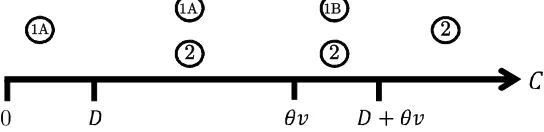
Figure 1 illustrates the equilibria for the case where .
1A
1A
2 2
1B
2
1A: punishment of noncompliance, compliance by both I1= 0,1 types.
1B: punishment of noncompliance, compliance by the I1= 1 type only.
2: no punishment, no compliance. 0
Figure 1: Equilibria of the Game
This example demonstrates important features of the theory. First, anger over
non-compliance depends upon the cost of non-compliance. Nonnon-compliance is excused when the cost
of compliance is high. There are multiple equilibria when the cost of compliance takes an
intermediate value. Second, we see that player 2’s de…nition of reasonableness – whether
player 2 feels there is a duty to comply (as we have assumed here) or not – matters for what
will be excused.
In this example, player 2’s anger over (and punishment of) noncompliance did not
a role when player 1 does not know player 2’s cost of compliance (). Upon observing
noncompliance, player 2 may be uncertain whether player 1 had a good excuse (was high)
or was just unreasonable. Player 2’s prior about player 1’s type () will a¤ect how much
weight player 2 puts on player 1 being unreasonable.
3 The Model
3.1 Statement of the Problem
We now turn to the formal model. Consider a two-period Bayesian game with two
players: 1 and 2. Player 1 is of type 1 2 f01g, where 1 = 0 re‡ects a player with
instrumental preferences and1 = 1re‡ects a player with a sense of duty to follow a rule.
Player 1 knows his own type (1) and the cost of compliance (). Player 2 does not
know 1 or . Player 2’s prior on 1 is that 1 = 1 with probability and 1 = 0 with
probability 1¡, with 1. Player 2’s prior on is that it is drawn from a distribution
with cdf and support µ(01). 1andare assumed to be independent. Let(1 )
denote player 2’s joint prior on1 and .
Player 2 also has a type 2 2 f01g. For simplicity, we assume 2 is common
knowl-edge.17 If
2 = 1, player 2 feels there is a duty to comply. If2 = 0, player 2 feels there is
no duty (player 2 feels player 1 is entitled to do what he wants). 2 describes how player
2 de…nes a reasonable person. Player 2 de…nes a reasonable person as an1=2 type.18
At time 1, player 1 chooses whether to comply with a rule (2 f01g). We will refer to
= 1as “compliance” and = 0as “noncompliance.” Player 2 observes player 1’s choice.
If player 1 fails to comply, player 2 chooses how much to punish player 1 at time 2: ¸0.19
We restrict attention to pure strategies for the players. A strategy for player 1 is a 17See Section 3.2 for a discussion of this assumption. A natural alternative would be to assume player 1
does not know player 2’s type (2) and believes 2= 1with probability
18We might have chosen, alternatively, to describe a person as “reasonable” whenever1
¸2. While we de…ne a reasonable person as an1 =2 type, we will see that the model implies that, whenever player 2 excuses the behavior of an1=2 type, she will also excuse the behavior of an1 2 type.
19An alternative game where player 2 can punish player 1 after
function ~( 1). ~( 1) denotes player 1’s choice of given and 1. A strategy
for player 2 is ~, which denotes player 2’s choice of how much to punish noncompliance.
(While player 2 also has a type 2,2 can simply be treated as an exogenous parameter of
the model. So, we choose not to write player 2’s strategy as a function of her type.)
If player 1 chooses actionand player 2 follows strategy~, player 1’s utility is given by:
1( ~ 1) =¡~¢(1¡)¡¢¡¢max(1¡0)
The …rst term is the punishment player 2 in‡icts on player 1. The second term is the cost
incurred if player 1 complies. The third term is the loss of utility to player 1 from failing
to do her duty. It is equal to zero unless player 1 feels he has a duty to comply and fails to
do so (1 = 1and = 0), in which case it is equal to 0.20 The …rst two terms of the
utility function are the economic part of player 1’s utility function, re‡ecting what player 1
wants to do, while the third term re‡ects what player 1 feels heshould do.
Before de…ning player 2’s utility function, it is …rst necessary to de…ne mistreatment
(). In line with our previous discussion, we de…ne mistreatment as how much better o¤
player 2 would be if player 1 had been a reasonable person (had possessed an appropriate
sense of duty). More formally, when player 1 plays strategy ~:
(~ 1) = max (¢~()¡¢~( 1)0)
¸0 is how much player 2 values compliance.21 ~() denotes the strategy followed by
a reasonable person. Since a reasonable person is de…ned as an 1 = 2 type, ~() =
~
( 2). ¢~()is what player 2 would receive from player 1 if player 1 were reasonable.
20As mentioned earlier, we assume player 1 losesregardless of the cost of compliance for simplicity.
The model can be generalized so thatis a function ofin order to account for circumstances in which a dutiful type only feels a duty to comply when it is not too costly to do so.
The duty term could also be generalized in other ways. We can capture more sophisticated rules – such as, for example, a duty to adhere to orders given by a leader – by allowing duty to depend upon the state of the world (in this case, the order given by the leader).
21We remark, more than parenthetically, that the model is unaltered if player 2 herself is not harmed by
¢~( 1) is what player 2 actually receives from player 1.22 According to this formula,
player 2 only feels mistreated when a reasonable person would comply (~() = 1) but
player 1 fails to comply (~( 1) = 0), in which case =. Otherwise, = 0.
If player 2 chooses to punish noncompliance in amount , her utility is given by:
2(~ 1) =¢¡()¢(1¡)¡©((~ 1) ¢(1¡))
The …rst term is the bene…tplayer 2 receives when player 1 complies. The second term is
the cost of in‡icting punishment on player 1, where()is the cost of in‡icting punishment
. The …nal term motivates player 2 to punish player 1 when she feels mistreated ( 0).
© represents the disutility associated with feeling mistreated; this disutility is reduced by
punishing player 1.
For the remainder of the paper, we will use the following functional forms forand©:23
() =
©( ) =log
µ
¶
0 parameterizes the ability to punish player 1 (higher implies a greater ability to
punish). Observe that the presence of a higher authority to which rule violations can be
reported would serve to increase . In order to ensure that player 2’s utility is decreasing
in the mistreatment she su¤ers, we assume ¡1.
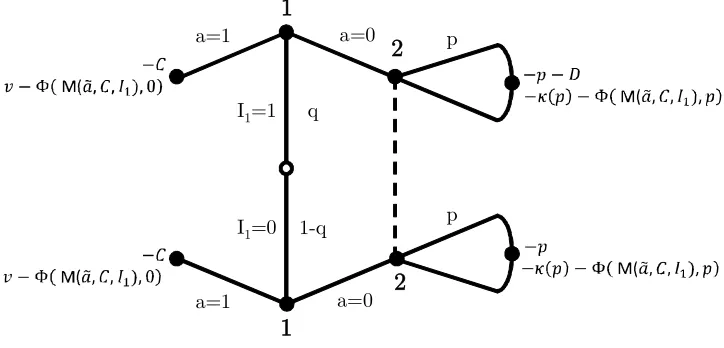
Figure 2 illustrates the game tree for the case where takes a single value. Observe
that player 2’s payo¤ at each node depends upon player 1’s choice of strategy (~). While
we typically do not see Bayesian games with this property, it is still a standard Bayesian 22As mentioned in the introduction, this de…nition of mistreatment exactly corresponds to the “reasonable
person test,” which is widely used in contract law, criminal law, and tort law (among other branches) to assess liability or guilt.
23These functional forms are convenient because they make it optimal for player 2 to choose= (or
=¢()whenis unknown). The choice of functional forms is not critical however. What matters is that the functional forms forand©ensure that: player 2 punishes player 1 more whenis greater and when player 2’s cost of punishment is lower.
log
is technically unde…ned when= 0. We will assume©(0 ) = lim!0+log
game and standard equilibrium concepts can be applied.
I1=1
I1=0 1-q q
1
1
2
2
p
p a=1
a=1
a=0
[image:15.612.126.488.122.296.2]a=0
Figure 2: The game tree for the case where takes a single value.
We will focus on perfect Bayesian equilibria of the game. For the sake of simplifying
analysis, we assume in the equilibrium de…nition that player 1 chooses to comply if he is
otherwise indi¤erent. Equilibria in the stylized version of the model presented in Section 2
correspond to a re…nement of perfect Bayesian equilibrium. For a detailed discussion, see
the Appendix.
The equilibrium de…nition, stated below, has three conditions. Condition D1 says that
player 1 maximizes utility, taking into account player 2’s punishment strategy (choosing
compliance if indi¤erent). Condition D2 says that player 2 maximizes expected utility
given her posterior beliefs (¢j). Condition D3 says that player 2 updates her beliefs
according to Bayes’ rule whenever possible. If player 1 chooseswith zero probability, so
that Bayes’ rule is unde…ned, any posterior beliefs are then admissible.
De…nition 1 A strategy pair (~¤~¤) is a perfect Bayesian equilibrium if:
(D1) ~¤( 1)2arg max1(~¤ 1) for all 1
~
¤( 1) = 1 if 12arg max1(~¤ 1) for all 1
(D2) ~¤ 2arg max
(D3) ( 1j) =
8 > < > :
(1)
(f(00
1):~¤(001)=g) if ~
¤(
1) =
0 otherwise
if (f(0 0
1) : ~¤(0 10) =g)0
3.2 Discussion of the Model
Let us pause brie‡y to discuss a few modeling choices.
First, we assumed player 1’s type is drawn from a distribution (1 = 1with probability
and 1 = 0 otherwise); in contrast, we …xed player 2’s type (2) and assumed it was
common knowledge. This leads to the possibility player 1 lacks a sense of duty with high
probability ( low) but still expects to face a second player who feels there is a duty to
comply (2 = 1). A natural alternative, which deals with this issue, would be to assume
player 1 does not know player 2’s type and holds the prior that2 = 1with probability. In
this case, both players’ types are drawn from the same distribution. We chose not to adopt
this assumption in order to simplify the model and analysis. Given that the reasonable
person test is a new idea, we consider it best to present the simplest possible formulation.
Furthermore, this alternative assumption does not yield much additional insight.
Second, the model suggests various ways in which (the probability of a dutiful type)
might be endogenized. For instance, one could imagine a many-round version of the game,
in which multiple pairs of agents play each round. The prevalence of dutiful types in round
+ 1 (+1) could depend upon the rate of compliance in round . This would capture
the idea that sense-of-duty might erode if rule-breaking were pervasive. We chose not
to endogenize because it would be a distraction from our focus, which is to understand
the implications of the reasonable person test. Nonetheless, a model in which were
endogenized would be a natural and worthwhile extension.
Third, the assumptions we made regarding player 2’s utility function may seem strong.
However, these assumptions are simply meant to rationalize player 2 punishing player 1
more when: (1) she feels more mistreated ( is larger), and (2) she has a greater ability to
Fourth, player 1 also has a conception of what is reasonable; it would be natural to put
into player 1’s utility function the same machinery as exists in player 2’s, so that he might
feel angered. If we further gave player 1 the opportunity to punish player 2, this would lead
to the possibility of retaliatory punishment. Such a model would be a natural extension;
it presents the possibility of capturing feuding. Again, for the sake of simplicity, we have
ruled out the possibility of retaliation.
Fifth, we assumed player 1 loses from failing to comply regardless of the cost of
compliance. This assumption was also made for the sake of simplicity. We could make
the model more realistic by assuming is a function of the cost of compliance, so that a
dutiful type does not feel it is a duty to comply when it is too costly to do so.
Finally, it is worth highlighting that, even though the equilibrium concept we will use
is standard (PBE), the game tree is not. Normally, the end node players reach is su¢cient
to determine their payo¤s. In our game, at an end node, player 2’s payo¤ depends upon
player 1’s strategy. This feature of the game is due to player 2’s use of the reasonable
person test.
3.3 Characterizing the Equilibria
Our assumptions on player 1’s utility allow us to restate condition D1 of de…nition 1
as follows:
~
¤( 1) =
8 > < > :
1, if ·~¤+¢1
0 otherwise
If player 1 has instrumental preferences (1 = 0), player 1 complies when the punishment
of noncompliance is greater than or equal to the cost of compliance: ·~¤. Player 1 is
more compliant if he feels a sense of duty to comply: player 1 complies if ·~¤+.
Our assumptions on player 2’s utility function allow us to restate condition D2 of
de…-nition 1 as follows:
~
Player 2’s punishment of noncompliance is increasing in her ability to punish () and her
expectation of how much she has been mistreated ().
First, consider the case where player 2 feels there is no duty to comply (2= 0). When
2 = 0, (~¤ 1) = 0 for all values of and 1.24 Intuitively, player 2 cannot feel
mistreated when 2 = 0 since player 1 is always at least as compliant as a reasonable
person. Hence, condition (*) implies that noncompliance is excused (~¤ = 0) when player
2 feels there is no duty to comply (2 = 0).
Now, consider the case where player 2 feels there is a duty to comply (2 = 1). When
Bayes’ rule is applicable, condition (*) implies that:
~
¤=¢ [(~¤+)¡(~¤)] (1¡)
[1¡(~¤)]¡[(~¤+)¡(~¤)]
where is player 2’s prior on the distribution ofandis player 2’s prior on the probability
that player 1 is of type 1 = 1. It can be shown that Bayes’ rule is applicable whenever
(~¤)1.25
When(~¤) = 1, Bayes’ rule is not applicable and condition D3 places no restrictions
on posterior beliefs ((¢j0)). In this case, player 2’s expectation of how much she has been
mistreated ((¢j0)[(~¤ 1)]) can take any value in the interval[0 ]. Hence, condition
(*) only requires that~¤ 2[0 ].26
Lemma 1 summarizes, giving necessary and su¢cient conditions for a pair of strategies
to be a perfect Bayesian equilibrium. Formal proofs are given in the Appendix.
Lemma 1 A pair of strategies (~¤~¤) is a perfect Bayesian equilibrium if and only if:
(P1) ~¤( 1) =
8 > < > :
1, if ·~¤+¢1
0 otherwise (P2) If (~¤)1:
24The mathematical reasoning is as follows. Recall that
(~¤ 1) =¢max (~¤( 2)¡~¤( 1)0). From our restatement of condition D1, we know that ~¤( 1) is nondecreasing in 1. Hence,
max (~¤( 2)¡~¤( 1)0) = 0whenever2 = 0.
~
¤ =
8 > < > :
0, if2 = 0
¢[1¡[( ~( ~¤¤)]+¡[)¡( ~( ~¤+¤)](1)¡¡(~)¤)], if 2 = 1 (P3) If (~¤) = 1:
~
¤ = 0, if 2= 0
~
¤ 2[0 ], if2 = 1
4 Results
We will now consider the equilibria of the game: …rst, describing the case where player
2 feels there is no duty to comply (2 = 0); then, turning to the case where player 2 feels
there is a duty (2= 1).
How much will player 2 punish noncompliance when player 2 feels there is no duty
to comply (2 = 0)? It follows from Lemma 1 that there is a unique perfect Bayesian
equilibrium. Noncompliance is not punished (~¤ = 0) and player 1 complies only from a
sense of duty (only if 1 = 1and ·).
Proposition 1 If player 2 feels there is no duty to comply (2 = 0), a unique perfect
Bayesian equilibrium exists. In this equilibrium, player 2 does not punish noncompliance:
~
¤ = 0
~
¤( 1) =
8 > < > :
1, if ·¢1
0 otherwise
What drives the …nding that noncompliance is excused? Player 2 feels mistreated
when she believes she has been harmed because player 1 lacks an appropriate sense of
duty (1 2). In this case, either player 1 has a minimally appropriate sense of duty
(1 = 2 = 0) or player 1 has a greater sense of duty to comply than player 2 thinks is
required (1 = 1 2 = 0). Since noncompliance cannot be due to a lack of an appropriate
sense of duty, player 2 will not feel mistreated when player 1 fails to comply.
Proposition 1 may seem trivial, but it has important implications. It says that, if player
angry when player 1 behaves in a self-interested way. It gives a rationale for self-interested
behavior sometimes being acceptable and not provoking anger.
We turn now to the case where player 2 feels there is a duty to comply (2 = 1).
Proposition 2, stated below, considers the case in which player 2 believes = with
probability and = ¸ with probability 1¡. The special case in which
== ¹ corresponds to the illustrative example from Section 2.
Proposition 2 Suppose player 2 feels there is a duty to comply (2 = 1), and player 2
believes = 0 with probability and = ¸ with probability 1¡
(0 1). There are three types of perfect Bayesian equilibria that can arise.27
Type 1: the reasonable type (1 = 1) always complies. If·+, PBE exist with:
(i) ~¤2[min( ) ]
(ii) ~¤( 1) =
8 > < > :
1, if ·~¤+¢1
0 otherwise
Type 2: the reasonable type never complies.
If , a PBE exists with:
(i) ~¤= 0
(ii) ~¤( 1) =
8 > < > :
1, if ·¢1
0 otherwise
Type 3: the reasonable type sometimes complies (when =).
If³¡
1¡ ´ ·+ ³ ¡ 1¡ ´
, a PBE exists with:
(i) ~¤=³1¡¡´
(ii) ~¤( 1) =
8 > < > :
1, if ·³¡1¡´+¢1
0 otherwise
Three types of equilibria can arise. The behavior of the reasonable type (1= 1) di¤ers
across these equilibria. In an equilibrium of type (1), reasonable people always comply.
27If
·min1¡¡
In an equilibrium of type (2), reasonable people never comply. In an equilibrium of type
(3), reasonable people sometimes comply (when =). Noncompliance is excused in
a type (2) equilibrium since reasonable people do not comply. Noncompliance is punished
in type (1) and type (3) equilibria since reasonable people do sometimes comply.
Let us begin by discussing the case where = = ¹, corresponding to the
illustrative example. Only equilibria of types (1) and (2) arise when = = ¹.
The set of perfect Bayesian equilibria produce a picture nearly identical to Figure 1. The
only di¤erence is that a wider range of punishments are admissible in Region 1A: ~¤ 2
[min( ) ] rather than ~¤ = These equilibria do not survive an appropriate
re…nement of PBE (see Appendix).
As in the illustrative example, the set of perfect Bayesian equilibria depends upon
whether the cost of compliance is low, intermediate, or high. Let us recall the reason
for this result. When the cost of compliance is low (·), reasonable people necessarily
comply, so noncompliance is not excused. When the cost of compliance is relatively high
( +), reasonable people cannot be induced to comply. So, noncompliance is always
excused.
When the cost of compliance takes an intermediate value ( ·+), there are
equilibria of both types. The reason for multiple types of equilibria is as follows. When
reasonable people comply, there is considerable anger over (and punishment of)
noncompli-ance. This punishment is su¢cient to induce reasonable people to comply. If reasonable
people fail to comply, however, player 2 excuses noncompliance and does not punish it. The
lack of punishment makes it optimal for reasonable people to choose noncompliance.
When , equilibria of type (3) sometimes exist. In an equilibrium of type
(3), noncompliance receives punishment of ~¤ =³1¡¡´. Punishment is greater: when
player 2 considers it more likely the cost of compliance is low ( is greater); and when player
2 considers it more likely player 1 is unreasonable ( is lower).
Consider the reasons for these two results. In a type (3) equilibrium, unreasonable
compliance is low ( =). Hence, if player 2 observes noncompliance, there might be
a good excuse – it might be due to a high cost of compliance ( =) – but it is also
possible that there is no good excuse ( = and 1 = 0). When player 2 considers it
more likely that the cost of compliance is low ( is greater) or when player 2 considers it
more likely player 1 is unreasonable ( is lower), player 2 puts less weight on there being a
good excuse. Thus, player 2 gets angrier over noncompliance.
Proposition 2 suggests three observations. First, unreasonable people potentially comply
in equilibrium – not just those with a sense of duty. When the cost of compliance is not
too high (·), equilibria of type (1) exist in which noncompliance receives su¢cient
punishment to induce compliance from unreasonable people with probability1. This result
shows that anger has a distinct role in the model from duty, since it generates compliance
from players who would not have complied out of a sense of duty. This property of the
model may also be important for the persistence of compliance over time. While we take
players’ views about duty as exogenous throughout the paper, one might imagine that
people’s sense of duty to comply with rules would erode if those lacking a sense of duty
were able to bene…t from breaking the rules.
Second, even when a sense of duty hardly motivates compliance at all ( is very low),
it still may be possible to obtain compliance. In particular, if ·, compliance (of
both reasonable and unreasonable people) can be achieved for any value of 0. This
result is somewhat surprising: even when duty hardly motivates compliance, it still may
be su¢cient to generate anger over noncompliance and punishment of noncompliance. On
the other hand, in order for player 2 to get angry over noncompliance, it is necessary that
player 2 feel there is at least some duty to comply. As we saw in Proposition 1, when player
2 feels there is no duty to comply at all, the unique equilibrium is one in which player 2
excuses noncompliance.
Third, player 2 only gets angry with players whose views regarding duty di¤er from her
own (1 6=2 types) or whose views player 2 suspects might di¤er. When == ¹,
never provoke anger. First players who hold di¤erent views (1 6=2 types), on the other
hand, sometimes do provoke anger: they fail to comply in equilibria of type (1) when
¹
and this angers player 2. When player 2 does not know the cost of compliance
( ), player 2 sometimes becomes angry because of suspected rather than actual
di¤erences of opinion: in equilibria of type (3),1 =2types fail to comply when =
and this provokes anger. If player 2 knew that player 1 shared her view regarding duty,
she would also know that player 1 had a good excuse (=); but she suspects player
2 may disagree about duty and lack a good excuse. The …nding that anger arises because
of disagreement about duty or the suspicion of disagreement has implications for how we
think about con‡ict situations.
Equilibrium Existence
It follows from Proposition 1 that a perfect Bayesian equilibrium always exists when
2 = 0. When2 = 1, a perfect Bayesian equilibrium does not always exist. However, the
following lemma gives an existence condition.
Lemma 2 If 2 = 1, a perfect Bayesian equilibrium exists if either of the following
condi-tions is satis…ed: (1) is continuous on [0 +] and ()1; or (2) = ¹.28
5 Phenomena Explained by the Model
The model accounts for a large number of phenomena. In particular, it captures two
important and ubiquitous enforcement problems. We will also discuss two phenomena
explained by the paper’s theory of anger and punishment.
Legitimacy
By common de…nition, a rule is “legitimate” if there is a widespread feeling that there is
a duty to comply. Rules lacking legitimacy are di¢cult – if not impossible – to enforce. The 28Condition (1) follows from the Intermediate Value Theorem. For a proof, see the Appendix. Condition
model explains why legitimacy is so important. When a rule completely lacks legitimacy
(which corresponds to the case where 1 = 2 = 0 in the model), there are three e¤ects.
One e¤ect is that people will only comply to avoid punishment. A second e¤ect, which
follows from Proposition 1, is that observers of noncompliance will excuse it (since 2 = 0).
A third e¤ect, consistent with the model but not directly captured by it, is that observers
may fear retaliation if they report rule violations to authorities or punish violators directly.
The reason is that punishing noncompliance provokes anger when a rule lacks legitimacy:
because reasonable observers (de…ned by player 1 as 2 = 0 types, since 1 = 0) would be
expected to excuse noncompliance. Lack-of-legitimacy thus presents a serious problem for
the enforcement of rules.
Legitimacy is crucial in many di¤erent contexts. Legal scholars have identi…ed it as a
key determinant of the ease or di¢culty of enforcing laws (see Tyler (1990) and Fagan and
Meares (2008)). The di¢culty confronting the police in rooting out gang activity provides
an illustrative example. The main problem of the police in the inner city is people’s
reluctance to report gang activity. Fagan and Meares (2008) point to illegitimacy of the
law as the key reason.29 In his classic study of gangs, Martin Sanchez Jankowski quotes
one New York police o¢cer as follows: “When we get the community support, we go with
it. It is so frustrating because there are some times when gang members commit a crime in
the neighborhood, then we come by, but nobody is willing to help. They say they know
nothing.”30 According to Sanchez Jankowski, gang survival depends upon such support
from the community. He describes, for instance, the case of the Pink Eagles in New York.
Expansion of the gang’s drug operations left them less time to patrol the neighborhood, with
a resultant increase in robberies and assaults in the community. While the community was
willing to excuse the gang’s violations of the law, they were angered by the gang’s failure
to adequately protect the neighborhood. As a result, the community began cooperating
with the police. Remarkably, in short order, the Pink Eagles dissolved as an organization. 29A number of factors, in their view, contribute to the law’s illegitimacy in these communities, such as
racially disproportionate incarceration rates.
Just as legitimacy plays a major role in the enforcement of the law, it also plays a
critical role in the enforcement of rules in …rms. We see one example in Gouldner’s study
of the Oscar Center plant of the General Gypsum Company. Prior to the arrival of a new
plant manager, the plant had “few rules. . . and fewer still that were strictly enforced.”31
The central o¢ce charged the new plant manager, Vincent Peele, with making reforms.
But, because of the previous lax regime, Peele’s new rules were seen as illegitimate and
he faced resistance at every turn. Consider Peele’s unsuccessful attempt to enforce a
rule against absenteeism. According to Gouldner: “Supervisors. . . did, at …rst, attempt
to enforce this rule. Very shortly thereafter, however, they...declared that this rule just
could not be enforced.”32 Supervisors could not ascertain whether those who took absences
had good reasons for doing so – since coworkers were unwilling to report when they did
not. In addition, when absenteeism was punished, workers became extremely angry (this
is the third e¤ect of lack-of-legitimacy, mentioned above). When management decreed
that those who took days o¤ without permission would be laid o¤ for an equal number of
days, the rate of absenteeism did not fall – it rose. According to Gouldner, “when several
workers had been penalized. . . others would deliberately take o¤ without excuses” as a form
of retaliation. As a result, “the number of absentees in any team was greater than usual,
and the team would be unable to function.”33
The need for legitimacy serves as a constraint, one which has been omitted from
third-party enforcement models and principal-agent theory more generally. Gouldner describes
how the General Gypsum Company came to recognize Peele’s lack-of-legitimacy as a
con-straint. Because rules set by the central o¢ce had greater legitimacy than Peele’s, the
company decided to delegate less authority to him. The central o¢ce had not lost faith in
Peele: instead, they recognized the value to Peele of being able to cite central o¢ce rules
in motivating workers. The organizational form that resulted was highly centralized and
bureaucratic.
Well-intended policies sometimes fail because of lack of appreciation of the constraints
imposed by legitimacy. Ostrom (1990) gives, as an example, the e¤ects of forest
nation-alizations in Thailand, Niger, Nepal, and India intended to prevent overuse. According to
standard third-party enforcement models (such as Becker (1968)), these measures should
have been helpful since they set up a system of government policing of forest use where none
had previously existed. However, contrary to this prediction, they exacerbated the
prob-lem. The respective governments were unable to police e¤ectively because villagers did not
feel the government had a legitimate right to nationalize the forests. Furthermore, villages
had had their own rules intended to protect their forest parcels from overuse. In ending
villages’ sense of ownership of their parcels, nationalization delegitimized these village rules
– thereby aborting the only e¤ective form of policing that had been taking place.
Noncompliance traps
When rules lack legitimacy, observers of noncompliance excuse it, making enforcement
di¢cult. Observers may also excuse noncompliance simply because the rate of
noncom-pliance is high. This leads to the possibility of a “noncomnoncom-pliance trap”: a high rate of
noncompliance makes enforcement di¢cult; the di¢culty of enforcing compliance sustains
a high rate of noncompliance.
Collier (2000) has argued that pervasive corruption is di¢cult to …ght for just such
a reason. In an honest society, a corrupt act “gives rise to a stronger sense of
indigna-tion. . . Indignation is the trigger for disclosure, and so if a corrupt act is detected, it is much
more likely to be reported to the authorities.” There is at least a scattering of evidence in
support of Collier’s story. In surveys, for example, people justify their own corrupt behavior
by citing its pervasiveness (see Rose-Ackerman (2001)).
The model captures Collier’s story.34 Recall from Proposition 2 and the illustrative
example that, when the cost of compliance takes an intermediate value, there are multiple
equilibria: one type with a high rate of compliance and anger over noncompliance, and 34While this paper gives the only theoretical account of Collier’s story, there are several other models of
another type with a low rate of compliance and no anger over noncompliance. An honest
society might correspond to the former type of equilibrium and a corrupt society might
correspond to the latter type. In the corrupt society, because everyone engages in corruption
(including reasonable people), corruption fails to provoke anger and is not punished. The
lack of punishment sustains the high rate of corruption. In an honest society, reasonable
people behave honestly, which means that corrupt acts provoke anger and are punished.
This punishment sustains the low rate of corruption.35
The model suggests a reason why underdeveloped countries would be especially prone
to corruption traps. They may initially lack laws against corruption; and, insofar as laws
do exist, they may lack e¤ective organizations to enforce them. In terms of the model, this
corresponds to a low (low ability to punish noncompliance).36 According to Proposition
2 and the illustrative example, if is su¢ciently low, there will be a unique equilibrium,
with high corruption. In due course, developing countries may create laws and authorities
to enforce them, which increases. With a higher, there may be multiple equilibria: both
a high-corruption equilibrium and a low-corruption equilibrium. While the model is not
dynamic, we might expect past corruption and past tolerance of corruption to lead to its
persistence even after increases.
To escape from such a trap, the sense that corruption is “reasonable” must be erased;
this can only be accomplished through a “big push” against corruption. Persson, Rothstein,
and Teorell (2012) argue that, historically, dramatic, persistent declines in corruption have
generally coincided with big push e¤orts. Examples include the United States, Sweden, and
Denmark, in the nineteenth century, and Hong Kong and Singapore, more recently.
Corruption is just one example of a “noncompliance trap” associated with underdevelop-35The model also accounts for Collier’s observation in a second way. We might imagine that the cost of
being honest is higher when a society is more corrupt. This corresponds to a higher cost of compliance () in the model for corrupt societies. For example, winning a government contract without paying a bribe might be possible for a …rm in an honest society but impossible in a corrupt society. According to Proposition 2 and the illustrative example, there might be a unique equilibrium in corrupt societies (with high ) in which people engage in corruption (fail to comply) and corrupt acts fail to provoke anger; in contrast, there might be a unique equilibrium in honest societies (with low ) in which people behave honestly (comply) and corrupt acts provoke anger.
36
ment. For example, there are also literatures documenting the persistence – and toleration –
of tax avoidance, teacher/health-worker absenteeism, and unpunctuality in underdeveloped
countries.37
Graduated Sanctions
We turn to a phenomenon explained by the paper’s theory of anger and punishment.
The model accounts for Ostrom’s observation that sanctions generally escalate for repeat
o¤enders. Such escalation of punishment is a common feature of the law: according to
Roberts (1997), “for as long as countries have had formal legal systems. . . recidivists have
been seen as deserving harsher punishments than crimes by …rst o¤enders.”38
One explanation for graduated sanctions is suggested by Polinsky and Rubinfeld (1991),
who show that they can be optimal in a principal-agent setting. In their model, some
agents maximize social welfare, while others have a desire to violate rules when it is not
socially optimal. The principal uses graduated sanctions because they permit occasional
noncompliance from agents who are appropriately motivated (as is optimal) while still
keeping in check those who are not.39
37Consistent with noncompliance traps, countries with low rates of tax compliance are typically more
tolerant of noncompliance (see Lederman (2003)) and …nd enforcement more di¢cult (see, for example, Das-Gupta, Lahiri, and Mookherjee (1995)). Similarly, Chaudhury, Hammer, Kremer, Muralidharan, and Rogers (2006) …nd high tolerance of absenteeism in countries where it is common. In government-run schools in India, for example, only one in three thousand teachers is dismissed for absenteeism annually, despite a 25 percent teacher-absence rate. There is also greater tolerance of unpunctuality when it is common (see Levine, Reis, and West (1980)). Cabral and Pacheco-de-Ameida (2006) cite evidence that the costs of unpunctuality are signi…cant.
38In the United States, most states have statutes requiring enhanced punishment for o¤enders with repeat
convictions (see Proband (1994)). California and several other states have enacted “three strikes” laws, which require life sentences for a third serious criminal o¤ense. The United States Supreme Court upheld the constitutionality of a life sentence for a third (and minor) property o¤ense inRummel v. Estelle (see Davis (1992) for a discussion). There is also strong public support for graduated sanctions. In a survey conducted in Missouri, for example, Fichter and Veneziano (1988) found that the percentage of respondents favoring a state prison sentence for an individual who committed a burglary rose from 12 percent on the …rst o¤ense to 60 percent on the third. Judge William Wilkins, who chaired the United States Sentencing Guidelines Commission, noted that “enhancing a defendant’s sentence on the basis of criminal history...is consistent with public perceptions of crime seriousness.” (Wilkins (1992), p. 577).
39Abreu, Bernheim, and Dixit (2005) …nd that graduated sanctions can be optimal even if it is never
While Polinsky and Rubinfeld provide one reason for escalating punishment, it has often
been suggested that a key reason is that anger is greater when there is a past history of
noncompliance. According to Fletcher (1982), “Retributivists hold that, whatever the
social utility or disutility of punishment, the recidivist deserves greater punishment.”40
Durham (1987) explains further that “repetitive criminal involvement indicates the existence
of ‘hidden’ attributes possessed by the o¤ender. . . Personal blameworthiness increases as
these hidden features are uncovered.”41
The model explains Durham’s statement. According to Proposition 2, there is more
anger over noncompliance when player 2 is more convinced player 1 is unreasonable. A
past history of rule violation generally signals that someone is unreasonable. In particular,
in a …nitely-repeated version of the punishment-compliance game in which player 1’s cost
of compliance () is redrawn each round, a past history of rule violation signals that player
1 is unreasonable.4243
Ostrom cites Glick’s (1970) study of the ancienthuertairrigation system of Valencia as
an example where the cost of compliance was redrawn in this manner. There was a set
rotation order for the receipt of water. A farmer was permitted to draw as much water as
needed on his turn, but none at other times. According to Ostrom, “from time to time, the
cost to a farmer of waiting for his next legal turn to receive water, as contrasted to stealing
water available in the canal, would be extraordinarily high.”44 In other words, while most
of the time, the cost of compliance () was low, occasionally it was extremely high and
hence there was a good excuse for taking water. For farmers who stole only in these rare 40Fletcher (1982), p.55.
41Durham (1987), p. 622.
42Durham also suggests that a reasonable person may fail to comply initially from lack of knowledge of
the rules. But, upon erring and learning the rules, there is no longer a good excuse for noncompliance. Hence, repeated noncompliance signals that a person is unreasonable. Durham writes: “The o¤ender has been alerted by his previous conviction to the unacceptability of his behavior. The initial conviction, and perhaps any ensuing punishment, acts as an informational conveyance. After being subjected to such an informational barrage, the o¤ender cannot fail to understand the message. Continued criminal behavior therefore re‡ects a de…ance of the law.” (p. 621)
43One application is to price setting by …rms. Rotemberg (2005) has argued that consumers’ anger
depends upon the frequency of price adjustments.
instances, the “monetary …ne...would be quite low.”45
While the perfect experiment has not yet been run, Kliemann, Young, Scholz, and Saxe
(2008) provide suggestive evidence that anger escalates with repeated noncompliance. In
their experiment, subjects played two rounds of a trust game with an anonymous
oppo-nent.46 Subjects were then presented with a vignette regarding the opponent. They were
told that he had found a neighbor’s sweater in his building’s washing machine; he moved
the sweater to the dryer; and it shrunk four sizes. Subjects assigned greater blame when
the opponent had previously failed to reciprocate in the trust game.47
Tolerance of self-interestedness in markets
It has been observed that what makes people angry depends upon the context (see
Konow (2003) Section 5.2 for a discussion). An example of particular economic signi…cance
is the high tolerance of self-interestedness in markets relative to other settings. Adam
Smith saw self-interestedness as a principal characteristic: “It is not from the benevolence
of the butcher, the brewer, or the baker that we expect our dinner, but from their regard
to their own interest.”48 Sen (1977) argues that economists are too quick, generally, to
apply an assumption of self-interestedness in non-market settings. He makes note of the
greater tolerance of it in markets – and points out that this di¤erence is a puzzle in need
of explanation.
Our model presents a resolution. Depending upon the context, a reasonable person may
be de…ned di¤erently. In a market setting, there is typically a feeling of entitlement to
pursue self-interest (1 = 2 = 0). According to Proposition 1, when 1 =2 = 0, player
1 will pursue self-interest (choose = 0); and this will be tolerated by player 2. In other
45Op. cit., p. 75.
46Unfortunately, the opponent in this experiment is …ctitious.
47The experimental setting in Masclet, Noussair, Tucker, and Villeval (2001) would seem to be ideal
for identifying whether anger escalates with repeated noncompliance. In their experiment, four subjects repeatedly play a two-stage game. The …rst stage is a public goods game. In the second stage, subjects have the opportunity anonymously to punish other subjects at a cost. We would hope to see punishments depend upon past levels of contribution as well as the current level. Unfortunately, Masclet et al. (2001) do not report whether this was the case.
settings, there is likely to be less sense of entitlement.49
There is considerable tolerance of self-interestedness in markets – but not complete
tolerance. The previously mentioned survey of Kahneman, Knetsch, and Thaler (1986)
has identi…ed exceptions. Two examples illustrate. 82 percent of respondents considered it
unfair for a hardware store to increase the price of snow shovels from $15 to $20 the morning
after a snowstorm. 77 percent thought it unfair for a small company to decrease workers’
wages by 5 percent when the company was making a pro…t but high unemployment made
it easy to replace current employees with new workers at a lower wage.
The model can account for the exceptions to tolerance of self-interestedness identi…ed
by Kahneman, Knetsch, and Thaler (1986). All of the cases in which they …nd such lack
of tolerance have a common feature: one or both of the market participants possess market
power. For instance, the hardware store is clearly exercising its market power if it raises the
price of snow shovels after a snowstorm. It therefore appears that, while market participants
normally feel entitled to pursue self-interest (1 =2 = 0), when there is market power they
feel there is a duty not to abuse it.
Kahneman, Knetsch, and Thaler sketched their own model to account for their …ndings.
They say that people do not get angry so long as the gains resulting from a transaction
are shared (where gains are de…ned relative to a reference point). Since only gains need
to be shared, the model accounts for some of the tolerance of self-interestedness we see.
For example, it explains why the failure of the rich to give away most of their wealth does
not necessarily provoke anger. But their model fails to account for competitive market
situations (as in the stock market), where there is tolerance of the self-interested pursuit of
49Note that the model gives a second reason why self-interestedness may be tolerated in markets. According