Original citation:
Wilkening, Ina, Gazzola, Silvia, Riva, Elena, Parascandolo, James S., Song, Lijiang and Tosin,
Manuela. (2016) Second-generation probes for biosynthetic intermediate capture : towards
a comprehensive profiling of polyketide assembly. Chemical Communications.
Permanent WRAP URL:
http://wrap.warwick.ac.uk/80878
Copyright and reuse:
The Warwick Research Archive Portal (WRAP) makes this work of researchers of the
University of Warwick available open access under the following conditions.
This article is made available under the Creative Commons Attribution 4.0 International
license (CC BY 4.0) and may be reused according to the conditions of the license. For more
details see: http://creativecommons.org/licenses/by/4.0/
A note on versions:
The version presented in WRAP is the published version, or, version of record, and may be
cited as it appears here.
Cite this:DOI: 10.1039/c6cc04681a
Second-generation probes for biosynthetic
intermediate capture: towards a comprehensive
profiling of polyketide assembly
†
Ina Wilkening,‡aSilvia Gazzola,‡§abElena Riva,aJames S. Parascandolo,a Lijiang Songaand Manuela Tosin*a
Malonyl carba(dethia) N-decanoyl cysteamine methyl esters and novel acetoxymethyl esters were utilised as second-generation probes for polyketide intermediate capture. The use of these tools in vivo led to the characterisation of an almost complete set of biosynthetic intermediates from a modular assembly line, providing a first kinetic overview of intermediate processing leading to complex natural product formation.
Polyketide natural products are ubiquitous in their distribution and remarkably varied in structure and biological function.1 Amongst them we encounter established potent antibiotics (e.g.fidaxomicin),2,3 anticancer agents (e.g.doxorubicin)4and cholesterol-lowering agents (e.g.statins),5as well as promising leads for the development of modulators of stem cell behaviour (e.g. salinomycin).6 Polyketide biosynthesis proceeds via the decarboxylative Claisen condensation of acyl carrier protein (ACP) bound-malonyl units with ketosynthase (KS)-bound acyl intermediates (Fig. 1, A): the resulting polyketide chain is subjected to variable ketoreduction, dehydration and enoyl reduction throughout chain extension, before being released from the polyketide synthase (PKS) enzyme (typicallyvia thio-ester hydrolysis) and further modified by post-PKS enzymes (e.g.methyltransferases, glycosyltransferases, cytochrome P450s,
etc.).7–9The detailed elucidation of polyketide biosynthesis is of the utmost priority in view of enzyme engineering for novel synthetic biology aiming at polyketide production:10–12 indeed the knowledge of intermediate processing is crucial to improve the functioning of current pathways and to design de novo
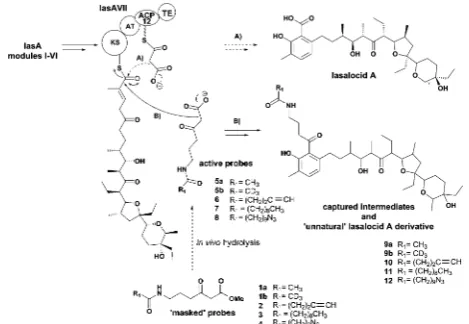
pathways leading to both high-value13and commodity chemicals.14 Advances in molecular biology, synthetic chemistry and analytical techniques have allowed the probing of PKS pathwaysvia recon-stitution of enzyme activityin vitro15andin vivogenetic manip-ulation leading to the accummanip-ulation of intermediate or shunt products,16 for which the detection and the characterisation of small molecule intermediates/products by advanced MS and NMR have proved crucial.17–19 Nonetheless, many challenges concerning the ability to monitor polyketide biocatalysis step-wise, especiallyin vivoand in relation to whole assembly kinetics, remain. One of the major hurdles is constituted by the covalent attachment of biosynthetic intermediates to the biosynthetic PKS enzymes throughout PKS assembly. In recent years we have developed a general strategy for probing polyketide biocatalysis based on the use of chemical probes (Fig. 1): nonhydrolysable small-molecule mimics of malonate units recruited in polyketide Fig. 1 Polyketide intermediate capture by chemical probes5–8: these interfere with the normal biosynthetic pathway (A) and undergo compe-titive decarboxylative Claisen condensation with KS-bound intermediates to off-load them (B). Advanced captured species constitute also novel unnatural product derivatives (e.g.9–12).23las A = lasalocid A polyketide synthase; KS = ketosynthase; AT = acyltransferase; ACP = acyl carrier protein; TE = thioesterase.
a
Department of Chemistry, University of Warwick, Library Road, CV4 7AL, UK. E-mail: [email protected]; Tel:+442476572878
bDipartimento di Scienza ed Alta Tecnologia, Universita’ dell’Insubria,
Via Valleggio 11, 22100 Como, Italy
†Electronic supplementary information (ESI) available: General methods for the synthesis of chemical probes and LC-HRMS analysis of the biosynthetic inter-mediates isolated fromS. lasaliensis. See DOI: 10.1039/c6cc04681a
‡Equal contribution.
§Current address: Bayer CropScience AG, Industriepark Ho¨chst, Building G836, Frankfurt am Main, 65926, Germany.
Received 8th June 2016, Accepted 28th July 2016
DOI: 10.1039/c6cc04681a
www.rsc.org/chemcomm
COMMUNICATION
Open Access Article. Published on 02 August 2016. Downloaded on 09/08/2016 10:15:16.
This article is licensed under a
Creative Commons Attribution 3.0 Unported Licence.
[image:2.595.310.545.264.426.2]formation compete in the natural decarboxylative Claisen con-densation (A) to capture prematurely truncated biosynthetic intermediates (B) which would otherwise remain covalently bound to PKSs.20–25 This approach has proved successful for the isolation and characterisation of intermediate species from both modular20–23and iterative polyketide synthases24,25in vitro andin vivo, allowing the gathering of information on the timing and the mechanism of single catalytic events otherwise inaccessible. Lately we also demonstrated that this methodology is amenable for the generation of unnatural polyketide derivatives: for instance, novel polyether species were obtained in low titre from feeding experiments of mutant strains of Streptomyces lasaliensis (harbouring the modular PKS responsible the production of the polyether antibiotic lasalocid A) with func-tionalised chemical probes (Fig. 1).23Moreover the use of the probes with strains harbouring 6-methylsalicylic acid synthase (a type I iterative PKS) has led to the generation of unnatural functionalised pentaketides.25During our studies towards the improvement of polyketide capture, it occurred to us that probe bioavailability could be a crucial limiting factor: indeed the hydrolysis of the methyl ester probes1–4by cellular esterases has been estimated to be in the range of 5–70%, depending on the nature of the probe (Fig. 1) and of the polyketide producing-microorganism. Therefore we decided to investigate whether, by changing the probe ester protection, a higher concentration of the ‘active’ carboxylate species 5–8could be systematically achievedin vivo, ultimately leading to improved intermediate capture and kinetic insights on polyketide assembly. In explor-ing possible protectexplor-ing groups that would be easily hydrolysed
in vivo, we considered the use of acetoxymethyl ester (AM) moieties. AM esters, notably introduced by Tsien for loading fluorescent indicators into cells,26 are widely employed in prodrugs27and chemical probes28 in eukaryotic cells to mask hydrophilic/charged bioactive functionalities, allowing effective compound cellular uptake through membrane permeation. The AM functionality and structural variants of it have been used to protect, directly and indirectly, a wide variety of groups, including alcohols,29 amines,30 phosphates31 and carboxylic acids.32,33 To the best of our knowledge, it has not been yet utilised for the protection ofb-keto carboxylic acid derivatives, and reports on the use of AM protected substrates in prokaryote cells are scarce. We first targeted the preparation of esters
15a–baccording to Scheme 1. Briefly, the carbonyl groups of the methyl esters 1a–b were protected by conversion either to the ketals 13a–b by reaction with 1-phenyl-1,2-ethanediol and chlorotrimethylsilane in reflux conditions (route 1),34 or to thioketals 17a by reaction with 1,2-ethanediol and boron trifluoride diethyl etherate (route 2).13a–band16awere then hydrolysed to the corresponding carboxylates by treatment with potassium trimethyl silanolate,35and converted to the acetoxy-methyl esters 14a–b and 17a by reaction with bromomethyl acetate in dry THF. Finally, the desired compounds15a–bwere obtained by hydrogenation of14a–bover Pd(OAc)2and Pd(OTf)2 catalysts in dry ethyl acetate (route 1),36or by treatment of17awith [bis-(trifluoroacetoxy)iodo]benzene (route 2). AM esters are known to spontaneously hydrolyse over time, even in neutral conditions.
Therefore15a–bwere promptly purified by HPLC and stored for a limited amount of time at low temperature and in a lyophilised form prior to their use.S. lasaliensisACP12 (S970A), for which late-stage intermediates of lasalocid A have been extensively characterised,22,23 was chosen as our in vivo model system to evaluate the efficiency of the ‘second-generation’ AM ester probes
15a–b in comparison to the first-generation methyl esters 1a–b. LC-HRMS analyses of the ethyl acetate extracts of S. lasaliensis
ACP12 (S970A) grown with gradual addition of probes 15a–b
(0.4–0.8 mM) over 5 days revealed their quantitative hydrolysis to
5a–b and the presence of significant higher amounts of the unnatural polyethers9a–b(Fig. 2). Several careful repetitions of these experiments and LC-MS analyses optimisation have Scheme 1 Synthesis of novel acetoxymethyl ester probes15a–band20. Reagents and conditions: (a) PhCH(OH)CH2OH, TMSCl, CH2Cl2, reflux, 90%;
(b) KOTMS, THF, 3 h, 86–100%; (c) BrCH2OAc, THF, 40–98%; (d) Pd(OAc)2,
Pd(OTf)2, H2(g), EtOAc, 48 h, 40% (after HPLC purification); (e) HS(CH2)2SH,
BF3Et2O, CH2Cl2, reflux, 61–90%; (f) (CF3CO2)2IC6H5, CH3CN, H2O, 78–82%
(after HPLC purification).
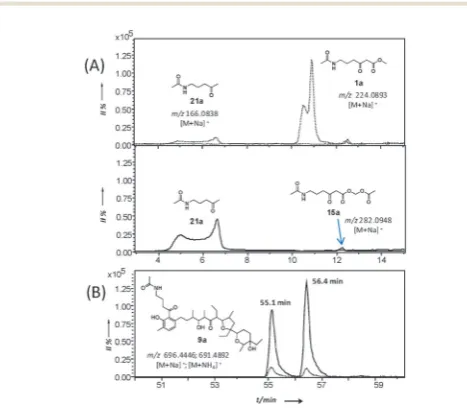
Fig. 2 Comparative micro LC-HRMS analysis (Bruker MaXis UHR-ESI-TOF) of the organic extracts ofS. lasaliensisACP12 (S970A) grown in the presence of1aand15a. (A) [M + Na]+extracted ion traces for probes1a(top) and15a
(bottom), and their hydrolysis/decarboxylation product21aafter 5 days of fermentation; (B) detection of species9a(sum of [M + Na]+and [M + NH
4]+
adducts): the amount captured by15a(continuous line) is approximately one order of magnitude higher than that obtained by1a(dashed line). The detection of a double peak for9ais under investigation.
Communication ChemComm
Open Access Article. Published on 02 August 2016. Downloaded on 09/08/2016 10:15:16.
This article is licensed under a
Creative Commons Attribution 3.0 Unported Licence.
[image:3.595.305.539.430.634.2]allowed us to estimate that up to ten times more of 9a was generated using the AM probes15ain comparison to its methyl ester counterparts 1a. Whereas the AM probes 15a–b led to increased amounts of 9a–b, no additional polyketide species could be detected in the organic extracts. In a variety of previous
in vivoexperiments, we noticed thatN-decanoyl probes methyl ester probes such as 3 (Fig. 1) seemed capable of off-loading relatively short intermediates from both modular and iterative PKSs,23–25possibly due to increased hydrophobicity of the probe or a better mimicking of the phosphopantetheine cofactor. Therefore we decided to pursue the preparation of N-decanoyl AM ester probe20following route 2 of Scheme 1. When both3
and 20were utilised in feeding experiments, further enhance-ment in the titre of captured intermediates was clearly observed in comparison to those deriving from short chain probes1and
15: this seemed to mirror the higher concentrations of active probe7generatedin vivo, especially from the AM precursor20
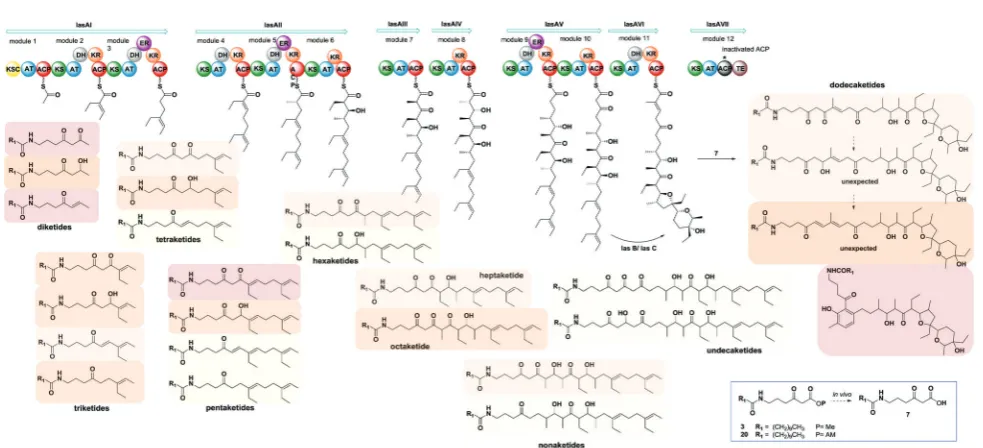
(B95%, Fig. S26, ESI†). More crucially, biosynthetic intermediates of different chain length and degree of processing were off-loaded from all the lasA modules with the exception of module 10 (Fig. 3 and ESI†). As well as expected species which were previously undetected, we also observed a number of unexpected overly processed dodecaketides (Fig. 3 and ESI†). These were unequivocally identified by them/z377 fragment (typical of lasalocid deriva-tives) obtained by high resolution MS2 (Fig. S47 and S48). Similar intermediates were obtained and confirmed from the use of the azido probe8and further intermediate functionalisation by Staudinger-phosphite reaction as previously reported23(ESI†). The mechanism and the timing of transformations leading to lasalocid A assembly have been previously investigated by us and by others.22,37 Also, spontaneous offloading of PKS biosynthetic intermediates has been occasionally reported from the fermenta-tion of wild-type and engineered bacterial strains.38,39Herein, we have been able to obtain for the first time a comprehensive and
stepwise picture of PKS modular assembly as a result of an improved chemical chain termination strategy. Diketides, pentaketides and dodecaketides were the most frequently and abundantly observed species for S. lasaliensis ACP12 (S970A) (highlighted in Fig. 3, see also ESI†), whereas the capture of intermediates from modules 9 to 11 proved particularly challenging. In this context the use of the AM ester probe20
proved more advantageous than the corresponding methyl ester3in that it lead to increased amounts of captured species aiding their identification and characterisation. The accumula-tion of intermediates in higher amounts from specific modules of the lasA PKS possibly arises from: (1) slower enzymatic steps taking place within particular modules and within the whole PKS, including different extent of KS site priming and inter-domain intermediate translocation, and/or (2) different active site accessibility and capability of diffusion for the probe and the off-loaded intermediates. Despite the abundance of kinetic data available for modular enzymatic constructs in vitro,40–42 the rate-determining steps of whole complex PKS biosynthetic pathways remain unclear. In our experiments, we observed condensation products of the chemical probes with KS-bound intermediates in most cases, however the abundance of these species varies across modules, suggesting that either the different Claisen condensation steps proceed at different rates, or that KS-priming varies within a whole PKS as a result of intermediate chain transfers across modules. In addition, the intermediates captured from different modules present different degree and extent of processing, which likely result from different rates of the individual KR-, DH- and ER-catalysed steps and/or from differential substrate accessibility to their active sites. On the basis of the data herein gathered, which show the detection of diketide, pentaketide and dodecaketide species in higher frequency and abundance, we propose that intermediate processing between modules 1 and 2, 4 and 5, and 11 and 12
Fig. 3 Overview of intermediates captured fromS. lasaliensisACP12 (S970A)viaester probes3and20. Coloured boxes have been used to differentiate the different species on the basis of their relative abundance (red boxes for the most abundant/recurrent species, light yellow for the least abundant/recurrent).
Open Access Article. Published on 02 August 2016. Downloaded on 09/08/2016 10:15:16.
This article is licensed under a
[image:4.595.53.545.468.692.2](including intermediate aromatisation) is slower compared to that occurring at other stages of PKS assembly: this is related either to the rapidity of intra- or inter-modular processing, or likely to a combination of both. For modular PKSs a ‘turnstile’42or ‘retarda-tion’43 mechanism control has been proposed, for which any ketosynthase of a modular PKS is not primed until completion of intermediate processing and transfer of the module product to the downstream KS: this would account for the unidirectionality of intermediate processing in co-linear pathways and may be con-trolled by the release of carbon dioxide following decarboxylative Claisen condensation.42Also, a number of structural models for selected PKS modules have recently become available on the basis of cryo-electron microscopy44,45 and small-angle-X-ray-scattering analyses:46,47 these preliminary results show a single reaction chamber into which most of the domain active sites face. The unexpected presence of overly processed dodecaketides, formally deriving from ketoredution and dehydration reactions of an expected dodecaketide yet to be aromatised (see Fig. 3 and ESI†), suggests that dodecaketide diffusion into the adjacent module 11 bearing active KR and the DH domains may have taken place. Whereas substrate diffusion across adjacent domains has been documentedin vitro,41free substrate diffusion to adjacent modules
in vivohas yet to be reported and is currently under investigation. In conclusion, we developed novel chemical probes of enhanced bioavailability that allowed the gathering of preliminary kinetic insights into complex natural product assemblyin vivo: these hold intriguing implications for the development of novel synthetic biology aiming at novel polyketide production.10–12,48–50 We gratefully acknowledge BBSRC (project grant BB/J007250/1 to M. T.), FP7 (Marie Curie Intraeuropean Fellowship to I. W.); Universita` degli Studi dell’Insubria (PhD studentship to S. G.); EPSRC (DTA PhD studentship to J. S. P.); the Institute of Advanced Studies (IAS) at Warwick (Postdoctoral Fellowship to E. R.); Dr Sue Slade and Dr Cleidiane Zampronio (School of Life Sciences, Warwick) for assistance with LC-HRMSn analyses performed on an Orbitrap Fusion instrument; Prof Greg Challis (University of Warwick) for the use of a MaXis Bruker Impact instrument; and Prof. Peter F. Leadlay (University of Cambridge) for the kind gift of
S. lasaliensisACP12 (S970A).
Notes and references
1 E. Larsen, M. R. Wilson and R. E. Taylor,Nat. Prod. Rep., 2015,32, 1183.
2 S. Kanoh and B. K. Rubin,Clin. Microbiol. Rev., 2010,23, 590.
3 W. Erb and J. Zhu,Nat. Prod. Rep., 2013,30, 161.
4 O. Tacar, P. Sriamornsak and C. R. Dass,J. Pharm. Pharmacol., 2013,
65, 157.
5 T. P. Stosse,Cell, 2008,134, 903.
6 P. B. Gupta, T. T. Onder, G. Jiang, K. Tao, C. Kuperwasser,
R. A. Weinberg and E. S. Lander,Cell, 2009,138, 645.
7 K. J. Weissman,Methods Enzymol., 2009,459, 3.
8 C. Hertweck,Angew. Chem., Int. Ed., 2009,48, 4618.
9 C. Olano, C. Me`ndez and J. A. Salas,Nat. Prod. Rep., 2010,27, 571.
10 M. Cummings, R. Breiting and E. Takano,FEMS Microbiol. Lett.,
2014,351, 116.
11 C. Hertweck,Trends Biochem. Sci., 2015,40, 189.
12 E. Kim, B. S. Moore and Y. J. Yon,Nat. Chem. Biol., 2015,11, 679.
13 R. Breitling and E. Takano,Curr. Opin. Biotechnol., 2015,35, 46.
14 A. Hagen, S. Poust, T. de Rond, J. L. Fortman, L. Katz, C. J. Petzold
and J. D. Keassling,ACS Synth. Biol., 2016,5, 21.
15 E. S. Sattely, M. A. Fischbach and C. T. Walsh,Nat. Prod. Rep., 2008,
25, 757.
16 H. Luhavaya, S. R. Williams, H. Hong, L. Gonzaga de Oliveira and
P. F. Leadlay,ChemBioChem, 2014,15, 2081.
17 S. B. Bumpus and N. L. Kelleher,Curr. Opin. Chem. Biol., 2008,12, 475.
18 E. Esquenazi, Y.-L. Yang, J. Watrous, W. H. Gerwick and
P. C. Dorrestein,Nat. Prod. Rep., 2009,26, 1521.
19 S. Nadmid, A. Plaza, R. Garcia and R. Mu¨ller,J. Nat. Prod., 2015,
78, 2023.
20 M. Tosin, L. Betancor, E. Stephens, W. M. A. Li, J. B. Spencer and
P. F. Leadlay,ChemBioChem, 2010,11, 539.
21 M. Tosin, Y. Demydchuk, J. S. Parascandolo, C. Blasco-Per,
F. J. Leeper and P. F. Leadlay,Chem. Commun., 2011,47, 3460.
22 M. Tosin, L. Smith and P. F. Leadlay,Angew. Chem., Int. Ed., 2011,
50, 11930.
23 E. Riva, I. Wilkening, S. Gazzola, W. M. A. Li, L. Smith, P. F. Leadlay
and M. Tosin,Angew. Chem., Int. Ed., 2014,53, 11944.
24 H. Kage, E. Riva, J. S. Parascandolo, M. F. Kreutzer, M. Tosin and
M. Nett,Org. Biomol. Chem., 2015,13, 11414.
25 J. S. Parascandolo, J. Havemann, H. K. Potter, F. Huang, E. Riva, J. Connolly, I. Wilkening, L. Song, P. F. L. Leadlay and M. Tosin,
Angew. Chem., Int. Ed., 2016,55, 3463.
26 R. Y. Tsien,Nature, 1981,290, 527.
27 L. D. Lavis,ACS Chem. Biol., 2008,3, 203.
28 V. S. Li, A. R. Lippert and C. J. Chang,Proc. Natl. Acad. Sci. U. S. A.,
2013,110, 7131.
29 L. D. Lavis, T.-Y. Chao and R. T. Raines,Chem. Sci., 2011,2, 521.
30 X. Sun, D. J. Zeckner, Y. Zhang, R. K. Sachs, W. L. Current,
M. Rodriguez and S. Chen,Bioorg. Med. Chem., 2001,11, 1881.
31 C. Schultz,Bioorg. Med. Chem., 2003,11, 885.
32 L. Tian, Y. Yang, L. M. Wysocki, A. C. Arnold, A. Hu, B. Ravichandran, S. M. Sternson, L. L. Looger and L. D. Lavis,
Proc. Natl. Acad. Sci. U. S. A., 2012,109, 4756.
33 X. Bao, Q. Zhao, T. Yang, Y. M. E. Fung and X. D. Li,Angew. Chem.,
Int. Ed., 2013,52, 4883.
34 T. H. Chan, M. A. Brook and T. Chaly,Synthesis, 1983, 203.
35 A. G. M. Barrett, M. Pen˜a and J. A. Willardsen,J. Org. Chem., 1996,
61, 1082.
36 S. J. Conway, J. W. Thuring, S. Andreu, B. T. Kvinlaug, H. L. Roderick,
M. D. Bootman and A. B. Holmes,Aust. J. Chem., 2006,59, 887.
37 A. Minami, H. Oguri, K. Watanabe and H. Oikawa,Curr. Opin. Chem.
Biol., 2013,17, 555.
38 J. Moldenhauer, X.-H. Chen, R. Borriss and J. Piel,Angew. Chem.,
Int. Ed., 2007,46, 8195.
39 B. Kusebauch, B. Busch, K. Scherlach, M. Roth and C. Hertweck,
Angew. Chem., Int. Ed., 2010,49, 1460.
40 N. Wu, S. Y. Tsuji, D. E. Cane and C. Khosla,J. Am. Chem. Soc., 2011,
123, 6465.
41 W. D. Fiers, G. J. Dodge, Y. li, J. L. Smith, R. A. Fecik and
C. C. Aldrich,Chem. Sci., 2015,6, 5027.
42 B. Lowry, X. Li, T. Robbins, D. E. Cane and C. Khosla,ACS Cent. Sci.,
2016,2, 14.
43 A. M. Hill and J. Staunton, Comprehensive Natural Products II:
Chemistry and Biology, Elsevier, 2010.
44 S. Dutta, J. R. Whicher, D. A. Hansen, W. A. Hale, J. A. Chemler, G. R. Condgon, A. R. H. Narayan, K. Håkansson, D. H. Sherman,
J. L. Smith and G. Skiniotis,Nature, 2014,510, 512.
45 J. R. Whicher, S. Dutta, D. A. Hansen, W. A. Hale, J. A. Chemler, A. M. Dosey, A. R. H. Narayan, K. Håkansson, D. H. Sherman,
J. L. Smith and G. Skiniotis,Nature, 2014,510, 560.
46 A. L. Edwards, T. Matsui, T. M. Weiss and C. Khosla,J. Mol. Biol.,
2014,426, 2229.
47 J. Davison, J. Dorival, H. Rabeharindranto, G. Mazon, B. Chagot,
A. Gruez and K. J. Weissman,Chem. Sci., 2014,5, 3081.
48 M. J. Hansson, S. J. Moss, M. Bobardt, U. Chatterji, N. Coates, J. A.
Garcia-Rivera, E. Elme´r, S. Kendrew, P. Leyssen, J. Neyts, M. Nur-E-Alam,
T. Warneck, B. Wilkinson, P. Gallay and M. A. Gregory,Chem. Biol., 2015,
22, 285.
49 M. A. Gregory, A. L. Kaja, S. G. Kendrew, N. J. Coates, T. Warneck, M. Nur-e-Alam, R. E. Lill, L. S. Sheehan, L. Chudley, S. J. Moss, R. M. Sheridan, M. Quimpere, M.-Q. Zhang, C. J. Martin and
B. Wilkinson,Chem. Sci., 2013,4, 1046.
50 M. C. Wu, B. Law, B. Wilkinson and J. Micklefield, Curr. Opin.
Biotechnol., 2012,23, 1.
Communication ChemComm
Open Access Article. Published on 02 August 2016. Downloaded on 09/08/2016 10:15:16.
This article is licensed under a
Creative Commons Attribution 3.0 Unported Licence.