Munich Personal RePEc Archive
Bank competition and export
diversification
Nakhoda, Aadil
State Bank of Pakistan
21 October 2013
Online at
https://mpra.ub.uni-muenchen.de/50774/
Bank Competition and Export Diversification
Aadil Nakhoda∗
October 2013
Abstract
The role of the banking industry in export promotion cannot be over-emphasized as banks provide the necessary financial support for borrowers in various industries to undertake investment activities. The banking industry consists of larger and smaller banks and the former are likely to be the preferred lenders as they provide loans for investment activities at a lower interest rate but may only finance the good borrowers within selected industries that are considered profitable. The banks require an appropriate market structure based on the level of competition in order to finance the maximum number of industries and in turn promote exporting activities across several industries within an economy. The influence of the market structure on export diversification is determined by the level of financial development and the prevailing macroeconomic conditions within an economy. With the help of an industry-level dataset on bilateral trade flows between various countries, I consider OLS and IV regressions to determine whether the Lerner Index of the banking industry, an indicator on the degree of competition, influences the number of industries exported. In order to consider the impact of competition in the banking industry on export diversification at different levels of financial development of the exporting countries, I split the countries into OECD member countries, non OECD countries and include a pooled set of countries. As macroeconomic conditions are likely to influence the market structure of the banking industry, I further split the samples of countries on the basis of the median levels of lending and the deposit rate spread, foreign bank participation rate and the ratio of government credit to private credit provided by the domestic banks for the respective groups of countries based on their OECD membership status and find varying results under different macroeconomic conditions and levels of financial development. In the recent years, several studies have determined the role of financial markets on exporting activities to be significant at the country-level as well as at the firm-level. To the best of my knowledge, this is one of the first paper to study the influence of competition within the banking industry on export diversification at the industry-level.
∗Address: State Bank of Pakistan, Research Department, I.I Chundrigar Road, Karachi-74000, Pakistan. Email:
Non-Technical Summary
Financial intermediation plays an important role in the promotion of export activities within an economy as it provides a source of finance to firms in need of additional funds to expand their international trading activities. The market structure of a banking industry influences the number of industries exported. The competitive nature of the banking industry defines the ease at which borrowers can access credit as banks maximize their revenue at the lowest cost. On the other hand, borrowers seek the best possible rates from banks to maximize their utility from their investments financed by a combination of cash holdings and bank loans. The level of information available across industries can determine the amount of knowledge on the characteristics of the borrowers obtained by the banks. The cost to service an industry is likely to increase with the vagueness of the information available across industries. Information that is relatively easy to obtain by lenders is considered ’hard’ and information that is difficult to obtain by lenders is considered ’soft’. The harder industries are likely to have a higher proportion of borrowers with lower rates of default than the softer industries. Industries with hard information are less costly to service than industries with soft information. Borrowers in an industry that provides hard information to their lenders relative to other industries will be offered loans at a lower interest rate. Such borrowers will have a lower utility for every dollar borrowed as credit is likely to be available with relative ease to its competitors as well. The market structure of the banking industry will determine the ability of banks to service the greatest number of borrowers that will not default within a specific range of industries and maximize their profits. This in turn will generate the incentives of the banks to promote export diversification across industries.
Banks incur explicit costs, such as fixed costs to service an industry as well as costs of lending to adversely selected borrowers that are likely to default on loan payments. The banks can be separated into two types, the larger banks and the smaller banks. In addition, the borrowers can be defined as either good borrowers or bad borrowers, with the latter more likely to default on loan payments than the former. The larger banks specialize in the provision of transaction-based lending facilities to borrowers that exhibit a lower risk of default on their payments and do not require to be in a close proximity to their lenders. On the other hand, the smaller banks specialize in relationship-based lending facilities to borrowers that require to be closely monitored by their lenders at an additional cost incurred to the banks in order to prohibit borrowers from undertaking risky investment activities that increases the risk of default. All borrowers will seek finance from the banks that offer the lowest interest rates but only the good borrowers within an industry will obtain funds from the larger banks. The bad borrowers, initially rejected by the larger banks, will be subsequently funded by the smaller banks.
of the borrowers. The good borrowers satisfy the banks with their ability to pay back the loans and are offered transaction-based lending facilities by the banks, while the bad borrowers require further screening by the lenders and are likely to require monitoring facilities that can only be provided by the smaller banks. The monitoring costs add to the marginal costs incurred by the smaller banks. Industries with a higher level of hard information are likely to have a higher proportion of good borrowers respective to industries with a higher level of soft information.
Banks face a certain level of fixed costs to service an industry in order to accumulate knowledge on the type of borrowers prevalent within an industry. The fixed costs incurred to service an industry are negatively correlated to the level of hard information available within an industry. The average fixed costs incurred by the banks to service an industry are determined by the number of potential borrowers. The larger banks incur lower average fixed costs relative to smaller banks in industries characterized by a higher level of information. As the level of information falls, the average fixed costs per dollar revenue earned by the larger banks is likely to increase as the rise in interest rates charged across industries to generate greater revenue cannot compensate for the rise in fixed costs and the fall in the number of potential borrowers across industries. The number of good borrowers decreases and the number of bad borrowers increases as the level of information falls. The decrease in the quality of borrowers lowers the average fixed costs per borrower for smaller banks but increases the average fixed costs per borrower for the larger banks. Hence, the larger banks define the number of industries serviced by establishing an upper limit and a lower limit on the level of information threshold based on their ability to maximize profits given the number of potential borrowers within an industry. Borrowers in the marginal industry at the upper limit will prefer cash holdings over bank loans as the source of funds for their investments at any positive level of interest rate. Larger banks that service a particular industry and incur significantly greater average fixed costs that do not provide them a cost advantage over the additional costs incurred by the smaller banks are likely to set that particular industry on the margin of the lower level of the information threshold. Further, the development of financial markets is likely to influence the ability of a bank to understand information. Banks in financially developed markets are likely to incur lower fixed costs to service industries and mon-itoring costs relative to banks in less developed financial markets, while also have a larger proportion of good borrowers across a greater number of industries.
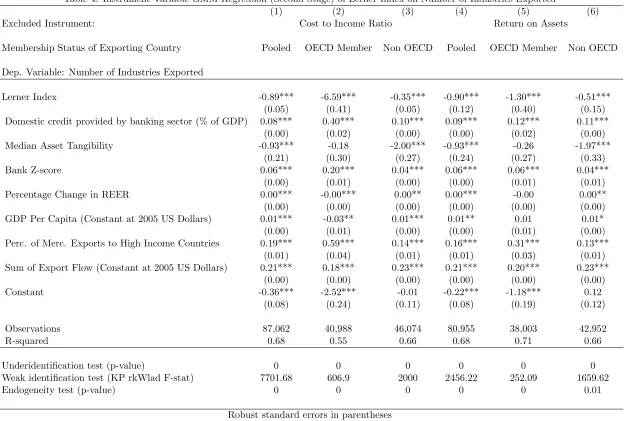
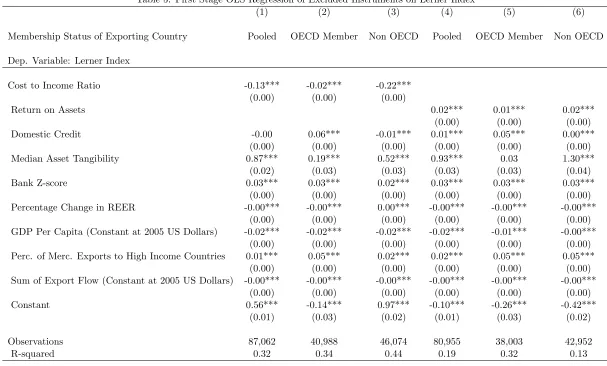
of the banking industry is likely to promote export diversification. I use return on assets, cost to income ratios, the concentration of the banking system and the level of credit reporting within a country as my excluded instruments for the IV regressions. The results I obtain for the IV regressions are consistent with the results I obtain for the OLS regressions.
Table of Contents
1 Introduction 1
1.1 Background . . . 1
1.2 Good Borrowers and Bad Borrowers . . . 3
1.3 Market Structure of the Banking Industry and the Number of Industries Exported . . . 7
1.4 The Lending and Deposit Rate Spread . . . 9
1.5 The Role of Foreign Banks . . . 10
1.6 Credit to the Government from Domestic Banks . . . 11
2 Theoretical Model 13 2.1 Setup . . . 13
2.2 Discussion . . . 15
2.3 The Lending and Deposit Rate Spread . . . 17
2.4 The Role of Foreign Banks . . . 18
2.5 Credit to the Government from Domestic Banks . . . 20
3 Empirics 21 3.1 Data . . . 21
3.2 Econometric Specification . . . 22
3.3 Results . . . 25
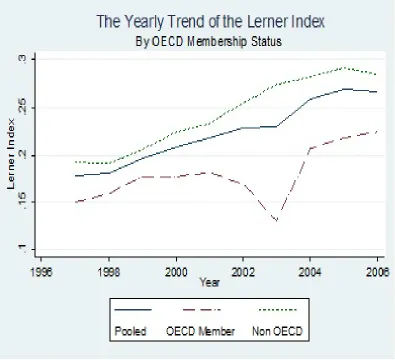
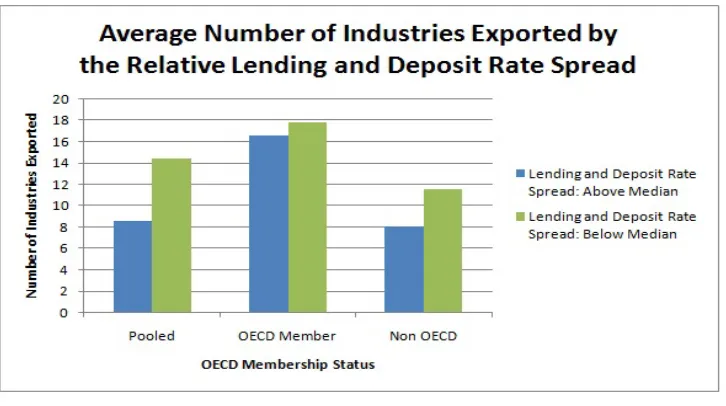
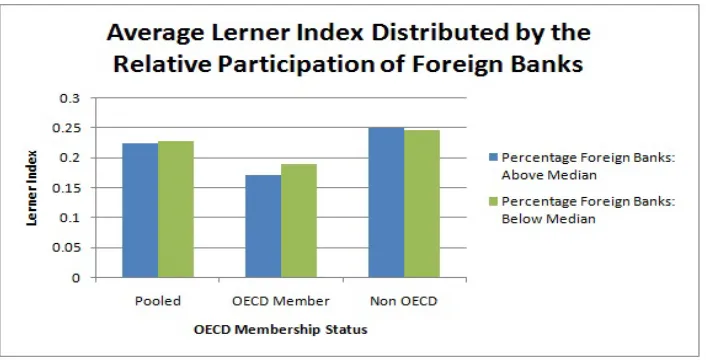
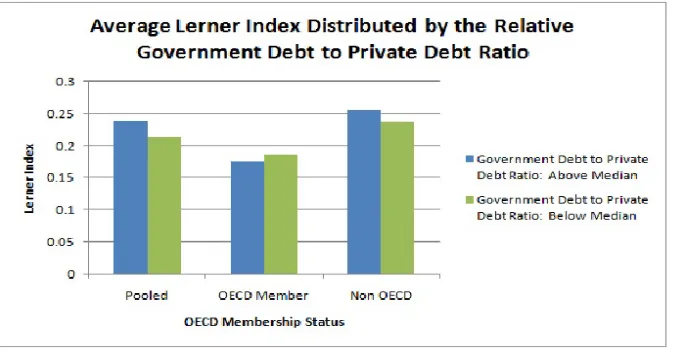
3.3.1 Discussion on Figures . . . 25
3.3.2 Discussion on Tables . . . 27
4 Conclusion 36
5 Figures and Tables 38
6 Appendix 51
1
Introduction
1.1 Background
Financial intermediation plays an important role in the promotion of export activities. Financial markets with strong fundamentals are likely to provide their new and well-established exporters that intend to increase their investment activities easier access to finance relative to such borrowers in financial markets with weak fundamentals. The seminal paper by Rajan and Zingales (1998) establishes a strong relationship between financial development and economic growth as it emphasizes the role of financial development on the access to finance for industries based on the level of financial dependence. This effect can be inter-preted as a crucial link between financial development and the number of industries in which borrowers are financed by banks. Beck (2002) and Chor and Manova (2012) consider the impact of financial development and growth in export activities at the country-level. In addition, Iacovone and Zavacka (2009) consider the detrimental role of financial dependence of industries on its export growth during episodes of banking crisis to reinforce the link between the financial development and export patterns observed within an economy. In addition, Greenaway, Guariglia, and Kneller (2007), Muˆuls (2008), Bellone, Musso, Nesta, and Schiavo (2010), Berman and H´ericourt (2010) and Nakhoda (2012) link credit constraints faced by firms that seek access to finance and its impact on their international trading activities. The aforementioned literature supports the evidence that easier access to finance for firms plays a crucial role in the expansion of their international trading activities. This paper attempts to establish an important connection between the role of the market structure of the banking industry and export diversification at the industry-level observed within an economy.
Easy access to credit is considered an important factor in the promotion of exporting activities. Hence, the role of the banking industry in export promotion cannot be over-emphasized. A banking system that provides easy access to finance for exporters across several industries will likely involve a market structure that is conducive to growth in the exporting activities of firms within a country. An effective banking system based on an appropriate market structure will provide an opportunity for the banks to best use the available information on the borrowers and subsequently provide borrowers with greater financing oppor-tunities1
. For instance, a competitive banking environment will induce intense price competition amongst banks that will compel them to provide cheaper loans to all its borrowers and subsequently increase their lending facilities to a greater number of industries. On the other hand, a larger bank with greater market power may provide cheaper loans to customers in a greater number of industries at the cost of higher interest rates to its captive borrowers. Therefore, both extremes of the market structure improve access to finance for firms, albeit in different ways. However, the effectiveness of the market structure is dictated by the macroeconomic conditions within a country. The purpose of this paper is to determine whether a certain type of market structure, based on the Lerner Index of the banking industry, plays an effective role in increasing the number of industries exported. As macroeconomic conditions are likely to influence the market structure of the banking industry, I will consider different macroeconomic conditions based on the lending and deposit rate spread, foreign bank participation rate and the ratio of government credit to private credit provided by the domestic banks. Although, several studies have determined the role of financial markets on exporting activities to be significant at the country-level as well as at the firm-level, there is a dearth of studies that consider the impact of the market structure of the banking industry on the number of industries that participate in the export market. To the best of my knowledge, this is one of the first paper to study the impact of the competitiveness of the banking industry on the diversification of the industries that participate in the export market.
Sharpe (1990), Diamond (1991) and Rajan (1992) consider whether asymmetric information between banks and borrowers affects the ability of banks to provide loans to the borrowers. Some banks monitor their borrowers and gather proprietary information that allows them to undertake a more personal banking relationship, or relationship-based lending, relative to the other banks that may service their clients at an arm’s length relationship, or transaction-based lending. However, the banks that require monitoring of the borrowers incur greater costs compared to the latter. Banks that do not monitor their clients will not lend to borrowers they believe will default on their loans. These type of borrowers create a potential market of clients for banks that specialize in monitoring clients and establish a more face-to-face rela-tionship with their borrowers in order to eliminate the risk of default. Rajan and Zingales (2004) defines relationship-based lending as a facility where lenders do not use the legal system to recover their loans
1
but instead threaten and cajole borrowers by using the lever of power they have strengthened through the collection of important information on their borrowers over the years. The relationship-based lend-ing facilities are prominent in systems that lack financial development. Hence, the banks that undertake transaction-based lending can provide loans at a lower interest rate than their counterparts that special-ize in a relationship-based lending service but will only lend to the borrowers with a low default rate as they can neither constantly monitor the behavior of the borrowers nor have the ability to threaten and cajole their borrowers through informal means. The difference in the interest rates offered by the banks that provide transaction-based lending makes them a preferred choice of lenders for all borrowers. Bolton, Freixas, Gambacorta, and Mistrulli (2013) consider transaction-based lending facilities to be a more pre-ferred option for the borrowers than the costly relationship-based lending facilities as the former is likely to be offered at a lower interest rate2
. As information asymmetry can become a major concern for lenders servicing industries with opaque information, such banks will only lend to borrowers in industries with easily obtainable information and that too only to the best borrowers within that industry. Therefore, the problem of adverse selection generated by asymmetric information may lead to the creation of different categories of borrowers, good and bad, based on the perceived ability of the borrowers to pay back their loans. Strahan (2008) extensively reviews various literature that focuses on the differences between larger banks and smaller banks and suggests that the former lend more to larger and better performing borrowers. The role of banks that undertake transaction-based lending plays an important role in determining the diversification in the number of industries exported.
The next subsection will discuss the differences between the good borrowers and the bad borrowers that either obtain arm’s length transaction-based lending facilities or relationship-based lending facilities respectively and the implication of this difference on the diversification of industries that participate in the export market as the banking industry maximizes its profits based on the pool of good and bad borrowers.
1.2 Good Borrowers and Bad Borrowers
Dell’Ariccia, Friedman, and Marquez (1999) present the basis of the theoretical model on the adverse se-lection of good borrowers and bad borrowers that apply for a loan from banks. The good borrowers have better access to finance relative to the bad borrowers. Some banks are likely to be more informationally challenged than other banks as private information on borrowers is accumulated by banks over years of experience of lending to their borrowers. Although, the model in this paper is similar to that suggested by
2
Dell’Ariccia et al. (1999), I assume that the larger banks and the smaller banks provide different products to the borrowers, transaction-based lending and relationship-based lending respectively. Dell’Ariccia and Marquez (2004) mention the benefits better information may provide to lenders when asymmetrical infor-mation on borrowers is likely to exist. Asymmetrical inforinfor-mation between the lenders and the borrowers may increase the probability that the bad borrowers obtain finance from banks instead of the good borrow-ers but lendborrow-ers with additional advantage through investments that accumulate knowledge on borrowborrow-ers may gain market power in the banking industry. Larger banks may enjoy the benefits of market power exerted on their captive borrowers in industries with hard information. Consequently, larger banks are likely to offer loans to such borrowers at a higher interest rate3
. The market structure of the banking industry will play an important role to determine whether borrowers in industries differentiated by the ability of banks to gather information obtain finance. Cetorelli and Gambera (2001) determine the detri-mental role of market concentration in the banking industry on the reduction of growth prospects of firms within an economy but also suggests that market concentration that facilitates lending relationships can be beneficial for borrowers in financially dependent industries as concentrated banking industries can increase the availability of finance to credit-constrained firms. In the context of this paper, banking concentration can promote diversification in the industries exported if the larger banks that are not dependent upon long-term relationships can charge higher interest rates to their captive borrowers in order to compensate for the costs of increasing the number of industries financed4
. In addition, Presbitero and Zazzaro (2011) determine that competition between larger banks where they are predominant in economies can be detri-mental to smaller banks that specialize in relationship-based lending facilities as larger banks may service a wider number of industries and reduce the number of borrowers available to the smaller banks. This may consequently influence the number of industries that participate in the export market as larger banks proliferate the banking industry by offering relatively cheaper loans to the borrowers of smaller banks and promote investments such as exporting activities.
Petersen and Rajan (2002) and Berger, Miller, Petersen, Rajan, and Stein (2005) consider the role of geographical distance between borrowers and lenders. They determine that larger banks are geographi-cally dispersed and have clients located across the country as their banking relationships are independent of the distance between the borrowers and lenders. On the other hand, the smaller banks are geographically concentrated and focus on clients in a specific region. As a result the borrowers of smaller banks are at a closer proximity relative to the borrowers of the larger banks. Degryse and Van Cayseele (2000) show
3
Banks can also enjoy market power in industries where informational asymmetries may be limited due to regulatory control or conditions in the macroeconomic environment that inhibits competition and the supply of bank loans. In this paper, I will show how large interest rate spreads promote the link between market power of larger banks and the diversification in the industries exported.
4
that the lock-in effect of relationship-based lending leads to higher interest rate on loans, allowing smaller banks to charge their borrowers higher interest rates. Hauswald and Marquez (2006) differentiate between informed banks and uninformed banks, where the the former are likely to undertake relationship-based lending and the latter undertake transaction based-lending. Informed banks screen borrowers in order to acquire proprietary information, for instance through regular face-to-face meetings with the client and spe-cialize in relationship-based lending facilities5
. Informed banks are able to mitigate the problems related with adverse-selection of borrowers that are likely to default but doing so incurs additional monitoring costs. Transaction-based lending facilities do not require constant monitoring of the clients. As it incurs lower marginal costs, it will be offered at a lower interest rate. Borrowers prefer transaction-based lending facilities and apply for a loan to the larger banks that specialize in transaction-based lending facilities if such banks service their industry. Good borrowers will obtain loans from the larger banks. Rejected borrowers will subsequently apply to the smaller banks for a loan and the smaller banks with its ability to monitor it clients will lower the probability of default to zero. Further, in my model, the banks undergo a fixed cost to obtain information on borrowers within an industry and this cost is an increasing function of the opaqueness of the level of information within an industry. The fixed costs incurred by the larger banks to service an industry creates a wedge between the optimal interest rates asked by the borrowers and offered by the lenders. Therefore, the reduction in the level of information across industries increases the average fixed costs for the larger banks, lowering their ability to provide transaction-based lending facilities to borrowers in industries with opaque information. Smaller banks will exclusively finance borrowers in industries with relatively opaque information.
Information that is easily obtainable by banks either through the balance sheets and income state-ments of banks or its trading activities is considered as ’hard’ information. On the other hand, relatively opaque information that is unobtainable information by banks is considered ’soft’ information. Petersen (2004) differentiates between hard and soft information, defining the former as quantitative, easy to store and transmittable data that can easily be ranked and categorized by the borrower. On the other hand, Petersen (2004) classifies soft information as qualitative information that is likely to be based on ideas, economic projection, rumors and collected in person by lending agents rather than based on impersonal credit reports. Iyer, Khwaja, Luttmer, and Shue (2013) emphasize the role of soft information on lending decisions as lenders tend to rely on additional information that cannot be obtained from credit reports to screen borrowers to be of lower quality. Improvements in the level of information will readjust the market structure of the banking industry as it will make the banks more efficient. This improvement in the level of
5
information will increase the number of industries financed by the larger banks and subsequently lower the cost of finance available to firms in industries not previously financed by the larger banks. In essence, the larger banks will finance a greater number of industries and diversify the industries exported from a country.
Braun (2003) ranks industries according to its level of asset tangibility. Larger banks are likely to have a comparative advantage lending to firms that belong to industries which provide hard information and smaller banks are likely to specialize their lending activities towards firms belonging to industries that exhibit soft information. In addition, lending practices of banks are also likely to differentiate between the good borrowers and the bad borrowers. Importantly, the percentage of good borrowers is likely to decrease as the level of hard information falls across industries. Pre-determined threshold levels, set as either upper bound or as lower bound, is based on the hardness of information of industries prevalent in the country. Firms belonging to industries above the upper bound will not borrow from banks as they believe that all lenders have set higher interest rates than they are willing to incur on their loan payments. Firms above the industry-level information upper bound threshold will use internal funds to finance their investments as they demand a lower interest rate than can be profitably set by the lenders due to the level of information offered by their industry. Firms below the industry-level lower bound threshold will borrow from smaller banks as larger banks are not able to service industries with high levels of opaqueness of information as the level of average fixed costs to service the industry may be substantially high. As smaller banks are likely to be geographically constrained to their own region and specialize in relationship-based lending facilities designed specifically for individual clients within their region, it is competition amongst larger banks that is likely to influence the number of industries financed. The increase in the number of larger banks is likely to lower the proportion of borrowers that seek the more expensive relationship-based lending facilities as larger banks offer a cheaper option across multiple industries.
to maximize their profits in extracting surplus from captive borrowers will be limited by the presence of competition in the banking industry. However, borrowers are likely to cap their interest payments and as a result are willing to accept an interest rate below a certain ceiling. Therefore, larger banks will need to manipulate their interest rates in order to maximize their profits as they offer loans to borrowers in industries above and below the upper and lower levels of information threshold respectively. The following section discusses the impact of the market structure of the banking industry on the number of industries exported.
1.3 Market Structure of the Banking Industry and the Number of Industries Ex-ported
Boot and Thakor (2000) combine the ability of a bank to undertake both, transaction-based and relationship-based lending facilities, and consider the impact of competition on the strategy of such a bank. Boot and Thakor (2000) suggest that an increase in competition between banks is likely to shift the preference of banks towards relationship-based lending facilities as transaction-based lending is likely to be susceptible to price competition6
. As industries that rely on relationship-based lending require greater investments in industry and location specific knowledge of the borrowers, banks prevalent in industries with soft informa-tion incur larger fixed costs in order to understand borrower characteristics to service such industries. The provision of relationship-based lending by smaller banks is likely to be insulated from competitive pres-sures. Similar to Boot and Thakor (2000), the larger banks are more susceptible to competitive pressure from other larger banks as the profits of the larger banks diminish with the increase in the number of larger banks. In addition, the number of banks that can match the interest rates offered by each lender increases. Hence, the larger banks will be compelled to set the lowest interest rate possible. In a perfectly competitive environment, this interest rate is likely to equal the marginal costs of offering transaction-based lending facilities to the borrowers. On the other hand, smaller banks that undertake relationship-based lending will be geographically concentrated and provide more specialized lending facilities that can insulate them from being exposed to intense price competition. However, the interest rates set by the smaller banks will take into account the additional monitoring costs incurred for providing relationship-based lending facilities.
The franchise valueof a bank can be defined as the present value of its stream of expected future prof-its. A lower franchise value, usually observed within a competitive environment, implies greater fragility within the banking system. However, the opinion whether competition increases fragility of the banking industry is divided amongst researchers. Keeley (1990) and Demsetz, Saidenberg, and Strahan (1996)
6
suggest competition reduces the franchise value of a bank and in turn induces riskier behavior from banks. Ratnovski (2013) suggests competition can increase stability by lowering interest rates as a larger number of banks compete for the same pool of borrowers but may also lead to destability as it can induce riskier lending patterns. In addition, Fung´aˇcov´a and Weill (2013) and Jim´enez, Lopez, and Saurina (2010) sup-port the franchise value paradigm as they determine that competition increases fragility within the banking industry. On the other hand, Boyd and De Nicolo (2005) and Schaeck, Cihak, and Wolfe (2009) counter the claims of the aforementioned paradigm and suggest that competition may instead increase stability within the banking industry. In the perspective of this paper, the good borrowers are likely to respond to a monopolistic setting within a banking industry by undertaking riskier investments with greater payoffs as borrowers may be constrained by their belief that a monopolistic bank will set higher interest rates and provide less opportunities to switch away from those lenders7
. I consider whether competition amongst banks induces riskier behavior as they undertake greater fixed costs to service a larger array of indus-tries with lower level of information and a higher proportion of bad borrowers. I find that the prevalent macroeconomic conditions play an important role in defining the relationship between market power in the banking industry and the number of industries exported.
Broecker (1990) determines a negative relationship between credit worthiness of borrowers and an increase in competition between banks as those that charge higher interest rates are likely to get the worst borrowers. Broecker (1990) defines this paradigm as the ’winner’s curse.’ Any improvement in the level of information that increases the competition within the banking industry is likely to reduce the market power of larger banks and its ability to charge high interest rates to its captured borrowers. Larger banks may compete for borrowers amongst themselves but cumulatively are likely to dominate smaller banks and may compel the latter to seek borrowers in industries with more opaque information. The ability of smaller banks to provide specialized lending product counters the informational asymmetries that would otherwise hamper transaction-based lending facilities. Although, competition amongst the larger banks is likely to reduce residual demand of loans from borrowers in industries financed by the larger banks, the smaller banks will be insulated from competition in industries that are not conducive to transaction-based lending.
Competitive pressure on larger banks will force them to service industries with softer information but the larger banks in these industries will incur a greater cost in terms of fixed costs as well as face a smaller pool of good borrowers. On the other hand, larger banks with market power will be able to charge
7
higher interest rates to their captive borrowers that find transaction-based lending facilities cheaper than relationship based lending facilities and service the best borrowers in industries that provide them with substantial returns. This reduces the number of borrowers for smaller banks and once again compelling them to service other industries. It is important to note that the conditions in the macroeconomic envi-ronment such as ability of the larger banks to maneuver interest rate spreads is likely to be influential in determining the lending patterns of larger banks.
1.4 The Lending and Deposit Rate Spread
Although, banks may set different interest rates for different industries based on their strategies to maxi-mize profits and increase the number of borrowers, the lending and deposit rate spread at the country-level is likely to be influenced by a regulatory authority, the central bank, which determines the discount rate at which the banks borrow to meet their own short-term liquidity needs. This provides the central bank power to dictate the interest rates at which banks may lend to the private sector. The desire of the central bank to adjust the discount rate may have little to do with the level of competition in the banking industry but rather to control the inflationary pressures within an economy. The lending and deposit rate spread will have an impact on the competitive nature of the banking system but it is unlikely to be endogenous. For instance, a monopolistic banking industry with one larger bank may have a similar lending and de-posit rate spread as a highly competitive banking industry with several larger banks. In addition, the ability of commercial banks to adjust lending and deposit rates may differ under different macroeconomic environment, for instance monetary tightening and loosening policies, as is suggested by Gambacorta and Iannotti (2007). Beck, De Jonghe, and Schepens (2012) determine the impact of an increase in competition on the risk taking activities of banks across countries under different economic environments and find that competition tends to have a larger impact on risk taking incentives of banks in countries where informa-tion between banks is shared more effectively. The purpose of the study in this paper is to determine the influence of the interest rate spread between the lending and deposit rates on the impact of the market structure of the banking industry on the number of industries exported.
1.5 The Role of Foreign Banks
Claessens and Laeven (2004) emphasize the importance of the presence of foreign banks on the competi-tiveness nature of the banking system. The development of financial markets is often accompanied by a greater presence of foreign banks within an economy. Clarke, Cull, Peria, and Sanchez (2003) discuss the various sizes and nature of foreign banks that participate in developed and developing financial economies by reviewing several studies focused on the role of foreign banks. More importantly and pertinent to the study undertaken in this paper, the authors suggest that foreign banks hosted in developed economies are likely to be smaller and less efficient than the larger domestic banks. On the other hand, foreign banks hosted in developing economies are likely to be larger and more efficient than the larger domestic banks. Goldberg, Dages, and Kinney (2000), Iacoviello and Minetti (2008) and Claessens and van Horen (2013) find that the significance of the role of foreign banks in developing countries is more prominent than domestic banks as the foreign banks tend to outperform their domestic competitors and contribute more towards an increase in the average productivity of the borrowers.
Detragiache, Tressel, and Gupta (2008) suggest that foreign banks are likely to ’cherry-pick’ the best borrowers and have a relatively safer portfolio than their competitors. Further, Sengupta (2007) suggests that foreign banks may be more effective in providing loans to low-risk borrowers. Foreign banks tend to make loans in their host country based on hard information, which they are likely to obtain more easily relative to soft information. Foreign banks may also prefer to have a clientele consisting mainly of multi-national firms, particularly those firms headquartered in their source country as well as larger exporting firms. Mian (2006) and Beck, Ioannidou, and Sch¨afer (2012) find that foreign banks offer different prod-ucts to their borrowers than domestic bank as foreign banks rely heavily on hard information in order to assess firms and provide them with more efficient lending facilities with access to foreign financial markets. This strategy of lending to the better performing borrowers in industries with hard information limits the provision of finance from foreign banks to certain sectors within the economy.
domestic banks, which may require the foreign banks to adopt strategies that compete with relatively smaller domestic banks. In a financially developed economy where the banking system is dominated by the presence of foreign banks, it is likely that diversification of the portfolio of industries exported occurs where larger banks are competitive rather than possess a higher degree of market power. With the inability to set higher interest rates, the domestic larger banks that enjoy market power will service a few selected industries with the highest level of information but will not necessarily be able to charge higher interest rates to their captured borrowers to diversify their portfolio. On the other hand, a competitive banking industry will compel the larger banks to diversify their portfolio as their profits are limited if they serve a smaller range of industries. As foreign banks do not finance industries serviced by the larger domestic banks in developed economies, the larger banks will seek to service the maximum number of industries in order to retain the maximum profits8
. An improvement in the level of information will allow the larger domestic banks to service additional industries. In addition, as the foreign banks service softer industries, they may be compelled to service the best borrowers in a wider range of such industries as competition and development of the financial market limits their ability to set higher interest rates to borrowers that need access to foreign markets. In developing economies, the market power in the banking industry will promote foreign banks to ’cherry-pick’ the best borrowers in additional industries as the level of informa-tion improves. Berger (2007) conducts an extensive literature review on topic of the relative differences in the efficiency frontier of foreign and domestic banks in the developing and developed economies and the various advantages and disadvantages of foreign bank entry in the respective economies. This paper attempts to determine whether the role of competition within the banking industry is likely to influence the number of industries exported in countries with different levels of foreign bank participation.
1.6 Credit to the Government from Domestic Banks
The level of borrowing by a government from its domestic financial institutions, particularly the commercial banks, can influence the market structure of the banking system and in turn dictate the number of indus-tries exported. Fischer and Easterly (1990) and Abbas and Christensen (2009) discuss the implications of the accumulation of bank debt by governments on the crowding out of private debt by financial institu-tions in shallow financial markets as banks seek to finance a safer asset that promises risk-free returns9
.
8
The larger domestic banks cannot set high interest rates even if the foreign banks do not service their industry. As the development of the financial markets reduces the distortions in costs to service an industry, a higher interest rate set by the larger domestic banks may increase the incentive of a large mass of foreign banks to service an industry financed by the larger domestic banks and earn greater profits even if it risks funding their bad borrowers. Foreign banks may provide their borrowers with greater incentives in an economy with high interest rates than the larger domestic banks and the smaller domestic banks.
9
Christensen (2004) suggests that expansion in domestic debt can have extensive repercussions to the econ-omy as it can lead to higher domestic interest rates and the effect is likely to be stronger in countries with a narrower investor base. The private sector is likely to suffer not only from the shrinking of the financial resources available but also from the increase in costs created by the demand for government credit from the banks. Further, Aghion and Marinescu (2008) determine the positive effect of counter-cyclical budget deficits on economic growth and suggest that the effect is greater in less financially developed countries. Kumhof and Tanner (2005) accounts for the poorly developed institutions and legal systems that may com-pel banks to lend to the government in order to compensate for the lack of provision of collateral offered by the private sector. Therefore, it is likely that in countries where the ratio of government credit to private credit is high, the government tends to substitute the private sector in providing resources to its citizens and the impact of the competition within the banking industry on the diversification in the industries exported is likely to be minimal. This effect is further amplified in less developed financial markets. In addition, Krueger (1991) emphasizes the highly distortive policies of governments in developing countries that may lead to lower investments in the improvement of the infrastructure to support the private sector and instead promotes higher spending on government payments for the agricultural sector, public sector enterprises, retail shops and in some cases, luxury hotels.
a role to influence the diversification of the number of industries exported in countries in which the ratio of government credit to private credit is high as it does for countries in which the ratio of government credit to private credit is low. I consider whether the relationship between the Lerner Index of the banking industry and the number of industries that participate in the export market varies within countries with different levels of financial development and varying levels of the ratio of government debt to private debt.
2
Theoretical Model
2.1 Setup
The assumptions put forward by Bolton et al. (2013), Hauswald and Marquez (2006), Dell’Ariccia and Marquez (2004), Rajan (1992), Diamond (1991), Sharpe (1990) contribute to the model discussed in this section10
.
In order to define the characteristics of the trading patterns, I assume that the exporting country has a single large trading partner and there is frictionless trade between the trading partners. The demand for goods will be determined by the characteristics of the exporting country, which competes with several other exporting countries, rather than the characteristics of the importing country. I assume m banks in an economy and m≥2. The Lerner Index in the banking industry is defined as P−M C
P , where P, price,
is calculated as total bank revenue over assets. M C is marginal cost and is calculated as the tanslog cost function with respect to output. Beck, De Jonghe, and Schepens (2012) adopts the Lerner Index as the choice variable to measure competition within the banking industry and explain the impact of pricing on the supply side based on the marginal cost as well as the impact of pricing on the assets owned by banks11
. Assuming there are mbanks,mL larger banks andm−mL smaller banks, the banking industry
is monopolistic whenmL= 1 and the market power diminishes within the banking industry asmL→ ∞12.
The industries serviced by the larger banks are characterized with the level of information,θL. The larger
banks charge an interest rate rθLL to their borrowers. The smaller banks charge an interest rate rSθL when
10
A detail mathematical working is provided in the technical supplement available at
http://sites.google.com/site/aadilnakhoda/ or by request from the author at [email protected].
11
The Lerner Index measures the pricing power of the banks within the banking industry and is not biased by geographical concentrations of banks that may reveal greater competitive powers when in contrast larger banks have monopoly power. For instance, an industry dominated by one larger bank and many geographically concentrated smaller banks will have a lower concentration ratio than an industry with many larger as well as smaller banks.
12
servicing industry with information level, θL and rSθS when servicing industry with information level, θS,
where rθSS, rθSL ≥rθLL and θL > θS. The smaller banks undertake relationship-based lending facilities that
require regular monitoring of their borrowers. The monitoring costs, (1−φ)γS(θL) and (1−φ)γS(θS) in
industries θL andθS respectively, result in a higher interest rate charged to their borrowers relative to the
interest rates charged by the larger banks that offer transaction-based lending facilities to their borrowers.
The information threshold determines the ability of large banks to finance good borrowers that be-long to industries within the upper and lower limits of the threshold. Setting, θl
L as the lower bound
and θLu as the upper bound of the information threshold respectively for the larger banks, I assume that
θlL≤θL≤θLu. The level of development of the financial market, φ, determines the ability of banks to
understand information. A higherφwill increase the level of the upper bound and decrease the level of the lower bound, allowing more industries to be financed by larger banks. This is consistent with the exposi-tion in Rajan and Zingales (1998) that promotes the link of financial development and economic growth. Therefore, θl
L = (1−φ)θL ≤θL ≤(1 +φ)θL = θLu, where the country with the least developed financial
market will haveφ= 0, the country with the most developed financial market will haveφ=∞and all other countries will have 0≤φ≤ ∞13. Asφdetermines the level of development of the financial markets, it also indicates the ease at which finance can be accessed by the borrowers. Borrowers that belong to industries with a higher level of information in financially developed markets are likely to have a lower demand for bank loans relative to borrowers in either industries with a lower level of information or less developed fi-nancial markets14
. Therefore, the interest rate on bank loans will fall with the increase in either the level of development of the financial markets or in the level of information available on an industry to the lenders15
.
Firms in the industry with information θLwill be the only ones to receive financing from larger banks.
Firms above this information threshold will not seek external sources of finance as cash holdings are prefer-able at the interest rate offered by the larger banks16
. Firms in industries below this threshold will not be financed by the larger banks and will have to seek funds from smaller banks that are able to monitor loan repayments unless an improvement in the level of information level makes such industries viable to service for the larger banks.
13
Although, it is mathematically possible to have φ = ∞, I assume φ to lie between 0 and 1 in order to simplify the
calculations.
14
Developed financial markets also have a greater supply of credit relative to less developed financial markets as well as greater demand for loans due to higher investment needs of the borrowers.
15
In this paper, I consider the former to be exogenously determined by the OECD membership status of the exporting country. The reallocation in the market structure will be a result of an improvement in the level of information transmitted to the banks.
16
I assume a Stackelberg leadership model where the larger banks are the market leaders and the smaller banks are the followers. The larger banks send a signal to all borrowers that it will lend at interest rate, rθL, to the good borrowers within a range of industries it services. The interest rates offered are
sorted according to the level of information provided by each industry and by the level of development of the financial market. The larger banks have a first mover advantage and they determine the infor-mation threshold, upper and lower, given the quality of inforinfor-mation on borrowers within each industry and their ability to pay fixed costs related to the provision of services to an industry17
. The industries above the upper threshold may have the lowest fixed costs to service an industry but the borrowers within the industries are likely to be reluctant to borrow as they assign a lower value to every dollar of bank loan18
.
2.2 Discussion
I assume that all larger banks charge the same interest rate to the borrowers as they provide similar transaction-based lending facilities and that the demand for credit within the economy satisfies profitable return to all larger banks. As larger banks can only offer loans to the good borrowers within an industry, it is necessary for the larger banks toex-ante screen out the borrowers based on their perceived ability to payback their loans. Banks pay a substantial amount of fixed costs to analyze an industry and understand the type of borrowers present within that industry. The average fixed costs per borrower undertaken by the larger bank decreases as the number of good borrowers and in turn, revenue earned, increases across indus-tries19
. The average fixed costs influence the difference in interest rates that a cost minimizing borrower is willing to pay and the profit-maximizing larger bank is willing to set at a given level of information20
. The greater the wedge, the less efficient is the market interest rate on loans. On the other hand, borrowers that apply for the first time will always prefer the larger banks as their source of funding as it is the cheapest source.
Firms that are not able to obtain financing from larger banks will seek funds from smaller banks. Borrowers applying for loans cannot ex-ante determine whether their loan application will be accepted by
17
Borrowers that concurrently need bank loans to increase their investments are likely to be the most in need of external funds within their industry to expand their production facilities. If such borrowers apply for a loan from a larger bank, it will compel the other borrowers, due to their competitive nature, to apply for a loan as greater funds increases business opportunities for a firm. The good borrowers are determined by borrower characteristics such as balance sheet and more importantly for the purpose of this paper, by their participation in the export market.
18
Smaller banks cannot lend in industries above the upper threshold as the smaller banks will charge interest rates higher than the already prohibitive interest rates set by the larger banks due to their additional monitoring costs.
19
The average fixed costs per borrower can be considered in terms of average fixed costs per dollar revenue earned by the borrower.
20
the bank. Larger banks that finance good borrowers within an industry will attract loan applications from all other borrowers present in the industry as well. Bad borrowers are likely to get their loan application rejected by larger banks but can reapply to smaller banks21
. On the other hand, smaller banks are likely to fund all the borrowers below the lower threshold of information. Although, larger banks are likely to lend to the best borrowers in industries they are willing to finance, smaller banks only receive a residual demand in industries financed by the larger banks and will get all the borrowers in industries not serviced by the larger banks below the lower bound information threshold.
A decrease in the number of borrowers will increase the average fixed costs incurred by the larger bank and lead to a magnification in the level of interest rates charged to its borrowers, particularly if the number of good borrowers decreases at a faster rate than the increase in the interest rates charged to each borrower by the larger bank22
. On the other hand, the softness of the information may increase the number of bad borrowers, the potential clients of the smaller banks, and in turn decrease the average fixed costs incurred by the smaller banks. Therefore, the larger banks are likely to increase in prominence within industries with harder information.
Improvements in the level of information can be generated by the introduction of a credit-reporting agency, implementation of better technology to determine the quality of borrowers and greater access to finance that lowers the distance between the lenders and the borrowers. These improvements are likely to generate changes in cost to income ratio and return on assets of the banks, which in turn, impact the market structure of the banking industry. The Lerner Index suggests the level of competition within the banking industry and is influenced by the ability of banks to generate profit. For instance, an increase in the credit information index may lower the Lerner Index as it may promote entry of additional larger banks into the banking system. On the other hand, if the improvement in the level of information increases the concentration ratio of the banking industry, the market power within the banking industry is likely to increase as well. Certain macroeconomic conditions along with the nature of the banking industry enable banks to charge higher interest rates to their captured borrowers and service additional industries by of-fering lower rates to their new borrowers. However, an increase in the cost to income ratio or a decrease in the return on assets is likely to indicate a more competitive banking industry. Improvements in the level
21
Once a bad borrower is rejected by larger banks, it is considered to have poor firm characteristics and requires relationship-based lending facilities from smaller banks rather than the transaction-relationship-based lending facilities provided by the larger banks. This assumption will increase the role of smaller banks in promoting diversification of the industries exported, particularly across industries in which the level of information is likely to be low.
22
of information that promote banks to service a diversified number of industries should induce a specific degrees of competitiveness in the banking industry within an economy and be accompanied by certain macroeconomic conditions to increase the number of industries exported. In the following paragraphs, I introduce a model that defines the banking relationships and the role of the larger and the smaller banks in the expansion of the number of industries that participate in the export market.
2.3 The Lending and Deposit Rate Spread
The conditions of the macroeconomic environment that either enhances or inhibits the ability of banks to maneuver their interest rates and attract new borrowers plays a crucial role to determine the profits of a bank. The ability of banks to take advantage of the conditions reduces the adverse-selection problem and is likely to increase the number of good borrowers relative to bad borrowers within an industry. Dell’Ariccia et al. (1999) suggest that as the proportion of good borrowers increases, the proportion of bad borrowers falls and in turn lowers the negative effects of adverse selection. Therefore, as the level of information improves, larger and smaller banks set their interest rates closer to parity23
.
When the interest rate spread is large, borrowers in one industry can be offered lower interest rates compensated by the higher interest rates charged to the captive borrowers. The larger banks can offer low interest rates to attract good borrowers in industries above the upper bound of the threshold level of information and below the lower bound of the information threshold in order to gain the extensive margin. On the other hand, when the spread is small, the larger banks will not have the ability to set higher interest rates to their captive borrowers in order to compensate the loss of servicing a diversified number of industries. However, in a competitive environment, a smaller interest rate spread will compel the larger banks with relatively lower franchise value to seek borrowers in a larger number of industries as they aim to increase the volume of loan in order to maximize their profits.
Borrowers that have successfully obtained a loan from one bank may have to undertake a certain amount of fixed cost to switch lenders. This may eliminate their willingness to switch from a smaller bank to a larger bank for a marginal benefit in interest rate payments. Kim, Kliger, and Vale (2003) determine that the switching costs can indeed be substantial and constitute a large proportion of the marginal value to a borrower. Therefore, borrowers that switch do so only if the lower interest rates offered by the larger banks compensate the costs of switching. However, when interest rate spreads are large, larger banks may
23
offer lower interest rates to attract good borrowers in industries marginally below the lower bound of infor-mation threshold and marginally above the upper bound of inforinfor-mation threshold in order to increase their pool of borrowers. Therefore, larger banks can play a role in increasing the number of industries that par-ticipate in exporting activities. On the other hand, greater competition within the smaller banks is likely to increase the pool of borrowers as funding opportunities will be provided to a greater number of borrowers.
2.4 The Role of Foreign Banks
Foreign banks enter the domestic banking industry and introduce additional sources of finance for bor-rowers. Their presence can change the dynamics of the banking system. Foreign banks may exploit weak fundamentals in the banking industry to increase their own market penetration and reduce the market share of the domestic banks. In developed financial markets, where larger domestic banks may have strong fundamentals, foreign banks may exhibit similar behavior to the smaller banks. With the assumption that specialized foreign banks are likely to lend to specific firms in industries with a possible objective of sup-porting international trading activities for those firms, competition within the banking industry is likely to increase the number of exporting industries. On the other hand, in less developed financial markets, it is likely that foreign banks that have relatively greater amount of assets than larger domestic banks may establish themselves as direct competitors of the larger banks. In less developed financial markets, if the foreign banks are similar to the larger banks and they control a large percentage of the share of total banks, an increase in their market power will diversify the number of industries exported as they will maximize their profits by seeking exporters from various industries and in turn increase their stream of expected profits. In addition, the smaller borrowing capacity of firms in developing countries that lowers the franchise value can force the foreign banks to seek borrowers in multiple industries.
Foreign banks may not fully understand the local conditions and are unable to perceive the qual-ity of information within their host economy as the larger domestic banks. It is likely that foreign banks will incur a cost, (1−φ)γF(θL), for every dollar lent out in the host country in industry θL. The foreign
bank will also incur a cost, (1−φ)γF(θS), for every dollar lent out in industry θS. Other implicit costs
associated with operating in a volatile developing country increase the costs of lending and are included. As the costs incurred for every dollar lent out by foreign banks is larger than that of the larger domestic banks, I assume rLθL ≤rFθL, where rθFL is the interest rate charged by the foreign bank. The cost for in-formation faced by foreign banks is less than the monitoring costs incurred by the smaller banks, hence (1−φ)γF(θL) <(1−φ)γS(θL) and (1−φ)γF(θS)<(1−φ)γS(θS) but foreign banks will not be able to
provide relationship-based lending facilities that are available from the smaller banks. Therefore,rSθL≥rFθL
and rS
There are advantages foreign banks can provide to borrowers with vested interest abroad, such as provide assistance to promote export participation of a firm, particularly if the export destination is the source country of the foreign bank. Foreign banks can enter the domestic industry with either the purpose of ’cherry picking’ their best borrowers and compete against the larger domestic banks or setup special-ized lending facilities that concentrate towards facilitation of firms in industries that would otherwise not obtain any funding. In developed financial markets where market conditions are likely to be predictable, foreign banks are less likely to ’cherry-pick’ the best borrowers in industries with hard information and compete against larger domestic banks. They will rather provide specialized lending facilities for exporters in industries with soft information and compete against smaller banks as the foreign banks may lack the efficiency to compete against the well established domestic larger banks. However, in less developed finan-cial markets, where market conditions are less predictable, foreign banks will prefer to lend to the best borrowers in industries with hard information as not only the quality of information is likely to be poor to make informed decisions on firm characteristics necessary for specialized lending, the surplus extracted from financing the best borrowers can be significantly larger. The preference of foreign banks to either ’cherry pick’ or set up as specialized lending facilities can be stated asκζF L(θL), 0≤κ≤1, whereζF L(θL)
is the net benefit of borrowing from a foreign bank. The benefits of the specialized foreign lenders to their borrowers can be stated as (1−κ)ζF S(θS). κ= 1 is the value set for the foreign banks that ’cherry pick’
and κ= 0 is the value set for the foreign banks that lend as specialized lenders24
.
The foreign banks will service the same industries as the larger domestic banks only if they setup operations to compete against the larger domestic banks in order to extract surplus profits. Foreign banks that enter the host country to provide specialized lending facilities will not service the same industries in which borrowers are financed by the larger banks as they will avoid lending to the rejected bad borrowers. They will only service industries that are otherwise exclusively serviced by the smaller banks. As the larger domestic banks are the first movers, it is likely that the larger banks will determine their information level thresholds and the smaller foreign banks will lend on the basis of the established threshold. Therefore, in a country with a larger number of smaller foreign banks, the larger domestic banks will need to be competitive in order to choose the most number of industries as large presence of the smaller foreign banks will lower the ability of the larger banks to increase the number of industries serviced through exercising market power with the improvement in the level of information. If the larger domestic banks set high interest rates, the smaller foreign banks may have an incentive to service the industries financed by the larger domestic banks even at the risk of funding the bad borrowers in order to increase their profits. An increase in the market power will reduce the number of industries financed by the larger domestic banks
24
and the foreign banks, particularly if the larger banks are unable to manipulate the interest rates offered to different borrowers. The banking industry, in both developed and less developed financial markets, is regulated to limit foreign bank participation and eliminate any endogenous relationship between the Lerner Index and foreign bank participation across countries.
2.5 Credit to the Government from Domestic Banks
Domestic banks also have an option of lending risk free to their own government. The government sets the demand for its debt ex-ante in accordance with the need to fund public projects, such as provision of social services to its population, and its public sector corporations. A larger government with greater fiscal spending requirements is likely to have a higher ratio of government debt to private debt. The larger banks are likely to exercise this option as governments may desire significant volume of loans that can only be provided with banks that have the capacity to meet the demand. Larger banks in developing financial markets that are characterized by asymmetrical information may prefer to lend to the government that promises risk free return rather than the private sector. Therefore, if the government has a large demand for funds, the larger banks will crowd out their lending to the private sector in favor of the government debt25
. However, as the number of larger banks increases and the banking industry becomes more com-petitive, the profit per bank is likely to diminish and the franchise value fall. This may compel banks to lend to the private sector. On the other hand, if the larger banks have monopolistic power, they are likely to continue lending to the government26
.
The ratio of government credit to private credit will influence the impact of the market structure of the banking industry to increase the number of industries exported. An economy with a competitive banking industry is likely to compel banks to lend to the private sector. An improvement in the competi-tiveness of the banking industry will have a positive impact on the diversification of the industries exported. However, the development of the financial markets will also play a role as a less developed financial market will bias the preference of lending towards the government rather than the private sector. A government that has a large appetite in terms of debt borrowing can demand a sufficient amount of loan from the domestic banks and the private sector will be crowded out in favor of government credit regardless of the
25
Banks that have the option of lending to the government will always prefer the risk free investments in a developing financial market. Any likelihood that the government will borrow will reduce the willingness of the larger banks to lend to the private sector.
26
degree of competition within the banking industry. The demand for loans by the government may have an undesirable effect on the domestic interest rates and in turn reduce lending opportunities to the best borrowers in industries with hard information. Therefore, the incentives of lending to the private sector may further diminish as banks crowd out their best borrowers in the private sector.
3
Empirics
3.1 Data
The data on the number of industries exported and the sum of export flow is borrowed from de Sousa, Mayer, and Zignago (2012)27
. The years considered are from 1997 to 2006. The dataset lists industry-level bilateral export flow using ISIC Revision 2 at the 3 digit-level for a total of 26 industries28
. The dataset includes a total of 226 countries of which 29 countries are listed as OECD member countries29
. Positive export flow between an exporting country and its trading partner is counted at the industry-level to de-termine the number of industries exported by each pair of trading partners30
. For the purpose of this paper, the industry-level bilateral export flow data is aggregated into country-level bilateral export flow. The bilateral export flow at the industry-level is aggregated to calculate the total sum of exports, which is converted to a constant value using the CPI of the average consumer based at the year2005. The Lerner Index, bank Z-score, percentage of foreign banks out of total banks, and lending-deposit rate spread, credit to government and state owned enterprises by domestic banks as a percentage of GDP and private credit by domestic banks as a percentage of GDP are borrowed from Global Financial Development Database, The World Bank (2013a). The last two indicators are converted into the ratio that accounts for the debt of government relative to the credit to the private sector provided by the domestic banks.
Data on the median asset tangibility is borrowed from Manova (2008)31
. The control for the me-dian level of asset tangibility allows to isolate the effect of the proportion of tangible assets to total assets within an economy on the level of information collected by lenders on borrowers and consider other borrower
27
Dataset is available at http://www.cepii.fr
28
Industries are considered at the sub-division of ’Major Groups’ as defined by the United Nations Statistics Division
29
List of OECD member countries is available at http://www.oecd.org/general/listofoecdmembercountries-ratificationoftheconventionontheoecd.htm.
30
I consider exports at the bilateral-level in order to get more variation in the data as several countries may export all industries to the world but not necessarily to all countries. As I assume trade to be frictionless, variable costs of trade induce zero bias on trading patterns. Importer-level fixed effects will sweep away any omitted variable bias resulting from importer characteristics.
31
The data set on the asset tangibility at the industry-level is available at http://www.stanford.edu/∼manova/research.html.
characteristics, such as exporting activities, that may influence the relationship between market structure of the banking industry and export diversification. In addition, the median of asset tangibility is likely to be higher in countries in which collateralizable assets as a ratio of total assets is more prominent due to the composition of the level of fixed capital investments relative to human capital available in a country. Therefore, it controls for the level of information which could be biased due to the level of collateralizable resources available in a country. Domestic credit provided by banking sector, GDP per capita, percentage change in the real effective exchange rate and percentage of merchandize exports to high income countries are borrowed from World Development Indicators, The World Bank (2013b). In Appendix B, I list the names of all countries considered in the dataset and their OECD membership status.
3.2 Econometric Specification
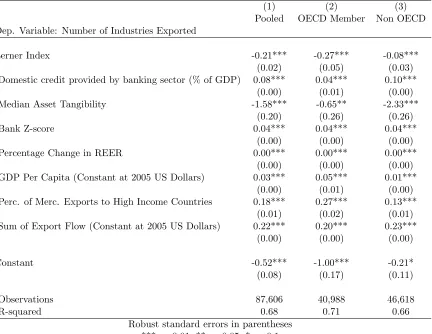
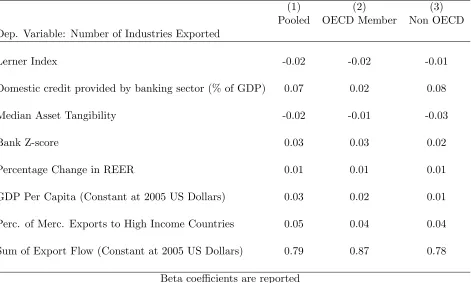
The equation used to estimate the results of the OLS regressions in Table 2, 6, 7 and 8 is:
N umIndusExpijt=β0ijt+β1LIndexit+β2Zit+αj+µt+ǫijt (1)
where i indicates exporter, j indicates importer, and t indicates year. N umIndusExpijt accounts for
the number of industries that export to a trading partner within the manufacturing sector,LIndexit is the
Lerner Index within the banking industry of the exporting country and Zit lists the independent variables
that account for the banking characteristics, economic indicators and international trading activities of the exporting country. The details on the variables is presented in Appendix A. Although, several studies have incorporated the Lerner Index, Beck, De Jonghe, and Schepens (2012) is a more recent paper to incorporate this variable into their study. The choice of the variable is based on the fact that the Lerner Index captures the asset side as well as the funding costs associated with the banking industry. The as-set side relates to the revenue generated on the loan and the funding costs relate to the marginal costs associated with an additional dollar lent out. In essence, the Lerner Index considers the price of the loan and is influenced by the interest rate elasticity on the number of borrowers, therefore making it a useful indicator for competition. The more sensitive the number of borrowers to the changes in the interest rate, more elastic is the interest rate elasticity and more competitive is the banking industry. This is true for a banking industry with a greater number of larger banks that induces price competition32
. αj and µt are
the importing partner fixed effects and year fixed effects respectively. The importing fixed effects control for the importing country characteristics of the importing partner and the year fixed effects control for the impact of technological changes within the banking industry. ǫijt is error term distributed as N ∼(0,1).
As the sum of bilateral export flow is calculated in a nominal monetary value, it is converted into real
32