ISSN Online: 2333-9721 ISSN Print: 2333-9705
Study on Extraction Technology of
Polysaccharides from Jujube by
Microwave Method
Minghang Xu, Xinjian Yao, Jun Wang
*Department of Chemistry, Zhoukou Normal University, ZhouKou, China
Abstract
Jujube polysaccharide is one of the important natural active ingredients. In this paper, microwave extraction technology was utilized to extract jujube po-lysaccharide in different conditions using the yield as test index. The results showed that the optimum conditions were solid-liquid ratio 1:30, ultrasonic lasting time 25 min, temperature 50˚C, which achieve the highest yield rate 5.38%.
Subject Areas
Analytical ChemistryKeywords
Microwave Extraction, Polysaccharides, Jujube
1. Introduction
Ziziphus jujube, the fruits of rhamnales, is one of Chinese traditional health foods, which has been applied in curing deficiency of qi and weakness of the spleen as a Chinese medicine for about 2000 years [1]. It has been found in recent pharma-cological studies that a variety of natural bioactive substances are contained in jujube, such as polysaccharides, flavonoids and dietary fiber [2] [3] [4]. Polysac-charides are composed of a number of monosacPolysac-charides joined by glycosidic bonds, which have medical effects of the immunoregulatory, lowering blood lipids and antitumor. The main extraction methods of polysaccharides from jujube in re- cent reports are hot water bath extraction, organic solvent extraction and sour al-kali soak extraction, while these methods have some disadvantages like long ex-traction time, low exex-traction efficiency and high impurity content.
How to cite this paper: Xu, M.H., Yao, X.J. and Wang, J. (2017) Study on Extraction Technology of Polysaccharides from Jujube by Microwave Method. Open Access Library Journal, 4: e3470.
https://doi.org/10.4236/oalib.1103470
Received: February 19, 2017 Accepted: March 6, 2017 Published: March 9, 2017
Copyright © 2017 by authors and Open Access Library Inc.
This work is licensed under the Creative Commons Attribution International License (CC BY 4.0).
http://creativecommons.org/licenses/by/4.0/
M. H. Xu et al.
2/4 OALib Journal
The principle of microwave assisted extraction is to let rays penetrate the cell wall to reach the cell interior under microwave, making temperature rise and pressure increase, thus the cell wall would be broken, at the same time, the effec-tive components inside of the cell are released and transferred into the solution [5] [6]. In this paper, microwave extraction technology was utilized to extract ju- jube polysaccharides.
2. Experimental
2.1. Materials and Methods
2.1.1 MaterialsChinese jujube were bought in the local area, after cleaned and dried to constant weight at 50˚C, they were ground to the particle size 60 mesh. Glucose, sulfuric acid and phenol were purchased from Chemical Reagent Co. Ltd. (Tianjin, China). All the solvent used are analytical reagent.
Instruments: high speed disintegrator, Midea M1-L202B microwave oven and 751 UV spectrophotometer.
2.1.2. Determination of the Drawing of Standard Curve
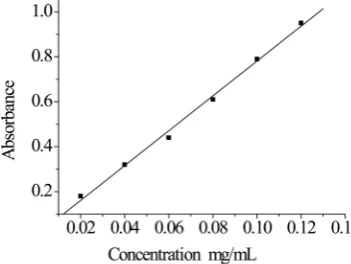
10.0 mg glucose was dissolved in distilled water, then transferred into a 250 mL volumetric flask to calibrate, shaked up and placed still. Afterwards 0.0, 0.2.0, 0.4, 0.6, 0.8, 1.0, and 1.2 mL glucose standard solution were sucked up respec-tively to different 2 mL comparison tubes, then added 1.0 mL 6% phenol solu-tion and 5.0 mL sulfuric acid to each test tube. Used distilled water as a reference to measure its absorbance at 490 nm, thus obtained the standard curve under di- fferent concentrations. The equation between Absorbance (Y) and concentration of glucose (X) in the scope of measurement was: Y = 7.81868X + 0.10226, R2 =
0.9980 (Figure 1).
2.1.3. Calculation of Polysaccharide Yield
Polysaccharide extraction yield (%) = determined polysaccharide mass/raw ma-terial mass × 100%.
3. Results and Discussion
[image:2.595.283.459.585.717.2]The extraction yield of polysaccharide is mainly influenced by extraction temper-
ature, time and weight ratio of liquid/solid. In order to control the extraction tem-perature exactly, we maintain microwave power at 300 W, the three factors above are investigated to study effect on the extraction yield.
3.1. Effect of Temperature on Extraction Yield
Temperature is an important factor of extraction yield. It is shown that the differ-ent yield of polysaccharide from jujube at differdiffer-ent temperature in Figure 2. High temperature would increase the solubility of polysaccharide from jujube, as is seen in the temperature scope from 20˚C to 50˚C. But higher temperature beyond 50˚C will cause degradation of polysaccharide.
3.2. Effect of Radiation Time on the Extraction Yield
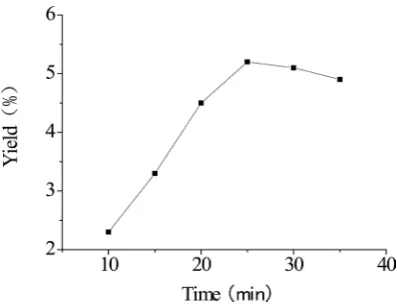
Microwave radiation time is another important factor influenced the yield of po- lysaccharide. The results show in Figure 3 that under microwave radiation, the yield is increasing among 10 - 25 min and reach the maximum 5.3%, afterwards it falls. It illustrates that the structure of polysaccharide could be changed and the sugar chain be broken, so that overlong radiation time would also cause degra-dation of polysaccharide.
[image:3.595.273.471.401.543.2]3.3. Effect of Weight Ratio of Solid/Liquid on the Extraction Yield
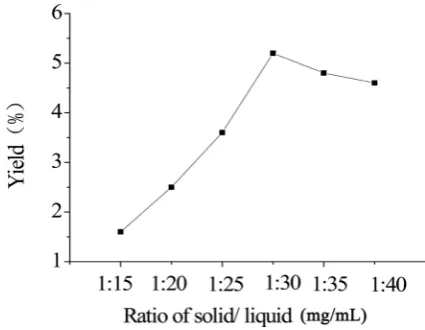
We can clearly know from Figure 4 that the ration of solid/ liquid is obviouslyFigure 2. Effect of temperature on the extraction yield.
[image:3.595.274.473.567.719.2]M. H. Xu et al.
[image:4.595.265.478.69.234.2]4/4 OALib Journal
Figure 4. Effect of weight ratio of liquid/solid on the extraction yield.
influenced the yield, the yield is increasing in accordance with the augment of ration of solid/liquid, considering the cost and difficulty of separation, the ratio 1:30 is preferred.
4. Conclusion
In this study, it was investigated the extraction of polysaccharide from jujube based on single-factor tests using microwave radiation method. We obtain the optimiza-tion condioptimiza-tion at 300 W power, extracoptimiza-tion time 25 min, temperature 50˚C, weight ratio of solid/liquid 1:30. The extraction process has some advantages like mild condition, short time and easy post-process, which provides a technical possibil-ity for local jujube’s deep processing.
Acknowledgements
This study is supported by the opening of laboratory program for Department of Chemistry and Chemical Engineering, Zhoukou Normal University (No. HXK20- 1604) and Zhoukou Normal University School-Based Project (No. ZKNUB2201- 701).
References
[1] Li, S.Z. (1982) Compendium of Materia Medica. People’s Medical Publishing House, Beijing, 1754-1760.
[2] Wang, J. and Zhang, B.S. (2003) Study on Nutritional Components and Functions of Chinese Jujube. Food Research and Development, 24, 68-72.
[3] Zhang, Z., Gao, Z.M. and Qian, R.S. (2006) Study on Physical and Chemical Proper- ty of Jujube Polysaccharides and It’s Extration. Storage and Process, 6, 30-32. [4] Tadashi, K. (1997) Polysaccharrides in Fungi XXXVIII Antidiabetic Activity and
Structural Feature of Agalactmannan Elaborated by Pestalotiopsis Species. Biologi-cal and PharmaceutiBiologi-cal Bulletin, 20, 118-121. https://doi.org/10.1248/bpb.20.118
[5] Yin, T.-Z., Xiong, G.-X., Wang, N., et al. (2016) Study on Extraction of Polysaccha-ride from Red Date by Multiple Enzymatic Assisted Microwave. Hubei Agricultural Sciences, 55, 1799-1801.
Submit or recommend next manuscript to OALib Journal and we will pro-vide best service for you:
Publication frequency: Monthly
9 subject areas of science, technology and medicine
Fair and rigorous peer-review system Fast publication process
Article promotion in various social networking sites (LinkedIn, Facebook, Twitter,
etc.)