ISSN Online: 2161-7589 ISSN Print: 2161-7570
Microbiostratigrapy of the Paleocene-Lower
Eocene Sequences in the Bibi Hakimeh 2
Subsurface Section Located in the SW of Iran
Fatemeh Moradian
1, Darioush Baghbani
2*, Mohsen Allameh
31Department of Geology, Science and Research Branch, Islamic Azad University, Tehran, Iran
2Department of Geology, Damavand University, Damavand, Iran
3Department of Geology, Mashhad Branch, Islamic Azad University, Mashhad, Iran
Abstract
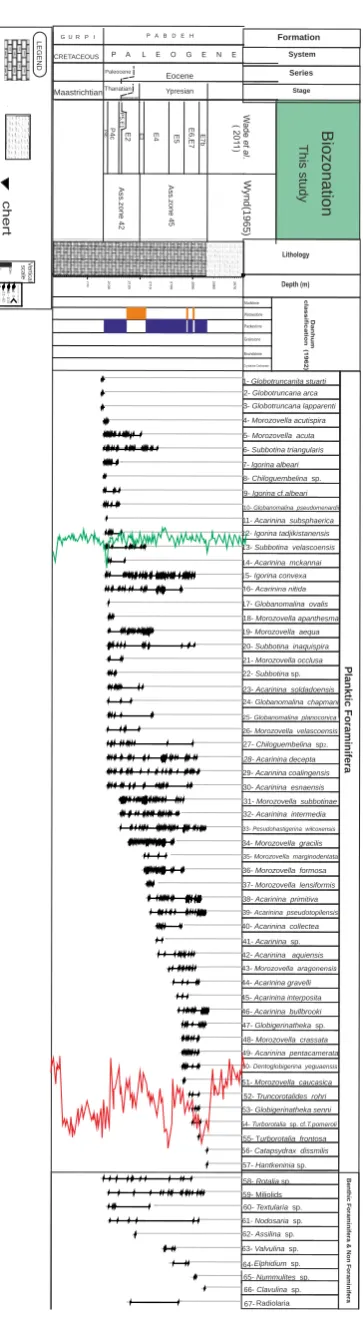
This paper investigates the biostratigraphy of the Palaeocene-Lower Eocene sequences in the Bibi Hakimeh 2 subsurface/subterranean sections located in the Bibi Hakimeh Oil Field. The Palaeocene-Lower Eocene sequences are in-duced as part of the Pabdeh Formation. They are 49 m in thickness and are made up of clayey limestone with chert intercalations. Biostratigraphic inves-tigations identified 10 genera and 51 species of Planktonic Foraminifera which with respect to the specific planktonic species and according to the newest Wade Biozonation led to the determination of 9 biozones and 4 subzones. The Palaeocene-Early Eocene biostratigraphic boundary determined previously in accordance with the Wynd Biozonation was reviewed with respect to the new biozonation. Moreover, the impression of the PETM on the Planktonic Fora-minifera found in the Bibi Hakimeh subsurface section, has been occurred at P/E boundary on global scale was studied. Based on this research we can con-clude the P/E biostratigraphic boundary border is occurred ranges between 2125 - 2124 meters in Pabdeh formation.
Keywords
Pabdeh Formation, Planktonic Foraminifera, Bibi Hakimeh, PETM
1. Introduction
The Zagros Orogenic Belt is located in the middle section of the Himalayan Alps Mountain range [1]. This orogeny is the result of the convergence of the conti-nental fragments of central Iran and the Arabian Plate formed as a result of the destruction of the Young Tethys Ocean [2]. Commencement of the continental
How to cite this paper: Moradian, F., Baghbani, D. and Allameh, M. (2017) Micro- biostratigrapy of the Paleocene-Lower Eoce- ne Sequences in the Bibi Hakimeh 2 Subsur-face Section Located in the SW of Iran. Open Journal of Geology, 7, 147-161.
https://doi.org/10.4236/ojg.2017.72010
Received: August 24, 2016 Accepted: February 21, 2017 Published: February 24, 2017
Copyright © 2017 by authors and Scientific Research Publishing Inc. This work is licensed under the Creative Commons Attribution International License (CC BY 4.0).
http://creativecommons.org/licenses/by/4.0/
rift at the Permian era and its reactivation during the Triassic age led to the for-mation of the said ocean. This tectonic incident resulted in the separation of the central Iran Plateau from the Gondwana supercontinent, of which it had been a part and subsequently the Young Tethys Ocean was enclosed by the subduc-tion, obducsubduc-tion, and continental impact processes. The Zagros Orogeny, simi-lar to most orogenies, comprises an internal part (the Sannadj-Sirjan Region) and the external part (the Zagros Fold-Thrust Belt) [2] [3]. The Zagros Fold-Thrust Belt is situated on the northeastern edge of the Arabian platform and consists of Phanaerozoic sedimentary fold sections of 10 m in thickness
[2] [4]. The Palaeocene and Eocene deposits on this section of the Zagros re-gion consist of the Pabdeh Formation which transforms into the Jahrom For-mation in an interfingering form, and the TalehZang, Amiran, Shahbazen and Sachoun Formations [5].
2. Literature Review
A host of studies have been carried out on the Cenozoic era and specifically on the Palaeogene period. Wynd [6] investigated the Triassic to Miocene sequen- ces of the Zagros region and determined the first bionization based on the spe-cified microfossils and subsequently separated and coined names for these se-quences. He believed that only the Palaeocene sediments in the Lorestan re-gion were complete. James & Wynd [7] investigated the Zagros zone from a biostratigraphical viewpoint and presented 38 formations for the Triassic pe-riod to the Quaternary era. They named the Palaeocene and Eocene dolomite deposits of the Fars region as Jahrum Formation while the shale and lime de-posits of the same periods in the Fars region were called Pabdeh Formation. They also referred to the same deposits of the Palaeocene to Oligocene and Miocene eras in the Lorestan and Khuzestan regions as the Pabdeh Formation
(Figure 1). Kalantari [8] studied various microscopic facies in the Zagros
re-gion including the Pabdeh Formation and presented its specific microfossils and subsequently determined the age of the Pabdeh Formation as Palaeocene to Oligocene. Motiei [4] conducted extensive research on stratigraphy of the Zagros region and identified the fossil and lithological properties of the forma-tions of this zone.
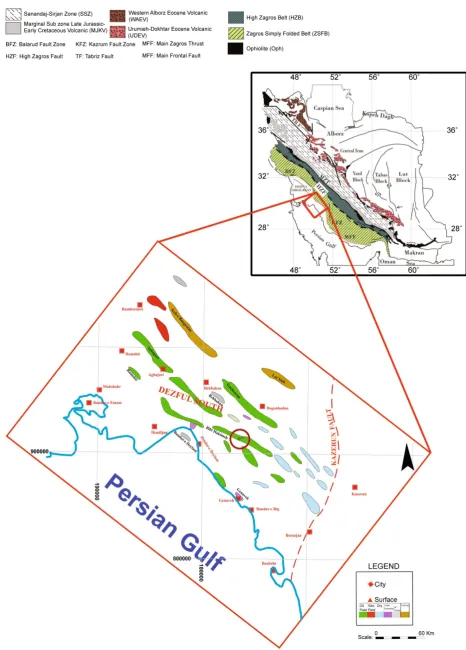
3. Geological Setting
Figure 1. Cenozoic stratigraphy of the Zagros basin, Motiei [4].
road.
4. Scope of Work
- Study of the Palaeocene and Eocene lithostratigraphic deposits (Pabdeh For- mation).
- Study of the biostratigraphy and identification of the specific microfossils and determination of new biozonations in by the aid of the microfossils. - Comparison of new biozonations with extensive older biozonations and
transformation of the Palaeocene-Eocene boundary on this basis.
5. Methodology
The research is divided into two sections: Laboratorial and Library-Based
In the laboratorial part, 150 microscopic thin-sections prepared by the Oil Company, were studied using PLM, Polarised Light Microscope. The cross-sec- tions were examined from a fossil content viewpoint and the biozonation of the Bibi Hakimeh subsurface/subterranean section was determined through the identification of the specific microfossils, their appearance/shape, emergence and decline period. Various sources such as Postuma [9], Loeblich and Tappan
[10], Olsson [11], Berggren [12], Berggren and Pearson [13], Payros [14], Wade
6. Lithology
Investigation of the peaks of the gamma and sonic waves alongside inspection of the cuttings produced within drilling operation indicates that the depositional sequence in this well consists of the Fars group of deposits, Asmari Formation limestones, marl and limey clay replete with cherts of Pabdeh Formation, clayey limestones replete with chert, and Gurpi Formation marl, and Bangestan se-quence group in a top-down direction. This sese-quence is 1310 m in thickness. Palaeocene and lower Eocene deposits, and clayey limestones including chert in-terlayers are indicative of the Paabdeh Formation. This formation has a thickness of 298 m in this well. The upper boundary of this formation is contiguous with the Oligocene-aged Asmari Formation while its lower boundary is contiguous with the Paabdeh Formation. The Palaeocene and lower Eocene deposits of the Paab-deh Formation in the Bibi Hakimeh-2 well have a thickness of 49 m and in a top- down direction including:
49 m of clayey limestone alongside chert interlayers (Figure 3).
7. Micro-Biostratigraphy
[image:5.595.57.540.433.715.2]Study of the Palaeocene and Lower Eocene depositional microfossils in the Bibi Hakimeh subsurface/subterranean section, revealed 10 genera and 51 species of Planktonic Foraminifera, 9 genera and species of benthic foraminifera, and 1 non-foraminifera form. The latest Wade Biozonation was employed in this re-search and was compared with the older Wynd [6] version performed on the Pabdeh Formation. 9 biozones and 4 sub-biozones were identified according to
Wade [15]:
Zone P4. Globanomalinapseudomenardii Taxon-Range Zone
This biozone has been determined according to the domain of the
Globano-malinapseudomenardii species [12]. The resource of this biozone does not lie
within this section although its end is identifieddetermined by the disappearance of the above species at a depth of 2125 m. This biozone was dated Middle-Late Palaeocene (Thanetian). This biozone includes three subzones of which the P4a subzone was not identified in this section.
P4b. Acarinina subsphaerica Subzone (partial-range-subzone)
This subzone is of the partial-range type and covers the distance/interval be-tween the highest occurrence, Parasubbotinavariospira (HO) and the lowest oc-currence of Acarininasoldadoensis (LO) [12]. In the Bibi Hakimeh section, the lower boundary of this subzone does not fall within the said section due to ab-sence of the Parasubbotinavariospira species and the lowest occurrence at a depth of 2130 m is identified as its upper boundary. The age of this subzone is determined as late Paleocene (Thanetian) according to the biozone defined by Wade, comparison and conformation with the same subzone and its fossil com-plex. The fossil complex concomitant with this zone includes:
Acarinina sp., Acarinina nitida, Morozovellaapanthesma, Acarinina
subsphae-rica, Subbotina triangularis, Igorinatadjikistanensis, Igorina pusilla, Morozovella
velascoensis, Igorinaalbeari, Morozovellaacutispira, Morozovellaconicotruncata,
Morozovella angulate, Globanomalinapseudomenardii, Subbotina velascoensis,
Morozovella acuta.
P4c. Acarinina soldadoensis Globanomalinapseudomenardii Subzone (concurrent-range-subzone)
This subzone is of the concurrent-range zone type and covers the interval be-tween the lowest occurrence, of Acarininasoldadoensis (LO) and the highest oc-currence of Globanomalinapseudomenardii (HO) [12]. In the Bibi Hakimeh sec-tion, the lower boundary of this subzone was identified at a depth of 2130 m with the lowest occurrence of Acarininasoldadoensis as the lower boundary while the highest occurrence of the Globanomalinapseudomenardii at a depth of 2125 was recognized as its upper boundary. The age of this subzone is deter-mined as Late Palaeocene (Late Thanetian) according to the biozone defined by Wade, comparison and conformation with the same subzone and its fossil com-plex. The fossil complex concomitant with this zone includes:
Globanomalinapseudomenardii, Acarinina soldadoensis, Morozovella aequa,
Acarininaesnaensis, Acarininacoalingensis, Acarinina decepta, Subbotina
velas-coensis, Morozovella acuta, Acarinina sp., Acarinina nitida, Morozovella
velas-coensis, Igorinaalbeari.
Zone P5. Morozovella velascoensis Partial-Range Zone (partial-range- zone)
lower boundary of this subzone was identified at a depth of 2125 m with the highest occurrence of Globanomalinapseudomenardii as the lower boundary while the highest occurrence cannot be determined due to the lack of identifica-tion of the Acarininasibaiyaensis species.
Zone E1. Acarininasibaiyaensis Lowest-Occurrence Zone (lowest-occur- rence-zone)
This subzone is of the lowest-occurrence zone type and covers the interval be- tween the lowest occurrence of Acarininasibaiyaensis (LO) and the highest oc-currence of Pseudohastigerinawilcoxensis (LO) [13]. In the Bibi Hakimeh sec-tion, the lower boundary of this biozone cannot be determined due to the lack of identification of the Acarininasibaiyaensis species. The upper boundary was de-termined at a depth of 2124 m with the lowest occurrence of Pseudohastigerina-wilcoxensis.
The boundary between the E1 & P5 biozones in the Bibi Hakimeh section is indistinguishable. Therefore, the age of the span between the lower boundary of the P5 biozone at 2125 m and the upper boundary of the E1 biozone at a depth of 2124 m is determined to be Late-Paleocene to Early Eocene (Latest Thanetian- Sparnacian).
Zone E2. Pseudohastigerinawilcoxensis/Morozovella velascoensis Concur-rent-Range Zone
This subzone is of the concurrent-range zone type and covers the interval be-tween the lowest occurrence of Pseudohastigerinawilcoxensis (LO) and the highest occurrence of Morozovella velascoensis (HO) [13].
In the Bibi Hakimeh section, the lower boundary of this biozone was deter-mined as the lowest occurrence of Pseudohastigerinawilcoxensis at a depth of 2124 m while the upper boundary was established to be the highest occurrence
of Morozovella velascoensis at a depth of 2115 m. The age of this zone is
deter-minedas early Eocene (Sparnacian) according to the biozone defined by Wade, comparison and conformation with the same subzone and its fossil complex. The fossil complex concomitant with this zone includes (Figure 4):
Acarininasoldadoensis, Morozovella aequa, Acarininaesnaensis,
Acarinina-collectea, Acarinina decepta, Subbotina velascoensis, Morozovella acuta,
Acari-nina intermedia, Acarininaaquensis, Morozovella velascoensis, Igorinaconvexa,
Subbotinainaquispira, Morozovella gracilis, Pseudohastigerinawilcoxensis.
Zone E3. Morozovella velascoensis Partial-Range Zone
This subzone is of the partial-range zone type and covers the interval between the highest occurrence of Morozovella velascoensis (HO) and the lowest occur-rence of Morozovella formosa (LO) [13].
In the Bibi Hakimeh section, the lower boundary of this biozone was deter-mined as the highest occurrence of Morozovella velascoensis at a depth of 2115 m while the upper boundary was established to be the highest occurrence of
Moro-zovella formosa at a depth of 2113 m. The age of this zone is determined as early
Figure 4. a) Acarininaaquiensis[17], b) Acarininabullbrookii[18], c) Turborotalia fron-tosa [19], d) Acarininacoalingensis [20], e) Morozovella caucasica[21], f) Morozovella formosa[21], g) Morozovella gracilis[22], h) Morozovellasubbotinae[23].
concomitant with this zone include:
Acarininaaquiensis, Igorinaconvexa, Morozovella gracilis, Morozovella
Zone E4. Morozovella formosa Lowest-Occurrence Zone
This zone is of the lowest-occurrence type and covers the distance between the lowest occurrence of Morozovella formosa (LO) and the highest occurrence of
Morozovella aragonensis (HO) [13].
In the Bibi-Hakimeh section, the lower boundary of this biozone was deter-mined as the lowest occurrence of Morozovella formosa at a depth of 2113 m while the upper boundary was established to be the highest occurrence of
Moro-zovella aragonensis at a depth of 2101 m. The age of this zone is determined as
early Eocene (Ypresian) according to the biozone defined by Wade and compar-ison and conformation with the same subzone and its fossil complex. The fossil complex concomitant with this zone include:
Acarinina primitiva, Morozovellalensiformis, Acarinina pseudotopilensis,
Acarinina decepta, Acarininaesnaensis, Morozovella aequa, Morozovella
subbo-tinae, Subbotinainaquispira, Pseudohastigerinawilcoxensis, Morozovella gracilis.
Zone E5. Morozovella aragonensis/Morozovella subbotinae Concurrent- Range Zone
This zone is of the lowest-occurrence zone type and covers the interval be-tween the lowest occurrence of Morozovella aragonensis (LO) and the highest occurrence of Morozovella subbotinae (HO) [13].
In the Bibi Hakimeh section, the lower boundary of this biozone was deter-mined as the lowest occurrence of Morozovella aragonensisa at a depth of 2101 m while the upper boundary was established to be the highest occurrence of
Morozovella subbotinae at a depth of 2093 m. The age of this zone is determined
as early Eocene (Ypresian) according to the biozone defined by Wade, compari-son and conformation with the same subzone and its fossil complex. The fossil complex concomitant with this zone includes:
Acarinina primitiva, Pseudohastigerinawilcoxensis, Acarinina
pseudotopilen-sis, Morozovella caucasica, Dentoglobigerinayeguaensis, Acarinina
pentacame-rata, Morozovella crassata, Morozovella aragonensis, Acarininaaquiensis,
Acari-ninacoalingensis, Globigerinathekasp, Acarininabullbrooki, Acarininagraveli,
Acarinina decepta, Acarininaesnaensis, Subbotinainaquispira, Igorinaconvexa.
Zone E6. Acarinina pentacamerata Partial-Range Zone
This subzone is of the partial-range zone type and covers the interval between the highest occurrence of Morozovella subbotinae (HO) and lowest occurrence
of Acarininacuneicamerata (HO) [13].
In the Bibi Hakimeh section, the lower boundary of this biozone was deter-mined by the highest occurrence of the Morozovella subbotinae at a depth of 2093 m. The upper boundary cannot be established due to the non-recognition of Aca-rininacunicamerata.
Zone E7. Acarininacuneicamerata Lowest-Occurrence Zone
subzones:
Subzone E7a Acarininacuneicamerata Lowest-Occurrence Zone
This zone is of the lowest-occurrence zone type and covers the interval be-tween the lowest occurrence of Acarininacuneicamerata (LO) and the lowest occurrence of Turborotalia frontosa (LO) [14].
The lower boundary of this biozone cannot be determined in the Bibi Haki-meh section due to the non-recognition of the Acarininacuneicamerata species while the upper boundary was determined by the lowest occurrence of the
Tur-borotalia frontosa at a depth of 2086 m. The boundary between the E6 & E7a
cannot be established on this basis; therefore, the same biozones were deter-mined for the depths of 2093 to 2086 m. The age of this zone is deterdeter-mined as early Eocene (Ypresian) according to the biozone defined by Wade, comparison and conformation with the same subzone and its fossil complex.
The fossil complex concomitant with this zone includes:
Acarininacoalingensis, Acarininacollectea, Acarinina intermedia, Acarinina
interposita, Acarinina pentacamerata, Dentoglobigerinayeguaensis.
Subzone E7b. Turborotalia frontosa Lowest-Occurrence Zone
This zone is of the lowest-occurrence zone type and covers the interval between the lowest occurrence of Turborotalia frontosa (LO) and the lowest occurrence of
Guembelitrioidesnuttalli (LO) [14]. In the Bibi Hakimeh section the lower
boundary of this biozonewas determined by the lowest occurrence of the
Tur-borotalia frontosa species at a depth of 2086 m while the upper boundary is
es-tablished by the lowest occurrence of the Guembelitrioidesnuttalli of the Middle Eocene age though it does not fall within the study area. Therefore, the age of this subzone is determined to be Early-Middle Eocene according to the fossil complex. The fossil complex concomitant with this zone includes:
Acarininacoalingensis, Acarininacollectea, Acarinina intermedia,
Acarinina-primitiva, Acarinina interposita, Acarininabullbrooki, Acarinina
pentacamera-ta, Dentoglobigerinayeguaensis, Turborotalia frontosa, Chilloguembelina sp.,
based on Planktonic Foraminifera while 2 biozones were classified according to Wynd [6].
Morozevella velascoensis-Globanomalina pseudo menardii Zone
(assem-blages-zone)
This biozone defined by Wynd [6] is referred to as zone number 42 and is de-termined by the occurrence of the Morozovella velascoensis and Globanomalina
pseudo menardii species at a depth of 2132 m. The upper boundary of this biozone
is established by the last occurrence of Morozovella velascoensis at a depth of 2115 m. The age of this zone is determined as Late Paleocene according to the biozone (No. 42) defined by Wynd & comparison and conformation.
Morozevella subbotinae-Morozovella Formosa Morozovella aragonensis
Zone
This zone referred to as zone Number 45 [6] comprises the abovementioned fossil complex and is located at the upper occurrence boundary of Morozovella
Hantkenina sp. It is determined by the last occurrence of the Morozovella
velas-coensis at a depth of 2115 m as the lower boundary of the biozone and the first
occurrence of Hantkenina sp. at a depth of 2083 m. The age of this zone is deter- mined as Late Eocene according to the biozone (No. 45) defined by Wynd & comparison and conformation.
Comparison and conformation of the Wade [15] biozonation with the oldest Wynd [6] Biozonation indicates that the Paleocene-Early Eocene biostratigraph-ic boundary, whbiostratigraph-ich according to the Wynd [6] Biozonation, had been located at the boundary of the biozone numbers 42 & 45 at 2115 m from the base of the formation, is transferred to the boundary between biozones P5 & E1 at a interval of 2124 to 2125 m according to the Wade Biozonation (Figure 5).
Comparing superimposition at the Wade [15] Biozonation with the oldest Wynd [6] Biozonation proves that the biostratigraphic boundary at Paleocene- early Eocene in the Bibi Hakimeh subsurface/subterranean section the which is carried out based on the Wynd Biozonation [6] is located between the two bio-zones at 42, 45 was marked by the presence at Morozovella velascoensis at 2115 meter all the base of the formation. On the very other mind, through comparing the Wade Biozonation [15] with the lost presence of
Globanomalinapseudome-nardii aged late Paleocene at 2125 meter cum the first occurrence of
Pseudohasti-gerinawilcoxensis aged early Eocene at 2124 all the base of the formation, serving
as the boundary at P/E containing two biozones at P5, E1.
The PETM is also applied to separate the P/E boundary cum the phenomenon at emergence, eptinction at index foraminifera [24]. The global warming has been deemed, short term climatic event which took place 55.5 milion years ear-lier [24][25]. The event of the P/E boundary is marked by significant enormous carbon exchanges that were once occurred on global scale, led to shifts in various phenomena like, 5 - 7 warming or temperature increase, extinction of the entire bentic foraminifera, upheaval in the cammunites of Planktonic Foraminifera, quick migration or shift at carbonate balance depth to shallower depth, discerni-ble negative change in CIE carbon isotope trend [26].
Figure 5. Biostratigraphy column and biozonation of Bibi Hakimeh subsurface section. P A B D E H
5 10m
V e rtic a l s c a le Stage Series System Formation
1- Globotruncanita stuarti
2- Globotruncana arca
3- Globotruncana lapparenti
4- Morozovella acutispira
5- Morozovella acuta
6- Subbotina triangularis
7- Igorina albeari
8- Chiloguembelina sp.
9- Igorina cf.albeari
10- Globanomalina pseudomenardii
11- Acarinina subsphaerica
12- Igorina tadjikistanensis
13- Subbotina velascoensis
14- Acarinina mckannai
15- Igorina convexa
17- Globanomalina ovalis
18- Morozovella apanthesma
19- Morozovella aequa
20- Subbotina inaquispira
21- Morozovella occlusa
22- Subbotina sp.
23- Acarinina soldadoensis
24- Globanomalina chapmani
25- Globanomalina planoconica
26- Morozovella velascoensis
27- Chiloguembelina sp .2
28- Acarinina decepta
29- Acarinina coalingensis
30- Acarinina esnaensis
31- Morozovella subbotinae
32- Acarinina intermedia
33- Pesudohastigerina wilcoxensis
34- Morozovella gracilis
35- Morozovella marginodentata
36- Morozovella formosa
37- Morozovella lensiformis
38- Acarinina primitiva
39- Acarinina pseudotopilensis
40- Acarinina collectea
41- Acarinina sp.
42- Acarinina aquiensis
44- Acarinina gravelli
45- Acarinina interposita
46- Acarinina bullbrooki
47- Globigerinatheka sp.
48- Morozovella crassata
49- Acarinina pentacamerata
50- Dentoglobigerina yeguaensis
51- Morozovella caucasica
52- Truncorotalides rohri
53- Globigerinatheka senni
54- Turborotalia sp. cf.T.pomeroli
55- Turborotalia frontosa
56- Catapsydrax dissmilis
57- Hantkeninia sp.
58- Rotalia sp.
59- Miliolids
60- Textularia sp.
61- Nodosaria sp.
62- Assilina sp.
63- Valvulina sp.
64- Elphidium sp.
65- Nummulites sp.
67-
66- Clavulina sp.
Radiolaria B e n th ic F o ra m in ife ra & N o n F o ra m in ife ra P la n k tic F o ra m in if e ra CRETACEOUS Paleocene G U R P I
Eocene
E
2 E3 E4 E5 E7b
at tolering the heat, all the sudden the variety number of Planktonic Foraminife-ra at the subsurface section at Bibi Hakimeh drops down at 2125 - 2124 meters interval. The cold-water groups suite assemblages Subbotinatrangularis,
Subbo-tinavelascoensis, Chilogumbelinasp. species have had presence from the base of
the formation up to the contiguity at the boundary, and however they have dis-appered all the sudden at 2125 meter from Formation, reappearing at 2124 me-ter all the base of the formation. Warm-wame-ter foraminifera have been identified that belong to Morozovellaacuta, Acarininasoldadoensis, Acarinina nitida are among them. Pardo [27] suggested that the impression at PETM on the Acarini-nids varies to some degree. Only the species that have had less chambers, less complicated shapes have resisted the heat. Furthermore, species of the more chambers, more angles have developed while kept away from such sudden heat at the Bibi Hakimeh subsurface section, solely the species of Acarininasoldadoensis, Acarinina nitida from the Acarininids who have less chambers, more plain shapes have been identified at 2125 - 2124 meters interval.
8. Conclusion
Analysis of the Palaeocene-Lower Eocene sequences of the Paabdeh Formation in the Bibi Hakimeh subsurface/subterranean section resulted in the identifica-tion of 10 genera and 51 spices of Planktonic Foraminifera. According to the latest Wade Biozonation and their appearance, emergence and decline of the Planktonic Foraminifera index, 9 biozones and 4 biosubzones were identified which were compared with the oldest biozonation performed on the Paabdeh Formation. On this basis, the Palaeocene-Lower Eocene biostratigraphic boundary, which ac-cording to the Wynd Biozonation had been located at the border of the biozone numbers 42 & 45 at 2115 m from the base of the formation, is now situated at the boundary between biozones P5 & E1 at an interval of 2124 to 2125 m from the formation base according to the Wade Biozonation. The new Wade Biozona-tion [15] incorporates P5 & E1 biozones at 2125 - 2124 meters interval at the base of the formation. More to the point, PETM that has occurred at P/E boun-dary on global scaleaffected the Planktonic Foraminifera found in the subsur-face section at Bibi Hakimeh, leading to slump in variety number of Planktonic Foraminifera at 2125 - 2124 meters interval. Hence considering the emergence declime at index species based on Wade Biozonation cum the impression at PETM on Planktonic Foraminifera at the aforesaid interval, the P/E biostrtigraphic boundary has been revised, decided at 2125 - 2124 meters interval inside the Pabdeh Formation.
References
[1] Berberian, M. and King, G.C.P. (1981) Towards a Paleogeography and Tectonic Evolution of Iran. Canadian Journal of Earth Sciences, 18, 210-265.
https://doi.org/10.1139/e81-019
[3] Motiei, H. (1994) Geology of Iran: Stratigraphy of Zagros. Geological Survey of Iran Publication, Tehran, 583.
[4] Motiei, H. (2001) Simplified Table of Rock Units in Southwest Iran. Keyhan Explo-ration and Production Services, Tehran.
[5] Alavi, M. (2004) Regional Stratigraphy of Zagros Fold-Thrust Belt of Iran and Its Proforel and Evolution. American Journal of Science, 304, 1-20.
https://doi.org/10.2475/ajs.304.1.1
[6] Wynd, J.G. (1965) Biofacies of the Iranian Oil Consortium Agreement Area. Iranian Oil Offshore Company Report 1082, Unpublished.
[7] James, G.A. and Wynd, J.G. (1965) Tratigraphic Nomenclature of Iranian Oil Con-sortium Agreement Area. American Association of Petroleum Geologists Bulletin, 49, 94-156.
[8] Kalantari, A. (1986) Microfacies of Carbonate Rocks of Iran. National Iranian Oil Company, Geological Laboratories, Publication, Tehran, 520.
[9] Postuma, J.A. (1971) Manual of Planktonic Foraminifera, Royal Dutch/Shell Group, the Hange, the Netherland, Elservier, Amsterdam, 420 p.
[10] Loeblich Jr., A.R. and Tappan, H. (2015) Foraminiferal Genera and Their Classifica-tion. Springer, Berlin.
[11] Olsson, R.K., Hemleben, C., Berggren, W.A. and Huber, B.T. (1999) Atlas of Paleo-cene Planktonic Foraminifera. Vol. 85, Smithsonian Institution Press, Washington DC, 1-252. https://doi.org/10.5479/si.00810266.85.1
[12] Berggren, W.A., Aubry, M.P., Van Fossen, M.P., Kent, D.V., Norris, R.D. and Quil-levere, F. (2000) Integrated Palaeocene Calcareous Plankton Magnetobiochronology and Stable Isotope Stratighraphy: DSDP Site 384 (NW Atlantic Ocean). Paleogeo-graphy, Paleoclimatology, Paleoecology, 159, 1-51.
https://doi.org/10.1016/S0031-0182(00)00031-6
[13] Berggren, W.A. and Pearson, P. (2005) A Revised Tropical to Subtropical Paleogene Planktonic Foraminiferal Zonation. The Journal of Foraminiferal Research,35, 279- 298. https://doi.org/10.2113/35.4.279
[14] Payros, A., Bemaola, G., Orue-Etxebarria, G., Dinares-Turell, J., Tosquella, J. and Apellaniz, E. (2007) Reassessment of the Early-Middle Eocene Biomagnetochrono- logy Based on Evidence from the Gorrondatxe Section (Basque Country, Western Pyrenees). Lethaia, 40, 183-195. https://doi.org/10.1111/j.1502-3931.2007.00016.x [15] Wade, B.S., Pearson, P.N., Berggren, W.A. and Palike, H. (2011) Review and
Revi-sion of Cenozoic Tropical Planktonic Foraminiferal Biostratigraphy and Calibration to the Geomagnetic Polarity and Astronimical Time Scale. Earth Science Review, 104, 111-142. https://doi.org/10.1016/j.earscirev.2010.09.003
[16] Bourgeois, E. (1962) Bibi Hakimeh Well. Report 22038, Iranian Oil Operating Com- pany.
[17] Loeblich, A.R.J. and Tappan, H. (1961) The Status of the Foraminiferal Genera Ammodiscus Reuss and Involutina Terquem. Micropaleontology, 7, 189-192.
https://doi.org/10.2307/1484277
[18] Bolli, H.M. (1957) The Genera Globigerina and Globorotalia in the Paleocene- Lower Eocene Lizard Springs Formation of Trinidad. B.W.L. US. National Muse-sum Bulltin, 215, 61-81.
[19] Subbotina, N.N. (1953) Fossil Foraminiferas of the USSR: Globigerinidae, Hantke-ninidae and Globorotaliidae. Trudy VNIGRI, New Series, 76, 296. (In Russian) [20] Cushman, J.A. and Hanna, G.D. (1927) Foraminifera from the Eocene near San
[21] Glaessner, M.F. (1937) Planktonische Foraminiferenaus der Kreide und demEozän und ihrestratigraphische Bedeutung. Studies in Micropaleontology. Vol. 1, Publica-tions of the Laboratory of Paleontology, Moscow University, Moscow, 27-52. [22] Bolli, H.M. (1957) Planktonic Foraminifera from the Eocene Navet and San
Feran-do Formation of Trinidad. B.W.L. US. National Musesum Bulltin, 215, 155-172. [23] Morozova, V.G. (1939) On the Stratigraphy of the Upper Cretaceous and Paleogene
of the Emba, Region According to the Foraminiferal Faunas. Moskova. Obshch. Is-pytately Prirody Byull. Otdel Geology, 17, 59-86. (In Russian)
[24] Zachos, J.C., Röhl, U., Schellenberg, S.A., Sluijs, A. and Hodell, D.A. (2005) Rapida-cidification of the Ocean during the Paleocene-Eocene Thermal Maximum. Science, 308, 1611-1615. https://doi.org/10.1126/science.1109004
[25] Zachos, J.C., Schouten, S., Bohaty, S., Quattlebaum, T. and Sluijs, A. (2006) Extreme Warming of Mid-Latitude Coastal Ocean during the Paleocene-Eocene Thermal Maximum: Inferences from TEX86 and Isotope Data. Geology, 34, 737-740. https://doi.org/10.1130/G22522.1
[26] Zachos, J.C., Dickens, G.R. and Zeebe, R.E. (2008) An Early Cenozoic Perspective on Greenhouse Warming and Carbon-Cycle Dynamics. Nature, 451, 279-283.
https://doi.org/10.1038/nature06588
[27] Pardo, A., Keller, G. and Oberhansli, H. (1999) Paleoecologic and Paleoceanogra- phic Evolution of the Tethyan Realm during the Paleocene-Eocene Transition. The Journal of Foraminiferal Research, 29, 37-57.
[28] Wade, B.S. (2004) Planktonic Foraminiferal Biostratigraphy and Mechanisms in the Extinction of Morozovella in the Late Middle Eocene. Marine Micropaleontology, 51, 23-38. https://doi.org/10.1016/j.marmicro.2003.09.001
Submit or recommend next manuscript to SCIRP and we will provide best service for you:
Accepting pre-submission inquiries through Email, Facebook, LinkedIn, Twitter, etc. A wide selection of journals (inclusive of 9 subjects, more than 200 journals)
Providing 24-hour high-quality service User-friendly online submission system Fair and swift peer-review system
Efficient typesetting and proofreading procedure
Display of the result of downloads and visits, as well as the number of cited articles Maximum dissemination of your research work
Submit your manuscript at: http://papersubmission.scirp.org/
![Figure 1. Cenozoic stratigraphy of the Zagros basin, Motiei [4].](https://thumb-us.123doks.com/thumbv2/123dok_us/7779327.720767/3.595.59.542.72.327/figure-cenozoic-stratigraphy-zagros-basin-motiei.webp)
![Figure 3. Lithostratigraphy column of Bibi Hakimeh subsurface/subterranean section, Bourgeois [16]](https://thumb-us.123doks.com/thumbv2/123dok_us/7779327.720767/5.595.57.540.433.715/figure-lithostratigraphy-column-hakimeh-subsurface-subterranean-section-bourgeois.webp)
![Figure 4. a) Acarininaaquiensis tosa formosa [17], b) Acarininabullbrookii [18], c) Turborotalia fron-[19], d) Acarininacoalingensis [20], e) Morozovella caucasica [21], f) Morozovella [21], g) Morozovella gracilis [22], h) Morozovellasubbotinae [23]](https://thumb-us.123doks.com/thumbv2/123dok_us/7779327.720767/8.595.209.542.70.630/acarininaaquiensis-acarininabullbrookii-turborotalia-acarininacoalingensis-morozovella-morozovella-morozovella-morozovellasubbotinae.webp)