Research on Logistics Value Chain Analysis and
Competitiveness Construction for Express Enterprises
*
Xingjian Zhou
School of Management, Wuhan Textile University, Research Center of Hubei Logistics Development, Wuhan, China. Email: [email protected]
Received January 20th, 2013; revised February 28th, 2013; accepted March 20th, 2013
Copyright © 2013 XingjianZhou. This is an open access article distributed under the Creative Commons Attribution License, which permits unrestricted use, distribution, and reproduction in any medium, provided the original work is properly cited.
ABSTRACT
Through analyzing the value of the activities in the process of express delivery, the model of logistics value chain analysis (LVCA) of express enterprises is constructed. Using the model, the express enterprises can identify the key activities from the whole process of express delivery from senders to receivers, and those key activities constitute the logistics competitiveness of express enterprises. Then a model of logistics competitiveness is established, which in- cludes four aspects: strategic location, network optimization, value-added services and performance measures. Those four aspects form the core logistics competitiveness for express enterprises.
Keywords: Logistics Value Chain; Logistics Competitiveness; Express Enterprises
1. Introduction
With about 30 years development, China has formed a large-scales express delivery industry. In 2008, the vol- ume of express enterprises registration in China has more than 5000, and the express delivery industry has em- ployed about 23.1 million people [1]. However, the competition of express markets becomes fiercer increas- ingly, more and more express enterprises are required to provide the services with faster and safer. A growing number of express enterprises began to develop the direct- service, such as “door to door”, “table to table”. Fur- thermore, some enterprises try to shorten the delivery time, and they began to develop the faster-service, such as “next day delivery”, “next morning delivery”. There- fore, it’s very important for express enterprises to form the core competitiveness, so as to win more customers in express market [2].
Consequently, for express enterprises, its core com- petitiveness is manifested in the implement “customer value strategy”. Customer value strategy is a value-cre- ating activity to win the finally success, and win custom- ers’ satisfies by creating more value for them, rather than simply improve the services qualities or service tech- nologies [3].
Therefore, the express enterprises will focus on how to
create customer demands, make the express delivery va- lue-added, and achieve the competitive advantage. We can use the theory of Michael Porter’s value chain (VC) [4] to help express enterprises to identity the key activi- ties or business which make logistics value added in the express delivery process, and then form their core logis- tics competitiveness.
2. Logistics Value Chain Analysis of Express
Delivery
2.1. Logistics Value Chain
Value chain is a theoretical tool of analysis the compete- tive advantage for an enterprise [5]. Introduction the the- ory to logistics area, so-called logistics value chain (LVC), refers to the chain with a series of intrinsic logis- tics value. Logistics value chain exists in the relationship of logistics process, from upstream to downstream. Lo- gistics value chain reflects the nature of supply chain, and shows the origin driving force to form the supply chain. The usual sense of the “logistics contract” is a concrete form, and the value chain has been translated into supply chain as a constraint. In the traditional struc- ture of value chain, the “logistics” activities were shown in internal logistics (i.e., industrial logistics) and external logistics (i.e., business logistics), but all of them are parts of logistics value chain [6].
*Sponsored by the Hubei Provincial Department of Education, and
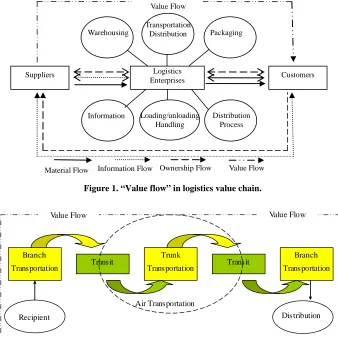
prise’s value chain, which includes such external logis- tics activities as delivery of raw materials and finished goods, and also involves such internal logistics activities as production and selling. So we can think that, in the supply chain, logistics is used to optimize and integrate the logistics resources, while logistics value chain is used to design and plan the value-added activities in the logis- tics process. Therefore, all those activities constitute a new chain, that is logistics value chain [7]. The “value flow” in logistics value chain is shown in Figure 1.
Logistics value chain can be used to optimize logistics system and reconstruct the logistics process of express enterprises, and then make the logistics value maximized.
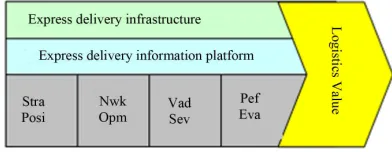
The express enterprises provide the logistics services, and there are different levels of value-added activities in the process of express delivery, which includes recipient, branch transportation, transit, trunk transportation, transit again, branch transportation again, distribution, etc. [8]. If the express enterprises want to improve its compete- tiveness, they need the cooperation and synergy from above activities to get the maximum values. Those values come from the logistics value chain, which exist in the express delivery process and networks. The logistics
value chain of express enterprises is shown in Figure 2.
2.2. Model of Logistics Value Chain Analysis
Value chain reflects the enterprises’ history, strategy, and tactics. All these activities in the enterprises can be di- vided into basic activities and ancillary activities, and the basic activities are considered as the key business in the enterprises. Generally, the basic activities include inter- nal logistics, production and management, external logis- tics, marketing and service, which lead to better services, and more effectiveness; ancillary activities include de- sign of the system, information sharing between logistics activities, inventory visibility and good coordination of operation, which lead to lower costs, and more efficiency [9].
According to above value chain analysis (VCA), the activities in the logistics enterprises can be also divided into basic activities and ancillary activities. For example, the basic activities in the process of express delivery: recipients, sorting (including the packaging and receiv- ing), transportation, and distribution. In order to achieve synergy between the four aspects of the express delivery, the express enterprises need to optimize delivery network,
Packaging Transportation
Distribution Warehousing
Value Flow Information Flow
Material Flow Ownership Flow
Logistics Enterprises
Suppliers Customers
Value Flow
Information Loading/unloading
Handling
[image:2.595.125.463.379.716.2]Distribution Process
Figure 1. “Value flow” in logistics value chain.
Air Transportation Branch
Transportation Transit
Trunk
Transportation Transit
Branch
Transportation
Recipient Distribution
Value Flow Value Flow
[image:2.595.137.453.379.553.2]design delivery process, etc. Ancillary activities are be- yond the basic activities, and extend the basic activities, such as payment collection, e-commerce, etc., which meet and create the demands of customers.
Above logistics value chain analysis (LVCA) help the express enterprises identify the key business, find new profit growth points, make the value of both the enter- prises and customers improved, and then get the core logistics competitiveness.
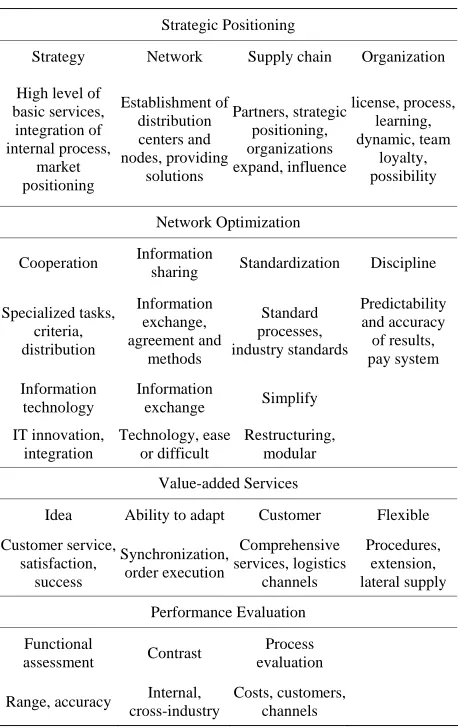
Specifically, for express enterprises, the basic activi- ties include four main aspects: strategic positioning, net- work optimization, value-added services and perform- ance evaluation, such as layout of logistics network, op- timization of delivery process, establish of call centers, evaluation of delivery performance, and so on. The an- cillary activities include two main aspects: delivery in- frastructure and information platform, such as sharing the delivery information, construction the delivery network, developing e-commerce, collection payment, and so on. Basic activities are the fundamental of express enter- prises to enhance competitiveness, and the source of lo- gistics profits. Ancillary activities support the basic ac- tivities to implement successfully. All those activities create logistics value from “the third profits resource”.
Through above analysis, we can build the model of lo- gistics value chain analysis of express delivery, as shown in Figure 3.
The logistics value chain of express delivery is a dy- namic process with creating logistics value for customers. In the traditional, the “customer” is the external custom- ers of an enterprise, and the “service” is the internal “cus- tomers”. In logistics value chain, combining the internal and external factors, the express enterprises improve the service quality of external and internal customers syn- chronously, so as to get the fully and continued advantages of internal and external resources, and then form the core logistics competitiveness.
3. Logistics Competitiveness Model of
Express Delivery
[image:3.595.313.536.541.710.2]Based on the model of logistics value chain analysis, the logistics competitiveness of express enterprises comes from the process of pursuit the logistics value. The model of logistics competitiveness for express enterprises is constructed based on the basic activities, including stra-
Figure 3. Model of LVCA for express delivery.
tegic positioning, network optimization, value-added ser- vices and performance measures, as shown in Figure 4.
3.1. Strategic Positioning
Strategic positioning is a competitiveness of the accurate positioning of markets and resources. Strategic position- ing refers that how to position the logistics activities in the enterprises from its strategy to structure. Business mar- keting strategy, procurement strategy, R & D strategy, and logistics strategy are closely linked with each other. Logistics organizational structure, personnel structure and logistics network structure, in other words, that all logistics resources are related and integrated with the enterprises strategies and department strategies.
3.2. Network Optimization
Network optimization is a competitiveness of achieving synergy effect, which comes from the theory of system. Network optimization refers that how to implement the logistics strategy. The logistics enterprises need to con- struct a coordination mechanism between internal and external enterprises, and use the mechanism to control the total cost of logistics, service objectives, logistics ideas and cross-functional process.
3.3. Value-Added Services
Value-added service is a competitiveness of responding the customers’ demands rapidly, which includes various kinds of business to improve customers’ satisfaction. Value-added services come from the idea of logistics sys- tem. The goal of logistics system is to serve customers, and the only purpose is to create value for customers.
3.4. Performance Evaluation
[image:3.595.73.269.645.721.2]Performance evaluation is a necessary factor so that a
logistics system can fulfill its functions successfully. The logistics process’s efficiency and effectiveness must be measurable, so that managers can control and adjust time- ly to ensure that the organization goals can be achieved with shorter time and lower costs. The logistics enter- prises should have an internal and external “monitor mode”, which will provide information for strategic posi- tioning, network optimization and value-added services.
4. Empirical Research: The Logistics
Competitiveness for SF
SF is an express enterprise and as the leader of the ex- press delivery industry in China. The core value of SF is “FIRST” (abbreviation of faith, integrity, responsibility, service and team). The competitiveness of SF is higher than other domestic express enterprises in such aspects as network architecture, value-added services and informa- tion system. However, for SF, there are also some prob- lems in those three areas.
4.1. The Situation of Express Delivery for SF
4.1.1. Express Delivery Network
The network of air transportation. At present, SF has own cargo aircrafts and airlines, but the coverage of shipping lines is small and the loading rate is low. Therefore, the delivery volume is not balanced, and lead to high logis- tics costs.
The network of road transportation. SF uses informa- tion technology to position the vehicles, and ensure the process of road transportation is smooth and effective. However, in current, the road transportation network is still unable to meet the increasing of express delivery, and the loading rate of road transportation is also low.
The process of express delivery. The delivery speed at the start and the end of express delivery is slow, because SF does not pay more attention to the links of different parts. SF spent more time in distribution, which leads to low efficiency.
4.1.2. Value-Added Services
Marketing homogenization. The marketing methods and means of SF are similar with other express enterprises, and imitate each other.
Marketing activities single. SF’s marketing activities are not the target and lacking of innovation. Service mar- keting and knowledge marketing are used to maintain customer relationships, and then SF failed to develop a variety of activities based on characteristics of the VIPs.
Important clients marketing system. SF did litter to construct the VIPs marketing system, the marketing or- ganizations and staffs are insufficient, and the marketing policy and design are not reasonable.
4.1.3. Information Systems
Scalability. Usually, a common demand of the informa- tion system or a business function changes will cause to modifications of a number of information subsystems in a wide range.
Synergies. The information subsystems of SF are rela- tive independent, which form the isolated islands of in- formation. The sharing capability of information is weak.
4.2. Logistics Competitiveness Model of SF
Based on above problems for SF, the logistics compete- tiveness model of SF is constructed from four aspects: SF’s strategic positioning, SF’s network optimization, SF’s value-added services, and SF’s performance evalua- tion.
4.2.1. SF’s Strategic Positioning
“FIRST” is the strategic positioning of SF. Network op- timization and value-added services are two important strategies. So the strategic positioning of SF combines those two strategies, through optimization of the express delivery network based on providing value-added ser- vices to add the logistics value in the different levels of customers’ demands.
4.2.2. SF’s Network Optimization
SF need to optimize the air transportation network and road transportation network based on logistics value chain. The network optimization is used to integrate va- riety resources of express delivery in order to get the synergy effects, form the coordination mechanisms, and achieve the goal of controlling total cost of delivery, ser- vices levels, process optimization and reconstruction.
4.2.3. SF’s Value-Added Services
SF should provide value-added services with a variety of marketing methods, which is an important way to im- prove customers’ satisfaction. SF need to use network to provide faster and more flexible delivery service, so as to meet and create customers’ demand constantly.
4.2.4. SF’s Performance Evaluation
SF should establish a measurable evaluation system and process of express delivery, which can be used to control and adjust the strategic positioning, network optimization and value-added services to achieve goals with the man- ner of efficiency and effectiveness.
4.3. Characters of Logistics Competitiveness for SF
each include a series of indicators. Good or bad indica- tors show that the express enterprises have or haven’t the competitive advantages comparative to other competitors. Those indicators have a broad applicability, and provide an important basis for SF to find the direction to improve its logistics competitiveness.
For SF, the characters of logistics competitiveness and the indicators of logistics value chain are shown in Table 1.
5. Conclusions
[image:5.595.58.287.307.671.2]The core competitiveness is a system of certain advan- tages, abilities or knowledge for the enterprises, and shown as the key activities or unique business in the en- terprises. The core competitiveness is in relation to the enterprises’ surviving and development, and it can make the enterprises stronger than other competitors. The
Table 1. Characters of logistics competitiveness.
Strategic Positioning
Strategy Network Supply chain Organization
High level of basic services,
integration of internal process,
market positioning
Establishment of distribution centers and nodes, providing
solutions
Partners, strategic positioning, organizations expand, influence
license, process, learning, dynamic, team
loyalty, possibility
Network Optimization
Cooperation Information
sharing Standardization Discipline
Specialized tasks, criteria, distribution
Information exchange, agreement and
methods
Standard processes, industry standards
Predictability and accuracy of results, pay system
Information technology
Information
exchange Simplify
IT innovation, integration
Technology, ease or difficult
Restructuring, modular
Value-added Services
Idea Ability to adapt Customer Flexible
Customer service, satisfaction,
success
Synchronization, order execution
Comprehensive services, logistics
channels
Procedures, extension, lateral supply
Performance Evaluation
Functional
assessment Contrast
Process evaluation
Range, accuracy Internal,
cross-industry
Costs, customers, channels
competitiveness of key activities or business and the management team leadership constitute the core com- petitiveness, and the core competitiveness is the essential part and fundament for the development of the enterprises.
The express enterprises provide high level services to meet customers’ demands, develop the customer markets constantly, and then get the chance of growing and being stronger. There are a number of activities in the process of express delivery, but the different activity contributes the different value to the whole process. Through con- struction the model of logistics value chain analysis, the key activities of express delivery can be identified, which constitute the logistics competitiveness for the express enterprises. Then a model of logistics competitiveness is established, which involves four factors: strategic posi- tioning, network optimization, value-added services and performance evaluation. The model helps the express en- terprises to form the core logistics competitiveness.
REFERENCES
[1] X. Y. Xu, “Report of the Development of Express Deliv-ery in Chian,” China Social Sciences Publishing House, Beijing, 2009.
[2] D. P. Wang and Y. F. Yang, “Analysis of the Competition of the Express Market in China,” Social Science of Bei-jing, Vol. 48, No. 2, 2009, pp. 10-15.
[3] C. B. Jiang, “Analysis of Market Opportunities for Chi-nese Private Express Service,” Logistics Sci-Tech, Vol. 32, No. 8, 2009, pp. 79-81.
[4] M. Port, “Competitive Advantage,” Hua Xia Press, Bei-jing, 1997.
[5] X. J. Zhou, “Logistics: From Supply Chain to Value Chain,” Logistics Sci-Tech, Vol. 30, No. 12, 2007, pp. 48-49.
[6] X. J. Zhou and Q. N. Zhang, “Research on Construction and Generation of Logistics Value Chain,” China Busi-ness and Market, Vol. 24, No. 4, 2010, pp. 26-29. [7] X. J. Zhou and C. H. Huang, “Value Chain Alliance of
Logistics Enterprises Based on Core Competition,” Jour-nal of Wuhan University of Science and Engineering, Vol. 20, No. 9, 2007, pp. 79-81.
[8] L. Ma and J. Tang, “Value Chain Analysis and Applica-tion of Express Enterprises,” Commercial Times, Vol. 22, No. 24, 2010, pp. 88-89.