Abstract ---- The indoor Telecom coverage suffers poor reception, call distortion and low voice quality, by signal distortions and interference. In order to improve the quality and performance of voice service at the indoor environment, a number of base stations are required. Therefore, femtocells were introduced in the indoor environment for signal booster and other services for end users. Femtocells are deployed in the existing macrocell network coverage to enhance network coverage in an indoor environment. In this paper, we present the simulation base on the signal and the path loss model in the indoor environment, to show that femtocell enhanced indoor communication with improved signal strength without interference.
Index Terms— Femtocell, Interference Management, Pathloss, Macrocell
I. INTRODUCTION
emtocell have recently been accepted, and utilized as a sustainable solution to allow broad connectivity in mobile networks. It serves as the indoor environment in which the transmitter and the base station are closer to the end user of the device. However, the prediction of path loss and wall losses is a major characteristic in planning of cellular systems. The broadband of a building materials and construction code changes, this make the prediction of attenuation vary, and difficult to support data or measurements. Path Loss is the attenuation that occurs as the voice travel over a distance or through obstacles. For example, if a speaker is loud enough that the attenuation of the sound allows the listener to hear and understand, then, communication is successful. Path Loss occurs naturally with distance and obstacle between the transmitter and receiver also attenuate signal.The application of femtocell provides a good quality of service (QoS) and high performance.
Manuscript received November 11, 2014; revised December 1, 2014. This work was supported in part by the Centre of Telecommunication under University of Johannesburg. The Paper: Indoor Communications: Femtocell Behaviour in an Indoor Environment.
O. A. Akinlabi is with the Electrical and Electronic Engineering Science, University of Johannesburg, Johannesburg. South Africa (phone: +2717157260; e-mail: akinlabiakindeji@ gmail.com).
B. S. Paul is with the Electrical and Electronic Engineering Technology, University of Johannesburg, Johannesburg. South Africa.
M. K. Joseph is with the Electrical and Electronic Engineering Technology Department, University of Johannesburg, Johannesburg, South Africa.
H. C. Ferreira is with the Electrical and Electronic Engineering Science, University of Johannesburg, Johannesburg, South Africa.
Figure 1 shows the path loss within the transmitter and receiver channel. Generally, whenever the received signal strength is poor, it is required to use the femtocell as signal booster’s receiver. Since most of the calls mainly originate from the indoor environment, this makes femtocell more important for indoor uses. A study by ABI showed that 50% of voice calls and more than 70% of data traffic is projected to originate from the indoor environment in the near future [1]
.
Fig 1: Show the direction of path loss between the transmitter and receiver.
It is widely believed that, by providing a good quality of service for an indoor user, there will be an increase in revenue for the Telecom operators. Femtocells are low cost, short range, which are usually installed by the subscriber [2]. They work within the license frequency band. The access point known as Femtocell Access Point (FAP) serve as Base Station (BSs), that allow high quality voice, data and multimedia service to be delivered to mobile devices at the indoor setting.
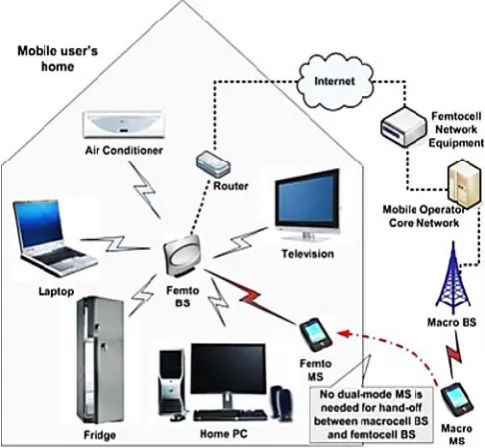
Apart from the communication enhancement of the femtocell, it can interact with smart home appliances and personal computers in the house [3] such as:
• Control TV from their mobile device • Control home appliance such as air condition
• Synchronize music collection on their mobile device with their home PC when return home
• Leave virtual fridge note to be delivered when the recipient returns home
The FAP connect the user’s optical fiber or broadband internet connection to the Telecom core network.
Another important function of the femtocells is that it operates in the closed subscriber group (CSG), which enable limited access by registered user equipment, while other user equipment cannot access the connection.
In this paper, we consider a femtocell as a signal booster in the indoor environment and their path loss. We provide
Indoor Communication: Femtocell Behavior in
an Indoor Environment
O.A Akinlabi, B.S. Paul, M. K. Joseph and H.C. Ferreira
[image:1.595.305.546.312.421.2]simulation results to demonstrate the performance of femtocell at the indoor environment.
The rest of this paper is organized as follows: the benefits of deploying femtocell in section II. In section III, the health and safety of femtocell in the indoor environment. Section IV, gives an overview of interference mitigation techniques. While section V, explains the notation representation for the modeling. Section VI, presents the experimental result. Finally, section VII, gives the conclusions.
II. BENEFITS OF DEPLOYMENT OFFEMTOCELL
The application of new technology called femtocell, reduce macro cell site and churn in the network, (where the operators spend millions of dollars to reduce churn in the network and built macro cell site). Femtocell improve quality of coverage to the end users of the network at the indoor and more additional revenue for the mobile network such as internet service, video calling and data service. However, femtocell maximizes the operator’s revenue and increase network capacity performance. The worry of electricity bills is more an issue for the operators.A typical femtocell network with appliances connect to a FAP is shown in figure 2. The entire smart home appliances are linked to the FAP, for the purpose of communication and security of the home or office.
[image:2.595.47.290.435.659.2]Due to poor coverage in the indoor environment, the new technology called a femtocell enhances the quality of the network coverage performance to be enjoyed along with additional services such as multimedia, internet, video calling, voice service and high speed data services with effective cost.
Fig 2: Application of a femtocell in an indoor environment
III. HEALTH AND SAFETY OF FEMTOCELL ATTHE
INDOOR ENVIRONMENT
The use of Femtocells in the indoor environment raises some health and safety concerns that related to the perceived association of some health problems with the use of radio radiation. Much work has been done by researchers on radio
between radiation and cancer, the general counsel is that of caution in the undue exposure to radio radiation. Moreover, the manufacturer of Femtocell has indicated that no health threat had been reported during the use of Femtocell in the indoor environment. Presently the principle of radio frequency radiation is set to ranking, which allow radio transmission of several forms to be used, but at a level where current scientific research shows that there are no unreasonable risk in regard to the usage of Femtocell at the indoor environment. Femtocell fulfil all the safety limits that are applied to other wireless device such as mobile phones, Wi-Fi access points, Bluetooth devices, etc. Thus, these safety limits have been recognized by the International Commission on Non-Ionizing Radiation Protection (ICNIRP) and also authorized by the World Health Organization (WHO) and widely approved by governments around the world.
IV. OVERVIEW OF INTERFERENCE MITIGATION TECHNIQUES
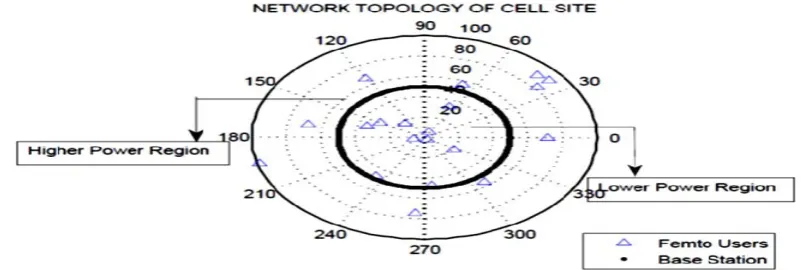
In this section, we describe the interference among the femtocell network in cellular network coverage where a Base Station is located at the center of the cell with a number of Femtocells randomly positioned around the home and office users of the network. The base station, which is located in the center of the cell is known as the primary base station and that of the Femtocell is known as the secondary base station in a spectrum overlay network. The Figure 3 depicts a centralized base station with a number of femtocell base stations randomly positioned within the cellular network. However, some related work on mitigating interference management in femtocell networks for communication purpose, which is the main problem, due to their self-behavior of each user of femtocell at each region of the cellular network, completing for the common license spectrum resource. Several works of researchers have indicated their interest on mitigation techniques, in order to utilize femtocell at the indoor (for high quality of voice and other purposes). The introduction of price policy to mitigate interference management in femtocell network was proposed by Akinlabi et al [4]. Under this concept, the price was used to control the power transmission of each Femto user in the cell coverage, in order to mitigate interference and ensure the quality of the network in the cell network coverage.This concept enhances quality performance of the cell network coverage whereby as power increase, the price is updated. Dynamic frequency planning [5] is another method employed to avoid interference, and hence capacity and the throughput of the network at its optimal level. The scheme estimate sub-channels, considering each user's bandwidth in each sector. The interference is calculated when all the sectors transmit at the same frequency.
Fig 3: A centralized base station with multiple femtocell base station
This scheme removes interference between the macrocell and femtocell by applying orthogonal spectrum. Due to high interference, that exists between the macrocell and femtocell network, Ji-Hoon et al. [8], recommend a distributed self-organized femtocell management architecture, which is known as CTRI (complementary Tri- control). This consists of three loops that determine the maximum transmission power of femtocell user, and target SINR of femtocell user, in order to protect the femtocell user from the macrocell interference. The effect of interference to neighboring macrocell users was addressed by this highly technical scheme. However, this paper addresses the indoor communication whereby Femtocell is used as a signal booster, and the behaviors of the femtocell performance evaluated in the indoor environment.
V. NOTATION SYSTEM FOR MODELLING
In this section we evaluate, and present the notation system for the modelling and the parameters for the experimental result. The primary focus is to understand the path loss model which is associated with femtocell in an indoor environment.
A. Path loss model in an indoor environment
The path loss model [9] that is used in this paper is ITU-R type of path loss model that approximates the fluctuation of a signal in an indoor environment. Thus, the path loss between the users and Femto base station at the indoor is expressed in equation (1):
10
10 2 ,
2 0.46 1
1 2
(
) max(15.3 37.6
( )),38.4
20
( ) 0.7
18.3
D indoor
n n
iw ow ow
PL dB
Log
d
Log
d
d
n
qL
L
qL
(1)
Where,
PL is the path loss model
n
---- Number of penetration floorsq
---- Number of walls separating apartments between Femto and user equipmentiw
L
--- Penetration loss of the wall separating rooms within an indoor
d --- Distance between transmitter and receiver in meter 2 ,
0.7
d
D indoor --- Account of penetration loss due to walls inside an apartment, this is expressed in meterow
L
--- Penetration loss of outdoor wallLow and Liw are assumed to be set to 20dB and 5dB
respectively.
B. Estimation of SINR at both indoor and outdoor In order to evaluate the performance of the network, the estimation of SINR is highly important. We estimate the SINR [10-12] for each user and each sub-carrier
n
. The SINR of the userK
with the powerP
is expressed in equation (2):, , ,
, , , ,
mk mk k m
o k m k m F k F k
M F
P G
SINR
N
P G
P G
(2),
m k
P
--- Power transmission from the base station ,m k
G
--- Gain channelo
N
--- White noise power ,F k
P
--- Power transmission from the FAP ,F k
G
--- Gain Channel from the FAPC. Bit Error Rate
The transmission model is concerned about the bit error rate (BER) due to the pathloss associate with the wireless channel. The BER of a Shannon channel capacity is expressed as shown mathematically in equation (3):
1.5
0.2exp
2
k1
SINR
BER
(3)
1.5
ln 5BER
D. Throughput estimation
To calculate the throughput [13], the capacity of Femto user on the same sub-carrier n, is expressed as [5]
,
.log 1
10 ,i n i n
C
W
SINR
(5) Where
Ci, n --- denote the capacity of the networks
W
--- Bandwidth for subcarriern
SINRi, n ---denote our signal to interference plus noise ratio
VI. EXPERIMENTAL RESULTS
In this section, the equations in section III were used for simulation results in MATLAB and other parameters, such as power transmission of femtocell base station, and path loss were put into consideration. The throughput estimation was calculated in Femto cell user at the indoor to integrate the Telecom core networks. However, the simulation provides here show the behavior of femtocell signal in the indoor environment, over the existing macrocell base station at the outdoor. We assumed that both Femto user and FAP are placed in the same room where they experience less cross-tier interference from macrocell transmission. This experiment evaluation will help us understand the merit of femtocell at the indoor environment.
[image:4.595.312.540.148.349.2]Based on the simulation result, figure 4 shows the results of bit error rate against signal, where the path loss within the indoor environment is considered. The bit error rate is the key parameter in data transmission of any system that transmits a data over the network where interference and path loss causes degradation of the digital signal. From the simulation result in figure 4, show that if the bit error rate is low the signal to interference will be high, and this will improve communication purpose. In reducing the bit error rate, the throughput will be achieved in the system.
Fig 4: illustrate the function of BER versus signal to interference ratio.
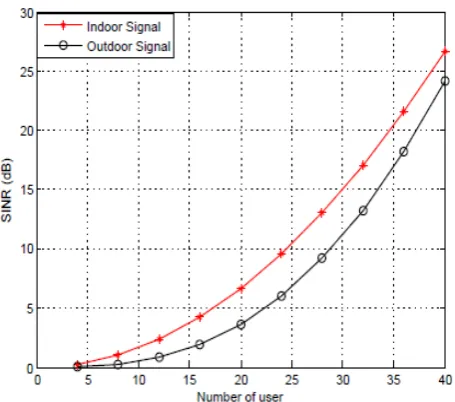
Figure 5 shows the signal behavior against the capacity at both indoor and outdoor. The signal at the indoor increase
along with capacity, this shows the quality of FAP at the indoor. However, the users experience no interference rather quality of service and other service from the mobile service. Moreover, it can be used for multiple purposes for the end users.
Fig 5: Demonstrate the signal at both indoor and outdoor behavior
VII. CONCLUSION
In this paper, we examined femtocell in an indoor environment to enhance good quality service and high performance to the mobile network, where the path loss was analyzed within the indoor environment. We discovered that femtocell at the indoor environment experience no interference, whereby the end users enjoy good quality and smooth communication within the cellular network from the service providers.
In addition, the capacity performance is achieved due to the closeness of the base station to the end users (.i.e. FAP) within the indoor environment for quality and data coverage. We hereby observed that for smooth and quality service from the service provider, the base station must be closer to the end users.
This will cut off expenditures from the service provider, such as electricity bills, maintenance cost etc...To enable them center on quality of service for the end users of the network.
ACKNOWLEDGMENT
The authors wish to acknowledge the effort and support of his supervisor and co-supervisors, Dr. Paul B.S and Dr. (Ms.) M. K. Joseph of Department of Electrical and Electronic Engineering Technology, University of Johannesburg and Prof. H.C. Ferreira of Department of Electrical and Electronic Engineering Science, University of Johannesburg, South Africa
REFERENCES
[1] Presentations by ABI Research, Picochip, Airvana, IP access Gartner Telefonica Espana, 2nd Intl. Conf. Home Access Points and
Femtocells; available online at:
[image:4.595.45.286.505.698.2][2] 3GPP TR 36.922 v9.1.0 “Evolved universal Terrestrial Radio Access (E-UTRA); TDD Home eNodeB (HeNB) Radio Frequency (RF) requirement analysis (Release 9)”. 3rd Generation Partnership Project
Tech. Rep 2010.
[3] Femtoforum, “Femtocell applications.” [Online]. Available:
http://femtoforum.org/femto/applications.php Access on August 2014
[4] O. A. Akinlabi, B. S. Paul, M. Joseph and H. C. Ferreira “A Pricing Policy to Mitigate Interference Management in Femtocell Network” paper presenting in International Conference on Computer Technology and Science, Sarawak, Malaysia 7-8 June 2014.
[5] D. Lopez-Perez et al. "Interference Avoidance and Dynamic Frequency Planning for WiMAX Femtocell Networks," IEEE International Conference on Communication Systems (ICCS), Nove.2008
[6] T. Kim, T. Lee," Throughput Enhancement of Macro and Femto Networks by Frequency Reuse and Pilot Sensing," IEEE International Performance, Computing and Communication Conference (IPCCC), Dec. 2008.
[7] V. Chandrasekhar, J. Andrews, "Spectrum Allocation in Two=tier Networks" IEEE Asilomar Conference on Signals, Systems and Computer, Oct. 2008.
[8] Y. Ji-Hoon and G. S. Kang, “Distributed self-organized femtocell management architecture for co-channel deployment”. The University of Michigan, Ann Arbor, Chicago, Illinois, USA, 20-24 September 2010.
[9] B. S. L. Castro, I. R. Gomes, F. C. J. Ribeiro, G. P. S. Cavalcarite, “COST231-Hatta and SUI Models Performance using a LMS Tuning Algorithm on 5.86Hz in Amazon Region Cities” Proc. Of IEEE.
EUCAP-2010. ISBN: 978-847653-472-4, pp. 1-3, Jul. 2010.
[10] 3GPP TR 36.942 v10.20. ” Evolved universal Terrestrial Radio Access (E-UTRA); Radio Frequency (RF) System scenarios” 3rd
Generation Partnership Project Tech. Rep, 2010- 2012.
[11] M. Simsk K, T. Akbudak, B. Zhao, and A. Czylwk,” An lte femtocell dynamic system level simulation” in smart antennas (WSA), 2010 international ITG workshop on Feb. 2010. Pp. 66-71.
[12] P. Lee, T. Lee, J. Jeong, and J. Shin, “Interference Management in Lte Femtocell Systems Using Fractional Frequency Reuse,” in Advanced Communication Technology (ICACT), 2010 The 12th International Conference on, vol. 2, Feb. 2010, pp. 1047 –1051.
[13] H. Lei, L. Zhang, X. Zhang, and D. Yang, "A Novel Multi-cell OFDMA System Structure Using Fractional Frequency Reuse,"
IEEE International Symposium on Personal, Indoor and Mobile