Abstract — the popularity of wireless networks has attracted the attention of researchers to improve the network system and this motivated the operators to find a new technology called femtocells with the aim of meeting the increased coverage and data demand in the indoor environment.
The application of femtocells in both indoors and office environment has provided good quality service and high performance network gains.
However, femtocells face challenges of interference management which deteriorate the capacity and quality of network. But to cope with these challenges, many researchers have come up with solutions to solve the problems, some of which include interference cancellation and interference avoidance.
Index Terms — femtocell, interference management and macrocell.
I. INTRODUCTION
HE main aim of mobile operators is to increase the system capacity and data transmission within a large cell coverage area, due to the popularity of wireless network service. The wireless network has taken over from wired service in terms of high data rate service and mobility it provides to end users.
To achieve this aim, several standard technologies have been developed such like 3GPPs High Speed Packet Access (HSPA), Long Term Evolution (LTE), and LTE advance, 3GPP2s Evolution-Data Optimized (EVDO) and Ultra Wide Band (UWB) to provide high speed communication to end users [1]. Furthermore, certain requirement must also be met along with this aim to achieve high rates, like Signal to Interference plus Noise Ratio (SINR) must be received, higher order Modulation and Coding Scheme.
Manuscript received June 13, 2013; revised February 08, 2014. This work was supported in part by the University of Johannesburg. This Paper: A Review of Femtocell.
A. O. Akinlabi is with Electrical and Electronic Engineering Technology Department, University of Johannesburg, Johannesburg, South Africa, SA. (Phone: +27717157260; e-mail: [email protected]).
S. B. Paul he is with the Department of Electrical and Electronic Engineering Technology, University of Johannesburg, Johannesburg, South Africa, SA.
M. K. Joseph she is with the Department of Electrical and Electronic Engineering Technology, University of Johannesburg, Johannesburg, South Africa, SA.
H. C. Ferreira he is with Department of Electrical and Electronic Engineering Science, University of Johannesburg, Johannesburg, South Africa, SA.
There is need for the mobile operator’s to improve the quality of service at the indoor due to poor coverage experience by the end user’s. A study by ABI shows that more than 50% of voice calls and more than 70% of data traffic is expected to originate from indoor users in future [2]. By providing good quality of service at indoor, it increased revenue of mobile operator’s and reduced churn. Due to losses, the indoor user require high power from the serving Base Station (BSs), which cannot be meet by mobile operator’s because it is very expensive to have a larger number of outdoor Base Station (BS) to meet the needs of high capacity network. This brings about the need of indoor coverage solution by use of Picocell, Distributed Antenna Systems (DAS) and Relay based systems. Picocells are small cells that provide coverage to limited indoor area [3]. It work as macrocells and it’s connected to each other through macrocells BS cables while DAS is another solution with number of distributed Antenna Elements (AE) and home Base Station (BSs) [4].
It work as macrocells and it’s connected to each other through macrocells BS cables while DAS is another solution with number of distributed Antenna Elements (AE) and home Base Station (BSs) [4]. They both provide good quality communication to where there is poor coverage. The antenna element is connected by dedicated line to the home Base Station offline.
However, picocells and DAS have the disadvantage of being costly and difficulty in installing the base station in every home and small office. Moreover, the overall network load increases as the number of picocells increase. The relay is used in LTE advanced for indoor environment [5], for high data rates to end user’s.
Relaying function in two types, Amplify and Forwarding relaying (AF) and Decode and Forward relaying (DF) [5], [6]. The introduction of femtocell technology [7], [8], [9], [10]-[11] brings a significant improvement to indoor network coverage. Femtocells are small base station, which are installed by the end user, and connect to the mobile operator’s core through the internet access [1], [9].
This provides a cost effective and widely available data link for the femtocells that can be used as a standard for all applications. Figure 1 Show the user equipment connection to an operator's core network. Where the user equipment to the access point through the user optical fiber or cable broadband internet connection to the operator’s core network.
A Review of Femtocell
O.A
Akinlabi, B.S. Paul, M. Joseph and H.C. Ferreira
Fig 1: UE connected to an operator's core network.
The access point is called Femtocell Access Point (FAP), that stand as Base Station, allow high quality voice, data and multimedia service to mobile device at the indoor. Femtocell addresses the problem of indoor coverage but faces many challenges. The use of the same frequency band brings the issue of interference, between the operation of both macrocell and femtocell. It can be between neighboring femtocells or between macrocell and femtocell.
The rest of this paper is structured as follows. Section 2 discusses about different types of femtocells. Section 3 discuss the advantage of deployment and classification of femtocell access point. Section 4 describes the issues and challenges in femtocell deployment. Section 5 deals with the possible available solutions to mitigate the interference issue. Conclusions are drawn in section 6.
II.DIFFERENTTYPESOFFEMTOCELLS
The work on Femtocell began with a group of engineers, investigating a new way of application that could deploy to mobile communication system to increase the capacity of the network. This idea gained momentum and as such many companies joined in the investigation of femtocell technology.
Femtocells are low power device that combine Home NodeB and Radio Network Controller (RNC) functionality to provide coverage to mobile users in an indoor environment or a home base station which provide coverage to mobile users through femtocell access point (FAP) at the indoor environment.
One of the vital functions of femtocell in 3GPP is that it operate on Closed Subscriber Group called CSG, this only allow limited and registered User Equipment (UEs) to connect to Home e NodeB (H(e)NB) and disable other UEs in the network. There are other access modes that allow connection of other UEs in the network such as the open access mode and hybrid access mode.
An access mode is used to access a specific femtocell by end users. The open access mode is generally not used by home users, the open access mode can be accessed by anybody and benefit from the services.
These types of mode are mostly used in public area e.g. airport, shopping malls and organization to ensure good coverage to the users [12]. The hybrid access mode on the other hand allows specific outside users to access femtocell and the permission is provided by the operators
The access point known as FAP, work as the base station for the femtocell and uses internet as backhaul network to connect to the macrocell base station. The quality of service solely depends on backhaul. Data, multimedia and video can be routed through the FAP to the end users.
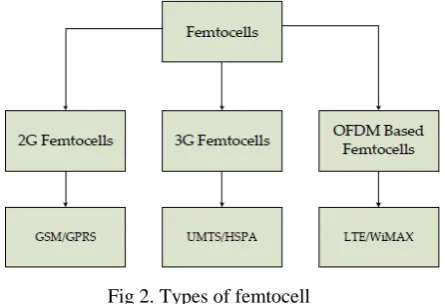
Femtocells are classified based on the air interface technology and each provides different type of services. Femtocell is selected based on a particular technology which depends on the need of the user. The main types of femtocells are; 2G Femtocell, 3G Femtocell and OFDM- Based Femtocell. Figure 2 shows the schematic diagram of the different types of femtocells
.
Fig 2. Types of femtocell A.2G FEMTOCELLS
2G femtocell is based on Global System for Mobile Communication (GSM) air interfaces. It has some drawback and economic viability, but some of the reason why 2G femtocell is generally embraced is that the cost is low and good quality voice service is provided to the end users. The main challenge of GSM is that the power control is not flexible enough to cope with the evolving interference issues and this consequently does not provide high data rates [13].
B.3G FEMTOCELLS
[image:2.595.322.545.409.561.2]rate compare to 2G femtocells [1] and it has the ability of connecting to the network through the IP base. Furthermore, the power control is better than Global System for Mobile (GSM), which can be used to prevent interference to macrocell user. The UMTS femtocells are standardized by 3GPPs as HNBs [14] and developed into HSPA femtocells, to provide better services [15]-[16].
C.THE OFDM BASED FEMTOCELLS
The categories of this are WIMAX and Long Team Evolution (LTE) femtocells. They provide a variety of high data rate service to the end users [2] by making use of OFDM as their physical layer technology. LTE femtocell is being considered as the future technology at the indoor environment.
III.DEPLOYMENTOFFEMTOCELLANDCLASSIFICATIONOF FEMTOCELLACCESSPOINT
There are many reasons for deployment of femtocells to both the operator’s and subscribers. The reasons are following;
a) Operator’s perspective
The application of femtocells brings the reduction in macro cells site and reduce churn in the network (operators spend millions of dollars to reduce churn in the network and built macro site). Femtocells provide an excellent improved coverage and additional revenue from the provision of additional services such as internet service, video, data service and so however, the operator offer two services namely broadband internet connection and femtocell. Femtocells maximize the operator’s revenue and increase network capacity upgrades. The electricity bill is no more the responsibility of the operator’s.
b) Subscriber’s perspective
For poor coverage experience by subscriber, femtocells enable a better coverage performance to be enjoyed along with additional services such as multimedia, internet, video, voice service and high speed data services with effective cost. Femtocells also serve as both focal point and gateway for device to be connected to internet.
FAP can be classified into two classes, namely home FAP, its support 3-5 simultaneous users and enterprise or office, FAP support 8-16 users. The most important attribute of FAP provides high data rate services for the end users. With cellular technologies used, FAP is classified in UMTS FAP, GSM FAP, and WiMAX FAP. FAPs are used by subscriber rather than operators; they are classed to consumer electronics. An FAP must be able to configure itself automatically, in order to minimum interference to macro cell and neighboring femtocells.
However, femtocell must be tested before used through simulation or trails. The main aim of simulation and trails is to know the performance and also the effect of each femtocell to other. More so, to study the impact of femtocells deployment on macro cells layer.
IV. ISSUESANDCHALLENGESINDEPLOYMENTOF FEMTOCELL
With benefits enjoyed by both the operator and the subscriber, femtocell still faces many challenges. The challenges are more acute when deployment is in the urban environment. The introduction of femtocells brings in new changes in macrocellular network. The new network architecture composes of two different layers namely femtocell layer and macrocell layer. The network architecture is now a two layer network or two tier networks. The first layer contains the traditional cellular network and the second layer composes of different smaller cell that can be planned for or distributed in a random manner.
The home base stations are randomly located inside the same area covered by the larger cellular network and they may use of the same spectral frequencies. One of the merits of deploying these smaller cells is that it increases the coverage and also gives room for higher data rates.
The two layer architecture networks bring in new challenges to the network systems. When a signal is transmitted, the various transmitters within the same frequency band might not be able to differentiate which one of the transmitter it listening to. These arise to interference in
telecommunications systems.
With interference-limited system such as Code Division Multiple Access (CDMA), and the introduction of interference avoidance techniques or interference cancellation such as time-hopping or power controls. The capacity-limited systems such as Orthogonal Frequency Division Multiple Access (OFDMA) need to be accepted to cope with the presence of interference along subcarriers due to femtocell layer.
However, femtocell brings about higher spectrum efficiency, spatial frequency reuse and better coverage in areas not fully covered by macrocells. Hence in the absence of interference cancellation or avoidance techniques, dead zone can occur within the macrocell, causing disturbance in the service of femtocell. The others challenges faced by femtocell apart from interference are self-organization, synchronization and timing, access mode, security, mobility movement and handover. But the main concern is interference management which is the important issue in the networking operation.
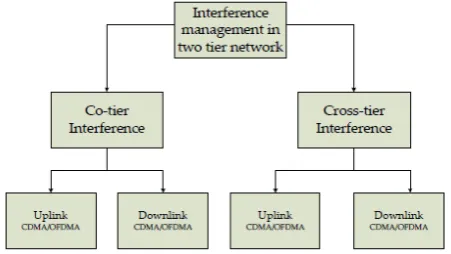
[image:3.595.313.539.642.769.2]The main types of interference in two tier architecture network, both in uplink and downlink are co-tier and cross-tier interference. Figure 3 illustrates types of interference in two tier architecture network.
• Co tier interference.
Co tier or Co layer interference are signal received at the femtocell, from other unwanted femtocells. This decreases the quality of communication. Co - tier interfere occur at the same network layer and it mainly between the immediate neighboring femtocell due to low isolation between houses and apartments.
[image:4.595.338.508.216.401.2]Deployment of Femtocell is opportunistic, because there are installed close to each other’s. The main problem from co tier interference is show in figure 4. The arrows indicate the effect of interference to the user in uplink or downlink direction.
Fig 4: co tier interference between neighboring femtocells However, the signals from other nearby femtocells cause an overall interference higher than the normal femtocell power levels. The carrier to interference and noise Ratio (CINR) value is low; the possibility of establishing communication through any femtocell might not be possible because such location will be a dead zone. Dead zone are area where quality of service are poor and they are created due to asymmetric level of transmission power within the network. This should not be missing up with the concept of coverage holes, when the region is of low pilot CINR due to path loss, the network of the user equipment will fail [17].
The situation of communication differs due to present of interference. Femtocell can be operated in closed subscriber group, open access or hybrid access mode but the co tier interference will vary depending on the access used. The two types of interference that is responsible in co tier interference to others femtocell is the FAP (downlink) and users (uplink).
Time Division Duplex (TDD) systems are used as a model to cope with interference and it’s depending on the source of interfering signal. Supposing, all femtocells in a particular area are synchronized, the victims are the neighboring FAPs at the downlink. It means that the transmission from FAPs will cause interference to UEs of the neighbor femtocell in downlink only.
• Cross tier interference
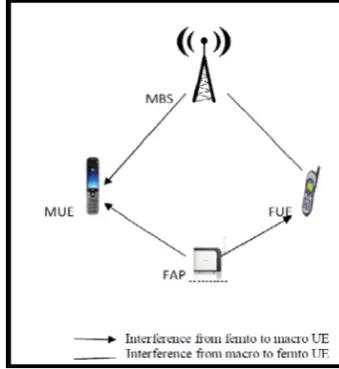
Interference in cross tier occurs between different network elements. For example, the unwanted signals by FAP cause interference to downlink of macrocell users and likewise the unwanted signal by macrocell user at the uplink cause interference to FAP user.
This is cross tier interference to both network systems. The cross tier interference is more sever in CDMA co- channel deployment due to the reason that both femtocell and macrocell make use the same frequency band. The figure below illustrate cross tier interference. Where the direction of arrows indicate the interference in the network.
Fig 5: Typical cross tier interference between femtocell and macrocell.
Other challenges of femtocells Self-organisation
Self-organisation: usually, femtocell are install by the end user and it can be turn on and off at any time. The main objective of self-organisation in wireless network is to achieve reductions in operational expend ure (OPEX) by removing any human involvement in operational tasks of the network, and enhance network capacity and quality of service.
Self-organisation comprises, configuration, self-optimisation and self-healing [20] [21].
Self-configuration; these occur due to any event like addition of new cell sites and removal or addition of network features.
Self-optimisation; it applied the techniques of updating and accepting network parameters. It’s also need to ensure that all parameters are turned to an acceptable level.
[image:4.595.68.265.226.414.2] Mobility management and handovers
The present of mobility management and handovers occur when femtocell operator in a dense environment [22], where femtocell would not be able to keep tracking of its neighbours for handover. However, handover depends on access mode use, in open access mode, handover is large while in closed and hybrid access mode is low [23].
A mobility management scheme is proposed [22], by introducing an intermediate node to control the mobility. The handover mechanism must ensure the quality of service and speed of user’s equipment for handover.
Security
Security is a challenge to femtocell network because information needs to be protected for hacker, who link FAP and mobile core network to up load information. Security can also be a way of preventing unwanted users not to access femtocell network and use the resources.
Due to threat, mobile operators use the internet protocol security (IPSec) between the link of FAP and operator core. Security challenge will became worse, due to the increase number of femtocell deploy.
Timing and synchronisation
Wireless system use crystal oscillator as their internal clock, which help to get the accurate between the transmitter and receiver and also to maintain specific frequency alignment. To achieve synchronisation in femtocell, Asymmetric Digital Subscriber Line (ADSL) is use and it’s connecting to clock of the operator core network through the backhaul.
Another method use to solve synchronisation is by use of GPS receiver within femtocell. The GPS provide timing and synchronisation for femtocell at cost effective. The merits of GPS service are it provides end user with local news and information, which is helpful in interference management.
However, the disadvantage of GPS service for indoor user is that the signal suffers significant amount of attenuation. Timing and synchronisation is a challenge for femtocell.
V. POSSIBLE SOLUTION TO FEMTOCELL CHALLENGES The deployment of femtocell layer brings about various types of interference in two tier architecture network. Interference is noticed in various forms in different air interface technologies. Interference is studied from the point of CDMA and OFDMA femtocell in two tier architecture network.
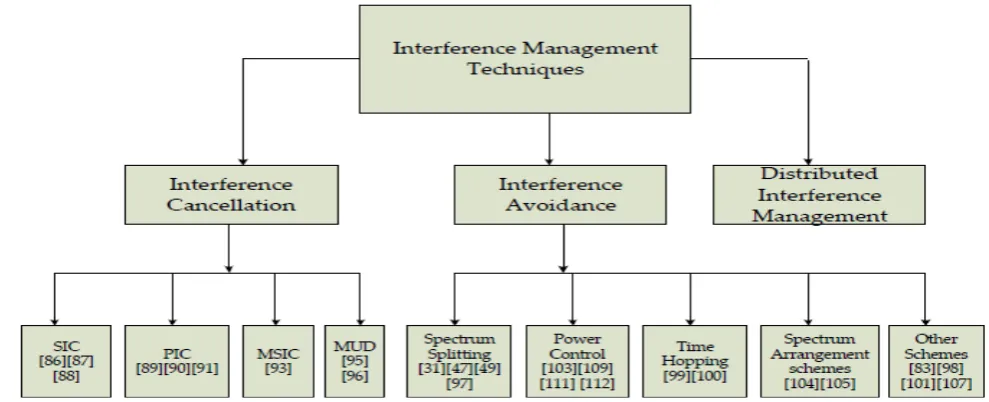
Deployment of femtocell introduces a number of challenges, among which interference the most important among others challenges. Several solution have been suggested by researchers in orders to cope with the technical challenges of femtocells. The various solutions to these challenges of femtocell have made network coverage better and have increased the efficiency of the indoor service. There are different techniques to manage interference, such as interference cancellation, interference avoidance and distributed interference management schemes.
1. Interference Cancellation in femtocells:
Interference cancellation (IC) is a way of reducing interference at the receiving end or minimizes the effects of interference in the received signal. Alternatively, it means that interference is canceled after receiving of the signal [24].
The sources of co channel interference is from FAP and MBS as well as femtocell and macrocell users, but the interfering source will be decide which one is the best possible for interference cancellation.
Co channel and Co tier interference are not the same; co channel interference refers to sharing the same desired frequency band or signal while co tier interference refers to unwanted signal received at the same network layer.
Interference cancellations techniques depend on quality of interfering signal, which they normally make use of antenna arrays at the receiving end to cancel out the interference. The technique is less suitable for the UEs, but appropriately useful in base stations of both macrocell BS and FAP and often used for uplink interference management [25].
Interference cancellation make use of two classical method of wireless networks, which are successive interference cancellation (SIC) and parallel interference Cancellation (PIC) [24] [26].
The PIC detects all the users interference at the same time while the SIC detects its interference one after the others .i.e. the strongest signal is detected first, followed by the next strongest signal and so on [27].
PIC is also called multistage interference cancellation [28]. The primary aim of femtocell is to improve mobile coverage at the indoor.
2. Interference Avoidance in femtocells:
The control of femtocell at the center is difficult due to is physical nature and as well as the cell planning. Therefore, the FAP must be influenced to be self-organize, so that it can be able to cope with interference without center control and hence provide good quality of service to the end user.
Femtocell rely on their location and environment, which bring about different interference challenges without the interest of the global network that is why self-organization and optimization approaches it most important.
The main interference is co - tier and cross - tier interference. Spectrum splitting was proposed [29], for cross – tier interference. In spectrum splitting the spectrum band is divided into two portions, one portion for macrocell users and others portion is used by femtocell users.
Another key technique in interference avoidance is power control mechanism. It is mainly used in environment where femtocells are densely deployed. In this mechanism the femtocell transmits power is controlled successfully so that the macrocell UE at the outdoor are protected from interference. This technique is proposed in [31], only where femtocell network is restricted within the indoor coverage. They are different interference avoidance techniques proposed for CDMA based wireless system, but the majority of them applied time hopping to reduce cross tier uplink interference.
In time hopping, the transmission period is subdivided into portions, a user will transmit and other remains silent during a particular slot [32]. But in the absent of synchronization between the two tier network, each are free to choose its periods. A joint hopping employ by all the user of femtocell to transmit in the same time slot, with minor interference in CDMA based system. These would not cause interference to each other and the neighbor femtocell are freely to select their own time slots, reducing co-tier interference by factor N. The cross tier uplink interference at FAP also decrease due to the same reason of freely selecting time slots [33]. The use of multi sector antenna at FAP has being proposed to avoid interference that macrocell UE might cause. This technique in [34] reduces cross tier interference. If an antenna having S number of sectors is used.
The use of more than one radiating elements [35] where many antenna elements are used to perform beam forming, helps in adapting the coverage area of femtocell.
3. Distributed Interference Management Schemes:
The issue of femtocell is how to control interference management and allow quality of service required by both macrocell and femtocell network.
The centralized techniques use in controlling interference management is difficult, whereby it cause congestion on the backhaul network and this will not allow large information
from the operator. A distributed interference management scheme is employ to avoid interference in network system. The development of distributed interference management scheme for two tier network systems employ the joint power and admission control algorithms. The aim of this approach is thus; their quality of service performance, expressed in terms of minimum signal to interference plus noise ratio must be maintained.
A distributed power control algorithm is proposed [36] for closed access mode. Cross-tier interference can be reduce through a distributed utility based on SINR approach at the femtocell BS, where the power of femtocell causing strong interference is gradually reduced [37].
There are other proposed distributed schemes to cope with interference such as distributed power control schemes for HSDPA femtocells [38] and distributed dynamic Inter Cell Interference (ICI) avoidance (DDIA) scheme [39]. Figure 6 below show different interference management techniques in femtocells.
VI. CONCLUSION
[image:6.595.56.551.533.734.2]The concept of femtocell technology has significant improvednetwork performance in the indoor environment. Furthermore, it provides advantage to mobile operators, in terms of increased revenue and better quality of service. Based on research work from literatures, the femto cell technology is a promising alternative for next generation wireless communication networks. However, Interference has being one of the main problems in femto cell network. The interference includes those between neighbouring femto cells and between macro cells and femto cells, due to the sharing of the same licensed frequency spectrum with an existing macro cells. Researchers have provided different types of techniques to cope with interference problem in femtocell networks. Some of the techniques are interference cancellation and interference avoidance. Finally, it is important to notethat with an efficient interference schemes the network capacity and coverage can be increased.
ACKNOWLEDGMENT
The authors wish to acknowledge the effort and support of his supervisor and co-supervisors, Dr. Paul B.S and Ms M. Joseph of Department of Electrical and Electronic Engineering Technology, University of Johannesburg and Prof. H.C. Ferreira of Deportment of Electrical and Electronic Engineering Science, University of Johannesburg, South Africa.
REFERENCES
[1] V. Chandrasekhar and J. Andrews, “Femtocell networks: A survey,” IEEE Commun. Mag., vol. 46, no. 9, pp. 59–67, Sep. 2008
[2] Presentations by ABI Research, Picochip, Airvana, IP access, Gartner, Telefonica Espana, 2nd Intl. Conf. Home Access Points and Femtocells; available online at http:// www.avrenevents.com/. Accessed August 2012.
[3] H. Daehyoung, C. Seungwoong, and C. Jaeweon, “Coverage and capacity analysis for the multi-layer cdma macro/indoor picocells,” IEEE International Conference on Communications, vol. 1, pp. 354– 358, 1999.
[4] H. Yankikomeroglu and E. S. Sousa, “Power control and number of antenna elements in cdma distributed antenna systems,” IEEE International Conference on Communications, vol. 2, pp. 1040–1045, 7-11 Jun 1998.
[5] T. Wirth, L. Thiele, T. Haustein, O. Braz, and J. Stefanik, “LTE amplify and forward relaying for indoor coverage extension,” IEEE 72nd Vehicular Technology Conference Fall, vol. 147, pp. 1–5, Oct.2010.
[6] V. Venkatkumar, T. Wirth, T. Haustein, and E. Schulz, “Relaying in long term evolution: Indoor full frequency reuse,” European Wireless (EW), vol. 149, pp. 298–302, May 2009
[7] D. L. Perez, G. D. la Roche, A. Valcarce, A. Juttner, and J. Zhang, “Interference avoidance and dynamic frequency planning for WiMAX femtocells networks,” 11th IEEE Singapore International Conference on Communication Systems, pp. 1579–1584, 19-21 Nov. 2008.
[8] M. Yavuz, F. Meshkati, S. Nanda, A. Pokhariyal, N. Johnson, B. Roghothaman, and A. Richardson, “Interference management and performance analysis of umts/hspa+ femtocells,” IEEE Commun. Mag., vol. 47, no. 9, pp. 102–109, Sep. 2009.
[9] H. Claussen, “Performance of macro and co channel femtocells in a hierarchical cell structure,” IEEE 18th International Symposium on Personal, Indoor and Mobile Radio Communications, pp. 1–5, 3-7 Sep. 2007.
[10] R. Baines, “The need for WiMAX picocell and femtocells,” WiMax London, pp. 1–36, 25-26 April 2007.
[11] D. Lopez-Perez, A. Valcarce, G. Roche, E. Liu, and J. Zhang, “Access methods to wimax femtocells: A downlink system-level case study,” 11th IEEE Singapore International Conference on Communication Systems, pp. 1657–1662, 19-21 Nov. 2008.
[12] M. Reardon, “Cisco predicts wireless data explosion,” Press release, 9th Feb 2010, online available. Access on October 2012
[13] M. Ismail, T. L. Doumi, and J. G. Gardiner, “Tele traffic performance of dynamic cell sectoring for mobile radio system,” ICCS Conference Proceedings, vol. 3, pp. 1090–1094, 14-18 Nov. 1994.
[14] K. Hamidian and J. Payne, “Performance analysis of a CDMA/FDMA cellular communication system with cell splitting,” in Proc Second IEEE Symposium on Computers and Communications, pp. 545–550, 1-3 Jul. 1997.
[15] M. Almgren, L. Bergstrom, M. Frodigh, and K. Wallstedt, “Channel allocation and power settings in a cellular system with macro and micro cells using the same frequency spectrum,” 46th IEEE Vehicular Technology Conference, vol. 2, pp. 1150–1154, 28 Apr-1 May. 1996
[16] V. C. M. Leung, “Internetworking wireless terminals to local area networks via radio bridges,” IEEE International Conference on Selected Topics in Wireless Communications, pp. 126–129, 25-26 Jun. 1992.
[17] S.-F. Su, the UMTS Air-Interface in RF Engineering: Design and
Operation of UMTS Network. McGraw- Hill Professional May 2007.
[18] R. S. Karlsson, ‘Radio resource sharing and capacity of some multiple
access methods in hierarchical cell structures,’ in Vehicular Technology
Conference (VTC), vol. 5, Sep. 1999, pp. 2825–2829.
[19] Ericsson, ‘Simulation results for Home NodeB uplink performance in case of adjacent channel deployment within the block of flats scenario,’ 3GPP TSG-RAN Working Group 4 (Radio), Sorrento (Italy), Tech. Rep. R4-080152, Feb. 2008.
[20] J. L. V. D. Berg, R. Litjens, A. Eisenbltter, M. Amirijoo, O. Linnell, C. Blondia, T. Krner, N. Scully, J. Oszmianski, and L. C. Schmelz, “Self – organization in future mobile communication networks” ICT Mobile Summit, Sweden, Vol. 2, pp. 915-920, June, 2008.
[21] I. Balan, “Self-organization in 3gpp lte networks” December, 2009
[22] L. Wang, Z. YONGSHENG, and W. Zhenrong, “Mobile management
schemes at radio network layer for lte femtocells” IEEE 69th Vehicular
Technology Conference, pp. 1-5, 26-29.
[23] A. Valcarce, D. Lopez-Perez, G. D. L. Roche, and Z. Jie, “Limited
access to cdma femtocells” IEEE 20TH International Symposium on
Personal, Indoor and Mobile Radio Communications, pp. 1-5, 13-16 Sept. 2009.
[24] J. G. Andrews, “Interference cancellation for cellular systems: A contemporary overview,” IEEE Wireless Commun., vol. 2, no. 3, pp. 19–29, April. 2005.
[25] M. Ghosh, “Co-channel interference cancellation for hdtv receivers,” IEEE International Conference on Acoustics, Speech, and Signal Processing, vol. 5, pp. 2675–2678, 1999.
[26] L. G. F. Trichard, J. S. Evans, and I. B. Collings, “Large system analysis of linear parallel interference cancellation,” IEEE International Conference on Communications, vol. 1, pp. 26–30, 11-14 Jun. 2001.
[27] P. Patel and J. Holtzman, “Analysis of a simple successive interference cancellation scheme in a ds/cdma system,” IEEE J. Sel. Areas Commun., vol. 12, no. 5, pp. 796–807, Jun. 1994.
[28] P. Frenger, P. Orten, and T. Ottosson, “Code spread cdma with interference cancellation,” IEEE J. Sel. Areas Commun., vol. 17, no. 12, pp. 2090–2095, 1999.
[29] R. S. Karlsson, “Radio resource sharing and capacity of some multiple access methods in hierarchical cell structures,” in Vehicular Technology Conference, vol. 5, pp. 2825–2829, Sep. 1999.
[30] M. Fan, M. Yavuz, S. Nanda, Y. Tokgoz, and F. Meshkati, “Interference management in femto cell deployment,” in 3GPP2 Femto Workshop, Oct. 2007.
[31] K. Han, Y. Choi, D. Kim, M. Na, S. Choi, and K. Han, “Optimization of femtocell network configuration under interference constraints,” 7thInternational Symposium on Modeling and Optimization in Mobile,
AdHoc, and Wireless Networks, pp. 1–7, 23-27 Jun. 2009.
[32] T. Zahir, K. Arshad, Y. Ko, and K. Moessner, “A downlink power control scheme for interference avoidance in femtocells,” 7th
International Wireless Communications and Mobile Computing