Abstract— Vehicular Ad-hoc Networks (VANET) has attracted a great deal of attention during the last decade. This type of wireless network is predicted to play a key role in future automotive innovation. VANET as a foundation for Intelligent Transportation System (ITS) promises many improvements in terms of safety, resource efficiency and passenger assistance services. Among these three main categories, safety applications are the most important ones because they deal with the lives of large numbers of people who drive every day. Safety applications are classified as real-time applications; they must act within a certain period of time, otherwise their implementation will be worthless. As a result, providing Quality of Service (QoS) is critical for this type of network. Various methods of improving QoS in the different layers of VANET, such as physical and Medium Access Control (MAC) have been proposed so far. In this paper the main focus will be the network layer. Two important routing protocols, Ad-hoc On-demand Distance Vector (AODV) and Destination-Sequenced Distance Vector (DSDV) are compared regarding their QoS parameters including delay, packet loss, and overhead in simulation scenarios.
Index Terms— VANET, QoS, Routing, Simulation, AODV, DSDV
I. INTRODUCTION
VANET is a special type of Mobile Ad-hoc networks (MANET) that provides wireless communication among vehicles known as Vehicle to Vehicle (V2V), and between vehicles and Road Side Units (RSU) known as V2R. It is considered as a decentralized and self-organizing network, which is different from other wireless communication networks such as Wi-Fi and Wimax that are centralized [1].
Saeed Tabar is with the college of IS&T at University of Nebraska at Omaha, Omaha, NE, 68182 USA (Corresponding author, phone: 402-769-9130; email: [email protected]).
Lotfollah Najjar is with the college of IS&T at University of Nebraska at Omaha, Omaha, NE, 68182 USA (email: [email protected]).
Maryam Gholamalitabar is with the computer engineering department at Sharif University of Technology, Tehran, Iran (Email:
Specific characteristics of VANET such as high mobility, make VANET unique in comparison with other types of MANETs. Vehicle’s velocity, vehicular movement patterns, and vehicles density are characteristics of mobility in VANET [2]. As a result, when providing QoS, VANET’s characteristics cause several issues and challenges, especially when vehicles travel at high speeds [3]. In order to provide safety services for passengers and vehicles in motion, VANET must support QoS for real-time applications, including safety and VoIP services [4]. Mahmood Fathy and et al. [5], utilized MPLS protocol in a wired Roadside Backbone Network (RBN) to improve delay, packet loss, and throughput.
That idea can be implemented in megacities such as New York and Los Angeles, where streets and highways may be blocked during rush hours. In this paper, different characteristics of AODV and DSDV routing algorithms with regard to QoS parameters will be simulated and analyzed. This paper is organized as follows. In section II, VENAT network architecture is discussed and then in section III routing in VANET, specifically AODV and DSDV and their main characteristics, is provided. Section IV talks about QoS requirements in VANET. Simulations including traffic and network simulation will be discussed in section V. In section VI, research results and analyses are covered. Finally in section VII, conclusion and the future research pathway are proposed.
II. VANETNETWORKARCHITECTURE
In 1999, thFederal Communication Commission (FCC) developed a Dedicated Short Range Communications (DSRC) protocol as a physical layer for VANET [6]. DSRC is a short-to-medium range communications service that was developed to support V2V and V2R communications [7]. In order to send and receive messages on a wireless wave, protocols that control access to a shared medium, which is the wireless frequency band, is required. These protocols are typically defined as a Medium Access Control (MAC) layer. Regular handshaking, which is used for sending Request-To-Send (RTS) and receiving Clear-To-Send (CTS) in wireless networks, cannot be used in VANET, because it will result in a big overhead for the network. To address these challenges, IEEE802.11p, a protocol that defines a way to exchange data without the need to wait for the authentication procedures, was
Quality of Service in the Network Layer of
Vehicular Ad hoc Networks
proposed in 2004. This protocol is standardized as Wireless Access in Vehicular Environment (WAVE). The VANET network architecture is shown in Figure 1.
Application(Safety, non-safety)
Secu
rity
Routing (AODV, DSDV, etc) MAC (IEEE802.11p) Physical layer
III. ROUTING
Different routing protocols are usually compared to one another based on three main parameters: End-to-End (E2E) delay, packet loss, and overhead. E2E delay is the time required for a packet to be delivered to a destination. Packet loss describes the quantity of packets or messages that have been lost during transmission. Packet Delivery Ratio (PDR) [9, 10] can also be used instead of packet loss. As its name implies, PDR calculates the ratio of delivered packets to the sent packets. Finally, routing overhead is the ratio of control data per payload data; this ratio should be as low as possible. One method for decreasing payload data is to use position-based routing algorithms [8]. Routing algorithms can be classified based on different criteria such as physical position of the nodes or how the algorithm computes paths from a source node to a destination. Based on the physical position, data can be sent to a group of nodes that are located in a specific geographical area or it can be sent to a group of addresses, which is known as multicast address. Based on the path calculation method, two types of reactive and proactive routing algorithms are defined. The proactive routing method maintains routing information of all nodes in the network. This method adds new routes or updates existing routes by periodically distributing routing information [12]. However, in the reactive routing method, routes are only calculated when one node requests it. Each of these two methods has its own advantages and disadvantages which will be discussed in more detail in the following sections.
A. Ad-hoc On-demand Distance Vector (AODV)
AODV is a reactive routing protocol that allows mobile nodes to obtain routes quickly. It does not require nodes to maintain routes to destinations that are not involved in an active communication. In AODV routing, nodes react quickly to the link breakage, as a result, network converges very soon when the topology of the network is changed [11]. Route establishment between a source and its destination is done through two messages: Route Request (RREQ) and Route Reply (RREP). Before sending data, the sender broadcasts a RREQ to its neighbours in order to find the best available route to the desired destination. After receiving the RREQ, nodes update their routing table and topology. This procedure continues until it reaches the destination. A node generates a RREP message if it is the destination, or its routing table contains an entry for an active route to the destination. At this time, the sender must make a decision about the data transmission path because there may be multiple paths from a
source to its destination. The routes are maintained as long as they are active.
B. Destination Sequenced Distance Vector (DSDV)
The DSDV is a type of proactive or table-driven routing protocol, which uses the Bellman-Ford algorithm for route calculation. The cost metric used is the “hop count”, the number of hops required for a packet to reach its destination [12]. DSDV as a proactive routing protocol maintains routes to all available destinations in a table and updates its information periodically. This protocol uses sequence numbering to distinguish previously-established routes from new ones, which will result in avoiding loop formation. Nodes exchange their routing tables with the immediate neighbours. The table-update is triggered by events such as topology change or time periods.
If you are using Word, use either the Microsoft Equation Editor or the MathType add-on (http://www.mathtype.com) for equations in your paper (Insert | Object | Create New | Microsoft Equation or MathType Equation). “Float over text” should not be selected.
IV. QOS PARAMETERS IN VANET
Safety has always been an important transportation issue. Due to the growing number of vehicles, safety is even more crucial today. Because of the availability of different applications in VANET, different QoS parameters must be taken into account. Three main categories of application have been defined for VANET: safety, resource efficiency, and Advanced Driver Assistance Services (ADAS) [13]. They may also be classified into safety and non-safety applications. Resource efficiency and ADAS are examples of non-safety applications. Safety applications have stringent QoS requirements regarding E2E delay and packet loss. For instance, based on Xu and et al. [14], safety messages must be generated by each vehicle at a rate higher than 1/500 ms, because a driver’s reaction time can be as short as 500 ms [15]. While two vehicles are moving toward one another at low speeds - less than 60mph – small amount of packet loss is not a big deal, but in higher speeds – 80mph or above - the packet loss of safety messages must be as small as possible [14]. The required bandwidth for active safety applications is relatively small and depends on the type of the safety service [15]. Table 1 shows the different QoS requirements of active safety applications used for avoiding hazardous situations such as head-on collisions.
Table1. QoS requirement of safety applications [14]
Application
Safety
Bandwidth
<16 kb
E2E delay
<=50ms
Packet loss
<1
QoS requirement
Hard
V. SIMULATION
Although VANET is considered as a sub-category of MANET, there are several new challenges in vehicular environments such as road topology, roadside obstacles, varying speed of vehicles, driver behavior, traffic lights, and intersection management. All the above factors must be taken into account in vehicular networks. Due to these factors and their imposed costs and dangers, testing and implementation of ideas in a real environment is very difficult.
A. Traffic simulation
In order to address the mentioned challenges and to create a semi-real environment for the simulation, a snapshot of the Interstate 80 (I-80) highway in Omaha, Nebraska between 42nd and 84th Streets was taken from [16]. This website provides maps of different areas with complete details such as roads and ramps, traffic lights, and their timing, speed limits of roads, and intersections. The output of OpenStreetMaps software [16] can be imported into other software in order to create mobility models. Figure 2 shows the structure of the map in Java Open Street Map (JOSM) software. JOSM is an extensible editor for .OSM files written in Java [16]. It is then brought to the Simulation of Urban Mobility (SUMO) software in order to simulate cars in that map. SUMO is an open-source traffic simulator that can be used for microscopic simulation. It allows modelling of intermodal traffic systems including road vehicles, public transport, and pedestrian traffic [17]. In macroscopic models, traffic flow is the basic entity, but in microscopic models, the movement of every single vehicle is the important factor [18]. By using “netconvert” command of SUMO, the .osm file taken from JOSM is converted to a .net.xml file. In SUMO, four flows of cars, each of which consists of 30 cars, are created and moved in the street. Simulation parameters of SUMO are given in Table 2.
Table2. SUMO simulation parameters Simulation
time
Number of flow
Car speed limit
Number of lanes 30 seconds 4 flows of 30
cars
60mph in I-80, 40mph in-town
streets, 25mph on the
ramp to I-80 4
lanes for each side of I-80, 3 lanes for each side of the in-town
street, 2 lanes for
ramps
B. Network Simulation
After simulating traffic, the next phase is to simulate the data network for sending and receiving data among vehicles or between vehicles and RSUs in the vehicular network. Many open source network simulators can be used for this purpose. In this work, OMNET++ was used with Veins framework. OMNET++ is a discrete event simulator used for modeling communication networks. Simulation parameters used in OMNET++ are given in Table 3.
TABLE3. OMNET++ network simulation parameters Chann
el type
Rad io rang
e Traff
ic type
MAC Routin g protoc
ols
Data transmiss
ion rate Pack
et size
Durati on Wirel
ess 300
m CBR
IEEE802. 11p
AOD V, DSDV
64Kbps 1000 byte
30s
C. Scenarios
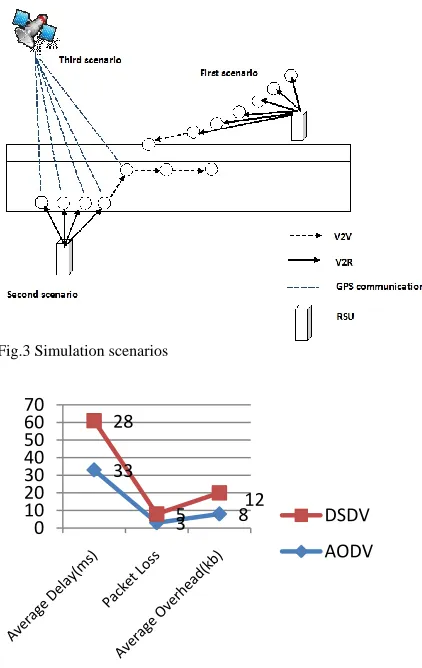
Three scenarios are considered to compare QoS parameters of AODV and DSDV routing protocols. In the first scenario, one RSU is located on a circular ramp connected to the highway. Via the ramp, 30 vehicles are entering the highway. The RSU is broadcasting packets to vehicles moving on the ramp in order to send them a critical safety message. The flow of vehicles spreads into an environment which is larger than the radio coverage of the RSU. Vehicles in the coverage range receive packets through a single hop communication. However, vehicles far from the RSU receive packets through multi-hop V2V communication. We would like to evaluate the average QoS parameters in communication between RSU and vehicles of the flow. In the second scenario, again 30 vehicles move onto the highway, but in their movement vehicles change lanes many times. There is an RSU in the middle of the highway through which packets are sent to this group of vehicles. The third scenario is the same as the second scenario, except the Global Positioning System (GPS) helps the nodes to communicate with one another. In these three scenarios, AODV and DSDV are compared in terms of E2E-delay, packet loss and network overhead. Figure 3 shows the simulation scenarios.
Fig.3 Simulation scenarios
VI. RESULTS AND ANALYSIS
In the first scenario, the group of vehicles entering the highway (I-80) spread into an area that is much bigger than the radio coverage of the RSU. As a result, a large number of vehicles receive their packet in a multi-hop V2V mode. Vehicles continue to move in the same order and they don’t change their lanes. Consequently, the percentage of topology change is very low because all the vehicles continue to move in the same pattern. In this scenario, we can see that the average delay of the AODV routing method is higher than the DSDV because as a reactive routing protocol, it creates routes when a request is received by the RSU. However, in DSDV, routes to all available nodes are known in advance. Creating and maintaining routes in routing tables imposes a higher volume of overhead. Due to the limited coverage area of the RSU, which is around 300 meters, some of the vehicles receive packets from other nearby vehicles. It results in topology changing and as mentioned earlier, DSDV does not have a good convergence when topology changes. For this reason, the amount of packet loss is higher for DSDV than AODV. In the second scenario, due to the higher speed of nodes and lane changing, average delay, packet loss, and average overhead are much higher than the first scenario. In this case, it is clear that the average delay of AODV is a somewhat higher than of DSDV, but the average overhead is lower. Packet loss for this scenario is much higher than in the first scenario because of continual topology changing. In the
[image:4.612.311.516.132.519.2]last scenario, GPS helps the RSU to find the positions of vehicles on the highway. In this case, average delay has improved over the second scenario, but overhead does not show a considerable improvement. In DSDV, routes are not always updated.
Fig. 5 Second scenario results
Fig. 6 Third scenario results
VII. CONCLUSION
In this paper two routing protocols, AODV and DSDV, were simulated in three different scenarios in VANET. Three parameters of QoS, delay, packet loss, and overhead were compared. Through this work it can be seen that position-based routing can considerably improve the QoS parameters of routing protocols. In future research, developing a position-based routing algorithm that can combine the low overhead of AODV with low delay of DSDV is a recommended research pathway.
33
3 8
28
5 12
0 10 20 30 40 50 60 70
DSDV
AODV
42
11 12
37
15 16
0 10 20 30 40 50 60 70 80 90
DSDV
AODV
39
8 10
37
10 13
0 10 20 30 40 50 60 70 80
DSDV
REFERENCES
[1] Sabih ur Rehman, M. Arif Khan, Tanveer A. Zia and Rashid H. Khokhar, “ A Synopsys of Simulation and Mobility Modeling in Vehicular Ad-hoc Networks (VANETs)” IOSR Journal of Computer Engineering (IOSR-JCE), Vol 15, No2, pp 01-16, 2013.
[2] Schoch, E., Kargl, F., Weber, M. & Leinmüller, T, “Communication Patterns in VANETs”, IEEE Communications Magazine, vol. 46, no. (11), 2008.
[3] Robil Daher, Djamshid Tavangarian, “QoS in Vehicular Communication Networks”, book, Quality of service Architecture Architecture for Wireless Network, chapter 14, pp 300-325.
[4] Bossom, R., Brignolo, R., Ernst, T., Evensen, K., Frötscher, A., Höfs, W., et al,” Communication for eSafety (COMeSafety)”, Overall Framework- Proof of Concept Implementation, Version 2.0.European ITS Communication Architecture, 2008.
[5] Mahmood Fathy, Saeed Gholamalitabar, Kaamran Raahemifar, “Improving QoS in VANET using MPLS”, Procedia computer science, Elsevier, Vol 10, p. 1018-1025, 2012.
[6] H. Hartenstein and K. Laberteaux, “VANET Vehicular Applications and Inter-Networking Technologies”, Intelligent Trans- port Systems. Wiley, 2009.
[7] Zeadally, S, R Hunt, Y.-S Chen, A Irwin, and A Hassan. "Vehicular Ad Hoc Networks (vanets): Status, Results, and Challenges", Telecommunication Systems, 50.4 (2012): 217-241. Print. [8] R. Popescu-Zeletin et al., “Vehicular-2-X Communication”,chapter 5,
p67 Springer, Berlin, 2010.
[9] M. Torrent-Moreno, F. Schmidt-Eisenlohr, H. Füßler, and H. Hartenstein, Packet forwarding in VANETs, the complete set of results, Karlsruhe, Germany, 2006.
[10] X. Ma and X. Chen, Performance analysis and enhancement of safety applications in DSRC vehicular ad hoc networks, 2007
[11] RFC 3561, July 2003.
[12] Hemanth Narra, Yufei Cheng, Egemen K. Cetinkaya, Justin P.Roher, James Sterbenz, “destination-sequenced distance vector routing protocol implementation in ns-3”, Proceeding of the ICST SIMUTools workshop on ns-3 (WNS3), Barcelona, Spain, 2011.
[13] "US: Mobileye intros smartphone connected driver assistance (ADAS) technology". Telematics News. 2012-01-12. Retrieved2012-01-12. [14] Xu, Q., Mak, T., Ko, J., & Sengupta, R, “Medium Access Control
Protocol Design for Vehicle–Vehicle Safety Messages” IEEE
Transactions on Vehicular Technology, vol. 56, no. (22), 2007.
[15] Olson, P, “Perception-Response Time to Unexpected Roadway
Hazards”,Hum. Factors, Vol 28, no (1), pp. 91–96, 2006.
[16] https://josm.openstreetmap.org/ Open street maps download software. [17]