© 2016, IRJET ISO 9001:2008 Certified Journal
Page 453
Analysis of Transmit Power Effects in Ad-hoc Network Protocols using
Network Simulator-3
Lakshman Naik.L
1, R.U.Khan
2, R.B.Mishra
31,2
Department of Electronics Engineering, I.I.T.(Banaras Hindu University),Varanasi, India.
3Department of Computer Science & Engineering, I.I.T.(Banaras Hindu University),Varanasi, India.
---***---Abstract –
Mobile ad-hoc networks (MANETs) have beenthe emphasis of research interest since last three decades. In ad-hoc network, nodes connect each other dynamically in a random manner. The dynamic topographies of mobile ad-hoc networks require improved version of routing protocols. MANET is a wireless ad hoc network, which has a routable networking scenario with self-forming and self-healing capabilities without a centralized infrastructure. In MANET, route choices are performed by the routing algorithms. This paper focuses on analysis of transmit power effects in three MANET routing protocols: Ad hoc on demand distance vector (AODV), Destination sequenced distance vector (DSDV) and Optimized link state routing (OLSR). We used different performance metrics in our analysis which are: Throughput, Packet delivery ratio, End to end delay, Packet loss and Normalized routing load.
Key Words: MANET, RWMM, PDR,EED ,AODV, DSDV, OLSR,
RREQ, RREP, RERR, DBF, MPR, TC, NS3, , Throughput, Packet delivery ratio, Simulation, End to end delay, Packet loss. Routing,
1.INTRODUCTION
The influence of transmit power in data propagation is presently one of the key issues in Mobile ad hoc networks. Transmission power is a key parameter for MANETs [1]. Characteristics of the Mobile ad hoc networks can be altered by altering the transmit power. “As power increases, the influence of mobility decreases and the effective density increases” [2]. Network survivability varies with different routing protocols in various environments like variable transmit power, mobility speed and node density. In this paper, we analyse impact of varying transmit power. A high transmit power influences higher connectivity by increasing the straight links realized by the member nodes of the network [3]. Prevailing MANET routing protocols are designed to determine routes by procedures of flooding at full transmission power. MANET protocols are optimized in order to reduce the number of hops from source to the destination. The protocols of MANET were simulated with NS-3 (Network Simulator-3) under Random waypoint mobility model (RWMM). In the past many researchers have performed analysis of MANET routing protocols by selecting
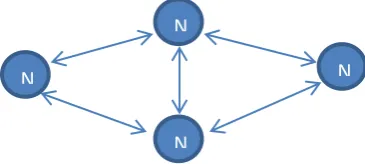
node density, node pause time and node velocity. In this paper, we have considered transmit power as a factor for our studies. Earlier, we have tested these protocols in NS-3, considering node velocity as the test factor. Fig - 1 demonstrates a Mobile ad hoc network with member nodes.
[image:1.595.339.522.313.395.2]
Fig - 1 :
Mobile Ad hoc Network
1.1 Routing in MANETs
Routing is a process by which route discovery takes place between a source nodes to the destination nodes. In MANET, each mobile node acts as a router. The most important aim of routing algorithms in ad hoc network is to create an accurate and proficient route among all the member nodes and to make sure correct and timely discharge of packets [4]. MANET routing protocols can be categorized into three types based on procedure used for route discovery and route maintenance [5]: reactive or on demand, proactive or table driven and hybrid (combination of reactive and proactive) protocols. Here we have considered AODV (reactive protocol), DSDV and OLSR (proactive protocols) for our experiments.
1.2 Reactive and Proactive Routing Protocols
Reactive routing protocols are on demand routing protocols in which, route requests generated by the member nodes of the network are processed [6]. If a source sends a route request to a node, the protocol establishes a path between them. Proactive routing protocols are table driven, therefore, timely updated routing tables are helpful to establish a path between the source and the destination node. Routing tables
N
N
© 2016, IRJET ISO 9001:2008 Certified Journal
Page 454
holds the detailed information pertaining to every membernode of the ad hoc network.
2. AODV (Ad hoc on demand distance vector)
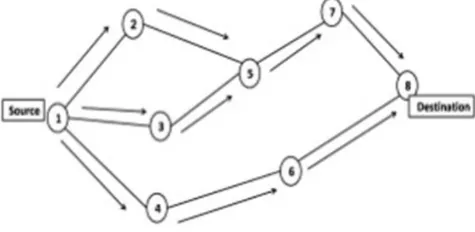
AODV is a routing protocol designed for mobile ad hoc network and for other wireless ad hoc networks. It was jointly developed by C. Perkins, E. Belding-Royer and S. Das on July 2003 [9]. In AODV, route discovery take place only when route requests are received from the member nodes of the ad hoc network [7]. AODV uses route finding procedures and updated routing tables in order to maintain latest routing information [8]. In AODV, establishment of path between the sources to the destination take place when a source node broadcasts RREQ (Route Request) message throughout the network till it reaches the required destination. When RREQ message reaches the destination, the destination node generates a message called RREP (Route Reply) which is sent to the source to confirm the path. When path break occurs for any reason, then the destination node will generate a RERR (Route Error) message and broadcasts it throughout the network. Fig - 2 demonstrates the processing of Route Request message from the source node 1 to the destination node 8.
[image:2.595.40.278.386.502.2]Fig - 2 : Processing of RREQ message in AODV[20]
Fig - 3 demonstrates the processing of Route Reply message from destination node 8 to the source node 1.
Fig - 3 : Processing of RREP message in AODV[20]
2.1 DSDV (Destination Sequenced distance vector)
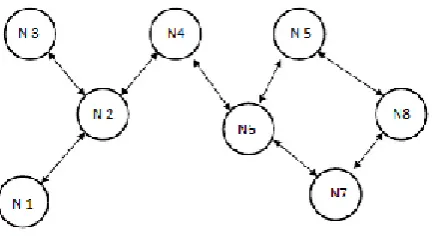
DSDV is a proactive routing protocol originally based on the Ford routing algorithm [10]. Distributed Bellman-Ford (DBF) technique was applied effectively in most of the packet switched networks and the DSDV routing protocol is a modified version of this technique. DBF technique is used to calculate the shortest path between source nodes to the destination nodes, it forms some routing loops. In DSDV, a new parameter called Destination Sequence Number (DSN) has been hosted to reduce routing loops problems of the DBF technique [11]. DSDV is almost same as conventional Routing Information Protocol (RIP) except above mentioned attribute in routing table and that is the destination sequence number [12]. In DSDV, network nodes transfer timely updated routing information and incremented sequence numbers to all their neighbors. This transfer process updates each and every node with up-to-date link information along with the routing table. Then the nodes of the network are able to create the path between the source nodes to the destination node. Distance vector shortest path algorithm selects the requested routes. DSDV protocol promotes two types of updated packets called “FULL DUMP” and “INCREMENTAL DUMP”. Transmission overheads are reduced by the help of these two updated packets. These updated dump packets are broadcasted through the entire network by all the nodes. The “full dump” packet holds the routing data whereas the “incremental dump” holds only the changed data since the last “full dump”. As compare to other MANET routing protocols, DSDV has much link overheads. This negative aspect of DSDV limits it for small scale deployments.
Table -1: Node N4 packet forwarding in DSDV
Destination Next hop Metric Sequence No.
N1 N2 2 S406_N4
N2 N2 1 S128_N1
N3 N2 2 S564_N2
N4 N4 0 S710_N3
N5 N6 2 S392_N5
N6 N6 1 S076_N6
N7 N6 2 S128_N7
[image:2.595.38.277.589.712.2]N8 N6 3 S050_N8
© 2016, IRJET ISO 9001:2008 Certified Journal
Page 455
Fig - 4 : DSDV in operation
2.2 OLSR (Optimized Link State Routing)
OLSR is a table driven proactive ad-hoc network protocol. It uses optimized technique in extracting topology related information. OLSR is based on link state algorithm [14]. In OLSR, change in topology reasons to flooding of information to all the nodes of the network. To reduce this flooding, Multi Point Relays (MPR) are used. Table driven feature of OLSR helps it to have updated routing information in various tables [15]. In OLSR, there are four types of control messages: HELLO, TC, MID and HNA.
HELLO: This message is transmitted to all the neighbors periodically. This message helps in getting information related to link status and the neighbor of the host.
TC (Topology Control): This message is sent periodically to the neighbors, it helps in broadcasting neighbors of the member nodes of the network.
HNA (Host and Network Association): HNA message is broadcasted to share information pertaining to the external routing. It holds network related information.
MID (Multiple Interface Declaration): This message is broadcasted throughout the network to inform all the member nodes that the host can have multiple interfaces of the OLSR. MID message lists the connection log of a node.
In OLSR, each node transmits control messages periodically. Therefore, OLSR does not necessitate using reliable control message delivery; henceforth OLSR protocol can endure reasonable control message losses.
.
Fig - 5 : OLSR in operation
Fig - 4 illustrates the operation of OLSR routing protocol. Node N6 generates a TC message broadcasting its neighbor set that is TC (N6) = { 4, 5 ,7 } and sends to its neighbors N4, N5 and N7. Node N4 forwards the message TC (N6) to its neighbors N1, N3 and N5. Node N3 then forwards the message TC (N6) to its neighbors and so on until the message reaches every node [16].
2.3 Consumption of Energy in MANET
The process of communication and computation involves consumption of energy in nodes of the network. Exists mobile nodes in the network are in four modes as given in equation 1. While communication proceeds the nodes undertake different transition states. From equation 2 we could notice that in sleep mode, the mobile node consume low power as compare to other states of the nodes [17].
E pt = E oh + E a+ Ei+ E s (1)
E a = E t+ E r (2)
E s ≌ 0 (3)
E t = E pt + E pd (4)
Where,
E pt = packet transmission energy
E oh = packet over hear
E a = active packet energy
E i = idle packet energy
E s = sleeping packet energy
E t = transmit packet energy
E r = received packet energy
[image:3.595.43.265.134.252.2]© 2016, IRJET ISO 9001:2008 Certified Journal
Page 456
2.4 Consumption of Power in Transmission mode
During transmission, a source node sends data packets to the destination node. Transmission energy refers to the energy required by a node to transmit the data packet. Transmission energy is totally depends on the size of the data packet. Therefore, the transmission energy has the following formula [17]:
E t = (PL × 330) ÷ (2×10⁶) (5)
PT = E t ÷ Tt (6)
Where,
E t = transmit packet energy PL= packet length
PT = transmission Power
Tt = time taken to transmit the data packet
2.4 Consumption of Power in Reception mode
Reception energy is refer to the energy required by a node to receive a data packet from the other node of the network. The energy in received mode is formulated as follows [17]:
E r = (PL × 230) ÷ (2×10⁶) (7)
P r = (E r ) ÷ (Tr) (8)
Where,
E r = reception energy
P r = reception power
T r = time taken to receive the data packet
PL = packet length
2.4 Consumption of Power in Idle mode
In idle mode, a packet will be in idle mode that is it neither transmit a packet nor receive any packet. In idle mode, the packet in idle mode consumes same amount of energy as an active node takes to receive the packet. In idle mode, nodes which are in idle state does not involve in data communication [17]. The power consumption in idle mode is given by :
P i = P r (9)
Where,
P i = power consumed in idle mode P r = power consumed in reception mode
2.5 Consumption of Power in overhearing mode
In overhearing state, a node hears to the packet which is not sent for it. Consumption of energy in this mode is equal to energy consumed in reception mode. Therefore, consumption of power in overhearing mode is given by [17] :
Po = P r (10)
Where,
P o = power consumed in overhearing mode
P r = power consumed in receiving mode
3. Performance Metrics
Different performance matrices are available to analyze the performances of MANET routing protocols. Here, we have considered the following metrics [10].
a) Throughput:
It is the amount of data transferred from source node to the destination node in a unit time stated in Kbps (Kilobits per second).
Throughput = (Received Bytes*8) / (Simulation time*1024) (11) It is calculated in Kbps. Larger value of the throughput delivers improved performance.
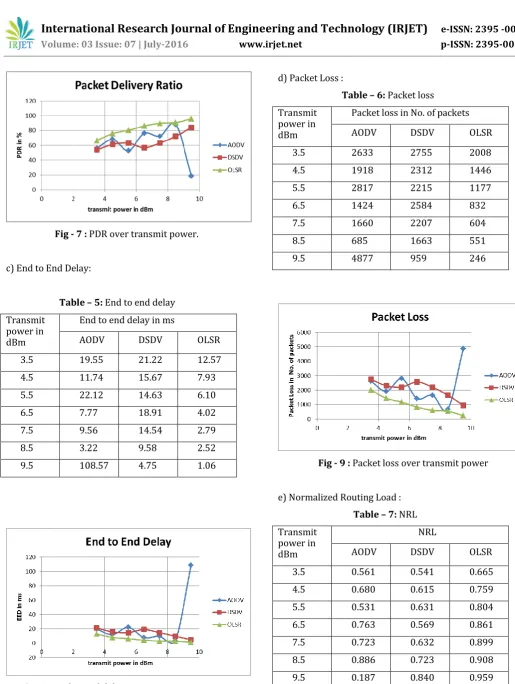
b) PDR (Packet Delivery Ratio) :
It is the ratio of total received packets to the total packets sent.
PDR = (total received packets) / (total sent packets) * 100 % (12) It is calculated in percentage (%). Larger value of PDR delivers improved performance.
c) EED (End to End Delay) :
It is the average time interval between packets generated at the source node and delivery of the packets at the destination node. It is the fraction of delay sum to the received packets. End to end delay = (delay sum) / (received packets) (13) It is calculated in ms (mille second). Lesser values of end to end delay delivers improved performance.
d) Packet loss :
It is the difference of total sent packets and the total received packets.
© 2016, IRJET ISO 9001:2008 Certified Journal
Page 457
e) NRL (Normalized Routing Load) :
It is the ratio of number of transmitted routing packets to the number of received data packets [18].
NRL = (No. of routing packets sent) / (No. of received data packets)
Larger NRL values give lesser efficiency of the routing protocol in terms of bandwidth consumption.
4. Simulation environment
For our experiments we have used 3.13 version of the Network Simulator (NS3). Using NS3, we carried out simulation based analysis of MANET routing protocols: AODV, DSDV and OLSR. NS3 is an open source discrete-event network simulator [19]. NS3 is developed by the help of high level programming language that is C++ with some optional bindings of the python. It has enhanced simulation reliability. NS3 was built from the scratch to replace Application Program Interfaces (APIs) of NS2. NS3 does not support APIs of NS2 [10]. We used CENTOS Linux platform to execute our simulation experiments.
4.1 Simulation Results
[image:5.595.304.555.129.480.2]The simulation experiments of the MANET routing protocols have been carried out by fixing 10 number of source/sink connections, while varying transmit power as 3.5dBm, 4.5dBm, 5.5dBm, 6.5dBm, 7.5 dBm, 8.5dBm and 9.5dBm. The simulation scenario and gained results are revealed in the following tables and graphs.
Table -2: Simulation Scenario of AODV, DSDV and OLSR
1 Number of Nodes 50
2 Simulation Time 150 seconds
3 Pause Time No pause time
4 Wi-Fi mode Ad-hoc
5 Wi-Fi Rate 2Mbps (802.11b)
6 Transmit Power 3.5dBm,4.5dBm,5.5dBm, 6.5dBm,7.5 dBm, 8.5dBm and 9.5dBm.
7 Mobility model Random mobility model Waypoint
8 No.of Source/Sink 10
9 Sent Data Rate 2048 bits per second (2.048Kbps)
10 Packet Size 64 Bytes
11 Node Speed 20 m/s
12 Protocols used AODV,DSDV and OLSR
13 Region 300x1500 m
14 Loss Model Friis loss model
a) Throughput:
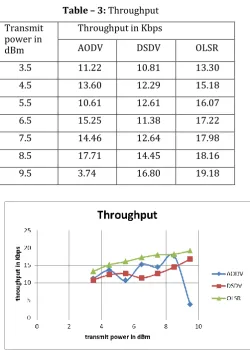
Table – 3: Throughput Transmit
power in dBm
Throughput in Kbps
AODV DSDV OLSR
3.5 11.22 10.81 13.30
4.5 13.60 12.29 15.18
5.5 10.61 12.61 16.07
6.5 15.25 11.38 17.22
7.5 14.46 12.64 17.98
8.5 17.71 14.45 18.16
9.5 3.74 16.80 19.18
Fig - 6 : Throughput over transmit power
b) Packet Delivery Ratio:
Table – 4: Packet delivery ratio Transmit
power in dBm
Packet delivery ratio in %
AODV DSDV OLSR
3.5 56.11 54.08 66.53
4.5 68.03 61.46 75.90
5.5 53.05 63.08 80.38
6.5 76.26 56.93 86.13
7.5 72.33 63.21 89.93
8.5 88.58 72.28 90.81
9.5 18.71 84.01 95.90
© 2016, IRJET ISO 9001:2008 Certified Journal
Page 458
Fig - 7 : PDR over transmit power.c) End to End Delay:
Table – 5: End to end delay Transmit
power in dBm
End to end delay in ms
AODV DSDV OLSR
3.5 19.55 21.22 12.57
4.5 11.74 15.67 7.93
5.5 22.12 14.63 6.10
6.5 7.77 18.91 4.02
7.5 9.56 14.54 2.79
8.5 3.22 9.58 2.52
[image:6.595.30.546.27.712.2]9.5 108.57 4.75 1.06
Fig - 8 : End to end delay over transmit power
d) Packet Loss :
Table – 6: Packet loss Transmit
power in dBm
Packet loss in No. of packets
AODV DSDV OLSR
3.5 2633 2755 2008
4.5 1918 2312 1446
5.5 2817 2215 1177
6.5 1424 2584 832
7.5 1660 2207 604
8.5 685 1663 551
9.5 4877 959 246
Fig - 9 : Packet loss over transmit power
e) Normalized Routing Load : Table – 7: NRL Transmit
power in dBm
NRL
AODV DSDV OLSR
3.5 0.561 0.541 0.665
4.5 0.680 0.615 0.759
5.5 0.531 0.631 0.804
6.5 0.763 0.569 0.861
7.5 0.723 0.632 0.899
8.5 0.886 0.723 0.908
© 2016, IRJET ISO 9001:2008 Certified Journal
Page 459
Fig - 10 : NRL over transmit power5. Conclusion
As per our test setup scenarios and gained results, we observed that, as compare to AODV and DSDV, OLSR protocol has shown better performance in terms of all the metrics calculated. Whereas AODV is also shown better performance, but performance of the AODV degrades as transmit power increases. As for as DSDV is concerned, we observed that the performance of DSDV is improving with the increase of transmit power. However, performance of the routing protocols rest on various technical aspects like, network size, transmission range, transmission region, no. of source/sink connections, speed of the nodes, mobility models, Wi-Fi rate, traffic scenarios etc. Further, our current research is focussing towards improving parameters of the weak protocols.
Acknowledgements
We would like to thank Dr.Ramesh Singh yadava and Dr. Chandan Kumar Rai of the Computer Centre, Banaras Hindu University, Varanasi, India, for their kind support.
REFERENCES
[1] R.Ramanathan, & J.Redi, “A Brief Overview of Ad Hoc
Networks: Challenges and Directions,”in IEEE
Communications Magazine 50th Anniversary
Commemorative Issue, May 2002, pp. 20-22.
[2] NS-3 tutorial. [Online]. Available:
https://www.nsnam.org/doxygen/manet-routing-compare_8cc_source.html
[3] Rajneesh Kumar Gujaral, Jitender Grover, Anjali, “An
Analysis of Network Survivability with Variable Transmission Range and Mobility on AODV over MANET” in TECHNIA, VOL.5 No. 2, Jan.2013.
[4] Rutvij H. Jhaveri, Sankita J. Patel and Devesh C. Jinwala
“DoS Attacks in Mobile Adhoc Networks: A Survey” 2012 Second International Conference on Advanced Computing & Communication Technologies.
[5] Arunima Patel, Sharda Patel, Ashok Verma “A Review of
performance Evaluation of AODV Protocol in Manet With and Without Black HoleAttack” International Journal of Emerging Technology and Advanced
Engineering ISSN 22502459,Volume 2, Issue 11, November 2012.
[6] Ashok M.Kanthe, Dina Simunic and Ramjee Prasad
“Comparison of AODV and DSR On Demand Routing Protocols in Mobile Ad hoc Networks”Emerging technology Trends in Electronics, communication and networking, © IEEE 2012 First international Conference ISBN 9781467316286.K. Elissa, “Title of paper if known,” unpublished.
[7] Vinay P.Virada “Securing And Preventing Aodv Routing
Protocol From Black Hole Attack Using Counter Algorithm” International Journal ofEngineering Research & Technology (IJERT) Vol. 1 Issue 8, October 2012 ISSN: 22780181.
[8] AshishBagwari, Raman Jee,Pankaj Joshi and Sourabh
Bisht “ Performance of AODV Routing Protocol with increasing the MANET Nodes and its effects on QoS of Mobile Ad hoc Networks ” 2012 International Conference on Communication Systems and Network Technologies 9780769546926/12 © 2012 IEEE.
[9] [Online].Available:https://en.wikipedia.org/wiki/Ad_
hoc_On Demand_Distance_Vector_Routing
[10] Rakesh Kumar Jha, Pooja Kharga, March 2015. “A
Comparative Performance Analysis of Routing Protocols in MANET using NS3 Simulator”.
[11] Sreekanth Vakati, Dr.Ch.Balaswamy, July 2013.
“Performance Analysis of Routing Protocols in Mobile Ad Hoc Networks”.
[12] Teressa Longjam and Neha Bagoria, February 2013.
“Comparative Study of Destination Sequenced Distance Vector and Ad-hoc on-demand Distance Vector Routing Protocol of Mobile Ad-hoc Network”.
[13] [Online].Available:
http://www.slideshare.net/shiujinghan/routing-in-manet
[14] Dilpreet Kaur, Naresh Kumar, 2013. “Comparative
Analysis of AODV, OLSR, TORA, DSR and DSDV Routing protocols in Mobile Ad-Hoc Networks,” in IJCNIS journal, vol.5, no.3, pp.39.
[15] T. Clausen, & P. Jacquet, “Optimized Link State Protocol,”
rfc3626, Available: https://www.ietf.org/rfc/rfc362 6.txt
[16] [Online].Available:
http://www.soi.wide.ad.jp/class/20060035/slides/04/ 41.html
[17] Suchismita Rout, Ashok Kumar Tauruk, and Bibhudatta
Sahoo, “Review of Transmission Power Control Techniques
in MANET” [Online]. Available :
http://dspace.nitrkl.ac.in/dspace/bitstream/2080/187 2/1/review.pdf
[18] Qutaiba Razouqi, Ahmed Boushehri, Mohamed Gaballah,
Lina Alsaleh, 2013. “Extensive Simulation Performance Analysis for DSDV, DSR, and AODV MANET Routing Protocols. IEEE.
[19] NS-3 tutorial. [Online]. Available:
http://www.nsnam.org/docs/release/3.14/tutorial/sin glehtml/index.html
[20] [Online].Available: