Abstract— In analyzing the relationship between precipitation and remotely sensed data, firstly, we investigate the correlation among Global Vegetation Index (GVI) from NOAA satellite with precipitation from ground-based rainfall measurements. Observation GVI indices are Vegetation Health Index (VHI), Vegetation Condition Index (VCI), Temperature Condition Index (TCI), and Smoothed Normalized Difference Vegetation Index (SMN). Four patterns of correlation between all indices and precipitation data are examined: concurrence month, lag of one, lag of two, and lag of three months of precipitation. SMN index reveals the highest correlation with precipitation in all four patterns. Especially, when use the precipitation data that lag of two month compare to the current month of SMN index, much more increase in the correlation coefficient. As a result, in order to use Neuron Network (NN) to approximate the precipitation, monthly SMN index is used as input to the backpropagation NN. Usage target output is the precipitation that lags of two months. The best performance got when uses the network with one hidden layer of only two neurons. Mean Squared Error (MSE) of training is 0.042040 when uses 70 percent of sample data collected monthly from Jan 2005 to Dec 2014. For the remaining 30 percent used for testing, MSE is 0.042002. Over fitting problem does not encounter when using such a suitable network. That means, NN can capture the relationship well between SMN index and the precipitation involves approximating the precipitation by no need of the complex networks.
Index Terms— neuron network, remotely sensed data, precipitation, approximation
I. INTRODUCTION
he drought caused a water shortage in area for a long time and rains do not meet seasons. The occurrence of drought makes the land incapable of cultivation throughout the year. So, there need to make an effort to monitor and relieve drought disaster [1]. A good designed relieve and preparedness plan can help to reduce the impact on agricultural products and plan use of water resources. Although meteorological information from ground stations
Manuscript received Jan 06, 2016; revised Jan 14, 2016. This work was supported in part by grant from Suranaree University of Technology through the funding of Data Engineering Research Unit.
*S. Bunrit is a doctoral student with the School of Computer Engineering, Suranaree University of Technology, Nakhon Ratchasima 30000, Thailand (e-mail: [email protected]).
R. Chanklan is a doctoral student with the School of Computer Engineering, Suranaree University of Technology, Nakhon Ratchasima 30000, Thailand (e-mail: [email protected]).
S. Boonamnuay is a master student with the School of Computer Engineering, Suranaree University of Technology, Nakhon Ratchasima 30000, Thailand (e-mail: [email protected]).
N. Kerdprasop is an associate professor with the School of Computer Engineering, Suranaree University of Technology, Nakhon Ratchasima 30000, Thailand.
K. Kerdprasop is an associate professor with the School of Computer Engineering, Suranaree University of Technology, Nakhon Ratchasima 30000, Thailand.
is popular and has good performance [2][3], data preparation has requirement of long time and cost. Satellite data can be used to monitoring of environmental. It can estimate the status of vegetation, find information easy. As a result, the analysis of satellite-based remotely sensed data incorporate to the ground-based measure data have great potential in monitoring, modeling and forecasting of the environment, especially drought.
This work, we analyze the relationship between meteorological information from ground stations and remotely sensed data. If we can find good the correlation that, can use remote sensing data represent the meteorological data to monitor drought, it has monitor a quick and timely. Although a many research trying to find the relationship with remote sensing data and the precipitation using different kinds of satellite data and methods [4][5][6][7], data and information used in such group of research observably fixed the study area. The result from one study area cannot compare to the others or the successful method in one area also may not be applied to the others.
This work, we observed the relationship data in Nakhon Ratchasima province of Thailand. Remotely sensed data used from NOAA satellite and the monthly precipitation from the Meteorological Department. The data collected monthly from 2005 to 2014. The correlation among Global Vegetation Index (GVI) and precipitation are first investigated. Many networks of backpropagation NN are then employed to analyze in order to extract the best suitable to a problem.
II. LITERATURE REVIEW A. Remotely Sensed Data
This study we used remotely sensed data about Global Vegetation Index (GVI) of Nakhon Ratchasima province in Thailand. This data set observed by NOAA, the satellite that was aggregating the 4 square km Global Area Coverage (GAC) daily. Advanced Very High Resolution Radiometer (AVHRR) products 16 square km spatial resolution every 7 days composite [8, 9]. The GAC is produced by sampling and mapping the AVHRR 1-km daily reflectance in the visible (VIS, Ch1, 0.58-068 μm), near infrared (NIR, Ch2, 0.72-1.1 μm), and two infrared bands (IR, Ch4, 10.3-11.3 and Ch5, 11.5-12.5 μm) to a 4-km map. The VIS and NIR reflectance were pre- and post-launch calibrated and the Normalized Difference Vegetation Index (NDVI) was calculated as (NIR-VIS)/(NIR+VIS). The IR emission was converted to brightness temperature (BT), which was corrected for non-linear behavior of the AVHRR sensor. Daily NDVI and BT were composited over a 7-day period
Neural Network-Based Analysis of Precipitation
and Remotely Sensed Data
Supaporn Bunrit*, Ratiporn Chanklan, Supajittree Boonamnuay, Nittaya Kerdprasop, and
Kittisak Kerdprasop
by saving those values that have the largest NDVI for each map cell. GVI include the indices:
(1). Vegetation Condition Index (VCI)
VCI is based on the pre- and post-launch calibrated radiances converted to the no noise Normalized Difference Vegetation Index (NDVI). It characterizing plant greenness and was calculated as Equation 1 [10].
(1)
Where, NDVI, NDVImax, and NDVImin are the smoothed weekly NDVI, its multi-year absolute maximum and minimum, respectively.
(2). Temperature Condition index (TCI)
TCI is based on 10.3-11.3 µm AVHRR's radiance measurements converted to brightness temperature (BT), which was improved through completely removed high frequency noise. It characterizing thermal conditions and was calculated as Equation 2 [10].
(2)
Where BT, BTmax, and BTmin are the smoothed weekly BT, its multi-year absolute maximum and minimum, respectively
(3). Vegetation Health index (VHI)
VHI is a coefficient determining contribution of the two indices. VHI is a proxy characterizing vegetation health or a combine estimation of moisture and thermal conditions. It was calculated as Equation 3 [10].
(3)
Where, a and (1-a) are coefficients quantifying a share of VCI and TCI contribution in the total vegetation health.
(4). Smoothed Normalized Difference Vegetation Index (SMN)
SMN is derived from no noise NDVI, which components were pre- and post-launch calibrated. SMN can be used to estimate the start and senescence of vegetation start of the growing season, phenological phases.
B. Precipitation (Rainfall) Data
Monitoring rainfall is measuring the height of the rain on the area. Height is measured in units such as millimeters or inches. Rain Gauge has 2 types: Non-recording Rain Gauge and Recording Rain Gauge.
Non-recording Rain Gauge is composed of three parts: a funnel, a tube, and 8-inch diameter overflow can, overflow can which has a mounting bracket. The funnel directs the precipitation into the tube. When rainfalls in Rain Gauge to flow into tube waiting for measurement at about 7am in each day. Pouring rainfall from tube to measuring tube scale 0.1 mm has maximum 10 mm.
Recording Rain Gauge uses to record rainfall onto graph paper. This is the type of record daily, weekly and monthly. It will start recording Thai local time at about 7.00 am,
equivalent to GMT at 00Z. In present the Department of Meteorology in Thailand used to record daily rainfall graph from 7:00 am. To 7:00 pm. of the next day. Recording Rain Gauge have widely used in three types: Tipping Bucket Gauge,Weighing Gauge and Float Gauge.
C. NN with Remotely Sensed Data and Precipitation
There are a number of studies using NN in remotely sensed data since 1990 as reported in the review [11]. From the other literatures, there also exists a small group involved using NN with remotely sensed data and precipitation. In [12] used a NN approach to estimating rainfall from spaceborne microwave data. They showed that NN can represent more accurately the underlying relationship between BT and rainrate than the regression model. An adaptive ANN model that estimates rainfall rates using infrared satellite imagery and ground-surface information was proposed in [13]. The model can successfully updated using only spatially and/or temporally limited observation data. The estimation of physical variables from multichannel remotely sensed imagery using a NN focusing the application to rainfall estimation was studied in [14]. The approach is based on a modified counterpropagation neural network (MCPN) of which both effective and efficient at building nonlinear input-output function mapping from large amount of data.
Feed-forward network of a so-called back propagation (BP) algorithm coupled with genetic algorithm (GA) was developed in [15] to simulate the rainfall field and used to train and optimize the network. The results of the study performed better compared to similar work of using ANN alone. ANN and MRM (Multilinear Regression Model) are used to derive spatially distributed precipitation data in [16]. The methods generated the spatially distributed precipitation data for the periods when Next-Generation Weather Radar (NEXRAD) data that are either unavailable or the quality of the data is not good. Where, MLR model did not perform as well as the ANN model. Recently, deep NN was used in [17] to estimate precipitation from remotely sensed data. They attempted to engage deep learning techniques to provide hourly precipitation estimation from long wave infrared data from operational geostationary weather satellites. In an experiment, the Probability of Detection (POD) of their proposed approach is increased and the False Alarm Ratio (FAR) is decreased as compared to the originally classic approach of PERSIANN-CCS (Precipitation Estimation from Remotely Sensed Information using Artificial Neural Networks Cloud Classification System) in [18].
III. METHODOLOGY A. Correlation Coefficient
The correlation coefficient (R) is a numerical value between -1 and 1 that expresses the strength of the linear relationship between two variables. When R is closer to 1 it indicates a strong positive relationship, if closer to -1 it signal a strong negative relationship and if values of 0 mean there is no relationship. The correlation coefficient can be calculated using Equation 4.
∑ ∑ ∑
√ ∑ ∑ ∑ ∑
Where n is the total number of samples, xi (x1, x2, ... ,xn) are the values of variable x and yi are the values of variable y.
B. Artificial Neural Networks (ANNs) Model
Artificial Neural Networks (ANNs) have been applied on many applications such as classification, modeling, prediction, smoothing, filtering, function approximation, and optimization [1][2][3]. It is simulated functions of the neural networks in the human brain on conventional computers. The idea of this model makes the computer to learn like a human.
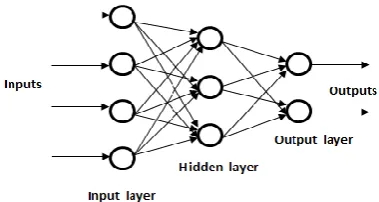
[image:3.595.344.496.84.198.2]ANN consists of a set of nodes and edges between nodes as shows in figure 1. The node has three levels: input layer, hidden layer and output layer. Hidden layer may be more than one layer. Nodes in the input layer called input node (or neuron), number of nodes is equal to the number of elements (attribute) in input data. Nodes in the hidden layer called hidden node, number of nodes and layer are based on the user design to experiments many different ways and use number of node gives the best performance. The node in the output layer called output node, number of node layer are equal to the number of target or class to recognize in dataset. The neural network consists of edges from all nodes in input layer to all nodes in hidden layer and all nodes in hidden to all nodes in output layer. ANN of at least one hidden layer often known as Multilayer Perceptron (MLP)
Fig. 1. The architecture of the Artificial Neural Network
The process in ANN of each node can be compared to one neuron cell in human brain. Input data is a vector of elements: p = [p1, p2, ..., pR], R is number of elements in input. Each input vector multiplied by weight: W = [w1, w2, ..., wR]. Then take input multiplied by the weight of each edge. After that sum all results of each edge and bias (b). Then forward result to transfer function, and finally can be obtain the output.
The weight values it needs to know is important for something we want computer to recognize. It is an uncertain but can set computer to update weight values by learning from the recognized pattern. If the neural network results a false output value, the weight will be updated to the error until it is less or obtained an acceptable.
Multilayer Perceptron (MLP) widely used the backpropagation algorithm to adjust the weights and biases of the network in order to minimize the mean square error. Figure 2 shows a neural network with one hidden layer; indexes: the subscript k denotes the output layer, j denotes the hidden layer, i denotes the input layer and s is input patterns. It defines an error function (based on the training
set) and would like to minimize it by adjusting the weights, define an error by Mean Squared Error (MSE).
Backpropagation algorithm steps are:
1. Forward pass in Neural Networks to calculate the outputs.
1.1 Activations function is a sigmoid function of the hidden units:
( )
(4)
Where: ∑
1.2 Activations of the output units use is given either by equation 4.
2. Backward pass for in Neural Networks to update weight and bias values by learn from recognize the pattern.
2.1 Calculate the output errors:
( ) (5)
Where: d = actual output o = target output
2.2 Calculate the new weights between hidden to output units and bias output neuron:
(6)
(7)
Where:
= learning rate
2.3 Calculate the new weights and bias between input to hidden units and bias hidden neuron and calculate the errors of the hidden is given either by equation 5, 6, 7. 3. Repeat the same procedure for the other training examples.
4. At the end of the epoch or error it is less or remained an acceptable.
IV. EXPERIMENT
A. Correlation Observation of GVI and Precipitation
Firstly, we investigated the correlation among monthly Global Vegetation Index (GVI) from NOAA satellite with
[image:3.595.72.262.384.485.2]precipitation from ground-based rainfall measurements. Observation GVI indices are Vegetation Health Index (VHI), Vegetation Condition Index (VCI), Temperature Condition Index (TCI), and Smoothed Normalized Difference Vegetation Index (SMN). We investigated on sample data in Nakhon Ratchasima province of Thailand collected monthly from January 2005 to December 2014. Four patterns of correlation between all indices and precipitation data are examined: concurrence month, lag of one, lag of two, and lag of three months of precipitation.
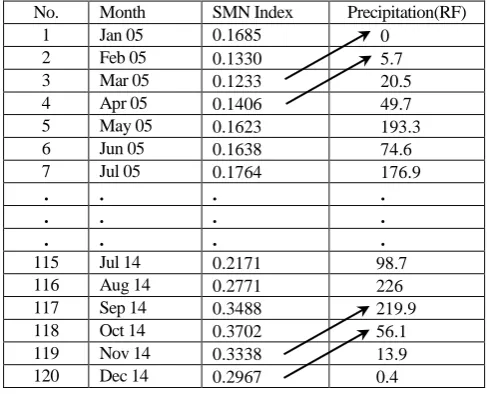
Table 1 shows pattern matching when consider the precipitation that lag of two months. SMN index of Mar 05 will match with the precipitation back of two months, Jan 05, as indicated by an upper arrow. Therefore, the examined correlation of the patterns of which lag of two months considered SMN index from Mar 05 (No.3) to Dec 14 (No.120) compared to precipitation from Jan 05 (No.1) to Oct 14 (No. 118). In the same way, lag of one month pattern considered SMN index from Feb 05 (No.2) to Dec 14 (No.120) compared to precipitation from Jan 05 (No.1) to Nov 14 (No. 119). And lag of three months also considered in the same manner. Where the concurrence month, No.1 to No. 120 of both SMN index and precipitation are matched and compared.
Table 1. Pattern matching when considered the precipitation (RF) that lag of two months.
No. Month SMN Index Precipitation(RF)
1 Jan 05 0.1685 0
2 Feb 05 0.1330 5.7
3 Mar 05 0.1233 20.5
4 Apr 05 0.1406 49.7
5 May 05 0.1623 193.3
6 Jun 05 0.1638 74.6
7 Jul 05 0.1764 176.9
. . . .
. . . .
. . . .
115 Jul 14 0.2171 98.7
116 Aug 14 0.2771 226
117 Sep 14 0.3488 219.9
118 Oct 14 0.3702 56.1
119 Nov 14 0.3338 13.9
120 Dec 14 0.2967 0.4
Table 2 shows the correlation coefficient among all GVI indices with precipitation (denote by RF) of the concurrence month. SMN index has the highest correlation with the precipitation with coefficient value 0.1590 as indicated by italic bold.
Table 2. Correlation coefficient among all GVI indices with precipitation (denote by RF) of the concurrence month.
VHI VCI TCI SMN RF
VHI 1.0000 0.6596 0.7369 -0.0288 -0.0127 VCI 0.6596 1.0000 -0.0220 0.2483 0.0714 TCI 0.7369 -0.0220 1.0000 -0.2616 -0.0812 SMN -0.0288 0.2483 -0.2616 1.0000 0.1590
RF -0.0127 0.0714 -0.0812 0.1590 1.0000 Table 3 shows the correlation coefficient between each GVI indices with precipitation that lag of 1 month, 2 months, and 3 months, respectively. All three patterns of correlation, SMN index also has the highest correlation with the precipitation. The degrees of relationship are much more than the result of the concurrence month in table 2.
Especially, when the consideration precipitation is of 2 months lag as indicated by italic bold of value 0.5822.
Table 3. Correlation coefficient between each GVI index with Precipitation that lag of 1 month, 2 months, and 3 months, respectively.
VHI VCI TCI SMN RF
Lag 1 m RF -0.1526 -0.0229 -0.1766 0.5051 1.0000 Lag 2 m RF -0.2227 -0.1931 -0.1173 0.5822 1.0000 Lag 2 m RF -0.0519 -0.0735 -0.0048 0.5004 1.0000
By observation the correlation coefficient, SMN index exposes the highest degree of relationship with precipitation that lag of 2 months. We, consequently, use SMN index and precipitation that lag of 2 months in analyzing with NN.
B. Experimental Setup for NN
In order to analyze the relationship between SMN index and precipitation that lag of 2 months by NN, input and target pairs to NN networks are matched as show in table 1. Monthly SMN index from NOAA STAR of Nakhon ratchasima province of Thailand collected from January 2005 to December 2014 are used as input to NN. Monthly precipitation collected by ground-based rainfall measurements from the Meteorological Department is considered as the target from the same period of time. Under an assumption thatcurrent month of SMN index will relate to the precipitation that lag of 2 months, we match each input and target pair as show by each arrow in table 1. The first input-target pair is SMN index of Mar 05 and precipitation of Jan 05(SMN: Mar 05, RF: Jan 05), the second pair is SMN index of Apr 05 and precipitation of Feb 05(SMN: Apr 05, RF: Feb 05), and so on. Therefore, input-target pair will end by SMN index of Dec 14 and rainfall of Oct 14 (SMN: Dec 14, RF: Oct 14). As a result, we used 118 number of sample data (number of input-target pairs) to evaluate ANN network. Where, the values of precipitation are normalized to the interval between 0 and 1. Seventy percent of sample data are randomly selected as the training set and the remaining thirty percent are used for testing.
Backpropagation NN with Lavenberg-Marquardt training algorithm (learnlm) from Matlab toolbox is used. Performances from training and testing are evaluated in term of Mean Squared Error (MSE) between target and output from NN.
C. Experimental Results and Discussions
Figure 3 shows MSE result from training and testing when use the network of 1 hidden layer. The comparison shows when number of hidden neurons used are one to twelve, respectively. The activation function used in the hidden layer is sigmoid function and linear function is used in output layer. The initial weight and bias values are randomly in the interval of -2 to 2. The setting number of epochs is 1,000. MSE from training represents as dash line with square markers at position of number of neuron. Testing MSE shows by solid line with circle markers.
[image:4.595.45.289.357.554.2]of 1 hidden layer using only two neurons in such layer can get the best performance.
Fig. 3. MSE results from training and testing when use the network of 1 hidden layer. Compare when number of hidden neurons used are one to twelve, respectively.
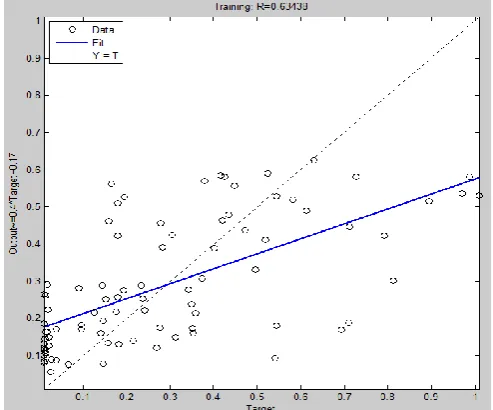
The result of regression equation and plot of target (T) and output (Y) from NN shows in figure 4. The figure shows the result from training when used 1 hidden layer and the number of hidden neuron is 2. The correlation R value is 0.63438 where MSE is 0.042002. The higher R value resulted in the lesser MSE.
Fig. 4. Regression equation and plot of target and output from NN when used 1 hidden layer and the number of hidden neuron is 2.
Figure 5 shows another result of the relationship between value of R and MSE. It’s the result from training when used 5 neurons of 1 hidden layer. The correlation R value is 0.68339 as the MSE is 0.03724. Training MSE of both figure 4 and figure 5 are from the same results showed in figure 3 when number of neuron is of 2 and 5, respectively.
It does not matter the highest R value or the lowest training MSE is the best, unless testing MSE is not good enough compare to the training. Overfiting is a major problem that we should be concerned. Table 4 shows an evident example of overfitting when we train and test a network of 1 hidden layer. MSE of training and testing showed when we used the initial random weight and bias
value by the default method of Mathlab toolbox for backppropagation algorithm. The table explicitly shows unsuitable initial weight and bias cause the overfitting result when the numbers of neuron use are 9, 10, and 12. The testing MSE as represent by values in italic bold are extremely high. Randomly initial weight and bias by default method of Matlab used too large of the interval values. Such manner, it’s not suitable to our problem. In our experiment, the appropriate initial weights and bias values are randomly in the interval of -2 to 2.
[image:5.595.305.549.176.390.2]Fig. 5. Regression equation and plot of target and output from NN when used 1 hidden layer and the number of hidden neuron is 5.
Table 4. MSE result when use initial random weight by default method of Matlab toolbox for backpropagation algorithm. Compare when use 1 hidden layer.
No. Neuron Train Test Test-Train
1 0.043690 0.038889 -0.004801
2 0.039475 0.042069 0.002594
3 0.039093 0.041764 0.002671
4 0.039083 0.043263 0.004180
5 0.038026 0.039808 0.001782
6 0.036659 0.074978 0.038319
7 0.036862 0.044434 0.007571
8 0.030110 0.041493 0.011383
9 0.034916 23.938381 23.903465
10 0.030575 110.847411 110.816835
11 0.030882 0.044903 0.014021
12 0.027500 41.393233 41.365733
[image:5.595.45.292.399.604.2] [image:5.595.314.539.452.646.2]
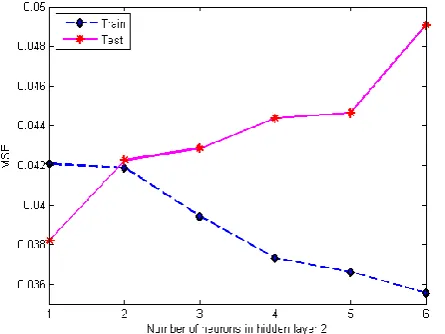
By the characteristic of NN for approximation problem, more complex network may get better in training performance but it’s always lead to overfit when testing. The experimental results show in figure 6 and Table 4 also confirm such characteristics.
Fig. 6. MSE results from training and testing when use 2 layers of hidden neuron. Compare when number of neuron in hidden layer 1 is set to two and numbers of neuron in hidden layer 2 are one to six, respectively.
From the experimental results mention above, the best network for our problem should be the network of 1 hidden layer of with using 2 hidden neurons. Although the network of 2 hidden layers with using 2 neurons in both layer resulted in the comparable performance, such network more complex and also using more total number of neurons. Finally, more time consuming.
V. CONCLUSIONS
We focus on the analyzing remotely sensed data using NN. Global Vegetation Index (GVI) from NOAA satellite with precipitation from ground-based rainfall measurements. The sample data is of Nakhon Ratchasima province in Thailand collected monthly from January 2005 to December 2014. The investigate correlations among VHI, VCI, TCI, and SMN with the precipitation expose SMN has the highest correlation coefficient when consider compared to the precipitation that lag of 2 months. SMN index and lag of 2 months of precipitation is then used as the sample data to analyze by NN in term of the approximation problem. The performances from many networks are monitored in order to get the best one suitable to a problem. Overfitting is a major concerning. Although the network of 2 hidden layers with using 2 neurons in both layer resulted in the comparable performance to a network of 2 hidden neurons of only 1 hidden layer, we have no need to use the more complex network. In conclusion, the best network for the problem should be the network of 1 hidden layer of with using 2 hidden neurons. Where, the suitable initial random weight and bias is in the interval of -2 to 2.
In order to increase the training performance for better practical usage, other indices or other features may be used incorporate to SMN index as the input to NN. Overfitting is also still must be a major concerning problem.
REFERENCES
[1] M. S. Rathore, “State level analysis of drought policies and impacts in Rajasthan, India”, Working paper 93, Drought Series, Paper 6, International Water Management Institute, 2005.
[2] J. F. Brown, B.D. Wardlow, T. Tadesse, M.J. Hayes and B.C. Reed, “The Vegetation Drought Response Index (VegDRI): a new integrated approach for monitoring drought stress in vegetation”, GIScience and Remote Sensing, vol. 45, pp. 16-46. 2008.
[3] L. S. Unganai, F. N. Kogan, “Southern Africa’s recent droughts from space”, Advances in Space Research, vol 21, pp 507-511, 1998. [4] L. Eklundh,“Estimating relationships between AVHRR NDVI and
Rainfall in East Africa at 10-day and monthly time scales”, International Journal of Remote Sensing, vol. 19, pp. 563-570, 1998. [5] W. P. du Plessis, “Linear regression relationships between NDVI, vegetation and rainfall in Etosha National Park, Namibia”, Journal of Arid Environments, vol. 42, pp. 235-260, 1999.
[6] P. Camberlin, N. Martiny, N. Philippon and Y. Richard, “Determinants of the interannual relationships between remote sensed photosynthetic activity and rainfall in tropical Africa”, Remote Sensing of Environment, vol. 106, pp. 199-216, 2007.
[7] D. Dutta, A. Kundu, N. R. Patel, S. K. Saha and A. R. Siddiqui, “Assessment of agricultural drought in Rajasthan (India) using remote sensing derived Vegetation Condition Index (VCI) and Standardized Precipitation Index (SPI)”, The Egyptian Journal of Remote Sensing and Space Science, vol. 18. pp. 53-63, 2015.
[8] K.B. Kidwell, “Global Vegetation Index User's Guide”, U.S. Department. of Commerce, National Oceanic and Atmospheric, MD, U.S.A., 1997.
[9] F. Kogan, “Global drought watch from space”, Bulletin of the American Meteorological Society. vol. 78, pp. 621–636., 1997 [10] R. Atiquer, R. Leonid, Y. Nir, N. Mohammad and G. Mitch, “Use of
Vegetation Health Data for Estimation of Aus Rice Yield in Bangladesh”. Sensors. vol. 9, pp. 2968-2975, 2009.
[11] J. F. Mas and J. J. Flores, “The application of artificial neural networks to the analysis of remotely sensed data”, International Journal of Remote Sensing, vol. 29, pp. 617-663, 2008.
[12] D. Tsintikidis, J. L. Haferman, E. N. Anagnostou and W. F. Krajewski, “A neural network approach to estimating rainfall from spaceborne microwave data”, IEEE Transactions on Geoscience and Remote Sensing, vol. 35, pp. 1079-1093, 1997.
[13] K. Hsu, X. Gao, S. Sorooshian, and H.V. Gupta, “Precipitation estimation from remotely sensed information using artificial neural networks”, Journal of Applied Meteorology, vol. 36, pp. 1176-1190, 1997.
[14] K. Hsu, H.V. Gupta, X. Gao and S. Sorooshian, “Estimation of physical variables from multichannel remotely sensed imagery using a neural network: application to rainfall estimation”, Water Resources Research, vol. 35, pp. 1605-1618, 1999.
[15] M. Nasseri, K. Asghri and M. J. Abedini, “Optimized scenario for rainfall forcasting using genertic algorithm coupled with artificial neural network”, Expert Systems with Applications, vol. 35, pp. 1415-1421, 2008.
[16] S. Sharma, S. Isik, P. Srivastava and L. Kalin, “Deriving Spatially Distributed Precipitation Data Using the Artificial Neural Network and Multilinear Regression Models”, Journal of Hydrologic Engineering, vol. 18, pp. 194-205, 2013.
[17] Y. Tao, X. Gao and S. Sorooshian, “Precipitation estimation from remotely sensed data using deep neural networks”, American Geophysical Union, Fall Meeting abstracts, vol 1. pp. 1077, 2014. [18] H. Yang, “Precipitation estimation from remotely sensed information