Multi-level Structured Models for Document-level Sentiment Classification
Ainur Yessenalina
Dept. of Computer Science Cornell University
Ithaca, NY, USA [email protected]
Yisong Yue
Dept. of Computer Science Cornell University
Ithaca, NY, USA [email protected]
Claire Cardie
Dept. of Computer Science Cornell University
Ithaca, NY, USA
Abstract
In this paper, we investigate structured mod-els for document-level sentiment classifica-tion. When predicting the sentiment of a sub-jective document (e.g., as positive or nega-tive), it is well known that not all sentences are equally discriminative or informative. But identifying the useful sentences automatically is itself a difficult learning problem. This pa-per proposes a joint two-level approach for document-level sentiment classification that simultaneously extracts useful (i.e., subjec-tive) sentences and predicts document-level sentiment based on the extracted sentences. Unlike previous joint learning methods for the task, our approach (1) does not rely on gold standard sentence-level subjectivity an-notations (which may be expensive to obtain), and (2) optimizes directly for document-level performance. Empirical evaluations on movie reviews and U.S. Congressional floor debates show improved performance over previous ap-proaches.
1 Introduction
Sentiment classification is a well-studied and active research area (Pang and Lee, 2008). One of the main challenges for document-level sentiment categoriza-tion is that not every part of the document is equally informative for inferring the sentiment of the whole document. Objective statements interleaved with the subjective statements can be confusing for learning methods, and subjective statements with conflicting sentiment further complicate the document catego-rization task. For example, authors of movie reviews
often devote large sections to (largely objective) de-scriptions of the plot (Pang and Lee, 2004). In ad-dition, an overall positive review might still include some negative opinions about an actor or the plot.
Early research on document-level sentiment clas-sification employed conventional machine learning techniques for text categorization (Pang et al., 2002). These methods, however, assume that documents are represented via a flat feature vector (e.g., a bag-of-words). As a result, their ability to identify and ex-ploit subjectivity (or other useful) information at the sentence-level is limited.
And although researchers subsequently proposed methods for incorporating sentence-level subjectiv-ity information, existing techniques have some un-desirable properties. First, they typically require gold standard sentence-level annotations (McDon-ald et al. (2007), Mao and Lebanon (2006)). But the cost of acquiring such labels can be prohibitive. Second, some solutions for incorporating sentence-level information lack mechanisms for controlling how errors propagate from the subjective sentence identification subtask to the main document classifi-cation task (Pang and Lee, 2004). Finally, solutions that attempt to handle the error propagation problem have done so by explicitly optimizing for the best combination of document- and sentence-level clas-sification accuracy (McDonald et al., 2007). Opti-mizing for this compromise, when the real goal is to maximize only the document-level accuracy, can potentially hurt document-level performance.
In this paper, we propose a joint two-level model to address the aforementioned concerns. We formu-late our training objective to directly optimize for
document-level accuracy. Further, we do not require gold standard sentence-level labels for training. In-stead, our training method treats sentence-level la-bels as hidden variables and jointly learns to predict the document label and those (subjective) sentences that best “explain” it, thus controlling the propaga-tion of incorrect sentence labels. And by directly optimizing for document-level accuracy, our model learns to solve the sentence extraction subtask only to the extent required for accurately classifying doc-ument sentiment. A software implementation of our method is also publicly available.1
For the rest of the paper, we will discuss re-lated work, motivate and describe our model, present an empirical evaluation on movie reviews and U.S. Congressional floor debates datasets and close with discussion and conclusions.
2 Related Work
Pang and Lee (2004) first showed that sentence-level extraction can improve document-sentence-level per-formance. They used a cascaded approach by first filtering out objective sentences and perform-ing subjectivity extractions usperform-ing a global min-cut inference. Afterward, the subjective extracts were converted into inputs for the document-level senti-ment classifier. One advantage of their approach is that it avoids the need for explicit subjectiv-ity annotations. However, like other cascaded ap-proaches (e.g., Thomas et al. (2006), Mao and Lebanon (2006)), it can be difficult to control how errors propagate from the sentence-level subtask to the main document classification task.
Instead of taking a cascaded approach, one can directly modify the training of flat document clas-sifiers using lower level information. For instance, Zaidan et al. (2007) used human annotators to mark the “annotator rationales”, which are text spans that support the document’s sentiment label. These an-notator rationales are then used to formulate addi-tional constraints during SVM training to ensure that the resulting document classifier is less confident in classifying a document that does not contain the ra-tionale versus the original document. Yessenalina et al. (2010) extended this approach to use automati-cally generated rationales.
1http://projects.yisongyue.com/svmsle/
A natural approach to avoid the pitfalls associ-ated with cascaded methods is to use joint two-level models that simultaneously solve the sentence-level and document-sentence-level tasks (e.g., McDonald et al. (2007), Zaidan and Eisner (2008)). Since these models are trained jointly, the sentence-level pre-dictions affect the document-level prepre-dictions and vice-versa. However, such approaches typically require sentence-level annotations during training, which can be expensive to acquire. Furthermore, the training objectives are usually formulated as a compromise between sentence-level and document-level performance. If the goal is to predict well at the document-level, then these approaches are solving a much harder problem that is not exactly aligned with maximizing document-level accuracy.
Recently, researchers within both Natural Lan-guage Processing (e.g., Petrov and Klein (2007), Chang et al. (2010), Clarke et al. (2010)) and other fields (e.g., Felzenszwalb et al. (2008), Yu and Joachims (2009)) have analyzed joint multi-level models (i.e., models that simultaneously solve the main prediction task along with important sub-tasks) that are trained using limited or no explicit lower level annotations. Similar to our approach, the lower level labels are treated as hidden or latent vari-ables during training. Although the training process is non-trivial (and in particular requires a good ini-tialization of the hidden variables), it avoids the need for human annotations for the lower level subtasks. Some researchers have also recently applied hidden variable models to sentiment analysis, but they were focused on classifying either phrase-level (Choi and Cardie, 2008) or sentence-level polarity (Nakagawa et al., 2010).
3 Extracting Hidden Explanations
Algorithm 1 Inference Algorithm for (2) 1: Input:x
2: Output:(y, s)
3: s+←argmaxs∈S(x)w~TΨ(x,+1, s)
4: s− ←argmaxs∈S(x)w~TΨ(x,−1, s)
5: ifw~TΨ(x,+1, s
+)> ~wTΨ(x,−1, s−)then
6: Return(+1, s+)
7: else
8: Return(−1, s−)
9: end if
cross validation experiments using an SVM classi-fier yields 97.44% accuracy – as opposed to 86.33% accuracy when using the full text of the original doc-uments. Clearly, extracting the best supporting seg-ments can offer a tremendous performance boost.
We are interested in settings where human-extracted explanations such as annotator rationales might not be readily available, or are imperfect. As such, we will formulate the set of extracted sen-tences as latent or hidden variables in our model. Viewing the extracted sentences as latent variables will pose no new challenges during prediction, since the model is expected to predict all labels at test time. We will leverage recent advances in training latent variable SVMs (Yu and Joachims, 2009) to ar-rive at an effective training procedure.
4 Model
In this section, we present a two-level document classification model. Although our model makes predictions at both the document and sentence lev-els, it will be trained (and evaluated) only with re-spect to document-level performance. We begin by presenting the feature structure and inference method. We will then describe a supervised train-ing algorithm based on structural SVMs, and finally discuss some extensions and design decisions.
Letxdenote a document,y =±1denote the sen-timent (for us, a binary positive or negative polarity) of a document, andsdenote a subset of explanatory sentences in x. Let Ψ(x, y, s) denote a joint fea-ture map that outputs feafea-tures describing the qual-ity of predicting sentimentyusing explanationsfor documentx. We focus on linear models, so given a (learned) weight vectorw~, we can write the quality
of predictingy(with explanations) as
F(x, y, s;w) =~ w~TΨ(x, y, s), (1)
and a document-level sentiment classifier as
h(x;w) = argmax~
y=±1 max
s∈S(x)F(x, y, s;w),~ (2) whereS(x)denotes the collection of feasible expla-nations (e.g., subsets of sentences) forx.
Letxjdenote thej-th sentence ofx. We propose the following instantiation of (1),
~
wTΨ(x, y, s) = 1
N(x)
X
j∈s
y·w~polT ψpol(xj) +w~Tsubjψsubj(xj), (3)
where the first term in the summation captures the quality of predicting polarity y on sentences in s, the second term captures the quality of predictings as the subjective sentences, andN(x)is a normaliz-ing factor (which will be discussed in more detail in Section 4.3). We represent the weight vector as
~ w=
~ wpol
~ wsubj
, (4)
andψpol(xj) andψsubj(xj)denote the polarity and
subjectivity features of sentence xj, respectively.
Note that ψpol and ψsubj are disjoint by
construc-tion, i.e.,ψpolT ψsubj = 0. We will present extensions
in Section 4.5.
For example, supposeψpol and ψsubj were both
bag-of-words feature vectors. Then we might learn a high weight for the feature corresponding to the word “think” inψsubj since that word is indicative
of the sentence being subjective (but not necessarily indicating positive or negative polarity).
4.1 Making Predictions
Algorithm 1 describes our inference procedure. Re-call from (2) that our hypothesis function predicts the sentiment label that maximizes (3). To do this, we compare the best set of sentences that explains a positive polarity prediction with the best set that explains a negative polarity prediction.
We now specify the structure ofS(x). In this pa-per, we use a cardinality constraint,
Algorithm 2 Training Algorithm for OP 1 1: Input:{(x1, y1), . . . ,(xN, yN)}//training data
2: Input:C//regularization parameter
3: Input:(s1, . . . , sN)//initial guess
4: w~ ←SSVMSolve(C,{(xi, yi, si)}Ni=1)
5: while w~ not converged do
6: for i= 1, . . . , N do 7: si←argmaxs∈S(xi)w~
TΨ(x i, yi, s)
8: end for
9: w~ ←SSVMSolve(C,{(xi, yi, si)}Ni=1)
10: end while 11: Returnw~
wheref(|x|)is a function that depends only on the number of sentences in x. For example, a simple function isf(|x|) =|x| ·0.3, indicating that at most 30% of the sentences inxcan be subjective.
Using this definition of S(x), we can then com-pute the best set of subjective sentences for each possible y by computing the joint subjectivity and polarity score of each sentencexj in isolation,
y·w~polT ψpol(xj) +w~Tsubjψsubj(xj),
and selecting the topf(|x|) ass(or fewer, if there are fewer thanf(|x|)that have positive joint score).
4.2 Training
For training, we will use an approach based on latent variable structural SVMs (Yu and Joachims, 2009).
Optimization Problem 1.
min
~ w,ξ≥0
1 2kw~k
2+ C N
N X
i=1
ξi (6)
s.t.∀i: max
s∈Si
~
wTΨ(xi, yi, s)≥
max
s0∈S(x
i)
~
wTΨ(xi,−yi, s0) + 1−ξi (7)
OP 1 optimizes the standard SVM training objec-tive for binary classification. Each training example has a corresponding constraint (7), which is quanti-fied over the best possible explanation of the train-ing polarity label. Note that we never observe the true explanation for the training labels; they are the hidden or latent variables. The hidden variables are also ignored in the objective function.
As a result, one can interpret OP 1 to be directly optimizing a trade-off between model complexity (as measured using the 2-norm) and document-level classification error in the training set. This has two main advantages over related training approaches. First, it solves the multi-level problem jointly as op-posed to separately, which avoids introducing diffi-cult to control propagation errors. Second, it does not require solving the sentence-level task perfectly, and also does not require precise sentence-level training labels. In other words, our goal is to learn to identify the informative (subjective) sentences that best explain the training labels to the extent required for good document classification performance.
OP 1 is non-convex because of the constraints (7). To solve OP 1, we use the combination of the CCCP algorithm (Yuille and Rangarajan, 2003) with cut-ting plane training of structural SVMs (Joachims et al., 2009), as proposed in Yu and Joachims (2009). Suppose each constraint (7) is replaced by
~
wTΨ(xi, yi, si)≥ max s0∈S(x
i)
~
wTΨ(xi,−yi, s0)+1−ξi,
where si is some fixed explanation (e.g., an initial
guess of the best explanation). Then OP 1 reduces to a standard structural SVM, which can be solved efficiently (Joachims et al., 2009). Algorithm 2 de-scribes our training procedure. Starting with an ini-tial guesssi for each training example, the training
procedure alternates between solving an instance of the resulting structural SVM (called SSVMSolve in Algorithm 2) using the currently best known expla-nationssi (Line 9), and making a new guess of the
best explanations (Line 7). Yu and Joachims (2009) showed that this alternating procedure for training latent variable structural SVMs is an instance of the CCCP procedure (Yuille and Rangarajan, 2003), and so is guaranteed to converge to a local optimum.
For our experiments, we do not train until conver-gence, but instead use performance on a validation set to choose the halting iteration. Since OP 1 is non-convex, a good initialization is necessary. To gener-ate the initial explanations, one can use an off-the-shelf sentiment classifier such as OpinionFinder2 (Wilson et al., 2005). For some datasets, there ex-ist documents with annotated sentences, which we
2
can treat either as the ground truth or another (very good) initial guess of the explanatory sentences.
4.3 Feature Representation
Like any machine learning approach, we must spec-ify a useful set of features for theψvectors described above. We will consider two types of features.
Bag-of-words. Perhaps the simplest approach is
to defineψusing a bag-of-words feature representa-tion, with one feature corresponding to each word in the active lexicon of the corpus. Using such a feature representation might allow us to learn which words have high polarity (e.g., “great”) and which are in-dicative of subjective sentences (e.g., “opinion”).
Sentence properties. We can incorporate many
useful features to describe sentence subjectivity. For example, subjective sentences might densely popu-late the end of a document, or exhibit spatial co-herence (so features describing previous sentences might be useful for classifying the current sentence). Such features cannot be compactly incorporated into flat models that ignore the document structure.
For our experiments, we normalize each ψsubj
andψpol to have unit 2-norm.
Joint Feature Normalization. Another design
decision is the choice of normalizationN(x)in (3). Two straightforward choices areN(x) =f(|x|)and N(x) = pf(|x|), where f(|x|) is the size con-straint as described in (5). In our experiments we tried both and found the square root normalization to work better in practice; therefore all the experi-mental results are reported usingN(x) =pf(|x|). The appendix contains an analysis that sheds light on when square root normalization can be useful.
4.4 Incorporating Proximity Information
As mentioned in Section 4.3, it is possible (and likely) for subjective sentences to exhibit spatial co-herence (e.g., they might tend to group together). To exploit this structure, we will expand the feature space ofψsubjto include both the words of the
cur-rent and previous sentence as follows,
ψsubj(x, j) =
ψsubj(xj)
ψsubj(xj−1)
.
The corresponding weight vector can be written as
~ wsubj0 =
~ wsubj
~
wprevSubj
.
By adding these features, we are essentially assum-ing that the words of the previous sentence are pre-dictive of the subjectivity of the current sentence.
Alternative approaches include explicitly ac-counting for this structure by treating subjective sentence extraction as a sequence-labeling problem, such as in McDonald et al. (2007). Such struc-ture formulations can be naturally encoded in the joint feature map. Note that the inference procedure in Algorthm 1 is still tractable, since it reduces to comparing the best sequence of subjective/objective sentences that explains a positive sentiment versus the best sequence that explains a negative sentiment. For this study, we chose not to examine this more expressive yet more complex structure.
4.5 Extensions
Though our initial model (3) is simple and intuitive, performance can depend heavily on the quality of latent variable initialization and the quality of the feature structure design. Consider the case where the initialization contains only objective sentences that do not convey any sentiment. Then all the fea-tures initially available during training are gener-ated from these objective sentences and are thus use-less for sentiment classification. In other words, too much useful information has been suppressed for the model to make effective decisions. To hedge against learning poor models due to using a poor initialization and/or a suboptimal feature structure, we now propose extensions that incorporate infor-mation from the entire document.
We identify the following desirable properties that any such extended model should satisfy:
(A) The model should be linear.
(B) The model should be trained jointly.
(C) The component that models the entire docu-ment should influence which sentences are ex-tracted.
4.5.1 Regularizing Relative to a Prior
We first consider a model that satisfies properties (A) and (C). Using the representation in (4), we pro-pose a training procedure that regularize w~pol
rela-tive to a prior model. Suppose we have a weight vectorw~0 which indicated the a priori guess of the contribution of each corresponding feature, then we can train our model using OP 2,
Optimization Problem 2.
min
~ w,ξ≥0
1
2kw~ −w~0k 2+ C
N
N X
i=1 ξi
s.t.∀i: max
s∈Si
~
wTΨ(xi, yi, s)≥
max
s0∈S(x
i)
~
wTΨ(xi,−yi, s0) + 1−ξi
For our experiments, we use
~ w0 =
~ wdoc
0
,
wherew~doc denotes a weight vector trained to
clas-sify the polarity of entire documents. Then one can interpret OP 2 as enforcing that the polarity weights
~
wpolnot be too far fromw~doc. Note thatw~0 must be available before training. Therefore this approach does not satisfy property (B).
4.5.2 Extended Feature Space
One simple way to satisfy all three aforemen-tioned properties is to jointly model not only po-larity and subjectivity of the extracted sentences, but also polarity of the entire document. Let w~doc
denote the weight vector used to model the polar-ity of entire documentx (so the document polarity score is thenw~docT ψpol(x)). We can also incorporate
this weight vector into our structured model to com-pute a smoothed polarity score of each sentence via
~ wT
docψpol(xj). Following this intuition, we propose
the following structured model,
~
wTΨ(x, y, s) =
y N(x)
X
j∈s
~
wpolT ψpol(xj) +w~docT ψpol(xj)
+ 1 N(x)
X
j∈s
~
wTsubjψsubj(xj)
+y·w~Tdocψpol(x)
where the weight vector is now
~ w=
~ wpol
~ wsubj
~ wdoc
.
Training this model via OP 1 achieves thatw~doc is
(1) used to model the polarity of the entire docu-ment, and (2) used to compute a smoothed estimate of the polarity of the extracted sentences. This sat-isfies all three properties (A), (B), and (C), although other approaches are also possible.
5 Experiments
5.1 Experimental Setup
We evaluate our methods using the Movie Reviews and U.S. Congressional Floor Debates datasets, fol-lowing the setup used in previous work for compar-ison purposes.3
Movie Reviews. We use the movie reviews dataset from Zaidan et al. (2007) that was originally released by Pang and Lee (2004). This version con-tains annotated rationales for each review, which we use to generate an additional initialization during training (described below). We follow exactly the experimental setup used in Zaidan et al. (2007).4
U.S. Congressional Floor Debates. We also use the U.S. Congressional floor debates transcripts from Thomas et al. (2006). The data was extracted from GovTrack (http://govtrack.us), which has all available transcripts of U.S. floor debates in the House of Representatives in 2005. As in previ-ous work, only debates with discussions of “con-troversial” bills were considered (where the los-ing side had at least 20% of the speeches). The goal is to predict the vote (“yea” or “nay”) for the speaker of each speech segment. For our experi-ments, we evaluate our methods using the speaker-based speech-segment classification setting as de-scribed in Thomas et al. (2006).5
3
Datasets in the required format for SVMsleare available at http://www.cs.cornell.edu/˜ainur/data.html
4Since the rationale annotations are available for nine out of
10 folds, we used the 10-th fold as the blind test set. We trained nine different models on subsets of size eight, used the remain-ing fold as the validation set, and then measured the average performance on the final test set.
5
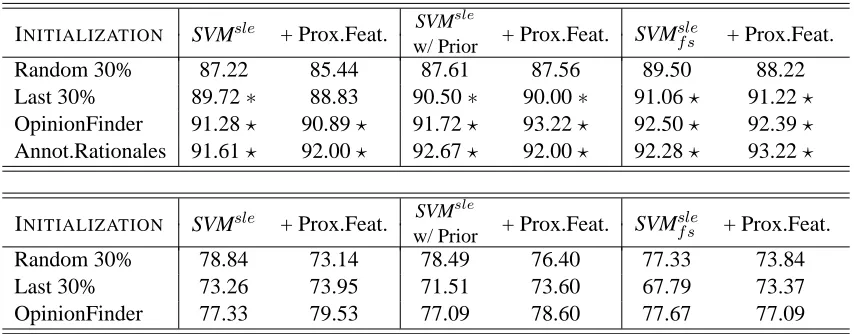
Table 1: Summary of the experimental results for the Movie Reviews (top) and U.S. Congressional Floor Debates (bottom) datasets using SVMsle, SVMslew/ Prior and SVMslef s with and without proximity features.
INITIALIZATION SVMsle + Prox.Feat. SVM sle
+ Prox.Feat. SVMslef s + Prox.Feat. w/ Prior
Random 30% 87.22 85.44 87.61 87.56 89.50 88.22
Last 30% 89.72∗ 88.83 90.50∗ 90.00∗ 91.06? 91.22? OpinionFinder 91.28? 90.89? 91.72? 93.22? 92.50? 92.39? Annot.Rationales 91.61? 92.00? 92.67? 92.00? 92.28? 93.22?
INITIALIZATION SVMsle + Prox.Feat. SVM sle
+ Prox.Feat. SVMslef s + Prox.Feat. w/ Prior
Random 30% 78.84 73.14 78.49 76.40 77.33 73.84
Last 30% 73.26 73.95 71.51 73.60 67.79 73.37
OpinionFinder 77.33 79.53 77.09 78.60 77.67 77.09
– For Movie Reviews, the SVM baseline accuracy is 88.56%. A?(or∗) indicates statically significantly better performance than baseline according to the paired t-test withp <0.001(orp <0.05).
– For U.S. Congressional Floor Debates, the SVM baseline accuracy is 70.00%. Statistical significance cannot be calculated because the data comes in a single split.
Since our training procedure solves a non-convex optimization problem, it requires an initial guess of the explanatory sentences. We use an explanatory set size (5) of 30% of the number of sentences in each document,L=d0.3· |x|e,with a lower cap of 1. We generate initializations using OpinionFinder (Wilson et al., 2005), which were shown to be a reasonable substitute for human annotations in the Movie Reviews dataset (Yessenalina et al., 2010).6
We consider two additional (baseline) methods for initialization: using a random set of sentences, and using the last 30% of sentence in the document. In the Movie Reviews dataset, we also use sentences containing human-annotator rationales as a final ini-tialization option. No such manual annotations are available for the Congressional Debates.
5.2 Experimental Results
We evaluate three versions of our model: the ini-tial model (3) which we call SVMsle (SVMs for
Sentiment classification with Latent Explanations), SVMsleregularized relative to a prior as described in
the documents in the whole dataset contain only 1-3 sentences, making it an uninteresting setting to analyze with our model.
6
We select all sentences whose majority vote of Opinion-Finder word-level polarities matches the document’s sentiment. If there are fewer thanLsentences, we add sentences starting from the end of the document. If there are more, we remove sentences starting from the beginning of the document.
Section 4.5.1 which we refer to as SVMslew/ Prior,7 and the feature smoothing model described in Sec-tion 4.5.2 which we call SVMslef s. Due to the diffi-culty of selecting a good prior, we expect SVMslef s to exhibit the most robust performance.
Table 1 shows a comparison of our proposed methods on the two datasets. We observe that SVMslef s provides both strong and robust perfor-mance. The performance of SVMsleis generally bet-ter when trained using a prior than not in the Movie Reviews dataset. Both extensions appear to hurt performance in the U.S. Congressional Floor De-bates dataset. Using OpinionFinder to initialize our training procedure offers good performance across both datasets, whereas the baseline initializations exhibit more erratic performance behavior.8 Unsur-prisingly, initializing using human annotations (in the Movie Reviews dataset) can offer further im-provement. Adding proximity features (as described in Section 4.4) in general seems to improve perfor-mance when using a good initialization, and hurts performance otherwise.
7
We either used the same value ofCto train both standard SVM model and SVMsle w/ Prior or used the best standard SVM model on the validation set to train SVMslew/ Prior. We chose the combination that works the best on the validation set.
8
Table 2: Comparison of SVMslef s with previous work on the Movie Reviews dataset. We considered two settings: when human annotations are available (Annot. Labels), and when they are unavailable (No Annot. Labels).
METHOD ACC
Baseline SVM 88.56
Annot. Zaidan et al. (2007) 92.20
Labels SVMslef s 92.28
SVMslef s+ Prox.Feat. 93.22 No Annot. Yessenalina et al. (2010) 91.78
Labels SVMslef s 92.50
[image:8.612.322.525.243.332.2]SVMslef s+Prox.Feat. 92.39
Table 3: Comparison of SVMslef s with previous work on the U.S. Congressional Floor Debates dataset for the speaker-based segment classification task.
METHOD ACC
Baseline SVM 70.00
Prior work Thomas et al. (2006) 71.28 Bansal et al. (2008) 75.00
Our work SVM
sle
f s 77.67
SVMslef s+ Prox.Feat. 77.09
Tables 2 and 3 show a comparison of SVMslef s with previous work on the Movie Reviews and U.S. Con-gressional Floor Debates datasets, respectively. For the Movie Reviews dataset, we considered two set-tings: when human annotations are available, and when they are not (in which case we initialized using OpinionFinder). For the U.S. Congressional Floor Debates dataset we used only the latter setting, since there are no annotations available for this dataset. In all cases we observe SVMslef s showing improved per-formance compared to previous results.
Training details. We tried around 10 different
values forCparameter, and selected the final model based on the validation set. The training proce-dure alternates between training a standard struc-tural SVM model and using the subsequent model to re-label the latent variables. We selected the halt-ing iteration of the trainhalt-ing procedure ushalt-ing the val-idation set. When initializing using human annota-tions for the Movie Reviews dataset, the halting iter-ation is typically the first iteriter-ation, whereas the halt-ing iteration is typically chosen from a later iteration
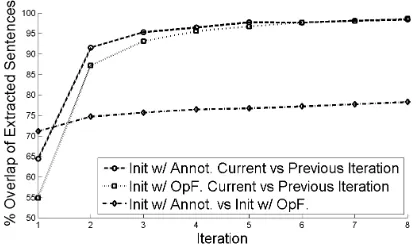
Figure 1: Overlap of extracted sentences from different
SVMslef s models on the Movie Reviews training set.
Figure 2: Test accuracy on the Movie Reviews dataset for
SVMslef s while varying extraction size.
when initializing using OpinionFinder.
Figure 1 shows the per-iteration overlap of ex-tracted sentences from SVMslef s models initialized us-ing OpinionFinder and human annotations on the Movie Reviews training set. We can see that train-ing has approximately converged after about 10 it-erations.9 We can also see that both models itera-tively learn to extract sentences that are more similar to each other than their respective initializations (the overlap between the two initializations is 57%). This is an indicator that our learning problem, despite be-ing non-convex and havbe-ing multiple local optima, has a reasonably large “good” region that can be ap-proached using different initialization methods.
Varying the extraction size. Figure 2 shows how
accuracy on the test set of SVMslef s changes on the Movie Reviews dataset as a function of varying the extraction sizef(|x|)from (5). We can see that per-formance changes smoothly10(and so is robust), and that one might see further improvement from more
9
The number of iterations required to converge is an upper bound on the number of iterations from which to choose the halting iteration (based on a validation set).
Table 4: Example ”yea” speech with Latent Explanations from the U.S. Congressional Floor Debates dataset predicted by SVMslef s with OpinionFinder initialization. Latent Explanations are preceded by solid circles with numbers denoting their preference order (1 being most preferred by SVMslef s). The five least subjective sentences are preceded by circles with numbers denoting the subjectivity order (1 being least subjective according to SVMslef s).
➋Mr. Speaker, I am proud to stand on the house floor today to speak in favor of the Stem Cell Research En-hancement Act, legislation which will bring hope to millions of people suffer-ing from disease in this nation. ➌I want to thank Congresswoman Degette and Congressman Castle for their tire-less work in bringing this bill to the house floor for a vote.
➀The discovery of embryonic stem cells is a major scientific breakthrough. ➄Embryonic stem cells have the po-tential to form any cell type in the human body. This could have pro-found implications for diseases such as Alzheimer’s, Parkinson’s, various forms of brain and spinal cord disorders, dia-betes, and many types of cancer.➁
Ac-cording to the Coalition for the Ad-vancement of Medical Research, there are at least 58 diseases which could po-tentially be cured through stem cell re-search.
That is why more than 200 major patient groups, scientists, and medical research groups and 80 Nobel Laure-ates support the Stem Cell Research En-hancement Act. ➂They know that this legislation will give us a chance to find cures to diseases affecting 100 million Americans.
I want to make clear that I oppose re-productive cloning, as we all do. I have voted against it in the past.➍However, that is vastly different from stem cell re-search and as an ovarian cancer sur-vivor, I am not going to stand in the way
of science.
Permitting peer-reviewed Federal funds to be used for this research, combined with public oversight of these activities, is our best assurance that research will be of the highest quality and performed with the greatest dignity and moral responsibility. The policy President Bush announced in August 2001 has limited access to stem cell lines and has stalled scientific progress.
As a cancer survivor, I know the des-peration these families feel as they wait for a cure. ➃This congress must not stand in the way of that progress.➎We have an opportunity to change the lives of millions, and I hope we take it. ➊I urge my colleagues to support this leg-islation.
careful tuning of the size constraint.
Examining an example prediction. Our
pro-posed methods are not designed to extract inter-pretable explanations, but examining the extracted explanations might still yield meaningful informa-tion. Table 4 contains an example speech from the U.S. Congressional Floor Debates test set, with La-tent Explanations found by SVMslef s highlighted in boldface. This speech was made in support of the Stem Cell Research Enhancement Act. For com-parison, Table 4 also shows the five least subjective sentences according to SVMslef s. Notice that most of these “objective” sentences can plausibly belong to speeches made in opposition to bills that limit stem cell research funding. That is, they do not clearly in-dicate the speaker’s stance towards the specific bill in question. We can thus see that our approach can indeed learn to infer sentences that are essential to understanding the document-level sentiment.
6 Discussion
Making good structural assumptions simplifies the development process. Compared to methods that modify the training of flat document classifiers (e.g., Zaidan et al. (2007)), our approach uses fewer pa-rameters, leading to a more compact and faster
train-ing stage. Compared to methods that use a cascaded approach (e.g., Pang and Lee (2004)), our approach is more robust to errors in the lower-level subtask due to being a joint model.
Introducing latent variables makes the training procedure more flexible by not requiring lower-level labels, but does require a good initialization (i.e., a reasonable substitute for the lower-level labels). We believe that the widespread availability of off-the-shelf sentiment lexicons and software, despite being developed for a different domain, makes this issue less of a concern, and in fact creates an opportunity for approaches like ours to have real impact.
One can incorporate many types of sentence-level information that cannot be directly incorporated into a flat model. Examples include scores from another sentence-level classifier (e.g., from Nakagawa et. al (2010)) or combining phrase-level polarity scores (e.g., from Choi and Cardie (2008)) for each sen-tence, or features that describe the position of the sentence in the document.
test instances to be known in advance (i.e., their for-mulations are transductive). Our method is not lim-ited to the transductive setting, and instead exploits a different and complementary structure: the latent explanation (i.e., only some sentences in the speech are indicative of the speaker’s vote).
In a sense, the joint feature structure used in our model is the simplest that could be used. Our model makes no explicit structural dependencies be-tween sentences, so the choice of whether to extract each sentence is essentially made independently of other sentences in the document. More sophisticated structures can be used if appropriate. For instance, one can formulate the sentence extraction task as a sequence labeling problem similar to (McDonald et al., 2007), or use a more expressive graphical model such as in (Pang and Lee, 2004; Thomas et al., 2006). So long as the global inference proce-dure is tractable or has a good approximation al-gorithm, then the training procedure is guaranteed to converge with rigorous generalization guarantees (Finley and Joachims, 2008). Since any formulation of the extraction subtask will suppress information for the main document-level task, one must take care to properly incorporate smoothing if necessary.
Another interesting direction is training models to predict not only sentiment polarity, but also whether a document is objective. For example, one can pose a three class problem (“positive”, “negative”, “ob-jective”), where objective documents might not nec-essarily have a good set of (subjective) explanatory sentences, similar to (Chang et al., 2010).
7 Conclusion
We have presented latent variable structured mod-els for the document sentiment classification task. These models do not rely on sentence-level an-notations, and are trained jointly (over both the document and sentence levels) to directly optimize document-level accuracy. Experiments on two stan-dard sentiment analysis datasets showed improved performance over previous results.
Our approach can, in principle, be applied to any classification task that is well modeled by jointly solving an extraction subtask. However, as evi-denced by our experiments, proper training does re-quire a reasonable initial guess of the extracted
ex-planations, as well as ways to mitigate the risk of the extraction subtask suppressing too much infor-mation (such as via feature smoothing).
Acknowledgments
This work was supported in part by National Science Foundation Grants BCS-0904822, BCS-0624277, IIS-0535099; by a gift from Google; and by the Department of Homeland Security under ONR Grant N0014-07-1-0152. The second author was also supported in part by a Microsoft Research Graduate Fellowship. The authors thank Yejin Choi, Thorsten Joachims, Nikos Karampatzi-akis, Lillian Lee, Chun-Nam Yu, and the anonymous re-viewers for their helpful comments.
Appendix
Recall that all the ψsubj andψpol vectors have unit 2-norm, which is assumed here to be desirable. We now show that using N(x) = pf(|x|) achieves a similar property forΨ(x, y, s). We can write the squared 2-norm ofΨ(x, y, s)as
|Ψ(x, y, s)|2= 1
N(x)2
X
j∈s
y·ψpol(xj) +ψsubj(xj)
2
= 1
f(|x|)
X
j∈s
ψpol(xj)
2
+
X
j∈s
ψsubj(xj)
2 ,
where the last equality follows from the fact that
ψpol(xj)Tψsubj(xj) = 0,
due to the two vectors using disjoint feature spaces by construction. The summation of theψpol(xj) terms is written as
X
j∈s
ψpol(xj)
2
=X
j∈s
X
i∈s
ψpol(xj)Tψpol(xi)
≈X
j∈s
ψpol(xj)Tψpol(xj) (8)
=X
j∈s
1≤f(|x|),
where (8) follows from the sparsity assumption that
∀i6=j: ψpol(xj)Tψpol(xi)≈0.
References
Mohit Bansal, Claire Cardie, and Lillian Lee. 2008. The power of negative thinking: Exploiting label disagree-ment in the min-cut classification framework. In
In-ternational Conference on Computational Linguistics (COLING).
Ming-Wei Chang, Dan Goldwasser, Dan Roth, and Vivek Srikumar. 2010. Discriminative learning over con-strained latent representations. In Conference of the
North American Chapter of the Association for Com-putational Linguistics (NAACL).
Yejin Choi and Claire Cardie. 2008. Learning with com-positional semantics as structural inference for subsen-tential sentiment analysis. In Empirical Methods in
Natural Language Processing (EMNLP).
James Clarke, Dan Goldwasser, Ming-Wei Chang, and Dan Roth. 2010. Driving semantic parsing from the world’s response. In ACL Conference on Natural
Lan-guage Learning (CoNLL), July.
Pedro Felzenszwalb, David McAllester, and Deva Ra-manan. 2008. A discriminatively trained, multiscale, deformable part model. In IEEE Conference on
Com-puter Vision and Pattern Recognition (CVPR).
Thomas Finley and Thorsten Joachims. 2008. Train-ing structural svms when exact inference is intractable. In International Conference on Machine Learning
(ICML).
Thorsten Joachims, Thomas Finley, and Chun-Nam Yu. 2009. Cutting plane training of structural svms.
Ma-chine Learning, 77(1):27–59.
Yi Mao and Guy Lebanon. 2006. Isotonic conditional random fields and local sentiment flow. In Neural
In-formation Processing Systems (NIPS).
Ryan McDonald, Kerry Hannan, Tyler Neylon, Mike Wells, and Jeff Reynar. 2007. Structured models for fine-to-coarse sentiment analysis. In Annual
Meet-ing of the Association for Computational LMeet-inguistics (ACL).
Tetsuji Nakagawa, Kentaro Inui, and Sadao Kurohashi. 2010. Dependency tree-based sentiment classification using crfs with hidden variables. In Conference of the
North American Chapter of the Association for Com-putational Linguistics (NAACL).
Bo Pang and Lillian Lee. 2004. A sentimental education: Sentiment analysis using subjectivity summarization based on minimum cuts. In Annual Meeting of the
As-sociation for Computational Linguistics (ACL).
Bo Pang and Lillian Lee. 2008. Opinion mining and sentiment analysis. Foundations and Trends in
Infor-mation Retrieval, 2(1-2):1–135.
Bo Pang, Lillian Lee, and Shivakumar Vaithyanathan. 2002. Thumbs up? Sentiment classification using ma-chine learning techniques. In Empirical Methods in
Natural Language Processing (EMNLP).
Slav Petrov and Dan Klein. 2007. Discriminative log-linear grammars with latent variables. In Neural
In-formation Processing Systems (NIPS).
Matt Thomas, Bo Pang, and Lillian Lee. 2006. Get out the vote: Determining support or opposition from Congressional floor-debate transcripts. In Empirical
Methods in Natural Language Processing (EMNLP).
Theresa Wilson, Janyce Wiebe, and Paul Hoffmann. 2005. Recognizing contextual polarity in phrase-level sentiment analysis. In Empirical Methods in Natural
Language Processing (EMNLP).
Ainur Yessenalina, Yejin Choi, and Claire Cardie. 2010. Automatically generating annotator rationales to im-prove sentiment classification. In Annual Meeting of
the Association for Computational Linguistics (ACL).
Chun-Nam Yu and Thorsten Joachims. 2009. Learning structural svms with latent variables. In International
Conference on Machine Learning (ICML).
Alan L. Yuille and Anand Rangarajan. 2003. The concave-convex procedure. Neural Computation,
15(4):915–936, April.
Omar F. Zaidan and Jason Eisner. 2008. Modeling notators: a generative approach to learning from an-notator rationales. In Empirical Methods in Natural
Language Processing (EMNLP).
Omar F. Zaidan, Jason Eisner, and Christine Piatko. 2007. Using “annotator rationales” to improve ma-chine learning for text categorization. In Conference