Estimating Semantic Distance Using Soft Semantic Constraints
in Knowledge-Source–Corpus Hybrid Models
Yuval Marton∗†, Saif Mohammad†, and Philip Resnik∗† ∗Department of Linguistics and
†Laboratory for Computational Linguistics and Information Processing,
Institute for Advanced Computer Studies.
University of Maryland, College Park, MD 20742-7505, USA. {ymarton,saif,resnik}@umiacs.umd.edu
Abstract
Strictly corpus-based measures of seman-tic distance conflate co-occurrence infor-mation pertaining to the many possible senses of target words. We propose a corpus–thesaurus hybrid method that uses soft constraints to generate word-sense-aware distributional profiles (DPs) from coarser “concept DPs” (derived from a Roget-like thesaurus) and sense-unaware traditional word DPs (derived from raw text). Although it uses a knowledge source, the method is not vocabulary-limited: if the target word is not in the thesaurus, the method falls back grace-fully on the word’s co-occurrence infor-mation. This allows the method to access valuable information encoded in a lexical resource, such as a thesaurus, while still being able to effectively handle domain-specific terms and named entities. Exper-iments on word-pair ranking by semantic distance show the new hybrid method to be superior to others.
1 Introduction
Semantic distance is a measure of the closeness in meaning of two concepts. People are consis-tent judges of semantic distance. For example, we can easily tell that the concepts of “exercise” and “jog” are closer in meaning than “exercise” and “theater”. Studies asking native speakers of a lan-guage to rank word pairs in order of semantic dis-tance confirm this—average inter-annotator corre-lation on ranking word pairs in order of semantic distance has been repeatedly shown to be around 0.9 (Rubenstein and Goodenough, 1965; Resnik, 1999).
A number of natural language tasks such as ma-chine translation (Lopez, 2008) and word sense disambiguation (Banerjee and Pedersen, 2003; McCarthy, 2006), can be framed as semantic distance problems. Thus, developing automatic measures that are in-line with human notions of semantic distance has received much attention. These automatic approaches to semantic distance rely on manually created lexical resources such as WordNet, large amounts of text corpora, or both.
WordNet-based information content measures have been successful (Hirst and Budanitsky, 2005), but there are significant limitations on their applicability. They can be applied only if a Word-Net exists for the language of interest (which is not the case for the “low-density” languages); and even if there is a WordNet, a number of domain-specific terms may not be encoded in it. On the other hand, corpus-based distributional measures of semantic distance, such as cosine andα-skew divergence (Dagan et al., 1999), rely on raw text alone (Weeds et al., 2004; Mohammad, 2008). However, when used to rank word pairs in order of semantic distance or correct real-word spelling errors, they have been shown to perform poorly (Weeds et al., 2004; Mohammad and Hirst, 2006). Mohammad and Hirst (2006) and Patwardhan and Pedersen (2006) argued that word sense ambi-guity is a key reason for the poor performance of traditional distributional measures, and they pro-posed hybrid approaches that are distributional in nature, but also make use of information in lexical resources such as published thesauri and WordNet. However, both these approaches can be applied to estimate the semantic distance between two terms
onlyif both terms exist in the lexical resource they rely on. We know lexical resources tend to have limited vocabulary and a large number of
specific terms are usually not included.
It should also be noted that similarity values from different distance measures are not compa-rable (even after normalization to the same scale), that is, a similarity score of .75 as per one distance measure does not correspond to the same semtic distance as a similarity score of .75 from an-other distance measure.1 Thus if one uses two
independent distance measures, in this case: one resource-reliant and one only corpus-dependent, then these two measures are not comparable (and hence cannot be used in tandem), even if both rely—partially or entirely—on distributional cor-pus statistics.
We propose a hybrid semantic distance method that inherently combines the elements of a resource-reliant measure and a strictly corpus-dependent measure by imposing resource-reliant soft constraints on the corpus-dependent model. We choose the Mohammad and Hirst (2006) method as the resource-reliant method and not one of the WordNet-based measures because, un-like the WordNet-based measures, the Moham-mad and Hirst method is distributional in nature and so lends itself immediately for combination with traditional distributional similarity measures. Our new hybrid method combines concept–word co-occurrence information (the Mohammad and Hirst distributional profiles of thesaurus concepts (DPC)) with word–word co-occurrence informa-tion, to generate word-sense-biased distributional profiles. The “pure” corpus-based distributional profile (a.k.a.co-occurrence vector, orword asso-ciation vector), for some target wordu, is biased with soft constraints towards each of the concepts
c that listu in the thesaurus, to create a distribu-tional profile that is specific touin the sense that is most related to the other words listed underc.
Thus, this method can make more fine-grained distinctions than the Mohammad and Hirst method, and yet uses word sense information.2
Our proposed method falls back gracefully to rely only on word-word co-occurrence information if any of the target terms is not listed in the lexical re-source. Experiments on the word-pair ranking task
1All we can infer is that ifw
1andw2 have a similarity score of .75 andw3andw4 have a score of .5 by thesame distance measure, then w1–w2 are closer in meaning than
w3–w4.
2Even though Mohammad and Hirst (2006) use thesaurus categories as coarse concepts, their algorithm can be applied using more finer-grained thesaurus word groupings (para-graphs and semicolon units), as well.
on three different datasets show that the our pro-posed hybrid measure outperforms all other com-parable distance measures.
Mohammad and Hirst (2007) show that their method can be used to compute semantic dis-tance in a resource poor language L1 by
com-bining its text with a thesaurus in a resource-rich languageL2 using anL1–L2 bilingual lexicon to create cross-lingual distributional profiles of con-cepts, that is, L2 word co-occurrence profiles of L1 thesaurus concepts. Since our method makes use of the Mohammad and Hirst DPCs, it can just as well make use of their cross-lingual DPCs, to compute semantic distance in a resource-poor lan-guage, just as they did. We leave that for future work.
2 Background and Related Work
Strictly speaking, semantic distance/closeness is a property of lexical units—a combination of the surface form and word sense.3Two terms are
con-sidered to be semantically close if there is a lex-ical semantic relation between them. Such a re-lation may be a classical rere-lation such as hyper-nymy, tropohyper-nymy, merohyper-nymy, and antohyper-nymy, or it may be what have been called an ad-hoc non-classical relation, such as cause-and-effect (Mor-ris and Hirst, 2004). If the closeness in meaning is due to certain specific classical relations such as hypernymy and troponymy, then the terms are said to be semanticallysimilar. Semantic relatedness
is the term used to describe the more general form of semantic closeness caused by any semantic re-lation (Hirst and Budanitsky, 2005). So the nouns
liquidandwaterare both semantically similar and semantically related, whereas the nounsboatand
rudderare semantically related, but not similar. The next three sub-sections describe three kinds of automatic distance measures: (1) lexical-resource-based measures that rely on a manually created resource such as WordNet; (2) corpus-based measures that rely only on co-occurrence statistics from large corpora; and (3) hybrid mea-sures that are distributional in nature, and that also exploit the information in a lexical resource.
2.1 Lexical-resource-based measures
WordNet is a manually-created hierarchical net-work of nodes (taxonomy), where each node in
the network represents a fine-grained concept or word sense. An edge between two nodes rep-resents a lexical semantic relation such as hy-pernymy and troponymy. WordNet-based mea-sures consider two terms to be close if they occur close to each other in the network (connected by only a few arcs), if their definitions share many terms (Banerjee and Pedersen, 2003; Patwardhan and Pedersen, 2006), or if they share a lot of infor-mation (Lin, 1998; Resnik, 1999). The length of each arc/link (distance between nodes) can be as-sumed a unit length, or can be computed from cor-pus statistics. Within WordNet, theis-ahierarchy is much more well-developed than that of other lexical semantic relations. So, not surprisingly, the best WordNet-based measures are those that rely only on the is-a hierarchy. Therefore, they are good at measuring semantic similarity (e.g.,
doctor–physician), but not semantic relatedness (e.g., doctor–scalpel). Further, the measures can only be used in languages that have a (sufficiently developed) WordNet. WordNet sense information has been criticized to be too fine grained (Agirre and Lopez de Lacalle Lekuona, 2003; Navigli, 2006). See Hirst and Budanitsky (2005) for a com-prehensive survey of WordNet-based measures.
2.2 Corpus-based measures
Strictly corpus-based measures of distributional similarity rely on the hypothesis that words that occur in similar context tend to be semantically close (Firth, 1957; Harris, 1940). The set of contexts of each target word u is represented by its distributional profile (DP)—the set of words that tend to co-occur with uwithin a certain dis-tance, along with numeric scores signifying this co-occurrence tendency with u. Then measures such as cosine or α-skew divergence are used to determine how close the DPs of the two target words are. See Section 3 for more details and re-lated work. These measures are very appealing because they rely simply on raw text, but, as de-scribed earlier, when used to rank word pairs in order of semantic distance, or to correct real-word spelling errors, they perform poorly, compared to the WordNet-based measures. See Weeds et al. (2004), Mohammad (2008), and Curran (2004) for detailed surveys of distributional measures.
As Mohammad and Hirst (2006) point out, the DP of a word u conflates information about the potentially many senses ofu. For example,
con-sider the following. The nounbankhas two senses “river bank” and “financial institution”. Assume that bank, when used in the “financial institu-tion” sense, co-occurred with the nounmoney100 times in a corpus. Similarly, assume that bank, when used in the “river bank” sense, co-occurred with the nounboat80 times. So the DP of bank
will have co-occurrence information with money
as well asboat:
DPW(bank):
money,100;boat,80;bond,70;fish,77; . . .
Assume that the DP of the wordATMis:
DPW(ATM):
money,120;boat,0;bond,90;fish,0; . . .
Thus the distributional distance ofbankwithATM
will be some sort of an average of the seman-tic distance between the “financial institution” and “ATM” senses and the semantic distance between the “river bank” and “ATM” senses. However, in various natural language tasks, we need the se-mantic distance between the intended senses of
bank andATM, which often also tends to be the semantic distance between their closest senses.
2.3 Hybrid measures
Both Mohammad and Hirst (2006) and Patward-han and Pedersen (2006) proposed measures that are not only distributional in nature but also rely on a lexical resource to exploit the manually en-coded information therein as well as to overcome the sense-conflation problem (described in sec-tion 2.2). Since we essentially combine the Mo-hammad and Hirst method with a “pure” word-based distributional measure to create our hybrid approach, we briefly describe their method here.
list u. Below are example DPCs of the two con-cepts pertaining tobank:4
DPC(“fin. inst.”):
money,1000;boat,32;bond,705;fish,0; . . . DPC(“river bank”):
money,5;boat,863;bond,0;fish,948; . . .
The distance between two words u, v is deter-mined by calculating the closeness of each of the DPCs ofu to each of DPCs ofv, and the closest DPC-pair distance is chosen.
Mohammad and Hirst (2006) show that their ap-proach performs better than other strictly corpus-based approaches that they experimented with. However, all those experiments were on word-pairs that were listed in the thesaurus. Their ap-proach is not applicable otherwise. In Sections 3 and 4 we show how cosine–log-likelihood-ratio (or any comparable distributional measure) can be combined with the Mohammad and Hirst DPCs to form a hybrid approach that is not limited to the vocabulary of a lexical resource.
Erk and Pad´o (2008) proposed a way of rep-resenting a word sense in context by biasing the target word’s DP according to the context sur-rounding a target (specific) occurrence of the tar-get word. They use dependency relations and se-lectional preferences of the target word and com-bine multiple DPs of words appearing in the con-text of the target occurrence, in a manner so as to give more weight to words co-occurring with both the target word and the target occurrence’s context words. The advantage of this approach is that it does not rely on a thesaurus or Word-Net. Its disadvantage is that it relies on depen-dency relations and selectional preferences infor-mation, and that the context information it uses in order to determine the word sense is quite limited (only the words surrounding a single occurrence of the and hence the representation of that sense might not be sufficiently accurate. Their approach effectively assumes that each occurrence of a word has a unique sense.
3 Distributional Measures with Soft Semantic Constraints
Traditional distributional profiles of words (DPW) give word–word co-occurrence frequencies. For example, DPW(u) gives the number of times
4The relatively large co-occurrence frequency values for DPCs as compared to DPWs is because a concept can be ref-ered to by many words (on average 100).
the target word u co-occurs with with all other words:5
DPW(u):
w1,f(u,w1);w2,f(u,w2);w3,f(u,w3); . . .
wheref stands for co-occurrence frequency (and can be generalized to stand for any strength of association (SoA) measure such as the log-likelihood ratio). Mohammad and Hirst create concept–word co-occurrence vectors, “distribu-tional profiles of concepts” (DPCs), from non-annotated corpus. For example, DPC(c) gives the number of times the concept (thesaurus category)
cco-occurs with all the words in a corpus.
DPC(c):
w1,f(c,w1);w2,f(c,w2);w3,f(c,w3); . . .
A target worduthat appears under thesaurus con-ceptsc1, ...,cnwould be assigned to DPC(c1), ...,
DPC(cn). Therefore, if a target word v also
ap-pears under some same conceptc, the DPCs ofu
andvwould be indistinguishable.
We propose the creation of distributional pro-files of word senses (DPWS(uc)) that approximate
the SoA of the target wordu, when used in sense
c, with each of the words in the corpus:
DPWS(uc):
w1,f(uc,w1);w2,f(uc,w2);w3,f(uc,w3); . . .
In order to get exact counts, one needs sense-annotated data. However, such data is expensive to create, and is scarce. Therefore, we propose estimating these counts from the DPW and DPC counts:
f(uc, wi) =p(c|wi)×f(u, wi) (1)
where the conditional probabilityp(c|wi)is
calcu-lated from the co-occurrence frequencies in DPCs; and the co-occurrence count f(u, wi) is
calcu-lated from DPWs. If the target word is not in the thesaurus’s vocabulary, then we assume uni-form distribution over all concepts, and in prac-tice use a single sense, and take the conditional probability to be 1. Since the method takes sense-proportional co-occurrence counts, we will refer to this method as the hybrid-sense-proportional-counts method(or,hybrid-propfor short).
For example, below is the DPWS of bank in the “financial institution” sense, calculated from its DPW and DPCs:
DPW(bank):
money,100;boat,80;bond,70;fish,77; . . . DPC(“fin. inst.”):
money,1000;boat,32;bond,705;fish,0; . . . DPC(“river bank”):
money,5;boat,863;bond,0;fish,948; . . . DPWS(bank“fin.inst.”):
money,( 1000
1000+5×100);boat,(32+86332 ×80);
bond,( 705
705+0×70);fish,(0+9480 ×77); . . .
Once the DPWS are calculated, any counts-based SoA and distance measures can be ap-plied. For example, in this work we use log-likelihood ratio (Dunning, 1993) to determine the SoA between a word sense and co-occurring words, and cosine to determine the distance be-tween two DPWS’s log likelihood vectors (Mc-Donald, 2000). We also contrast this measure with cosine of conditional probabilities vectors. Given two target words, we determine the distance be-tween each of their DPWS pairings and the closest DPWS-pair distance is chosen.
3.1 The hybrid-sense-filtered-counts method
Since the DPCs are created in an unsupervised manner, they are expected to be somewhat noisy. Therefore, we also experimented with a variant of the method proposed above, that simply makes use of whether the conditional probability p(c|wi) is
greater than 0 or not:
f(uc, wi) =
(
f(u, wi) Ifp(c|wi)>0
0 Otherwise (2)
Since this method essentially filters out collocates that are likely not relevant to the target sensecof the target word u, we will refer to this method as the hybrid-sense-filtered-counts method(or, just hybrid-filtfor short). Below is an example hybrid-filtered DPWS ofbankin the “financial in-stitution” sense:
DPWS(bank“fin.inst.”:
money,100);boat,80;bond,70; . . .
Note that the collocate fish is now filtered out, whereasbank’sco-occurrence counts withmoney, boat, and bond are left as is (and not sense-proportionally attenuated).
4 Evaluation
We evaluated various methods on the task of ranking word pairs in order of semantic dis-tance. These methods included our sense-biased methods as well as several baselines: the Mo-hammad and Hirst (2006) DPC-based methods, the traditional word-based distributional similar-ity methods, and several Latent Semantic Analysis (LSA)-based methods. We used three testsets and their corresponding human judgment gold stan-dards: (1) the Rubenstein and Goodenough (1965) set of 65 noun pairs—denoted RG-65; (2) the WordSimilarity-353 (Finkelstein et al., 2002) set of 353 noun pairs (which include the RG-65 pairs) of which we discarded of one repeating pair—denoted WS-353; and (3) the Resnik and Diab (2000) set of 27 verb pairs—denotedRD-00.
4.1 Corpora and Pre-processing
We generated distributional profiles (DPWs and DPCs) from the British National Corpus (BNC) (Burnard, 2000), which is a balanced cor-pus. We lowercased the characters, and stripped numbers, punctuation marks, and any SGML-like syntactic tags, but kept sentence boundary mark-ers. The BNC contained 102,100,114 tokens of 546,299 types (vocabulary size) after tokenization. For the verb set, we also lemmatized this corpus.
We considered two words as co-occurring if they occurred in a window of±5 words from each other. We stoplisted words that co-occurred with more than 2000 word types.
4.2 Results
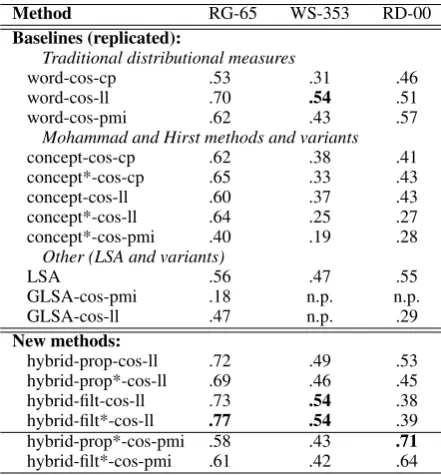
The Spearman rank correlations of the automatic rankings of the RG-65, WS353, and RD-00 test-sets with the corresponding gold-standard human rankings is listed in Table 1.6 The higher the
Spearman rank correlation, the more accurate is the distance measure.
4.2.1 Results on the RG-65 testset
Baselines. We replicated the traditional word-based distributional distance measure using co-sine of vectors (DPs) containing conditional prob-abilities (word-cos-cp). Its rank correlation of .53 is close to the correlation of .54 reported in Mohammad and Hirst (2006), hereafter MH06. We replicated the MH06 concept-based approach
Method RG-65 WS-353 RD-00 Baselines (replicated):
Traditional distributional measures
word-cos-cp .53 .31 .46
word-cos-ll .70 .54 .51
word-cos-pmi .62 .43 .57
Mohammad and Hirst methods and variants
concept-cos-cp .62 .38 .41
concept*-cos-cp .65 .33 .43
concept-cos-ll .60 .37 .43
concept*-cos-ll .64 .25 .27
concept*-cos-pmi .40 .19 .28
Other (LSA and variants)
LSA .56 .47 .55
GLSA-cos-pmi .18 n.p. n.p.
GLSA-cos-ll .47 n.p. .29
New methods:
[image:6.595.72.293.63.301.2]hybrid-prop-cos-ll .72 .49 .53 hybrid-prop*-cos-ll .69 .46 .45 hybrid-filt-cos-ll .73 .54 .38 hybrid-filt*-cos-ll .77 .54 .39 hybrid-prop*-cos-pmi .58 .43 .71 hybrid-filt*-cos-pmi .61 .42 .64
Table 1: Spearman rank correlation on RG-65, WS-353, and RD-00 testsets, trained on BNC. ‘*’ indicates the use of a smaller bootstrapped concept–word co-occurrence matrix. ‘n.p.’ indi-cates that the experiment was not pursued.
(concept-cos-cp), and its bootstrapped variant that uses a smaller concept–word co-occurrence matrix (concept*-cos-cp). The latter yielded a correla-tion score .65, close to the .69 reported in MH06.
We also experimented with cosine of PMI vec-tors (word-cos-pmi) which obtained a correlation of .62. Log likelihood ratios (word-cos-ll) gave best results among the baseline methods (.70), and so we it more often in the implementations of our hybrid method.
We conducted experiments with LSA and its GLSA variants (Budiu et al., 2006) as additional baselines. A limited vocabulary of the 33,000 most frequent words in the BNC and all test words was used in these experiments. (A larger vocab-ulary was computationally expensive and 33,000 is also the vocabulary size used by Budiu et al. (2006) in their LSA experiments.)
New Methods: The hybrid method variants
proposed in this paper (hybrid-prop-cos-ll and
hybrid-filt-cos-ll) were the best performers on the RG-65 test set. Particularly, they performed better than both the traditional word-distance measures (word-cos-ll), and our concept-based methods— variants of the MH06 method that are used with likelihood ratios (concept-cos-ll,
concept*-cos-ll). The -pmi methods were all poorer performers than their -ll counterparts. The -pmi hybrid vari-ants obtained higher scores than the concept-based ones, but almost the same scores as the word-based ones.
4.2.2 Results on WS-353 and RD-00 testsets
On WS-353, all our hybrid methods out-performed their concept counterparts, and were on par with their word-based counterparts. On RD-00, word-cos-pmi out-performed all other word-based methods, and the hybrid -pmi meth-ods were best performers with scores of .64 and .71. Our word-cos-ll, hybrid-prop-cos-ll, and the two hybrid pmi results on RD-00 are better than any non-WordNet results reported by Resnik and Diab (2000), including their syntax-informed methods—the variants of Lin (“distrib”, .43) and Dorr (“LCS”, .39). In fact, our hybrid*-prop-cos-pmi and hybrid*-filt-cos-hybrid*-prop-cos-pmi results reach corlation levels of the WordNet-based methods re-ported there (.66–.68). Also, on WS-353, our hybrid sense-filtered variants and word-cos-ll ob-tained a correlation score higher than published re-sults using WordNet-based measures (Jarmasz and Szpakowicz, 2003) (.33 to .35) and Wikipedia-based methods (Ponzetto and Strube, 2006) (.19 to .48); and very close to the results obtained by thesaurus-based (Jarmasz and Szpakowicz, 2003) (.55) and LSA-based methods (Finkelstein et al., 2002) (.56).
The lower correlation scores of all measures on the WS-353 test set are possibly due to it hav-ing politically biased word pairs (examples in-clude: Arafat–peace, Arafat–terror, Jerusalem– Palestinian) for which BNC texts are likely to in-duce low correlation with the human raters of WS-353. This testset also has disproportionately many terms from the news domain.
The concept methods performed poorly on WS-353 partly because many of the target words do not exist in the thesaurus. For instance, there were 17 such word types that occurred in 20 WS-353 testset word pairs. When excluding these pairs, concept-cos-cp goes up from .38 to .45, and concept*-cos-pmi from .19 to .24. Interestingly, results of the hybrid methods show that they were largely unaffected by the out-of-vocabulary prob-lem on the WS-353 dataset.
hybrid*-prop-cos-ll compared to word-cos-ll. But results suggest that the -pmi methods might serve as a better measure than -ll for verbs, although this claim should be tested more rigorously.
Human judgments of semantic distance are less consistent on verb-pairs than on noun-pairs, as re-flected in inter-rater agreement measures in Resnik and Diab (2000) and others). Thus, not surpris-ingly, the scores of almost all measures are lower for the verb data than the RG-65 noun data.
5 Discussion
The hybrid methods proposed in this paper ob-tained higher accuracies than all other methods on the RG-65 testset (all of whose words were in the published thesaurus), and on the RD-00 testset, and their performance was at least respectable on the WS-353 testset (many of whose words were not in the published thesaurus). This is in con-trast to the concept-distance methods which suf-fer greatly when the target words are not in the lexical resource (here, the thesaurus) they rely on, even though these methods can make use of co-occurrence information of words not in the the-saurus with concepts from the thethe-saurus.
Amongst the two hybrid methods proposed, the
sense-filtered-counts method performed better using the smaller bootstrapped concept–word co-occurrence matrix whereas the sense-proportional method performed better using the larger concept– word co-occurrence matrix. We believe this is be-cause the bootstrapping method proposed in Mo-hammad and Hirst (2006) has the effect of reset-ting to 0 the small co-occurrence counts. The noise from these small co-occurrence counts af-fects the sense-filtered-counts method more ad-versely (since any non-zero value will cause the inclusion of the corresponding collocate’s full co-occurrence count) and so the bootstrapped matrix is more suitable for this method.
The results also show that the cosine of log-likelihood ratios method mostly performs better than cosine of conditional probabilities and the pmi methods on the noun sets. This further supports the claim by Dunning (1993) that log-likelihood ratio is much less sensitive than pmi to low counts. Interestingly, on the verb set, the pmi methods, and especially hybrid*-prop-cos-pmi, did extremely well. Further investigation is needed in order to determine if pmi is indeed more suitable for verb semantic similarity, and why.
6 Conclusion
Traditional distributional similarity conflates co-occurrence information pertaining to the many senses of the target words. Mohammad and Hirst (2006) show how distributional measures can be used to compute distance between very coarse word senses or concepts (thesaurus cat-egories), and even obtain better results than traditional distributional similarity. However, their method requires that the target words be listed in the thesaurus, which is often not the case for domain-specific terms and named enti-ties. In this paper, we proposed hybrid meth-ods (hybrid-sense-filtered-counts and hybrid-sense-proportional-counts) that combine word– word co-occurrence information (traditional dis-tributional similarity) with word–concept co-occurrence information (Mohammad and Hirst, 2006), with soft constraints in such a manner that the method makes use of information en-coded in the thesaurus when available, and de-grades gracefully if the target word is not listed in the thesaurus. Our method generates word-sense-biased distributional profiles (DPs) from non-annotated corpus-based word-based DPs and coarser-grained aggregated thesaurus-based “con-cept DPs” (DPCs). We showed that the hybrid method correlates with human judgments of se-mantic distance in most cases better than any of the other methods we replicated.
We are now interested in improving seman-tic distance measures for verb–verb, adjective– adjective, and cross-part-of-speech pairs, by ex-ploiting specific information pertaining to these parts of speech in lexical resources in addition to purely co-occurrence information.
Acknowledgments
References
Eneko Agirre and Oier Lopez de Lacalle Lekuona. 2003. Clustering WordNet word senses. In Pro-ceedings of the 1st International Conference on Recent Advances in Natural Language Processing (RANLP-2003), Borovets, Bulgaria.
Satanjeev Banerjee and Ted Pedersen. 2003. Ex-tended gloss overlaps as a measure of semantic re-latedness. InProceedings of the Eighteenth Inter-national Joint Conference on Artificial Intelligence (IJCAI-03), pages 805–810, Acapulco, Mexico. John R. L. Bernard, editor. 1986. The Macquarie
The-saurus. Macquarie Library, Sydney, Australia. Raluca Budiu, Christiaan Royer, and Peter Pirolli.
2006. Modeling information scent: A compari-son of LSA, PMI and GLSA similarity measures on common tests and corpora. In Proceedings of RIAO’07, Pittsburgh, PA.
Lou Burnard. 2000. Reference Guide for the British National Corpus. Oxford University Computing Services, Oxford, England, world edition edition. James R. Curran. 2004. From Distributional to
Seman-tic Similarity. Ph.D. thesis, School of Informatics, University of Edinburgh, Edinburgh, UK.
Ido Dagan, Lillian Lee, and Fernando Pereira. 1999. Similarity-based models of cooccurrence probabili-ties.Machine Learning, 34(1–3):43–69.
Ted Dunning. 1993. Accurate methods for the statis-tics of surprise and coincidence. Computational Linguistics, 19(1):61–74.
Katrin Erk and Sebastian Pad´o. 2008. A struc-tured vector space model for word meaning in con-text. InProceedings of the Conference on Empirical Methods in Natural Language Processing (EMNLP-2086), pages 897–906, Honolulu, HI.
Lev Finkelstein, Evgeniy Gabrilovich, Yossi Matias, Ehud Rivlin, Zach Solan, Gadi Wolfman, and Ey-tan Ruppin. 2002. Placing search in context: The concept revisited. ACM Transactions on Informa-tion Systems, 20(1):116–131.
John R. Firth. 1957. A synopsis of linguistic theory 193055.Studies in Linguistic Analysis, (special vol-ume of the Philological Society):132. Distributional Hypothesis.
Zellig S. Harris. 1940. Review of Louis H. Gray, foun-dations of language (New York: Macmillan, 1939). Language, 16(3):216–231.
Graeme Hirst and Alexander Budanitsky. 2005. Cor-recting real-word spelling errors by restoring lexical cohesion.NLE, 11(1):87–111.
Mario Jarmasz and Stan Szpakowicz. 2003. Ro-get’s Thesaurus and semantic similarity. In Pro-ceedings of the International Conference on Recent Advances in Natural Language Processing (RANLP-2003), pages 212–219, Borovets, Bulgaria.
Thomas Landauer, Peter Foltz, and Darrell Laham. 1998. Introduction to latent semantic analysis. Dis-course Processes, 25:259 – 284.
Dekang Lin. 1998. An information-theoretic defini-tion of similarity. In Proceedings of the 15th In-ternational Conference on Machine Learning, page 296304, San Francisco, CA.
Adam Lopez. 2008. Statistical machine translation. ACM Computing Surveys, 40(3):149.
Diana McCarthy. 2006. Relating WordNet senses for word sense disambiguation. InProceedings of the European Chapter of the Association for Computational Linguistics Workshop Making Sense of Sense -Bringing Computational Linguistics and Psycholin-guistics Together, pages 17–24, Trento, Italy. S. McDonald. 2000. Environmental determinants of
lexical processing effort. Ph.D. thesis, University of Edinburgh, Edinburgh, UK.
Saif Mohammad and Graeme Hirst. 2006. Distribu-tional measures of concept-distance: A task-oriented evaluation. InProceedings of EMNLP.
Saif Mohammad, Iryna Gurevych, Graeme Hirst, and Torsten Zesch. 2007. Cross-lingual distribu-tional profiles of concepts for measuring seman-tic distance. In Proceedings of the Joint Confer-ence on Empirical Methods in Natural Language Processing and Computational Natural Language Learning (EMNLP/CoNLL-2007), pages 571–580, Prague, Czech Republic.
Saif Mohammad. 2008. Measuring Semantic Distance using Distributional Profiles of Concepts. Ph.D. the-sis, Department of Computer Science, University of Toronto, Toronto, Canada.
Jane Morris and Graeme Hirst. 2004. Non-classical lexical semantic relations. In Proceedings of the Workshop on Computational Lexical Semantics, Hu-man Language Technology Conference of the North American Chapter of the Association for Compu-tational Linguistics, pages 46–51, Boston, Mas-sachusetts.
Roberto Navigli. 2006. Meaningful clustering of senses helps boost word sense disambiguation per-formance. InProceedings of the 21st International Conference on Computational Linguistics and the 44th annual meeting of the Association, pages 105– 112, Sydney, Australia.
Siddharth Patwardhan and Ted Pedersen. 2006. Us-ing WordNet based context vectors to estimate the semantic relatedness of concepts. InProceedings of Making Sense of Sense EACL Workshop, pages 1–8. Simone Paolo Ponzetto and Michael Strube. 2006. Exploiting semantic role labeling, WordNet and Wikipedia for coreference resolution. In Proceed-ings of the Human Language Technology Confer-ence of the North American Chapter of the Associ-ation for ComputAssoci-ational Linguistics (NAACL-2006), pages 192–199, New York, NY.
Philip Resnik and Mona Diab. 2000. Measuring verb similarity. In22nd Annual Meeting of the Cognitive Science Society (COGSCI2000), Philadelphia, PA. Philip Resnik. 1999. Semantic similarity in a
Herbert Rubenstein and John B. Goodenough. 1965. Contextual correlates of synonymy. Communica-tions of the ACM, 8(10):627–633.