Here’s My Point: Joint Pointer Architecture for Argument Mining
Peter Potash, Alexey Romanov, Anna Rumshisky
Department of Computer Science University of Massachusetts Lowell
{ppotash,aromanov,arum}@cs.uml.edu
Abstract
In order to determine argument structure in text, one must understand how indi-vidual components of the overall argu-ment are linked. This work presents the first neural network-based approach to link extraction in argument mining. Specif-ically, we propose a novel architecture that applies Pointer Network sequence-to-sequence attention modeling to structural prediction in discourse parsing tasks. We then develop a joint model that extends this architecture to simultaneously address the link extraction task and the classifica-tion of argument components. The pro-posed joint model achieves state-of-the-art results on two separate evaluation corpora, showing far superior performance than the previously proposed corpus-specific and heavily feature-engineered models. Fur-thermore, our results demonstrate that jointly optimizing for both tasks is crucial for high performance.
1 Introduction
An important goal in argument mining is to un-derstand the structure in argumentative text ( Pers-ing and Ng,2016;Peldszus and Stede,2015;Stab and Gurevych,2016;Nguyen and Litman,2016). One fundamental assumption when working with argumentative text is the presence of Arguments Components (ACs). The types of ACs are gener-ally characterized as aclaimor apremise(Govier,
2013), with premises acting as support (or possi-bly attack) units for claims (though some corpora have further AC types, such asmajor claim(Stab and Gurevych,2016,2014b)).
The task of processing argument structure en-capsulates four distinct subtasks (our work
fo-cuses on subtasks 2 and 3): (1) Given a sequence of tokens that represents an entire argumentative text, determine the token subsequences that con-stitute non-intersecting ACs; (2) Given an AC, determine the type of AC (claim, premise, etc.); (3) Given a set/list of ACs, determine which ACs have directed links that encapsulate overall argu-ment structure; (4) Given two linked ACs, deter-mine whether the link is a supporting or attack-ing relation. This can be labeled as a ‘micro’ ap-proach to argument mining (Stab and Gurevych,
2016). In contrast, there have been a number of efforts to identify argument structure at a higher level (Boltuzic and ˇSnajder, 2014; Ghosh et al.,
2014;Cabrio and Villata,2012), as well as slightly re-ordering the pipeline with respect to AC types (Rinott et al.,2015)).
There are two key assumptions our work makes going forward. First, we assume subtask 1 has been completed, i.e. ACs have already been iden-tified. Second, we follow previous work that as-sumes a tree structure for the linking of ACs (Palau and Moens, 2009; Cohen, 1987; Peldszus and Stede, 2015;Stab and Gurevych,2016). Specifi-cally, a given AC can only have a single outgoing link, but can have numerous incoming links. Fur-thermore, there is a ‘head’ component that has no outgoing link (the top of the tree). Depending on the corpus (see Section4), an argument structure can be either a single tree or a forest, consisting of multiple trees. Figure1shows an example that we will use throughout the paper to concretely explain how our approach works. First, the left side of the figure presents the raw text of a paragraph in a persuasive essay (Stab and Gurevych,2016), with the ACs contained in square brackets. Squiggly vs straight underlining differentiates between claims and premises, respectively. The ACs have been an-notated as to how they are linked, and the right side of the figure reflects this structure. The argument
First, [:::::::cloning:::::will:::be::::::::::beneficial::::for
:::::
many:::::::people::::who::::are:::in:::::need:::of:::::organ
:::::::::
transplants]AC1. In addition, [it shortens
the healing process]AC2. Usually, [it is
very rare to find an appropriate organ donor]AC3and [by using cloning in order
to raise required organs the waiting time can be shortened tremendously]AC4.
AC1 Claim
AC2 Premise
AC4 Premise AC3
[image:2.595.263.477.66.193.2]Premise
Figure 1: An example of argument structure with four ACs. The left side shows raw text that has been annotated for the presence of ACs. Squiggly or straight underlining means an AC is aclaimorpremise, respectively. The ACs in the text have also been annotated for links to other ACs, which is shown in the right figure. ACs 3 and 4 arepremisesthat link to anotherpremise, AC2. Finally, AC2 links to aclaim, AC1. AC1 therefore acts as the central argumentative component.
structure with four ACs forms a tree, where AC2 has two incoming links, and AC1 acts as the head, with no outgoing links. We also specify thetype of AC, with the head AC marked as a claim and the remaining ACs marked aspremises. Lastly, we note that the order of argument components can be a strong indicator of how components should re-late. Linking to the first argument component can provide a competitive baseline heuristic (Peldszus and Stede,2015;Stab and Gurevych,2016).
Given the above considerations, we propose that sequence-to-sequence attention modeling, in the spirit of a Pointer Network (PN) (Vinyals et al.,
2015b), can be effective for predicting argument structure. To the best of our knowledge, a clean, elegant implementation of a PN-based model has yet to be introduced for discourse parsing tasks. A PN is a sequence-to-sequence model (Sutskever et al.,2014) that outputs a distribution over the en-coding indices at each deen-coding timestep. More generally, it is a recurrent model with attention (Bahdanau et al.,2014), and we claim that as such, it is promising for link extraction because it inher-ently possesses three important characteristics: (1) it is able to model the sequential nature of ACs, (2) it constrains ACs to have a single outgoing link, thus partly enforcing the tree structure, and (3) the hidden representations learned by the model can be used for jointly predicting multiple sub-tasks. Furthermore, we believe the sequence-to-sequence aspect of the model provides two distinct benefits: (1) it allows for two separate representa-tions of a single AC (one for the source and one for the target of the link), and (2) the decoder network-could learn to predict correct sequences of linked
indices, which is a second recurrence over ACs. Note that we also test the sequence-to-sequence architecture against a simplified model that only uses hidden states from an encoding network to make predictions (see Section5).
The main technical contribution of our work is a joint model that simultaneously predicts links be-tween ACs and determines their type. Our joint model uses the hidden representation of ACs pro-duced during the encoding step (see Section3.4). While PNs were originally proposed to allow a variable length decoding sequence, our model dif-fers in that it decodes for the same number of timesteps as there are inputs. This is a key insight that allows for a sequence-to-sequence model to be used for structural prediction. Aside from the partial assumption of tree structure in the argu-mentative text, our models do not make any ad-ditional assumptions about the AC types or con-nectivity, unlike the work of Peldszus (2014). Lastly, in respect to the broad task of parsing, our model is flexible because it can easily handle non-projective, multi-root dependencies. We evaluate our models on the corpora ofStab and Gurevych
2 Related Work
Palau and Moens(2009) is an early work in argu-ment mining, using a hand-crafted Context-Free Grammar to determine the structure of ACs in a corpus of legal texts.Lawrence et al.(2014) lever-age a topic modeling-based AC similarity to un-cover tree-structured arguments in philosophical texts. Recent work offers data-driven approaches to the task of predicting links between ACs. Stab and Gurevych(2014b) approach the task as a bi-nary classification problem. The authors train an SVM with various semantic and structural fea-tures. Peldszus and Stede have also used classifi-cation models for predicting the presence of links (2015). The first neural network-based model for argumentation mining was proposed byLaha and Raykar(2016), who use two recurrent networks in end-to-end fashion to classify AC types.
Various authors have also proposed to jointly model link extraction with other subtasks from the argument mining pipeline, using either an Inte-ger Linear Programming (ILP) framework ( Pers-ing and Ng, 2016;Stab and Gurevych, 2016) or directly feeding previous subtask predictions into a tree-based parser. The former joint approaches are evaluated on an annotated corpus of persuasive essays (Stab and Gurevych,2014a,2016), and the latter on a corpus of microtexts (Peldszus,2014). The ILP framework is effective in enforcing a tree structure between ACs when predictions are made from otherwise naive base classifiers.
Recurrent neural networks have previously been proposed to model tree/graph structures in a linear manner. Vinyals et al.(2015c) use a sequence-to-sequence model for the task of syntactic parsing.
Bowman et al. (2015) experiment on an artificial entailment dataset that is specifically engineered to capture recursive logic (Bowman et al.,2014). Standard recurrent neural networks can take in complete sentence sequences and perform com-petitively with a recursive neural network. Multi-task learning for sequence-to-sequence has also been proposed (Luong et al.,2015), though none of the models used a PN for prediction.
In the field of discourse parsing, the work ofLi et al.(2016) is the only work, to our knowledge, that incorporates attention into the network archi-tecture. However, the attention is only used in the process of creating representations of the text it-self. Attention is not used to predict the overall discourse structure. In fact, the model still relies
on a binary classifier to determine if textual com-ponents should have a link. Arguably the most similar approach to ours is in the field of depen-dency parsing (Cheng et al., 2016). The authors propose a model that performs ‘queries’ between word representations in order to determine a dis-tribution over potential headwords.
3 Proposed Approach
In this section, we describe our approach to using a sequence-to-sequence model with attention for ar-gument mining, specifically, identifying AC types and extracting the links between them. We begin by giving a brief overview of these models.
3.1 Pointer Network
A PN is a sequence-to-sequence model (Sutskever et al.,2014) with attention (Bahdanau et al.,2014) that was proposed to handle decoding sequences over the encoding inputs, and can be extended to arbitrary sets (Vinyals et al., 2015a). The origi-nal motivation for a pointer network was to allow networks to learn solutions to algorithmic prob-lems, such as the traveling salesperson and convex hull problems, where the solution is a sequence over input points. The PN model is trained on in-put/output sequence pairs(E, D), whereE is the source andDis the target (our choice of E,Dis meant to represent the encoding, decoding steps of the sequence-to-sequence model). Given model parameters Θ, we apply the chain rule to deter-mine the probability of a single training example:
p(D|E; Θ) =
mY(E)
i=1
p(Di|D1, ..., Di−1, E; Θ)
(1) where the functionmsignifies that the number of decoding timesteps is a function of each individual training example. We will discuss shortly why we need to modify the original definition ofmfor our application. By taking the log-likelihood of Equa-tion1, we arrive at the optimization objective:
Θ∗ = arg max
Θ
X
E,D
logp(D|E; Θ) (2)
Component 1 Component 2 Component 3 Component 4
LSTM D1
LSTM D2
LSTM D3
LSTM D4 LSTM
E1
LSTM E2
LSTM E3
[image:4.595.125.474.64.156.2]LSTM E4
Figure 2: Applying a Pointer Network to the example paragraph in Figure1with LSTMs unrolled over time. Note that D1 points to itself to denote that it has not outgoing link and is therefore the head of a tree.
encoding and one for decoding. Thus, we refer to encoding hidden layers ase, and decoding hidden layers asd.
The PN uses a form of content-based at-tention (Bahdanau et al., 2014) to allow the model to produce a distribution over input ele-ments. This can also be thought of as a dis-tribution over input indices, wherein a decoding step ‘points’ to the input. Formally, given encod-ing hidden states(e1, ..., en), the model calculates
p(Di|D1, ..., Di−1, E)as follows:
ui
j =vT tanh(W1ej+W2di) (3)
p(Di|D1, ..., Dj−1, E) =softmax(ui) (4)
where matricesW1, W2 and vectorv are
eters of the model (along with the LSTM param-eters used for encoding and decoding). In Equa-tion 3, prior to taking the dot product withv, the resulting transformation can be thought of as cre-ating a joint hidden representation of inputsiand
j. Vectorui in equation 4is of lengthn, and
in-dexj corresponds to input elementj. Therefore, by taking the softmax ofui, we are able to create
a distribution over the input.
3.2 Link Extraction as Sequence Modeling
A given piece of text has a set of ACs, which occur in a specific order in the text:(C1, ..., Cn).
There-fore, at encoding timestep i, the model is fed a representation of Ci. Since the representation is
large and sparse (see Section3.3for details on how we represent ACs), we add a fully-connected layer before the LSTM input. Given a representationRi
for ACCi, the LSTM inputAiis calculated as:
Ai =σ(WrepRi+brep) (5)
whereWrep, brep in turn become model
parame-ters, andσis the sigmoid function1. Similarly, the
1We also experimented with relu and elu activations, but found sigmoid to yield the best performance.
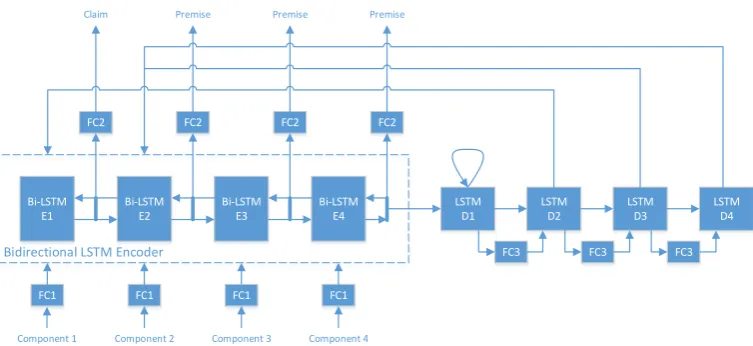
decoding network applies a fully-connected layer with sigmoid activation to its inputs, see Figure3. At encoding stepi, the encoding LSTM produces hidden layerei, which can be thought of as a
hid-den representation of ACCi.
In order to make sequence-to-sequence model-ing applicable to the problem of link extraction, we explicitly set the number of decoding timesteps to be equal to the number of input components. Using notation from Equation1, the decoding se-quence length for an encoding sese-quenceEis sim-ply m(E) = |{C1, ..., Cn}|, which is trivially
equal ton. By constructing the decoding sequence in this manner, we can associate decoding timestep
iwith ACCi.
From Equation4, decoding timestepiwill out-put a distribution over inout-put indices. The result of this distribution will indicate to which AC compo-nentCilinks. Recall there is a possibility that an
AC has no outgoing link, such as if it’s the root of the tree. In this case, we state that if ACCi does
not have an outgoing link, decoding stepDi will
output indexi. Conversely, ifDioutputs indexj,
such thatjis not equal toi, this implies thatCihas
an outgoing link toCj. For the argument structure
in Figure1, the corresponding decoding sequence is (1,1,2,2). The topology of this decoding se-quence is illustrated in Figure2. Observe howC1
points to itself since it has no outgoing link. Finally, we note that we have a Bidirectional LSTM (Graves and Schmidhuber,2005) as the en-coder, unlike the model proposed byVinyals et al.
(2015b). Thus,ei is the concatenation of forward
and backward hidden states−→eiand←−en−i+1,
pro-duced by two separate LSTMs. The decoder re-mains a standard forward LSTM.
3.3 Representing Argument Components
Bi-LSTM E1
FC1 FC1 FC1 FC1
Bidirectional LSTM Encoder
Component 1 Component 2 Component 3 Component 4
FC2 FC2 FC2 FC2
Claim Premise Premise Premise
LSTM D1
LSTM D2
LSTM D3
LSTM D4 Bi-LSTM
E2
Bi-LSTM E3
Bi-LSTM E4
[image:5.595.111.488.63.236.2]FC3 FC3 FC3
Figure 3: Architecture of the joint model applied to the example in Figure1. Note that D1 points to itself to denote that it has not outgoing link and is therefore the head of a tree.
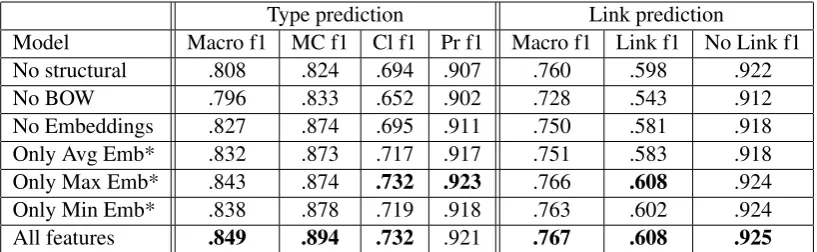
a sequence of tokens, similar to the Question-Answering dataset fromWeston et al.(2015). We follow the work ofStab and Gurevych(2016) and focus on three different types of features to repre-sent our ACs: (1) Bag-of-Words of the AC; (2) Embedding representation based on GloVe em-beddings (Pennington et al.,2014), which uses av-erage, max, and min pooling across the token em-beddings; (3) Structural features: Whether or not the AC is the first AC in a paragraph, and whether the AC is in an opening, body, or closing para-graph. See Section6 for an ablation study of the proposed features.
3.4 Joint Neural Model
Up to this point, we focused on the task of extract-ing links between ACs. However, recent work has shown that joint models that simultaneously try to complete multiple aspects of the subtask pipeline outperform models that focus on a single sub-task (Persing and Ng, 2016;Stab and Gurevych,
2014b;Peldszus and Stede,2015). Therefore, we will modify the single-task architecture so that it would allow us to perform AC classification (Kwon et al.,2007;Rooney et al.,2012) together with link prediction. Knowledge of an individual subtask’s predictions can aid in other subtasks. For example,claimsdo not have an outgoing link, so knowing the type of AC can aid in the link predic-tion task. This can be seen as a way of regulariz-ing the hidden representations from the encodregulariz-ing component (Che et al.,2015).
At each timestep, predicting AC type is a straightforward classification task: given AC Ci,
we need to predict whether it is aclaim,premise,
or possibly major claim. More generally, this is another sequence modeling problem: given input sequence E, we want to predict a sequence of argument types T. For encoding timestep i, the model creates hidden representation ei. This can
be thought of as a representation of ACCi.
There-fore, our joint model will simply pass this repre-sentation through a fully-connected layer as fol-lows:
zi =Wclsei+bcls (6)
where Wcls, bcls become elements of the model
parameters,Θ. The dimensionality ofWcls,bclsis
determined by the number of classes. Lastly, we use softmax to form a distribution over the possi-ble classes.
Consequently, the probability of predicting the component type at timestepiis defined as:
p(Ti|Ei; Θ) =softmax(zi) (7)
Finally, combining this new prediction task with Equation2, we arrive at the new training objective:
Θ∗= arg max
Θ α
X
E,D
logp(D|E; Θ)
+(1−α)X
E
logp(T|E; Θ) (8)
4 Experimental Design
As we have mentioned, our work assumes that ACs have already been identified. The order of ACs corresponds directly to the order in which the ACs appear in the text. We test the effectiveness of our proposed model on a dataset of persuasive essays (PEC) (Stab and Gurevych,2016), as well as a dataset of microtexts (MTC) (Peldszus,2014). The feature space for the PEC has roughly 3,000 dimensions, and the MTC feature space has be-tween 2,500 and 3,000 dimensions, depending on the data split. The PEC contains a total of 402 es-says, with a frozen set of 80 essays held out for testing. There are three AC types in this corpus: major claim, claim, and premise. In this corpus, individual structures can be either trees or forests. Also, in this corpus, each essay has multiple para-graphs, and argument structure is only uncovered within a given paragraph. The MTC contains 112 short texts. Unlike the PEC, each text in this cor-pus is itself a complete example, as well as a single tree. Since the dataset is small, the authors have created 10 sets of 5-fold cross-validation, report-ing the the average across all splits for final model evaluation. This corpus contains only two types of ACs:claimandpremise. Note that link prediction is directed, i.e., predicting a link between the pair
Ci, Cj(i6=j)is different thanCj, Ci.
We implement our models in TensorFlow (Abadi et al., 2015). We use the following pa-rameters: hidden input dimension size 512, hidden layer size 256 for the bidirectional LSTMs, hidden layer size 512 for the LSTM decoder, α equal to 0.5, and dropout (Srivastava et al., 2014) of 0.9. We believe the need for such high dropout is due to the small amounts of training data (Zarrella and Marsh,2016), particularly in the MTC. All models are trained with Adam optimizer (Kingma and Ba,
2014) with a batch size of 16. For a given training set, we randomly select 10% to become the valida-tion set. Training occurs for 4,000 epochs. Once training is completed, we select the model with the highest validation accuracy (on the link prediction task) and evaluate it on the held-out test set. At test time, we take a greedy approach and select the index of the probability distribution (whether link or type prediction) with the highest value.
5 Results
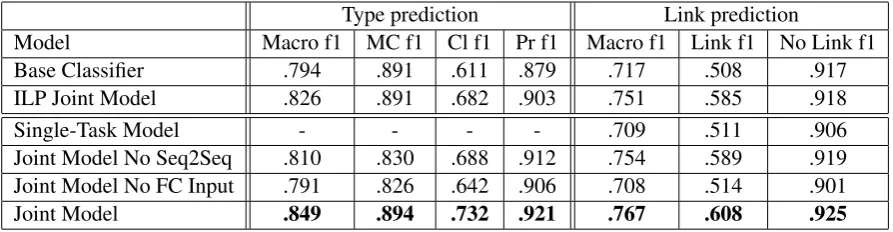
The results of our experiments are presented in Ta-bles1and2. For each corpus, we present f1 scores
for the AC type classification experiment, with a macro-averaged score of the individual class f1 scores. We also present the f1 scores for predict-ing the presence/absence of links between ACs, as well as the associated macro-average between these two values.
We implement and compare four types of neural models: 1) The previously described joint model from Section 3.4 (called Joint Model in the ta-bles); 2) The same as 1), but without the fully-connected input layers (called Joint Model No FC Input in the table); 3) The same as 1), but the model only predicts the link task, and is therefore not optimized for type prediction (called Single-Task Model in the table); 4) A non-sequence-to-sequence model that uses the hidden layers pro-duced by the BLSTM encoder with the same type of attention as the joint model (called Joint Model No Seq2Seq in the table). That is,di in Equation 3is replaced byei.
In both corpora we compare against the follow-ing previously proposed models: Base Classifier (Stab and Gurevych,2016) is a feature-rich, task-specific (AC type or link extraction) SVM clas-sifier. Neither of these classifiers enforce struc-tural or global constraints. Conversely, the ILP Joint Model (Stab and Gurevych, 2016) provides constraints by sharing prediction information be-tween the base classifiers. For example, the model attempts to enforce a tree structure among ACs within a given paragraph, as well as using incom-ing link predictions to better predict the type class claim. For the MTC only, we also have the fol-lowing comparative models: Simple (Peldszus and Stede, 2015) is a feature-rich logistic regression classifier. Best EG (Peldszus and Stede,2015) cre-ates an Evidence Graph (EG) from the predictions of a set of base classifiers. The EG models the po-tential argument structure, and offers a global opti-mization objective that the base classifiers attempt to optimize by adjusting their individual weights. Lastly, MP+p (Peldszus and Stede, 2015) com-bines predictions from base classifiers with a Min-imum Spanning Tree Parser (MSTParser).
6 Discussion
First, we point out that the joint model achieves state-of-the-art on 10 of the 13 metrics in Tables
en-Type prediction Link prediction
Model Macro f1 MC f1 Cl f1 Pr f1 Macro f1 Link f1 No Link f1 Base Classifier .794 .891 .611 .879 .717 .508 .917 ILP Joint Model .826 .891 .682 .903 .751 .585 .918
Single-Task Model - - - - .709 .511 .906
[image:7.595.76.523.62.178.2]Joint Model No Seq2Seq .810 .830 .688 .912 .754 .589 .919 Joint Model No FC Input .791 .826 .642 .906 .708 .514 .901 Joint Model .849 .894 .732 .921 .767 .608 .925
Table 1: Results on the Persuasive Essay corpus. All models we tested are joint models, except for the Single-Task Model model, which only predicts links. All model have a fully-connected input layer, except for the row titled ‘Joint Model No FC Input’. See Section5for a full description of the models.
Type prediction Link prediction
Model Macro f1 Cl f1 Pr f1 Macro f1 Link f1 No Link f1
Simple .817 - - .663 .478 .848
Best EG .869 - - .693 .502 .884
MP+p .831 - - .720 .546 .894
Base Classifier .830 .712 .937 .650 .446 .841 ILP Joint Model .857 .770 .943 .683 .486 .881 Joint Model .813 .692 .934 .740 .577 .903
Table 2: Results on the Microtext corpus.
couraging for several reasons. First, the fact that the model can perform so well with only a hun-dred training examples is rather remarkable. Sec-ond, although we motivate the use of an attention model due to the fact that it partially enforces a tree structure, other models we compare against explicitly contain further constraints (for example, only premises can have outgoing links). More-over, the MP+p model directly enforces the sin-gle tree constraint unique to the microtext cor-pus (the PEC allows forests). Even though the joint model does not have the tree constraint di-rectly encoded, it able to learn the structure ef-fectively from the training examples so that it can outperform the Mp+p model for link prediction. As for the other neural models, the joint model with no seq2seq performs competitively with the ILP joint model on the PEC, but trails the per-formance of the joint model. We believe this is because the joint model is able to create two dif-ferent representations for each AC, one each in the encoding/decoding state, which benefits per-formance in the two tasks. We also believe that the joint model benefits from a second recurrence over the ACs, modeling the tree/forest structure in a linear manner. Conversely, the joint model with no seq2seq must encode information relating to type as well as link prediction in a single hidden
representation. On one hand, the joint model no seq2seq outperforms the ILP model on link pre-diction, yet it is not able to match the ILP joint model’s performance on type prediction, primar-ily due to the poor performance on predicting the major claimclass. Another interesting outcome is the importance of the fully-connected layer before the LSTM input. This extra layer seems to be cru-cial for improving performance on this task. The results dictate that even a simple fully-connected layer with sigmoid activation can provide a use-ful dimensionality reduction step. Finally, and ar-guably most importantly, the single-task model, only optimized for link prediction, suffers a large drop in performance, conveying that the dual op-timization of the joint model is vital for high per-formance in the link prediction task. We believe this is because the joint optimization creates more expressive representations of the ACs, which cap-ture the natural relation between AC type and AC linking.
state-Type prediction Link prediction
[image:8.595.95.504.62.188.2]Model Macro f1 MC f1 Cl f1 Pr f1 Macro f1 Link f1 No Link f1 No structural .808 .824 .694 .907 .760 .598 .922 No BOW .796 .833 .652 .902 .728 .543 .912 No Embeddings .827 .874 .695 .911 .750 .581 .918 Only Avg Emb* .832 .873 .717 .917 .751 .583 .918 Only Max Emb* .843 .874 .732 .923 .766 .608 .924 Only Min Emb* .838 .878 .719 .918 .763 .602 .924 All features .849 .894 .732 .921 .767 .608 .925
Table 3: Feature ablation study. * indicates that both BOW and Structural are present, as well as the stated embedding type.
Type prediction Link prediction
[image:8.595.101.499.230.303.2]Bin Macro f1 MC f1 Cl f1 Pr f1 Macro f1 Link f1 No Link f1 1≤len <4 .863 .902 .798 .889 .918 .866 .969 4≤len <8 .680 .444 .675 .920 .749 .586 .912 8≤len <12 .862* .000* .762 .961 .742 .542 .941
Table 4: Results of binning test data by length of AC sequence. * indicates that this bin does not contain anymajor claimlabels, and this average only applies toclaimandpremiseclasses. However, we do not disable the model from predicting this class: the model was able to avoid predicting this class on its own.
of-the-art results compared to the ILP Joint Model. This shows that the Joint Model is able to capture structural cues through sequence modeling and se-mantics. When considering type prediction, both BOW and structural features are important, and it is the embedding features that provide the least benefit. The ablation results also provide an in-teresting insight into the effectiveness of different pooling strategies for using individual token em-beddings to create a multi-word embedding. The popular method of averaging embeddings (which is used byStab and Gurevych(2016) in their sys-tem) is in fact the worst method, although its per-formance is still competitive with the previous state-of-the-art. Conversely, max pooling results are on par with the joint model results in Table1.
Table 4shows results on the PEC test set with the test examples binned by sequence length. First, it is not surprising to see that the model per-forms best when the sequences are the shortest (for link prediction; type prediction actually sees the worst performance in the middle bin). As the se-quence length increases, the accuracy on link pre-diction drops. This is possibly due to the fact that as the length increases, a given AC has more possi-bilities as to which other AC it can link to, making the task more difficult. Conversely, there is actu-ally a rise in no link prediction accuracy from the second to third row. This is likely due to the fact
that since the model predicts at most one outgoing link, it indirectly predicts no link for the remain-ing ACs in the sequence. Since the chance prob-ability is low for having a link between a given AC in a long sequence, the no link performance is actually better in longer sequences. The results of the length-based binning could also potentially give insight into the poor performance on the type prediction task in the MTC. Since the arguments in the MTC average 5 ACs, they would be in the sec-ond bin (row 2) of Table4. Theclaimandpremise f1 scores for this bin are similar to those from the same system’s performance on the MTC.
7 Conclusion
Lastly, future work can integrate subtasks 1 and 4 into the model. The representations produced by Equation3could potentially be used to predict link type, i.e. supporting or attacking (the fourth subtask in the pipeline). In addition, a segment-ing technique, such as the one proposed byWeston et al.(2014), can accomplish subtask 1.
Acknowledgments
This work was supported in part by the U.S. Army Research Office under Grant No. W911NF-16-1-0174.
References
Mart´ın Abadi, Ashish Agarwal, Paul Barham, Eugene Brevdo, Zhifeng Chen, Craig Citro, Greg S. Cor-rado, Andy Davis, Jeffrey Dean, Matthieu Devin, Sanjay Ghemawat, Ian Goodfellow, Andrew Harp, Geoffrey Irving, Michael Isard, Yangqing Jia, Rafal Jozefowicz, Lukasz Kaiser, Manjunath Kudlur, Josh Levenberg, Dan Man´e, Rajat Monga, Sherry Moore, Derek Murray, Chris Olah, Mike Schuster, Jonathon Shlens, Benoit Steiner, Ilya Sutskever, Kunal Tal-war, Paul Tucker, Vincent Vanhoucke, Vijay Vasude-van, Fernanda Vi´egas, Oriol Vinyals, Pete Warden, Martin Wattenberg, Martin Wicke, Yuan Yu, and Xi-aoqiang Zheng. 2015. TensorFlow: Large-scale
ma-chine learning on heterogeneous systems. Software
available from tensorflow.org.
Dzmitry Bahdanau, Kyunghyun Cho, and Yoshua Ben-gio. 2014. Neural machine translation by jointly learning to align and translate. arXiv preprint arXiv:1409.0473.
Filip Boltuzic and Jan ˇSnajder. 2014. Back up your stance: Recognizing arguments in online discus-sions. InProceedings of the First Workshop on Ar-gumentation Mining, pages 49–58. Citeseer. Samuel R Bowman, Christopher D Manning, and
Christopher Potts. 2015. Tree-structured composi-tion in neural networks without tree-structured ar-chitectures. arXiv preprint arXiv:1506.04834. Samuel R Bowman, Christopher Potts, and
Christo-pher D Manning. 2014. Recursive neural net-works can learn logical semantics. arXiv preprint arXiv:1406.1827.
Elena Cabrio and Serena Villata. 2012. Natural lan-guage arguments: A combined approach. InECAI, volume 242, pages 205–210.
Zhengping Che, David Kale, Wenzhe Li, Moham-mad Taha Bahadori, and Yan Liu. 2015. Deep com-putational phenotyping. InProceedings of the 21th ACM SIGKDD International Conference on Knowl-edge Discovery and Data Mining, pages 507–516. ACM.
Hao Cheng, Hao Fang, Xiaodong He, Jianfeng Gao, and Li Deng. 2016. Bi-directional attention with agreement for dependency parsing. arXiv preprint arXiv:1608.02076.
Robin Cohen. 1987. Analyzing the structure of ar-gumentative discourse. Computational linguistics, 13(1-2):11–24.
Debanjan Ghosh, Smaranda Muresan, Nina Wacholder, Mark Aakhus, and Matthew Mitsui. 2014. Analyz-ing argumentative discourse units in online interac-tions. InProceedings of the First Workshop on Ar-gumentation Mining, pages 39–48.
Trudy Govier. 2013. A practical study of argument. Cengage Learning.
Alex Graves and J¨urgen Schmidhuber. 2005. Frame-wise phoneme classification with bidirectional lstm and other neural network architectures. Neural Net-works, 18(5):602–610.
Sepp Hochreiter and J¨urgen Schmidhuber. 1997. Long short-term memory. Neural computation, 9(8):1735–1780.
Diederik Kingma and Jimmy Ba. 2014. Adam: A method for stochastic optimization. arXiv preprint arXiv:1412.6980.
Ankit Kumar, Ozan Irsoy, Jonathan Su, James Brad-bury, Robert English, Brian Pierce, Peter On-druska, Ishaan Gulrajani, and Richard Socher. 2015. Ask me anything: Dynamic memory networks for natural language processing. arXiv preprint arXiv:1506.07285.
Namhee Kwon, Liang Zhou, Eduard Hovy, and Stu-art W Shulman. 2007. Identifying and classifying subjective claims. InProceedings of the 8th annual international conference on Digital government re-search: bridging disciplines & domains, pages 76– 81. Digital Government Society of North America. Anirban Laha and Vikas Raykar. 2016. An empirical
evaluation of various deep learning architectures for bi-sequence classification tasks. InCOLING. John Lawrence, Chris Reed, Colin Allen, Simon
McAl-ister, Andrew Ravenscroft, and David Bourget. 2014. Mining arguments from 19th century philo-sophical texts using topic based modelling. In Pro-ceedings of the First Workshop on Argumentation Mining, pages 79–87. Citeseer.
Qi Li, Tianshi Li, and Baobao Chang. 2016. Discourse parsing with attention-based hierarchical neural net-works. InEMNLP.
Minh-Thang Luong, Quoc V Le, Ilya Sutskever, Oriol Vinyals, and Lukasz Kaiser. 2015. Multi-task sequence to sequence learning. arXiv preprint arXiv:1511.06114.
Raquel Mochales Palau and Marie-Francine Moens. 2009. Argumentation mining: the detection, clas-sification and structure of arguments in text. In Pro-ceedings of the 12th international conference on ar-tificial intelligence and law, pages 98–107. ACM.
Andreas Peldszus. 2014. Towards segment-based recognition of argumentation structure in short texts. ACL 2014, page 88.
Andreas Peldszus and Manfred Stede. 2015. Joint pre-diction in mst-style discourse parsing for argumen-tation mining. InProc. of the Conference on Empiri-cal Methods in Natural Language Processing, pages 938–948.
Jeffrey Pennington, Richard Socher, and Christopher D Manning. 2014. Glove: Global vectors for word representation. InEMNLP, volume 14, pages 1532– 43.
Isaac Persing and Vincent Ng. 2016. End-to-end argu-mentation mining in student essays. InProceedings of NAACL-HLT, pages 1384–1394.
Ruty Rinott, Lena Dankin, Carlos Alzate Perez, Mitesh M Khapra, Ehud Aharoni, and Noam Slonim. 2015. Show me your evidence-an automatic method for context dependent evidence detection. In EMNLP, pages 440–450.
Niall Rooney, Hui Wang, and Fiona Browne. 2012. Applying kernel methods to argumentation mining. InFLAIRS Conference.
Nitish Srivastava, Geoffrey E Hinton, Alex Krizhevsky, Ilya Sutskever, and Ruslan Salakhutdinov. 2014. Dropout: a simple way to prevent neural networks from overfitting. Journal of Machine Learning Re-search, 15(1):1929–1958.
Christian Stab and Iryna Gurevych. 2014a. Annotating argument components and relations in persuasive es-says. InCOLING, pages 1501–1510.
Christian Stab and Iryna Gurevych. 2014b. Identify-ing argumentative discourse structures in persuasive essays. InEMNLP, pages 46–56.
Christian Stab and Iryna Gurevych. 2016. Parsing ar-gumentation structures in persuasive essays. arXiv preprint arXiv:1604.07370.
Ilya Sutskever, Oriol Vinyals, and Quoc V Le. 2014. Sequence to sequence learning with neural net-works. InAdvances in neural information process-ing systems, pages 3104–3112.
Oriol Vinyals, Samy Bengio, and Manjunath Kudlur. 2015a. Order matters: Sequence to sequence for sets. arXiv preprint arXiv:1511.06391.
Oriol Vinyals, Meire Fortunato, and Navdeep Jaitly. 2015b. Pointer networks. In Advances in Neural Information Processing Systems, pages 2692–2700.
Oriol Vinyals, Łukasz Kaiser, Terry Koo, Slav Petrov, Ilya Sutskever, and Geoffrey Hinton. 2015c. Gram-mar as a foreign language. InAdvances in Neural Information Processing Systems, pages 2773–2781. Jason Weston, Antoine Bordes, Sumit Chopra,
Alexan-der M Rush, Bart van Merri¨enboer, Armand Joulin, and Tomas Mikolov. 2015. Towards ai-complete question answering: A set of prerequisite toy tasks. arXiv preprint arXiv:1502.05698.
Jason Weston, Sumit Chopra, and Antoine Bor-des. 2014. Memory networks. arXiv preprint arXiv:1410.3916.