AWS and TPWS
Interface Requirements
SynopsisThis document defines the track / train and driver / machine interface
requirements for the Automatic Warning System (AWS) and the Train Protection and Warning System (TPWS).
[This document contains one or more pages which contain colour] Copyright in the Railway Group Standards is owned by Rail Safety and Standards Board Limited. All rights are hereby reserved. No Railway Group Standard (in whole or in part) may be reproduced, stored in a retrieval system, or transmitted, in any form or means, without the prior written permission of Rail Safety and Standards Board Limited, or as expressly permitted by law. RSSB Members are granted copyright licence in accordance with the Constitution Agreement relating to Rail Safety and Standards Board Limited.
In circumstances where Rail Safety and Standards Board Limited has granted a particular person or organisation permission to copy extracts from Railway Group Standards, Rail Safety and Standards Board Limited accepts no responsibility for, nor any liability in connection with, the use of such extracts, or any claims arising therefrom. This disclaimer applies to all forms of media in which extracts from Railway Group Standards may be reproduced. Published by: RSSB Block 2 Angel Square 1 Torrens Street London EC1V 1NY © Copyright 2013
Issue record
Issue Date Comments
One September 2013 Original document
Replaces GE/RT8030 issue four and GE/RT8035 issue two
Superseded documents
The following Railway Group documents are superseded, either in whole or in part as indicated:
Superseded documents Sections
superseded
Date when sections are superseded GE/RT8030 issue four Requirements for the Train
Protection and Warning System (TPWS)
All 07 December 2013
GE/RT8035 issue two Automatic Warning System (AWS)
All 07 December 2013
GE/RT8030 issue four Requirements for the Train Protection and Warning System (TPWS), ceases to be in force and is withdrawn as of 07 December 2013.
GE/RT8035 issue two Automatic Warning System (AWS), ceases to be in force and is withdrawn as of 07 December 2013.
Supply
The authoritative version of this document is available atwww.rgsonline.co.uk. Uncontrolled copies of this document can be obtained from Communications, RSSB, Block 2, Angel Square, 1 Torrens Street, London EC1V 1NY, telephone 020 3142 5400 or [email protected]. Other Standards and associated documents can also be viewed atwww.rgsonline.co.uk.
Contents
Section Description Page
Part 1 Purpose and Introduction 5
1.1 Purpose 5
1.2 Introduction 5
1.3 Approval and authorisation of this document 5
Part 2 Track / Train Interface for AWS 6
2.1 AWS track sub-system 6
2.2 AWS train sub-system 14
2.3 AWS route compatibility assessment requirements 22
Part 3 Track / Train Interface for TPWS 24
3.1 TPWS track sub-system 24
3.2 TPWS train sub-system 28
Part 4 Driver / Machine Interface (DMI) for AWS and TPWS 31
4.1 Layout of Driver / Machine Interface (DMI) 31
4.2 Operation of Driver / Machine Interface (DMI) 32
4.3 Fault detection 36
4.4 Output requirements 37
Part 5 System Availability and Integrity 38
5.1 AWS and TPWS equipment 38
Part 6 Application of this document 39
6.1 Application – infrastructure managers 39
6.2 Application – railway undertakings 40
6.3 Health and safety responsibilities 40
Appendices
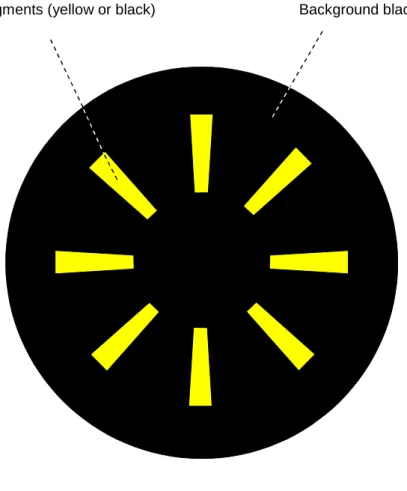
Appendix A AWS Visual Indicator 41
Appendix B TPWS Visual Indicator State Transition Diagram 42 Appendix C Field Strength Diagram for TPWS Track Sub-System Standard Loop
Installations 43
Appendix D Field Strength Diagram for TPWS Track Sub-System Miniature Loop
Installations 44
Appendix E Field Strength for TPWS Track Sub-System Installations through Section
B-B of Appendices C and D 45
Appendix F Driver / Machine Interface for AWS and TPWS – Design Requirements for
Non-integrated DMI 46
Appendix G Driver / Machine Interface for AWS and TPWS – Design Requirements for
DMI Integrated with ETCS 50
Appendix H TPWS Audible Alert Sound Files 51
Definitions and Abbreviations 52
Tables
Table 1 Dimensions of magnetic field planes above AWS track magnet 6 Table 2 Magnetic flux densities for standard strength track equipment 7 Table 3 Magnetic flux densities for standard strength depot test magnets 7 Table 4 Magnetic flux densities for extra strength track equipment 8 Table 5 Magnetic flux densities for extra strength depot test magnets 8
Table 6 Provision of AWS at signals 9
Table 7 Configurations of AWS track magnets 10
Table 8 Magnetic flux densities for standard strength AWS receivers 15 Table 9 Magnetic flux densities for extra strength AWS receivers 15
Table 10 Operational ready state 17
Table 11 Primed state 18
Table 12 Clear signal response state 18
Table 13 Restrictive response state 19
Table 14 Restrictive acknowledgement state 19
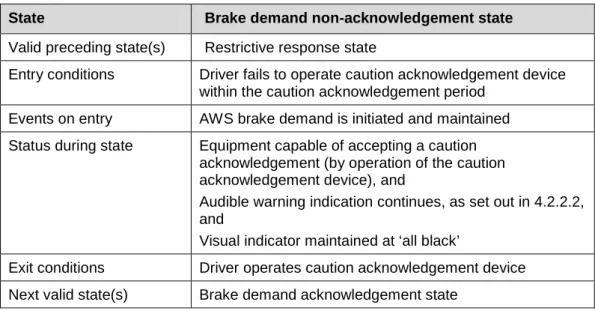
Table 15 Brake demand non-acknowledgement state 20
Table 16 Brake demand acknowledgement state 20
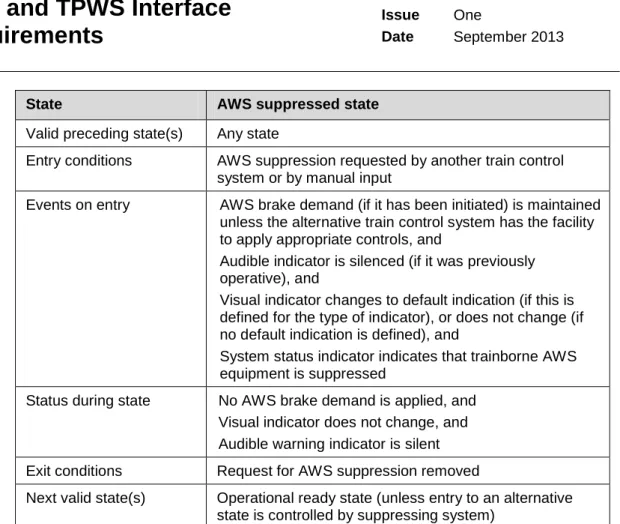
Table 17 AWS suppressed state 21
Table 18 System isolation state 21
Table 19 Track transmitter frequencies for overspeed protection functionality 24 Table 20 Track transmitter frequencies for train stop functionality 24
Table 21 Trigger delay timer settings 29
Figures
Figure 1 Defined magnetic field planes above AWS track magnet 6
Figure 2 Position of TSS transmitters 27
Figure A.1 AWS visual indicator 41
Figure E.1 Field strength for TPWS track sub-system installations through section B-B
of Appendices C and D 45
Figure F.1 General arrangement of TPWS DMI 46
Part 1
Purpose and Introduction
1.1
Purpose
1.1.1 This document mandates requirements for the functional operation, performance and application of the Automatic Warning System (AWS) and the Train Protection and Warning System (TPWS).
1.2
Introduction
1.2.1 Background1.2.1.1 AWS is provided to give train drivers in-cab warnings of the approach to signals, reductions in permissible speed and temporary / emergency speed restrictions, and to apply the brakes in the event that a driver does not acknowledge cautionary warnings given by the system within the specified time. 1.2.1.2 TPWS is a train protection system compliant with the train protection
requirements of the Railway Safety Regulations: 1999. The primary purpose of TPWS is to minimise the consequence of a train passing a TPWS fitted signal at danger and a train overspeeding at certain other locations.
1.2.2 Principles
1.2.2.1 The requirements of this document are based on the following principles.
1.2.2.2 AWS and TPWS are the principal warning and train protection systems which are installed on most Network Rail lines and on most rolling stock operating over them. The only exceptions are certain lines which are fitted with mechanical trainstops, lines fitted with European Train Control System (ETCS), and trains which operate only over those lines.
1.2.2.3 The principles of operation of AWS and TPWS are set out in GE/GN8675. 1.2.3 Supporting documents
1.2.3.1 The following Rail Industry Guidance Notes support this Railway Group Standard: GE/GN8675 Guidance on AWS and TPWS Interface Requirements GM/GN2169 Combined Manual for AWS and TPWS Trainborne
Equipment
1.3
Approval and authorisation of this document
1.3.1 The content of this document was approved by Control Command and Signalling (CCS) Standards Committee on 13 June 2013.
Part 2
Track / Train Interface for AWS
2.1
AWS track sub-system
2.1.1 General requirements for AWS track equipment
2.1.1.1 AWS permanent magnets, including suppressor magnets, shall be mounted on the track with their south pole uppermost.
2.1.1.2 AWS electromagnets shall be mounted on the track with their north pole uppermost.
2.1.1.3 The magnetic centres of AWS magnets shall be positioned between the running rails, within 10 mm of the track centre line.
2.1.1.4 Where AWS magnets are used in combinations, as set out in Table 7, the distance between the magnetic centres of adjacent magnets, measured longitudinally along the track centre line, shall be not less than 0.70 m and not more than 0.75 m.
2.1.1.5 The uppermost surfaces of AWS magnets shall be not more than 12 mm above rail level.
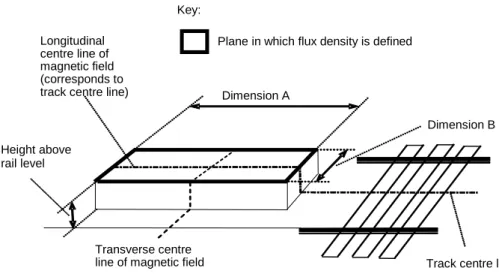
2.1.1.6 The magnetic flux densities of AWS track magnets specified in 2.1.2 and 2.1.3 for standard strength magnets and in 2.1.4 and 2.1.5 for extra strength magnets shall apply throughout the planes above the magnet defined in Figure 1 and Table 1.
Figure 1 Defined magnetic field planes above AWS track magnet
Type of AWS magnet
Dimension A in Figure 1 (mm) Dimension B in Figure 1 (mm) Standard strength
(except depot test magnets) 150 100
Extra strength
(except depot test magnets) 70 100
Depot test magnets 50 50
Table 1 Dimensions of magnetic field planes above AWS track magnet
Dimension A Height above rail level Longitudinal centre line of magnetic field (corresponds to track centre line)
Track centre line Transverse centre
line of magnetic field Key:
Dimension B Plane in which flux density is defined
2.1.2 Magnetic field requirements for standard strength track equipment
2.1.2.1 The minimum magnetic flux density of the magnetic field of a standard strength AWS magnet in free air shall conform to the limits set out in Table 2 throughout the plane above the magnet shown in Figure 1.
Height above rail level
(mm)
Minimum flux density (mT) for standard strength
magnets 100 5.0 120 4.1 140 3.4 160 2.8 180 2.3 200 2.0
Table 2 Magnetic flux densities for standard strength track equipment 2.1.2.2 The minimum flux densities set out in Table 2 shall apply to:
a) Permanent magnets, including portable magnets for temporary and emergency speed restrictions.
b) Electromagnets when energised.
c) Suppressor magnets when not suppressed.
2.1.2.3 For all types of standard strength magnets, except depot test magnets, the maximum flux density at 115 mm above rail level shall be 18 mT.
2.1.2.4 The maximum flux density produced by a de-energised standard strength electromagnet at 115 mm above rail level shall be 0.7 mT.
2.1.2.5 The maximum flux density produced by a suppressed standard strength magnet at 115 mm above rail level shall be 0.7 mT.
2.1.3 Magnetic field requirements for standard strength depot test magnets
2.1.3.1 For standard strength depot test magnets, the minimum and maximum magnetic flux density of the magnetic field in free air shall conform to the limits set out in Table 3 throughout the plane above the magnet shown in Figure 1.
Height above rail level
(mm)
Minimum flux density (mT) for standard strength
depot test magnets
Maximum flux density (mT) for standard strength
depot test magnets
100 4.8 5.0 120 3.9 4.1 140 3.2 3.4 160 2.6 2.8 180 2.1 2.3 200 1.8 2.0
2.1.4 Magnetic field requirements for extra strength track equipment
2.1.4.1 The minimum magnetic flux density of the magnetic field of an extra strength AWS magnet in free air shall conform to the limits set out in Table 4 throughout the plane above the magnet shown in Figure 1.
Height above rail level
(mm)
Minimum flux density (mT) for extra strength
magnets 120 6.5 140 6.1 160 5.7 180 5.3 200 5.0 220 4.6
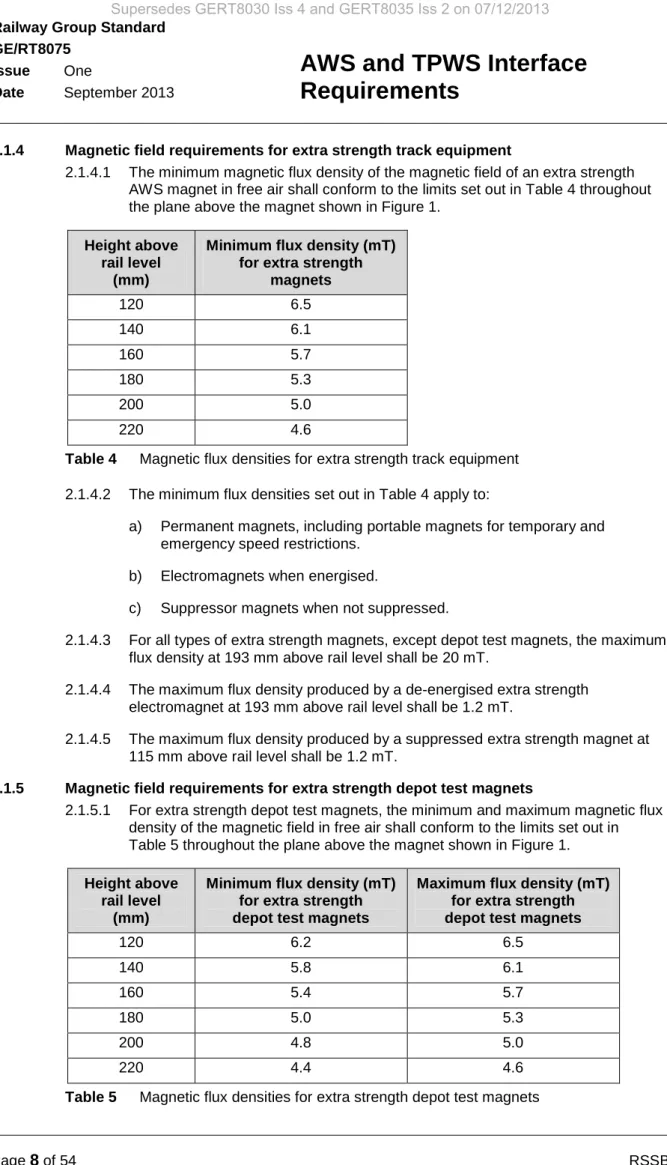
Table 4 Magnetic flux densities for extra strength track equipment 2.1.4.2 The minimum flux densities set out in Table 4 apply to:
a) Permanent magnets, including portable magnets for temporary and emergency speed restrictions.
b) Electromagnets when energised.
c) Suppressor magnets when not suppressed.
2.1.4.3 For all types of extra strength magnets, except depot test magnets, the maximum flux density at 193 mm above rail level shall be 20 mT.
2.1.4.4 The maximum flux density produced by a de-energised extra strength electromagnet at 193 mm above rail level shall be 1.2 mT.
2.1.4.5 The maximum flux density produced by a suppressed extra strength magnet at 115 mm above rail level shall be 1.2 mT.
2.1.5 Magnetic field requirements for extra strength depot test magnets
2.1.5.1 For extra strength depot test magnets, the minimum and maximum magnetic flux density of the magnetic field in free air shall conform to the limits set out in Table 5 throughout the plane above the magnet shown in Figure 1. Height above
rail level (mm)
Minimum flux density (mT) for extra strength depot test magnets
Maximum flux density (mT) for extra strength depot test magnets
120 6.2 6.5 140 5.8 6.1 160 5.4 5.7 180 5.0 5.3 200 4.8 5.0 220 4.4 4.6
2.1.6 Provision of AWS track equipment – lines to be fitted
2.1.6.1 AWS shall be fitted on all signalled lines, except those where an alternative train protection system providing a level of protection equivalent to or better than that provided by AWS and TPWS is fitted and operational on the infrastructure and on all trains operating on the route.
2.1.7 Provision of AWS track equipment – equipment to be provided
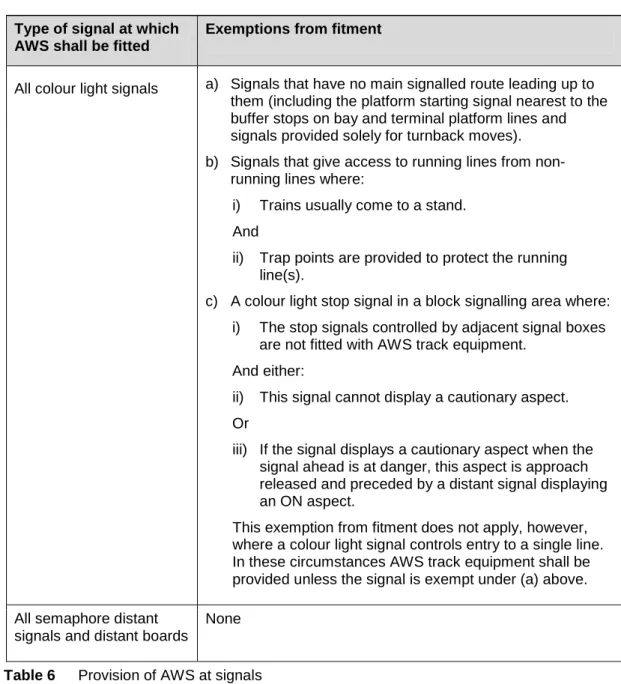
2.1.7.1 On fitted lines, AWS equipment shall be provided at signals in accordance with Table 6, except where AWS gaps are permitted by the provisions of 2.1.9.1. Type of signal at which
AWS shall be fitted
Exemptions from fitment
All colour light signals a) Signals that have no main signalled route leading up to them (including the platform starting signal nearest to the buffer stops on bay and terminal platform lines and signals provided solely for turnback moves). b) Signals that give access to running lines from
non-running lines where:
i) Trains usually come to a stand. And
ii) Trap points are provided to protect the running line(s).
c) A colour light stop signal in a block signalling area where: i) The stop signals controlled by adjacent signal boxes
are not fitted with AWS track equipment. And either:
ii) This signal cannot display a cautionary aspect. Or
iii) If the signal displays a cautionary aspect when the signal ahead is at danger, this aspect is approach released and preceded by a distant signal displaying an ON aspect.
This exemption from fitment does not apply, however, where a colour light signal controls entry to a single line. In these circumstances AWS track equipment shall be provided unless the signal is exempt under (a) above. All semaphore distant
signals and distant boards
None
Table 6 Provision of AWS at signals
2.1.7.2 AWS equipment shall be provided only at the locations and for the purposes set out in this document and in GK/RT0075 and GK/RT0192.
2.1.7.3 On bi-directionally signalled lines, AWS track equipment shall be provided for signalled train movements in both directions.
2.1.7.4 Magnets, or combinations of magnets, shall be provided and configured as set out in Table 7.
Application Magnets to be provided
a) Colour light signal not capable of displaying a green aspect. b) Semaphore distant signal fixed
at caution.
c) Fixed distant board.
Permanent magnet (south pole).
d) Colour light signal capable of displaying a green aspect. e) Semaphore distant signal
(except those fixed at caution).
Permanent magnet (south pole) followed, in the direction of travel, by an electromagnet (north pole).
f) Two colour light signals or semaphore distant signals for movements in opposite directions, sharing a common set of AWS track equipment.
Permanent magnet (south pole), with
electromagnets (north pole) both before and after the permanent magnet.
(Where either of the signals is not capable of displaying a green (or distant signal ‘off’) aspect, the electromagnet for that signal is not required.) g) Warning of an approach to a
reduction in permissible speed. h) Warning of an approach to a
level crossing.
Permanent magnet (south pole).
i) Warning of an approach to a temporary or emergency speed restriction (where required by GK/RT0075).
Permanent magnet (south pole).
j) Maintenance depot exit lines. Depot test magnet, as set out in 2.2.6. Table 7 Configurations of AWS track magnets
2.1.7.5 Where AWS is required to be suppressed, a suppressor magnet shall be provided instead of the permanent magnet.
2.1.7.6 Standard strength AWS magnets shall be used on lines that are not DC electrified.
2.1.7.7 Extra strength AWS magnets shall be used on DC third rail electrified lines. 2.1.8 Provision of AWS track equipment – position of equipment
2.1.8.1 AWS track equipment shall be positioned not less than three seconds running time at the permissible speed before the associated signal or sign.
2.1.8.2 AWS track equipment shall be positioned 180 m (+ 18 m,9 m) before the associated signal or sign, except where any of the following apply:
a) On a section of line where existing AWS track equipment at successive signals is positioned 230 m (+ 23 m,11.5 m) before signals, it is permissible for new AWS track equipment also to be positioned at this distance, provided that this does not create additional risk.
b) On bi-directionally signalled platform lines, it is permissible to position AWS track equipment at distances other than those specified above where common AWS track equipment is provided for signals applying in opposite directions, in order to achieve correct operation of the equipment for train movements.
c) Where the AWS magnet is positioned less than 180 m from the signal or sign so that the driver is able to read the associated signal aspect or sign when the audible warning is received.
d) On a non-passenger line on which permissive working is authorised, the AWS track equipment may be positioned beyond, but as close as practicable to, the signal.
e) Where infrastructure constraints prevent the installation of AWS equipment at the standard position.
f) Where an alternative position is required to meet the constraints set out in 2.1.8.3.
g) Where the AWS magnet is positioned beyond the signal in the circumstances set out in 2.1.8.7a).
h) Where a signal sighting committee (SSC) recommends an alternative position and this achieves a reduction in risk.
2.1.8.3 AWS equipment shall not be positioned:
a) Where a train is likely to come to a stand with the receiver for the active driving position over the AWS track equipment.
b) Within four seconds travelling time of any other AWS track equipment (calculated at the permissible speed), except where one or other of the sets of equipment is always suppressed for any movement over them.
c) Where AWS equipment could interfere with the correct operation of Automatic Power Control (APC) equipment, or vice versa.
d) Where the correct operation of the AWS track equipment could be jeopardised by the proximity of DC traction cables or impedance bonds. Specifically, on DC electrified lines, AWS track equipment shall not be positioned:
i) Less than 3.5 m from cross-track traction feeder cables, traction return bonds or impedance bonds.
ii) Less than 1.5 seconds travelling time (measured at the permissible speed) before cross-track traction feeder cables, traction return bonds or impedance bonds.
2.1.8.4 An SSC shall agree the position of the AWS track equipment where either: a) The distance of the track equipment from the signal or sign is other than
180 m (+ 18 m,9 m). Or
b) The AWS audible indication is received by the driver before the signal or sign becomes visible.
2.1.8.5 In considering the position of AWS track equipment, the SSC shall assess whether the positioning of the equipment will:
a) Help the driver to read the associated signal or sign safely. And
b) Not create a risk that the driver fails to associate the audible warning with the signal or sign.
2.1.8.6 The following infrastructure features shall not be positioned between a signal or sign and its associated AWS track equipment:
a) Another main signal applicable to movements in the same direction. b) A warning indicator for a reduction in permissible speed.
c) A warning board for a temporary or emergency speed restriction. d) Other AWS equipment applicable to movements in the same direction. 2.1.8.7 Where a signal controls train movements from a running line not fitted with AWS
track equipment to a running line that is fitted, one of the following arrangements shall apply:
a) Where there is a turnout from a through running line not fitted with AWS onto an AWS fitted line, AWS track equipment shall be provided for the stop signal controlling the movement onto the fitted line. The track equipment shall incorporate provision for suppression, and shall be positioned beyond, but as close as practicable to, the signal.
The signals that display cautionary aspects associated with the stop signal shall not be fitted with AWS.
Or
b) Where a running line not fitted with AWS converges with an AWS fitted line, the stop signal controlling movements from the unfitted line to the fitted line and any associated signals displaying cautionary aspects shall be fitted with AWS track equipment in accordance with the requirements set out in 2.1.6. 2.1.9 AWS gap areas
2.1.9.1 When an existing signalling layout incorporating an AWS gap area (a station area not fitted with AWS track equipment) is resignalled, AWS track equipment shall be provided, unless both of the following apply:
a) Permissible speeds in the unfitted area do not exceed 50 km/h (30 mph). And
b) A risk assessment shows that absence of AWS track equipment within the gap area does not introduce an unacceptable risk.
2.1.9.3 Lineside signs shall be provided to indicate the commencement and termination of the AWS gap on all running lines that provide entry to or exit from the gap area as follows:
a) A ‘commencement of AWS gap’ lineside sign shall be provided at or beyond the last fitted signal and before the position where the AWS track equipment for the next signal would have been, had it been provided.
And
b) A ‘termination of AWS gap’ sign shall be provided beyond the last signal not fitted with AWS and not less than four seconds’ travelling time at the permissible speed before the AWS track equipment for the first fitted signal. 2.1.10 Control of AWS track equipment
2.1.10.1 The AWS electromagnet shall be energised only when the associated colour light signal is displaying a green aspect, or when the associated semaphore distant signal is intentionally displaying the OFF aspect.
2.1.10.2 In the case of a splitting distant signal, the AWS electromagnet shall be energised if either signal colour light head is displaying a green aspect.
2.1.10.3 Where an AWS magnet is positioned beyond the signal, as set out in 2.1.8.2d), the AWS track equipment shall be controlled to provide an indication that is consistent with the aspect seen by the driver at the time of passing the signal. 2.1.10.4 Where a suppressed AWS magnet is situated beyond the signal protecting a
turnout from a through unfitted line, as set out in 2.1.8.7, the magnet shall be suppressed for movements along the unfitted line.
2.1.10.5 For movements through the turnout onto the fitted line, the AWS track equipment shall be controlled to provide an indication that is consistent with the aspect seen by the driver at the time of passing the signal controlling the movement onto the fitted line.
2.1.11 Suppression of AWS track equipment
2.1.11.1 On bi-directionally signalled lines, except where AWS track equipment is effective for movements in both directions, as set out in Table 7 item f), the magnetic field of the AWS track equipment shall be suppressed for signalled movements in the direction to which the equipment does not apply, except as permitted by 2.1.11.4 and 2.1.11.5.
2.1.11.2 Suppression shall be effective from before the vehicle on which the receiver for the active driving position is mounted has reached the AWS track equipment until that vehicle has passed over the AWS track equipment.
2.1.11.3 Where a semaphore junction signal has both stop and distant arms but the distant arm(s) are not applicable to all routes, the AWS equipment shall be suppressed when the signal is cleared for a route to which the distant arm(s) is / are not applicable.
2.1.11.4 It is permissible for AWS track equipment not to be suppressed for: a) Shunting movements on unidirectionally signalled lines. b) Unsignalled movements.
c) Movements over AWS magnets associated with warning boards for
temporary / emergency restrictions that are not applicable to the direction of movement.
2.1.11.5 On lightly used single lines it is permissible for AWS track equipment not to be suppressed for movements in the direction to which the AWS indication does not apply where this is justified by a risk assessment.
2.1.11.6 Provision or non-provision of suppression of AWS track equipment shall be applied consistently on all single line sections on an operating route. 2.1.12 AWS cancelling indicators
2.1.12.1 Where AWS track equipment is not suppressed for signalled movements in the opposite direction, as permitted by 2.1.11.4c) and 2.1.11.5, an AWS cancelling indicator shall be provided for each set of track equipment.
2.1.12.2 The AWS cancelling indicator shall be positioned:
a) 180 m (+ 18 m,9 m) beyond the AWS track equipment in the direction of movement to which the equipment does not apply.
And
b) Facing trains travelling in the direction to which the AWS track equipment does not apply.
2.1.12.3 The AWS cancelling indicator shall be positioned so that it is readable from the normal driving position when the train passes over the unsuppressed track equipment.
2.2
AWS train sub-system
2.2.1 Provision of trainborne AWS equipment
2.2.1.1 AWS trainborne equipment shall be fitted to all vehicles that have a driving cab, with the exception of the following types of vehicles:
a) Locomotives used exclusively for shunting purposes. b) Vehicles that operate solely within T3 possessions.
c) Vehicles that are authorised to operate only on lines where an alternative train protection system providing a level of protection equivalent to or better than that provided by AWS and TPWS is fitted and operational on both the trains and the infrastructure.
2.2.1.2 It is permissible to suppress the operation of the AWS train sub-system when an alternative train protection system providing a level of protection equivalent to or better than that provided by AWS and TPWS is fitted and operational on the train and on the track over which the train is operating.
2.2.2 Receiver sensitivity requirements for AWS train sub-system
2.2.2.1 AWS receivers shall be capable of detecting the sequences and polarities of magnetic fields emitted by the configurations of AWS track magnets set out in Table 7.
2.2.2.2 On lines fitted with standard strength magnets, the trainborne equipment shall be capable of detecting the minimum field strengths set out in Table 8, measured in free air at the heights above rail level set out in the table and directly above the track centre line.
Height above rail level
(mm)
Flux density (mT) which trainborne AWS equipment
shall detect 100 4.8 120 3.9 140 3.2 160 2.6 180 2.1 200 1.8
Table 8 Magnetic flux densities for standard strength AWS receivers
2.2.2.3 On lines fitted with extra strength magnets, the trainborne equipment shall be capable of detecting the minimum field strengths set out in Table 9, measured in free air at the heights above rail level set out in the table and directly above the track centre line.
Height above rail level
(mm)
Flux density (mT) which trainborne AWS equipment
shall detect 120 6.2 140 5.8 160 5.4 180 5.0 200 4.8 220 4.4
Table 9 Magnetic flux densities for extra strength AWS receivers
2.2.2.4 Trainborne AWS equipment shall not detect magnetic fields producing a flux density less than 1.5 mT at a height of 115 mm above rail level and directly above the track centre line.
2.2.2.5 AWS receivers shall be positioned so that:
a) They are within 18 m of all the driving positions in the cabs that they provide with indications.
b) The time delay experienced by the driver between passing over a track magnet and receiving the audible warning, for a given speed, is consistent for all rolling stock of the same class.
c) The trainborne AWS equipment will not respond to the magnetic fields of APC magnets.
d) So far as is practicable, the trainborne AWS equipment will not respond to extraneous magnetic fields from DC traction supply infrastructure or impedance bonds.
2.2.2.6 Each AWS equipped vehicle of an electric train that operates over both AC and DC electrified lines shall be fitted with two separate receivers, or one receiver with switchable sensitivity, with appropriate sensitivities for use on DC electrified lines, as set out in Table 9, and on other lines, as set out in Table 8.
2.2.2.7 Where switchable receiver sensitivities are provided (in accordance with 2.2.2.6), the appropriate receiver or receiver sensitivity for the line over which the train is passing shall be selected automatically.
2.2.2.8 So far as is reasonably practicable, on trains that are fitted with AWS receivers with switchable sensitivity for operation on DC electrified lines and on other lines (in accordance with 2.2.2.6), a failure of the automatic selection sub-system shall cause the receiver(s) to default to the ‘other lines’ configuration.
2.2.3 Operation of trainborne AWS equipment
2.2.3.1 The interface between the AWS and the train brake system shall enable an emergency brake application, or where available an enhanced emergency brake application, to be initiated and cancelled.
2.2.3.2 Each vehicle shall be fitted with an isolation device to enable the trainborne AWS equipment to be isolated. Requirements for the controlling device and associated indications are set out in Part 4.
2.2.3.3 The trainborne AWS equipment shall be capable of operating at train speeds up to at least the lower of:
a) The maximum permissible speed of the vehicle in which it is installed. And
b) The maximum speed at which the AWS is required to be operational.
2.2.3.4 The trainborne AWS equipment shall be capable of operating down to a minimum speed of 5 km/h.
2.2.3.5 The trainborne AWS equipment shall respond within 100 ms to:
a) Detection of the presence of magnetic fields of the relevant flux densities set out in 2.1.2 and 2.1.4.
And
b) Operation of the caution acknowledgement device. 2.2.4 AWS functional requirements and states
2.2.4.1 The trainborne AWS equipment shall comply with the functional requirements set out in Table 10 to Table 18. The functional requirements are expressed in the form of functional states and the transitions between them.
2.2.4.2 The rows in each table have the following meanings:
State Indicates the state that the table is describing
Valid preceding state(s) Indicates which state(s) (functional or non-functional) it is permissible for the equipment to have been in prior to entering this state.
Entry conditions Indicates the conditions that shall be satisfied before this state is entered. The equipment shall also be in one of the defined valid previous states in order to enter this state.
Events on entry Indicates the events that shall take place immediately upon entry into this state.
Status during state Indicates the status of the equipment that shall be maintained while it is in this state.
Exit conditions Indicates the conditions that shall be fulfilled before the equipment can move from this state to another one. Next valid state(s) Indicates which functional states it is permissible for the
equipment to move to on leaving this state.
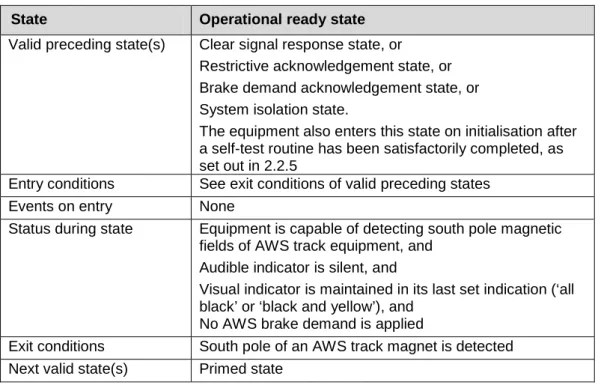
2.2.4.3 The operational ready state shall be the normal operational state of the trainborne AWS equipment on initialisation. The equipment shall return to the operational ready state after having passed over a set of AWS track magnets and, where appropriate, the driver has responded to the audible warning given in response to the track magnets.
State Operational ready state
Valid preceding state(s) Clear signal response state, or Restrictive acknowledgement state, or Brake demand acknowledgement state, or System isolation state.
The equipment also enters this state on initialisation after a self-test routine has been satisfactorily completed, as set out in 2.2.5
Entry conditions See exit conditions of valid preceding states Events on entry None
Status during state Equipment is capable of detecting south pole magnetic fields of AWS track equipment, and
Audible indicator is silent, and
Visual indicator is maintained in its last set indication (‘all black’ or ‘black and yellow’), and
No AWS brake demand is applied
Exit conditions South pole of an AWS track magnet is detected Next valid state(s) Primed state
Table 10 Operational ready state
2.2.4.4 The trainborne AWS equipment shall enter the primed state when it has passed over the south pole of an AWS track magnet and is waiting to determine whether there is an energised electromagnet (north pole) immediately after it.
State Primed state
Valid preceding state(s) Operational ready state
Entry conditions South pole of an AWS track magnet is detected
Events on entry Visual indicator changes to ‘all black’ (if it was previously at ‘black and yellow’)
Status during state Equipment capable of detecting the north pole of an AWS track magnet, and
Audible warning indicator is silent, and Visual indicator is at ‘all black’, and No AWS brake demand is applied
Exit conditions North pole of an AWS track magnet is detected within one second (+0.0,0.1 seconds) of having entered the primed state (in which case the trainborne equipment moves to the clear signal response state), or
Automatic exit occurs one second (+0.0,0.1 seconds) after the primed state was entered, if a north pole is not detected (in which case the trainborne equipment moves to the restrictive response state).
The one second period is known as the Initial Delay Period
Next valid state(s) Clear signal response state, or Restrictive response state Table 11 Primed state
2.2.4.5 The trainborne AWS equipment shall enter the clear signal response state when it has passed over AWS track equipment associated with a signal that is
displaying a green aspect or a semaphore distant signal showing ‘off’.
State Clear signal response state
Valid preceding state(s) Primed state
Entry conditions North pole of an AWS track magnet detected Events on entry Audible ‘clear’ indication given, as set out in 4.2.2.3 Status during state Visual indicator maintained at ‘all black’, and
No AWS brake demand is applied
Exit conditions Automatic exit occurs when the audible ‘clear’ indication has finished
Next valid state(s) Operational ready state Table 12 Clear signal response state
2.2.4.6 The trainborne AWS equipment shall enter the restrictive response state when it has passed over AWS track equipment associated with a signal that is displaying an aspect other than green (or other than ‘off’ in the case of a semaphore distant signal), or that is associated with a warning for a reduction in permissible speed, a temporary / emergency speed restriction or the approach to a level crossing.
State Restrictive response state Valid preceding state(s) Primed state
Entry conditions Initial delay period expires without detecting a north pole magnet during that period
Events on entry Audible warning indication given, as set out in 4.2.2.2, which continues until the equipment exits from this state Status during state Equipment capable of accepting a caution
acknowledgement (by operation of the caution acknowledgement device), and
Visual indicator maintained at ‘all black’, and No AWS brake demand is applied
Exit conditions Caution acknowledgement device is operated within the caution acknowledgement delay period, in which case the restrictive acknowledgement state is entered, or
Automatic exit occurs if the caution acknowledgement device is not operated within the caution
acknowledgement delay period, in which case the brake demand non-acknowledgement state is entered* Next valid state(s) Restrictive acknowledgement state, or
Brake demand non-acknowledgement state Table 13 Restrictive response state
2.2.4.7 * The caution acknowledgement delay period for trains authorised to operate at speeds above 160 km/h (100 mph) shall be two seconds (+/0.25 seconds) after entering the restrictive response state.
The caution acknowledgement delay period for trains authorised to operate at speeds up to and including 160 km/h (100 mph) shall be between two seconds and 2.7 seconds after entering the restrictive response state.
2.2.4.8 The trainborne AWS equipment shall enter the restrictive acknowledgement state when a driver has acknowledged receipt of an AWS warning by operation of the caution acknowledgement device.
State Restrictive acknowledgement state
Valid preceding state(s) Restrictive response state
Entry conditions Driver operates the caution acknowledgement device Events on entry Visual indicator changes to ‘black and yellow’, and
Audible warning indication is silenced Status during state No AWS brake demand is applied and
Visual indicator maintained at ‘black and yellow’, and Audible indicator is silent
Exit conditions Automatic exit occurs when the entry events have been completed
Next valid state(s) Operational ready state Table 14 Restrictive acknowledgement state
2.2.4.9 The trainborne AWS equipment shall enter the brake demand
non-acknowledgement state when a driver has failed to acknowledge receipt of an AWS warning by operation of the caution acknowledgement device within the caution acknowledgement period.
State Brake demand non-acknowledgement state
Valid preceding state(s) Restrictive response state
Entry conditions Driver fails to operate caution acknowledgement device within the caution acknowledgement period
Events on entry AWS brake demand is initiated and maintained Status during state Equipment capable of accepting a caution
acknowledgement (by operation of the caution acknowledgement device), and
Audible warning indication continues, as set out in 4.2.2.2, and
Visual indicator maintained at ‘all black’
Exit conditions Driver operates caution acknowledgement device Next valid state(s) Brake demand acknowledgement state
Table 15 Brake demand non-acknowledgement state
2.2.4.10 The trainborne AWS equipment shall enter the brake demand acknowledgement state when a driver has acknowledged receipt of an AWS warning by operation of the caution acknowledgement device following the expiration of the caution acknowledgement period.
State Brake demand acknowledgement state
Valid preceding state(s) Brake demand non-acknowledgement state
Entry conditions Driver operates the caution acknowledgement device Events on entry Visual indicator changes to ‘black and yellow’, and
Audible warning indication is silenced
Status during state After satisfying the conditions in 2.2.4.11, the AWS brake demand is cancelled
Exit conditions Automatic exit occurs when the brake demand has been cancelled
Next valid state(s) Operational ready state Table 16 Brake demand acknowledgement state
2.2.4.11 The AWS brake demand shall be cancelled not less than 59 seconds after the brake demand has been initiated, and following operation of the caution acknowledgement device and the brake release action set out in Part 4.
2.2.4.12 In the suppressed state the trainborne AWS equipment shall remain operational but shall not provide any indications to the driver or initiate any brake demands.
State AWS suppressed state Valid preceding state(s) Any state
Entry conditions AWS suppression requested by another train control system or by manual input
Events on entry AWS brake demand (if it has been initiated) is maintained unless the alternative train control system has the facility to apply appropriate controls, and
Audible indicator is silenced (if it was previously operative), and
Visual indicator changes to default indication (if this is defined for the type of indicator), or does not change (if no default indication is defined), and
System status indicator indicates that trainborne AWS equipment is suppressed
Status during state No AWS brake demand is applied, and Visual indicator does not change, and Audible warning indicator is silent Exit conditions Request for AWS suppression removed
Next valid state(s) Operational ready state (unless entry to an alternative state is controlled by suppressing system)
Table 17 AWS suppressed state
2.2.4.13 In the system isolation state the trainborne AWS equipment shall be inoperative.
State System isolation state
Valid preceding state(s) Any state
Entry conditions System isolation device operated so as to isolate the trainborne AWS equipment
Events on entry AWS brake demand is cancelled (if it has been initiated), and
Audible indicator is silenced (if it was previously operative), and
Visual indicator changes to default indication (if this is defined for the type of indicator), or does not change (if no default indication is defined), and
Isolation indicator indicates that trainborne AWS equipment is isolated
Status during state No AWS brake demand is applied, and Visual indicator does not change, and Audible warning indicator is silent
Exit conditions System isolation device is operated so as to restore the AWS to its functional condition
Next valid state(s) Operational ready state Table 18 System isolation state
2.2.5 Trainborne AWS equipment self-test capability
2.2.5.1 The trainborne AWS equipment shall have a built-in self-test routine which, as a minimum, tests the following features:
a) That the audible and visual indications operate correctly when required to do so.
And
b) That an AWS brake demand is requested when required.
2.2.5.2 The power-up test routine, as set out in 4.3.1, shall be initiated whenever the train is powered up or, in the case of dual cab trains, when the driver changes cab. 2.2.5.3 The self-test routine shall also be conducted automatically when a train enters a
portion of line where the trainborne AWS equipment is required to be active, having previously been suppressed.
2.2.5.4 When carrying out a self-test in the circumstances of 2.2.5.3, it is not necessary to test that a brake demand is requested if this has been done when the train or cab was powered up.
2.2.5.5 On successful completion of the test routine the trainborne AWS equipment shall move to the operational ready state.
2.2.5.6 Failure to complete the self-test successfully shall result in an appropriate and distinct warning being given to the driver.
2.2.6 Depot test magnets
2.2.6.1 AWS test magnets shall be provided (in accordance with the requirements set out in Table 3 and Table 5) on the exit lines from maintenance depots, except as permitted by 2.2.6.2, so that trains pass over a test magnet before entering Network Rail managed infrastructure.
2.2.6.2 A depot test magnet is not required if all trains that leave the maintenance depot have trainborne AWS equipment that includes a self-test routine which is: a) Conducted before the train enters Network Rail managed infrastructure. And
b) Adequate for the purposes of verifying that the trainborne AWS equipment is fully functional, and in particular that it meets the appropriate field strength sensitivity requirements set out in Table 8 or Table 9.
2.2.6.3 Where a maintenance depot services trains that are fitted with AWS receivers for operation on DC electrified lines, as well as trains fitted with receivers for
operation on other lines, additional arrangements shall be made to ensure that all types of receivers are regularly tested for compliance with the sensitivity
requirements set out in Table 8 and Table 9.
2.3
AWS route compatibility assessment requirements
2.3.1 If on a route it is proposed to replace AWS track equipment of one type (standard or extra strength) by equipment of the other type, the infrastructure manager shall assess the risks of so doing, taking into account the types of AWS receivers fitted to trains that operate on the route.
2.3.2 Where route compatibility is being assessed, as set out in GE/RT8270, the AWS receiver arrangements on a train shall be assessed to determine whether they are compatible with the type of AWS track equipment on the route over which the train is to operate.
2.3.3 Where it is necessary for a train not fitted with AWS equipment to operate over an AWS fitted line, except where an alternative train protection system providing a level of protection equivalent to or better than that provided by AWS and TPWS is fitted and in use on both the trains and the infrastructure, the infrastructure manager and railway undertaking shall agree, document and implement appropriate operating procedures to ensure the safe movement of trains.
Part 3
Track / Train Interface for TPWS
3.1
TPWS track sub-system
3.1.1 Positioning of TPWS track equipment
3.1.1.1 TPWS track transmitters shall be positioned between the running rails on the longitudinal centre line of the track.
3.1.2 Magnetic field requirements of TPWS track equipment
3.1.2.1 When the track transmitters are energised, the TPWS track sub-system shall transmit the appropriate pair of frequencies set out in Tables 19 and 20 as un-modulated sinusoidal carriers, with a tolerance of ± 10 Hz.
Frequency set Arming frequency Trigger frequency OSS frequency set A 64.25 kHz (f1) 65.25 kHz (f2) OSS frequency set B 64.75 kHz (f4) 65.75 kHz (f5)
Table 19 Track transmitter frequencies for overspeed protection functionality
Frequency set Arming frequency Trigger frequency TSS frequency set A 66.25 kHz (f3) 65.25 kHz (f2) TSS frequency set B 66.75 kHz (f6) 65.75 kHz (f5) Table 20 Track transmitter frequencies for train stop functionality
3.1.2.2 The magnetic fields emitted from TSS track transmitters and standard OSS track transmitters shall comply with the magnetic field strength parameters set out in Appendices C and E.
3.1.2.3 The magnetic fields emitted from miniature OSS track transmitters shall comply with the magnetic field strength parameters set out in Appendices D and E. 3.1.2.4 The magnetic fields emitted from TSS track transmitters shall, in the area
between the 90 nT zones of the two track transmitter loops shown in Appendix C, over the same height / offset profile as shown in Appendix E:
a) Be greater than 45 nT from both track transmitters throughout the area. b) Not exhibit any inflection or reversal of slope of the magnetic field.
c) Be greater than 70 nT at the point where their magnetic field strengths are equal.
3.1.2.5 It is permissible to use either sequence of track transmitter frequencies to provide the appropriate function for either direction of operation, subject to meeting the requirements of 3.1.2.6.
3.1.2.6 It is permissible to interleave or nest TSS or OSS transmitters using one set of frequencies (set A or set B) with TSS or OSS transmitters of the other set of frequencies. TSS or OSS transmitters of the same frequency set shall not be interleaved or nested.
3.1.3 Provision of TPWS track equipment
3.1.3.1 TPWS track sub-system equipment shall be provided on all passenger lines at the locations specified in 3.1.3.2 to 3.1.3.8, except where exemptions are permitted by 3.1.4.
3.1.3.2 TPWS shall be provided on passenger lines at all main stop signals and stop boards that protect crossing or converging movements with any running line or siding.
3.1.3.3 TPWS shall be provided at any main stop signal on a non-passenger line that protects a crossing of, or convergence with, a passenger line.
3.1.3.4 TPWS shall be provided at a stop signal where conflicting movements could take place in the overlap of the next stop signal ahead.
3.1.3.5 On non-track circuit block lines with a semaphore equivalent aspect sequence, TPWS shall be provided at the first home signal at the end of a block section where conflicting movements could take place within station limits ahead.
3.1.3.6 It is permissible to provide TPWS at other signals where required for mitigation of SPAD risk, as set out in GK/RT0045.
3.1.3.7 TPWS shall be provided on the approach to the buffer stop at the end of a passenger platform.
3.1.3.8 TPWS shall be provided on the approach to speed restrictions where the permitted speed on the approach is 60 mph or more and the speed restriction reduces the speed by at least one-third, except for:
a) Temporary speed restrictions in place for three months or less. And
b) Temporary speed restrictions in place for between three months and twelve months, subject to risk assessment, as set out in 3.1.4.2.
3.1.3.9 TPWS miniature loops shall be used as OSS transmitters only where the speed of trains does not exceed 40 mph.
3.1.4 Exemptions to provision of TPWS track equipment
3.1.4.1 The TPWS track sub-system is not required to be provided in the circumstances set out below:
a) Where an alternative train protection system providing a level of protection equivalent to or better than AWS and TPWS is fitted and operational on the infrastructure and on all trains operating on the route.
b) At a signal used solely for shunting purposes.
c) At a stop signal that protects only a convergence of a passenger running line with a locally operated emergency crossover.
d) At a stop signal that protects a crossing or convergence with a passenger running line, where the track layout and interlocking controls would prevent a collision at the crossing or convergence in the event of a SPAD.
e) At a stop signal that protects only a convergence with a siding that is secured out of use in accordance with GE/RT8000.
f) Where a permissible speed indicator is provided to indicate a permissible speed that has been imposed solely to reduce the dynamic loading on track systems from rail traffic.
g) Where the attainable speed on entry to the commencement of a speed restriction is less than 60 mph, or less than the excessive speed defined for the section of track.
h) Where a permissible speed indicator is provided on the approach to a diverging junction where the risk from overspeeding on the diverging route is mitigated by approach control of the signalling.
3.1.4.2 In the circumstances set out below, the TPWS track sub-system need be fitted only where the results of a risk assessment show that the fitment of TPWS is justified in order to reduce risk so far as reasonably practicable:
a) On the approach to a permissible speed indicator where, in order to prevent unwarranted emergency brake applications on freight trains passing over the TPWS OSS, the position of the OSS would have to be adjusted such that it would provide no protection to any trains.
b) On the approach to a permissible speed indicator solely associated with a plain line curve where there is a potential risk from derailment or overturning. c) Where a permissible speed indicator is provided to indicate a permissible
speed that has been imposed solely to protect trains from the infrastructure or other passing trains due to limited clearance.
d) Where a permissible speed indicator is provided on the approach to a footpath or bridleway level crossing for the sole purpose of increasing the warning time for crossing users.
e) For temporary speed restrictions that are planned to be in place for between three and twelve months.
3.1.4.3 The TPWS track sub-system is not required to be operational in the circumstances set out below:
a) When the track sub-system is to be disconnected, removed, replaced or repositioned in accordance with engineering protection or possession arrangements, as set out in GE/RT8000.
And
b) When the track sub-system is to be disconnected to facilitate other work, provided that permission to disconnect has been obtained in accordance with GE/RT8000.
3.1.5 Positioning of TPWS track equipment – TSS
3.1.5.1 Except where this is not practicable, TSS transmitters shall be positioned at or near the longitudinal position of the signal, as shown in Figure 2.
3.5 m
f2 f3
Point where the train returns the signal to danger Arming transmitter Trigger transmitter Direction of travel Figure 2 Position of TSS transmitters
3.1.5.2 The distance from the centre of the TSS to the position on the track where the leading wheelset will cause the signal to be replaced to danger shall not be less than 3.5 m.
3.1.6 Positioning of TPWS track equipment – OSS
3.1.6.1 OSS transmitters shall be positioned to optimise their safety benefits, taking account of:
a) The braking performance of trains, as set out in GM/RT2045.
b) The attainable speeds of trains on the approach to the signal or other location.
c) The distance from the stop signal to the point of conflict at the crossing or convergence ahead.
d) The gradient of the line on the approach to the signal or other location. e) The interleaving of other location OSS functions where signal OSS and TSS
functions are, or will be, installed.
f) The potential for inhibition of the vehicle TPWS self-test on power-up. g) The potential for unwarranted intervention during movements in the opposite
direction on bi-directional or reversible lines.
3.1.6.2 The provision and positioning of the TPWS track sub-system shall be reviewed if a change to the infrastructure or the operational use of the railway is proposed which may affect the track layout, signal location, the attainable speed of trains, or the SPAD risk.
3.1.7 Control of TPWS track equipment
3.1.7.1 The track transmitters associated with signals shall be energised when the signal is controlled to danger.
3.1.7.2 The track transmitters provided at other locations shall always be energised when a train is passing over the transmitter on the line concerned.
3.2
TPWS train sub-system
3.2.1 Provision of trainborne TPWS equipment
3.2.1.1 The TPWS train sub-system shall be provided on all trains that operate over lines fitted with the TPWS track sub-system, except for:
a) Vehicles that operate solely in T3 possessions.
b) Shunting locomotives that are not fitted with AWS and that operate over a route which has been risk assessed to demonstrate that there is little or no risk from collision with trains on running lines.
c) Vehicles fitted with alternative train protection system(s) providing a level of protection equivalent to or better than that provided by AWS and TPWS that operate only over tracks fitted with the appropriate system(s).
3.2.1.2 The TPWS train sub-system is not required to be operational in the circumstances set out below:
a) The TPWS train sub-system may be temporarily isolated:
i) When vehicles fitted with TPWS are working in a T3 possession. ii) When temporary block working is implemented and a train is required to
pass signals at danger, with authority, in accordance with GE/RT8000. iii) On driving units with an active cab that is not at the front of the train, in
accordance with GE/RT8000.
b) It is permissible to suppress the operation of the TPWS train sub-system when an alternative train protection system is fitted and operational on both the train and the track over which the train is to operate.
3.2.1.3 The TPWS receiver shall be positioned:
a) Behind the leading wheelset of the vehicle. And
b) Within 2.3 m of the leading wheelset of the vehicle. 3.2.2 Receiver sensitivity requirements for TPWS train sub-system
3.2.2.1 The train sub-system shall be capable of detecting the magnetic fields emitted by the track sub-system, as set out in 3.1.2, when the active part of the receiver passes through the 90 nT region of the magnetic field shown in Appendix E. 3.2.2.2 The train sub-system shall respond to field strengths of 60 nT or more. 3.2.2.3 Once a magnetic field of 60 nT or more has been detected, detection shall be
retained as long as the field strength remains above 30 nT, and shall be lost if the field strength falls below 10 nT.
3.2.2.4 To avoid spurious tripping during bi-directional operation, the train sub-system shall not hold detection of an arming frequency for a period greater than 150 milliseconds.
3.2.3 Operation of trainborne TPWS equipment at OSS
3.2.3.1 On detecting the presence of an OSS arming frequency as defined in Table 19, the train sub-system shall start the trigger delay timer.
3.2.3.2 The trigger delay timer shall be set to one of two timings, with an appropriate value for either:
a) Trains with a braking performance characteristic of a passenger train. Or
b) Trains with a braking performance characteristic of a freight train.
3.2.3.3 The trigger delay timer shall be set to the appropriate value set out in Table 21. Set speed adjustment Trigger delay timer settings
(+/- 2 ms) Freight train braking performance 1218 ms Passenger train braking performance 974 ms Table 21 Trigger delay timer settings
3.2.3.4 If the trigger delay timer reaches the trigger delay timer setting before detecting the appropriate trigger frequency, as set out in Table 19, the train sub-system shall reset and no brake application shall be made.
3.2.3.5 If the appropriate trigger frequency is detected before the trigger delay timer reaches the trigger delay timer setting, an emergency brake application, or where available an enhanced emergency brake application, shall immediately be initiated.
3.2.3.6 The train sub-system shall respond to valid OSS frequency sequences even when OSS transmitters are interleaved, as set out in 3.1.2.6. The train sub-system shall not make an OSS brake application in any other circumstance. 3.2.3.7 The brake application and the visual indication shall be maintained until:
a) At least 59 seconds have elapsed since the initiation of the brake application.
And
b) The train sub-system has received an acknowledgement from the driver. 3.2.3.8 The TPWS train sub-system shall respond correctly to valid frequencies from
standard OSS transmitters at speeds from 15 mph (24 km/h) up to at least 125 mph (200 km/h) (-0 +10%).
3.2.3.9 The TPWS train sub-system shall respond correctly to valid frequencies from miniature OSS transmitters at speeds between 10 mph (16 km/h) and 40 mph (64 km/h).
3.2.4 Operation of trainborne TPWS equipment at TSS
3.2.4.1 The train sub-system shall detect the presence of a TSS arming frequency as defined in Table 19.
3.2.4.2 If, before detecting the loss of the arming frequency, the train sub-system detects the presence of the appropriate trigger frequency, an emergency brake
application, or where available an enhanced emergency brake application, shall immediately be initiated.
3.2.4.3 The train sub-system shall not make a TSS brake application in any other circumstance.
3.2.4.4 The brake application and the visual indication shall be maintained until: a) At least 59 seconds have elapsed since the initiation of the brake
application. And
b) The train sub-system has received an acknowledgement from the driver. 3.2.4.5 The TPWS train sub-system shall respond correctly to valid TSS frequencies at
any speed greater than 0 mph (0 km/h) up to at least 125 mph (200 km/h) (-0 to +10%).
3.2.5 Trainborne TPWS equipment self-test
3.2.5.1 The TPWS shall perform a power-up test, as set out in 4.3.1, when the system is started, subject to awaiting initialisation of ETCS when the TPWS indications are presented by the ETCS DMI.
3.2.6 Trainborne TPWS equipment in-service monitoring
3.2.6.1 The TPWS shall undertake system monitoring while in service. System
monitoring shall continue to be undertaken while the train is operating with TPWS suppressed, as set out in 3.2.1.2.
3.2.6.2 A TPWS fault that results in loss of the protection normally provided by TPWS shall be indicated as a fault, as set out in 4.3.2, but shall not apply the brakes solely due to the detection of the fault.
3.2.6.3 The in-service monitoring and fault display functions shall not disable or compromise the train stop or overspeed functionality of the TPWS, or the
functionality of the AWS. Detection of a fault shall not suppress an existing brake demand.
3.2.6.4 Faults to be detected while the train is in service shall include:
a) Electrical continuity failure between the aerial and the control unit. b) Degradation in signal transfer between the aerial and the control unit. c) A control unit fault that could result in loss of TPWS protection.
3.2.6.5 A TPWS fault shall not be indicated solely as a result of powering up the system while the train is standing over an active TPWS loop.
Part 4
Driver / Machine Interface (DMI) for AWS and
TPWS
4.1
Layout of Driver / Machine Interface (DMI)
4.1.1 AWS visual indications4.1.1.1 An AWS visual indicator shall be provided in each driving cab, either as a separate indicator unit or incorporated into an integrated DMI (see Appendix G). 4.1.1.2 The AWS visual indicator shall be capable of providing two indications, ‘all black’
and ‘black and yellow’ (described in the Rule Book as the ‘normal’ and ‘warning’ indications respectively), in the form shown in Appendix A.
4.1.1.3 The AWS indications shall meet all the following requirements:
a) The indicator shall be circular, and shall have between eight and 10 narrow segments, with colours and size as depicted in Appendix A.
b) The indicator shall be in the field of vision of the driver when looking at the track ahead from the driving position(s) to which it applies.
c) The indications provided by the indicator shall be clearly visible from the driving position(s) to which the indicator applies, in all conditions of cab illumination.
d) Where duplicate indicators are provided in the same driving cab, they shall be synchronised in their operation.
4.1.2 AWS controls
4.1.2.1 An AWS caution acknowledgement device shall be provided in each driving cab. 4.1.2.2 The AWS caution acknowledgement device shall be in the form of a physical
button, located where the driver can easily operate it when seated at the active driving position, but so that it is not operable from any other driving position. 4.1.2.3 It shall not be possible for a driver to give a caution acknowledgement to the
trainborne AWS equipment by either:
a) Permanently operating the caution acknowledgement device. Or
b) Operating the caution acknowledgement device before the restrictive response state is entered.
4.1.3 TPWS indications and controls
4.1.3.1 The TPWS Driver Machine Interface (DMI) shall be designed in accordance with the requirements set out in Appendix F when the TPWS DMI is provided as a separate group of physical control devices and indications which is not integrated into an ETCS DMI, and in Appendix G when TPWS indications and controls are integrated into the ETCS DMI.
4.1.3.2 A visual indication that the train sub-system has initiated a TPWS brake application shall be presented to the driver.
4.1.3.3 The visual indication shall distinguish between brake demands caused by TPWS TSS, TPWS OSS, and failure to acknowledge an AWS warning.
4.1.3.4 The visual indication shall be a primary instrument, the design and positioning of which shall be in accordance with the requirements set out in GM/RT2161. 4.1.3.5 The train sub-system shall not permit the driver to use the train stop override or
TPWS temporary isolation facilities to cancel a TPWS brake application.
4.1.3.6 A facility to override the train stop function shall be provided to allow the driver to pass a signal at danger without TPWS initiating a brake application. The override facility shall be positioned in the primary control area of the active driving cab. 4.1.3.7 When the train stop override facility has been operated, it shall remain active until
either:
a) One active TSS has been passed. Or
b) Up to 60 seconds have elapsed.
4.1.3.8 Continuous operation of the train stop override facility shall not extend the active time of the override facility.
4.1.4 Isolation of AWS and TPWS
4.1.4.1 A facility shall be provided to fully isolate the AWS and TPWS train sub-systems (for example, in the event of equipment failure). The isolation device shall meet the requirements set out in GM/RT2185.
4.1.4.2 It shall be possible to isolate the trainborne AWS equipment independently of the isolation of TPWS equipment.
4.1.4.3 A facility shall be provided to allow temporary isolation of the TPWS train sub-system.
4.1.4.4 The TPWS temporary isolation device shall not be within reach of the driver from the normal driving position.
4.1.4.5 The driver shall be provided with a prominent visual indication that a temporary isolation has been effected. The visual indication shall be visible to the driver from the normal driving position.
4.2
Operation of Driver / Machine Interface (DMI)
4.2.1 Brake demand visual indications4.2.1.1 When a cab is made operational, any override or temporary isolations previously applied to the train sub-system shall be removed automatically and any TPWS train sub-system faults shall be indicated to the driver.
4.2.1.2 Following the successful completion of the power-up test (see 4.3.1), all brake demand indicators shall be extinguished until AWS or TPWS initiates a brake demand.
4.2.1.3 The visual indicator for a SPAD brake demand shall flash when the TPWS aerial at the front of the train passes over an active TSS and a brake demand is initiated.
4.2.1.4 The visual indicator for an overspeed brake demand shall flash when the TPWS aerial at the front of the train passes over an active OSS and a brake demand is initiated.
4.2.1.5 The visual indicator for an AWS brake demand shall flash when a brake demand is initiated following an AWS caution warning that has not been acknowledged within the caution acknowledgement period.
4.2.1.6 The flashing brake demand visual indication shall change to steady when the driver has acknowledged the appropriate alert.
4.2.1.7 The brake demand indicators shall display the indications as shown in the state transition diagram in Appendix B. Transitions between indication states shall occur in accordance with the conditions shown in Appendix B.
4.2.1.8 When the TPWS train sub-system is suppressed, the TPWS DMI indicators (other than the fault indicator) shall be extinguished.
4.2.1.9 When the TPWS train sub-system is suppressed, the system shall continue to undertake in-service monitoring, as set out in 4.3.2, and any TPWS train sub-system faults shall be indicated to the driver.
4.2.2 AWS audible indications
4.2.2.1 Each driving cab shall be fitted with an AWS audible indicator that is capable of providing a ‘warning’ indication and a ‘clear’ indication. These two indications shall:
a) Be distinguishable from all other audible indications in the cab.
b) Have a sound level at least 10 dBA above the expected ambient noise level, subject to a minimum of 65 dBA and a maximum of 95 dBA, at a distance of 1 m from the front of the equipment, measured as installed in the driving cab.
c) Be audible from all applicable driving positions and in all driving conditions. 4.2.2.2 The ‘warning’ indication shall be a steady alarm / horn with a frequency of 800 Hz
(with a tolerance of +/- 20 Hz). The duration of the ‘warning’ indication is determined by the driver’s response to the indication, as set out in Table 13. 4.2.2.3 The ‘clear’ indication shall be a bell or simulated chime tone with a frequency of
1200 Hz (with a tolerance of +/- 30 Hz) and a duration of 0.5 to 1.5 seconds. 4.2.3 TPWS audible indications
4.2.3.1 There shall be separate and distinct audible alerts to inform the driver of brake demands due to:
a) Operation of the TSS (SPAD audible alert). And
b) Operation of the OSS (overspeed audible alert).
4.2.3.2 The audible alerts for SPAD and overspeed events shall be speech messages, which shall be preceded by a short priming sound.
4.2.3.3 The speech message for a SPAD audible alert shall be: ‘SPAD alert, contact the signaller’.
4.2.3.4 The speech message for an overspeed audible alert shall be: ‘Overspeed, contact the signaller’.