Proceedings of the 2019 Conference on Empirical Methods in Natural Language Processing
2262
A Unified Neural Coherence Model
Han Cheol Moon∗¶, Tasnim Mohiuddin∗¶, Shafiq Joty∗¶§, and Xu Chi† ¶
Nanyang Technological University, Singapore §Salesforce Research Asia, Singapore
†A*STAR, Singapore
¶{hancheol001@e., mohi0004@e.}ntu.edu.sg
Abstract
Recently, neural approaches to coherence modeling have achieved state-of-the-art results in several evaluation tasks. However, we show that most of these models often fail on harder tasks with more realistic application scenar-ios. In particular, the existing models under-perform on tasks that require the model to be sensitive to local contexts such as candidate ranking in conversational dialogue and in ma-chine translation. In this paper, we propose a unified coherence model that incorporates sen-tence grammar, inter-sensen-tence coherence re-lations, and global coherence patterns into a common neural framework. With extensive experiments on local and global discrimina-tion tasks, we demonstrate that our proposed model outperforms existing models by a good margin, and establish a new state-of-the-art.
1 Introduction
Coherence modeling involves building text anal-ysis models that can distinguish a coherent text from incoherent ones. It has been a key problem in discourse analysis with applications in text gen-eration, summarization, and coherence scoring.
Various linguistic theories have been proposed to formulate coherence, some of which have in-spired development of many of the existing co-herence models. These include the entity-based
local models (Barzilay and Lapata, 2008; Elsner and Charniak,2011b) that consider syntactic real-ization of entities in adjacent sentences, inspired by the Centering Theory (Grosz et al.,1995). An-other line of research usesdiscourse relations be-tween sentences to predict local coherence (Pitler and Nenkova,2008;Lin et al.,2011). These meth-ods are inspired by the discourse structure theo-ries like Rhetorical Structure Theory (RST) (Mann and Thompson,1988) that formalizes coherence in
∗
*Equal contribution
terms of discourse relations. Other notable meth-ods includeword co-occurrencebased local mod-els (Soricut and Marcu, 2006),content (or topic distribution) based global models (Barzilay and Lee, 2004), and syntax based local and global models (Louis and Nenkova,2012).
With the neural invasion, some of the above tra-ditional models have got their neural versions with much improved performance. For example,Li and Hovy (2014) implicitly model syntax and inter-sentence relations using a neural framework that uses a recurrent (or recursive) layer to encode each sentence and a fully-connected layer with sigmoid activations to estimate coherence probability for every window of three sentences. Li and Jurafsky (2017) incorporate global topic information with an encoder-decoder architecture, which is also ca-pable of generating discourse. Mesgar and Strube (2018) model change patterns of salient seman-tic information between sentences. Nguyen and Joty(2017);Mohiuddin et al.(2018) propose neu-ral entity grid models using convolutions over dis-tributed representations of entity transitions, and report state-of-the-art results in standard evalua-tion tasks on the Wall Street Journal (WSJ) corpus. Traditionally coherence models have been eval-uated on two kinds of tasks. The first kind in-cludes synthetic tasks such asdiscrimination and
insertion that evaluate the models directly based on their ability to identify the right order of the sentences in a text with different levels of diffi-culty (Barzilay and Lapata,2008;Elsner and Char-niak, 2011b). The latter kind of tasks evaluate the impact of coherence score as another feature in downstream applications like readability as-sessmentandessay scoring(Barzilay and Lapata, 2008;Mesgar and Strube,2018).
Mohi-uddin et al.,2018), it is far from being solved. As we show later, state-of-the-art models often fail on harder tasks like local discrimination and inser-tion that ask the model to evaluate a local con-text (e.g.,a 3-sentence window). This task has di-rect applications in utterance ranking (Lowe et al., 2015) or bot detection1 in dialogue, and for sen-tence ordering in summarization.
According to Grosz and Sidner (1986), three factors collectively contribute to discourse co-herence: (a) the organization of discourse seg-ments, (b) intention or purpose of the discourse, and (c) attention or focused items. The entity-based approaches capture attentional structure, the syntax-based approaches consider intention, and the organizational structure is largely captured by models that consider discourse relations and con-tent (topic) distribution. Although methods like (Elsner et al., 2007; Li and Jurafsky, 2017) at-tempt to combine these aspects of coherence, to our knowledge, no methods consider all the three aspects together in a single framework.
In this paper, we propose a unified neural model that incorporates sentence grammar (in-tentional structure), discourse relations, attention and topic structures in a single framework. We use an LSTM sentence encoder with explicit lan-guage model loss to capture the syntax. Inter-sentence discourse relations are modeled with a bi-linear layer, and a lightweight convolution-pooling is used to capture the attention and topic struc-tures. We evaluate our models on both local and global discrimination tasks on the bench-mark dataset. Our results show that our ap-proach outperforms existing methods by a wide margin in both tasks. We have released our code at https://ntunlpsg.github.io/project/coherence/n-coh-emnlp19/for research purposes.
2 Related Works
Inspired by various linguistic theories of dis-course, many coherence models have been pro-posed. In this section, we give a brief overview of the existing coherence models.
Motivated by the Centering Theory (Grosz et al., 1995), Barzilay and Lapata (2005, 2008) proposed the entity-based local model for rep-resenting and assessing text coherence, which showed significant improvements in two out of three evaluation tasks. Their model represents a
1http://workshop.colips.org/wochat/data/index.html
text by a two-dimensional array calledentity grid
that captures local transitions of discourse entities across sentences as the deciding patterns for as-sessing coherence. They consider thesalienceof the entities to distinguish between transitions of important entities from unimportant ones, by mea-suring the occurrence frequency of the entities.
Subsequent studies extended the basic entity grid model. By including non-head nouns as en-tities in the grid, Elsner and Charniak (2011b) gained significant improvements. They incor-porate entity-specific features like named entity, noun class, and modifiers to distinguish between entities of different types, which led to further im-provements. Instead of using the transitions of grammatical roles, Lin et al. (2011) model the transitions of discourse roles for entities. Feng and Hirst(2012) used the basic entity grid, but im-proved its learning to rank scheme. Their model learns not only from the original document and its permutations but also from ranking preferences among the permutations themselves.
Guinaudeau and Strube (2013) proposed a
graph-based unsupervised method for modeling text coherence. Assuming the sentences in a co-herent discourse should share the same structural syntactic patterns, Louis and Nenkova(2012) in-troduced a coherence model based on syntac-tic patterns in text. Their proposed method comprises of local and global coherence model, where the former one captures the co-occurrence of structural features in adjacent sentences and the latter one captures the global structure based on clusters of sentences with similar syntax.
Our model also considers syntactic patterns through a biLSTM sentence encoder that is trained on an explicit language modeling loss. Compared to the entity grid and the syntax-based models, our model does not require any syntactic parser.
With the neural tsunami, some of the above traditional models have got theirneural versions with better performance.Li and Hovy(2014) pro-posed a neural framework to compute the ence score of a document by estimating coher-ence probability for every window of three sen-tences. Li and Jurafsky (2017) proposed two
varia-tional inference. Our proposed model also mod-els inter-sentence relations and global coherence patterns. We use a bi-linear layer to model re-lations between two consecutive sentences exclu-sively. Also, our global model implements a light-weight convolution that requires much less param-eters, which gives better generalization. More-over, we train the whole network end-to-end with a window-based adaptive pairwise ranking loss.
Nguyen and Joty(2017) proposed a neural ver-sion of the entity grid model where they first trans-form the grammatical roles in a grid into their dis-tributed representations. Then they employ a con-volution operation over it to model entity transi-tions in the distributed space. Finally, they com-pute the coherence score from the convoluted fea-tures by a spatial max-pooling operation. The model is trained with a document-level (global) pairwise ranking loss. Mohiuddin et al. (2018) improve the neural entity grid model by lexical-izing its entity transitions They use off-the-shelf
word embeddings to achieve better generalization with the lexicalized model. As we will demon-strate, because of the spatial-pooling operation, entity-based neural models are not sensitive to mismatch of local patterns in a document lim-iting their applicability to tasks that require local discrimination. Another crucial limitation of em-ploying adocument-levelpairwise ranking loss is that the loss from the document-level permutation for a negative document may penalize the con-volution kernel weightseven if the local permu-tation matches that of the positive document. In contrast, we apply a window-level (local) adap-tive pairwise ranking lossthat gets activated only if the corresponding windows of the positive and negative documents differ. This way our model is sensitive to local patterns without penalizing the weights unfairly. We capture global patterns using a separate light-weight convolution module.
3 Proposed Model
LetD = (s1,· · · ,sn) be a document consisting
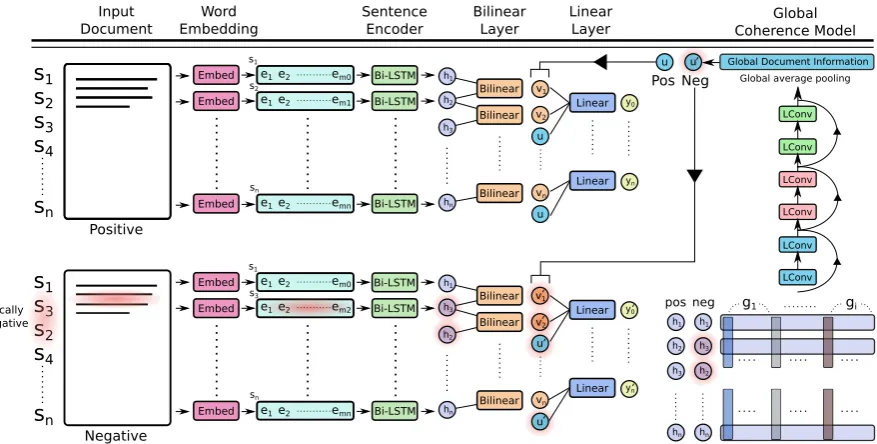
ofnsentences. Our goal is to assess its coherence score. Figure1 provides an overview of our pro-posed unified coherence model. It has four com-ponents in a Siamese architecture (Bromley et al., 1993): (i) a sentence encoder (§3.1), (ii) a local coherence model (§3.2), (iii) a global coherence model (§3.3), and (iv) a coherence scoring layer (§3.4). For encoding a sentence, we first map each
word of the sentence to its corresponding vector representation. We then use a bidirectional LSTM sentence encoder with explicit language model loss to capture the sentence grammar. Given the sentence representations, the local and global co-herence model extract the respective coco-herence features. The local coherence model implements a bilinear layer to model inter-sentence discourse relations. This layer captures the local contexts
of the document. To capture the attention (entity distribution) and topic structures, i.e., the global coherenceof the document, our global coherence model uses alight-weight convolution(Wu et al., 2019) with average pooling. The coherence scor-ing is a linear layer that evaluates the coherence from the extracted features. The whole architec-ture is trainedend-to-endwith a pairwise ranking loss. In the following, we elaborate on different components of our proposed model.
3.1 Modeling Intention
A discourse has a purpose such as describing an event, explaining some results, evaluating a prod-uct, etc. As such, sentences in the discourse should support the purpose as a whole. The syntactic structure of the sentence can be used to model the intent structure (Louis and Nenkova, 2012). We use a bidirectional long short-term memory or bi-LSTM (Hochreiter and Schmidhuber,1997) to encode each sentence into a vector representation while modeling its compositional structure.
For an input sentence si = (w1,· · · , wm) of
length m, we first map each word wt to its
cor-responding vector representationet ∈ Rd, where
dis the dimension of the word embedding. The LSTM recurrent layer then computes a composi-tional representationht ∈ Rp at every time step
tby performing nonlinear transformations of the current time step word vector representation et
and the output of the previous time step ht−1,
where p is the number of features in the LSTM hidden state. The output of the last time stephmis
considered as the representation of the sentence. A bi-LSTM processes a given sentencesiin two
di-rections: fromleft-to-rightandright-to-left, yield-ing a representationhi = [
−→
hm;
←−
hm]∈R2p, where
‘;’ denotes concatenation.
We train our sentence encoder with an explicit
s1 s2 s3 s4 sn s1 s2 s3 s4 sn Positive Negative Locally negative Word Embedding Sentence Encoder Input Document Bilinear Layer Linear Layer Bi-LSTM Bilinear Linear Embed Bi-LSTM Bi-LSTM Embed Embed h1 h3 hn Bilinear Bilinear Linear h2 y0 yn s1 s3 sn Global Coherence Model h1 h3 hn h2
g1 gi
Global average pooling Global Document Information
LConv u v2 u vn u LConv LConv LConv LConv LConv v1' ' Bi-LSTM Bi-LSTM Bilinear Linear Embed e1e2 em0
Embed Embed h1 h2 hn Bilinear Bilinear Linear h3 y0 yn s1 s2 sn u v2 u vn v1
e1e2 em1
e1e2 emn
e1e2 em0
e1e2 em2
e1e2 emn
[image:4.595.84.523.60.282.2]u Pos Neg h1 h2 hn h3 pos neg ' ' ' Bi-LSTM ' '
Figure 1: An overview of the proposed coherence model (best viewed in color). The superscript ‘0’ above output of each component denotes negative outputs and the red shade represents incoherent portions in the document. Note that all network parameters and components are shared regardless of the input documents.
we jointly minimize thenegative log-likelihoodof the forward and backward directions:
Llm =−
m
X
j=1
logp(wj|w1,· · · , wj−1;θ,
− →
θlstm)+
logp(wj|wj+1,· · ·, wm;θ,
←−
θlstm)
(1)
where−→θlstmand
←−
θlstm are the parameters of the
forward and backward LSTMs, and θdenote the rest of the parameters which are shared.
3.2 Modeling Inter-Sentence Relation
Discourse relations between sentences reflect the organizational structure of a discourse that can be used to evaluate the coherence of a text (Lin et al.,2011;Li and Hovy,2014). To model inter-sentence discourse relations, we use a bilinear model. Our bi-LSTM sentence encoder gives a representation hi ∈ R2p for each sentence si in
the document. We feed the representations of ev-ery two consecutive sentences (hi,hi+1) to this
layer, which applies a bilinear transformation as:
vi=hTi Wbhi+1+b (2)
whereWb ∈ Rq×2p×2p is a learnable tensor, and
b ∈ Rq is a learnable bias vector. Hereq is the
number of output features (i.e.,vi ∈Rq).
3.3 Modeling Global Coherence Patterns
The model proposed so far captures only local in-formation. However, global discourse phenomena like entity or topic distributions are also important for coherence evaluation (Barzilay and Lee,2004; Elsner et al., 2007; Louis and Nenkova, 2012). Global coherence is modeled in our architecture by aconvolution-poolingmechanism.
As shown in the Figure 1, our global coher-ence sub-module takes the representations H = (h1,· · · ,hn) of all the sentences in a document
generated by the bi-LSTM encoder. The module uses six convolution layers with residual connec-tions, followed by an average pooling layer. In-stead of using regular convolutions, we use light-weight convolution (Wu et al., 2019), which is built upondepth-wiseconvolution (Chollet,2016).
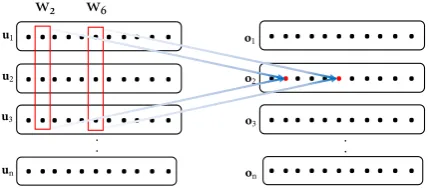
Depth-wise convolutions perform a convolution independently over every input channel which sig-nificantly reduces the number of parameters as shown in Figure2. For a given inputH ∈ Rn×d,
the output O ∈ Rn×d of the depth-wise
convo-lution with convoconvo-lution weightW ∈ Rd×k with
kernel sizekfor elementiand output dimensionc can be written as:
Oi,c =Dcon(H,Wc,:, i, c)
=
k
X
j=1
Wc,jH(i+j−dk+1
. . . .
. . . .
. . . .
. . . .
.
.
. . .
.
. . . . .
. . . .
w2 w6
. . . .
. . . .
u1u2
u3
un
o1
o2
o3
on .
[image:5.595.73.288.69.163.2]. ..
Figure 2: Depth-wise convolution for kernel size k = 3. The convolutions are done over the input dimensions.
Compared to the regular convolutions,depth-wise convolutions reduces the number of parameters fromd2ktodk(note thatd= 2pin our case).
Light-weight Convolutionsmake the depth-wise convolution even simpler by sharing groups of out-put channels and normalizing weights across the temporal dimension using a softmax. It has a fixed context window which determines the importance of context elements with a set of weights that do not change over time steps. For thei-th element in the sequence and output channelc,light-weight convolutioncomputes:
Lcon(H,Wg,:, i, c)
=Dcon(H,softmax(Wg,:), i, c) (4)
where g = dcG
d e with G being the number of
groups. The number of parameters with light-weight convolutions reduces to H.k. Wu et al. (2019) show that models equipped with light-weight convolution exhibit better generalization compared to regular convolutions. It is indeed crucial in our case since we use convolutions to model a document, with large kernel size it would be difficult to learn from small datasets compared to (sentence-level) machine translation datasets.
The light-weight convolution layers generate d feature maps fi ∈ Rn, i = 1, ..., d for each
in-put document by the convolutional operation over an input dimension across all the sentences in a document. Subsequently,global average pooling
is performed over the extracted feature maps to achieve a global view of the input document. The achieved global featureu ∈Rdcan be expressed
as follows:
u= 1
n[1·f
1, ...,1·fd] (5)
where1 ∈ Rn is the vector of ones andnis the
number of sentences in an input document. The
global document level featuresuare then concate-nated with the local features of each consecutive sentence pair (vi;vi+1)in the document, i.e., the
output of the bilinear layer (see Figure1).
zi = [vi;vi+1;u] (6)
wherezi ∈R2q+2pand ‘;’ denotes concatenation. 3.4 Coherence Scoring
We then feed the concatenated global and local features zi to the final linear layer of our model
to compute the coherence scoreyi ∈ Rn for each
local window.
yi =zTi wl+bl (7)
where wl is weight vector and bl is a bias. The
final decision on documents is made by summing up all local scores of documents and compares the summed scores.
3.5 Overall Objective and Training Details
Our model assigns a coherence score yi to
ev-ery possible local windowD`in the documentD, where`is thelocal windowindex. During imple-mentation, the input document ispadded, so that the number of possible local window is the same as the number of sentences (n) in the documentD. Let y = Ω(D|Θ) define our model that pro-duces the coherence scores y = (y1, . . . , yn)for
an input documentD, withΘbeing the parame-ters. We use awindow-level pairwise ranking ap-proach(Collobert et al.,2011) to learnΘ.
Our training set containsorderedpairs of doc-uments (Dpos, Dneg), where document Dpos
ex-hibits a higher degree of coherence than document Dneg. See Section4for details about the dataset.
We seek to learnΘthat assigns higher coherence scores to Dpos than to Dneg. We observed that
the naive pairwise ranking loss that uses a fixed margin unfairly penalizes the locally positive sen-tences during training. In other words, the loss should be active only for local windows that dif-fer inDposandDneg. To address this, we propose
to use anadaptive pairwise ranking lossLΘ
de-fined as follows.
LΘ= 1
n
n
X
`=1
maxn0, φ(D`pos, D`neg)−
whereφ(Dpos` , Dneg` ) is an adaptive margin given by
φ(Dpos` , Dneg` ) = (
0 ifD`pos=Dneg` τ otherwise
whereτ is a margin constant. Our total loss,LΘ=LΘ+Llm.
Note that our model shares all the layers and components, i.e., Θ to obtain Ω(Dpos|Θ) and
Ω(Dneg|Θ)from a pair of document(Dpos, Dneg).
Therefore, once trained, it can be used to score any input document independently.
4 Evaluation Tasks and Datasets
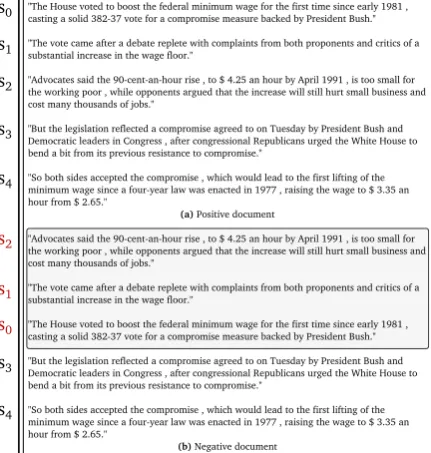
For comparison purposes with previous work, we evaluate our models on the standard“global” dis-crimination task (Barzilay and Lapata, 2008), where a document is compared to arandom per-mutation of its sentences, which is considered to be incoherent. We also evaluate on aninverse dis-crimination task (Mohiuddin et al.,2018), where the sentences of the original document are placed in the reverse order to create the incoherent docu-ment. Similar to them, we do not train our models explicitly on this task, rather we use the trained model from the standard discrimination task. In addition and more importantly, we evaluate the models on a more challenging “local” discrimi-nationtask, where two documents differ only in a local context (e.g., a 3-sentence window), as shown with an example in Figure3.
Dataset for Global Discrimination. We follow the same experimental setting of the WSJ news dataset as used in previous works (Mohiuddin et al., 2018;Nguyen and Joty, 2017; Elsner and Charniak, 2011b; Feng et al., 2014). Similar to them, we use 20 random permutations of each doc-ument for both training and testing, and exclude permutations that match the original one. Table1 summarizes the data sets used in global discrim-ination task. We randomly selected 10% of the training set for development purposes.
Dataset for Local Discrimination. We use the same WSJ articles used in the global discrimina-tion task (Table1) to create our local discrimina-tion datasets. Sentences inside a localwindow of size 3are re-ordered to form a locally incoherent text. Only articles withmore than 10 sentences
are included in our dataset. This gives 748 docu-ments for training and 618 for testing.
Sections # Doc. # Pairs
Train 00-13 1,378 26,422
[image:6.595.327.503.64.116.2]Test 14-24 1,053 20,411
Table 1: Statistics of the WSJ news dataset used for
“global” discriminationtask.
Sections # Doc. # Pairs
Dw=1 Dw=2 Dw=3 Dw=1,2,3
Train 00-13 748 7,890 12,280 12,440 32,610
Test 14-24 618 6,568 9,936 9,906 26,410
Table 2: Statistics on the WSJ news dataset used for
“local” discriminationtask. Thewdenotes the
num-ber of permuted local windows in a document.
We first set was the number of local windows that we want to permute in a document. Based on this, we create four datasets for our local discrim-ination task: Dw=1, Dw=2, Dw=3 andDw=1,2,3.
Dw=1 contains the documents, where only one randomly selected window is permuted. Simi-larly, Dw=2 contains the documents, where two
randomly selected windows are permuted. Dw=3 is similarly created for 3 windows. Dw=1,2,3 de-notes the concatenated datasets. The number of negative documents for each article was restricted
not to exceed 20 samples. Additionally, we ex-clude the cases of the overlap between windows. In other words, the sentences are allowed to be permuted only inside their respective window.
We randomly select 10% of the training set for development purposes. Table 2 summarizes the datasets. Consequently, the training and the test dataset forDw=1,2,3consists of 32,610 and 26,410
pairs, respectively.
5 Experiments
This section presents details of our experiment procedures and results.
5.1 Models Compared
"The House voted to boost the federal minimum wage for the first time since early 1981 , casting a solid 382-37 vote for a compromise measure backed by President Bush."
"The vote came after a debate replete with complaints from both proponents and critics of a substantial increase in the wage floor."
"Advocates said the 90-cent-an-hour rise , to $ 4.25 an hour by April 1991 , is too small for the working poor , while opponents argued that the increase will still hurt small business and cost many thousands of jobs."
"But the legislation reflected a compromise agreed to on Tuesday by President Bush and Democratic leaders in Congress , after congressional Republicans urged the White House to bend a bit from its previous resistance to compromise."
"So both sides accepted the compromise , which would lead to the first lifting of the minimum wage since a four-year law was enacted in 1977 , raising the wage to $ 3.35 an hour from $ 2.65."
(a) Positive document
"Advocates said the 90-cent-an-hour rise , to $ 4.25 an hour by April 1991 , is too small for the working poor , while opponents argued that the increase will still hurt small business and cost many thousands of jobs."
"The vote came after a debate replete with complaints from both proponents and critics of a substantial increase in the wage floor."
"The House voted to boost the federal minimum wage for the first time since early 1981 , casting a solid 382-37 vote for a compromise measure backed by President Bush."
"But the legislation reflected a compromise agreed to on Tuesday by President Bush and Democratic leaders in Congress , after congressional Republicans urged the White House to bend a bit from its previous resistance to compromise."
"So both sides accepted the compromise , which would lead to the first lifting of the minimum wage since a four-year law was enacted in 1977 , raising the wage to $ 3.35 an hour from $ 2.65."
(b) Negative document
s0 s1 s2
s3
s4
s0
s1
s2
s3
[image:7.595.74.290.64.291.2]s4
Figure 3: Sample data in the local permutation data set. (a) is the positive document, WSJ0098, and (b) is the negative version of the positive document, which is locally sentence-order permuted.
Distributed Sentence Model (L&H). This is the neural model proposed byLi and Hovy(2014). Similar to our local model, it extracts local coher-ence features for small windows of sentcoher-ences to compute the coherence score of a document. First, they use a recurrent or a recursive neural network to compute the representation for each sentence in the local window from its words and their pre-trained embeddings. Then the concatenated vec-tor is passed through a non-linear hidden layer, and finally the output layer decides if the window of sentences is a coherent text or not. The main differences between our implementation and the implementation referred in their paper are that we used a bi-LSTM (as opposed to simple RNN) for sentence encoding and trained the network with the Adam optimizer (as opposed to AdaGrad).
Grid-all nouns & Extended grid (E&C)2. El-sner and Charniak(2011b) report significant gains by including all nouns as entities in the origi-nal entity grid model as opposed to considering only head nouns. In their extended grid model, they used 9 additional entity-specific features, 4 of which are computed from external corpora.
2https://bitbucket.org/melsner/browncoherence/src
Neural Grid & Ext. Neural Grid (N&J)3. These are the neural versions of the entity grid models as proposed by (Tien Nguyen and Joty, 2017). They use convolutions over grammatical roles to model entity transitions in the distributed space. In the extended model, they incorporate three entity-specific features.
Lex. Neural Grid (M&J)4. Mohiuddin et al. (2018) improved the neural grid model by lexical-izing the entity transitions. Experiment results for this model were obtained with the optimal setting described in the original paper.
Global Coherence Model. This is the global co-herence model component in our proposed unified model as described in Section3.3. The model ex-tracts document-level features through lightweight convolutions. The extracted features are subse-quently averaged along the temporal dimension, which is in turn used in a linear layer for coher-ence scoring. This model used a kernel size of 5 and each document was padded by the size of 3.
5.2 Settings of Our Model
We held out 10% of the training documents to form a development set (DEV) on which we tune the hyper-parameters of our models. In our exper-iments, we use bothword2vec(Mikolov et al., 2013) and ELMo (Peters et al., 2018) for the distributed representations of the words. Unlike word2vec, ELMo is capable of capturing both subword information and contextual clues. We im-plemented our models in PyTorch framework on a Linux machine with a single GTX 1080 Ti GPU.
During training, for optimization we use Adam optimizer (Kingma and Ba, 2015) with L2
regu-larization (0.00001 reguregu-larization parameter). We trained the model up to 25 epochs to make the models’ performance converge. To search for op-timal parameters, we conducted various experi-ments while varying the hyper-parameters. Pre-cisely, minibatch size in{5, 10, 20, 25}, sentence embedding size in{128, 256}, lightweight convo-lution kernel size in {3, 5, 7, 9}, bilinear output dimension size in{32, 64} are investigated. We present the optimal hyper-parameter values in the
supplementary document. The results are reported by averaging over five different runs of the model with different seeds for statistical stability.
3
https://github.com/datienguyen/cnn coherence
Model Emb. Dw=1,2,3 Dw=1 Dw=2 Dw=3
Lex. Neural Grid (M&J)? word2vec 60.27 56.11 60.23 62.23
Lex. Neural Grid (M&J) word2vec 55.01 53.81 55.37 56.16
Dist. sentence (L&H) word2vec 6.76 4.28 6.82 9.25
Our Global Model word2vec 57.24 53.35 56.58 59.67
Our Local Model word2vec 73.23 66.21 73.16 77.93
Our Local Model ELMo 74.12 65.82 73.54 78.16
Our Full Model word2vec 75.37 67.29 75.58 80.21
[image:8.595.305.525.61.180.2]Our Full Model ELMo 77.07 64.38 76.12 81.23
Table 3: Results in accuracy on the Local
Discrim-ination task. ? is a pre-trained model on the global
discrimination task.
5.3 Results on Local Discrimination
Table3 shows the results in accuracy on the “lo-cal” discriminationtask. From the table, we see that existing models including our global model perform poorly compared to our proposed local models. They are likely to fail in distinguishing the text segments that are locally coherent and pe-nalize them unfairly. One of the possible expla-nations of this phenomenon can be found in the nature of the global model. These models (except L&H) are designed to make a decision at a global level, thus they are likely to penalize locally coher-ent segmcoher-ents of a text. This observation is further bolstered by the performance of our local coher-ence models, which show higher sensitivity in dis-criminating locally coherent texts and achieve sig-nificantly higher accuracy compared to the base-line models and our global model.
Another aspect to notice here is that the per-formance of all the models become gradually bet-ter with the increase in the number of permuta-tion windows in the dataset. This is not surpris-ing because in the datasets with a lower number of permutation windows, the difference between a positive and a negative document is very sub-tle. For example, in Dw=1 dataset, positive and
negative documents differ only in a small window position. Another interesting observation regard-ing the entity-grid based neural models is that the model pretrained on the global discrimination task performs better than the ones trained on the spe-cific tasks. From the table, we observe that our full model withELMoword embeddings achieves the highest accuracies on the datasets Dw=1,2,3, Dw=2, and Dw=3 , while on the Dw=1 dataset,
our full model with the pretrainedword2vec em-beddings performs the best. The reason could be that with more generalized contextual embed-dings, our model losses the discrimination capa-bility for small changes in the document.
Model Emb. Standard Inverse
I Dist. sentence (L&H) word2vec 17.39 18.11
II Grid-all nouns (E&C) - 81.60 75.78 Ext. Grid (E&C) - 84.95 80.34
III Neural Grid (N&J) Random 84.36 83.94 Ext. Neural Grid (N&J) Random 85.93 83.00
IV
Lex. Neural Grid (M&J) Random 87.03 86.88 Lex. Neural Grid (M&J)(paper) word2vec 88.56 88.23 Lex. Neural Grid (M&J)(code) word2vec 88.51 88.13
V Our Best Model word2vec 90.42 95.27 Our Best Model ELMo 93.19 96.78
Table 4: Results in accuracy on theGlobal
Discrimi-nationtask.
5.4 Results on Global Discrimination
Table4presents the results in accuracy on the two
“global” discriminationtasks – theStandardand theInverseorder discrimination. The reported re-sults of the entity-grid models are from the origi-nal papers. ‘Lex. Neural Grid (M&J)(code)’ refers to the results achieved by running the code re-leased byMohiuddin et al.(2018) on our machine. From the table, we see that our unified neural coherence model outperforms the existing mod-els by a good margin. In this dataset, our best model with theword2vecembeddings achieves 90.42% and 95.27%, onStandardandInverse or-der discrimination tasks, respectively. We achieve the best results with our proposed model by using theELMoword embeddings, where we get 93.19% and 96.78% accuracies on Standard and Inverse
order discrimination tasks, respectively.
5.5 Ablation Study
To investigate the impact of different components in our proposed model, we conducted two sets of ablation study on the local and global discrimina-tion tasks. Specifically, we want to see: (i) the im-pact of our global model component, and (ii) the impact of the language model (LM) loss.
Model Emb. Dw=1,2,3 Dw=1 Dw=2 Dw=3
Without LM Loss
Local Model word2vec 73.23 66.21 73.16 77.93 Local Model ELMo 74.12 65.82 73.54 78.16 Local + Global Model word2vec 74.69 65.04 75.27 79.69 Local + Global Model ELMo 76.01 64.61 75.22 79.37
With LM Loss
[image:9.595.74.290.62.168.2]Local Model word2vec 75.03 66.95 75.04 80.07 Local Model ELMo 75.20 64.22 75.93 80.57 Local + Global Model word2vec 75.37 67.29 75.58 80.21 Local + Global Model ELMo 77.07 64.38 76.12 81.23
Table 5: Ablation study of different model components on theLocal Discrimination task.
all the datasets on the local discrimination task. On the other hand, the addition of the LM loss to our model (with/without global model) in-creases the accuracy in most of the datasets and embeddings. Exception is theELMoembeddings on Dw=1 dataset, where the overall performance drops by 1.60% and 0.23% for the local model with and without the global model, respectively.
Another interesting observation on Dw=1 dataset is that in all the casesword2vec embed-dings outperforms ELMo. This unusual behavior ofDw=1 dataset to the rests is not surprising be-cause it is the hardest dataset where the difference between the positive and the negative document is subtle. In this case, generally flexible and simple models outperform complex ones.
For the performance degradation of the global model inDw=1case, we assume that in some texts,
the global model fails to capture the significant feature from the locally negative region. Subse-quently, the global feature is added into the score calculation at every local window, so the overall influence of the global model becomes bigger than that of the local model in the decision making.
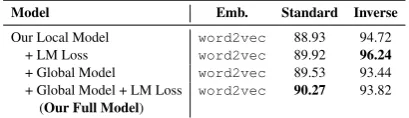
Global Discrimination. We also studied the im-pact of our global model and the LM loss in the global discrimination task. As shown in Table6, the addition of the global model and LM loss to the local model improves performance on the standard discrimination task by 1.34%.
However, the addition of global model impacts negatively on the inverse order task and degrades accuracies by 2.42% and 1.28% in the presence and absence of LM loss respectively. We suspect that the global model is adding noise because of the pooling operation, which throws away the spa-tial relation between sentences and provides the global information that is invariant to the sentence-order. But in this task, order information is crucial.
Model Emb. Standard Inverse
Our Local Model word2vec 88.93 94.72 + LM Loss word2vec 89.92 96.24 + Global Model word2vec 89.53 93.44 + Global Model + LM Loss word2vec 90.27 93.82
[image:9.595.314.519.63.122.2](Our Full Model)
Table 6: Ablation study of different model components on theGlobal Discrimination task.
In the inverse order task, we get the best perfor-mance by adding the LM loss to our local model.
6 Conclusion
In this paper, we proposed a unified coherence model. The proposed model incorporates a local coherence model and a global coherence model to capture the sentence grammar (intentional ture), discourse relations, attention and topic struc-tures in a single framework. The unified coherence model shows state of the art results on the standard coherence assessment tasks: the inverse-order and the global discrimination tasks. Also, our evalua-tion of the local discriminaevalua-tion task demonstrates the effectiveness of the unified coherence model in assessing global and local coherence of texts.
Acknowledgments
We would like to thank the anonymous review-ers for their comments. Shafiq Joty would like to thank the funding support from his Start-up Grant (M4082038.020). Also, this work is partly supported by SIMTech-NTU Joint Laboratory on Complex Systems.
References
Regina Barzilay and Mirella Lapata. 2005. Modeling local coherence: An entity-based approach. In Pro-ceedings of the 43rd Annual Meeting on Association for Computational Linguistics, ACL ’05, pages 141– 148, Ann Arbor, Michigan. Association for Compu-tational Linguistics.
Regina Barzilay and Mirella Lapata. 2008. Modeling local coherence: An entity-based approach. Compu-tational Linguistics, 34(1):1–34.
Regina Barzilay and Lillian Lee. 2004. Catching the drift: Probabilistic content models, with applica-tions to generation and summarization. In HLT-NAACL 2004: Main Proceedings, pages 113–120, Boston, Massachusetts, USA. Association for Com-putational Linguistics.
ver-ification using a ”siamese” time delay neural net-work. InProceedings of the 6th International Con-ference on Neural Information Processing Systems, NIPS’93, pages 737–744, San Francisco, CA, USA. Morgan Kaufmann Publishers Inc.
Franc¸ois Chollet. 2016. Xception: Deep learning with depthwise separable convolutions. CoRR, abs/1610.02357.
Ronan Collobert, Jason Weston, L´eon Bottou, Michael Karlen, Koray Kavukcuoglu, and Pavel Kuksa. 2011. Natural language processing (almost) from scratch. The Journal of Machine Learning Re-search, 12:2493–2537.
Micha Elsner, Joseph Austerweil, and Eugene Char-niak. 2007. A unified local and global model for discourse coherence. In Human Language Tech-nologies 2007: The Conference of the North Amer-ican Chapter of the Association for Computational Linguistics; Proceedings of the Main Conference, pages 436–443, Rochester, New York. Association for Computational Linguistics.
Micha Elsner and Eugene Charniak. 2011a. Disentan-gling chat with local coherence models. In Proceed-ings of the 49th Annual Meeting of the Association for Computational Linguistics: Human Language Technologies - Volume 1, HLT ’11, pages 1179– 1189, Stroudsburg, PA, USA. Association for Com-putational Linguistics.
Micha Elsner and Eugene Charniak. 2011b. Extending the entity grid with entity-specific features. In Pro-ceedings of the 49th Annual Meeting of the Associ-ation for ComputAssoci-ational Linguistics: Human Lan-guage Technologies: Short Papers - Volume 2, HLT ’11, pages 125–129, Portland, Oregon. Association for Computational Linguistics.
Vanessa Wei Feng and Graeme Hirst. 2012. Extend-ing the entity-based coherence model with multiple ranks. InProceedings of the 13th Conference of the European Chapter of the Association for Computa-tional Linguistics, EACL ’12, pages 315–324, Avi-gnon, France. Association for Computational Lin-guistics.
Vanessa Wei Feng, Ziheng Lin, and Graeme Hirst. 2014. The impact of deep hierarchical discourse structures in the evaluation of text coherence. In
COLING.
Barbara J. Grosz and Candace L. Sidner. 1986. Atten-tion, intentions, and the structure of discourse. Com-putational Linguistics, 12(3):175–204.
Barbara J. Grosz, Scott Weinstein, and Aravind K. Joshi. 1995. Centering: A framework for modeling the local coherence of discourse.Comput. Linguist., 21(2):203–225.
Amit Gruber, Yair Weiss, and Michal Rosen-Zvi. 2007. Hidden topic markov models. InProceedings of the
Eleventh International Conference on Artificial In-telligence and Statistics, volume 2 ofProceedings of Machine Learning Research, pages 163–170, San Juan, Puerto Rico. PMLR.
Camille Guinaudeau and Michael Strube. 2013. Graph-based local coherence modeling. In Proceed-ings of the 51st Annual Meeting of the Association for Computational Linguistics, ACL 2013, 4-9 Au-gust 2013, Sofia, Bulgaria, Volume 1: Long Papers, pages 93–103.
Sepp Hochreiter and J¨urgen Schmidhuber. 1997. Long short-term memory. Neural computation, 9(8):1735–1780.
Diederik P. Kingma and Jimmy Ba. 2015. Adam: A method for stochastic optimization. In 3rd Inter-national Conference on Learning Representations, ICLR 2015, San Diego, CA, USA, May 7-9, 2015, Conference Track Proceedings.
Jiwei Li and Eduard Hovy. 2014. A model of co-herence based on distributed sentence representa-tion. In Proceedings of the 2014 Conference on Empirical Methods in Natural Language Processing (EMNLP), pages 2039–2048, Doha, Qatar. Associa-tion for ComputaAssocia-tional Linguistics.
Jiwei Li and Dan Jurafsky. 2017. Neural net models of open-domain discourse coherence. In Proceed-ings of the 2017 Conference on Empirical Methods in Natural Language Processing, pages 198–209, Copenhagen, Denmark. Association for Computa-tional Linguistics.
Ziheng Lin, Hwee Tou Ng, and Min-Yen Kan. 2011. Automatically evaluating text coherence using dis-course relations. InProceedings of the 49th Annual Meeting of the Association for Computational Lin-guistics: Human Language Technologies - Volume 1, HLT ’11, pages 997–1006, Portland, Oregon. As-sociation for Computational Linguistics.
Annie Louis and Ani Nenkova. 2012. A coherence model based on syntactic patterns. InProceedings of the 2012 Joint Conference on Empirical Methods in Natural Language Processing and Computational Natural Language Learning, EMNLP-CoNLL ’12, pages 1157–1168, Stroudsburg, PA, USA. Associa-tion for ComputaAssocia-tional Linguistics.
Ryan Lowe, Nissan Pow, Iulian Serban, and Joelle Pineau. 2015. The Ubuntu dialogue corpus: A large dataset for research in unstructured multi-turn dia-logue systems. InProceedings of the 16th Annual Meeting of the Special Interest Group on Discourse and Dialogue, pages 285–294, Prague, Czech Re-public. Association for Computational Linguistics.
Mohsen Mesgar and Michael Strube. 2018. A neu-ral local coherence model for text quality assess-ment. In Proceedings of the 2018 Conference on Empirical Methods in Natural Language Process-ing, pages 4328–4339, Brussels, Belgium. Associ-ation for ComputAssoci-ational Linguistics.
Tomas Mikolov, Ilya Sutskever, Kai Chen, Greg S Cor-rado, and Jeff Dean. 2013. Distributed representa-tions of words and phrases and their compositional-ity. InAdvances in neural information processing systems, pages 3111–3119.
Muhammad Tasnim Mohiuddin, Shafiq Joty, and Dat Tien Nguyen. 2018. Coherence modeling of asyn-chronous conversations: A neural entity grid ap-proach. InProceedings of the 56th Annual Meet-ing of the Association for Computational LMeet-inguis- Linguis-tics (Volume 1: Long Papers), pages 558–568, Mel-bourne, Australia. Association for Computational Linguistics.
Dat Nguyen and Shafiq Joty. 2017. A neural local coherence model. In Proceedings of the 55th An-nual Meeting of the Association for Computational Linguistics (Volume 1: Long Papers), pages 1320– 1330. Association for Computational Linguistics.
Matthew E. Peters, Mark Neumann, Mohit Iyyer, Matt Gardner, Christopher Clark, Kenton Lee, and Luke Zettlemoyer. 2018. Deep contextualized word rep-resentations. InProc. of NAACL.
Emily Pitler and Ani Nenkova. 2008. Revisiting read-ability: A unified framework for predicting text quality. InProceedings of the 2008 Conference on Empirical Methods in Natural Language Process-ing, pages 186–195, Honolulu, Hawaii. Association for Computational Linguistics.
Radu Soricut and Daniel Marcu. 2006. Discourse gen-eration using utility-trained coherence models. In
Proceedings of the COLING/ACL on Main Con-ference Poster Sessions, COLING-ACL ’06, pages 803–810, Sydney, Australia. Association for Com-putational Linguistics.
Dat Tien Nguyen and Shafiq Joty. 2017.A neural local coherence model. In Proceedings of the 55th An-nual Meeting of the Association for Computational Linguistics (Volume 1: Long Papers), pages 1320– 1330, Vancouver, Canada. Association for Compu-tational Linguistics.